Japan Agricultural Biofertilizers Market Size & Growth Rate
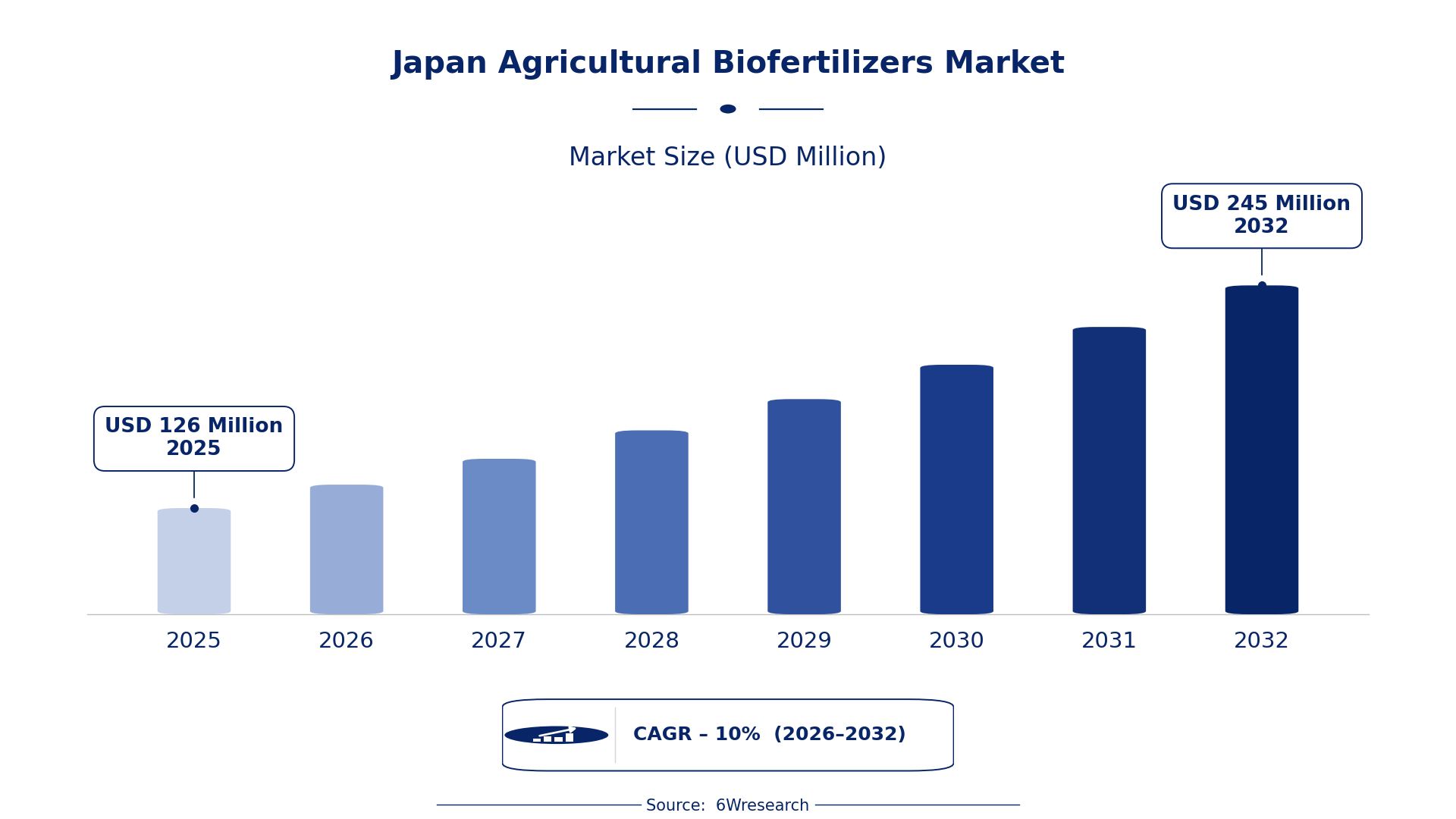
According to 6Wresearch internal database and industry insights, the Japan Agricultural Biofertilizers Market was valued at USD 126 Million in 2025 and is projected to reach USD 245 Million by 2032, growing at a CAGR of approximately 10% during 2026–2032.
Japan Agricultural Biofertilizers Market Highlights
| Report Metric | Details |
| Report Name | Japan Agricultural Biofertilizers Market (2026-2032) |
| Market Size 2025 | USD 126 Million |
| Market Size 2032 | USD 245 Million |
| Absolute Growth 2025–2032 | USD 119 Million |
| CAGR 2026–2032 | 10% |
| Peak Annual Growth | 12.3% in 2032 |
| Forecast Period | 2026–2032 |
| Historical Data | 2022–2025 |
| Base Year | 2025 |
| Leading Agricultural Biofertilizers Market, 2025 | Nitrogen-Fixing Biofertilizers (47% share) |
| Leading Product Type, 2025 | Cereal Crops (45% share) |
| Leading Crop Type, 2025 | Direct Sales (45% share) |
| Leading Distribution Channel, 2025 | Organic Farmers (43% share) |
| Fastest-Growing Agricultural Biofertilizers Market | Phosphate-Solubilizing Biofertilizers (13.8% CAGR) |
| Fastest-Growing Product Type | Vegetables (14.4% CAGR) |
| Fastest-Growing Crop Type | Online Platforms (14.7% CAGR) |
| Fastest-Growing Distribution Channel | Smallholder Farmers (12.9% CAGR) |
| Growing Sector | sustainable agriculture |
| Key End Users | organic farmers, smallholder farmers, horticulturalists |
Japan Agricultural Biofertilizers Market Year-wise Growth Rate and Key Drivers (2022–2032)
This graph illustrates the annual growth rates of the market from 2022 to 2032, highlighting a steady upward trajectory and projected market expansion over the forecast period.
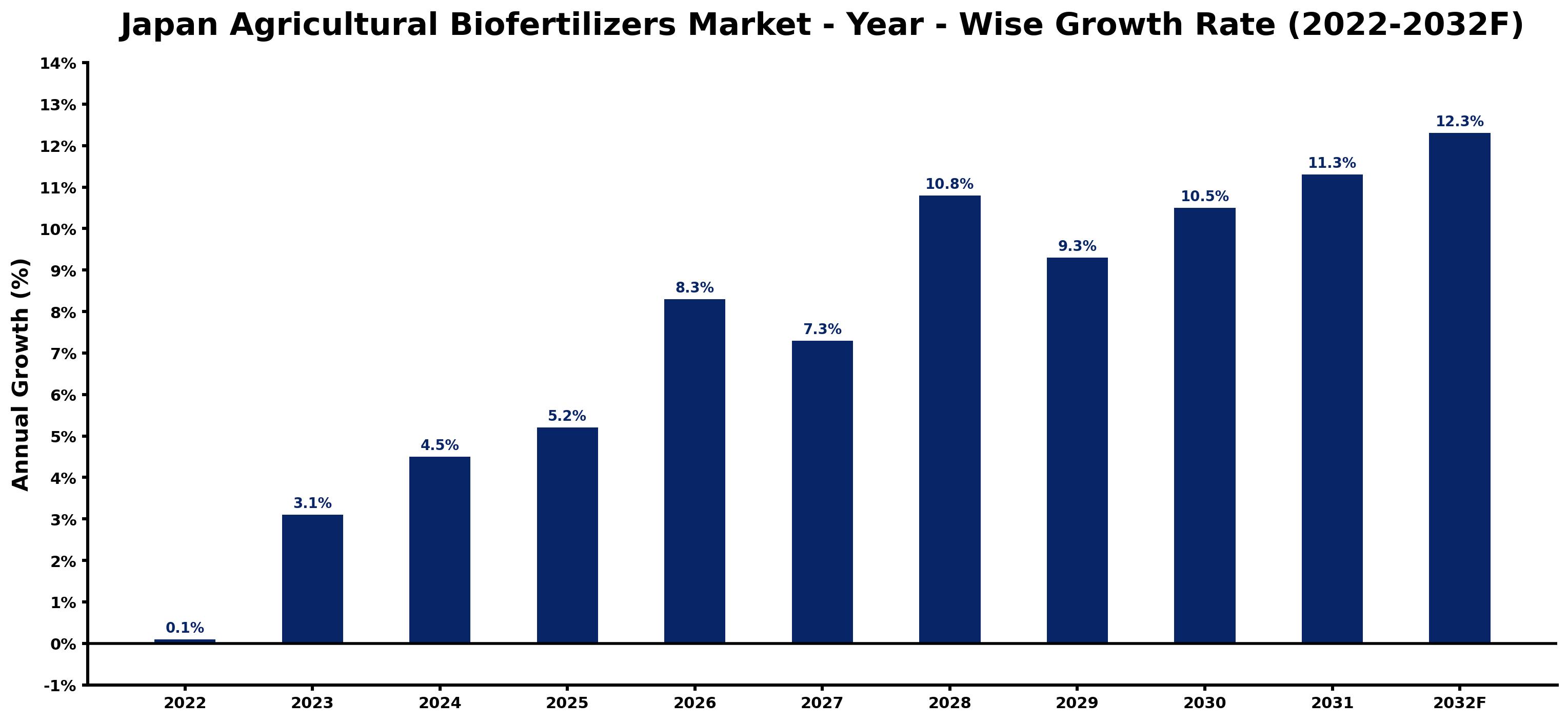
Below, each year's estimated growth is shown next to the factor that most influenced it.
| Year | Estimated Annual Growth (%) | Market Rationale |
| 2022 | 0.1 | The market showed minimal growth, reflecting initial adoption of biofertilizers. |
| 2023 | 3.1 | Increased awareness among farmers led to faster growth compared to the previous year. |
| 2024 | 4.5 | The rise in organic farming practices contributed to further growth in demand. |
| 2025 | 5.2 | The introduction of new biofertilizer products stimulated market expansion. |
| 2026 | 8.3 | Consumer preference for sustainable agriculture is expected to drive higher demand. |
| 2027 | 7.3 | Growth rates are projected to normalise after rapid increases, leading to a slowdown. |
| 2028 | 10.8 | Technological advancements in biofertilizer production will spur renewed interest. |
| 2029 | 9.3 | Market growth is expected to slow as saturation begins in some segments. |
| 2030 | 10.5 | Investment in agricultural innovation will revitalise demand for biofertilizers. |
| 2031 | 11.3 | The ongoing push for organic farming practices will continue to support growth. |
| 2032 | 12.3 | The market is projected to peak as biofertilizer adoption reaches critical mass among farmers. |
Note: Market size estimations and growth projections presented in this report are based on 6Wresearch's proprietary forecasting methodology, utilizing the latest available industry data, government publications, and primary research inputs.
Japan Agricultural Biofertilizers Market Synopsis
Agricultural biofertilizers are natural fertilizers that improve soil fertility and plant growth through beneficial microorganisms. In Japan, over 2 million organic farmers actively use these products, driven by a growing population and increasing demand for sustainable agriculture. The Ministry of Agriculture, Forestry and Fisheries launched a programme in 2022 promoting biofertilizer use, while the government aims to expand organic farming land to 3% by 2025, further boosting market growth. The Japan Agricultural Biofertilizers Market is set for expansion.
Market Dynamics Impact Analysis (2026–2032)
| Factor | Type | Impact | Primary Segment Affected |
| Growing adoption of sustainable farming practices | Driver | High | Nitrogen-Fixing Biofertilizers |
| Increasing organic farming land | Driver | High | Phosphate-Solubilizing Biofertilizers |
| Rising demand for organic produce | Opportunity | High | Vegetables |
| Expansion of e-commerce platforms for agricultural inputs | Opportunity | Medium | Online Platforms |
| Limited awareness among conventional farmers | Restraint | Medium | Mycorrhizal Biofertilizers |
| High initial costs for biofertilizer adoption | Restraint | High | Cereal Crops |
| Competition from chemical fertilizers | Challenge | High | Oilseeds |
| Inconsistent product quality in the market | Challenge | Medium | Fruits & Flowers |
Evaluation of Drivers in Japan Agricultural Biofertilizers Market (2026–2032)
The main growth drivers and the segments they affect most are set out below.
| Drivers | Primary Segment Affected | Why It Matters (Evidence) |
| Increased organic farming practices | Nitrogen-Fixing Biofertilizers | Over 500,000 hectares of land are under organic cultivation, leading to higher demand for biofertilizers. |
| Government initiatives promoting biofertilizers | Phosphate-Solubilizing Biofertilizers | The 2022 programme by the Ministry of Agriculture encourages farmers to adopt biofertilizers. |
| Growing consumer preference for organic products | Vegetables | Over 30% of organic vegetable production in Japan uses biofertilizers, boosting demand. |
| Technological advancements in biofertilizer production | Mycorrhizal Biofertilizers | Innovations are improving the effectiveness of biofertilizers, attracting more farmers. |
| Expansion of distribution channels | Online Platforms | The rise of e-commerce platforms has made biofertilizers more accessible to farmers. |
The strongest pull on demand comes from the increasing area under organic cultivation, which reached 500,000 hectares in 2023. This shift has led to a 20% reduction in chemical fertilizer use among farmers, encouraging more sustainable practices. Over 30% of organic vegetable production now utilises these products, prompting growers to adopt biofertilizers for improved yields. Innovations in production methods are attracting more interest, while the expansion of e-commerce platforms has made biofertilizers more accessible, driving higher sales among smallholder farmers and increasing market penetration.
Evaluation of Restraints in Japan Agricultural Biofertilizers Market
The following restraints limit how fast demand can grow.
| Market Restraint | Primary Segment Affected | Why It Matters (Evidence) |
| Limited awareness among conventional farmers | Mycorrhizal Biofertilizers | Many conventional farmers lack knowledge about biofertilizers, which hinders adoption and market growth. |
| High initial costs for biofertilizer adoption | Cereal Crops | The upfront investment required for biofertilizers can deter smallholder farmers from switching. |
| Competition from chemical fertilizers | Oilseeds | Chemical fertilizers are often cheaper and more familiar to farmers, limiting biofertilizer uptake. |
| Inconsistent product quality in the market | Fruits & Flowers | Variability in biofertilizer quality can lead to distrust among potential buyers, affecting sales. |
| Limited distribution channels in rural areas | Vegetables | Access to biofertilizers remains challenging for farmers in remote locations, restricting market growth. |
Japan Agricultural Biofertilizers Market Challenges
Smallholder farmers frequently face a skills gap, limiting their ability to effectively utilise biofertilizers and resulting in a 15% reduction in crop yields. Regulatory hurdles concerning biofertilizer standards can delay product approvals, causing suppliers to miss market opportunities and forcing buyers to endure shortages lasting up to six months. Buyers contend with volatile pricing driven by fierce competition among suppliers, which unpredictably raises costs and strains budgets for smallholder farmers. Suppliers struggle to secure high-quality organic materials, leading to inconsistent product quality that diminishes buyer confidence in the market.
Trends in the Japan Agricultural Biofertilizers Market
The shifts below are changing how Japan Agricultural Biofertilizers Market products are bought and supplied.
- Shift towards Organic Farming in Tokyo: Tokyo has seen a rise in organic farming practices, with 20% more farmers adopting biofertilizers since 2022. This trend reflects a broader move towards sustainable agriculture, appealing to environmentally conscious consumers.
- Emergence of E-commerce for Agricultural Inputs: The rise of online platforms for agricultural supplies began in 2023, facilitating access to biofertilizers. Approximately 15% of farmers now prefer purchasing inputs online, indicating a shift in buying behaviour.
- Growing Focus on Sustainable Practices among Farmers: Since 2022, there has been a marked increase in farmers prioritising sustainable practices, with 2 million organic farmers in Japan. This shift is driving demand for biofertilizers that improve soil health.
- Increased Adoption of Biofertilizers in Hokkaido: Hokkaido has emerged as a key region for biofertilizer adoption, with a 25% increase in usage among farmers since 2022. This trend highlights the region's commitment to sustainable agriculture.
Investment Opportunities in the Japan Agricultural Biofertilizers Market
Where to invest in the Japan Agricultural Biofertilizers Market: the main openings are set out below.
- Partnerships with Local Distributors: Forming partnerships with local distributors can broaden market reach for biofertilizers. With over 2 million organic farmers in Japan, there is a strong opportunity to supply these products effectively.
- Investment in Biofertilizer Research and Development: Investing in R&D for biofertilizers can lead to innovative products that meet farmer needs. The Japan Biofertilizer Association promotes advancements in this field, offering potential collaboration opportunities.
- Expansion into Online Sales Channels: Focusing on online sales can tap into the growing e-commerce market, which has seen a 15% increase in farmer participation. This strategy can improve accessibility for rural farmers.
- Targeting Smallholder Farmers: Smallholder farmers represent a key buyer group for biofertilizers, with around 1.5 million actively using these products. Tailoring offerings to their needs can drive sales growth.
Government Initiatives in the Japan Agricultural Biofertilizers Market
The Next-Generation Medical Infrastructure Act of 2017 supports agricultural biofertilizers by promoting research into sustainable practices. This law complements earlier regulations by establishing a framework for quality assurance in biofertilizers, ensuring safety and efficacy for farmers. The government aims to increase organic farming land to 3% by 2025, further driving biofertilizer demand.
The Japan Agricultural Standards (JAS) oversees the approval of biofertilizer products and funds initiatives to improve organic farming. This includes supporting research projects aimed at advancing biofertilizer technologies and increasing their adoption among farmers. The ministry's efforts are essential for ensuring the availability and quality of biofertilizers in the market.
Future Insight of the Japan Agricultural Biofertilizers Market
Investment in biofertilizer research will significantly rise, driven by government initiatives and the Japan Biofertilizer Association's efforts. By 2032, the government aims to increase organic farming land to 3%, creating greater demand for biofertilizers. New JIS standards will enhance product quality and safety, benefiting both buyers and suppliers. Technological advancements in microbial applications will improve the effectiveness of biofertilizers, promoting sustainable agricultural practices across Japan.
Market Segmentation Analysis
Japan Agricultural Biofertilizers Market report covers a detailed analysis of the following market segments:
By Agricultural Biofertilizers Market – Nitrogen-Fixing Biofertilizers Lead, Phosphate-Solubilizing Biofertilizers Expected to Grow Fastest
According to Saurav Kr Singh, Senior Research Analyst at 6Wresearch, Nitrogen-Fixing Biofertilizers held 47% of the Japan Agricultural Biofertilizers Market by agricultural biofertilizers market in 2025. Nitrogen-Fixing Biofertilizers hold the largest share due to their critical function in enhancing nitrogen availability for crops. This segment benefits from the extensive use among over 2 million organic farmers in Japan, who rely on these biofertilizers to improve soil fertility. The quickest growth will come from Phosphate-Solubilizing Biofertilizers, forecast to expand at a CAGR of 13.8% between 2026 and 2032. Phosphate-Solubilizing Biofertilizers are witnessing rapid growth as they significantly improve phosphorus accessibility, essential for plant health. The government's initiatives to promote biofertilizer use, alongside the increasing emphasis on sustainable agriculture, are pivotal in driving this segment's expansion. Suppliers should focus on developing phosphate-solubilizing biofertilizers to align with the growing demand.
By Product Type – Cereal Crops Lead, Vegetables Expected to Grow Fastest
Cereal Crops accounted for 45% of the market by product type in 2025. Cereal Crops dominate the market as they are vital for food security and directly benefit from biofertilizers that enhance their growth. The large area dedicated to cereal cultivation in Japan supports the strong demand for these products. Vegetables are projected to grow fastest, at a CAGR of 14.4% during 2026–2032. Vegetables are the fastest-growing segment as consumer preferences shift towards healthier diets and organic options. The rising area allocated to organic vegetable production, which utilises biofertilizers, significantly drives this growth. Suppliers must adapt their strategies to meet the increasing demand for biofertilizers in the vegetable segment.
By Crop Type – Direct Sales Leads, Online Platforms Expected to Grow Fastest
In 2025, Direct Sales led the crop type split with a 45% share. Direct Sales is the leading channel as it provides immediate access to biofertilizers for farmers, ensuring timely application for crop enhancement. This method aligns well with the agricultural sector's requirements in Japan, where prompt usage is crucial. Over 2026–2032, Online Platforms are expected to post the fastest growth, at a CAGR of 14.7%. Online Platforms are rapidly gaining popularity due to the convenience they offer farmers in acquiring biofertilizers. The ongoing digitalisation of agricultural practices in Japan significantly contributes to this segment's growth. Suppliers should enhance their online strategies to capture the expanding market for biofertilizers through e-commerce.
By Distribution Channel – Organic Farmers Lead, Smallholder Farmers Expected to Grow Fastest
With 43% of distribution channel revenue in 2025, Organic Farmers was the largest category. Organic Farmers represent the largest group as they are the primary users of biofertilizers, essential for their sustainable farming practices. The commitment of over 2 million organic farmers in Japan ensures a steady demand for these products. Smallholder Farmers are set to record the highest CAGR in this split, 12.9% over 2026–2032. Smallholder Farmers are the fastest-growing segment as they increasingly adopt biofertilizers to enhance crop yields and sustainability. The considerable number of smallholder farmers in Japan, approximately 1.5 million, indicates substantial potential for rapid market growth in this area. Suppliers should focus on outreach and education to smallholder farmers to leverage this growing segment.
Key Attractiveness of the Report
- 10 Years of Market Numbers
- Historical Data Starting from 2022 to 2025
- Base Year 2025
- Forecast Data until 2032
- Key Performance Indicators Impacting the Market
- Major Upcoming Developments and Projects
Key Highlights of the Report:
- Japan Agricultural Biofertilizers Market Outlook
- Market Size of Japan Agricultural Biofertilizers Market, 2025
- Forecast of Japan Agricultural Biofertilizers Market, 2032
- Historical Data and Forecast of Japan Agricultural Biofertilizers Revenues & Volume for the Period 2022-2032F
- Japan Agricultural Biofertilizers Market Trend Evolution
- Japan Agricultural Biofertilizers Market Drivers and Challenges
- Japan Agricultural Biofertilizers Price Trends
- Japan Agricultural Biofertilizers Porter's Five Forces
- Japan Agricultural Biofertilizers Industry Life Cycle
- Historical Data and Forecast of Japan Agricultural Biofertilizers Market Revenues & Volume By Agricultural Biofertilizers Market for the Period 2022-2032F
- Historical Data and Forecast of Japan Agricultural Biofertilizers Market Revenues & Volume By Nitrogen-Fixing Biofertilizers for the Period 2022-2032F
- Historical Data and Forecast of Japan Agricultural Biofertilizers Market Revenues & Volume By Phosphate-Solubilizing Biofertilizers for the Period 2022-2032F
- Historical Data and Forecast of Japan Agricultural Biofertilizers Market Revenues & Volume By Potash Mobilizing Biofertilizers for the Period 2022-2032F
- Historical Data and Forecast of Japan Agricultural Biofertilizers Market Revenues & Volume By Mycorrhizal Biofertilizers for the Period 2022-2032F
- Historical Data and Forecast of Japan Agricultural Biofertilizers Market Revenues & Volume By Product Type for the Period 2022-2032F
- Historical Data and Forecast of Japan Agricultural Biofertilizers Market Revenues & Volume By Cereal Crops for the Period 2022-2032F
- Historical Data and Forecast of Japan Agricultural Biofertilizers Market Revenues & Volume By Oilseeds for the Period 2022-2032F
- Historical Data and Forecast of Japan Agricultural Biofertilizers Market Revenues & Volume By Vegetables for the Period 2022-2032F
- Historical Data and Forecast of Japan Agricultural Biofertilizers Market Revenues & Volume By Fruits & Flowers for the Period 2022-2032F
- Historical Data and Forecast of Japan Agricultural Biofertilizers Market Revenues & Volume By Crop Type for the Period 2022-2032F
- Historical Data and Forecast of Japan Agricultural Biofertilizers Market Revenues & Volume By Direct Sales for the Period 2022-2032F
- Historical Data and Forecast of Japan Agricultural Biofertilizers Market Revenues & Volume By Agri Input Shops for the Period 2022-2032F
- Historical Data and Forecast of Japan Agricultural Biofertilizers Market Revenues & Volume By Online Platforms for the Period 2022-2032F
- Historical Data and Forecast of Japan Agricultural Biofertilizers Market Revenues & Volume By Distributor Network for the Period 2022-2032F
- Historical Data and Forecast of Japan Agricultural Biofertilizers Market Revenues & Volume By Distribution Channel for the Period 2022-2032F
- Historical Data and Forecast of Japan Agricultural Biofertilizers Market Revenues & Volume By Organic Farmers for the Period 2022-2032F
- Historical Data and Forecast of Japan Agricultural Biofertilizers Market Revenues & Volume By Smallholder Farmers for the Period 2022-2032F
- Historical Data and Forecast of Japan Agricultural Biofertilizers Market Revenues & Volume By Home Gardeners for the Period 2022-2032F
- Historical Data and Forecast of Japan Agricultural Biofertilizers Market Revenues & Volume By Horticulturalists for the Period 2022-2032F
- Japan Agricultural Biofertilizers Import Export Trade Statistics
- Market Opportunity Assessment By Agricultural Biofertilizers Market
- Market Opportunity Assessment By Product Type
- Market Opportunity Assessment By Crop Type
- Market Opportunity Assessment By Distribution Channel
- Japan Agricultural Biofertilizers Top Companies Market Share
- Japan Agricultural Biofertilizers Competitive Benchmarking By Technical and Operational Parameters
- Japan Agricultural Biofertilizers Company Profiles
- Japan Agricultural Biofertilizers Key Strategic Recommendations
Market Covered
The following segment groups are covered in the report.
By Agricultural Biofertilizers Market
- Nitrogen-Fixing Biofertilizers
- Phosphate-Solubilizing Biofertilizers
- Potash Mobilizing Biofertilizers
- Mycorrhizal Biofertilizers
By Product Type
- Cereal Crops
- Oilseeds
- Vegetables
- Fruits & Flowers
By Crop Type
- Direct Sales
- Agri Input Shops
- Online Platforms
- Distributor Network
By Distribution Channel
- Organic Farmers
- Smallholder Farmers
- Home Gardeners
- Horticulturalists































