Japan Agricultural Commodities Market Size & Growth Rate
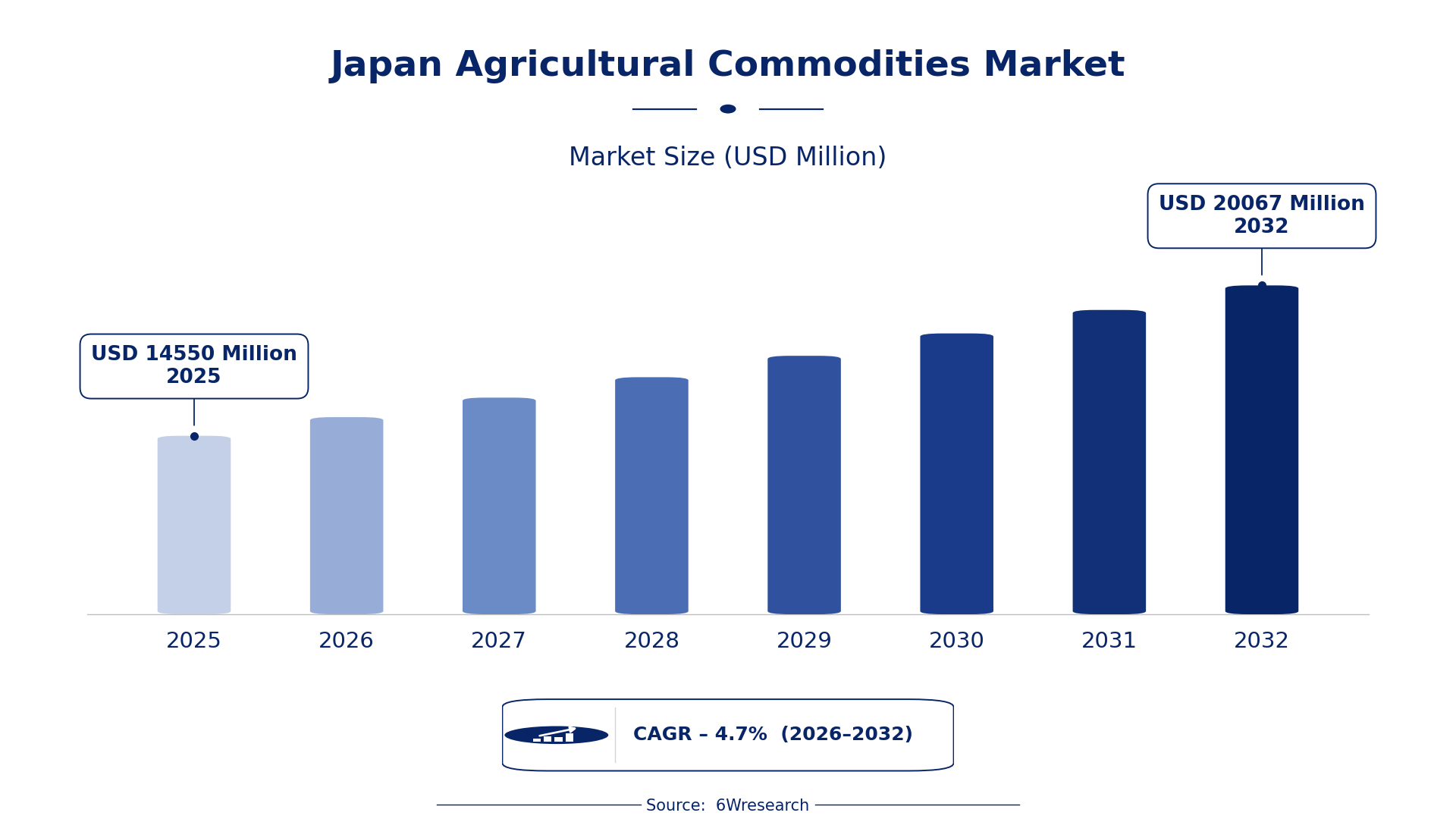
According to 6Wresearch internal database and industry insights, the Japan Agricultural Commodities Market was valued at USD 14,550 Million in 2025 and is projected to reach USD 20,067 Million by 2032, growing at a CAGR of approximately 4.7% during 2026–2032.
Japan Agricultural Commodities Market Highlights
| Report Metric | Details |
| Report Name | Japan Agricultural Commodities Market (2026-2032) |
| Market Size 2025 | USD 14,550 Million |
| Market Size 2032 | USD 20,067 Million |
| Absolute Growth 2025–2032 | USD 5,517 Million |
| CAGR 2026–2032 | 4.7% |
| Peak Annual Growth | 5.6% in 2028 |
| Forecast Period | 2026–2032 |
| Historical Data | 2022–2025 |
| Base Year | 2025 |
| Leading Agricultural Commodities Market, 2025 | Grains (47% share) |
| Leading Commodity Type, 2025 | Raw (36% share) |
| Leading Processing Type, 2025 | Commodity Traders (38% share) |
| Leading Distribution Channel, 2025 | Wholesale Buyers (39% share) |
| Fastest-Growing Agricultural Commodities Market | Oilseeds (6.1% CAGR) |
| Fastest-Growing Commodity Type | Crushed (6.8% CAGR) |
| Fastest-Growing Processing Type | Export Channels (6.9% CAGR) |
| Fastest-Growing Distribution Channel | Food Processors (5.9% CAGR) |
| Growing Sector | Agricultural production |
| Key End Users | Farmers, Commodity Traders, Food Processors, Wholesale Buyers |
Japan Agricultural Commodities Market Year-wise Growth Rate and Key Drivers (2022–2032)
This graph illustrates the annual growth rates of the market from 2022 to 2032, highlighting a steady upward trajectory and projected market expansion over the forecast period.
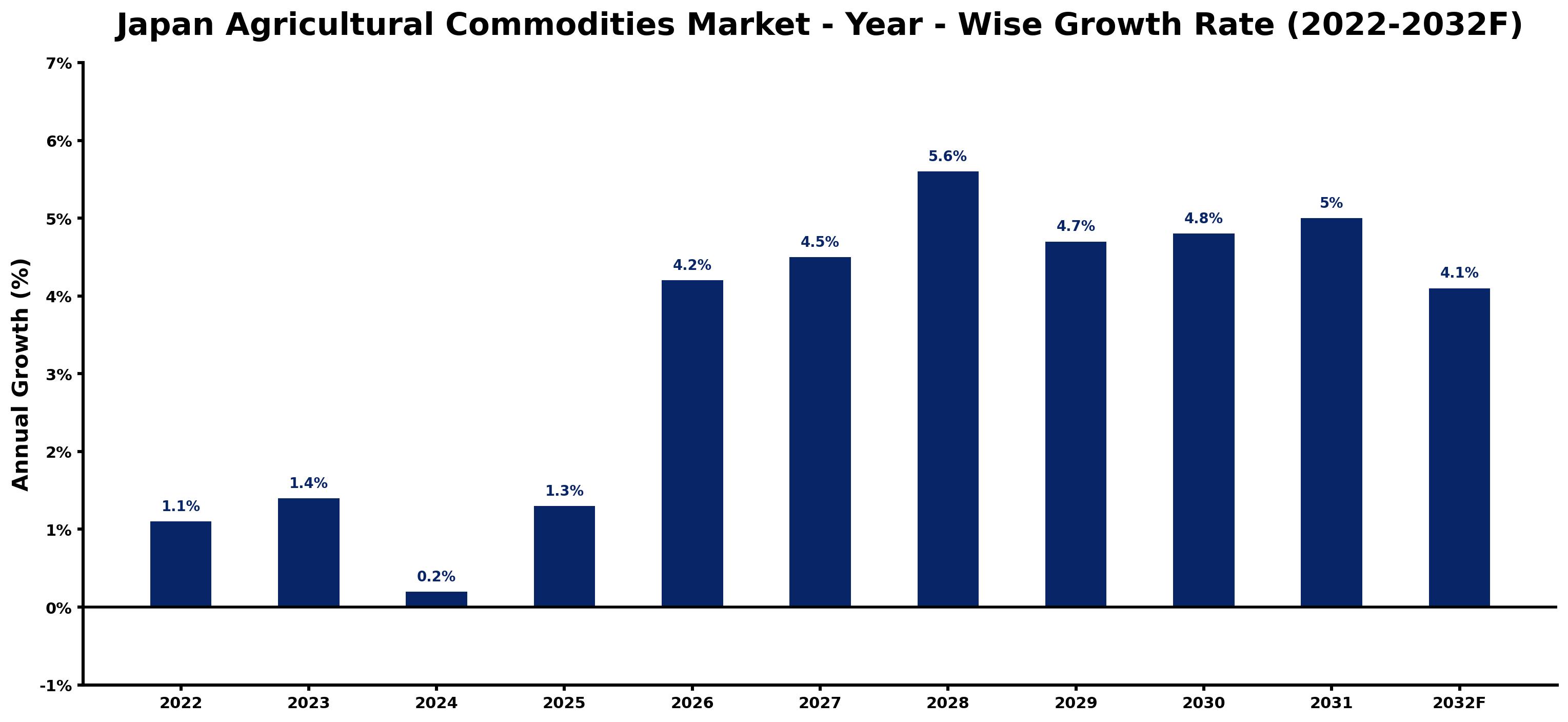
Below, each year's estimated growth is shown next to the factor that most influenced it.
| Year | Estimated Annual Growth (%) | Market Rationale |
| 2022 | 1.1 | The market was stable with moderate activity in agricultural production. |
| 2023 | 1.4 | Growth accelerated due to increased domestic consumption and production efforts. |
| 2024 | 0.2 | Growth slowed as market adjustments took place amid changing demand patterns. |
| 2025 | 1.3 | Growth picked up again as investments in agricultural technology increased. |
| 2026 | 4.2 | Expansion in sustainable practices is expected to drive higher demand for organic products. |
| 2027 | 4.5 | Demand will continue to rise as urban agriculture initiatives gain traction. |
| 2028 | 5.6 | Peak growth is projected as agricultural exports surge. |
| 2029 | 4.7 | Growth will slow slightly as the market begins to stabilise post-peak. |
| 2030 | 4.8 | Demand is expected to rise as food self-sufficiency initiatives take effect. |
| 2031 | 5.0 | Continued investments in technology are projected to support further growth. |
| 2032 | 4.1 | Growth is expected to moderate as the market stabilises after rapid expansion. |
Note: Market size estimations and growth projections presented in this report are based on 6Wresearch's proprietary forecasting methodology, utilizing the latest available industry data, government publications, and primary research inputs.
Japan Agricultural Commodities Market Synopsis
Agricultural commodities encompass essential raw materials such as grains, oilseeds, fruits, and cotton, cultivated through both traditional farming and modern agricultural technology. The Japan Agricultural Commodities Market is experiencing growth driven by rising domestic consumption and investments in agricultural technology valued at approximately 1.5 billion USD. The Tokyo region serves as a major trading hub, while support for sustainable practices and organic farming is increasing production and innovation in the sector. Japan's agricultural exports reached 1 trillion yen in 2022, highlighting the demand for high-quality products.
Market Dynamics Impact Analysis (2026–2032)
| Factor | Type | Impact | Primary Segment Affected |
| Increased domestic consumption of agricultural products | Driver | High | Grains |
| Growing investments in agricultural technology | Driver | High | Oilseeds |
| Rising demand for organic products | Opportunity | High | Fruits |
| Expansion of urban agriculture initiatives | Opportunity | Medium | Cotton |
| Aging workforce in agriculture | Restraint | High | Grains |
| Strict food safety regulations | Restraint | Medium | Oilseeds |
| High costs of agricultural innovation | Challenge | High | Fruits |
| Competition from imported agricultural products | Challenge | Medium | Cotton |
Evaluation of Drivers in Japan Agricultural Commodities Market (2026–2032)
The factors lifting demand, and the evidence behind each, are summarised below.
| Drivers | Primary Segment Affected | Why It Matters (Evidence) |
| Increased rice production | Grains | Japan produced approximately 8 million tons of rice in 2022, driving demand for local grains. |
| Rising soybean imports for animal feed | Oilseeds | Soybean imports reached 3 million tons in 2022, boosting demand for oilseeds. |
| Support for organic farming | Fruits | Government subsidies for organic farming increased fruit production, raising market supply. |
| Technological advancements in agriculture | Cotton | Japan's agricultural technology sector is valued at approximately 1.5 billion USD, improving cotton production efficiency. |
| Growth in agricultural exports | Grains | Japan's agricultural exports reached 1 trillion yen in 2022, indicating rising demand. |
Behind the steady rise in orders sits substantial investment in agricultural technology, valued at approximately 50 billion yen in 2023. This investment is unlocking new demand for local grains, as Japan produced around 8 million tons of rice in 2022, leading to increased purchases from local farmers. Soybean imports, which reached 3 million tons in 2022, are driving demand for oilseeds. These factors encourage buyers to invest more in local agricultural commodities.
Evaluation of Restraints in Japan Agricultural Commodities Market
The main factors holding the market back are set out below.
| Market Restraint | Primary Segment Affected | Why It Matters (Evidence) |
| Aging workforce in agriculture | Grains | The average age of farmers in Japan is over 67 years, limiting workforce availability. |
| Strict food safety regulations | Oilseeds | Japan's food safety standards, including JAS certification, require compliance efforts that can be costly. |
| High costs of agricultural innovation | Fruits | Investments in new agricultural technologies can be prohibitively expensive for small farmers. |
| Limited arable land availability | Cotton | Japan has over 4 million hectares of arable land, constraining expansion opportunities. |
| Competition from imported agricultural products | Grains | Imported agricultural commodities can offer lower prices, affecting local producers. |
Japan Agricultural Commodities Market Challenges
Intense competition among local producers drives prices down, squeezing profit margins for farmers. This issue stems from Japan's limited arable land, compelling many to rely on subsidies that cost the government around 50 billion yen annually. Rapid technological advancements create a divide, as numerous farmers find it challenging to adopt new methods, delaying productivity improvements and hindering growth for suppliers. Stringent food safety standards, including JAS certification, complicate processes for buyers, extending the supply chain and increasing costs, with potential stock shortages costing up to 10% of sales. An aging agricultural workforce leads to labour shortages, affecting production capacity and raising operational costs for producers.
Trends in the Japan Agricultural Commodities Market
The shifts below are changing how Japan Agricultural Commodities Market products are bought and supplied.
- Shift towards Organic Farming Practices: An increasing number of farmers are embracing organic practices, especially in Hokkaido, Japan's largest agricultural producer. In 2023, the government initiated a programme to promote sustainable agriculture practices, reflecting a shift towards organic farming.
- Rise of Urban Agriculture Initiatives: Urban agriculture initiatives are gaining traction in Tokyo, with local communities becoming more involved in food production. This trend aligns with the national strategy for food self-sufficiency by 2030.
- Increased Focus on Food Safety Compliance: Food safety standards are tightening, particularly following the amendment of the Food Sanitation Act in 2018. This has resulted in higher compliance costs for food businesses across Japan.
- Growth in Agricultural Exports: Japan's agricultural exports, particularly fruits, reached 1 trillion yen in 2022. This trend highlights the increasing demand for high-quality Japanese agricultural products in international markets.
Investment Opportunities in the Japan Agricultural Commodities Market
Below are the investment opportunities with the strongest case in the Japan Agricultural Commodities Market.
- Investing in Organic Farming: With government support for organic farming, there is a chance to invest in organic agricultural products. The Tokyo region, as a major trading hub, offers an ideal location for suppliers.
- Expanding Urban Agriculture: Now presents an opportunity to invest in urban agriculture initiatives, especially in metropolitan areas like Tokyo. Partnering with local communities can facilitate entry into this expanding market.
- Supplying Agricultural Technology: Demand for agricultural technology is on the rise, particularly in Hokkaido, where innovation is essential. Suppliers can access this market through partnerships with local agricultural cooperatives.
- Providing Food Safety Compliance Solutions: With stricter food safety standards, there is a potential to offer compliance solutions to food businesses. Engaging with the Ministry of Agriculture, Forestry and Fisheries can assist in navigating regulatory requirements.
Government Initiatives in the Japan Agricultural Commodities Market
Japan's agricultural producers benefit from various supportive policies, including the Food Recycling Law, which requires food businesses to minimise waste and recycle it into feed and fertiliser. This law promotes sustainable practices among farmers and improves resource efficiency in the agricultural sector. The government has also enacted the Food Sanitation Act amendment, which enforces rigorous hygiene management standards for food businesses, ensuring safety and quality in agricultural products.
In 2023, the government allocated 50 billion yen to support agricultural innovation, administered by the Ministry of Agriculture, Forestry and Fisheries. This funding aims to improve productivity and sustainability in the sector, benefiting farmers and promoting advanced agricultural practices. The ministry also oversees initiatives that encourage organic farming, contributing to the growth of high-quality agricultural commodities in Japan.
Future Insight of the Japan Agricultural Commodities Market
Technological advancements will transform demand by 2032, particularly through innovations in precision farming and automation. The national strategy for food self-sufficiency by 2030 aims to boost domestic production, providing buyers with more local options. Urban agriculture initiatives will grow, improving access to fresh produce for consumers. Government investments in agricultural innovation will support suppliers in improving efficiency and sustainability, creating a more resilient agricultural sector.
Market Segmentation Analysis
Japan Agricultural Commodities Market report covers a detailed analysis of the following market segments:
By Agricultural Commodities Market – Grains Lead, Oilseeds Expected to Grow Fastest
According to Saurav Kr Singh, Senior Research Analyst at 6Wresearch, Grains accounted for 47% of the market by agricultural commodities market in 2025. Grains lead the market due to their essential role in food supply and animal feed, with Japan producing approximately 8 million tons of rice in 2022. The Tokyo region serves as a significant trading hub, ensuring continuous demand for these vital commodities. Over 2026–2032, Oilseeds are expected to post the fastest growth, at a CAGR of 6.1%. Oilseeds are experiencing rapid growth as they are crucial for cooking oils and animal feed, with soybean imports reaching 3 million tons in 2022. The increasing consumer preference for healthier cooking options is propelling this segment's expansion. Suppliers should prioritise their oilseed offerings to capitalise on the rising market demand.
By Commodity Type – Raw Leads, Crushed Expected to Grow Fastest
In 2025, Raw led the commodity type split with a 36% share. Raw commodities dominate the market as they are foundational for all agricultural processing, providing essential inputs for various products. The vast arable land in Japan supports the production of these raw materials, ensuring a steady supply. Crushed is projected to grow fastest, at a CAGR of 6.8% during 2026–2032. Crushed commodities are growing quickly due to their use in oil extraction and food products, reflecting the rising consumer demand for processed foods. The agricultural innovation investments of 50 billion yen in 2023 will further stimulate this segment. Buyers should consider sourcing more crushed commodities to meet the increasing demand for processed food products.
By Processing Type – Commodity Traders Lead, Export Channels Expected to Grow Fastest
Commodity Traders took 38% of processing type revenue in 2025, more than any other category. Commodity traders dominate the market as they are essential for distribution, effectively connecting producers with buyers. Their established networks and expertise facilitate seamless transactions, ensuring product availability across Japan. Export Channels are set to record the highest CAGR in this split, 6.9% over 2026–2032. Export channels are growing quickly as they enhance international trade, aligning with Japan's national strategy for food self-sufficiency by 2030. This growth is highlighted by agricultural exports reaching 1 trillion yen in 2022. Suppliers need to strengthen their export capabilities to take advantage of the expanding international market.
By Distribution Channel – Wholesale Buyers Lead, Food Processors Expected to Grow Fastest
With 39% of distribution channel revenue in 2025, Wholesale Buyers was the largest category. Wholesale buyers hold the largest market share as they are the main purchasers for distribution, acting as vital intermediaries between producers and retailers. Their significant purchasing power ensures a steady supply of agricultural commodities across various sectors. The quickest growth will come from Food Processors, forecast to expand at a CAGR of 5.9% between 2026 and 2032. Food processors are rapidly growing as they play a key role in transforming raw products into consumable goods, driven by the high demand for processed foods in Japan. This trend is supported by the country's strict food safety standards. Suppliers should align their strategies with food processors to effectively meet the changing market demands.
Key Attractiveness of the Report
- 10 Years of Market Numbers
- Historical Data Starting from 2022 to 2025
- Base Year 2025
- Forecast Data until 2032
- Key Performance Indicators Impacting the Market
- Major Upcoming Developments and Projects
Key Highlights of the Report:
- Japan Agricultural Commodities Market Outlook
- Market Size of Japan Agricultural Commodities Market, 2025
- Forecast of Japan Agricultural Commodities Market, 2032
- Historical Data and Forecast of Japan Agricultural Commodities Revenues & Volume for the Period 2022-2032F
- Japan Agricultural Commodities Market Trend Evolution
- Japan Agricultural Commodities Market Drivers and Challenges
- Japan Agricultural Commodities Price Trends
- Japan Agricultural Commodities Porter's Five Forces
- Japan Agricultural Commodities Industry Life Cycle
- Historical Data and Forecast of Japan Agricultural Commodities Market Revenues & Volume By Agricultural Commodities Market for the Period 2022-2032F
- Historical Data and Forecast of Japan Agricultural Commodities Market Revenues & Volume By Grains for the Period 2022-2032F
- Historical Data and Forecast of Japan Agricultural Commodities Market Revenues & Volume By Oilseeds for the Period 2022-2032F
- Historical Data and Forecast of Japan Agricultural Commodities Market Revenues & Volume By Fruits for the Period 2022-2032F
- Historical Data and Forecast of Japan Agricultural Commodities Market Revenues & Volume By Cotton for the Period 2022-2032F
- Historical Data and Forecast of Japan Agricultural Commodities Market Revenues & Volume By Commodity Type for the Period 2022-2032F
- Historical Data and Forecast of Japan Agricultural Commodities Market Revenues & Volume By Raw for the Period 2022-2032F
- Historical Data and Forecast of Japan Agricultural Commodities Market Revenues & Volume By Crushed for the Period 2022-2032F
- Historical Data and Forecast of Japan Agricultural Commodities Market Revenues & Volume By Fresh/Packaged for the Period 2022-2032F
- Historical Data and Forecast of Japan Agricultural Commodities Market Revenues & Volume By Ginned/Baled for the Period 2022-2032F
- Historical Data and Forecast of Japan Agricultural Commodities Market Revenues & Volume By Processing Type for the Period 2022-2032F
- Historical Data and Forecast of Japan Agricultural Commodities Market Revenues & Volume By Commodity Traders for the Period 2022-2032F
- Historical Data and Forecast of Japan Agricultural Commodities Market Revenues & Volume By Export Channels for the Period 2022-2032F
- Historical Data and Forecast of Japan Agricultural Commodities Market Revenues & Volume By Direct-to-Retail for the Period 2022-2032F
- Historical Data and Forecast of Japan Agricultural Commodities Market Revenues & Volume By Online Exchanges for the Period 2022-2032F
- Historical Data and Forecast of Japan Agricultural Commodities Market Revenues & Volume By Distribution Channel for the Period 2022-2032F
- Historical Data and Forecast of Japan Agricultural Commodities Market Revenues & Volume By Wholesale Buyers for the Period 2022-2032F
- Historical Data and Forecast of Japan Agricultural Commodities Market Revenues & Volume By Food Processors for the Period 2022-2032F
- Historical Data and Forecast of Japan Agricultural Commodities Market Revenues & Volume By Supermarket Chains for the Period 2022-2032F
- Historical Data and Forecast of Japan Agricultural Commodities Market Revenues & Volume By Textile Manufacturers for the Period 2022-2032F
- Japan Agricultural Commodities Import Export Trade Statistics
- Market Opportunity Assessment By Agricultural Commodities Market
- Market Opportunity Assessment By Commodity Type
- Market Opportunity Assessment By Processing Type
- Market Opportunity Assessment By Distribution Channel
- Japan Agricultural Commodities Top Companies Market Share
- Japan Agricultural Commodities Competitive Benchmarking By Technical and Operational Parameters
- Japan Agricultural Commodities Company Profiles
- Japan Agricultural Commodities Key Strategic Recommendations
Market Covered
The following segment groups are covered in the report.
By Agricultural Commodities Market
- Grains
- Oilseeds
- Fruits
- Cotton
By Commodity Type
- Raw
- Crushed
- Fresh/Packaged
- Ginned/Baled
By Processing Type
- Commodity Traders
- Export Channels
- Direct-to-Retail
- Online Exchanges
By Distribution Channel
- Wholesale Buyers
- Food Processors
- Supermarket Chains
- Textile Manufacturers































