Japan Agricultural Emulsifiers Market Size & Growth Rate
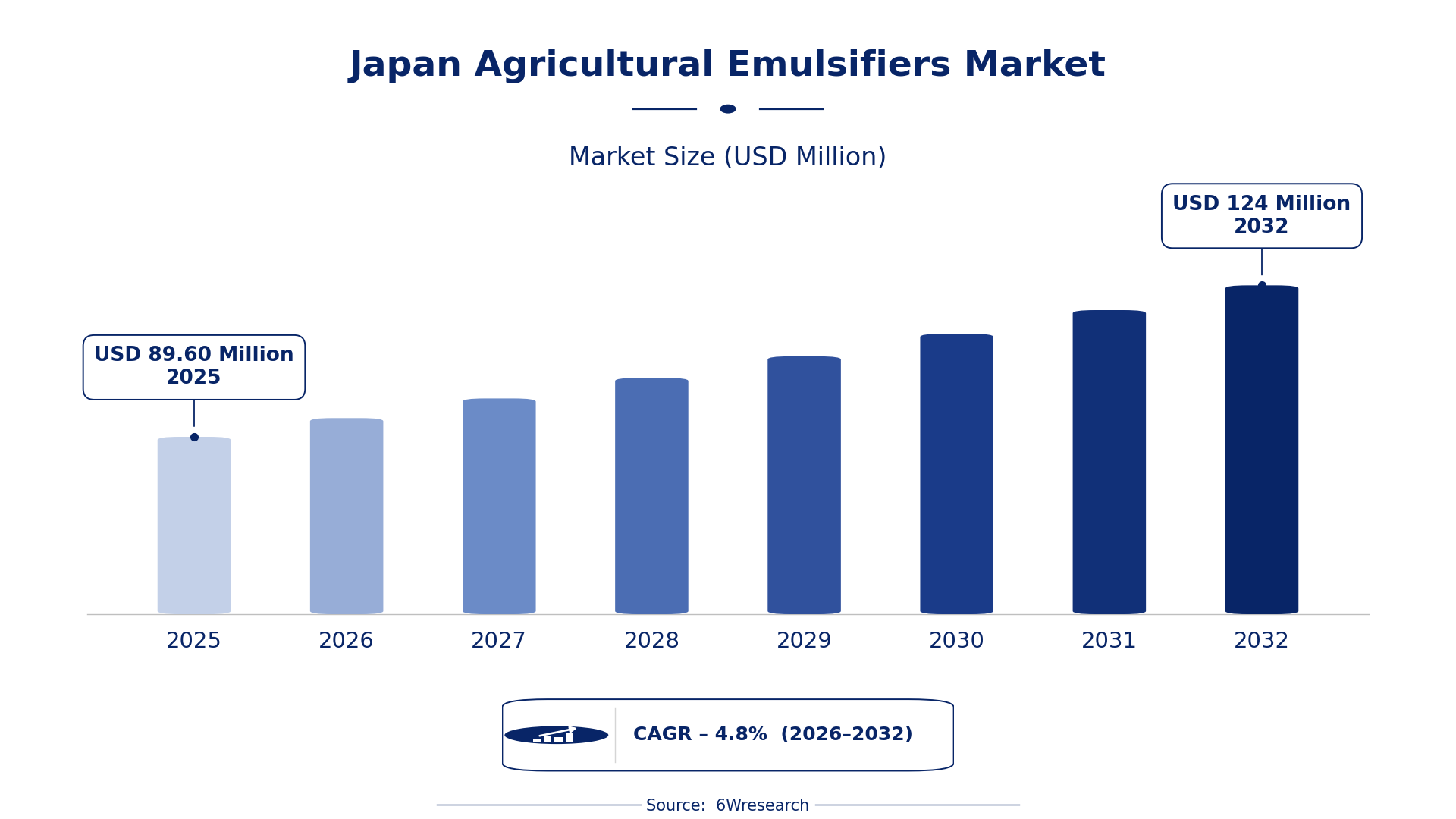
According to 6Wresearch internal database and industry insights, the Japan Agricultural Emulsifiers Market was valued at USD 89.60 Million in 2025 and is projected to reach USD 124 Million by 2032, growing at a CAGR of approximately 4.8% during 2026–2032.
Japan Agricultural Emulsifiers Market Highlights
| Report Metric | Details |
| Report Name | Japan Agricultural Emulsifiers Market (2026-2032) |
| Market Size 2025 | USD 89.60 Million |
| Market Size 2032 | USD 124 Million |
| Absolute Growth 2025–2032 | USD 34.40 Million |
| CAGR 2026–2032 | 4.8% |
| Peak Annual Growth | 5.7% in 2027 |
| Forecast Period | 2026–2032 |
| Historical Data | 2022–2025 |
| Base Year | 2025 |
| Leading Agricultural Emulsifiers Market, 2025 | Lecithin-Based Emulsifiers (45% share) |
| Leading Emulsifier Type, 2025 | Natural (38% share) |
| Leading Source Type, 2025 | Plant-Based (50% share) |
| Leading Distribution Channel, 2025 | Agri Input Stores (35% share) |
| Leading End User, 2025 | Pesticide Manufacturers (40% share) |
| Fastest-Growing Agricultural Emulsifiers Market | Sorbitan Esters (6.3% CAGR) |
| Fastest-Growing Source Type | Chemical Derived (6.9% CAGR) |
| Fastest-Growing Distribution Channel | Online Platforms (6.4% CAGR) |
| Fastest-Growing End User | Organic Farmers (6.5% CAGR) |
| Growing Sector | Agricultural Chemicals |
| Key End Users | Pesticide Manufacturers, Organic Farmers, Fertilizer Producers, Agri Chemical Firms |
Japan Agricultural Emulsifiers Market Year-wise Growth Rate and Key Drivers (2022–2032)
This graph illustrates the annual growth rates of the market from 2022 to 2032, highlighting a steady upward trajectory and projected market expansion over the forecast period.
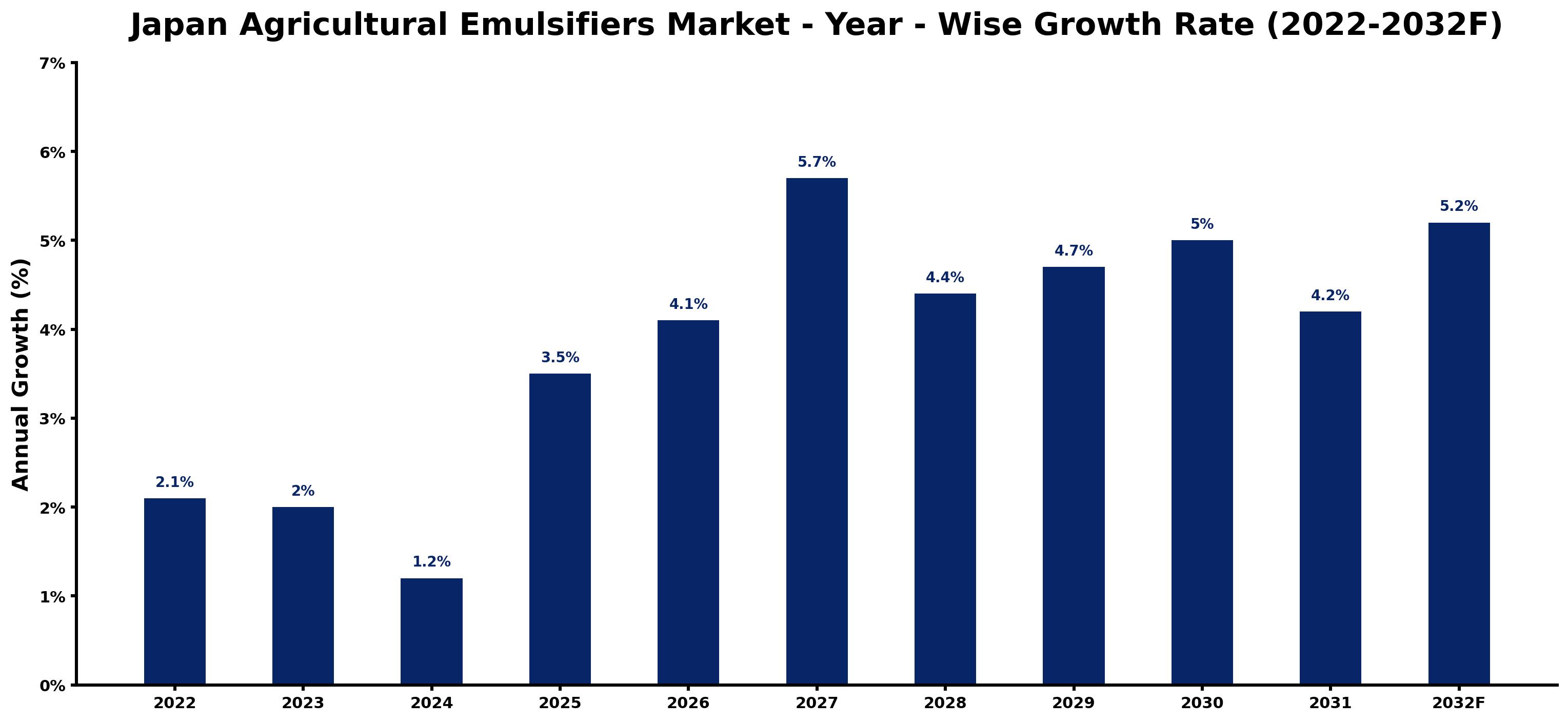
The table below sets out the estimated growth rate for each year and the main factor behind it.
| Year | Estimated Annual Growth (%) | Market Rationale |
| 2022 | 2.1 | The market showed steady growth, reflecting ongoing agricultural activities and demand for emulsifiers. |
| 2023 | 2.0 | Growth slowed slightly due to market saturation and stable production levels in agriculture. |
| 2024 | 1.2 | Continued slow growth resulted from a lack of new product launches in emulsifiers. |
| 2025 | 3.5 | Growth accelerated as pesticide manufacturers increased their use of emulsifiers for formulations. |
| 2026 | 4.1 | Demand is expected to rise as organic farmers seek natural emulsifiers for sustainable practices. |
| 2027 | 5.7 | The market is projected to peak with rising pesticide production and increased agricultural innovation investments. |
| 2028 | 4.4 | Growth will slow as the market stabilises after reaching a peak in production and demand. |
| 2029 | 4.7 | Demand is expected to increase again as online sales of agricultural inputs gain traction among farmers. |
| 2030 | 5.0 | Growth will continue with a focus on eco-friendly emulsifiers aligning with consumer preferences. |
| 2031 | 4.2 | The market is projected to experience slower growth due to increased competition among suppliers. |
| 2032 | 5.2 | Demand is expected to rise as new agricultural practices are adopted and supported. |
Note: Market size estimations and growth projections presented in this report are based on 6Wresearch's proprietary forecasting methodology, utilizing the latest available industry data, government publications, and primary research inputs.
Japan Agricultural Emulsifiers Market Synopsis
Agricultural emulsifiers are substances that stabilise mixtures of water and oil, primarily derived from natural sources like lecithin or chemicals. The Japan Agricultural Emulsifiers Market is expanding due to over 1.5 million organic farmers and a growing focus on sustainable farming practices. In 2023, Japan allocated ¥5 billion for agricultural innovation programs, which supports the sector's growth. The rising preference for natural emulsifiers reflects consumer demand for eco-friendly products, further driving market expansion.
Market Dynamics Impact Analysis (2026–2032)
| Factor | Type | Impact | Primary Segment Affected |
| Growing number of organic farmers | Driver | High | Natural |
| Increased pesticide production | Driver | High | Polysorbates |
| Rising demand for eco-friendly products | Opportunity | High | Natural |
| Expansion of online sales channels | Opportunity | Medium | Agri Input Stores |
| Market saturation in certain emulsifier types | Restraint | Medium | Sorbitan Esters |
| Dependence on imports for certain emulsifiers | Restraint | High | Chemical Derived |
| Competition among suppliers leading to pricing pressure | Challenge | High | Lecithin-Based Emulsifiers |
| Regulatory compliance costs for new products | Challenge | Medium | Alkyl Aryl Sulfonates |
Evaluation of Drivers in Japan Agricultural Emulsifiers Market (2026–2032)
Key forces behind demand, with the segment each one moves most, are listed below.
| Drivers | Primary Segment Affected | Why It Matters (Evidence) |
| Increase in organic farming practices | Natural | The number of organic farmers in Japan exceeds 1.5 million, driving demand for natural emulsifiers. |
| Higher pesticide production levels | Polysorbates | Increased agricultural activity is reflected in higher pesticide production levels, with polysorbates used in many formulations. |
| Consumer preference for sustainable products | Lecithin-Based Emulsifiers | Natural emulsifiers are preferred for organic farming, aligning with market trends towards sustainability. |
| Growth in online sales of agricultural inputs | Agri Input Stores | Online sales grew by 25% in 2023, expanding access for farmers to emulsifiers. |
| Investment in agricultural innovation programs | Chemical Derived | In 2023, ¥5 billion was allocated for agricultural innovation, boosting demand for emulsifiers. |
A wider customer base explains much of the growth, as the number of organic farmers in Japan has surpassed 1.5 million, increasing the demand for natural emulsifiers. The agricultural sector, valued at approximately ¥9 trillion, is experiencing higher pesticide production levels, with many formulations utilising emulsifiers. The rise in online sales of agricultural inputs has also improved access for farmers, enhancing their purchasing options.
Evaluation of Restraints in Japan Agricultural Emulsifiers Market
The key brakes on demand, and where they bite hardest, are shown below.
| Market Restraint | Primary Segment Affected | Why It Matters (Evidence) |
| Market saturation in certain emulsifier types | Sorbitan Esters | The market for Sorbitan Esters is saturated, limiting growth potential for this emulsifier type. |
| Dependence on imports for certain emulsifiers | Chemical Derived | Japan imports 15% of its agricultural emulsifiers, which may affect supply stability. |
| Regulatory compliance costs for new products | Alkyl Aryl Sulfonates | Compliance with existing regulations increases costs for producers of emulsifiers. |
| Limited awareness of emulsifier benefits among farmers | Lecithin-Based Emulsifiers | Some farmers remain unaware of the advantages of using Lecithin in formulations. |
| Competition among suppliers leading to pricing pressure | Natural | Intense competition in the natural emulsifier segment can drive prices down, affecting margins. |
Japan Agricultural Emulsifiers Market Challenges
Producers struggle with a lack of skilled workers, as the ageing agricultural workforce limits expertise and raises production costs by 20%. Buyers face rising prices due to the reliance on 15% imported emulsifiers from Southeast Asia, which can inflate budgets and disrupt financial planning. Supply chain disruptions occur from stringent regulations enforced by the Agricultural Chemicals Registration System, delaying product availability and affecting farmers' planting schedules. Competition intensifies as demand for natural emulsifiers grows, forcing producers to invest in reformulation, which diverts resources and hampers innovation.
Trends in the Japan Agricultural Emulsifiers Market
Below are the shifts with the largest effect on the Japan Agricultural Emulsifiers Market.
- Shift towards Natural Emulsifiers: Consumer demand for organic products is driving the trend towards natural emulsifiers. In 2023, natural emulsifiers accounted for a growing share of the market, reflecting changing preferences among farmers.
- Growth of Online Sales Channels: The rise of online sales channels for agricultural inputs is notable, with a 25% growth rate in 2023. This shift allows farmers greater access to emulsifiers, improving purchasing convenience.
- Increased Focus on Sustainable Practices: The agricultural sector is prioritising sustainable practices, with the Ministry of Agriculture promoting eco-friendly farming. This focus is driving demand for natural emulsifiers in Japan.
- Regulatory Changes Supporting Eco-Friendly Products: The Economic Security Promotion Act, enacted in 2022, supports supply-chain resilience for eco-friendly products. This law encourages the use of sustainable emulsifiers in agricultural applications.
Investment Opportunities in the Japan Agricultural Emulsifiers Market
Investors looking at the Japan Agricultural Emulsifiers Market should consider the following areas.
- Gap in Natural Emulsifier Supply: With the growing preference for natural emulsifiers, there is a supply gap. This presents an opportunity for suppliers to invest in natural emulsifiers, particularly in regions like Tokyo.
- Expansion of Online Platforms: The rise of online sales channels offers an opportunity for suppliers to reach farmers directly. Investing in online marketing strategies can enhance visibility in this growing segment.
- Increased Investment in Sustainable Practices: The allocation of ¥5 billion for agricultural innovation programs creates a prime opportunity for suppliers of eco-friendly emulsifiers to enter the market and meet rising demand.
- Partnerships with Organic Farmers: Forming partnerships with organic farmers can facilitate the introduction of natural emulsifiers. This strategy allows suppliers to tap into a growing market segment focused on sustainability.
Government Initiatives in the Japan Agricultural Emulsifiers Market
The Economic Security Promotion Act, enacted in 2022, supports supply-chain resilience for critical agricultural products. This law encourages local producers to improve their capacity for agricultural emulsifiers, ensuring a stable supply for domestic needs. Additionally, the PRTR Law mandates reporting on chemical substances, which affects how emulsifiers are produced and used in agriculture, ensuring safety and compliance with environmental standards.
Buyers of agricultural emulsifiers benefit from the Agricultural Chemicals Registration System, which guarantees product safety and efficacy. This system, overseen by the Japan Agricultural Chemicals Association, ensures that only approved emulsifiers are used in pesticide formulations. Furthermore, the Ministry of Agriculture, Forestry, and Fisheries promotes sustainable farming practices, encouraging the use of natural emulsifiers among farmers.
Future Insight of the Japan Agricultural Emulsifiers Market
By 2032, a shift towards sustainable farming practices will drive suppliers to innovate and diversify their emulsifier offerings. The allocation of ¥5 billion for agricultural innovation programs will enable the development of advanced emulsifier technologies that enhance product stability. JIS standards will evolve to incorporate sustainability metrics, ensuring buyers receive higher quality emulsifiers. As online sales of agricultural inputs continue to rise, suppliers must enhance their digital strategies to meet changing consumer preferences.
Market Segmentation Analysis
Japan Agricultural Emulsifiers Market report covers a detailed analysis of the following market segments:
By Agricultural Emulsifiers Market – Lecithin-Based Emulsifiers Lead, Sorbitan Esters Expected to Grow Fastest
According to Saurav Kr Singh, Senior Research Analyst at 6Wresearch, the largest agricultural emulsifiers market category in 2025 was Lecithin-Based Emulsifiers, at 45% of revenue. Lecithin-based emulsifiers hold a substantial share in Japan due to their effectiveness in stabilising active ingredients in pesticide formulations. Their usage is particularly prominent in regions like Tokyo and Hokkaido, which are key agricultural areas. Sorbitan Esters are set to record the highest CAGR in this split, 6.3% over 2026–2032. Sorbitan esters are experiencing rapid growth as they are essential in emulsifying agents for various agricultural products. Their increasing application in pesticide formulations reflects a strong demand for improved product performance. Suppliers should focus on enhancing the availability of sorbitan esters to meet the rising needs of the agricultural sector.
By Emulsifier Type – Natural Leads and Records the Fastest Growth
Natural took 38% of emulsifier type revenue in 2025, more than any other category. Natural emulsifiers lead the market as they are preferred for organic farming practices, aligning with consumer demand for sustainable solutions. This preference is particularly strong among Japan's over 1.5 million organic farmers who rely on these products. Natural is also forecast to expand faster than any other category, at a CAGR of 7.0% over 2026–2032. The natural emulsifier segment is also the fastest-growing, fuelled by a significant preference for organic inputs in agriculture. This trend is reinforced by initiatives from the Ministry of Agriculture, Forestry, and Fisheries promoting sustainable practices. Buyers should prioritise natural emulsifiers to align with the market's shift towards organic farming.
By Source Type – Plant-Based Leads, Chemical Derived Expected to Grow Fastest
With 50% of source type revenue in 2025, Plant-Based was the largest category. Plant-based emulsifiers lead the market as they are sourced from natural materials, appealing to eco-conscious consumers and farmers. This source type is particularly relevant in Japan's agricultural sector, valued at approximately ¥9 trillion. The quickest growth will come from Chemical Derived, forecast to expand at a CAGR of 6.9% between 2026 and 2032. Chemical derived emulsifiers are growing rapidly due to their common use in many formulations, providing cost-effective solutions for manufacturers. Their versatility in applications makes them increasingly attractive to various segments of the agricultural market. Suppliers should consider diversifying their offerings to include both plant-based and chemical derived emulsifiers to cater to diverse buyer preferences.
By Distribution Channel – Agri Input Stores Lead, Online Platforms Expected to Grow Fastest
In 2025, Agri Input Stores led the distribution channel split with a 35% share. Agri input stores are the primary distribution channel for farmers, providing essential access to agricultural inputs including emulsifiers. This channel accounts for 40% of emulsifier sales in Japan, highlighting its importance in the market. Online Platforms are projected to grow fastest, at a CAGR of 6.4% during 2026–2032. Online platforms are the fastest-growing distribution channel, with a notable 25% increase in agricultural input sales in 2023. This growth indicates a shift in purchasing behaviours among farmers seeking convenience and efficiency. Suppliers must strengthen their online presence to capture the growing segment of buyers preferring digital purchasing options.
By End User – Pesticide Manufacturers Lead, Organic Farmers Expected to Grow Fastest
Pesticide Manufacturers held 40% of the Japan Agricultural Emulsifiers Market by end user in 2025. Pesticide manufacturers represent the largest end user group, primarily utilising emulsifiers in their product formulations. With 300 registered pesticide manufacturers in Japan, this segment generates considerable demand for emulsifiers. Organic Farmers are set to record the highest CAGR in this split, 6.5% over 2026–2032. Organic farmers are emerging as the fastest-growing end user group, significantly utilising natural emulsifiers to meet organic farming standards. Their increasing numbers reflect a broader shift towards sustainable agricultural practices in Japan. Suppliers should tailor their product offerings to meet the specific needs of organic farmers to capitalise on this growth opportunity.
Key Attractiveness of the Report
- 10 Years of Market Numbers
- Historical Data Starting from 2022 to 2025
- Base Year 2025
- Forecast Data until 2032
- Key Performance Indicators Impacting the Market
- Major Upcoming Developments and Projects
Key Highlights of the Report:
- Japan Agricultural Emulsifiers Market Outlook
- Market Size of Japan Agricultural Emulsifiers Market, 2025
- Forecast of Japan Agricultural Emulsifiers Market, 2032
- Historical Data and Forecast of Japan Agricultural Emulsifiers Revenues & Volume for the Period 2022-2032F
- Japan Agricultural Emulsifiers Market Trend Evolution
- Japan Agricultural Emulsifiers Market Drivers and Challenges
- Japan Agricultural Emulsifiers Price Trends
- Japan Agricultural Emulsifiers Porter's Five Forces
- Japan Agricultural Emulsifiers Industry Life Cycle
- Historical Data and Forecast of Japan Agricultural Emulsifiers Market Revenues & Volume By Agricultural Emulsifiers Market for the Period 2022-2032F
- Historical Data and Forecast of Japan Agricultural Emulsifiers Market Revenues & Volume By Lecithin-Based Emulsifiers for the Period 2022-2032F
- Historical Data and Forecast of Japan Agricultural Emulsifiers Market Revenues & Volume By Sorbitan Esters for the Period 2022-2032F
- Historical Data and Forecast of Japan Agricultural Emulsifiers Market Revenues & Volume By Polysorbates for the Period 2022-2032F
- Historical Data and Forecast of Japan Agricultural Emulsifiers Market Revenues & Volume By Alkyl Aryl Sulfonates for the Period 2022-2032F
- Historical Data and Forecast of Japan Agricultural Emulsifiers Market Revenues & Volume By Emulsifier Type for the Period 2022-2032F
- Historical Data and Forecast of Japan Agricultural Emulsifiers Market Revenues & Volume By Natural for the Period 2022-2032F
- Historical Data and Forecast of Japan Agricultural Emulsifiers Market Revenues & Volume By Synthetic for the Period 2022-2032F
- Historical Data and Forecast of Japan Agricultural Emulsifiers Market Revenues & Volume By Semi-Synthetic for the Period 2022-2032F
- Historical Data and Forecast of Japan Agricultural Emulsifiers Market Revenues & Volume By Anionic for the Period 2022-2032F
- Historical Data and Forecast of Japan Agricultural Emulsifiers Market Revenues & Volume By Source Type for the Period 2022-2032F
- Historical Data and Forecast of Japan Agricultural Emulsifiers Market Revenues & Volume By Plant-Based for the Period 2022-2032F
- Historical Data and Forecast of Japan Agricultural Emulsifiers Market Revenues & Volume By Petroleum-Based for the Period 2022-2032F
- Historical Data and Forecast of Japan Agricultural Emulsifiers Market Revenues & Volume By Chemical Derived for the Period 2022-2032F
- Historical Data and Forecast of Japan Agricultural Emulsifiers Market Revenues & Volume By Mineral-Based for the Period 2022-2032F
- Historical Data and Forecast of Japan Agricultural Emulsifiers Market Revenues & Volume By Distribution Channel for the Period 2022-2032F
- Historical Data and Forecast of Japan Agricultural Emulsifiers Market Revenues & Volume By Agri Input Stores for the Period 2022-2032F
- Historical Data and Forecast of Japan Agricultural Emulsifiers Market Revenues & Volume By Online Platforms for the Period 2022-2032F
- Historical Data and Forecast of Japan Agricultural Emulsifiers Market Revenues & Volume By Specialty Stores for the Period 2022-2032F
- Historical Data and Forecast of Japan Agricultural Emulsifiers Market Revenues & Volume By Direct Sales for the Period 2022-2032F
- Historical Data and Forecast of Japan Agricultural Emulsifiers Market Revenues & Volume By End User for the Period 2022-2032F
- Historical Data and Forecast of Japan Agricultural Emulsifiers Market Revenues & Volume By Organic Farmers for the Period 2022-2032F
- Historical Data and Forecast of Japan Agricultural Emulsifiers Market Revenues & Volume By Pesticide Manufacturers for the Period 2022-2032F
- Historical Data and Forecast of Japan Agricultural Emulsifiers Market Revenues & Volume By Agri Chemical Firms for the Period 2022-2032F
- Historical Data and Forecast of Japan Agricultural Emulsifiers Market Revenues & Volume By Fertilizer Producers for the Period 2022-2032F
- Japan Agricultural Emulsifiers Import Export Trade Statistics
- Market Opportunity Assessment By Agricultural Emulsifiers Market
- Market Opportunity Assessment By Emulsifier Type
- Market Opportunity Assessment By Source Type
- Market Opportunity Assessment By Distribution Channel
- Market Opportunity Assessment By End User
- Japan Agricultural Emulsifiers Top Companies Market Share
- Japan Agricultural Emulsifiers Competitive Benchmarking By Technical and Operational Parameters
- Japan Agricultural Emulsifiers Company Profiles
- Japan Agricultural Emulsifiers Key Strategic Recommendations
Market Covered
The report covers the following segments.
By Agricultural Emulsifiers Market
- Lecithin-Based Emulsifiers
- Sorbitan Esters
- Polysorbates
- Alkyl Aryl Sulfonates
By Emulsifier Type
- Natural
- Synthetic
- Semi-Synthetic
- Anionic
By Source Type
- Plant-Based
- Petroleum-Based
- Chemical Derived
- Mineral-Based
By Distribution Channel
- Agri Input Stores
- Online Platforms
- Specialty Stores
- Direct Sales
By End User
- Organic Farmers
- Pesticide Manufacturers
- Agri Chemical Firms
- Fertilizer Producers































