Japan Agricultural Fertilizer Market Size & Growth Rate
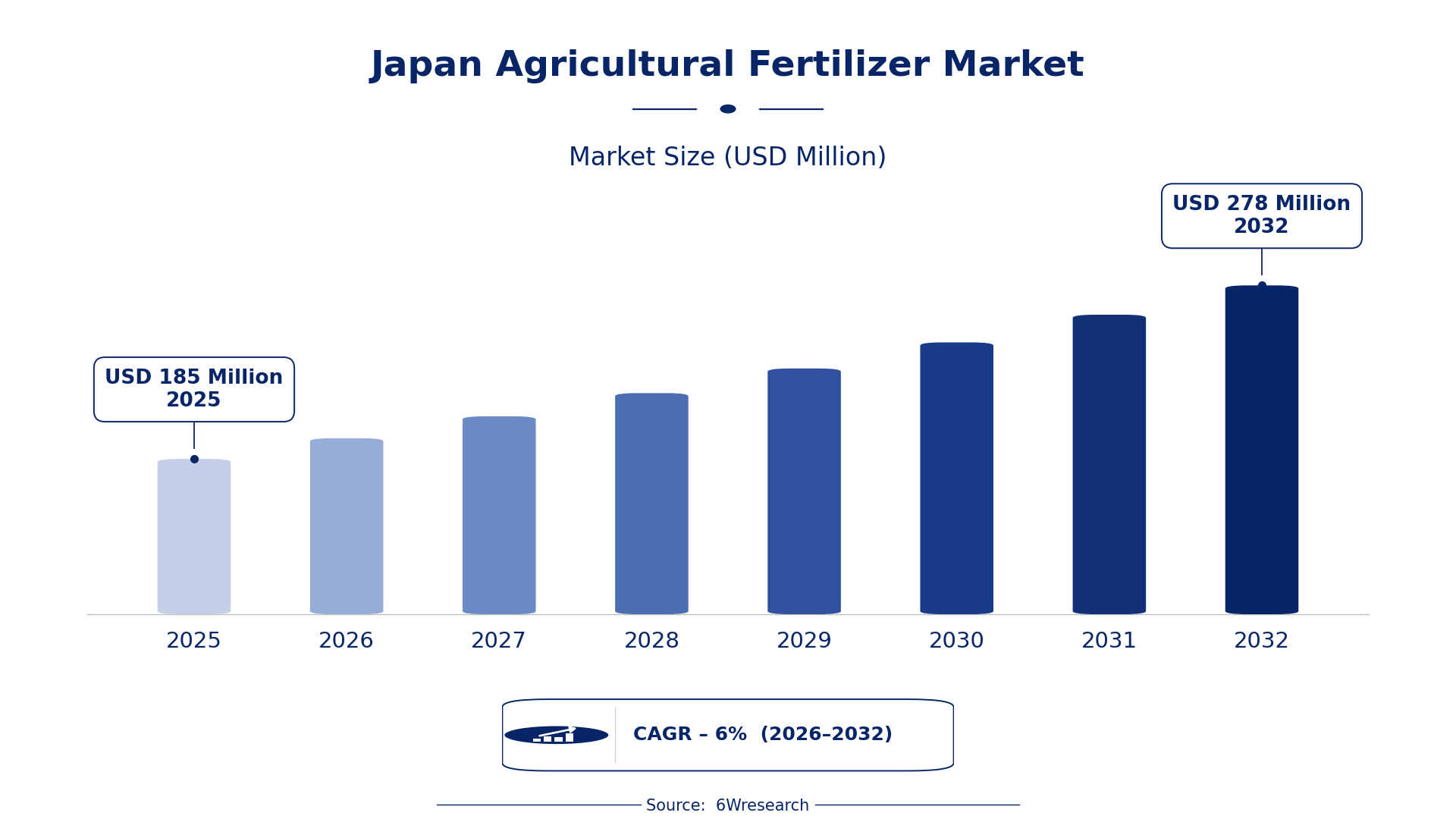
According to 6Wresearch internal database and industry insights, the Japan Agricultural Fertilizer Market was valued at USD 185 Million in 2025 and is projected to reach USD 278 Million by 2032, growing at a CAGR of approximately 6% during 2026–2032.
Japan Agricultural Fertilizer Market Highlights
| Report Metric | Details |
| Report Name | Japan Agricultural Fertilizer Market (2026-2032) |
| Market Size 2025 | USD 185 Million |
| Market Size 2032 | USD 278 Million |
| Absolute Growth 2025–2032 | USD 93 Million |
| CAGR 2026–2032 | 6% |
| Peak Annual Growth | 7.1% in 2030 |
| Forecast Period | 2026–2032 |
| Historical Data | 2022–2025 |
| Base Year | 2025 |
| Leading Agricultural Fertilizer Market, 2025 | Nitrogen Fertilizer (42% share) |
| Leading Fertilizer Type, 2025 | Urea (49% share) |
| Leading Nutrient Type, 2025 | N (43% share) |
| Leading Distribution Channel, 2025 | Agri Cooperatives (51% share) |
| Leading End User, 2025 | Grain Farmers (43% share) |
| Fastest-Growing Agricultural Fertilizer Market | Micronutrient Mixes (7.8% CAGR) |
| Fastest-Growing Fertilizer Type | Liquid Fertilizer (8.4% CAGR) |
| Fastest-Growing Nutrient Type | Mixed Nutrients (7.9% CAGR) |
| Fastest-Growing Distribution Channel | Online Platforms (8.2% CAGR) |
| Fastest-Growing End User | Horticulture Farms (7.7% CAGR) |
| Growing Sector | Horticulture |
| Key End Users | Grain Farmers, Horticulture Farms, Agri Cooperatives |
Japan Agricultural Fertilizer Market Year-wise Growth Rate and Key Drivers (2022–2032)
This graph illustrates the annual growth rates of the market from 2022 to 2032, highlighting a steady upward trajectory and projected market expansion over the forecast period.
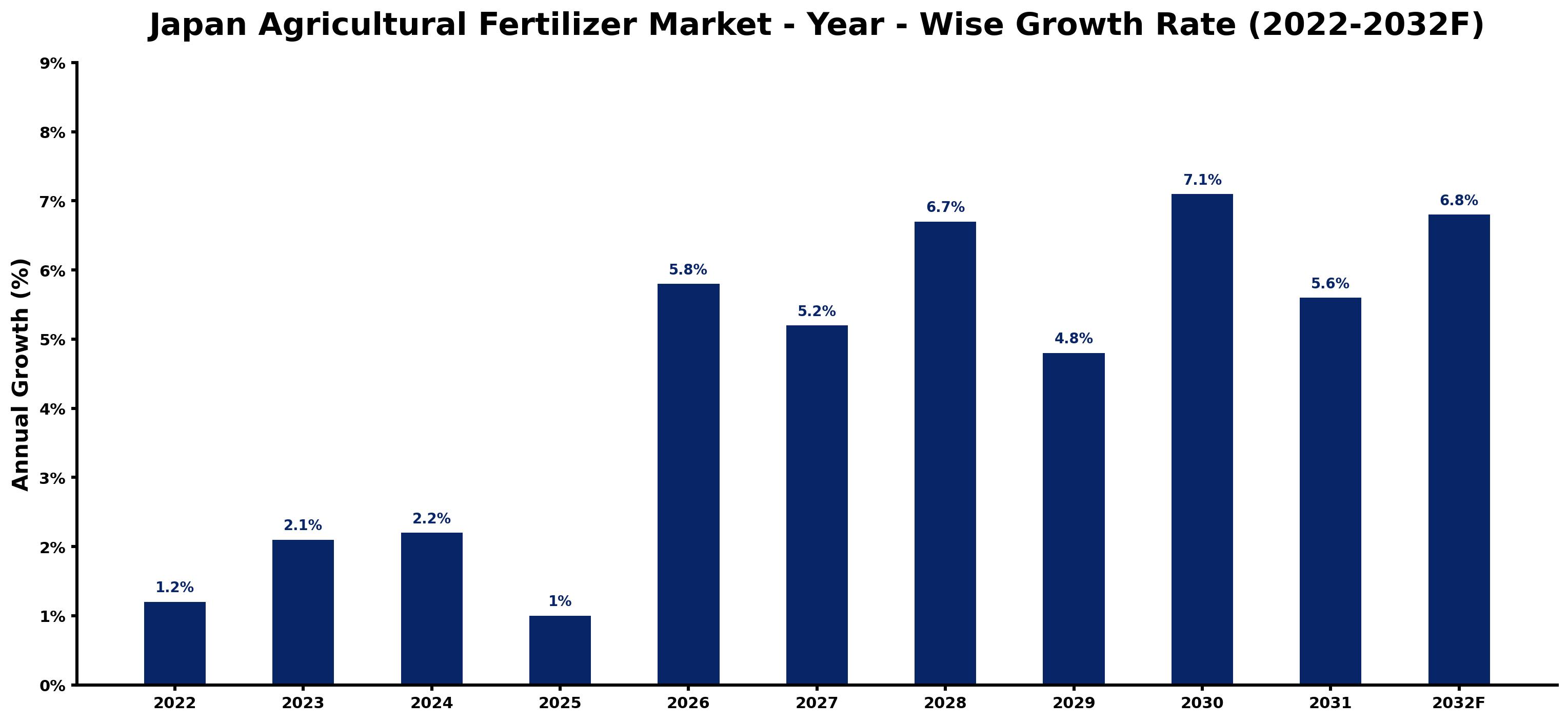
Each row of the following table gives one year's estimated growth and the event or demand shift that explains it.
| Year | Estimated Annual Growth (%) | Market Rationale |
| 2022 | 1.2 | The market showed stable growth, reflecting consistent demand from grain farmers. |
| 2023 | 2.1 | Growth accelerated due to increased adoption of liquid fertilizers among farmers. |
| 2024 | 2.2 | The market continued to expand as farmers sought higher crop yields. |
| 2025 | 1.0 | Growth slowed as the market adjusted to previous high demand levels. |
| 2026 | 5.8 | Demand is expected to surge with the introduction of new sustainable farming practices. |
| 2027 | 5.2 | Growth is projected to decelerate as market saturation begins to set in. |
| 2028 | 6.7 | A renewed interest in micronutrient mixes is anticipated to spur growth again. |
| 2029 | 4.8 | Growth is expected to slow as farmers become more cautious in their purchasing. |
| 2030 | 7.1 | Demand is projected to peak as farmers invest heavily in advanced fertilizers. |
| 2031 | 5.6 | Growth is expected to moderate as the market stabilises after peak demand. |
| 2032 | 6.8 | The market is expected to grow steadily with ongoing innovation in fertilizers. |
Note: Market size estimations and growth projections presented in this report are based on 6Wresearch's proprietary forecasting methodology, utilizing the latest available industry data, government publications, and primary research inputs.
Japan Agricultural Fertilizer Market Synopsis
Agricultural fertilizers, primarily composed of nitrogen, phosphorus, and potassium, are essential for enhancing crop yield and quality in Japan. The Japan Agricultural Fertilizer Market is expanding due to increasing demand from grain farmers and horticulture farms, driven by government investments in sustainable practices. In 2023, ¥10 billion was allocated for initiatives promoting eco-friendly farming. The Kanto region remains a key hub for fertilizer consumption, contributing significantly to overall market growth.
Market Dynamics Impact Analysis (2026–2032)
| Factor | Type | Impact | Primary Segment Affected |
| Rising adoption of liquid fertilizers among farmers | Driver | High | Liquid Fertilizer |
| Increased focus on sustainable agriculture practices | Driver | High | Micronutrient Mixes |
| Growing demand for organic fertilizers | Opportunity | Medium | Micronutrient Mixes |
| Expansion of agri cooperatives in rural areas | Opportunity | Medium | Agri Cooperatives |
| Aging farmer population affecting adoption rates | Restraint | High | Grain Farmers |
| Limited awareness of advanced fertilizer options | Restraint | Medium | Horticulture Farms |
| High costs associated with advanced fertilizer technology | Challenge | High | Liquid Fertilizer |
| Regulatory compliance requirements for new products | Challenge | Medium | Micronutrient Mixes |
Evaluation of Drivers in Japan Agricultural Fertilizer Market (2026–2032)
These are the developments adding the most demand over the forecast period.
| Drivers | Primary Segment Affected | Why It Matters (Evidence) |
| Increased production of nitrogen fertilizers | Nitrogen Fertilizer | Japan produced 8 million tons of nitrogen fertilizer in 2022, boosting supply for grain farmers. |
| Popularity of liquid fertilizers | Liquid Fertilizer | Liquid fertilizers gained traction for their efficiency, appealing to farmers seeking better nutrient uptake. |
| Growing use of micronutrient mixes | Micronutrient Mixes | Micronutrient mixes are increasingly used in horticulture to improve crop quality, reflecting changing farming practices. |
| Government investment in sustainable agriculture | Micronutrient Mixes | The government allocated ¥10 billion for sustainable agriculture initiatives in 2023, promoting eco-friendly practices. |
| Expansion of agri cooperatives | Agri Cooperatives | Over 1,000 agri cooperatives across Japan facilitate access to fertilizers for farmers, enhancing distribution. |
Several shifts outside the market lift sales. In 2022, Japan produced 8 million tons of nitrogen fertilizer, supporting the needs of grain farmers. The growing popularity of liquid fertilizers, which improve nutrient uptake, has attracted many farmers. The increasing use of micronutrient mixes is evident in horticulture, reflecting the need for better crop quality. With numerous agri cooperatives, farmers have improved access to various fertilizers, ensuring a steady supply and fostering market growth.
Evaluation of Restraints in Japan Agricultural Fertilizer Market
These restraints slow adoption and weigh on supplier margins.
| Market Restraint | Primary Segment Affected | Why It Matters (Evidence) |
| Aging population of farmers leading to lower adoption rates | Grain Farmers | The average age of farmers in Japan is 67 years, impacting fertilizer usage. |
| Limited knowledge about advanced fertilizer options | Horticulture Farms | Many farmers lack awareness of the benefits of new fertilizer technologies, limiting their adoption. |
| High costs of advanced fertilizer technologies | Liquid Fertilizer | Investing in advanced fertilizers can be prohibitively expensive for smaller farmers, restricting their options. |
| Strict regulatory compliance for new products | Micronutrient Mixes | Producers must navigate complex regulations, which can delay product launches and increase costs. |
| Market saturation affecting growth potential | N | With stable demand, growth rates may slow as the market matures. |
Japan Agricultural Fertilizer Market Challenges
Grain producers encounter a skills shortage, as the average age of farmers in Japan is 67 years, resulting in reduced efficiency in fertilizer application that can lower crop yields by up to 20%. Suppliers face challenges with outdated technology, which causes delays in production and increases costs for producers reliant on timely fertilizer deliveries. Competition from organic alternatives is intensifying, as government initiatives aim to reduce chemical fertilizer use by 20% by 2025, compelling conventional suppliers to adapt swiftly or risk losing market share. Compliance with strict JIS standards incurs rising costs, creating financial pressures for producers who must ensure their products meet these regulations.
Trends in the Japan Agricultural Fertilizer Market
These developments are changing demand patterns in the Japan Agricultural Fertilizer Market.
- Grain Farmers Shifting to Liquid Fertilizers: Grain farmers are increasingly adopting liquid fertilizers for their efficiency, with consumption on the rise. In 2022, approximately 5 million tons of fertilizers were consumed, reflecting this trend.
- Horticulture Farms Embracing Micronutrient Mixes: Horticulture farms are increasingly utilising micronutrient mixes to improve crop quality. In 2023, the demand for these mixes surged, driven by the need for specific nutrient applications.
- Rise of Sustainable Practices in Agriculture: The government’s focus on sustainable agriculture has led to a rise in organic fertilizer usage. In 2023, ¥10 billion was allocated to support sustainable practices across the sector.
- Digital Transformation in Fertilizer Distribution: The distribution of fertilizers is shifting towards online platforms, with an anticipated growth of 8.2% in this channel. This change reflects the growing preference for digital purchasing among farmers.
Investment Opportunities in the Japan Agricultural Fertilizer Market
Below are the investment opportunities with the strongest case in the Japan Agricultural Fertilizer Market.
- Gap in Organic Fertilizer Market: With the government aiming to reduce chemical fertilizer use by 20% by 2025, there is an opportunity for organic fertilizers. Horticulture farms are increasingly seeking organic alternatives to meet this target.
- Growing Demand for Specialty Fertilizers: The Tokyo Metropolitan area has a high demand for specialty fertilizers, with consumption rising annually. Suppliers can enter this market through local partnerships and certifications to meet this demand.
- Expansion of Agri Cooperatives: The presence of over 1,000 agri cooperatives presents opportunities for suppliers to reach farmers more effectively. Collaborating with these cooperatives can improve distribution channels and enhance market penetration.
- Investment in Advanced Fertilizer Technologies: With the increasing focus on efficiency, there is a growing need for advanced fertilizer technologies. Suppliers can target grain farmers looking to boost productivity through innovative solutions.
Government Initiatives in the Japan Agricultural Fertilizer Market
The Industrial Standardization Act, established in 1949 and amended in 2019, sets the framework for quality and safety standards for fertilizers. Compliance with JIS standards is mandatory for producers, ensuring that fertilizers meet safety and quality benchmarks. The Act against Unjustifiable Premiums and Misleading Representations protects consumers by ensuring accurate labeling and fair practices in the market.
The Consumer Affairs Agency oversees compliance with labeling regulations, ensuring that buyers receive accurate information about fertilizers. In 2023, the government allocated ¥10 billion for sustainable agriculture initiatives, supporting farmers transitioning to eco-friendly practices and promoting the use of organic fertilizers.
Future Insight of the Japan Agricultural Fertilizer Market
Emerging technologies in precision agriculture will transform nutrient application, enabling producers to optimise usage and minimise waste. The government's investment of ¥10 billion in sustainable agriculture initiatives will drive the creation of eco-friendly fertilizer options, attracting environmentally conscious buyers. By 2032, new production facilities dedicated to organic fertilizers will address the increasing demand for sustainable practices among agricultural users. As annual fertilizer consumption reaches approximately 5 million tons, suppliers must innovate to meet the evolving needs of producers seeking efficiency in crop production.
Market Segmentation Analysis
Japan Agricultural Fertilizer Market report covers a detailed analysis of the following market segments:
By Agricultural Fertilizer Market – Nitrogen Fertilizer Leads, Micronutrient Mixes Expected to Grow Fastest
According to Saurav Kr Singh, Senior Research Analyst at 6Wresearch, in 2025, Nitrogen Fertilizer led the agricultural fertilizer market split with a 42% share. Nitrogen fertilizers are vital for enhancing crop growth, making them the preferred choice among farmers in Japan. The production of 8 million tons in 2022 underscores their widespread application, particularly in grain farming and horticulture. Micronutrient Mixes are projected to grow fastest, at a CAGR of 7.8% during 2026–2032. Micronutrient mixes are gaining traction due to their effectiveness in addressing specific nutrient deficiencies in crops. The increasing focus on improving crop quality, especially in horticulture, is propelling this segment's rapid growth. Suppliers should prioritise the development of micronutrient mixes to meet the rising demand from farmers.
By Fertilizer Type – Urea Leads, Liquid Fertilizer Expected to Grow Fastest
Urea accounted for 49% of the market by fertilizer type in 2025. Urea is a commonly used nitrogen source that significantly improves crop yield across Japan. Its widespread application across various agricultural practices reinforces its status as a staple for farmers. Liquid Fertilizer is set to record the highest CAGR in this split, 8.4% over 2026–2032. Liquid fertilizers are becoming more popular due to their efficiency in nutrient uptake, appealing to farmers seeking optimal crop performance. This trend is expected to continue as modern agricultural practices gain prominence. Buyers may benefit from exploring liquid fertilizer options to boost crop productivity.
By Nutrient Type – N Leads, Mixed Nutrients Expected to Grow Fastest
N held 43% of the Japan Agricultural Fertilizer Market by nutrient type in 2025. Nitrogen is a crucial nutrient for plant growth, making it the most sought-after nutrient type among farmers in Japan. Its essential role in enhancing crop yield solidifies its dominant market position. Over 2026–2032, Mixed Nutrients are expected to post the fastest growth, at a CAGR of 7.9%. Mixed nutrients are increasingly favoured as they provide balanced nutrition to crops, addressing the diverse needs of various plant species. This trend indicates a shift towards more holistic fertilisation strategies. Suppliers should consider creating mixed nutrient products to cater to the evolving preferences of farmers.
By Distribution Channel – Agri Cooperatives Lead, Online Platforms Expected to Grow Fastest
With 51% of distribution channel revenue in 2025, Agri Cooperatives was the largest category. Agri cooperatives are the main distribution channel for fertilizers, connecting suppliers directly with farmers. Their extensive network across Japan ensures a consistent supply of agricultural inputs to local users. The quickest growth will come from Online Platforms, forecast to expand at a CAGR of 8.2% between 2026 and 2032. Online platforms are rapidly emerging as a key sales channel, particularly among farmers who value convenience in purchasing. This shift reflects a broader trend towards digitalisation within agricultural supply chains. Suppliers should invest in online sales strategies to effectively engage a wider audience.
By End User – Grain Farmers Lead, Horticulture Farms Expected to Grow Fastest
The largest end user category in 2025 was Grain Farmers, at 43% of revenue. Grain farmers are the predominant end users of fertilizers, relying heavily on these products to maximise their crop yields. Their substantial presence in the agricultural sector highlights the importance of this group. Horticulture Farms are projected to grow fastest, at a CAGR of 7.7% during 2026–2032. Horticulture farms are increasingly utilising fertilizers to improve the quality of their produce, contributing to rapid growth in this segment. This trend reflects a rising demand for high-quality fruits and vegetables in the market. Suppliers should tailor their offerings to meet the specific needs of horticulture farms to capitalise on growth opportunities.
Key Attractiveness of the Report
- 10 Years of Market Numbers
- Historical Data Starting from 2022 to 2025
- Base Year 2025
- Forecast Data until 2032
- Key Performance Indicators Impacting the Market
- Major Upcoming Developments and Projects
Key Highlights of the Report:
- Japan Agricultural Fertilizer Market Outlook
- Market Size of Japan Agricultural Fertilizer Market, 2025
- Forecast of Japan Agricultural Fertilizer Market, 2032
- Historical Data and Forecast of Japan Agricultural Fertilizer Revenues & Volume for the Period 2022-2032F
- Japan Agricultural Fertilizer Market Trend Evolution
- Japan Agricultural Fertilizer Market Drivers and Challenges
- Japan Agricultural Fertilizer Price Trends
- Japan Agricultural Fertilizer Porter's Five Forces
- Japan Agricultural Fertilizer Industry Life Cycle
- Historical Data and Forecast of Japan Agricultural Fertilizer Market Revenues & Volume By Agricultural Fertilizer Market for the Period 2022-2032F
- Historical Data and Forecast of Japan Agricultural Fertilizer Market Revenues & Volume By Nitrogen Fertilizer for the Period 2022-2032F
- Historical Data and Forecast of Japan Agricultural Fertilizer Market Revenues & Volume By Phosphatic Fertilizer for the Period 2022-2032F
- Historical Data and Forecast of Japan Agricultural Fertilizer Market Revenues & Volume By Potash Fertilizer for the Period 2022-2032F
- Historical Data and Forecast of Japan Agricultural Fertilizer Market Revenues & Volume By Micronutrient Mixes for the Period 2022-2032F
- Historical Data and Forecast of Japan Agricultural Fertilizer Market Revenues & Volume By Fertilizer Type for the Period 2022-2032F
- Historical Data and Forecast of Japan Agricultural Fertilizer Market Revenues & Volume By Urea for the Period 2022-2032F
- Historical Data and Forecast of Japan Agricultural Fertilizer Market Revenues & Volume By DAP for the Period 2022-2032F
- Historical Data and Forecast of Japan Agricultural Fertilizer Market Revenues & Volume By MOP for the Period 2022-2032F
- Historical Data and Forecast of Japan Agricultural Fertilizer Market Revenues & Volume By Liquid Fertilizer for the Period 2022-2032F
- Historical Data and Forecast of Japan Agricultural Fertilizer Market Revenues & Volume By Nutrient Type for the Period 2022-2032F
- Historical Data and Forecast of Japan Agricultural Fertilizer Market Revenues & Volume By N for the Period 2022-2032F
- Historical Data and Forecast of Japan Agricultural Fertilizer Market Revenues & Volume By P for the Period 2022-2032F
- Historical Data and Forecast of Japan Agricultural Fertilizer Market Revenues & Volume By K for the Period 2022-2032F
- Historical Data and Forecast of Japan Agricultural Fertilizer Market Revenues & Volume By Mixed Nutrients for the Period 2022-2032F
- Historical Data and Forecast of Japan Agricultural Fertilizer Market Revenues & Volume By Distribution Channel for the Period 2022-2032F
- Historical Data and Forecast of Japan Agricultural Fertilizer Market Revenues & Volume By Agri Cooperatives for the Period 2022-2032F
- Historical Data and Forecast of Japan Agricultural Fertilizer Market Revenues & Volume By Online Platforms for the Period 2022-2032F
- Historical Data and Forecast of Japan Agricultural Fertilizer Market Revenues & Volume By Direct Sales for the Period 2022-2032F
- Historical Data and Forecast of Japan Agricultural Fertilizer Market Revenues & Volume By Fertilizer Dealers for the Period 2022-2032F
- Historical Data and Forecast of Japan Agricultural Fertilizer Market Revenues & Volume By End User for the Period 2022-2032F
- Historical Data and Forecast of Japan Agricultural Fertilizer Market Revenues & Volume By Grain Farmers for the Period 2022-2032F
- Historical Data and Forecast of Japan Agricultural Fertilizer Market Revenues & Volume By Horticulture Farms for the Period 2022-2032F
- Historical Data and Forecast of Japan Agricultural Fertilizer Market Revenues & Volume By Plantation Owners for the Period 2022-2032F
- Historical Data and Forecast of Japan Agricultural Fertilizer Market Revenues & Volume By Smallholder Farmers for the Period 2022-2032F
- Japan Agricultural Fertilizer Import Export Trade Statistics
- Market Opportunity Assessment By Agricultural Fertilizer Market
- Market Opportunity Assessment By Fertilizer Type
- Market Opportunity Assessment By Nutrient Type
- Market Opportunity Assessment By Distribution Channel
- Market Opportunity Assessment By End User
- Japan Agricultural Fertilizer Top Companies Market Share
- Japan Agricultural Fertilizer Competitive Benchmarking By Technical and Operational Parameters
- Japan Agricultural Fertilizer Company Profiles
- Japan Agricultural Fertilizer Key Strategic Recommendations
Market Covered
The study includes the following segmentation.
By Agricultural Fertilizer Market
- Nitrogen Fertilizer
- Phosphatic Fertilizer
- Potash Fertilizer
- Micronutrient Mixes
By Fertilizer Type
- Urea
- DAP
- MOP
- Liquid Fertilizer
By Nutrient Type
- N
- P
- K
- Mixed Nutrients
By Distribution Channel
- Agri Cooperatives
- Online Platforms
- Direct Sales
- Fertilizer Dealers
By End User
- Grain Farmers
- Horticulture Farms
- Plantation Owners
- Smallholder Farmers































