Japan Agricultural Harvesting Automation Market Size & Growth Rate
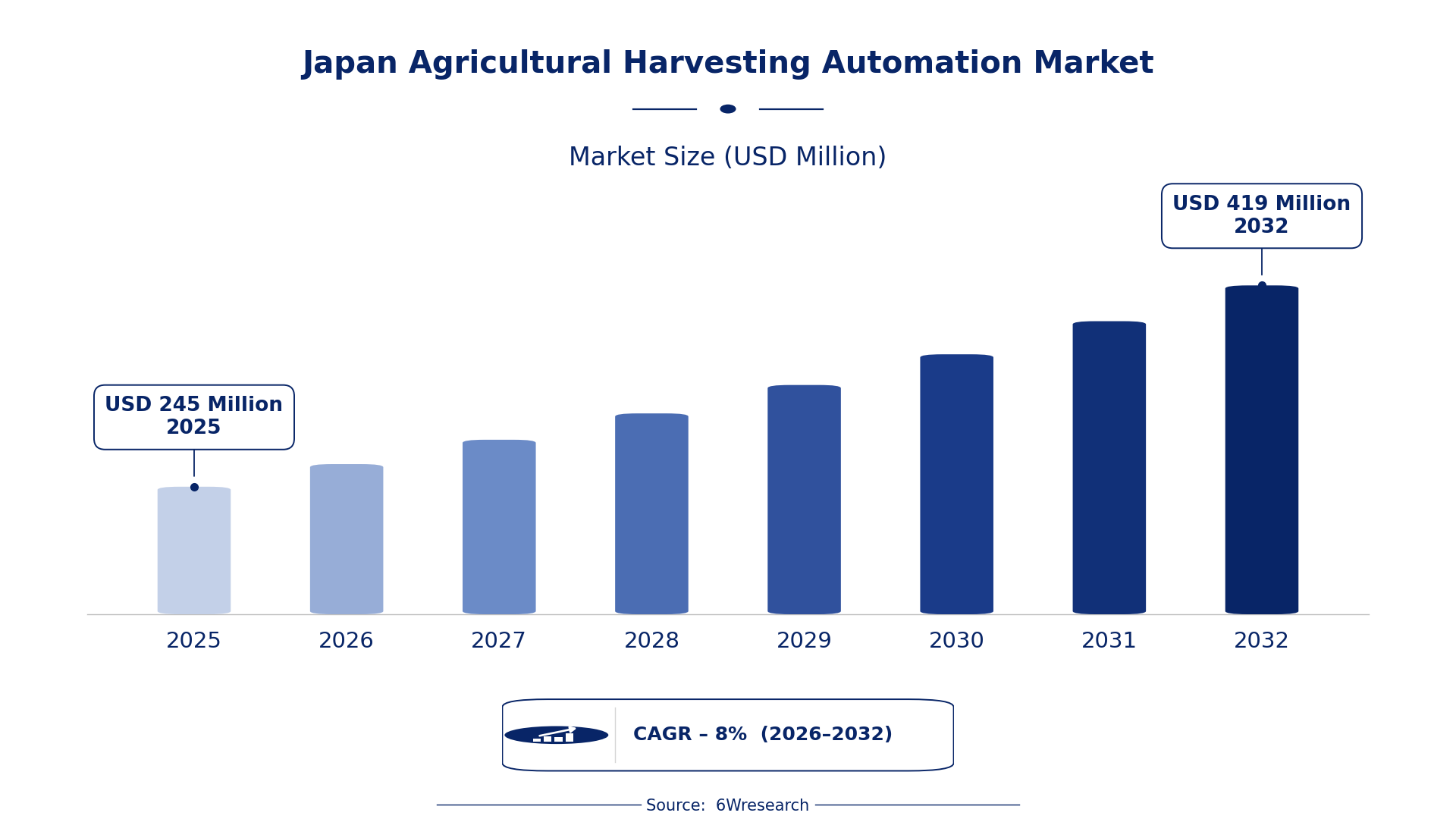
According to 6Wresearch internal database and industry insights, the Japan Agricultural Harvesting Automation Market was valued at USD 245 Million in 2025 and is projected to reach USD 419 Million by 2032, growing at a CAGR of approximately 8% during 2026–2032.
Japan Agricultural Harvesting Automation Market Highlights
| Report Metric | Details |
| Report Name | Japan Agricultural Harvesting Automation Market (2026-2032) |
| Market Size 2025 | USD 245 Million |
| Market Size 2032 | USD 419 Million |
| Absolute Growth 2025–2032 | USD 174 Million |
| CAGR 2026–2032 | 8% |
| Peak Annual Growth | 8.6% in 2027 |
| Forecast Period | 2026–2032 |
| Historical Data | 2022–2025 |
| Base Year | 2025 |
| Leading Agricultural Harvesting Automation Market, 2025 | Robotic Fruit Pickers (43% share) |
| Leading Equipment Type, 2025 | Fully Autonomous (48% share) |
| Leading Automation Level, 2025 | AI-Controlled (47% share) |
| Leading Distribution Channel, 2025 | OEMs (40% share) |
| Leading End User, 2025 | Large Orchards (41% share) |
| Fastest-Growing Agricultural Harvesting Automation Market | Smart Harvesting Drones (10.9% CAGR) |
| Fastest-Growing Equipment Type | Semi-Automated (11.7% CAGR) |
| Fastest-Growing Distribution Channel | Online Platforms (10.5% CAGR) |
| Fastest-Growing End User | Precision Agri Firms (11.0% CAGR) |
| Growing Sector | Precision Agri Firms |
| Key End Users | Large Orchards, Commercial Farmers, Potato/Ginger Farms, Precision Agri Firms |
Japan Agricultural Harvesting Automation Market Year-wise Growth Rate and Key Drivers (2022–2032)
This graph illustrates the annual growth rates of the market from 2022 to 2032, highlighting a steady upward trajectory and projected market expansion over the forecast period.
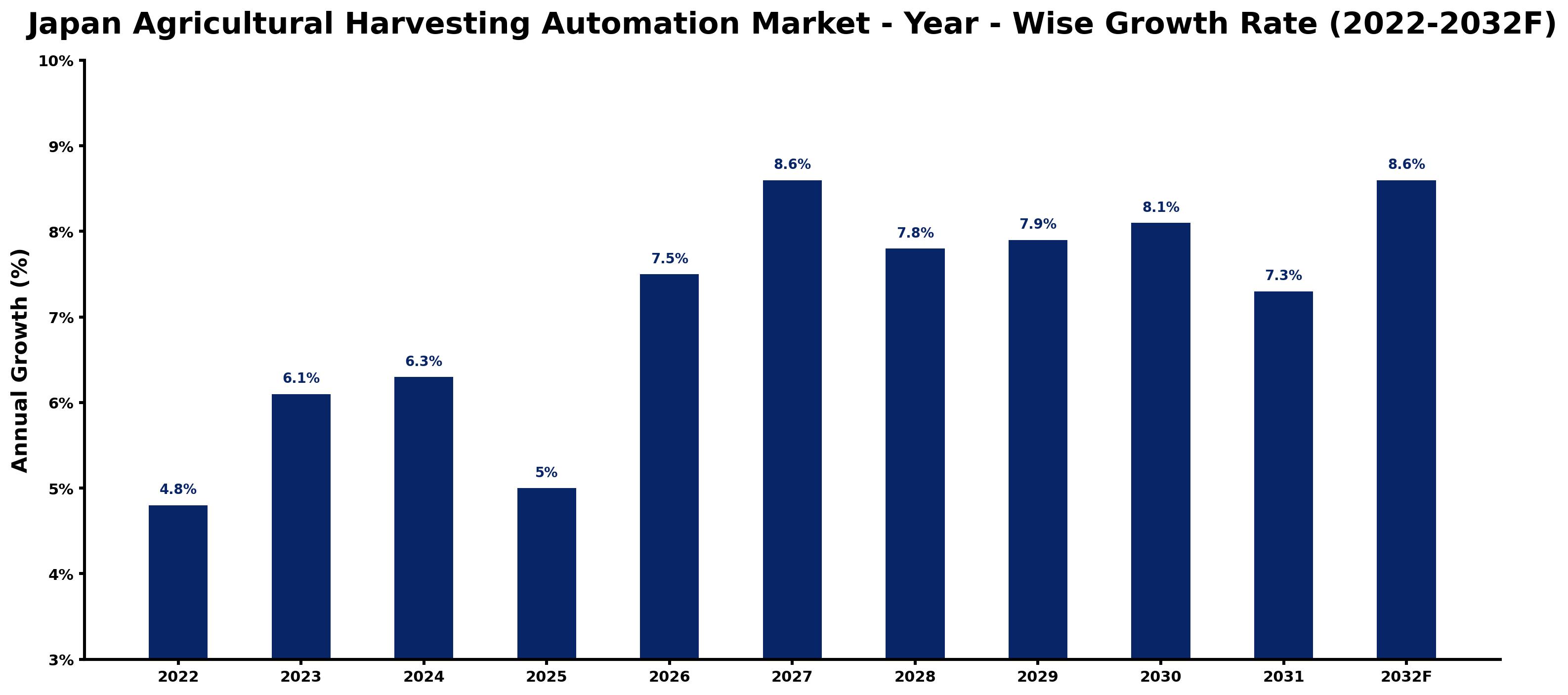
Below, each year's estimated growth is shown next to the factor that most influenced it.
| Year | Estimated Annual Growth (%) | Market Rationale |
| 2022 | 4.8 | The market showed steady growth due to ongoing investments in agricultural technology. |
| 2023 | 6.1 | Demand increased as commercial farmers adopted more automation solutions for efficiency. |
| 2024 | 6.3 | Growth accelerated with the introduction of new harvesting technologies and equipment. |
| 2025 | 5.0 | Market growth slowed as some farmers faced budget constraints amid rising costs. |
| 2026 | 7.5 | Investment in AI technologies is expected to surge, boosting demand for automation solutions. |
| 2027 | 8.6 | The market will reach its peak growth as adoption of robotic systems expands. |
| 2028 | 7.8 | Growth is projected to slow slightly as the market begins to stabilise after rapid expansion. |
| 2029 | 7.9 | Demand is expected to increase again as precision agriculture practices gain traction among farmers. |
| 2030 | 8.1 | The market will continue to grow as government initiatives support agricultural automation. |
| 2031 | 7.3 | Growth is projected to slow as the market matures, but demand for advanced solutions will remain strong. |
| 2032 | 8.6 | The market is expected to peak again as new technologies are introduced. |
Note: Market size estimations and growth projections presented in this report are based on 6Wresearch's proprietary forecasting methodology, utilizing the latest available industry data, government publications, and primary research inputs.
Japan Agricultural Harvesting Automation Market Synopsis
Agricultural harvesting automation utilises robotics and AI to improve efficiency in crop harvesting. This technology is vital for increasing productivity and reducing labor costs, particularly in large orchards and commercial farms. The Japan Agricultural Harvesting Automation Market is expanding due to rising demand from domestic users, investments in technology, and initiatives aimed at improving productivity. The sector is positioned for continued growth driven by innovation and efficiency improvements.
Market Dynamics Impact Analysis (2026–2032)
| Factor | Type | Impact | Primary Segment Affected |
| Growing adoption of AI technologies in agriculture | Driver | High | Robotic Fruit Pickers |
| Increased investment in agricultural automation | Driver | High | Smart Harvesting Drones |
| Rising demand for efficient harvesting solutions | Opportunity | High | Grain Harvesting Combines |
| Expansion of online sales platforms for agricultural equipment | Opportunity | Medium | Online Platforms |
| High initial costs of automation equipment | Restraint | High | Fully Autonomous |
| Limited awareness of automation benefits among traditional farmers | Restraint | Medium | Semi-Automated |
| Compliance with safety and operational standards | Challenge | High | AI-Controlled |
| Capacity constraints in local manufacturing | Challenge | Medium | Hydraulic-Powered |
Evaluation of Drivers in Japan Agricultural Harvesting Automation Market (2026–2032)
The factors lifting demand, and the evidence behind each, are summarised below.
| Drivers | Primary Segment Affected | Why It Matters (Evidence) |
| Increased adoption of AI technologies | Robotic Fruit Pickers | Commercial farmers are investing in AI-driven solutions, resulting in a 15% increase in adoption among them in 2023. |
| Rising labour costs | Grain Harvesting Combines | The national minimum wage rose to JPY 1,055 per hour, prompting farmers to seek automation to reduce costs. |
| Government support for agricultural automation | Smart Harvesting Drones | In 2023, a government program allocated ¥10 billion to support automation, driving demand for advanced technologies. |
| Growing focus on sustainability | Fully Autonomous | Japan targets a 46% cut in greenhouse-gas emissions by 2030, encouraging the adoption of efficient harvesting solutions. |
| Increasing size of commercial farms | Root Crop Harvesters | The average size of large orchards is approximately 10 hectares, necessitating efficient harvesting equipment. |
Spending rises because commercial farmers are increasingly adopting AI technologies, with robotic fruit pickers seeing a 15% increase in adoption in 2023. Rising labour costs push farmers to seek automation solutions, as the national minimum wage reached JPY 1,055 per hour. The focus on sustainability drives the need for fully autonomous systems, as Japan aims for a 46% reduction in greenhouse-gas emissions by 2030. The average size of large orchards at approximately 10 hectares necessitates efficient harvesting equipment, further boosting market growth.
Evaluation of Restraints in Japan Agricultural Harvesting Automation Market
These are the pressures that could keep growth below its potential.
| Market Restraint | Primary Segment Affected | Why It Matters (Evidence) |
| High initial costs of automation equipment | Fully Autonomous | The high investment required for fully autonomous systems limits accessibility for smaller farms. |
| Limited awareness of automation benefits among traditional farmers | Semi-Automated | Many traditional farmers are unaware of the efficiency gains from adopting semi-automated solutions. |
| Compliance with safety and operational standards | AI-Controlled | Meeting safety regulations can delay the implementation of AI-controlled harvesting systems. |
| Capacity constraints in local manufacturing | Hydraulic-Powered | Local manufacturers struggle to meet the growing demand for hydraulic-powered harvesting equipment. |
| Market fragmentation with many small players | Robotic Fruit Pickers | The presence of numerous small manufacturers complicates market operations and consumer choices. |
Japan Agricultural Harvesting Automation Market Challenges
Rising operational costs pressure profit margins for producers, with the national minimum wage set to JPY 1,055 per hour, pushing buyers to seek more efficient solutions. Intense competition among producers drives prices down, forcing farmers to compromise on quality, which can reduce crop yields by 10%. Slow technological adoption persists due to high initial costs, delaying efficiency improvements for farmers, particularly in the Tohoku region. Regulatory complexities, such as compliance with ISO 9001, can extend product launch timelines for manufacturers, hindering their ability to meet market demands swiftly.
Trends in the Japan Agricultural Harvesting Automation Market
The following changes are redrawing the Japan Agricultural Harvesting Automation Market.
- Shift from Manual to Automated Harvesting: Since 2023, there has been a notable shift towards automated harvesting solutions, particularly in the Tohoku region where grain harvesting combines are essential. This change is driven by the need to improve efficiency and reduce labour costs.
- Transition to Smart Harvesting Drones: The use of smart harvesting drones has increased significantly, with over 20% of large orchards adopting this technology in 2023. This trend highlights the growing focus on precision agriculture among commercial farmers.
- Emergence of AI-Controlled Systems: AI-controlled harvesting systems are becoming increasingly popular, with a 47% market share in 2025. This trend reflects the industry's shift towards integrating advanced technologies for better decision-making in agriculture.
- Growing Online Sales for Agricultural Equipment: Online platforms for agricultural equipment sales have surged by 30% in usage among farmers, indicating a shift towards digital purchasing methods in the agricultural sector.
Investment Opportunities in the Japan Agricultural Harvesting Automation Market
Below are the investment opportunities with the strongest case in the Japan Agricultural Harvesting Automation Market.
- Supply of Robotic Fruit Pickers: With robotic fruit pickers seeing a 15% increase in adoption among commercial farmers, suppliers can focus on this growing segment to meet demand for efficient harvesting solutions.
- Investment in Smart Harvesting Drones: Precision Agri Firms are increasingly adopting smart harvesting drones, with a projected growth of 10% annually. Suppliers should consider partnerships with these firms to expand their market reach.
- Development of Fully Autonomous Systems: The government aims to cut greenhouse gas emissions by 46% by 2030, creating opportunities for suppliers of fully autonomous systems that support sustainability in agriculture.
- Expansion of Online Sales Platforms: The rise of online platforms for agricultural equipment sales presents an opportunity for suppliers to reach a broader audience, especially in rural areas where access to physical stores is limited.
Government Initiatives in the Japan Agricultural Harvesting Automation Market
The GX Promotion Act (2023) establishes a framework for promoting agricultural automation, building on earlier initiatives like the New Robot Strategy (2015) that aimed to expand robot use across various sectors. This new act provides clearer guidelines and support for automation technologies in agriculture, encouraging investment and innovation.
In 2023, the government allocated ¥10 billion to support agricultural automation initiatives, administered by the Ministry of Agriculture, Forestry and Fisheries. This funding aims to improve productivity and efficiency in the agricultural sector, benefiting farmers and technology providers alike.
Future Insight of the Japan Agricultural Harvesting Automation Market
Commercial farmers will increasingly embrace automation technologies, with government initiatives driving a 30% increase in agricultural productivity by 2032. The average age of farmers will shift demand towards robotics, as younger individuals enter the sector. Precision agriculture standards will become more prevalent, streamlining processes and improving overall efficiency in farming operations. With over 50% of potato farms already utilising automation, this trend will likely expand across other crop types, enhancing competitiveness in the agricultural market.
Market Segmentation Analysis
Japan Agricultural Harvesting Automation Market report covers a detailed analysis of the following market segments:
By Agricultural Harvesting Automation Market – Robotic Fruit Pickers Lead, Smart Harvesting Drones Expected to Grow Fastest
According to Saurav Kr Singh, Senior Research Analyst at 6Wresearch, Robotic Fruit Pickers held 43% of the Japan Agricultural Harvesting Automation Market by agricultural harvesting automation market in 2025. Robotic fruit pickers hold the largest share as they directly automate fruit picking, significantly improving efficiency in large orchards, which are key users. The substantial installed base in these orchards illustrates the strong demand for such automation technologies. Smart Harvesting Drones are projected to grow fastest, at a CAGR of 10.9% during 2026–2032. Smart harvesting drones are experiencing rapid growth due to their effectiveness in monitoring and precision agriculture, particularly in the Chiba prefecture known for its advanced technology adoption. This segment's expansion is expected to continue as farmers strive to enhance productivity and reduce labour costs. Suppliers should focus on enhancing features of robotic fruit pickers to meet the increasing demand from large orchards.
By Equipment Type – Fully Autonomous Leads, Semi-Automated Expected to Grow Fastest
In 2025, Fully Autonomous led the equipment type split with a 48% share. Fully autonomous systems dominate the equipment type segment as they operate independently, appealing to large-scale agricultural operations seeking maximum efficiency. The ongoing investment in decarbonisation initiatives further supports the growth of these systems. Over 2026–2032, Semi-Automated is expected to post the fastest growth, at a CAGR of 11.7%. Semi-automated systems are witnessing rapid growth as they require some human operation, making them more accessible for smaller farms looking to adopt automation. This trend indicates a shift towards more adaptable solutions in the agricultural sector. Buyers may find semi-automated systems to be a cost-effective entry point into agricultural automation.
By Automation Level – AI-Controlled Leads and Records the Fastest Growth
With 47% of automation level revenue in 2025, AI-Controlled was the largest category. AI-controlled systems lead the automation level segment as they utilise advanced decision-making technologies, providing notable advantages in operational efficiency. This capability is essential for achieving Japan's goal of a 30% increase in agricultural productivity by 2030. Its lead should widen, with a projected CAGR of 10.6% during 2026–2032, the highest in this split. The AI-controlled segment is also the fastest-growing, as continuous advancements in technology enhance operational capabilities, reinforcing its market position. This dual role as leader and fastest will likely widen the gap as adoption increases. Suppliers should prioritise advanced decision-making features in their products to remain competitive.
By Distribution Channel – OEMs Lead, Online Platforms Expected to Grow Fastest
OEMs accounted for 40% of the market by distribution channel in 2025. OEMs are the leading distribution channel as they supply automation systems directly to farmers, ensuring reliable access to advanced technologies. Their established relationships with agricultural producers facilitate consistent sales and support for these systems. The quickest growth will come from Online Platforms, forecast to expand at a CAGR of 10.5% between 2026 and 2032. Online platforms are rapidly increasing in popularity as they streamline sales through e-commerce channels, appealing to tech-savvy farmers seeking convenience. This shift towards digital sales channels reflects a changing approach in agricultural equipment marketing. Suppliers must enhance their online presence to capture the growing market of farmers using digital platforms.
By End User – Large Orchards Lead, Precision Agri Firms Expected to Grow Fastest
The largest end user category in 2025 was Large Orchards, at 41% of revenue. Large orchards are the primary end users of agricultural harvesting automation, as they significantly benefit from technologies that improve efficiency and reduce labour costs. Their scale makes them ideal candidates for implementing automation solutions. Precision Agri Firms are projected to grow fastest, at a CAGR of 11.0% during 2026–2032. Precision agri firms are the fastest-growing end user segment, focusing on high-tech agricultural solutions that leverage automation for enhanced productivity. This growth highlights the increasing reliance on technology in contemporary agriculture. Suppliers should tailor their offerings to meet the specific needs of precision agri firms to capitalise on this growth.
Key Attractiveness of the Report
- 10 Years of Market Numbers
- Historical Data Starting from 2022 to 2025
- Base Year 2025
- Forecast Data until 2032
- Key Performance Indicators Impacting the Market
- Major Upcoming Developments and Projects
Key Highlights of the Report:
- Japan Agricultural Harvesting Automation Market Outlook
- Market Size of Japan Agricultural Harvesting Automation Market, 2025
- Forecast of Japan Agricultural Harvesting Automation Market, 2032
- Historical Data and Forecast of Japan Agricultural Harvesting Automation Revenues & Volume for the Period 2022-2032F
- Japan Agricultural Harvesting Automation Market Trend Evolution
- Japan Agricultural Harvesting Automation Market Drivers and Challenges
- Japan Agricultural Harvesting Automation Price Trends
- Japan Agricultural Harvesting Automation Porter's Five Forces
- Japan Agricultural Harvesting Automation Industry Life Cycle
- Historical Data and Forecast of Japan Agricultural Harvesting Automation Market Revenues & Volume By Agricultural Harvesting Automation Market for the Period 2022-2032F
- Historical Data and Forecast of Japan Agricultural Harvesting Automation Market Revenues & Volume By Robotic Fruit Pickers for the Period 2022-2032F
- Historical Data and Forecast of Japan Agricultural Harvesting Automation Market Revenues & Volume By Grain Harvesting Combines for the Period 2022-2032F
- Historical Data and Forecast of Japan Agricultural Harvesting Automation Market Revenues & Volume By Root Crop Harvesters for the Period 2022-2032F
- Historical Data and Forecast of Japan Agricultural Harvesting Automation Market Revenues & Volume By Smart Harvesting Drones for the Period 2022-2032F
- Historical Data and Forecast of Japan Agricultural Harvesting Automation Market Revenues & Volume By Equipment Type for the Period 2022-2032F
- Historical Data and Forecast of Japan Agricultural Harvesting Automation Market Revenues & Volume By Fully Autonomous for the Period 2022-2032F
- Historical Data and Forecast of Japan Agricultural Harvesting Automation Market Revenues & Volume By Semi-Automated for the Period 2022-2032F
- Historical Data and Forecast of Japan Agricultural Harvesting Automation Market Revenues & Volume By Manual + Auto Assist for the Period 2022-2032F
- Historical Data and Forecast of Japan Agricultural Harvesting Automation Market Revenues & Volume By Autonomous for the Period 2022-2032F
- Historical Data and Forecast of Japan Agricultural Harvesting Automation Market Revenues & Volume By Automation Level for the Period 2022-2032F
- Historical Data and Forecast of Japan Agricultural Harvesting Automation Market Revenues & Volume By AI-Controlled for the Period 2022-2032F
- Historical Data and Forecast of Japan Agricultural Harvesting Automation Market Revenues & Volume By Sensor-Assisted for the Period 2022-2032F
- Historical Data and Forecast of Japan Agricultural Harvesting Automation Market Revenues & Volume By Hydraulic-Powered for the Period 2022-2032F
- Historical Data and Forecast of Japan Agricultural Harvesting Automation Market Revenues & Volume By GPS-Based for the Period 2022-2032F
- Historical Data and Forecast of Japan Agricultural Harvesting Automation Market Revenues & Volume By Distribution Channel for the Period 2022-2032F
- Historical Data and Forecast of Japan Agricultural Harvesting Automation Market Revenues & Volume By OEMs for the Period 2022-2032F
- Historical Data and Forecast of Japan Agricultural Harvesting Automation Market Revenues & Volume By Equipment Dealers for the Period 2022-2032F
- Historical Data and Forecast of Japan Agricultural Harvesting Automation Market Revenues & Volume By Direct Sales for the Period 2022-2032F
- Historical Data and Forecast of Japan Agricultural Harvesting Automation Market Revenues & Volume By Online Platforms for the Period 2022-2032F
- Historical Data and Forecast of Japan Agricultural Harvesting Automation Market Revenues & Volume By End User for the Period 2022-2032F
- Historical Data and Forecast of Japan Agricultural Harvesting Automation Market Revenues & Volume By Large Orchards for the Period 2022-2032F
- Historical Data and Forecast of Japan Agricultural Harvesting Automation Market Revenues & Volume By Commercial Farmers for the Period 2022-2032F
- Historical Data and Forecast of Japan Agricultural Harvesting Automation Market Revenues & Volume By Potato/Ginger Farms for the Period 2022-2032F
- Historical Data and Forecast of Japan Agricultural Harvesting Automation Market Revenues & Volume By Precision Agri Firms for the Period 2022-2032F
- Japan Agricultural Harvesting Automation Import Export Trade Statistics
- Market Opportunity Assessment By Agricultural Harvesting Automation Market
- Market Opportunity Assessment By Equipment Type
- Market Opportunity Assessment By Automation Level
- Market Opportunity Assessment By Distribution Channel
- Market Opportunity Assessment By End User
- Japan Agricultural Harvesting Automation Top Companies Market Share
- Japan Agricultural Harvesting Automation Competitive Benchmarking By Technical and Operational Parameters
- Japan Agricultural Harvesting Automation Company Profiles
- Japan Agricultural Harvesting Automation Key Strategic Recommendations
Market Covered
Segments analysed in this report are listed below.
By Agricultural Harvesting Automation Market
- Robotic Fruit Pickers
- Grain Harvesting Combines
- Root Crop Harvesters
- Smart Harvesting Drones
By Equipment Type
- Fully Autonomous
- Semi-Automated
- Manual + Auto Assist
- Autonomous
By Automation Level
- AI-Controlled
- Sensor-Assisted
- Hydraulic-Powered
- GPS-Based
By Distribution Channel
- OEMs
- Equipment Dealers
- Direct Sales
- Online Platforms
By End User
- Large Orchards
- Commercial Farmers
- Potato/Ginger Farms
- Precision Agri Firms































