Japan Agricultural Hygiene Market Size & Growth Rate
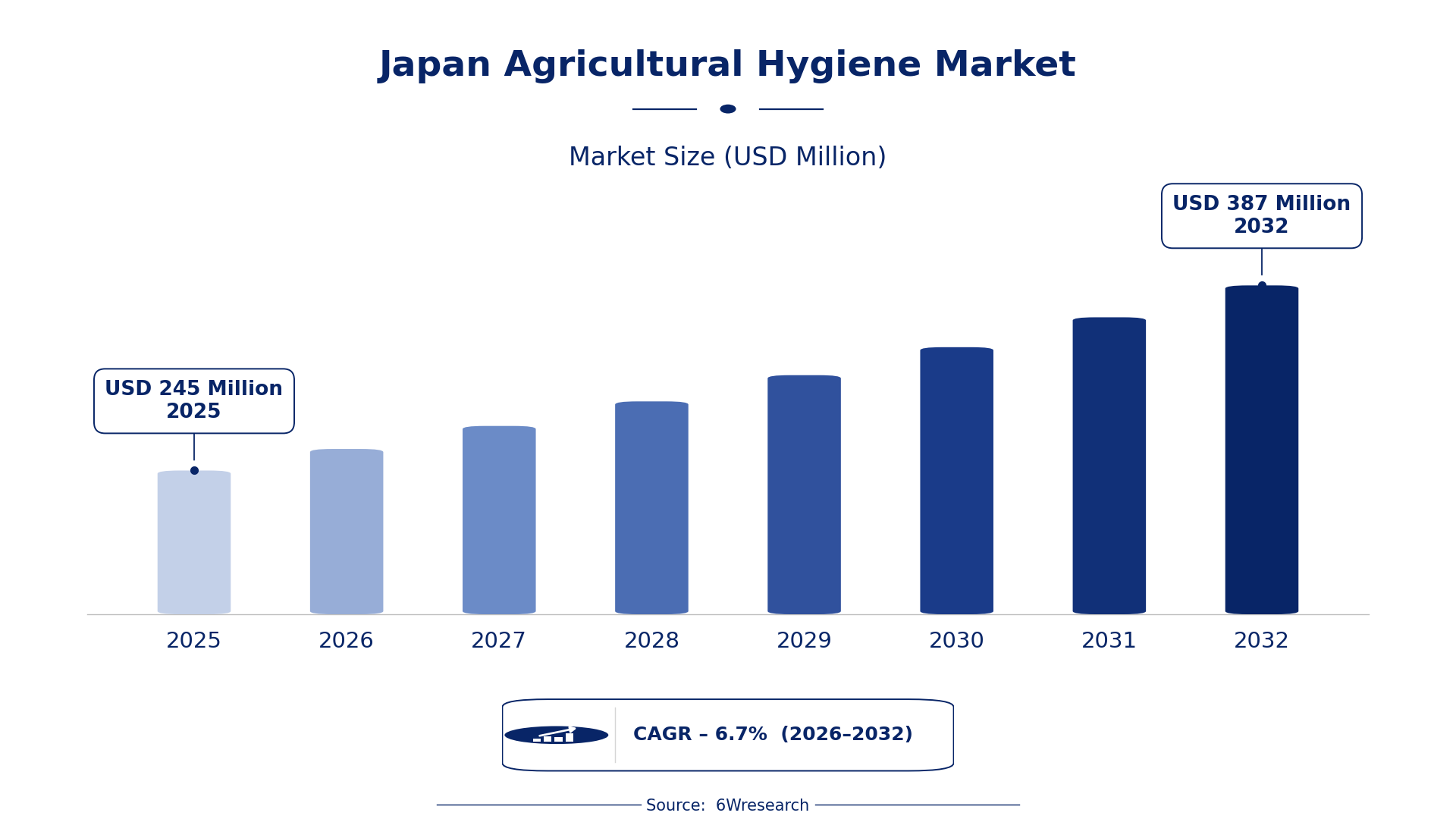
According to 6Wresearch internal database and industry insights, the Japan Agricultural Hygiene Market was valued at USD 245 Million in 2025 and is projected to reach USD 387 Million by 2032, growing at a CAGR of approximately 6.7% during 2026–2032.
Japan Agricultural Hygiene Market Highlights
| Report Metric | Details |
| Report Name | Japan Agricultural Hygiene Market (2026-2032) |
| Market Size 2025 | USD 245 Million |
| Market Size 2032 | USD 387 Million |
| Absolute Growth 2025–2032 | USD 142 Million |
| CAGR 2026–2032 | 6.7% |
| Peak Annual Growth | 7.5% in 2028 |
| Forecast Period | 2026–2032 |
| Historical Data | 2022–2025 |
| Base Year | 2025 |
| Leading Agricultural Hygiene Market, 2025 | Disinfectants (39% share) |
| Leading Product Type, 2025 | Livestock Sanitation (49% share) |
| Leading Application Area, 2025 | Agri Supply Stores (41% share) |
| Leading Distribution Channel, 2025 | Poultry Farms (39% share) |
| Fastest-Growing Agricultural Hygiene Market | Hand Hygiene Products (8.6% CAGR) |
| Fastest-Growing Product Type | Farmer Health (9.3% CAGR) |
| Fastest-Growing Application Area | Online Retail (8.4% CAGR) |
| Fastest-Growing Distribution Channel | Dairy Farms (8.8% CAGR) |
| Growing Sector | Livestock Farming |
| Key End Users | Farmers, Agri Supply Stores, Poultry Farms, Dairy Farms |
Japan Agricultural Hygiene Market Year-wise Growth Rate and Key Drivers (2022–2032)
This graph illustrates the annual growth rates of the market from 2022 to 2032, highlighting a steady upward trajectory and projected market expansion over the forecast period.
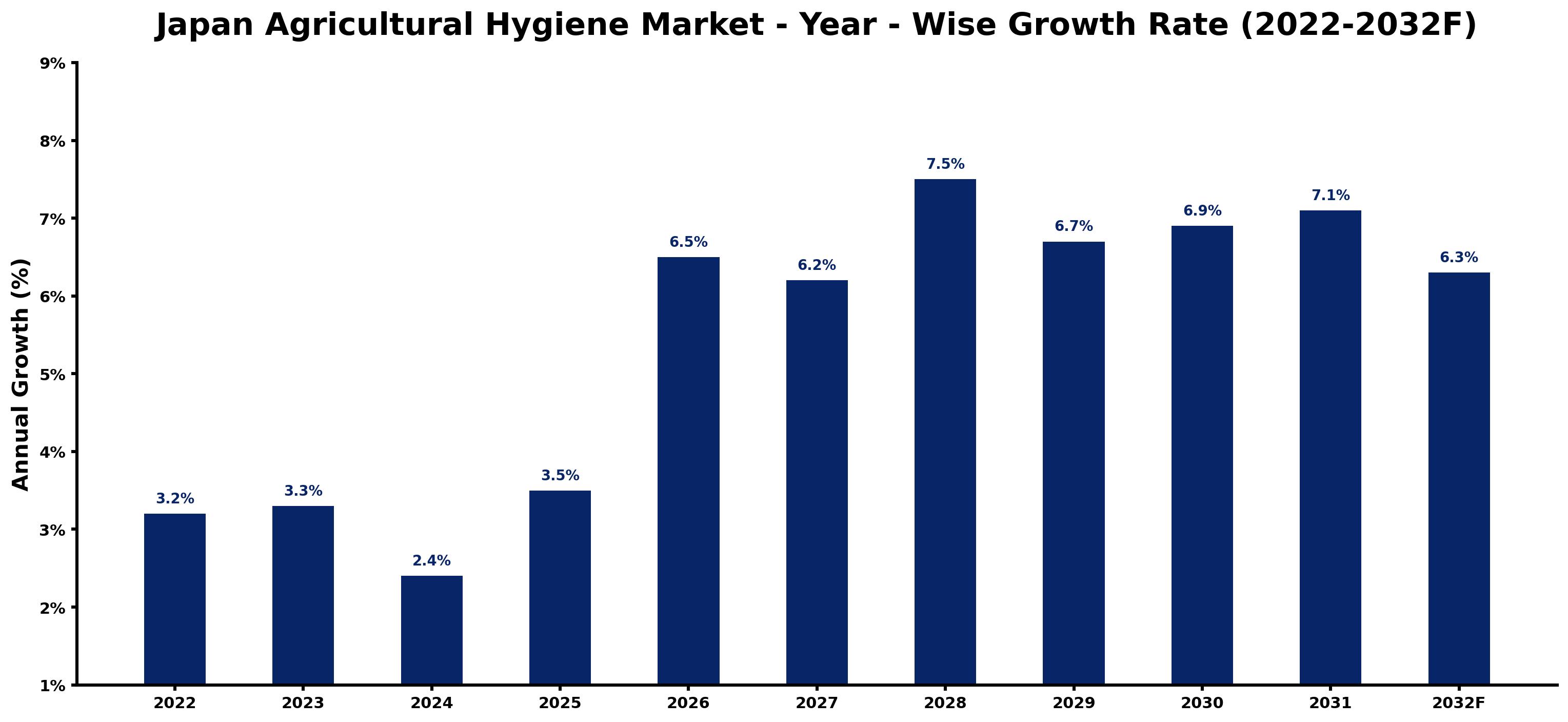
The yearly estimates that follow link every growth rate to its principal driver, so readers can see why the pace changed in each period.
| Year | Estimated Annual Growth (%) | Market Rationale |
| 2022 | 3.2 | The market showed steady growth due to consistent demand from the agricultural sector. |
| 2023 | 3.3 | Growth continued as the livestock sector maintained its contribution to agricultural output. |
| 2024 | 2.4 | The growth rate slowed as market adjustments occurred following previous expansions. |
| 2025 | 3.5 | Demand increased again, driven by biosecurity measures in poultry farms. |
| 2026 | 6.5 | The growth rate is expected to rise as investments in farmer health initiatives gain traction. |
| 2027 | 6.2 | A slight slowdown is projected, reflecting market adjustments to new supply conditions. |
| 2028 | 7.5 | The market is expected to peak as demand surges for livestock sanitation products. |
| 2029 | 6.7 | Growth is projected to slow slightly as market conditions stabilise after peak demand. |
| 2030 | 6.9 | A renewed interest in hygiene products is expected to lead to a faster growth rate. |
| 2031 | 7.1 | Demand will continue to rise, supported by ongoing investments in agricultural hygiene. |
| 2032 | 6.3 | Growth is projected to slow as the market reaches a more mature stage. |
Note: Market size estimations and growth projections presented in this report are based on 6Wresearch's proprietary forecasting methodology, utilizing the latest available industry data, government publications, and primary research inputs.
Japan Agricultural Hygiene Market Synopsis
Agricultural hygiene products include disinfectants, hand hygiene products, equipment sanitizers, and antimicrobial coatings, crucial for maintaining livestock health and ensuring farmer safety. The Japan Agricultural Hygiene Market is expanding due to a robust livestock sector, contributing about 30% to agricultural output, and a growing emphasis on biosecurity, particularly in poultry farms. Government initiatives to improve farmer health and the increasing use of online retail channels further drive market growth, with over 1.5 million farms in Japan creating substantial demand for these products.
Market Dynamics Impact Analysis (2026–2032)
| Factor | Type | Impact | Primary Segment Affected |
| The increasing livestock population drives demand for disinfectants, essential for pathogen control in farms. | Driver | High | Disinfectants |
| The rise in online retail sales provides farmers with easier access to hygiene products, boosting overall market growth. | Driver | High | Hand Hygiene Products |
| The limited availability of essential agricultural hygiene products raises procurement costs, affecting farmers' operations. | Restraint | High | Equipment Sanitizers |
| Supply chain disruptions due to stringent regulations delay product approvals, impacting hygiene standards on farms. | Restraint | Medium | Livestock Sanitation |
| The need for specialized training in hygiene practices presents challenges for farms, leading to increased disease outbreaks. | Challenge | High | Farmer Health |
| Emerging specialty stores increase competition, making it harder for traditional suppliers to maintain market share. | Challenge | Medium | Machinery Cleaning |
| The growing focus on biosecurity in poultry farms presents opportunities for suppliers of disinfectants and sanitizers. | Opportunity | High | Disinfectants |
| The increasing awareness of farmer health initiatives creates demand for hand hygiene products and related solutions. | Opportunity | Medium | Hand Hygiene Products |
Evaluation of Drivers in Japan Agricultural Hygiene Market (2026–2032)
The following drivers explain most of the expected growth.
| Drivers | Primary Segment Affected | Why It Matters (Evidence) |
| Growing livestock population increases demand for sanitation products. | Livestock Sanitation | The livestock sector contributes approximately 30% to Japan's agricultural output, leading to higher purchases of hygiene products. |
| Biosecurity measures in poultry farms drive product adoption. | Poultry Farms | In 2022, a government programme aimed at improving poultry biosecurity spurred demand for disinfectants. |
| Rising farmer health initiatives promote hygiene product usage. | Farmer Health | In 2023, the Ministry of Agriculture allocated funds to improve farmer health, increasing demand for hand hygiene products. |
| ISO 22000 standards drive compliance for food safety in agriculture. | Disinfectants | The adoption of ISO 22000 standards necessitates the use of effective hygiene products on farms. |
| Increased online retail sales provide wider access to hygiene products. | Online Retail | Online retail sales of agricultural hygiene products grew by 15% in 2023, expanding market reach. |
Several shifts outside the market lift sales. The livestock population is increasing, leading to heightened demand for sanitation products, particularly in the livestock sanitation segment. Compliance with ISO 22000 standards is also pushing the adoption of disinfectants, ensuring food safety in agricultural practices. The surge in online retail sales has provided farmers with easier access to essential hygiene products.
Evaluation of Restraints in Japan Agricultural Hygiene Market
The main factors holding the market back are set out below.
| Market Restraint | Primary Segment Affected | Why It Matters (Evidence) |
| Supply chain disruptions can impact product availability. | Livestock Sanitation | Unforeseen disruptions in the supply chain may lead to delays in product delivery. |
| Regulatory compliance can limit product options for buyers. | Disinfectants | Strict adherence to the Chemical Substances Control Law restricts the types of disinfectants that can be used. |
| Traditional sales channels may lose ground to online retail. | Hand Hygiene Products | While online retail grows, it may not fully offset declines in traditional purchasing methods. |
| Limited awareness of niche products may hinder market growth. | Specialty Stores | Emerging specialty stores face challenges in educating buyers about available hygiene solutions. |
| Market adjustments can lead to fluctuations in product demand. | Equipment Sanitizers | The market's response to changing conditions may result in inconsistent purchases of sanitizers. |
Japan Agricultural Hygiene Market Challenges
In 2023, many farms struggle with a lack of trained personnel for effective hygiene practices, leading to increased disease outbreaks among livestock. Buyers face rising costs due to limited availability of essential agricultural hygiene products, which can delay procurement processes by up to three weeks. Supply chain disruptions arise from stringent regulations, causing delays in product approvals and impacting farmers' ability to maintain hygiene standards. Competition intensifies as specialty stores emerge, making it harder for traditional suppliers to retain market share, ultimately raising prices for farmers seeking reliable products.
Trends in the Japan Agricultural Hygiene Market
Four trends stand out in the Japan Agricultural Hygiene Market.
- Shift to Improved Biosecurity Practices: Poultry farms are increasingly adopting stringent biosecurity measures, driven by a government programme launched in 2022. This shift has resulted in a rise in the demand for disinfectants, ensuring safer farming practices.
- Growing Online Retail for Hygiene Products: Agri supply stores are experiencing a transition towards online retail channels, with online sales of agricultural hygiene products growing by 15% in 2023. This trend allows farmers greater access to essential products.
- Increased Focus on Farmer Health Initiatives: The emphasis on farmer health is rising, particularly following funding from the Ministry of Agriculture in 2023. This focus has led to an increase in purchases of hand hygiene products.
- Emergence of Specialty Stores for Niche Products: Specialty stores are becoming more prominent in distributing niche agricultural hygiene products, catering to specific needs. This trend is expected to grow as awareness increases among farmers.
Investment Opportunities in the Japan Agricultural Hygiene Market
The following areas offer the clearest openings for investors and suppliers in the Japan Agricultural Hygiene Market.
- Supply of Disinfectants: With the livestock sector's growth, there is a strong demand for disinfectants, particularly in dairy farms. Entering through partnerships with local suppliers can improve market access.
- Investment in Hand Hygiene Products: The rising focus on farmer health presents an opportunity to supply hand hygiene products. Collaborating with agricultural cooperatives can facilitate entry into this market segment.
- Distribution through Online Retail Channels: The growth of online retail creates an opportunity for suppliers to reach a broader audience. Establishing a joint venture with an e-commerce platform can improve distribution capabilities.
- Expansion into Specialty Stores: The emergence of specialty stores provides a chance to supply niche hygiene products. Targeting urban areas with high agricultural activity can yield significant returns.
Government Initiatives in the Japan Agricultural Hygiene Market
The Chemical Substances Control Law regulates the safety and quality of agricultural hygiene products, ensuring compliance for producers and buyers. This law mandates that all disinfectants and sanitizers meet specific safety standards, impacting how products are formulated and marketed. Additionally, the Economic Security Promotion Act supports supply-chain resilience for critical agricultural products, improving the stability of hygiene product availability in the market.
In 2023, the Ministry of Agriculture allocated USD 5 million for initiatives aimed at improving farmer health, administered by the Ministry of Agriculture, Forestry and Fisheries (MAFF). This funding supports projects that promote better hygiene practices on farms, ensuring that producers have access to necessary resources to maintain health and safety standards.
Future Insight of the Japan Agricultural Hygiene Market
The introduction of biosecurity programmes will improve hygiene measures across farms by 2032, particularly benefiting livestock sectors. The implementation of ISO 22000 standards will simplify food safety management, providing advantages for both buyers and suppliers. Antimicrobial coatings will become commonplace in equipment hygiene, driving demand for advanced solutions. Increased distribution efficiency in the Tokyo region will support farmers, with online retail sales projected to grow by 15%, enhancing access to effective hygiene products.
Market Segmentation Analysis
Japan Agricultural Hygiene Market report covers a detailed analysis of the following market segments:
By Agricultural Hygiene Market – Disinfectants Lead, Hand Hygiene Products Expected to Grow Fastest
According to Saurav Kr Singh, Senior Research Analyst at 6Wresearch, Disinfectants held 39% of the Japan Agricultural Hygiene Market by agricultural hygiene market in 2025. Disinfectants hold the largest share as they are essential for controlling pathogens on farms. The significant number of over 1.5 million farms in Japan drives the critical demand for effective disinfectants to maintain livestock health. The quickest growth will come from Hand Hygiene Products, forecast to expand at a CAGR of 8.6% between 2026 and 2032. Hand hygiene products are experiencing rapid growth due to their importance in ensuring farmer health and safety. The recent government initiatives to improve farmer health further propel this segment's expansion. Suppliers should focus on enhancing the availability of hand hygiene products to meet the increasing demand.
By Product Type – Livestock Sanitation Leads, Farmer Health Expected to Grow Fastest
Livestock Sanitation accounted for 49% of the market by product type in 2025. Livestock sanitation products dominate the market as they are vital for maintaining animal health and productivity. The livestock sector's contribution of approximately 30% to Japan's agricultural output underscores the paramount need for effective sanitation. Farmer Health is projected to grow fastest, at a CAGR of 9.3% during 2026–2032. Farmer health products are witnessing the fastest growth because they are critical for preventing disease among workers. The government's allocation of funds for farmer health initiatives is likely to accelerate this trend. Buyers will benefit from improved health products that directly support worker safety and productivity.
By Application Area – Agri Supply Stores Lead, Online Retail Expected to Grow Fastest
With 41% of application area revenue in 2025, Agri Supply Stores was the largest category. Agri supply stores are the key distribution point for agricultural hygiene products, providing essential access to farmers. Their established presence in the market ensures that products reach a wide customer base effectively. Online Retail is set to record the highest CAGR in this split, 8.4% over 2026–2032. Online retail is growing rapidly as a channel for consumer access to agricultural hygiene products. The 15% growth in online sales in 2023 indicates a shift towards digital purchasing options among consumers. Suppliers should consider enhancing their online presence to capture the growing segment of digital consumers.
By Distribution Channel – Poultry Farms Lead, Dairy Farms Expected to Grow Fastest
In 2025, Poultry Farms led the distribution channel split with a 39% share. Poultry farms represent the largest user group of hygiene products, necessitating robust sanitation measures to maintain biosecurity. The recent government programme aimed at enhancing biosecurity in poultry farms underscores their importance in this market. Over 2026–2032, Dairy Farms are expected to post the fastest growth, at a CAGR of 8.8%. Dairy farms are experiencing the fastest growth in demand for sanitation products due to their significant need for effective hygiene measures. The average size of dairy farms in Japan, with approximately 100 cows, highlights the necessity for stringent sanitation practices. Suppliers should target dairy farms with tailored sanitation solutions to meet their specific hygiene needs.
Key Attractiveness of the Report
- 10 Years of Market Numbers
- Historical Data Starting from 2022 to 2025
- Base Year 2025
- Forecast Data until 2032
- Key Performance Indicators Impacting the Market
- Major Upcoming Developments and Projects
Key Highlights of the Report:
- Japan Agricultural Hygiene Market Outlook
- Market Size of Japan Agricultural Hygiene Market, 2025
- Forecast of Japan Agricultural Hygiene Market, 2032
- Historical Data and Forecast of Japan Agricultural Hygiene Revenues & Volume for the Period 2022-2032F
- Japan Agricultural Hygiene Market Trend Evolution
- Japan Agricultural Hygiene Market Drivers and Challenges
- Japan Agricultural Hygiene Price Trends
- Japan Agricultural Hygiene Porter's Five Forces
- Japan Agricultural Hygiene Industry Life Cycle
- Historical Data and Forecast of Japan Agricultural Hygiene Market Revenues & Volume By Agricultural Hygiene Market for the Period 2022-2032F
- Historical Data and Forecast of Japan Agricultural Hygiene Market Revenues & Volume By Disinfectants for the Period 2022-2032F
- Historical Data and Forecast of Japan Agricultural Hygiene Market Revenues & Volume By Hand Hygiene Products for the Period 2022-2032F
- Historical Data and Forecast of Japan Agricultural Hygiene Market Revenues & Volume By Equipment Sanitizers for the Period 2022-2032F
- Historical Data and Forecast of Japan Agricultural Hygiene Market Revenues & Volume By Antimicrobial Coatings for the Period 2022-2032F
- Historical Data and Forecast of Japan Agricultural Hygiene Market Revenues & Volume By Product Type for the Period 2022-2032F
- Historical Data and Forecast of Japan Agricultural Hygiene Market Revenues & Volume By Livestock Sanitation for the Period 2022-2032F
- Historical Data and Forecast of Japan Agricultural Hygiene Market Revenues & Volume By Farmer Health for the Period 2022-2032F
- Historical Data and Forecast of Japan Agricultural Hygiene Market Revenues & Volume By Machinery Cleaning for the Period 2022-2032F
- Historical Data and Forecast of Japan Agricultural Hygiene Market Revenues & Volume By Surface Protection for the Period 2022-2032F
- Historical Data and Forecast of Japan Agricultural Hygiene Market Revenues & Volume By Application Area for the Period 2022-2032F
- Historical Data and Forecast of Japan Agricultural Hygiene Market Revenues & Volume By Agri Supply Stores for the Period 2022-2032F
- Historical Data and Forecast of Japan Agricultural Hygiene Market Revenues & Volume By Online Retail for the Period 2022-2032F
- Historical Data and Forecast of Japan Agricultural Hygiene Market Revenues & Volume By Industrial Suppliers for the Period 2022-2032F
- Historical Data and Forecast of Japan Agricultural Hygiene Market Revenues & Volume By Specialty Stores for the Period 2022-2032F
- Historical Data and Forecast of Japan Agricultural Hygiene Market Revenues & Volume By Distribution Channel for the Period 2022-2032F
- Historical Data and Forecast of Japan Agricultural Hygiene Market Revenues & Volume By Poultry Farms for the Period 2022-2032F
- Historical Data and Forecast of Japan Agricultural Hygiene Market Revenues & Volume By Dairy Farms for the Period 2022-2032F
- Historical Data and Forecast of Japan Agricultural Hygiene Market Revenues & Volume By Agri Processing Units for the Period 2022-2032F
- Historical Data and Forecast of Japan Agricultural Hygiene Market Revenues & Volume By Greenhouses for the Period 2022-2032F
- Japan Agricultural Hygiene Import Export Trade Statistics
- Market Opportunity Assessment By Agricultural Hygiene Market
- Market Opportunity Assessment By Product Type
- Market Opportunity Assessment By Application Area
- Market Opportunity Assessment By Distribution Channel
- Japan Agricultural Hygiene Top Companies Market Share
- Japan Agricultural Hygiene Competitive Benchmarking By Technical and Operational Parameters
- Japan Agricultural Hygiene Company Profiles
- Japan Agricultural Hygiene Key Strategic Recommendations
Market Covered
The following segment groups are covered in the report.
By Agricultural Hygiene Market
- Disinfectants
- Hand Hygiene Products
- Equipment Sanitizers
- Antimicrobial Coatings
By Product Type
- Livestock Sanitation
- Farmer Health
- Machinery Cleaning
- Surface Protection
By Application Area
- Agri Supply Stores
- Online Retail
- Industrial Suppliers
- Specialty Stores
By Distribution Channel
- Poultry Farms
- Dairy Farms
- Agri Processing Units
- Greenhouses































