Japan Agricultural Insecticides Market Size & Growth Rate
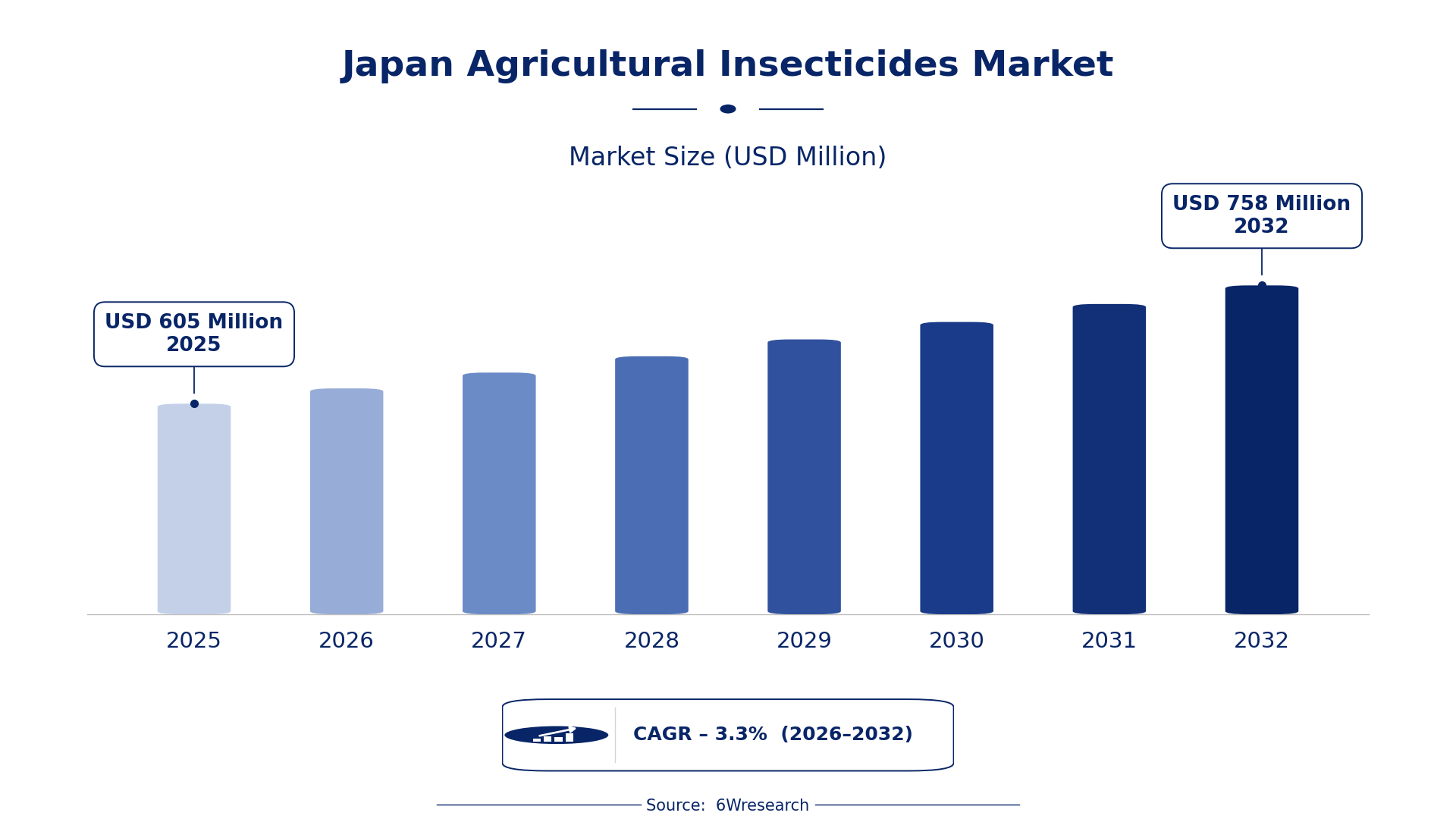
According to 6Wresearch internal database and industry insights, the Japan Agricultural Insecticides Market was valued at USD 605 Million in 2025 and is projected to reach USD 758 Million by 2032, growing at a CAGR of approximately 3.3% during 2026–2032.
Japan Agricultural Insecticides Market Highlights
| Report Metric | Details |
| Report Name | Japan Agricultural Insecticides Market (2026-2032) |
| Market Size 2025 | USD 605 Million |
| Market Size 2032 | USD 758 Million |
| Absolute Growth 2025–2032 | USD 153 Million |
| CAGR 2026–2032 | 3.3% |
| Peak Annual Growth | 4.6% in 2032 |
| Forecast Period | 2026–2032 |
| Historical Data | 2022–2025 |
| Base Year | 2025 |
| Leading Agricultural Insecticides Market, 2025 | Organophosphates (42% share) |
| Leading Product Type, 2025 | Leaf-Eating Insects (47% share) |
| Leading Target Insects, 2025 | Direct Sales (36% share) |
| Leading Distribution Channel, 2025 | Sugarcane Growers (51% share) |
| Fastest-Growing Agricultural Insecticides Market | Pyrethroids (4.6% CAGR) |
| Fastest-Growing Product Type | Flying Insects (4.7% CAGR) |
| Fastest-Growing Target Insects | Agri Shops (4.8% CAGR) |
| Fastest-Growing Distribution Channel | Cotton Farmers (4.4% CAGR) |
| Growing Sector | Cotton Farmers |
| Key End Users | Sugarcane Growers, Cotton Farmers, Fruit Growers, Organic Farms |
Japan Agricultural Insecticides Market Year-wise Growth Rate and Key Drivers (2022–2032)
This graph illustrates the annual growth rates of the market from 2022 to 2032, highlighting a steady upward trajectory and projected market expansion over the forecast period.
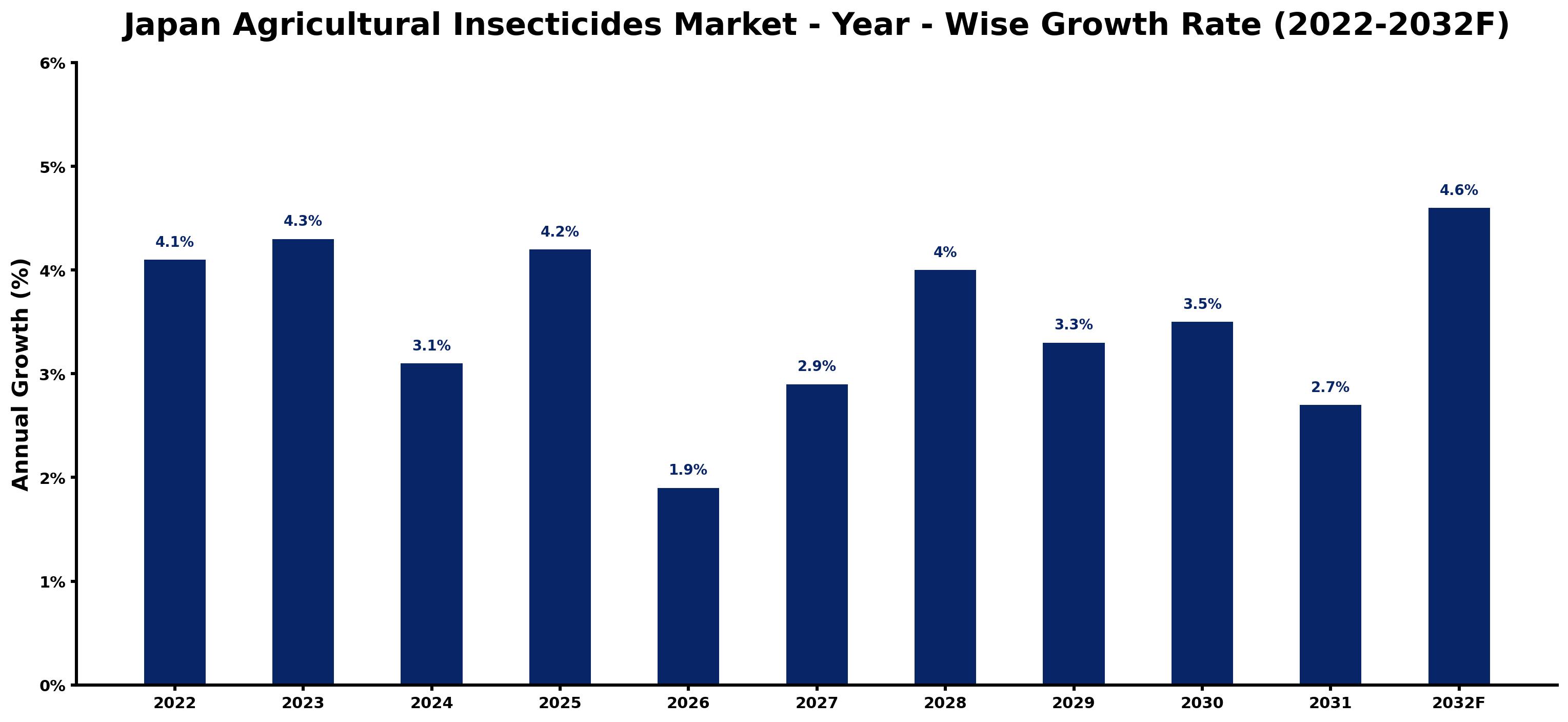
For each year, the table pairs the estimated growth rate with the leading influence on demand, showing how the drivers changed across the period.
| Year | Estimated Annual Growth (%) | Market Rationale |
| 2022 | 4.1 | The market experienced steady demand from domestic farmers and cooperatives. |
| 2023 | 4.3 | Increased adoption of integrated pest management practices contributed to growth. |
| 2024 | 3.1 | A slowdown occurred as farmers adjusted to changing pest management strategies. |
| 2025 | 4.2 | Rising agricultural yields drove renewed interest in effective pest control solutions. |
| 2026 | 1.9 | Growth is expected to slow as market saturation in certain insecticides limits expansion. |
| 2027 | 2.9 | A recovery in demand is projected as new pest threats emerge. |
| 2028 | 4.0 | Sustainability initiatives will boost interest in bio-insecticides. |
| 2029 | 3.3 | Economic pressures are anticipated to affect farmers' spending on insecticides. |
| 2030 | 3.5 | Technological advancements are set to improve pest control efficacy. |
| 2031 | 2.7 | Market conditions will stabilise, leading to slower growth rates. |
| 2032 | 4.6 | Demand for advanced insecticides is projected to surge. |
Note: Market size estimations and growth projections presented in this report are based on 6Wresearch's proprietary forecasting methodology, utilizing the latest available industry data, government publications, and primary research inputs.
Japan Agricultural Insecticides Market Synopsis
Agricultural insecticides are chemical substances used to control pests that harm crops, ensuring higher yields. The Japan Agricultural Insecticides Market is primarily driven by domestic farmers and agricultural cooperatives, with the sector valued at approximately ¥9 trillion. The government's recent promotion of bio-insecticides and integrated pest management practices is fuelling new demand, as farmers seek sustainable solutions to protect their crops and improve productivity. With over 300 registered insecticides, the market is adapting to evolving agricultural needs and consumer preferences.
Market Dynamics Impact Analysis (2026–2032)
| Factor | Type | Impact | Primary Segment Affected |
| Increasing adoption of bio-insecticides due to environmental concerns | Driver | High | Bio-Insecticides |
| Growing agricultural sector requiring effective pest control | Driver | High | Organophosphates |
| Rising demand for organic farming solutions | Opportunity | Medium | Bio-Insecticides |
| Expansion of distribution channels for easier access to products | Opportunity | Medium | Direct Sales |
| Regulatory compliance costs for pesticide registration | Restraint | High | Organophosphates |
| Limited awareness of integrated pest management practices | Restraint | Medium | Bio-Insecticides |
| High costs associated with research and development | Challenge | High | Organophosphates |
| Capacity constraints in production facilities | Challenge | Medium | Bio-Insecticides |
Evaluation of Drivers in Japan Agricultural Insecticides Market (2026–2032)
The table below links each growth driver to the segment it affects and the evidence for it.
| Drivers | Primary Segment Affected | Why It Matters (Evidence) |
| Increasing investment in sustainable agricultural practices | Bio-Insecticides | The government's recent programme to promote bio-insecticides has led to a rise in purchases by farmers seeking eco-friendly solutions. |
| Growing agricultural production in regions like Hokkaido | Organophosphates | Farmers are increasingly purchasing insecticides to protect their crops in a sector valued at approximately ¥9 trillion. |
| Rising consumer demand for organic produce | Bio-Insecticides | The government aims to increase organic farming by 50% by 2025, driving demand for environmentally friendly pest control. |
| Expansion of distribution channels like agri shops | Direct Sales | Direct sales accounted for 36% of the market in 2025, enabling easier access for farmers. |
| Adoption of integrated pest management practices | Organophosphates | With an adoption rate of around 30%, farmers are purchasing more insecticides that fit these practices. |
Spending rises because the agricultural sector in regions like Hokkaido is valued at approximately ¥9 trillion, prompting farmers to invest in effective pest control solutions. The demand for organic produce drives the goal to boost organic farming by 50% by 2025. The growth of distribution channels, particularly agri shops, has made insecticides more accessible, with direct sales accounting for 36% of the market in 2025. The adoption of integrated pest management practices, currently at around 30%, is encouraging farmers to buy insecticides that align with these strategies.
Evaluation of Restraints in Japan Agricultural Insecticides Market
Below are the constraints most often cited by buyers and suppliers, with the segment each affects.
| Market Restraint | Primary Segment Affected | Why It Matters (Evidence) |
| High costs of agricultural insecticides | Organophosphates | The average price of insecticides can reach ¥9 trillion annually, impacting farmers' budgets. |
| Regulatory hurdles in product approval | Bio-Insecticides | Approval processes can extend up to two years, delaying market entry and affecting pest control options. |
| Skills shortages among farmers | Neonicotinoids | With the average age of farmers exceeding 67 years, modern pest management techniques are less frequently adopted. |
| Confusion in product selection | Pyrethroids | Over 300 registered insecticides can overwhelm buyers, leading to inefficiencies in pest control strategies. |
| Economic pressures on farmers | Flying Insects | Farmers face financial constraints that limit their ability to invest in effective pest management solutions. |
Japan Agricultural Insecticides Market Challenges
Farmers face rising costs from agricultural insecticides, which can strain their finances by up to 20%. Regulatory hurdles delay the approval of new insecticides, causing setbacks of up to two years for producers needing effective solutions against crop threats. The average age of farmers exceeds 67 years, leading to a skills gap that hampers the adoption of modern pest management techniques. Buyers encounter confusion from over 300 registered insecticides, resulting in inefficiencies and potential crop losses due to ineffective pest control strategies.
Trends in the Japan Agricultural Insecticides Market
Buyers and suppliers in the Japan Agricultural Insecticides Market are adjusting to the following trends.
- Shift towards Bio-Insecticides: The 2023 government programme to promote bio-insecticides is changing the market dynamics. This shift is encouraging farmers to adopt more sustainable pest management practices, with a growing interest in eco-friendly solutions.
- Transition to Integrated Pest Management: The adoption of integrated pest management practices is increasing, with around 30% of farmers currently using these strategies. This trend is likely to rise as farmers seek more effective and sustainable pest control methods.
- Emergence of Online Purchasing Channels: The rise of online platforms for purchasing agricultural insecticides is changing buyer behaviour. This trend is gaining traction as farmers look for convenience and better access to products.
- Growing Demand for Organic Farming: The government's goal to increase organic farming by 50% by 2025 is influencing market trends. This initiative is driving demand for insecticides that comply with organic standards.
Investment Opportunities in the Japan Agricultural Insecticides Market
Several openings in the Japan Agricultural Insecticides Market merit attention from investors.
- Investment in Bio-Insecticides: The government programme launched in 2023 aims to promote bio-insecticides, creating a gap in the market. Farmers are increasingly seeking eco-friendly solutions, providing opportunities for suppliers to meet this demand.
- Supply of Integrated Pest Management Solutions: With an adoption rate of 30%, there is an opportunity to supply integrated pest management solutions. Farmers are looking for effective strategies to manage pests sustainably.
- Expansion of Agri Shops: The rise of agri shops, which accounted for a significant share of the market, presents an opportunity for suppliers. Investing in local partnerships can enhance distribution and reach farmers effectively.
- Development of Online Sales Platforms: The growing trend of online purchasing channels indicates a gap for digital sales solutions. Suppliers can invest in e-commerce platforms to cater to tech-savvy farmers.
Government Initiatives in the Japan Agricultural Insecticides Market
The Clinical Trials Act, in force since 2018, sets conduct and disclosure rules for agricultural chemicals, adding transparency to the approval process. This law strengthens the regulatory framework for producers, ensuring that all products meet safety standards before reaching the market.
The Ministry of Agriculture, Forestry and Fisheries oversees pesticide regulations and funds initiatives to promote sustainable practices. This agency plays a vital role in approving new products and supporting research in agricultural technologies.
Future Insight of the Japan Agricultural Insecticides Market
The introduction of precision agriculture technology will reshape demand by 2032, allowing farmers to enhance pest control efficiency. A government programme aimed at increasing organic farming by 50% by 2025 will drive innovation in sustainable pest management practices. The adoption rate of integrated pest management is expected to rise, leading to improved crop yields. With the agricultural sector valued at approximately ¥9 trillion, these advancements will create new opportunities for both buyers and suppliers, fostering a more resilient agricultural sector.
Market Segmentation Analysis
Japan Agricultural Insecticides Market report covers a detailed analysis of the following market segments:
By Agricultural Insecticides Market – Organophosphates Lead, Pyrethroids Expected to Grow Fastest
According to Saurav Kr Singh, Senior Research Analyst at 6Wresearch, the largest agricultural insecticides market category in 2025 was Organophosphates, at 42% of revenue. Organophosphates hold the largest share as they are extensively utilised by domestic farmers for effective pest control across various crops. Their importance is underscored by the high number of registered insecticides available, particularly in major agricultural regions like Tokyo and Hokkaido. Over 2026–2032, Pyrethroids are expected to post the fastest growth, at a CAGR of 4.6%. The growth of Pyrethroids is spurred by their effectiveness against a wide array of insects, crucial for farmers focused on maximising agricultural yields. This segment's expansion is further supported by the government's initiative to promote alternative pest management strategies. Suppliers must focus on developing organophosphate and pyrethroid products to meet the evolving pest management needs of farmers.
By Product Type – Leaf-Eating Insects Lead, Flying Insects Expected to Grow Fastest
With 47% of product type revenue in 2025, Leaf-Eating Insects was the largest category. Leaf-Eating Insects represent the largest share as they are a primary concern for crop protection, impacting many essential crops. Farmers prioritise controlling these pests to ensure optimal yields, especially in areas with intensive agricultural practices. The quickest growth will come from Flying Insects, forecast to expand at a CAGR of 4.7% between 2026 and 2032. Flying Insects are growing rapidly due to their critical role in the cultivation of fruit and vegetable crops, which are increasingly in demand. This growth reflects a broader trend among farmers to diversify their crop production efforts. Buyers should seek effective solutions to combat both leaf-eating and flying insects to improve overall crop health.
By Target Insects – Direct Sales Leads, Agri Shops Expected to Grow Fastest
In 2025, Direct Sales led the target insects split with a 36% share. Direct Sales dominate this segment as they serve as the primary channel for farmers, allowing for immediate access to necessary insecticides. This direct approach ensures that farmers can quickly obtain products tailored to their specific pest control needs. Agri Shops are set to record the highest CAGR in this split, 4.8% over 2026–2032. Agri Shops are growing rapidly as they serve as key distribution points for local farmers, providing convenient access to a variety of pest control solutions. The increasing number of agri shops reflects a shift towards more localised purchasing behaviours among farmers. Suppliers must strengthen relationships with agri shops to ensure their products are readily available to farmers.
By Distribution Channel – Sugarcane Growers Lead, Cotton Farmers Expected to Grow Fastest
Sugarcane Growers held 51% of the Japan Agricultural Insecticides Market by distribution channel in 2025. Sugarcane Growers dominate this segment because their specific pest control requirements are vital for maintaining crop productivity. The tailored pest management strategies employed by these growers highlight the need for specialised solutions in this sector. Cotton Farmers are projected to grow fastest, at a CAGR of 4.4% during 2026–2032. Cotton Farmers are experiencing the fastest growth as effective pest control is essential for protecting their high-value crops. The rising demand for cotton in various markets is driving this segment's rapid development. Suppliers should develop targeted approaches to address the unique needs of both sugarcane growers and cotton farmers.
Key Attractiveness of the Report
- 10 Years of Market Numbers
- Historical Data Starting from 2022 to 2025
- Base Year 2025
- Forecast Data until 2032
- Key Performance Indicators Impacting the Market
- Major Upcoming Developments and Projects
Key Highlights of the Report:
- Japan Agricultural Insecticides Market Outlook
- Market Size of Japan Agricultural Insecticides Market, 2025
- Forecast of Japan Agricultural Insecticides Market, 2032
- Historical Data and Forecast of Japan Agricultural Insecticides Revenues & Volume for the Period 2022-2032F
- Japan Agricultural Insecticides Market Trend Evolution
- Japan Agricultural Insecticides Market Drivers and Challenges
- Japan Agricultural Insecticides Price Trends
- Japan Agricultural Insecticides Porter's Five Forces
- Japan Agricultural Insecticides Industry Life Cycle
- Historical Data and Forecast of Japan Agricultural Insecticides Market Revenues & Volume By Agricultural Insecticides Market for the Period 2022-2032F
- Historical Data and Forecast of Japan Agricultural Insecticides Market Revenues & Volume By Organophosphates for the Period 2022-2032F
- Historical Data and Forecast of Japan Agricultural Insecticides Market Revenues & Volume By Pyrethroids for the Period 2022-2032F
- Historical Data and Forecast of Japan Agricultural Insecticides Market Revenues & Volume By Neonicotinoids for the Period 2022-2032F
- Historical Data and Forecast of Japan Agricultural Insecticides Market Revenues & Volume By Bio-Insecticides for the Period 2022-2032F
- Historical Data and Forecast of Japan Agricultural Insecticides Market Revenues & Volume By Product Type for the Period 2022-2032F
- Historical Data and Forecast of Japan Agricultural Insecticides Market Revenues & Volume By Leaf-Eating Insects for the Period 2022-2032F
- Historical Data and Forecast of Japan Agricultural Insecticides Market Revenues & Volume By Flying Insects for the Period 2022-2032F
- Historical Data and Forecast of Japan Agricultural Insecticides Market Revenues & Volume By Sap-Sucking Insects for the Period 2022-2032F
- Historical Data and Forecast of Japan Agricultural Insecticides Market Revenues & Volume By Eco-friendly Targets for the Period 2022-2032F
- Historical Data and Forecast of Japan Agricultural Insecticides Market Revenues & Volume By Target Insects for the Period 2022-2032F
- Historical Data and Forecast of Japan Agricultural Insecticides Market Revenues & Volume By Direct Sales for the Period 2022-2032F
- Historical Data and Forecast of Japan Agricultural Insecticides Market Revenues & Volume By Agri Shops for the Period 2022-2032F
- Historical Data and Forecast of Japan Agricultural Insecticides Market Revenues & Volume By Online Platforms for the Period 2022-2032F
- Historical Data and Forecast of Japan Agricultural Insecticides Market Revenues & Volume By Specialty Stores for the Period 2022-2032F
- Historical Data and Forecast of Japan Agricultural Insecticides Market Revenues & Volume By Distribution Channel for the Period 2022-2032F
- Historical Data and Forecast of Japan Agricultural Insecticides Market Revenues & Volume By Sugarcane Growers for the Period 2022-2032F
- Historical Data and Forecast of Japan Agricultural Insecticides Market Revenues & Volume By Cotton Farmers for the Period 2022-2032F
- Historical Data and Forecast of Japan Agricultural Insecticides Market Revenues & Volume By Fruit Growers for the Period 2022-2032F
- Historical Data and Forecast of Japan Agricultural Insecticides Market Revenues & Volume By Organic Farms for the Period 2022-2032F
- Japan Agricultural Insecticides Import Export Trade Statistics
- Market Opportunity Assessment By Agricultural Insecticides Market
- Market Opportunity Assessment By Product Type
- Market Opportunity Assessment By Target Insects
- Market Opportunity Assessment By Distribution Channel
- Japan Agricultural Insecticides Top Companies Market Share
- Japan Agricultural Insecticides Competitive Benchmarking By Technical and Operational Parameters
- Japan Agricultural Insecticides Company Profiles
- Japan Agricultural Insecticides Key Strategic Recommendations
Market Covered
The study includes the following segmentation.
By Agricultural Insecticides Market
- Organophosphates
- Pyrethroids
- Neonicotinoids
- Bio-Insecticides
By Product Type
- Leaf-Eating Insects
- Flying Insects
- Sap-Sucking Insects
- Eco-friendly Targets
By Target Insects
- Direct Sales
- Agri Shops
- Online Platforms
- Specialty Stores
By Distribution Channel
- Sugarcane Growers
- Cotton Farmers
- Fruit Growers
- Organic Farms































