Japan Agricultural Machinery Engine Market Size & Growth Rate
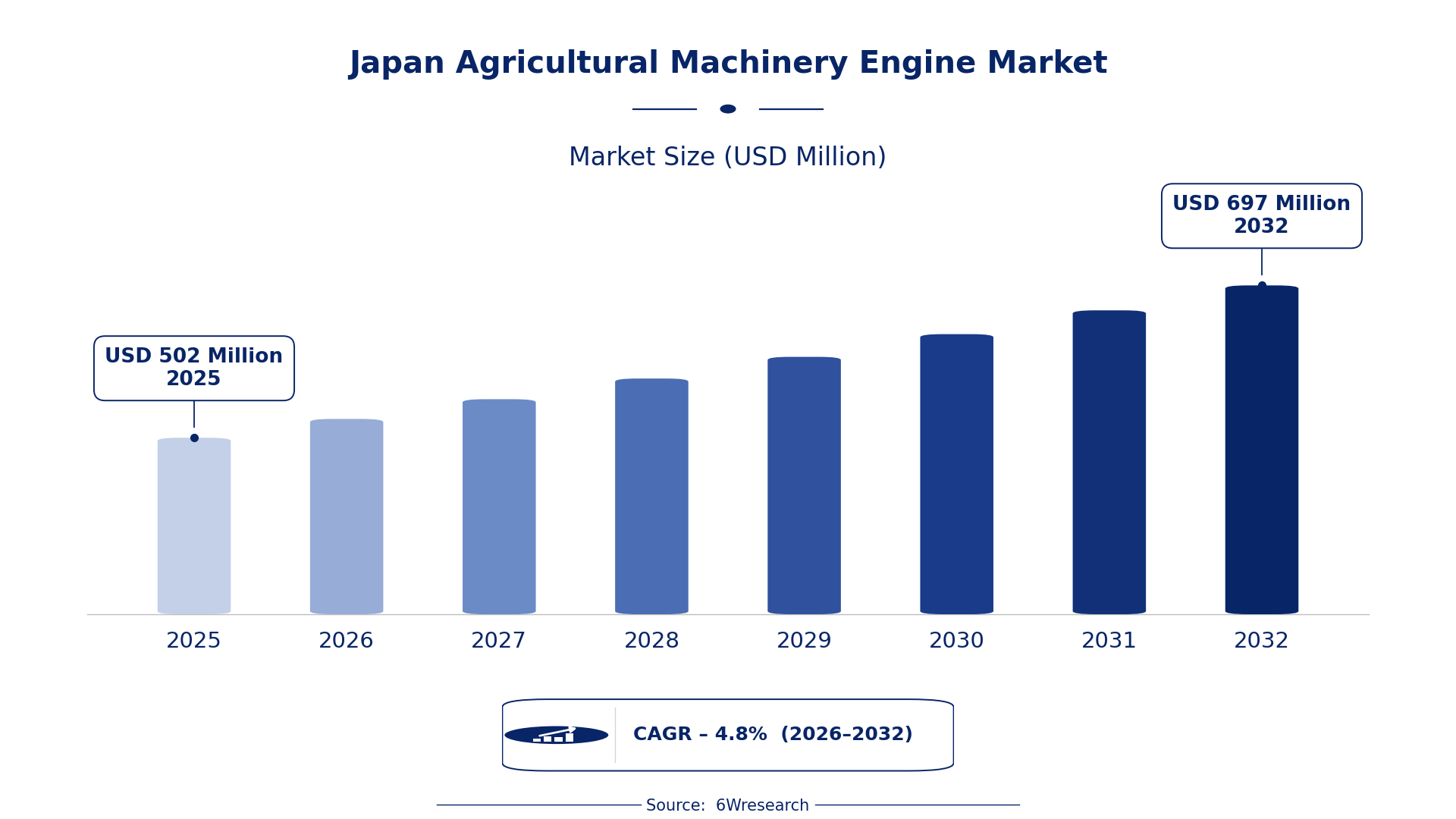
According to 6Wresearch internal database and industry insights, the Japan Agricultural Machinery Engine Market was valued at USD 502 Million in 2025 and is projected to reach USD 697 Million by 2032, growing at a CAGR of approximately 4.8% during 2026–2032.
Japan Agricultural Machinery Engine Market Highlights
| Report Metric | Details |
| Report Name | Japan Agricultural Machinery Engine Market (2026-2032) |
| Market Size 2025 | USD 502 Million |
| Market Size 2032 | USD 697 Million |
| Absolute Growth 2025–2032 | USD 195 Million |
| CAGR 2026–2032 | 4.8% |
| Peak Annual Growth | 6.3% in 2032 |
| Forecast Period | 2026–2032 |
| Historical Data | 2022–2025 |
| Base Year | 2025 |
| Leading Agricultural Machinery Engine Market, 2025 | Diesel Engines (46% share) |
| Leading Engine Type, 2025 | 4-Stroke (39% share) |
| Leading Fuel Type, 2025 | Diesel (47% share) |
| Leading Distribution Channel, 2025 | Machinery Dealers (54% share) |
| Leading End User, 2025 | Tractor OEMs (48% share) |
| Fastest-Growing Agricultural Machinery Engine Market | Gasoline Engines (6.6% CAGR) |
| Fastest-Growing Engine Type | 2-Stroke (6.8% CAGR) |
| Fastest-Growing Fuel Type | Gasoline (7.0% CAGR) |
| Fastest-Growing Distribution Channel | Equipment Suppliers (6.4% CAGR) |
| Fastest-Growing End User | Irrigation Pump Users (6.5% CAGR) |
| Growing Sector | Agricultural technology |
| Key End Users | Farmers, Agricultural cooperatives, Machinery dealers, Equipment suppliers |
Japan Agricultural Machinery Engine Market Year-wise Growth Rate and Key Drivers (2022–2032)
This graph illustrates the annual growth rates of the market from 2022 to 2032, highlighting a steady upward trajectory and projected market expansion over the forecast period.
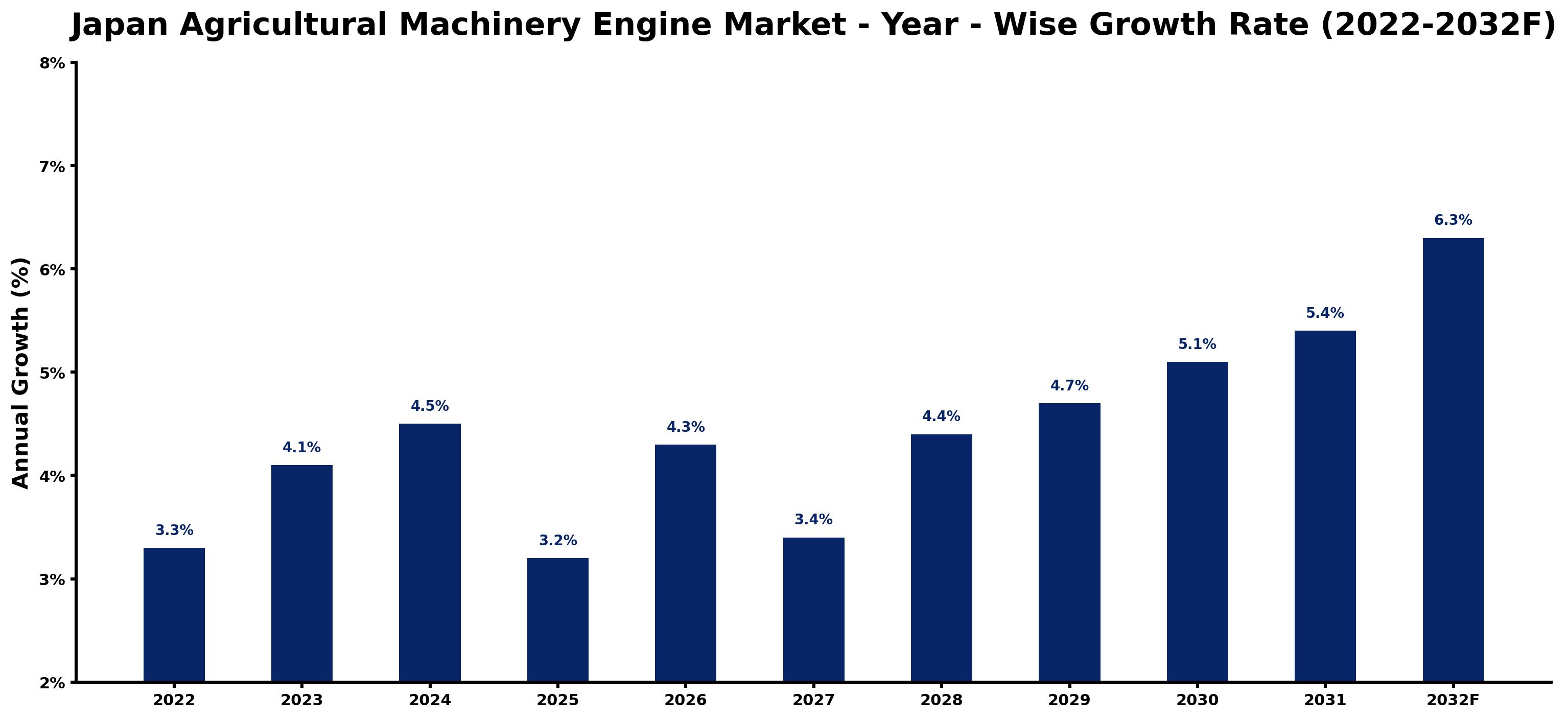
Each row of the following table gives one year's estimated growth and the event or demand shift that explains it.
| Year | Estimated Annual Growth (%) | Market Rationale |
| 2022 | 3.3 | Demand was steady as farmers maintained existing equipment and sought replacements. |
| 2023 | 4.1 | Growth accelerated due to increased investment in agricultural technology and machinery. |
| 2024 | 4.5 | Continued investment in modernisation led to higher demand for engines. |
| 2025 | 3.2 | Cautious spending emerged as buyers faced economic uncertainties. |
| 2026 | 4.3 | Demand is expected to rise with a focus on efficiency and sustainability in farming. |
| 2027 | 3.4 | A slight slowdown is projected as market saturation begins to affect new purchases. |
| 2028 | 4.4 | Increased interest in hybrid solutions is expected to spur demand for new engines. |
| 2029 | 4.7 | Demand will rise as farmers seek to improve productivity with advanced machinery. |
| 2030 | 5.1 | Investment in precision agriculture is projected to drive further growth in engine purchases. |
| 2031 | 5.4 | Continued adoption of sustainable practices will support engine demand. |
| 2032 | 6.3 | Peak demand is anticipated as the market shifts towards advanced technologies. |
Note: Market size estimations and growth projections presented in this report are based on 6Wresearch's proprietary forecasting methodology, utilizing the latest available industry data, government publications, and primary research inputs.
Japan Agricultural Machinery Engine Market Synopsis
Agricultural machinery engines are combustion engines powering essential farming equipment such as tractors and harvesters. These engines are manufactured using advanced engineering techniques and precision assembly. The Japan Agricultural Machinery Engine Market is expanding due to investments from domestic farmers and agricultural cooperatives, alongside government initiatives promoting sustainable practices. The Tohoku region plays a crucial role in production, with demand driven by technological advancements and efficiency requirements, contributing to a market valued at approximately 1 trillion JPY.
Market Dynamics Impact Analysis (2026–2032)
| Factor | Type | Impact | Primary Segment Affected |
| Growing adoption of advanced agricultural technologies | Driver | High | Diesel Engines |
| Rising focus on sustainable farming practices | Driver | High | Gasoline Engines |
| Emerging demand for hybrid engines | Opportunity | Medium | Hybrid Engines |
| Increased interest in electric engines for urban farming | Opportunity | Medium | Electric Engines |
| High costs associated with engine upgrades | Restraint | High | Diesel Engines |
| Limited infrastructure for electric engine support | Restraint | Medium | Electric Engines |
| Competition from imported machinery engines | Challenge | High | Diesel Engines |
| Technological adaptation challenges for older farms | Challenge | Medium | Gasoline Engines |
Evaluation of Drivers in Japan Agricultural Machinery Engine Market (2026–2032)
The following drivers explain most of the expected growth.
| Drivers | Primary Segment Affected | Why It Matters (Evidence) |
| Increased investments in agricultural technology | Diesel Engines | In 2022, over 4 million registered tractors in Japan drove demand for efficient engines. |
| Government subsidies for modernization | Gasoline Engines | Subsidies of 50 billion JPY annually encourage farmers to upgrade machinery. |
| Rising demand for fuel-efficient engines | Hybrid Engines | The 2023 government program promoting hybrid adoption is boosting interest. |
| Growing urban farming initiatives | Electric Engines | Urban farming projects are increasing the use of electric engines in Japan. |
| Focus on sustainability in agriculture | Diesel Engines | The Ministry of Agriculture promotes sustainable practices, increasing engine demand. |
Purchasing is picking up as domestic farmers invest in modern agricultural technology, with over 4 million tractors registered in 2022. Urban farming projects are also increasing the demand for electric engines, reflecting a shift towards sustainability. The emphasis on fuel efficiency and sustainable practices is shaping purchasing decisions across the market.
Evaluation of Restraints in Japan Agricultural Machinery Engine Market
The key brakes on demand, and where they bite hardest, are shown below.
| Market Restraint | Primary Segment Affected | Why It Matters (Evidence) |
| High costs associated with upgrading engines | Diesel Engines | Many farmers face financial constraints, limiting their ability to invest in new engines. |
| Limited infrastructure for electric engine support | Electric Engines | The lack of charging stations restricts the adoption of electric engines in agriculture. |
| Competition from imported machinery engines | Gasoline Engines | Imported engines often offer lower prices, affecting local manufacturers' sales. |
| Technological adaptation challenges for older farms | Hybrid Engines | Older farms struggle to integrate new technologies, slowing hybrid engine adoption. |
| Market saturation affecting new purchases | Diesel Engines | With over 4 million registered tractors, demand for new engines is stabilising. |
Japan Agricultural Machinery Engine Market Challenges
Over 4 million registered tractors in Japan indicate a reliance on aging technology, with the average tractor age around 15 years. This outdated machinery reduces operational efficiency, causing farmers to incur higher fuel costs. The national minimum wage, which rose to JPY 1,055 per hour in October 2024, increases labour expenses for producers, leading to elevated prices for buyers. Local manufacturers face intense competition from imported specialized equipment, compelling them to cut prices, which may result in diminished quality and service for agricultural cooperatives.
Trends in the Japan Agricultural Machinery Engine Market
These developments are changing demand patterns in the Japan Agricultural Machinery Engine Market.
- Shift from Traditional to Hybrid Engines: In 2023, the government launched a program to promote hybrid engine adoption, responding to rising environmental concerns. This initiative is projected to increase hybrid engine sales, reflecting a growing trend towards sustainable farming practices.
- Increase in Electric Engine Usage: Urban farming initiatives are driving the adoption of electric engines, with a notable rise in demand. In 2022, electric engines accounted for a small but growing segment, indicating a shift in farming practices.
- Growing Demand for Fuel-Efficient Engines: The focus on sustainability has led to an increased demand for fuel-efficient engines. In 2022, the Ministry of Agriculture highlighted the importance of efficiency in modern farming, influencing purchasing decisions.
- Rising Interest in Advanced Agricultural Technologies: The Tohoku region has seen a surge in technological investments, with farmers increasingly adopting advanced machinery. This trend is expected to continue, reflecting a broader shift towards modern agricultural practices.
Investment Opportunities in the Japan Agricultural Machinery Engine Market
The following opportunities in the Japan Agricultural Machinery Engine Market pair current demand with a clear way in.
- Irrigation Pump Users Seeking Efficiency: Irrigation pump users are increasingly looking for efficient engine solutions, with demand projected to rise. The average farm size in Japan is about 1.5 hectares, necessitating effective machinery.
- Growing Need for Hybrid Solutions: The recent government program promoting hybrid engines creates a timely opportunity for suppliers. With a projected increase in hybrid engine adoption, manufacturers can benefit from this shift.
- Machinery Dealers Expanding Offerings: Machinery dealers are looking to expand their product lines to include more advanced engines. With the market valued at approximately 1 trillion JPY, there is considerable potential for growth.
- Equipment Suppliers Targeting New Markets: Equipment suppliers can capitalise on the rising interest in electric engines, particularly in urban farming. The market gap for electric solutions presents an opportunity for strategic investments.
Government Initiatives in the Japan Agricultural Machinery Engine Market
The Act on the Rational Use of Energy, established in 1979, mandates large energy users to improve efficiency. This law affects agricultural machinery producers, requiring them to invest in energy-efficient technologies to comply with regulations. Additionally, the New Robot Strategy launched in 2015 aims to promote automation in agriculture, encouraging the adoption of advanced machinery.
Various agricultural programs are overseen by the Ministry of Agriculture, Forestry and Fisheries. The government allocates 50 billion JPY annually for agricultural modernization, supporting farmers in upgrading their machinery. This funding enables buyers to access modern engines and improve productivity.
Future Insight of the Japan Agricultural Machinery Engine Market
Electric engines will reshape demand by 2032 as urban farming initiatives integrate advanced technologies to enhance productivity. Government programmes will support agricultural modernization, encouraging producers to invest in new machinery. With annual subsidies for innovation reaching 50 billion JPY, suppliers will focus on developing efficient equipment. Buyers will benefit from improved access to sustainable solutions, driving growth in the agricultural sector.
Market Segmentation Analysis
Japan Agricultural Machinery Engine Market report covers a detailed analysis of the following market segments:
By Agricultural Machinery Engine Market – Diesel Engines Lead, Gasoline Engines Expected to Grow Fastest
According to Saurav Kr Singh, Senior Research Analyst at 6Wresearch, Diesel Engines accounted for 46% of the market by agricultural machinery engine market in 2025. Diesel engines dominate the agricultural machinery engine market due to their widespread use in tractors and heavy machinery, which are essential for large-scale farming operations. For instance, the presence of over 4 million registered tractors in Japan highlights the reliance on diesel engines for agricultural productivity. Gasoline Engines are set to record the highest CAGR in this split, 6.6% over 2026–2032. Gasoline engines are experiencing rapid growth as they are increasingly used in smaller agricultural equipment, catering to niche markets. The government's recent programme promoting hybrid engine adoption may also encourage a shift towards gasoline engines in specific applications. Suppliers should focus on diversifying their product offerings to include gasoline engines to meet changing market demands.
By Engine Type – 4-Stroke Leads, 2-Stroke Expected to Grow Fastest
With 39% of engine type revenue in 2025, 4-Stroke was the largest category. 4-stroke engines hold the largest share in Japan due to their efficiency and reliability, making them ideal for powering various agricultural machinery. Their prevalence among farmers and manufacturers, particularly in regions like Tohoku, ensures they remain the preferred choice for agricultural applications. 2-Stroke is projected to grow fastest, at a CAGR of 6.8% during 2026–2032. 2-stroke engines are experiencing rapid growth as they are increasingly utilised in specific applications such as handheld tools for modern farming. This focused use is driving their adoption and expanding their market presence. Suppliers should consider investing in the development of 2-stroke engine technologies to capitalise on this growth opportunity.
By Fuel Type – Diesel Leads, Gasoline Expected to Grow Fastest
The largest fuel type category in 2025 was Diesel, at 47% of revenue. Diesel is the leading fuel type for agricultural engines, largely due to its performance in heavy-duty applications, which are vital for powering most agricultural machinery. Its established dominance ensures that it remains the fuel of choice among users. The quickest growth will come from Gasoline, forecast to expand at a CAGR of 7.0% between 2026 and 2032. Gasoline is experiencing accelerated growth as it becomes the preferred option for smaller machinery, appealing to farmers who require versatile equipment. This trend suggests a shift in fuel preferences towards more adaptable solutions. Suppliers ought to diversify their fuel offerings to include gasoline options to meet changing customer demands.
By Distribution Channel – Machinery Dealers Lead, Equipment Suppliers Expected to Grow Fastest
Machinery Dealers held 54% of the Japan Agricultural Machinery Engine Market by distribution channel in 2025. Machinery dealers dominate the distribution of agricultural engines, providing vital access to a wide range of products and services for farmers. Their established relationships with manufacturers and end users facilitate efficient distribution across Japan's agricultural sector. Over 2026–2032, Equipment Suppliers are expected to post the fastest growth, at a CAGR of 6.4%. Equipment suppliers are rapidly gaining traction as they offer engines as part of larger machinery solutions, appealing to farmers looking for comprehensive equipment packages. This trend indicates a shift towards integrated solutions in the market. Suppliers should enhance partnerships with equipment suppliers to improve their market reach and visibility.
By End User – Tractor OEMs Lead, Irrigation Pump Users Expected to Grow Fastest
Tractor OEMs took 48% of end user revenue in 2025, more than any other category. Tractor OEMs constitute the largest end user segment for agricultural engines, underscoring the essential role tractors play in modern farming. Their steady demand for reliable engines significantly influences the overall market for agricultural machinery engines. Irrigation Pump Users are set to record the highest CAGR in this split, 6.5% over 2026–2032. Irrigation pump users are increasingly becoming a vital segment, relying on specialised engines to enhance their irrigation systems. This trend highlights the growing emphasis on effective water management practices in agriculture. Suppliers should tailor their products to meet the specific needs of irrigation pump users to effectively engage with this expanding market.
Key Attractiveness of the Report
- 10 Years of Market Numbers
- Historical Data Starting from 2022 to 2025
- Base Year 2025
- Forecast Data until 2032
- Key Performance Indicators Impacting the Market
- Major Upcoming Developments and Projects
Key Highlights of the Report:
- Japan Agricultural Machinery Engine Market Outlook
- Market Size of Japan Agricultural Machinery Engine Market, 2025
- Forecast of Japan Agricultural Machinery Engine Market, 2032
- Historical Data and Forecast of Japan Agricultural Machinery Engine Revenues & Volume for the Period 2022-2032F
- Japan Agricultural Machinery Engine Market Trend Evolution
- Japan Agricultural Machinery Engine Market Drivers and Challenges
- Japan Agricultural Machinery Engine Price Trends
- Japan Agricultural Machinery Engine Porter's Five Forces
- Japan Agricultural Machinery Engine Industry Life Cycle
- Historical Data and Forecast of Japan Agricultural Machinery Engine Market Revenues & Volume By Agricultural Machinery Engine Market for the Period 2022-2032F
- Historical Data and Forecast of Japan Agricultural Machinery Engine Market Revenues & Volume By Diesel Engines for the Period 2022-2032F
- Historical Data and Forecast of Japan Agricultural Machinery Engine Market Revenues & Volume By Gasoline Engines for the Period 2022-2032F
- Historical Data and Forecast of Japan Agricultural Machinery Engine Market Revenues & Volume By Electric Engines for the Period 2022-2032F
- Historical Data and Forecast of Japan Agricultural Machinery Engine Market Revenues & Volume By Hybrid Engines for the Period 2022-2032F
- Historical Data and Forecast of Japan Agricultural Machinery Engine Market Revenues & Volume By Engine Type for the Period 2022-2032F
- Historical Data and Forecast of Japan Agricultural Machinery Engine Market Revenues & Volume By 4-Stroke for the Period 2022-2032F
- Historical Data and Forecast of Japan Agricultural Machinery Engine Market Revenues & Volume By 2-Stroke for the Period 2022-2032F
- Historical Data and Forecast of Japan Agricultural Machinery Engine Market Revenues & Volume By Brushless DC for the Period 2022-2032F
- Historical Data and Forecast of Japan Agricultural Machinery Engine Market Revenues & Volume By Dual Fuel for the Period 2022-2032F
- Historical Data and Forecast of Japan Agricultural Machinery Engine Market Revenues & Volume By Fuel Type for the Period 2022-2032F
- Historical Data and Forecast of Japan Agricultural Machinery Engine Market Revenues & Volume By Diesel for the Period 2022-2032F
- Historical Data and Forecast of Japan Agricultural Machinery Engine Market Revenues & Volume By Gasoline for the Period 2022-2032F
- Historical Data and Forecast of Japan Agricultural Machinery Engine Market Revenues & Volume By Electricity for the Period 2022-2032F
- Historical Data and Forecast of Japan Agricultural Machinery Engine Market Revenues & Volume By Diesel-Electric for the Period 2022-2032F
- Historical Data and Forecast of Japan Agricultural Machinery Engine Market Revenues & Volume By Distribution Channel for the Period 2022-2032F
- Historical Data and Forecast of Japan Agricultural Machinery Engine Market Revenues & Volume By Machinery Dealers for the Period 2022-2032F
- Historical Data and Forecast of Japan Agricultural Machinery Engine Market Revenues & Volume By Equipment Suppliers for the Period 2022-2032F
- Historical Data and Forecast of Japan Agricultural Machinery Engine Market Revenues & Volume By Online Platforms for the Period 2022-2032F
- Historical Data and Forecast of Japan Agricultural Machinery Engine Market Revenues & Volume By Direct Sales for the Period 2022-2032F
- Historical Data and Forecast of Japan Agricultural Machinery Engine Market Revenues & Volume By End User for the Period 2022-2032F
- Historical Data and Forecast of Japan Agricultural Machinery Engine Market Revenues & Volume By Tractor OEMs for the Period 2022-2032F
- Historical Data and Forecast of Japan Agricultural Machinery Engine Market Revenues & Volume By Irrigation Pump Users for the Period 2022-2032F
- Historical Data and Forecast of Japan Agricultural Machinery Engine Market Revenues & Volume By Solar Farming Units for the Period 2022-2032F
- Historical Data and Forecast of Japan Agricultural Machinery Engine Market Revenues & Volume By Government Buyers for the Period 2022-2032F
- Japan Agricultural Machinery Engine Import Export Trade Statistics
- Market Opportunity Assessment By Agricultural Machinery Engine Market
- Market Opportunity Assessment By Engine Type
- Market Opportunity Assessment By Fuel Type
- Market Opportunity Assessment By Distribution Channel
- Market Opportunity Assessment By End User
- Japan Agricultural Machinery Engine Top Companies Market Share
- Japan Agricultural Machinery Engine Competitive Benchmarking By Technical and Operational Parameters
- Japan Agricultural Machinery Engine Company Profiles
- Japan Agricultural Machinery Engine Key Strategic Recommendations
Market Covered
Coverage by segment is as follows.
By Agricultural Machinery Engine Market
- Diesel Engines
- Gasoline Engines
- Electric Engines
- Hybrid Engines
By Engine Type
- 4-Stroke
- 2-Stroke
- Brushless DC
- Dual Fuel
By Fuel Type
- Diesel
- Gasoline
- Electricity
- Diesel-Electric
By Distribution Channel
- Machinery Dealers
- Equipment Suppliers
- Online Platforms
- Direct Sales
By End User
- Tractor OEMs
- Irrigation Pump Users
- Solar Farming Units
- Government Buyers































