Japan Agricultural Plastics Market Size & Growth Rate
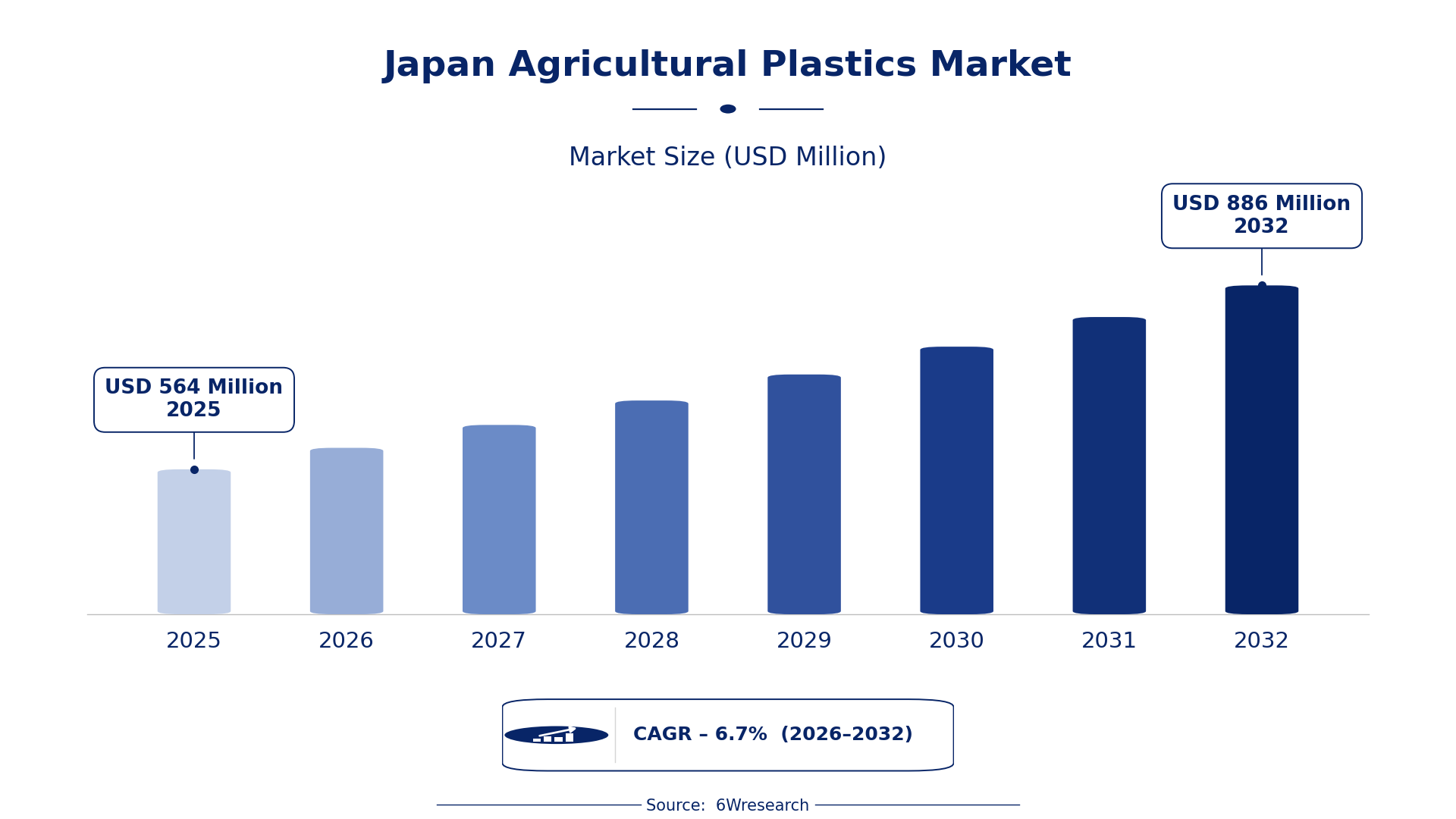
According to 6Wresearch internal database and industry insights, the Japan Agricultural Plastics Market was valued at USD 564 Million in 2025 and is projected to reach USD 886 Million by 2032, growing at a CAGR of approximately 6.7% during 2026–2032.
Japan Agricultural Plastics Market Highlights
| Report Metric | Details |
| Report Name | Japan Agricultural Plastics Market (2026-2032) |
| Market Size 2025 | USD 564 Million |
| Market Size 2032 | USD 886 Million |
| Absolute Growth 2025–2032 | USD 322 Million |
| CAGR 2026–2032 | 6.7% |
| Peak Annual Growth | 7.8% in 2030 |
| Forecast Period | 2026–2032 |
| Historical Data | 2022–2025 |
| Base Year | 2025 |
| Leading Agricultural Plastics Market, 2025 | Greenhouse Films (46% share) |
| Leading Product Type, 2025 | UV-Resistant Films (55% share) |
| Leading Use Case, 2025 | Online Retailers (54% share) |
| Leading Distribution Channel, 2025 | Vegetable Growers (40% share) |
| Fastest-Growing Agricultural Plastics Market | Mulch Films (8.6% CAGR) |
| Fastest-Growing Product Type | Biodegradable Options (9.5% CAGR) |
| Fastest-Growing Use Case | Specialty Distributors (9.0% CAGR) |
| Fastest-Growing Distribution Channel | Organic Farmers (8.5% CAGR) |
| Growing Sector | sustainable agriculture |
| Key End Users | farmers, vegetable growers, agricultural distributors, organic farmers |
Japan Agricultural Plastics Market Year-wise Growth Rate and Key Drivers (2022–2032)
This graph illustrates the annual growth rates of the market from 2022 to 2032, highlighting a steady upward trajectory and projected market expansion over the forecast period.
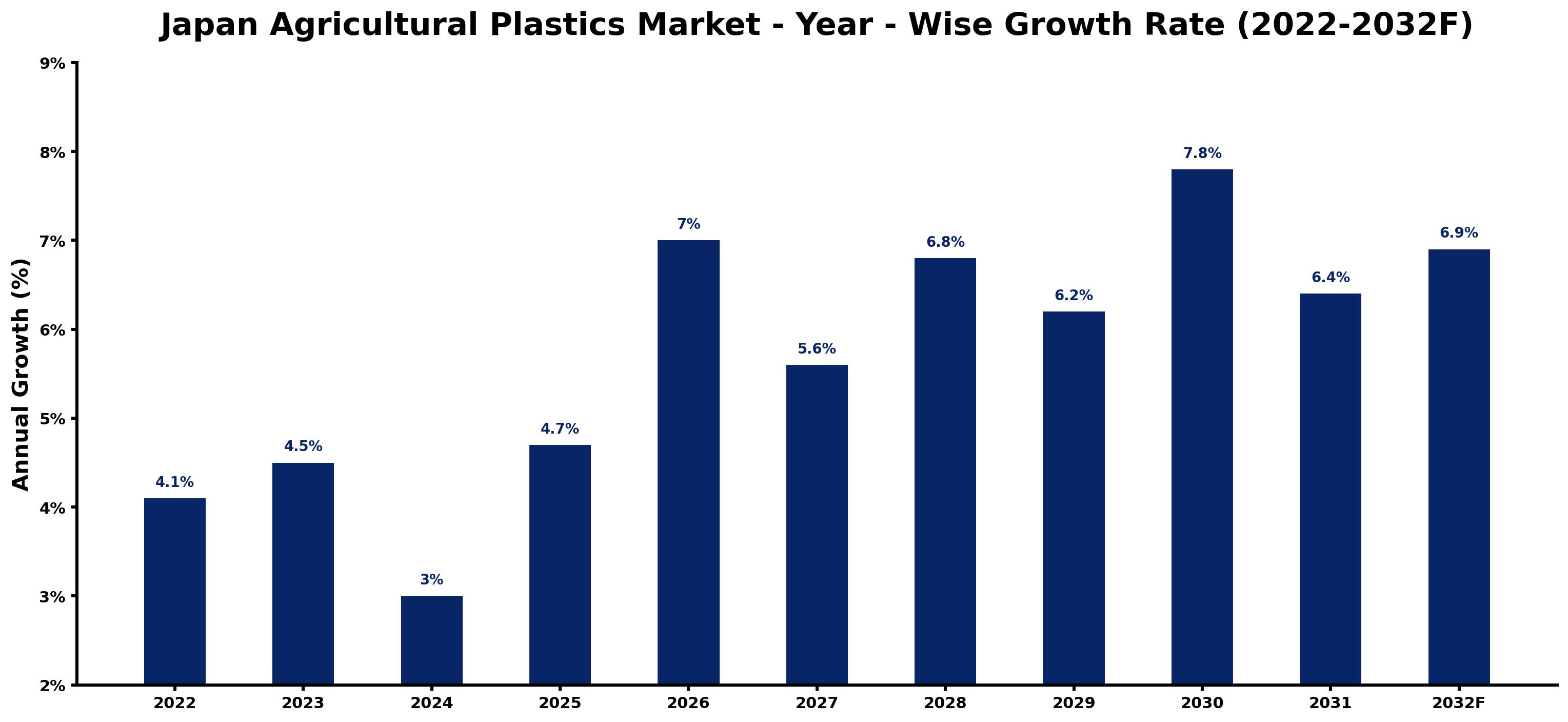
Year by year, the estimates below pair each growth rate with the development that shaped it.
| Year | Estimated Annual Growth (%) | Market Rationale |
| 2022 | 4.1 | The market experienced steady growth, supported by ongoing agricultural activities. |
| 2023 | 4.5 | Demand increased as farmers adopted advanced agricultural plastics for crop protection. |
| 2024 | 3.0 | Growth slowed due to market saturation in certain plastic types and increased competition. |
| 2025 | 4.7 | The market saw a resurgence as farmers invested in new greenhouse technologies. |
| 2026 | 7.0 | Demand is expected to surge with the introduction of new biodegradable options for eco-conscious farmers. |
| 2027 | 5.6 | Growth is projected to decelerate as the market adjusts to higher adoption rates of sustainable practices. |
| 2028 | 6.8 | The market is expected to rebound with renewed interest in mulch films for moisture retention. |
| 2029 | 6.2 | Growth is anticipated to moderate as farmers evaluate the cost-effectiveness of various plastic types. |
| 2030 | 7.8 | The peak growth year is projected to be driven by investments in irrigation systems and technology. |
| 2031 | 6.4 | Growth is expected to slow as the market stabilises after reaching peak adoption rates. |
| 2032 | 6.9 | Demand is expected to rise again as farmers seek durable and efficient agricultural plastics. |
Note: Market size estimations and growth projections presented in this report are based on 6Wresearch's proprietary forecasting methodology, utilizing the latest available industry data, government publications, and primary research inputs.
Japan Agricultural Plastics Market Synopsis
Agricultural plastics are synthetic materials primarily made from polyethylene and polypropylene, used in farming for crop protection, soil improvement, and irrigation. The Japan Agricultural Plastics Market is valued at approximately 200 billion yen, supported by local farmers and the increasing adoption of greenhouse films, which account for 40% of the market. Growth is driven by rising demand for sustainable practices, with strong backing from the Ministry of Agriculture, Forestry and Fisheries for eco-friendly innovations.
Market Dynamics Impact Analysis (2026–2032)
| Factor | Type | Impact | Primary Segment Affected |
| Increasing adoption of greenhouse films among farmers | Driver | High | Greenhouse Films |
| Rising demand for biodegradable options due to environmental concerns | Driver | High | Biodegradable Options |
| Growing market for irrigation systems in rural areas | Opportunity | Medium | Irrigation Pipes |
| Expanding vegetable production in regions like Hokkaido | Opportunity | Medium | Mulch Films |
| Competition from imported agricultural plastics | Restraint | High | LDPE/HDPE |
| Limited awareness of advanced plastic options among small farmers | Restraint | Medium | UV-Resistant Films |
| High initial investment costs for advanced agricultural plastics | Challenge | High | Irrigation Pipes |
| Regulatory compliance costs for biodegradable plastics | Challenge | Medium | Biodegradable Options |
Evaluation of Drivers in Japan Agricultural Plastics Market (2026–2032)
Demand rests on the following drivers, each shown with the segment it touches most.
| Drivers | Primary Segment Affected | Why It Matters (Evidence) |
| Investment in greenhouse technologies | Greenhouse Films | This investment leads to increased purchases of greenhouse films, which protect crops from harsh weather, with 40% market share. |
| Growing interest in sustainable farming practices | Biodegradable Options | As farmers adopt eco-friendly methods, the adoption rate of biodegradable options has reached 15%. |
| Expansion of irrigation systems in rural areas | Irrigation Pipes | The installed base of over 500,000 units drives demand for efficient water delivery solutions. |
| Increased vegetable production in Hokkaido | Mulch Films | Hokkaido's vegetable growers are utilising mulch films for moisture retention, boosting market demand. |
| Support for UV-resistant films through subsidies | UV-Resistant Films | Subsidies encourage farmers to invest in these protective materials, improving crop resilience. |
Spending rises because investment in greenhouse technologies is expanding, leading to a notable market share for greenhouse films. The growing interest in sustainable farming practices is driving the adoption of biodegradable options, which has reached a significant rate among farmers. The expansion of irrigation systems enhances demand for efficient water delivery solutions, with a considerable installed base across rural areas.
Evaluation of Restraints in Japan Agricultural Plastics Market
Below are the constraints most often cited by buyers and suppliers, with the segment each affects.
| Market Restraint | Primary Segment Affected | Why It Matters (Evidence) |
| Competition from imported agricultural plastics | LDPE/HDPE | Imported plastics can be cheaper, limiting the market share of local producers who must compete on price. |
| Limited awareness of advanced plastic options among small farmers | UV-Resistant Films | Many small farmers lack knowledge about the benefits of UV-resistant films, hindering their adoption. |
| High initial investment costs for advanced agricultural plastics | Irrigation Pipes | The upfront costs deter many farmers from investing in modern irrigation solutions, impacting overall market growth. |
| Regulatory compliance costs for biodegradable plastics | Biodegradable Options | Producers face additional costs to meet compliance standards, which can affect their pricing strategies. |
| Market saturation in certain plastic types | Greenhouse Films | With many farmers already using greenhouse films, growth potential is limited in this segment. |
Japan Agricultural Plastics Market Challenges
High competition among local farmers drives down prices, making it difficult for suppliers to maintain margins. This situation arises from the abundance of small-scale farms, which collectively struggle to invest in advanced agricultural plastics, causing a 10% reduction in supplier profitability. A shortage of skilled workers in the agricultural sector limits the effective adoption of advanced plastics, resulting in delays for suppliers trying to meet evolving market demands. Supply chain disruptions occur from reliance on imported materials, leading to delays in product availability for farmers and a 20% increase in operational costs. Rising production costs for agricultural plastics due to material price fluctuations can burden suppliers, affecting their ability to offer competitive pricing to buyers.
Trends in the Japan Agricultural Plastics Market
Several trends are reshaping the Japan Agricultural Plastics Market; the most important are set out below.
- Shift from Conventional to Biodegradable Plastics: Since 2023, farmers have increasingly adopted biodegradable options, with a 15% adoption rate, reflecting environmental concerns and government support for sustainable practices.
- Transition from Traditional to Advanced Irrigation Systems: In 2023, the installed base of irrigation systems surpassed 500,000 units, reflecting a shift towards more efficient water delivery methods among Japanese farmers.
- Emergence of Online Retail Channels for Agricultural Products: The rise of online retailers has transformed how farmers purchase agricultural plastics, capturing 54% of the market share, facilitating easier access to products.
- Growing Preference for UV-Resistant Films: Since 2023, the demand for UV-resistant films has surged due to government support, motivating farmers to protect crops from harmful UV rays.
Investment Opportunities in the Japan Agricultural Plastics Market
The opportunities below stand out in the Japan Agricultural Plastics Market for new entrants and existing suppliers.
- Current demand for biodegradable plastics: With a 15% adoption rate, there is an opportunity to supply biodegradable agricultural plastics, particularly in regions focused on sustainable farming practices.
- Investment in advanced irrigation systems: Now is the time to invest in irrigation pipes, as the installed base exceeds 500,000 units, creating demand for efficient water delivery solutions.
- Expansion in Hokkaido's vegetable production: Hokkaido offers opportunities for suppliers of mulch films, as vegetable growers seek effective moisture retention solutions.
- Partnerships with local distributors: Forming joint ventures with agricultural distributors can facilitate market entry, particularly in urban areas with high demand for agricultural products.
Government Initiatives in the Japan Agricultural Plastics Market
The regulatory framework for agricultural plastics is shaped by several key laws, including the Industrial Standardization Act of 1949, which governs product standards. The Plastic Resource Circulation Act of 2021 promotes the reduction, reuse, and recycling of plastics, supporting alternatives like biodegradable options. These measures aim to ensure quality and sustainability in agricultural practices, benefiting both producers and consumers.
The Ministry of Agriculture, Forestry and Fisheries plays a critical role in approving and funding agricultural innovation projects. In 2023, the government allocated 5 billion yen for initiatives aimed at promoting sustainable practices in agriculture. These funds support the development and adoption of advanced agricultural plastics, ensuring compliance with quality standards and encouraging eco-friendly practices among farmers.
Future Insight of the Japan Agricultural Plastics Market
Investment in agricultural innovation will increase, creating demand for advanced plastics in farming applications. By 2032, the adoption rate of biodegradable plastics is expected to rise to 40% among farmers, influenced by government initiatives and support. New standards will emerge, promoting the use of high-performance irrigation systems, which will improve efficiency across the sector. The government's allocation of 5 billion yen for agricultural innovation projects will drive the development of eco-friendly practices, ultimately benefiting both buyers and suppliers in the agricultural plastics market.
Market Segmentation Analysis
Japan Agricultural Plastics Market report covers a detailed analysis of the following market segments:
By Agricultural Plastics Market – Greenhouse Films Lead, Mulch Films Expected to Grow Fastest
According to Saurav Kr Singh, Senior Research Analyst at 6Wresearch, Greenhouse Films took 46% of agricultural plastics market revenue in 2025, more than any other category. Greenhouse films play a vital role in protecting crops from adverse weather conditions, especially in the Tohoku region known for its agricultural activities. Their extensive adoption among local farmers ensures a strong installed base, cementing their leading position in the market. The quickest growth will come from Mulch Films, forecast to expand at a CAGR of 8.6% between 2026 and 2032. The increasing use of mulch films is notable as farmers in Hokkaido adopt them for effective weed control and moisture retention. This trend is likely to continue as more farmers recognise the benefits of mulch films in enhancing crop yields. Suppliers should focus on developing mulch films to align with the growing demand in the agricultural sector.
By Product Type – UV-Resistant Films Lead, Biodegradable Options Expected to Grow Fastest
The largest product type category in 2025 was UV-Resistant Films, at 55% of revenue. UV-resistant films are critical for protecting crops from harmful UV rays, which is essential in Japan's diverse climates. Farmers depend on these films to ensure crop health and productivity, reinforcing their prominent market position. Biodegradable Options are set to record the highest CAGR in this split, 9.5% over 2026–2032. Biodegradable options are gaining traction, with 15% of farmers choosing these eco-friendly alternatives as sustainability becomes increasingly important. This growth is expected to accelerate as government initiatives encourage environmentally friendly practices in agriculture. Suppliers should prioritise the development of biodegradable products to meet the rising demand for sustainable agricultural solutions.
By Use Case – Online Retailers Lead, Specialty Distributors Expected to Grow Fastest
Online Retailers held 54% of the Japan Agricultural Plastics Market by use case in 2025. Online retailers serve as the main channel for agricultural plastics, providing farmers with convenient access to essential products. The growth of e-commerce has significantly improved purchasing ease, establishing this channel as a leader in the market. Over 2026–2032, Specialty Distributors are expected to post the fastest growth, at a CAGR of 9.0%. Specialty distributors are experiencing rapid growth as they cater to the specific needs of niche markets, particularly for unique and eco-friendly agricultural products. This trend reflects a broader shift as farmers seek tailored solutions for their distinct challenges. Suppliers should consider forming partnerships with specialty distributors to improve visibility and address niche market demands.
By Distribution Channel – Vegetable Growers Lead, Organic Farmers Expected to Grow Fastest
In 2025, Vegetable Growers led the distribution channel split with a 40% share. Vegetable growers are the largest user group of agricultural plastics, directly employing these materials for effective crop management. Their substantial presence in the market drives consistent demand for a variety of agricultural plastic products. Organic Farmers are projected to grow fastest, at a CAGR of 8.5% during 2026–2032. Organic farmers are increasingly adopting agricultural plastics, especially biodegradable options, to align with sustainable practices. This trend is set to grow as the organic farming sector expands in Japan, highlighting a shift towards eco-friendly solutions. Suppliers should develop products specifically for organic farmers to capitalise on this growing market segment.
Key Attractiveness of the Report
- 10 Years of Market Numbers
- Historical Data Starting from 2022 to 2025
- Base Year 2025
- Forecast Data until 2032
- Key Performance Indicators Impacting the Market
- Major Upcoming Developments and Projects
Key Highlights of the Report:
- Japan Agricultural Plastics Market Outlook
- Market Size of Japan Agricultural Plastics Market, 2025
- Forecast of Japan Agricultural Plastics Market, 2032
- Historical Data and Forecast of Japan Agricultural Plastics Revenues & Volume for the Period 2022-2032F
- Japan Agricultural Plastics Market Trend Evolution
- Japan Agricultural Plastics Market Drivers and Challenges
- Japan Agricultural Plastics Price Trends
- Japan Agricultural Plastics Porter's Five Forces
- Japan Agricultural Plastics Industry Life Cycle
- Historical Data and Forecast of Japan Agricultural Plastics Market Revenues & Volume By Agricultural Plastics Market for the Period 2022-2032F
- Historical Data and Forecast of Japan Agricultural Plastics Market Revenues & Volume By Greenhouse Films for the Period 2022-2032F
- Historical Data and Forecast of Japan Agricultural Plastics Market Revenues & Volume By Mulch Films for the Period 2022-2032F
- Historical Data and Forecast of Japan Agricultural Plastics Market Revenues & Volume By Irrigation Pipes for the Period 2022-2032F
- Historical Data and Forecast of Japan Agricultural Plastics Market Revenues & Volume By Silage Bags for the Period 2022-2032F
- Historical Data and Forecast of Japan Agricultural Plastics Market Revenues & Volume By Product Type for the Period 2022-2032F
- Historical Data and Forecast of Japan Agricultural Plastics Market Revenues & Volume By UV-Resistant Films for the Period 2022-2032F
- Historical Data and Forecast of Japan Agricultural Plastics Market Revenues & Volume By Biodegradable Options for the Period 2022-2032F
- Historical Data and Forecast of Japan Agricultural Plastics Market Revenues & Volume By LDPE/HDPE for the Period 2022-2032F
- Historical Data and Forecast of Japan Agricultural Plastics Market Revenues & Volume By High-Density Plastic for the Period 2022-2032F
- Historical Data and Forecast of Japan Agricultural Plastics Market Revenues & Volume By Use Case for the Period 2022-2032F
- Historical Data and Forecast of Japan Agricultural Plastics Market Revenues & Volume By Online Retailers for the Period 2022-2032F
- Historical Data and Forecast of Japan Agricultural Plastics Market Revenues & Volume By Specialty Distributors for the Period 2022-2032F
- Historical Data and Forecast of Japan Agricultural Plastics Market Revenues & Volume By Agri Equipment Stores for the Period 2022-2032F
- Historical Data and Forecast of Japan Agricultural Plastics Market Revenues & Volume By Direct Sales for the Period 2022-2032F
- Historical Data and Forecast of Japan Agricultural Plastics Market Revenues & Volume By Distribution Channel for the Period 2022-2032F
- Historical Data and Forecast of Japan Agricultural Plastics Market Revenues & Volume By Vegetable Growers for the Period 2022-2032F
- Historical Data and Forecast of Japan Agricultural Plastics Market Revenues & Volume By Organic Farmers for the Period 2022-2032F
- Historical Data and Forecast of Japan Agricultural Plastics Market Revenues & Volume By Sugarcane Growers for the Period 2022-2032F
- Historical Data and Forecast of Japan Agricultural Plastics Market Revenues & Volume By Cattle Feed Producers for the Period 2022-2032F
- Japan Agricultural Plastics Import Export Trade Statistics
- Market Opportunity Assessment By Agricultural Plastics Market
- Market Opportunity Assessment By Product Type
- Market Opportunity Assessment By Use Case
- Market Opportunity Assessment By Distribution Channel
- Japan Agricultural Plastics Top Companies Market Share
- Japan Agricultural Plastics Competitive Benchmarking By Technical and Operational Parameters
- Japan Agricultural Plastics Company Profiles
- Japan Agricultural Plastics Key Strategic Recommendations
Market Covered
The following segment groups are covered in the report.
By Agricultural Plastics Market
- Greenhouse Films
- Mulch Films
- Irrigation Pipes
- Silage Bags
By Product Type
- UV-Resistant Films
- Biodegradable Options
- LDPE/HDPE
- High-Density Plastic
By Use Case
- Online Retailers
- Specialty Distributors
- Agri Equipment Stores
- Direct Sales
By Distribution Channel
- Vegetable Growers
- Organic Farmers
- Sugarcane Growers
- Cattle Feed Producers































