Japan Agricultural Robotics Market Size & Growth Rate
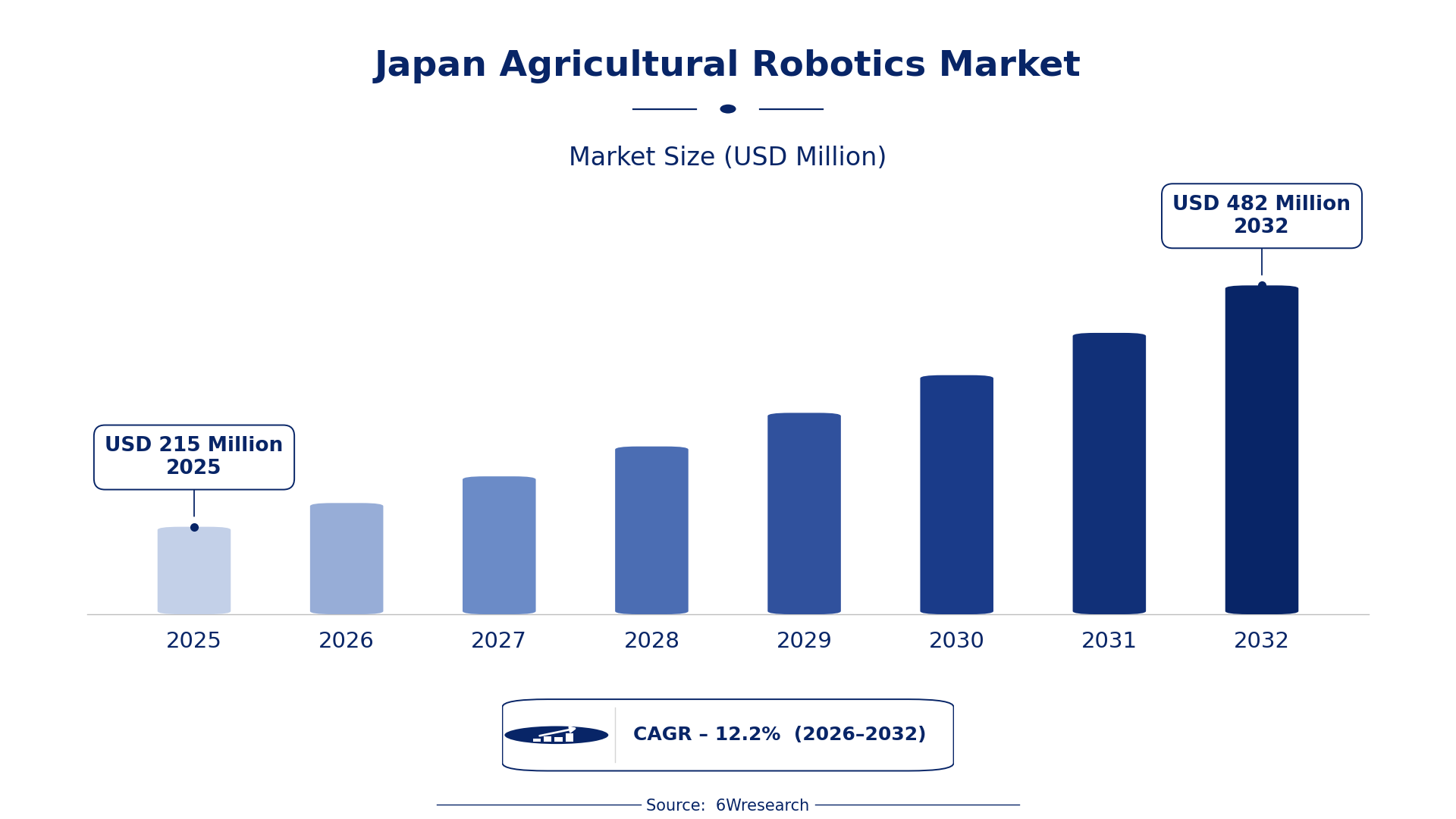
According to 6Wresearch internal database and industry insights, the Japan Agricultural Robotics Market was valued at USD 215 Million in 2025 and is projected to reach USD 482 Million by 2032, growing at a CAGR of approximately 12.2% during 2026–2032.
Japan Agricultural Robotics Market Highlights
| Report Metric | Details |
| Report Name | Japan Agricultural Robotics Market (2026-2032) |
| Market Size 2025 | USD 215 Million |
| Market Size 2032 | USD 482 Million |
| Absolute Growth 2025–2032 | USD 267 Million |
| CAGR 2026–2032 | 12.2% |
| Peak Annual Growth | 14.1% in 2029 |
| Forecast Period | 2026–2032 |
| Historical Data | 2022–2025 |
| Base Year | 2025 |
| Leading Agricultural Robotics Market, 2025 | Harvesting Robots (40% share) |
| Leading Robot Type, 2025 | Fruit/Vegetable Picking (49% share) |
| Leading Application, 2025 | Equipment Dealers (41% share) |
| Leading Distribution Channel, 2025 | Commercial Farmers (42% share) |
| Fastest-Growing Agricultural Robotics Market | Weeding Robots (16.1% CAGR) |
| Fastest-Growing Robot Type | Precision Weeding (17.4% CAGR) |
| Fastest-Growing Application | Online Platforms (16.2% CAGR) |
| Fastest-Growing Distribution Channel | Organic Producers (15.2% CAGR) |
| Growing Sector | Online Platforms |
| Key End Users | Equipment Dealers, Online Platforms, OEMs, Direct Sales |
Japan Agricultural Robotics Market Year-wise Growth Rate and Key Drivers (2022–2032)
This graph illustrates the annual growth rates of the market from 2022 to 2032, highlighting a steady upward trajectory and projected market expansion over the forecast period.
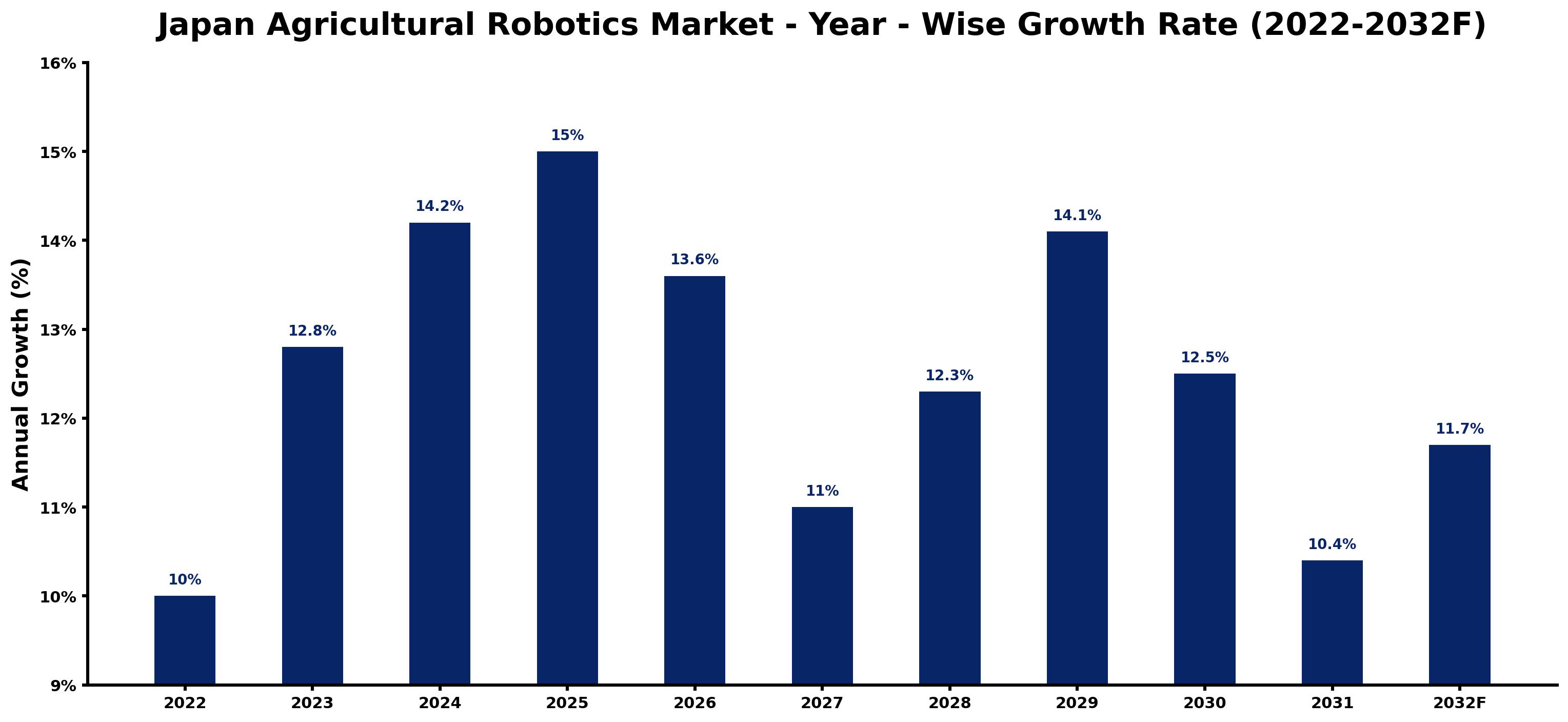
The following figures match every annual growth estimate with the main market development of that year, giving the reasoning behind each rise or slowdown.
| Year | Estimated Annual Growth (%) | Market Rationale |
| 2022 | 10.0 | The agricultural robotics market showed steady growth as farmers began exploring automation solutions. |
| 2023 | 12.8 | A 30% rise in robotic equipment usage among farmers boosted adoption significantly. |
| 2024 | 14.2 | Investment in autonomous tractors gained momentum, driving market expansion further. |
| 2025 | 15.0 | Demand peaked due to heightened efficiency needs among commercial farmers. |
| 2026 | 13.6 | Growth is expected to slow as the market adjusts to saturation in certain robotic applications. |
| 2027 | 11.0 | A further slowdown is projected as market maturity sets in, affecting new investments. |
| 2028 | 12.3 | Innovation in weeding robots is expected to attract new buyers, increasing growth. |
| 2029 | 14.1 | The market is projected to experience a surge in demand, reaching its peak growth rate. |
| 2030 | 12.5 | Growth is expected to slow once more as the market stabilises after rapid expansion. |
| 2031 | 10.4 | Continued growth is projected, albeit at a reduced rate as competition intensifies. |
| 2032 | 11.7 | Demand is expected to increase again, driven by new technological advancements in agricultural robotics. |
Note: Market size estimations and growth projections presented in this report are based on 6Wresearch's proprietary forecasting methodology, utilizing the latest available industry data, government publications, and primary research inputs.
Japan Agricultural Robotics Market Synopsis
Agricultural robotics encompasses the use of automated machines and technologies in farming to boost productivity and efficiency. These robots, equipped with advanced sensors and AI, undertake tasks such as harvesting and weeding. The Japan Agricultural Robotics Market is expanding due to escalating labour costs and an ageing farming population, with the Smart Agriculture Promotion Strategy targeting 50% robotics integration by 2030. Commercial farmers are increasingly investing in autonomous tractors to enhance operational efficiency, contributing to a dynamic market.
Market Dynamics Impact Analysis (2026–2032)
| Factor | Type | Impact | Primary Segment Affected |
| Rising labour costs drive farmers to seek automation solutions. | Driver | High | Harvesting Robots |
| Increased efficiency in operations leads to higher adoption of autonomous tractors. | Driver | High | Autonomous Tractors |
| Growing interest in sustainable practices opens opportunities for weeding robots. | Opportunity | High | Weeding Robots |
| The push for high-tech solutions creates demand for precision agriculture technologies. | Opportunity | Medium | Precision Weeding |
| High initial investment costs restrict access to advanced robotics for smaller farms. | Restraint | High | Seeding Robots |
| Limited awareness of robotic solutions among traditional farmers hinders market growth. | Restraint | Medium | Smart Navigation |
| The ageing farmer population leads to a shortage of skilled operators for new technologies. | Challenge | High | Fruit/Vegetable Picking |
| Competition from low-cost manual labour in certain regions affects robotics adoption. | Challenge | Medium | Commercial Farmers |
Evaluation of Drivers in Japan Agricultural Robotics Market (2026–2032)
The main growth drivers and the segments they affect most are set out below.
| Drivers | Primary Segment Affected | Why It Matters (Evidence) |
| Increased labour costs encourage investment in automation technologies. | Harvesting Robots | Japan's national weighted-average minimum wage rose to JPY 1,055 per hour in October 2024, prompting farmers to adopt robotics. |
| The need for efficiency drives the adoption of autonomous tractors. | Autonomous Tractors | Commercial farmers are increasingly investing in autonomous tractors to improve productivity and reduce labour costs. |
| Growing environmental concerns boost demand for weeding robots. | Weeding Robots | Organic producers are adopting weeding robots to reduce chemical usage and promote sustainable practices. |
| Technological advancements in AI improve robotic capabilities. | Precision Weeding | The integration of AI in agricultural robotics enhances precision, attracting more buyers and increasing sales. |
| Government support for agricultural technology fuels market growth. | Seeding Robots | In 2022, the government allocated 5 billion yen for agricultural technology development, encouraging innovation among farmers. |
Several shifts outside the market lift sales. The average age of farmers in Japan exceeds 67, creating urgency for automation solutions as the workforce shrinks. In 2023, a 30% increase in robotic equipment usage among farmers highlighted a shift towards efficiency. Investment in autonomous tractors is rising, driven by the need for improved productivity. The allocation of 5 billion yen for agricultural technology development in 2022 supports innovation and adoption, leading to increased purchases of seeding and weeding robots.
Evaluation of Restraints in Japan Agricultural Robotics Market
The key brakes on demand, and where they bite hardest, are shown below.
| Market Restraint | Primary Segment Affected | Why It Matters (Evidence) |
| High initial investment costs limit access to advanced robotics. | Seeding Robots | Many smaller farms cannot afford the upfront costs associated with robotic technologies, which can exceed 10 million yen. |
| Limited awareness of robotics among traditional farmers hinders adoption. | Smart Navigation | Many farmers remain unaware of the benefits that robotic solutions can provide, affecting their purchasing decisions. |
| The ageing farmer population leads to a shortage of skilled operators. | Fruit/Vegetable Picking | As experienced farmers retire, fewer skilled operators are available to manage advanced technologies, limiting adoption. |
| Competition from low-cost manual labour affects robotics adoption. | Commercial Farmers | In some regions, manual labour remains cheaper than investing in robotic solutions, slowing market growth. |
| Slow integration of technology in rural areas limits market growth. | Harvesting Robots | Rural infrastructure challenges make it difficult for farmers to adopt new technologies, hindering expansion. |
Japan Agricultural Robotics Market Challenges
In 2023, 30% of farmers reported increased robotic equipment usage, but high initial costs, often exceeding 10 million yen for advanced systems, restrict access for smaller operations. Many farmers, averaging over 67 years old, lack the tech-savviness required for effective technology integration, delaying progress for suppliers. Traditional farming methods remain competitive, particularly in the Tohoku region, hindering the adoption of automated solutions. Rising minimum wages, now at JPY 1,055 per hour, elevate operational expenses, compelling buyers to urgently pursue automation to maintain profitability.
Trends in the Japan Agricultural Robotics Market
The trends below show where the Japan Agricultural Robotics Market is heading.
- Shift from Manual to Automated Harvesting: Since 2023, farmers have increasingly adopted automated harvesting solutions, reflecting labour shortages. The Tohoku region has seen a 30% rise in robotic equipment usage, indicating a shift in farming practices.
- Transition from Traditional to Precision Agriculture: The integration of AI in agriculture is changing farming methods, with precision weeding gaining traction. The Smart Agriculture Promotion Strategy aims for 50% robotics integration by 2030, reflecting this trend.
- Emergence of Weeding Robots: Weeding robots have become essential for organic producers, reducing chemical usage. In 2023, organic producers reported a 25% increase in efficiency through automation.
- Growing Demand for Autonomous Tractors: The demand for autonomous tractors has surged, particularly among commercial farmers. In 2022, investments in autonomous tractors rose by 40%, showcasing their increasing importance.
Investment Opportunities in the Japan Agricultural Robotics Market
Where to invest in the Japan Agricultural Robotics Market: the main openings are set out below.
- Current Need for Automation: With Japan's agricultural workforce ageing, there is an urgent need for automation solutions. Investing in harvesting robots can address this demand, especially among commercial farmers seeking efficiency.
- Emerging Market for Weeding Robots: The increasing interest in sustainable farming practices presents an opportunity for weeding robots. Organic producers are actively seeking efficient solutions to minimise chemical usage.
- Investment in Precision Agriculture: The demand for high-tech solutions in agriculture offers an opportunity to supply precision weeding technologies. Collaborating with equipment dealers can facilitate market entry and growth.
- Expansion of Online Sales Platforms: With the rise of e-commerce, there is an opportunity to create online platforms for agricultural robotics. This can improve accessibility for farmers in search of advanced solutions.
Government Initiatives in the Japan Agricultural Robotics Market
The New Robot Strategy, established in 2015, aims to expand robot use across various sectors, including agriculture. This initiative encourages the integration of robotics in farming practices, enabling producers to improve productivity and efficiency. The AI Promotion Act, set to be implemented in 2025, will further establish a national framework for AI research and development, benefitting agricultural robotics by promoting innovation and technological advancement.
The Agricultural Robotics Association of Japan, established in 2021, promotes innovation in agricultural robotics. The association supports farmers by providing resources and facilitating access to advanced technologies, thus increasing the adoption of robotics in farming. Additionally, the government has allocated funds to assist farmers in integrating these technologies, ensuring they can improve their operations and productivity.
Future Insight of the Japan Agricultural Robotics Market
A pipeline of 5 billion yen in agricultural technology investment will stimulate demand for automation among 1.5 million farmers. By 2032, the integration of advanced technology will improve productivity and operational efficiency across farms. As ISO 13482 becomes widely adopted, safety standards will enhance, encouraging broader acceptance of automated solutions. The Agricultural Robotics Association of Japan will promote innovation and collaboration, enabling suppliers to better align their offerings with buyer needs.
Market Segmentation Analysis
Japan Agricultural Robotics Market report covers a detailed analysis of the following market segments:
By Agricultural Robotics Market – Harvesting Robots Lead, Weeding Robots Expected to Grow Fastest
According to Saurav Kr Singh, Senior Research Analyst at 6Wresearch, Harvesting Robots accounted for 40% of the market by agricultural robotics market in 2025. Harvesting robots play a vital role in enhancing crop collection efficiency, making them essential for high-yield farming operations. Their adoption is particularly pronounced in the Tohoku region, which showcases the importance of these technologies in modern agricultural practices. Weeding Robots are projected to grow fastest, at a CAGR of 16.1% during 2026–2032. Weeding robots are experiencing rapid growth as they effectively minimise manual weeding efforts, especially among organic producers. The 30% increase in robotic equipment usage among farmers indicates a significant shift towards these automated solutions for improved efficiency. Suppliers should focus on advancing weeding technologies to align with the increasing demand for automation in agriculture.
By Robot Type – Fruit/Vegetable Picking Leads, Precision Weeding Expected to Grow Fastest
In 2025, Fruit/Vegetable Picking led the robot type split with a 49% share. Fruit and vegetable picking robots are crucial for the harvesting process, a fundamental aspect of agricultural operations. Their widespread utilisation among commercial farmers highlights their importance in improving overall productivity in the sector. Precision Weeding is set to record the highest CAGR in this split, 17.4% over 2026–2032. Precision weeding robots are witnessing swift growth due to their capability to target weeds while minimising disruption to crops, which is essential for sustainable farming practices. The government's support for agricultural technology development is further accelerating this trend. Suppliers must prioritise the creation of precision weeding solutions to take advantage of this growing market opportunity.
By Application – Equipment Dealers Lead, Online Platforms Expected to Grow Fastest
The largest application category in 2025 was Equipment Dealers, at 41% of revenue. Equipment dealers are essential as they provide the necessary agricultural machinery and robotics, establishing their dominance in the application segment. Their established networks and industry expertise ensure a consistent demand for agricultural robotics across various farming operations. Over 2026–2032, Online Platforms are expected to post the fastest growth, at a CAGR of 16.2%. Online platforms are rapidly gaining traction as they streamline sales and information sharing, appealing to a more digitally inclined customer base. The increasing reliance on digital channels for purchasing agricultural equipment is driving this growth. This trend suggests that suppliers should enhance their online presence to effectively reach a wider audience.
By Distribution Channel – Commercial Farmers Lead, Organic Producers Expected to Grow Fastest
With 42% of distribution channel revenue in 2025, Commercial Farmers was the largest category. Commercial farmers represent the primary users of agricultural robotics, reinforcing their position as the leading distribution channel. Their significant investments in automation technologies reflect the ongoing transformation within the agricultural landscape. The quickest growth will come from Organic Producers, forecast to expand at a CAGR of 15.2% between 2026 and 2032. Organic producers are increasingly adopting agricultural robotics to support sustainable practices that reduce chemical usage. This trend aligns with the rising demand for environmentally friendly farming methods, indicating a shift in agricultural practices. Suppliers should consider targeting organic producers to access this rapidly growing segment of the market.
Key Attractiveness of the Report
- 10 Years of Market Numbers
- Historical Data Starting from 2022 to 2025
- Base Year 2025
- Forecast Data until 2032
- Key Performance Indicators Impacting the Market
- Major Upcoming Developments and Projects
Key Highlights of the Report:
- Japan Agricultural Robotics Market Outlook
- Market Size of Japan Agricultural Robotics Market, 2025
- Forecast of Japan Agricultural Robotics Market, 2032
- Historical Data and Forecast of Japan Agricultural Robotics Revenues & Volume for the Period 2022-2032F
- Japan Agricultural Robotics Market Trend Evolution
- Japan Agricultural Robotics Market Drivers and Challenges
- Japan Agricultural Robotics Price Trends
- Japan Agricultural Robotics Porter's Five Forces
- Japan Agricultural Robotics Industry Life Cycle
- Historical Data and Forecast of Japan Agricultural Robotics Market Revenues & Volume By Agricultural Robotics Market for the Period 2022-2032F
- Historical Data and Forecast of Japan Agricultural Robotics Market Revenues & Volume By Harvesting Robots for the Period 2022-2032F
- Historical Data and Forecast of Japan Agricultural Robotics Market Revenues & Volume By Weeding Robots for the Period 2022-2032F
- Historical Data and Forecast of Japan Agricultural Robotics Market Revenues & Volume By Autonomous Tractors for the Period 2022-2032F
- Historical Data and Forecast of Japan Agricultural Robotics Market Revenues & Volume By Seeding Robots for the Period 2022-2032F
- Historical Data and Forecast of Japan Agricultural Robotics Market Revenues & Volume By Robot Type for the Period 2022-2032F
- Historical Data and Forecast of Japan Agricultural Robotics Market Revenues & Volume By Fruit/Vegetable Picking for the Period 2022-2032F
- Historical Data and Forecast of Japan Agricultural Robotics Market Revenues & Volume By Precision Weeding for the Period 2022-2032F
- Historical Data and Forecast of Japan Agricultural Robotics Market Revenues & Volume By Smart Navigation for the Period 2022-2032F
- Historical Data and Forecast of Japan Agricultural Robotics Market Revenues & Volume By Auto Planting for the Period 2022-2032F
- Historical Data and Forecast of Japan Agricultural Robotics Market Revenues & Volume By Application for the Period 2022-2032F
- Historical Data and Forecast of Japan Agricultural Robotics Market Revenues & Volume By Equipment Dealers for the Period 2022-2032F
- Historical Data and Forecast of Japan Agricultural Robotics Market Revenues & Volume By Online Platforms for the Period 2022-2032F
- Historical Data and Forecast of Japan Agricultural Robotics Market Revenues & Volume By OEMs for the Period 2022-2032F
- Historical Data and Forecast of Japan Agricultural Robotics Market Revenues & Volume By Direct Sales for the Period 2022-2032F
- Historical Data and Forecast of Japan Agricultural Robotics Market Revenues & Volume By Distribution Channel for the Period 2022-2032F
- Historical Data and Forecast of Japan Agricultural Robotics Market Revenues & Volume By Commercial Farmers for the Period 2022-2032F
- Historical Data and Forecast of Japan Agricultural Robotics Market Revenues & Volume By Organic Producers for the Period 2022-2032F
- Historical Data and Forecast of Japan Agricultural Robotics Market Revenues & Volume By Agri Enterprises for the Period 2022-2032F
- Historical Data and Forecast of Japan Agricultural Robotics Market Revenues & Volume By Seed Farms for the Period 2022-2032F
- Japan Agricultural Robotics Import Export Trade Statistics
- Market Opportunity Assessment By Agricultural Robotics Market
- Market Opportunity Assessment By Robot Type
- Market Opportunity Assessment By Application
- Market Opportunity Assessment By Distribution Channel
- Japan Agricultural Robotics Top Companies Market Share
- Japan Agricultural Robotics Competitive Benchmarking By Technical and Operational Parameters
- Japan Agricultural Robotics Company Profiles
- Japan Agricultural Robotics Key Strategic Recommendations
Market Covered
This report examines the market across the segments below.
By Agricultural Robotics Market
- Harvesting Robots
- Weeding Robots
- Autonomous Tractors
- Seeding Robots
By Robot Type
- Fruit/Vegetable Picking
- Precision Weeding
- Smart Navigation
- Auto Planting
By Application
- Equipment Dealers
- Online Platforms
- OEMs
- Direct Sales
By Distribution Channel
- Commercial Farmers
- Organic Producers
- Agri Enterprises
- Seed Farms































