Japan Agricultural Seeds Market Size & Growth Rate
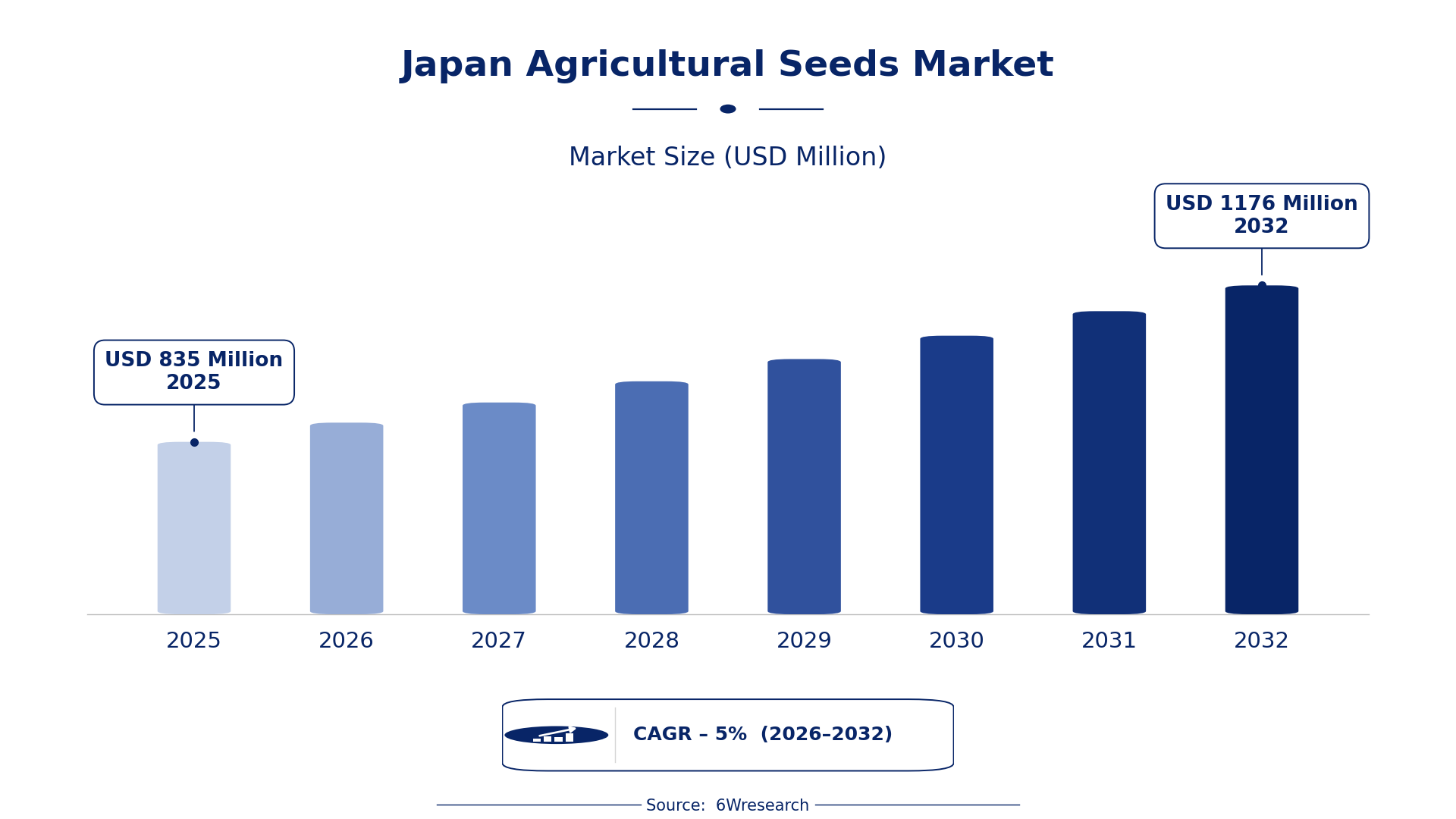
According to 6Wresearch internal database and industry insights, the Japan Agricultural Seeds Market was valued at USD 835 Million in 2025 and is projected to reach USD 1,176 Million by 2032, growing at a CAGR of approximately 5% during 2026–2032.
Japan Agricultural Seeds Market Highlights
| Report Metric | Details |
| Report Name | Japan Agricultural Seeds Market (2026-2032) |
| Market Size 2025 | USD 835 Million |
| Market Size 2032 | USD 1,176 Million |
| Absolute Growth 2025–2032 | USD 341 Million |
| CAGR 2026–2032 | 5% |
| Peak Annual Growth | 5.9% in 2030 |
| Forecast Period | 2026–2032 |
| Historical Data | 2022–2025 |
| Base Year | 2025 |
| Leading Agricultural Seeds Market, 2025 | Hybrid Seeds (46% share) |
| Leading Seed Type, 2025 | High Yield (40% share) |
| Leading Trait, 2025 | Agri Stores (45% share) |
| Leading Distribution Channel, 2025 | Food Crop Farmers (34% share) |
| Fastest-Growing Agricultural Seeds Market | Organic Seeds (6.7% CAGR) |
| Fastest-Growing Seed Type | Pest Resistance (7.0% CAGR) |
| Fastest-Growing Trait | Direct Sales (6.8% CAGR) |
| Fastest-Growing Distribution Channel | Natural Food Growers (6.3% CAGR) |
| Growing Sector | Natural Food Growers |
| Key End Users | Food Crop Farmers, Smallholder Farmers, Cotton Growers, Natural Food Growers |
Japan Agricultural Seeds Market Year-wise Growth Rate and Key Drivers (2022–2032)
This graph illustrates the annual growth rates of the market from 2022 to 2032, highlighting a steady upward trajectory and projected market expansion over the forecast period.
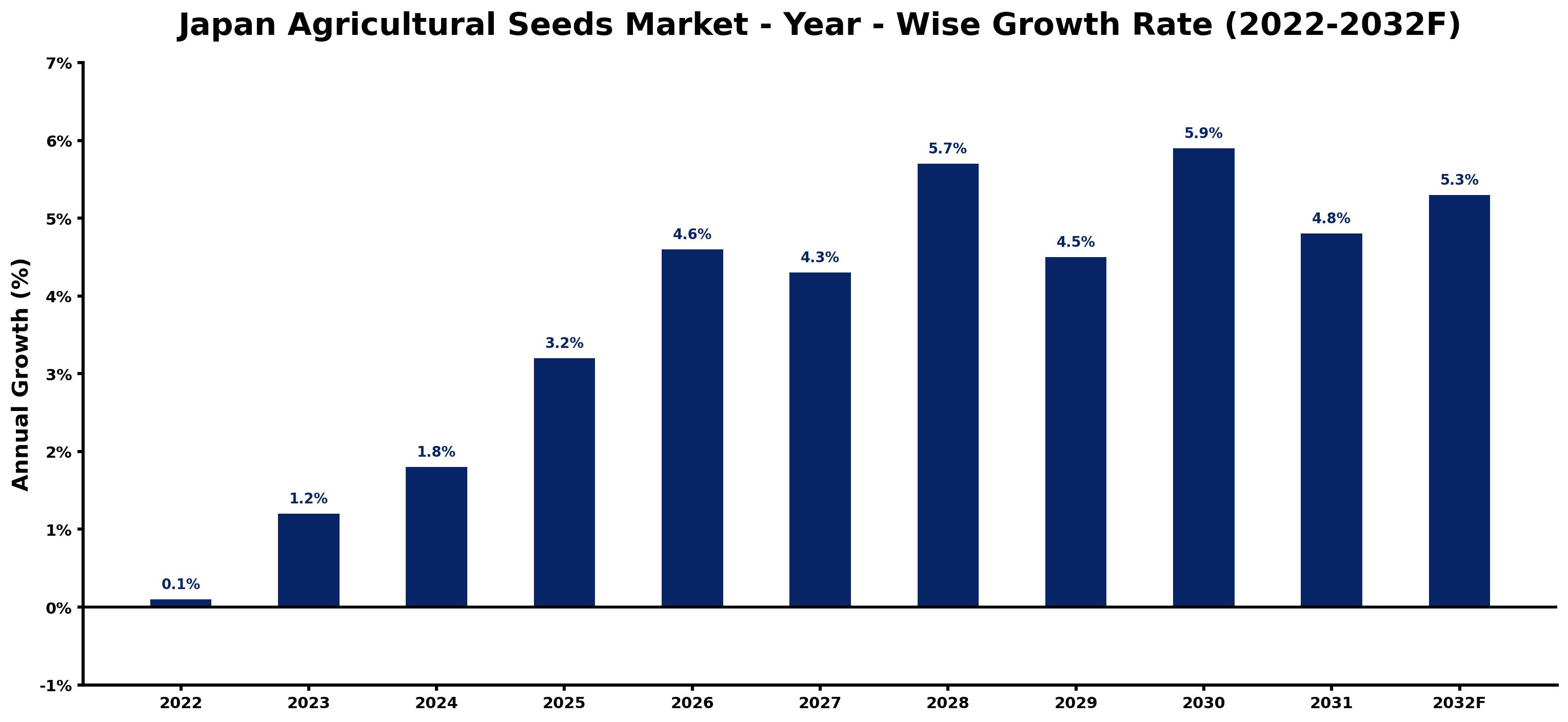
The table below sets out the estimated growth rate for each year and the main factor behind it.
| Year | Estimated Annual Growth (%) | Market Rationale |
| 2022 | 0.1 | The market experienced minimal growth due to stabilised agricultural practices. |
| 2023 | 1.2 | Increased interest in organic farming led to faster growth compared to the previous year. |
| 2024 | 1.8 | Higher demand for hybrid seeds contributed to continued growth in the market. |
| 2025 | 3.2 | The introduction of new high-yield varieties stimulated market expansion. |
| 2026 | 4.6 | Investment in seed research and development is expected to drive demand further. |
| 2027 | 4.3 | Growth slows slightly as the market adjusts to previous rapid expansions. |
| 2028 | 5.7 | Rising organic farming practices will boost demand for organic seeds. |
| 2029 | 4.5 | The market will experience a slowdown as growth stabilises after previous peaks. |
| 2030 | 5.9 | Peak growth is driven by advancements in seed technology and research. |
| 2031 | 4.8 | A slight slowdown will occur as market growth stabilises after peak years. |
| 2032 | 5.3 | Sustained demand for high-yield varieties will support continued market growth. |
Note: Market size estimations and growth projections presented in this report are based on 6Wresearch's proprietary forecasting methodology, utilizing the latest available industry data, government publications, and primary research inputs.
Japan Agricultural Seeds Market Synopsis
Agricultural seeds are biological products essential for planting crops, produced through selective breeding or genetic modification to improve traits like yield and pest resistance. The Japan Agricultural Seeds Market is driven by domestic farmers and agricultural cooperatives, with a notable increase in organic farming practices. The market is projected to grow due to rising investments in seed research, a focus on high-yield varieties, and the promotion of local food production through initiatives like 'Food Action Nippon', which supports local agriculture valued at approximately $1 billion in 2023.
Market Dynamics Impact Analysis (2026–2032)
| Factor | Type | Impact | Primary Segment Affected |
| Rising investments in seed technology and research | Driver | High | Hybrid Seeds |
| Increasing consumer preference for organic produce | Driver | High | Organic Seeds |
| Expansion of organic farming practices | Opportunity | High | Organic Seeds |
| Growing demand for high-yield varieties | Opportunity | Medium | High Yield |
| Limited arable land affecting production capacity | Restraint | High | High Yield |
| Regulatory challenges in seed quality standards | Restraint | Medium | Genetically Modified Seeds |
| High production costs for certified organic seeds | Challenge | High | Organic Seeds |
| Slow adoption of new seed technologies among farmers | Challenge | Medium | Hybrid Seeds |
Evaluation of Drivers in Japan Agricultural Seeds Market (2026–2032)
These are the developments adding the most demand over the forecast period.
| Drivers | Primary Segment Affected | Why It Matters (Evidence) |
| Increased investment in agricultural research | Hybrid Seeds | This investment leads to the development of new high-yield varieties, boosting demand among farmers, with seed production in Hokkaido accounting for 40% of Japan's total output. |
| Growing consumer interest in organic produce | Organic Seeds | As organic farming rises, farmers are purchasing more organic seeds to meet market demand, with organic farming in Japan growing at 10% annually since 2020. |
| Focus on improving crop resilience through pest-resistant seeds | Pest Resistance | Farmers are adopting these seeds to reduce pesticide use and increase yield, which is important for sustainable farming practices. |
| Support from local agricultural cooperatives | High Yield | These cooperatives provide resources and education, encouraging farmers to invest in high-yield seed varieties, improving productivity across regions. |
| Increased exports of agricultural products | Genetically Modified Seeds | The push for exports drives demand for seeds with specific traits that meet international standards, contributing to a market valued at approximately $1 billion. |
The strongest pull on demand comes from increased investment in agricultural research, leading to the development of high-yield varieties that farmers are eager to adopt. In Japan, approximately 1.2 million tons of rice seeds were produced in 2022, reflecting the focus on staple crops. The growing consumer interest in organic produce has resulted in a 10% annual increase in organic farming since 2020, prompting farmers to purchase more organic seeds. Local agricultural cooperatives are also driving demand by providing resources and education to farmers, promoting high-yield varieties. The push for agricultural exports, valued at approximately $1 billion in 2023, is driving demand for genetically modified seeds with specific traits.
Evaluation of Restraints in Japan Agricultural Seeds Market
These restraints slow adoption and weigh on supplier margins.
| Market Restraint | Primary Segment Affected | Why It Matters (Evidence) |
| Limited variety of seeds available for farmers | Hybrid Seeds | This restricts their ability to meet diverse crop demands, resulting in lost sales opportunities for suppliers. |
| High production costs for seed producers | Organic Seeds | These costs can limit the availability of organic seeds, affecting farmers' choices and market competitiveness. |
| Supply chain disruptions due to natural disasters | Pest Resistance | These disruptions lead to inconsistent seed availability, forcing farmers to adjust planting schedules and potentially reducing crop yields. |
| Intense competition from imported seeds | Genetically Modified Seeds | This pressure forces local producers to lower prices, impacting profit margins and reducing investment in research and development. |
| Lack of skilled labour in seed production | High Yield | This shortage causes delays in seed production timelines, affecting output for local farmers. |
Japan Agricultural Seeds Market Challenges
In Hokkaido, seed producers face challenges due to a shortage of skilled labour, resulting in delays in production timelines and affecting local farmers' output. Buyers struggle with a limited variety of seeds available, which restricts their capacity to meet diverse crop demands and can lead to lost sales opportunities. Intense competition from imported seeds pressures local producers to reduce prices, impacting profit margins and hindering investment in research and development. Supply chain disruptions, worsened by natural disasters, cause inconsistent seed availability, forcing farmers to adjust planting schedules and potentially decreasing crop yields by up to 20%.
Trends in the Japan Agricultural Seeds Market
Several trends are reshaping the Japan Agricultural Seeds Market; the most important are set out below.
- Shift towards Organic Farming: The 'Organic Farming Promotion Law' established in 2000 has resulted in a 10% annual growth in organic farming since 2020, motivating farmers to adopt organic seeds.
- Transition to High-Yield Varieties: In 2023, high-yield rice varieties are a focal point of research in Japanese agricultural universities, reflecting the demand for increased productivity.
- Emergence of Direct Sales Channels: Direct sales to farmers have risen, with a projected CAGR of 6.8% from 2026 to 2032, as farmers seek more accessible purchasing options.
- Prioritisation of Seed Quality Standards: ISO 9001 is increasingly applied to seed production processes, ensuring higher quality and reliability for buyers.
Investment Opportunities in the Japan Agricultural Seeds Market
The openings below show where demand in the Japan Agricultural Seeds Market is visible and how suppliers can enter.
- Investment in Research Facilities: The National Agricultural Research Organization is increasing its investment in seed research, with a projected funding rise of 20% in 2024, creating opportunities for suppliers in seed development.
- Expansion of Organic Seed Production: With 30,000 certified organic farms in Japan as of 2023, there is a growing demand for organic seeds, prompting suppliers to broaden their offerings.
- Development of Pest-Resistant Varieties: The demand for pest-resistant seeds is increasing, as farmers seek solutions to reduce pesticide use, creating opportunities for seed developers.
- Enhancement of Local Distribution Channels: As food crop farmers continue to dominate the market, suppliers can concentrate on strengthening local distribution networks to meet rising demand.
Government Initiatives in the Japan Agricultural Seeds Market
The 'Organic Farming Promotion Law' established in 2000 supports organic agriculture by providing guidelines and resources for farmers, resulting in a growth of 10% annually in organic farming since 2020. The law encourages the adoption of organic seeds, making them more accessible to farmers and creating market opportunities.
Seed quality standards are overseen by the Ministry of Agriculture, Forestry and Fisheries (MAFF), which also supports initiatives like 'Food Action Nippon', promoting local food production. This initiative has led to agricultural exports, including seeds, valued at approximately $1 billion in 2023, benefiting local producers and buyers.
Future Insight of the Japan Agricultural Seeds Market
Investment in seed research and development will rise by 2032, driven by initiatives like the National Agricultural Research Organization focusing on high-yield varieties. The number of certified organic farms is expected to reach 40,000, creating a growing demand for diverse seed types. Technological advancements in production processes will improve quality standards, aligning with ISO 9001. Agricultural exports, including seeds, are projected to increase to approximately $1.5 billion, opening new opportunities for suppliers and buyers in both domestic and international markets.
Market Segmentation Analysis
Japan Agricultural Seeds Market report covers a detailed analysis of the following market segments:
By Agricultural Seeds Market – Hybrid Seeds Lead, Organic Seeds Expected to Grow Fastest
According to Saurav Kr Singh, Senior Research Analyst at 6Wresearch, with 46% of agricultural seeds market revenue in 2025, Hybrid Seeds was the largest category. Hybrid seeds hold the largest share as they are widely adopted by farmers aiming for higher yields and improved disease resistance. The focus on high-yield rice varieties illustrates their critical role in Japan's agricultural production. Organic Seeds are projected to grow fastest, at a CAGR of 6.7% during 2026–2032. Organic seeds are rapidly gaining traction as the number of certified organic farms reached 30,000 in 2023, reflecting a growing shift towards organic farming practices. This growth is further supported by government initiatives promoting organic agriculture. Suppliers need to invest in developing organic seed varieties to cater to the increasing demand from farmers.
By Seed Type – High Yield Leads, Pest Resistance Expected to Grow Fastest
High Yield took 40% of seed type revenue in 2025, more than any other category. High yield seeds lead the market due to their necessity for maximising agricultural output in Japan's limited arable land. The emphasis on high-yield rice varieties highlights their importance in achieving food security. The quickest growth will come from Pest Resistance, forecast to expand at a CAGR of 7.0% between 2026 and 2032. Pest resistance seeds are experiencing significant growth as farmers seek to reduce pesticide use while maintaining crop resilience. This trend aligns with a broader commitment to sustainable farming practices among the agricultural community. Buyers are likely to prefer pest-resistant seeds to meet their sustainability goals.
By Trait – Agri Stores Lead, Direct Sales Expected to Grow Fastest
Agri Stores held 45% of the Japan Agricultural Seeds Market by trait in 2025. Agri stores lead the distribution channels for agricultural seeds, as they offer a diverse range of products to farmers. Their established presence in rural areas positions them as a vital resource for seed procurement. Direct Sales is set to record the highest CAGR in this split, 6.8% over 2026–2032. Direct sales are rapidly gaining traction as farmers prefer purchasing seeds directly from suppliers, facilitating better access to information and support. This shift indicates a movement towards more tailored purchasing experiences. Suppliers should refine their direct sales strategies to align with farmers' preferences for personalised service.
By Distribution Channel – Food Crop Farmers Lead, Natural Food Growers Expected to Grow Fastest
The largest distribution channel category in 2025 was Food Crop Farmers, at 34% of revenue. Food crop farmers represent the largest user group for agricultural seeds in Japan, primarily utilising seeds for staple crops. Their substantial demand plays a crucial role in shaping the agricultural seed market. Over 2026–2032, Natural Food Growers are expected to post the fastest growth, at a CAGR of 6.3%. Natural food growers are witnessing the fastest growth as consumer interest in organic produce continues to rise. This niche market is expanding as more growers embrace sustainable agricultural methods, reflecting changing consumer preferences. Suppliers should focus on natural food growers to capitalise on opportunities within the growing organic sector.
Key Attractiveness of the Report
- 10 Years of Market Numbers
- Historical Data Starting from 2022 to 2025
- Base Year 2025
- Forecast Data until 2032
- Key Performance Indicators Impacting the Market
- Major Upcoming Developments and Projects
Key Highlights of the Report:
- Japan Agricultural Seeds Market Outlook
- Market Size of Japan Agricultural Seeds Market, 2025
- Forecast of Japan Agricultural Seeds Market, 2032
- Historical Data and Forecast of Japan Agricultural Seeds Revenues & Volume for the Period 2022-2032F
- Japan Agricultural Seeds Market Trend Evolution
- Japan Agricultural Seeds Market Drivers and Challenges
- Japan Agricultural Seeds Price Trends
- Japan Agricultural Seeds Porter's Five Forces
- Japan Agricultural Seeds Industry Life Cycle
- Historical Data and Forecast of Japan Agricultural Seeds Market Revenues & Volume By Agricultural Seeds Market for the Period 2022-2032F
- Historical Data and Forecast of Japan Agricultural Seeds Market Revenues & Volume By Hybrid Seeds for the Period 2022-2032F
- Historical Data and Forecast of Japan Agricultural Seeds Market Revenues & Volume By Genetically Modified Seeds for the Period 2022-2032F
- Historical Data and Forecast of Japan Agricultural Seeds Market Revenues & Volume By Organic Seeds for the Period 2022-2032F
- Historical Data and Forecast of Japan Agricultural Seeds Market Revenues & Volume By Open Pollinated Seeds for the Period 2022-2032F
- Historical Data and Forecast of Japan Agricultural Seeds Market Revenues & Volume By Seed Type for the Period 2022-2032F
- Historical Data and Forecast of Japan Agricultural Seeds Market Revenues & Volume By High Yield for the Period 2022-2032F
- Historical Data and Forecast of Japan Agricultural Seeds Market Revenues & Volume By Pest Resistance for the Period 2022-2032F
- Historical Data and Forecast of Japan Agricultural Seeds Market Revenues & Volume By Chemical-Free for the Period 2022-2032F
- Historical Data and Forecast of Japan Agricultural Seeds Market Revenues & Volume By Local Adaptability for the Period 2022-2032F
- Historical Data and Forecast of Japan Agricultural Seeds Market Revenues & Volume By Trait for the Period 2022-2032F
- Historical Data and Forecast of Japan Agricultural Seeds Market Revenues & Volume By Agri Stores for the Period 2022-2032F
- Historical Data and Forecast of Japan Agricultural Seeds Market Revenues & Volume By Direct Sales for the Period 2022-2032F
- Historical Data and Forecast of Japan Agricultural Seeds Market Revenues & Volume By Online Platforms for the Period 2022-2032F
- Historical Data and Forecast of Japan Agricultural Seeds Market Revenues & Volume By Seed Banks for the Period 2022-2032F
- Historical Data and Forecast of Japan Agricultural Seeds Market Revenues & Volume By Distribution Channel for the Period 2022-2032F
- Historical Data and Forecast of Japan Agricultural Seeds Market Revenues & Volume By Food Crop Farmers for the Period 2022-2032F
- Historical Data and Forecast of Japan Agricultural Seeds Market Revenues & Volume By Cotton Growers for the Period 2022-2032F
- Historical Data and Forecast of Japan Agricultural Seeds Market Revenues & Volume By Natural Food Growers for the Period 2022-2032F
- Historical Data and Forecast of Japan Agricultural Seeds Market Revenues & Volume By Smallholder Farmers for the Period 2022-2032F
- Japan Agricultural Seeds Import Export Trade Statistics
- Market Opportunity Assessment By Agricultural Seeds Market
- Market Opportunity Assessment By Seed Type
- Market Opportunity Assessment By Trait
- Market Opportunity Assessment By Distribution Channel
- Japan Agricultural Seeds Top Companies Market Share
- Japan Agricultural Seeds Competitive Benchmarking By Technical and Operational Parameters
- Japan Agricultural Seeds Company Profiles
- Japan Agricultural Seeds Key Strategic Recommendations
Market Covered
Segments analysed in this report are listed below.
By Agricultural Seeds Market
- Hybrid Seeds
- Genetically Modified Seeds
- Organic Seeds
- Open Pollinated Seeds
By Seed Type
- High Yield
- Pest Resistance
- Chemical-Free
- Local Adaptability
By Trait
- Agri Stores
- Direct Sales
- Online Platforms
- Seed Banks
By Distribution Channel
- Food Crop Farmers
- Cotton Growers
- Natural Food Growers
- Smallholder Farmers































