Japan Agricultural Sensor Systems Market Size & Growth Rate
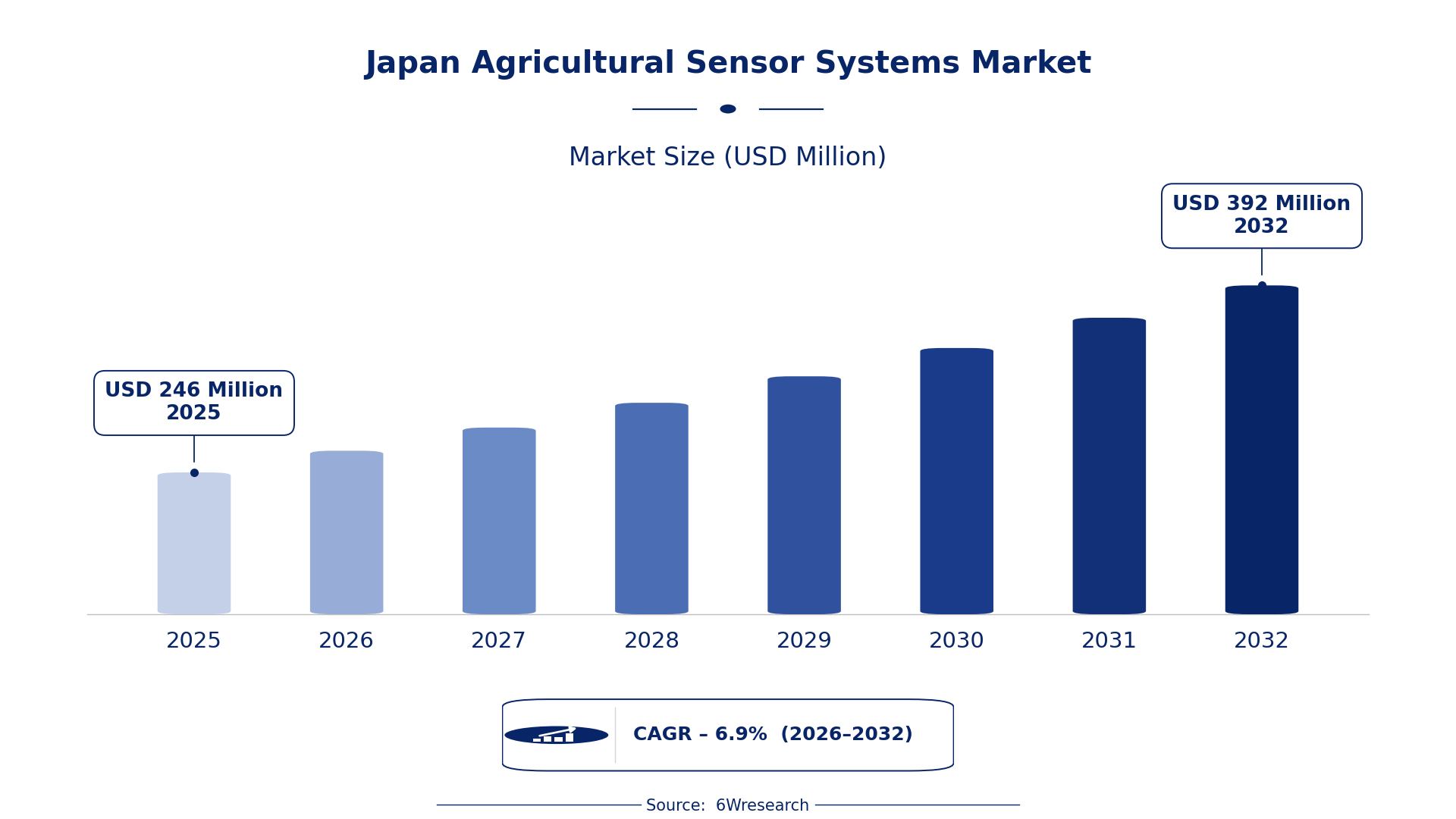
According to 6Wresearch internal database and industry insights, the Japan Agricultural Sensor Systems Market was valued at USD 246 Million in 2025 and is projected to reach USD 392 Million by 2032, growing at a CAGR of approximately 6.9% during 2026–2032.
Japan Agricultural Sensor Systems Market Highlights
| Report Metric | Details |
| Report Name | Japan Agricultural Sensor Systems Market (2026-2032) |
| Market Size 2025 | USD 246 Million |
| Market Size 2032 | USD 392 Million |
| Absolute Growth 2025–2032 | USD 146 Million |
| CAGR 2026–2032 | 6.9% |
| Peak Annual Growth | 8.3% in 2032 |
| Forecast Period | 2026–2032 |
| Historical Data | 2022–2025 |
| Base Year | 2025 |
| Leading Agricultural Sensor Systems Market, 2025 | Soil Moisture Sensors (45% share) |
| Leading Sensor Type, 2025 | Irrigation Control (37% share) |
| Leading Application Area, 2025 | Direct Sales (45% share) |
| Leading Distribution Channel, 2025 | Smart Farms (36% share) |
| Fastest-Growing Agricultural Sensor Systems Market | Weather Sensors (10.2% CAGR) |
| Fastest-Growing Sensor Type | Climate Monitoring (9.7% CAGR) |
| Fastest-Growing Application Area | Online Platforms (8.9% CAGR) |
| Fastest-Growing Distribution Channel | Greenhouse Operators (9.0% CAGR) |
| Growing Sector | Online Platforms |
| Key End Users | Direct Sales, Online Platforms, Agri Tech Suppliers, Specialty Stores |
Japan Agricultural Sensor Systems Market Year-wise Growth Rate and Key Drivers (2022–2032)
This graph illustrates the annual growth rates of the market from 2022 to 2032, highlighting a steady upward trajectory and projected market expansion over the forecast period.
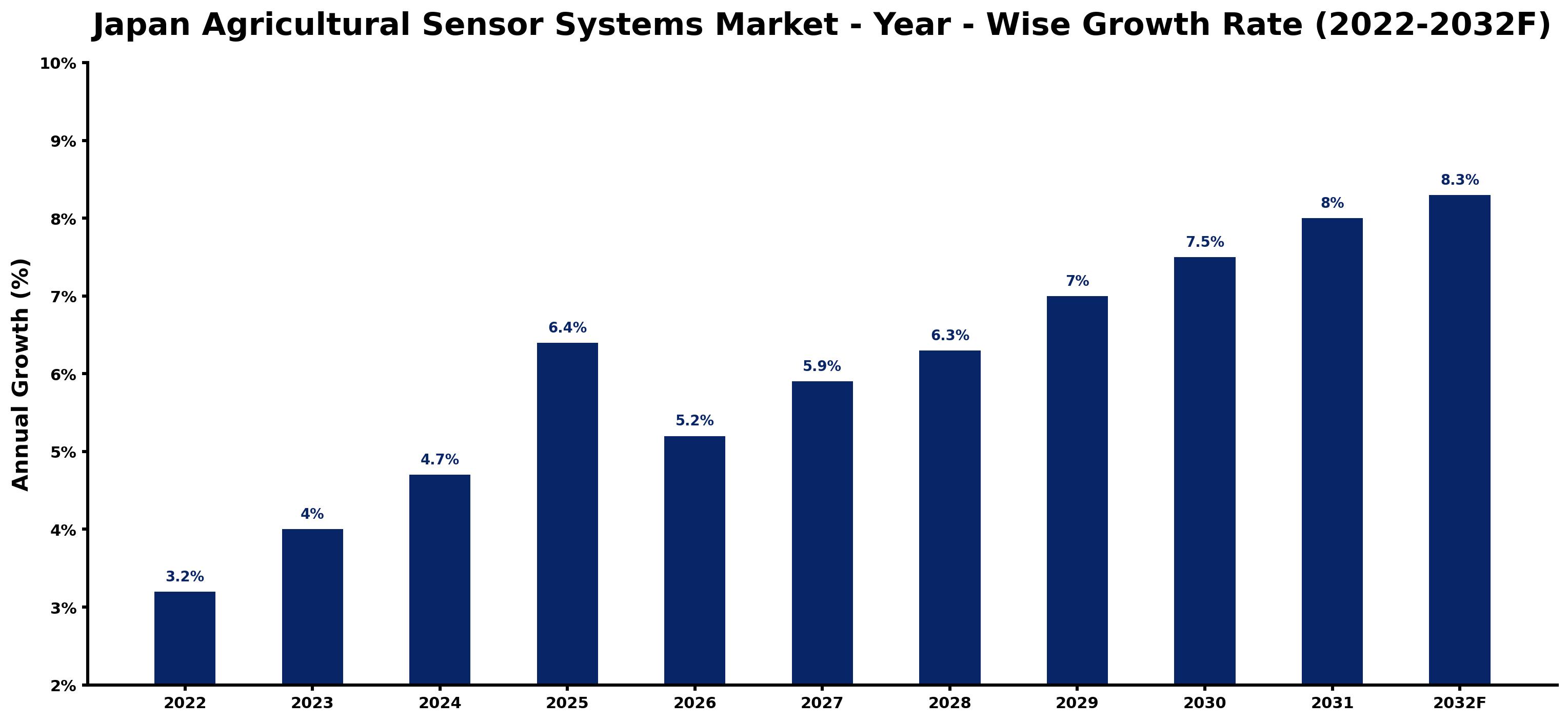
Below, each year's estimated growth is shown next to the factor that most influenced it.
| Year | Estimated Annual Growth (%) | Market Rationale |
| 2022 | 3.2 | The market experienced steady growth due to ongoing agricultural activities and technology adoption. |
| 2023 | 4.0 | Growth accelerated as more farmers adopted advanced sensor technologies for better crop management. |
| 2024 | 4.7 | Increased awareness of resource efficiency contributed to a rise in sensor usage among growers. |
| 2025 | 6.4 | The peak growth rate was driven by investments in smart farming initiatives across the country. |
| 2026 | 5.2 | Growth is expected to slow slightly as the market stabilises after a period of rapid expansion. |
| 2027 | 5.9 | Demand will increase as more commercial growers recognise the benefits of sensor data for productivity. |
| 2028 | 6.3 | The market is projected to continue growing, supported by rising interest in climate-smart agriculture practices. |
| 2029 | 7.0 | Adoption of weather sensors will surge, driven by changing climate conditions affecting farming. |
| 2030 | 7.5 | The market is expected to expand further as irrigation control systems become essential for water management. |
| 2031 | 8.0 | Demand will rise as the government promotes agricultural technology adoption among rural farmers. |
| 2032 | 8.3 | The market is projected to peak with a strong push for sustainable farming practices and advanced sensor integration. |
Note: Market size estimations and growth projections presented in this report are based on 6Wresearch's proprietary forecasting methodology, utilizing the latest available industry data, government publications, and primary research inputs.
Japan Agricultural Sensor Systems Market Synopsis
Agricultural Sensor Systems optimise irrigation, improve crop yield, and reduce resource waste through advanced technology that monitors soil conditions, weather patterns, and crop health. In Japan, the Agricultural Sensor Systems Market is expanding due to rising adoption rates, which reached 30% in 2022, supported by government initiatives. The number of commercial growers using sensors is estimated at 150,000, indicating strong demand for these technologies.
Market Dynamics Impact Analysis (2026–2032)
| Factor | Type | Impact | Primary Segment Affected |
| Increased adoption of smart farming technologies | Driver | High | Soil Moisture Sensors |
| Government initiatives promoting agricultural technology | Driver | High | Weather Sensors |
| Growing interest in sustainable farming practices | Opportunity | High | Nutrient Sensors |
| Expansion of agricultural technology suppliers in rural areas | Opportunity | Medium | Pest Detection Sensors |
| High initial investment costs for sensor systems | Restraint | High | Irrigation Control |
| Limited awareness among traditional farmers about sensor benefits | Restraint | Medium | Climate Monitoring |
| Compliance with stringent agricultural standards | Challenge | High | Soil Testing |
| Capacity limitations in sensor manufacturing | Challenge | Medium | Crop Protection |
Evaluation of Drivers in Japan Agricultural Sensor Systems Market (2026–2032)
These are the developments adding the most demand over the forecast period.
| Drivers | Primary Segment Affected | Why It Matters (Evidence) |
| Rising adoption of smart farming technologies | Soil Moisture Sensors | In 2022, Japan's agricultural technology adoption rate reached 30%, prompting growers to invest in soil moisture sensors for efficient irrigation management. |
| Government initiatives promoting agricultural technology | Weather Sensors | The Economic Security Promotion Act (2022) supports supply-chain resilience, leading to increased demand for weather sensors for climate adaptation. |
| Growing interest in sustainable farming practices | Nutrient Sensors | Nutrient sensors are increasingly used in the Kanto region for rice cultivation, reflecting a shift towards sustainable agricultural practices. |
| Expansion of agricultural technology suppliers in rural areas | Pest Detection Sensors | Agri Tech suppliers are increasing their presence in rural areas, facilitating access to pest detection sensors for local farmers. |
| High concentration of greenhouse operators in Tokyo | Irrigation Control | The Tokyo region's greenhouse operators rely on irrigation control systems to optimise water usage and improve crop productivity. |
Orders keep climbing as the agricultural technology adoption rate reached 30% in 2022, spurring demand for advanced sensor systems among growers. Increased awareness of the benefits of climate monitoring is driving demand for weather sensors, which assist in adapting to changing conditions. Nutrient sensors are gaining traction in the Kanto region, particularly for rice cultivation, reflecting a shift towards sustainable practices. Suppliers are expanding their presence in rural areas, improving access to pest detection systems. Greenhouse operators in the Tokyo region rely heavily on irrigation control systems, which effectively manage water resources and improve crop yield.
Evaluation of Restraints in Japan Agricultural Sensor Systems Market
The key brakes on demand, and where they bite hardest, are shown below.
| Market Restraint | Primary Segment Affected | Why It Matters (Evidence) |
| High initial investment costs for sensor systems | Irrigation Control | The upfront costs deter some farmers from adopting advanced irrigation control systems, limiting market growth. |
| Limited awareness among traditional farmers about sensor benefits | Climate Monitoring | Many traditional farmers lack knowledge of the advantages of climate monitoring sensors, hindering widespread adoption. |
| Compliance with stringent agricultural standards | Soil Testing | Producers must adhere to the JIS Z 8801 standard for agricultural sensors, complicating manufacturing processes. |
| Market saturation in urban areas | Crop Protection | Urban markets are becoming saturated with existing sensor products, limiting opportunities for new entrants. |
| Technological complexity of sensor systems | Pest Detection Sensors | The advanced technology involved in pest detection systems can be challenging for some farmers to operate effectively. |
Japan Agricultural Sensor Systems Market Challenges
Producers struggle with outdated technology, as only 30% adopted agricultural sensors in 2022, which limits efficiency and reduces crop yields. Regulatory hurdles arise from the JIS Z 8801 standard, complicating compliance for smaller farms and causing project delays that can extend timelines by up to six months. Local distributors face stiff competition from advanced foreign systems, forcing price reductions that can shrink profit margins by 20%. Skills shortages in rural areas hinder the effective implementation of new technologies, preventing producers from fully utilising available resources.
Trends in the Japan Agricultural Sensor Systems Market
These developments are changing demand patterns in the Japan Agricultural Sensor Systems Market.
- Shift towards Smart Farming in Hokkaido: Hokkaido is experiencing a shift towards smart farming, with over 4 million hectares of arable land monitored by advanced sensor systems. This trend is driven by the need for efficient resource management and is expected to grow as more farmers adopt these technologies.
- Emergence of Online Platforms for Sensor Sales: Since 2022, online platforms have gained traction for purchasing agricultural sensors, with an estimated growth rate of 8.9% for this distribution channel. This shift allows farmers to access a wider range of products conveniently, catering to the growing demand for technology.
- Increased Use of Nutrient Sensors among Commercial Growers: Commercial growers are increasingly adopting nutrient sensors, particularly in the Kanto region, where rice cultivation is prevalent. This trend reflects the need for precise soil health monitoring, improving crop yields and sustainability.
- Rising Demand for Climate Monitoring Solutions: The demand for climate monitoring solutions is rising as farmers adapt to changing weather patterns. This shift is evident in the growing use of weather sensors, which are essential for effective agricultural planning.
Investment Opportunities in the Japan Agricultural Sensor Systems Market
The following areas offer the clearest openings for investors and suppliers in the Japan Agricultural Sensor Systems Market.
- Timing for Investment in Sensor Technologies: With the government aiming to increase sensor usage by 50% by 2025, there is an opportunity for suppliers to invest in advanced sensor technologies. Agri Tech suppliers can enter the market by partnering with local farmers to provide tailored solutions.
- Supply of Nutrient Sensors for Rice Cultivation: The Kanto region is experiencing demand for nutrient sensors, particularly among rice growers. Suppliers can focus on developing these sensors to meet the specific needs of this buyer group, capitalising on the growing interest in sustainable practices.
- Expansion of Online Sales Channels: The shift towards online platforms for sensor sales presents an opportunity for suppliers to reach a broader audience. By investing in e-commerce strategies, suppliers can effectively cater to the growing interest in agricultural sensors.
- Investment in Pest Detection Technologies: With the growing need for pest management solutions, suppliers can invest in advanced pest detection technologies. Targeting commercial growers will be key, as they are significant users of these systems.
Government Initiatives in the Japan Agricultural Sensor Systems Market
The Industrial Standardization Act (1949; amended 2019) governs JIS product and test standards for agricultural sensors, ensuring quality and safety for producers and buyers. This law requires manufacturers to comply with established testing protocols, which can influence production costs and timelines.
The GX Basic Policy (adopted 2023) aims for about JPY 150 trillion of public-private decarbonisation investment over 10 years, promoting sustainable practices in agriculture. The Ministry of Agriculture, Forestry and Fisheries oversees this initiative, funding projects that support sensor technology adoption among farmers.
Future Insight of the Japan Agricultural Sensor Systems Market
Smart farming initiatives will gain traction by 2032, with the Agricultural Innovation Strategy 2023 promoting advanced sensor systems across various facilities. The Tokyo region will see an increase in greenhouse operators adopting these technologies to improve crop yield and resource management. By 2025, the government aims to boost sensor usage by 50%, which will enhance agricultural productivity. As agricultural technology evolves, buyers will benefit from improved data analytics, enabling more informed decisions and better resource allocation.
Market Segmentation Analysis
Japan Agricultural Sensor Systems Market report covers a detailed analysis of the following market segments:
By Agricultural Sensor Systems Market – Soil Moisture Sensors Lead, Weather Sensors Expected to Grow Fastest
According to Saurav Kr Singh, Senior Research Analyst at 6Wresearch, Soil Moisture Sensors held 45% of the Japan Agricultural Sensor Systems Market by agricultural sensor systems market in 2025. Soil moisture sensors hold the largest share due to their essential role in irrigation management, particularly in regions like Hokkaido and Tohoku where water conservation is critical. The reliance on these sensors by approximately 150,000 commercial growers underscores their significance in enhancing agricultural productivity. The quickest growth will come from Weather Sensors, forecast to expand at a CAGR of 10.2% between 2026 and 2032. Weather sensors are experiencing rapid growth as farmers increasingly recognise their importance for climate adaptation, especially with the agricultural technology adoption rate reaching 30% in 2022. The government's promotion of smart farming initiatives is likely to further bolster this segment's expansion. Suppliers should focus on developing weather sensors to meet the rising demand in the agricultural sector.
By Sensor Type – Irrigation Control Leads, Climate Monitoring Expected to Grow Fastest
Irrigation Control took 37% of sensor type revenue in 2025, more than any other category. Irrigation control systems lead the market due to their integral role in efficient water use, especially in areas with limited water resources. Their effectiveness in optimising irrigation practices makes them indispensable for many agricultural operations across Japan. Over 2026–2032, Climate Monitoring is expected to post the fastest growth, at a CAGR of 9.7%. Climate monitoring systems are growing rapidly as they are crucial for agricultural planning, particularly in response to changing weather patterns. The increasing focus on sustainable farming practices is expected to accelerate this segment's growth. Buyers should invest in climate monitoring systems to improve their agricultural resilience and adaptability.
By Application Area – Direct Sales Leads, Online Platforms Expected to Grow Fastest
With 45% of application area revenue in 2025, Direct Sales was the largest category. Direct sales dominate the market as the primary method for selling agricultural sensors, allowing for direct engagement with farmers and tailored solutions. This approach is particularly effective in rural regions where personal relationships significantly impact purchasing decisions. Online Platforms are projected to grow fastest, at a CAGR of 8.9% during 2026–2032. Online platforms are quickly gaining traction as a purchasing method, driven by the digitalisation of the agricultural sector and the convenience they offer to buyers. This trend is anticipated to continue as more farmers embrace technology in their operations. Suppliers must enhance their online strategies to effectively connect with the growing number of digital buyers in the market.
By Distribution Channel – Smart Farms Lead, Greenhouse Operators Expected to Grow Fastest
In 2025, Smart Farms led the distribution channel split with a 36% share. Smart farms are the main users of advanced sensors, extensively utilising them to boost productivity and operational efficiency. Their proactive adoption of technology sets a benchmark for the agricultural sector, encouraging other growers to follow their lead. Greenhouse Operators are set to record the highest CAGR in this split, 9.0% over 2026–2032. Greenhouse operators are experiencing the fastest growth as they take advantage of precise monitoring capabilities that optimise their controlled environments. This trend is expected to accelerate as more operators incorporate advanced technologies into their practices. Suppliers should tailor their products to meet the specific needs of greenhouse operators, capitalising on the increasing demand in this segment.
Key Attractiveness of the Report
- 10 Years of Market Numbers
- Historical Data Starting from 2022 to 2025
- Base Year 2025
- Forecast Data until 2032
- Key Performance Indicators Impacting the Market
- Major Upcoming Developments and Projects
Key Highlights of the Report:
- Japan Agricultural Sensor Systems Market Outlook
- Market Size of Japan Agricultural Sensor Systems Market, 2025
- Forecast of Japan Agricultural Sensor Systems Market, 2032
- Historical Data and Forecast of Japan Agricultural Sensor Systems Revenues & Volume for the Period 2022-2032F
- Japan Agricultural Sensor Systems Market Trend Evolution
- Japan Agricultural Sensor Systems Market Drivers and Challenges
- Japan Agricultural Sensor Systems Price Trends
- Japan Agricultural Sensor Systems Porter's Five Forces
- Japan Agricultural Sensor Systems Industry Life Cycle
- Historical Data and Forecast of Japan Agricultural Sensor Systems Market Revenues & Volume By Agricultural Sensor Systems Market for the Period 2022-2032F
- Historical Data and Forecast of Japan Agricultural Sensor Systems Market Revenues & Volume By Soil Moisture Sensors for the Period 2022-2032F
- Historical Data and Forecast of Japan Agricultural Sensor Systems Market Revenues & Volume By Weather Sensors for the Period 2022-2032F
- Historical Data and Forecast of Japan Agricultural Sensor Systems Market Revenues & Volume By Nutrient Sensors for the Period 2022-2032F
- Historical Data and Forecast of Japan Agricultural Sensor Systems Market Revenues & Volume By Pest Detection Sensors for the Period 2022-2032F
- Historical Data and Forecast of Japan Agricultural Sensor Systems Market Revenues & Volume By Sensor Type for the Period 2022-2032F
- Historical Data and Forecast of Japan Agricultural Sensor Systems Market Revenues & Volume By Irrigation Control for the Period 2022-2032F
- Historical Data and Forecast of Japan Agricultural Sensor Systems Market Revenues & Volume By Climate Monitoring for the Period 2022-2032F
- Historical Data and Forecast of Japan Agricultural Sensor Systems Market Revenues & Volume By Soil Testing for the Period 2022-2032F
- Historical Data and Forecast of Japan Agricultural Sensor Systems Market Revenues & Volume By Crop Protection for the Period 2022-2032F
- Historical Data and Forecast of Japan Agricultural Sensor Systems Market Revenues & Volume By Application Area for the Period 2022-2032F
- Historical Data and Forecast of Japan Agricultural Sensor Systems Market Revenues & Volume By Direct Sales for the Period 2022-2032F
- Historical Data and Forecast of Japan Agricultural Sensor Systems Market Revenues & Volume By Online Platforms for the Period 2022-2032F
- Historical Data and Forecast of Japan Agricultural Sensor Systems Market Revenues & Volume By Agri Tech Suppliers for the Period 2022-2032F
- Historical Data and Forecast of Japan Agricultural Sensor Systems Market Revenues & Volume By Specialty Stores for the Period 2022-2032F
- Historical Data and Forecast of Japan Agricultural Sensor Systems Market Revenues & Volume By Distribution Channel for the Period 2022-2032F
- Historical Data and Forecast of Japan Agricultural Sensor Systems Market Revenues & Volume By Smart Farms for the Period 2022-2032F
- Historical Data and Forecast of Japan Agricultural Sensor Systems Market Revenues & Volume By Greenhouse Operators for the Period 2022-2032F
- Historical Data and Forecast of Japan Agricultural Sensor Systems Market Revenues & Volume By Agronomists for the Period 2022-2032F
- Historical Data and Forecast of Japan Agricultural Sensor Systems Market Revenues & Volume By Commercial Growers for the Period 2022-2032F
- Japan Agricultural Sensor Systems Import Export Trade Statistics
- Market Opportunity Assessment By Agricultural Sensor Systems Market
- Market Opportunity Assessment By Sensor Type
- Market Opportunity Assessment By Application Area
- Market Opportunity Assessment By Distribution Channel
- Japan Agricultural Sensor Systems Top Companies Market Share
- Japan Agricultural Sensor Systems Competitive Benchmarking By Technical and Operational Parameters
- Japan Agricultural Sensor Systems Company Profiles
- Japan Agricultural Sensor Systems Key Strategic Recommendations
Market Covered
This report examines the market across the segments below.
By Agricultural Sensor Systems Market
- Soil Moisture Sensors
- Weather Sensors
- Nutrient Sensors
- Pest Detection Sensors
By Sensor Type
- Irrigation Control
- Climate Monitoring
- Soil Testing
- Crop Protection
By Application Area
- Direct Sales
- Online Platforms
- Agri Tech Suppliers
- Specialty Stores
By Distribution Channel
- Smart Farms
- Greenhouse Operators
- Agronomists
- Commercial Growers































