Japan Agricultural Supplements Market Size & Growth Rate
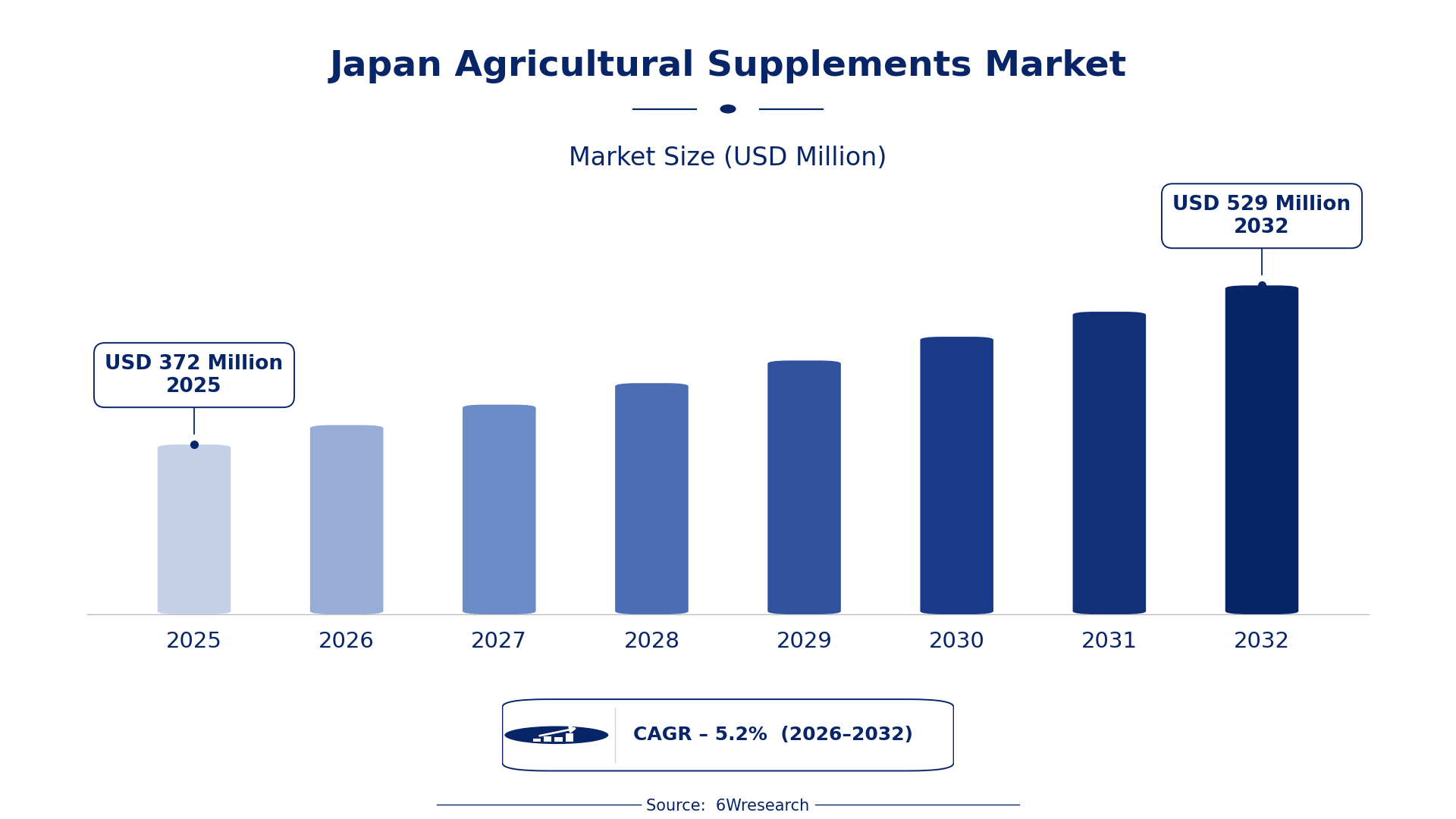
According to 6Wresearch internal database and industry insights, the Japan Agricultural Supplements Market was valued at USD 372 Million in 2025 and is projected to reach USD 529 Million by 2032, growing at a CAGR of approximately 5.2% during 2026–2032.
Japan Agricultural Supplements Market Highlights
| Report Metric | Details |
| Report Name | Japan Agricultural Supplements Market (2026-2032) |
| Market Size 2025 | USD 372 Million |
| Market Size 2032 | USD 529 Million |
| Absolute Growth 2025–2032 | USD 157 Million |
| CAGR 2026–2032 | 5.2% |
| Peak Annual Growth | 6.4% in 2032 |
| Forecast Period | 2026–2032 |
| Historical Data | 2022–2025 |
| Base Year | 2025 |
| Leading Agricultural Supplements Market, 2025 | Vitamin Mixes (33% share) |
| Leading Product Type, 2025 | Livestock (40% share) |
| Leading Target Organism, 2025 | Veterinary Stores (46% share) |
| Leading Distribution Channel, 2025 | Dairy Farmers (41% share) |
| Fastest-Growing Agricultural Supplements Market | Mineral Blends (7.1% CAGR) |
| Fastest-Growing Product Type | Poultry (7.3% CAGR) |
| Fastest-Growing Target Organism | Online Platforms (7.0% CAGR) |
| Fastest-Growing Distribution Channel | Poultry Farms (6.9% CAGR) |
| Growing Sector | Livestock |
| Key End Users | Dairy Farmers, Poultry Farmers, Organic Growers, Veterinary Stores |
Japan Agricultural Supplements Market Year-wise Growth Rate and Key Drivers (2022–2032)
This graph illustrates the annual growth rates of the market from 2022 to 2032, highlighting a steady upward trajectory and projected market expansion over the forecast period.
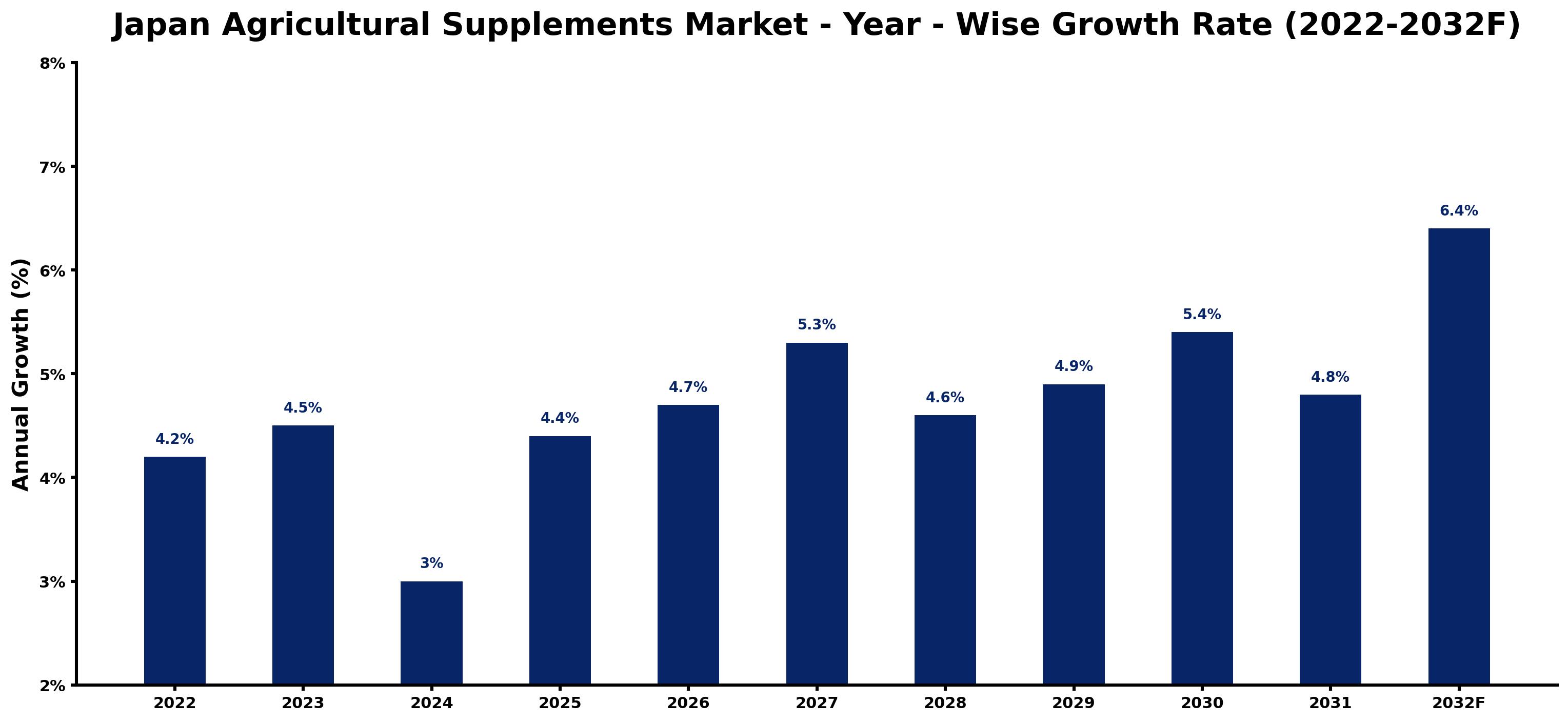
Annual growth estimates for each year appear below with the principal reason behind them, explaining the shifts that set the pace of the market.
| Year | Estimated Annual Growth (%) | Market Rationale |
| 2022 | 4.2 | The market experienced stable growth due to consistent demand from domestic users. |
| 2023 | 4.5 | Growth accelerated as agricultural cooperatives increased their purchasing of supplements. |
| 2024 | 3.0 | A slowdown occurred as market adjustments shifted towards more sustainable practices. |
| 2025 | 4.4 | Demand rose again as dairy farmers sought to improve livestock health and yield. |
| 2026 | 4.7 | Growth is expected to continue as the popularity of probiotic additives gains traction among users. |
| 2027 | 5.3 | Increased focus on organic farming is projected to drive further demand for agricultural supplements. |
| 2028 | 4.6 | A slight slowdown is anticipated as market adjustments take place in response to trends. |
| 2029 | 4.9 | Growth is expected to pick up as online platforms expand access to agricultural supplements. |
| 2030 | 5.4 | Demand is projected to surge as the Fisheries Agency promotes aquaculture supplement guidelines. |
| 2031 | 4.8 | A slowdown is anticipated as the market stabilises after several years of rapid growth. |
| 2032 | 6.4 | Growth is expected to peak due to heightened investments in sustainable agricultural practices. |
Note: Market size estimations and growth projections presented in this report are based on 6Wresearch's proprietary forecasting methodology, utilizing the latest available industry data, government publications, and primary research inputs.
Japan Agricultural Supplements Market Synopsis
Agricultural supplements support the growth and health of crops and livestock, utilising natural or synthetic compounds, including vitamins and minerals. The Japan Agricultural Supplements Market is valued at approximately 200 billion yen, with the livestock segment accounting for 40% of this value. Demand is driven by domestic users and agri cooperatives, alongside increasing interest in organic farming, supported by government initiatives aiming to increase organic farmland to 3% by 2025.
Market Dynamics Impact Analysis (2026–2032)
| Factor | Type | Impact | Primary Segment Affected |
| Increasing focus on organic farming practices | Driver | High | Probiotic Additives |
| Rising demand from dairy farmers for improved livestock health | Driver | High | Livestock |
| Growing online sales channels for agricultural supplements | Opportunity | Medium | Online Platforms |
| Expansion of aquaculture practices requiring specialized supplements | Opportunity | High | Aquaculture |
| Aging farmer population leading to decreased workforce availability | Restraint | High | Livestock |
| Strict regulations under JIS standards affecting product approval | Restraint | Medium | Mineral Blends |
| High costs associated with transitioning to organic farming | Challenge | High | Organic Growers |
| Competition from imported agricultural supplements | Challenge | Medium | Veterinary Stores |
Evaluation of Drivers in Japan Agricultural Supplements Market (2026–2032)
The following drivers explain most of the expected growth.
| Drivers | Primary Segment Affected | Why It Matters (Evidence) |
| Increased adoption of probiotic additives | Probiotic Additives | Probiotic additives are gaining traction, with a 15% increase in usage reported in 2023, as dairy farmers seek better gut health for livestock. |
| Rising demand for livestock health improvements | Livestock | The livestock segment accounts for 40% of the agricultural supplements market, as producers focus on improving yield and nutritional value. |
| Growth in online sales channels | Online Platforms | Online sales of agricultural supplements increased by 25% in the last year, providing farmers with easier access to products. |
| Support for aquaculture practices | Aquaculture | Aquaculture contributes to Japan's seafood production, necessitating specialized supplements to ensure fish health and growth, driving demand for tailored products. |
| Government initiatives promoting organic farming | Organic Growers | The Japanese government aims to increase organic farmland to 3% by 2025, stimulating demand for relevant agricultural supplements. |
Spending rises because the livestock segment accounts for 40% of the agricultural supplements market, reflecting producers' focus on improving yield and nutritional value. In 2023, probiotic additives saw a 15% increase in usage, as dairy farmers seek better gut health for livestock. Online sales of agricultural supplements surged by 25% over the past year, providing easier access to essential products. Aquaculture's contribution to seafood production necessitates specialized supplements to ensure fish health and growth, further driving market expansion.
Evaluation of Restraints in Japan Agricultural Supplements Market
The main factors holding the market back are set out below.
| Market Restraint | Primary Segment Affected | Why It Matters (Evidence) |
| Aging farmer population leading to decreased workforce availability | Livestock | The average age of farmers in Japan is 67, limiting the workforce available for agricultural production. |
| Strict regulations under JIS standards affecting product approval | Mineral Blends | Japan has stringent regulations for agricultural products, increasing the time and cost for producers to gain approval. |
| High costs associated with transitioning to organic farming | Organic Growers | Investing in organic farming practices can be expensive, which deters some farmers from making the switch. |
| Competition from imported agricultural supplements | Veterinary Stores | Imported products often provide cheaper alternatives, challenging local suppliers in the veterinary market. |
| Limited awareness of supplement benefits among some farmers | Dairy Farmers | Some farmers may not fully understand the advantages of using agricultural supplements, affecting demand. |
Japan Agricultural Supplements Market Challenges
Japan's agricultural supplements market is valued at approximately 200 billion yen, yet the average age of farmers is 67, leading to a skills shortage that limits the adoption of modern agricultural techniques among producers. Buyers face rising costs as the Ministry of Agriculture, Forestry and Fisheries promotes sustainable practices, which often require more expensive certified products, increasing expenses by up to 20%. Strict JIS standards hinder the introduction of new supplements, causing delays in product availability for farmers. Regulatory changes can disrupt supply chains, forcing producers to navigate complex approval processes that may exceed six months.
Trends in the Japan Agricultural Supplements Market
Below are the shifts with the largest effect on the Japan Agricultural Supplements Market.
- Increase in Online Sales Channels: The rise in online sales of agricultural supplements has surged by 25% in the last year, particularly benefiting rural farmers who seek convenient purchasing options.
- Growing Use of Probiotic Additives: Probiotic additives are gaining traction in the livestock sector, with a reported 15% increase in usage in 2023 as farmers seek to improve gut health.
- Expansion of Aquaculture Practices: Aquaculture's contribution to Japan's seafood production necessitates specialized supplements, driving demand for products tailored to fish health and growth, with specific guidelines from the Fisheries Agency.
- Shift towards Organic Farming: In 2023, the Japanese government launched a program to support organic farming, including supplement use, aiming to increase organic farmland to 3% by 2025.
Investment Opportunities in the Japan Agricultural Supplements Market
The opportunities below stand out in the Japan Agricultural Supplements Market for new entrants and existing suppliers.
- Investment in Online Sales Channels: The rise in online sales by 25% presents an opportunity to invest in e-commerce platforms catering to agricultural supplement buyers, particularly in rural areas.
- Expansion in Aquaculture Supplement Supply: Aquaculture's growth necessitates specialized supplements, creating opportunities for suppliers to cater to fishery owners looking for effective health solutions.
- Focus on Organic Farming Products: The government's goal to increase organic farmland to 3% by 2025 creates an opportunity to supply organic agricultural supplements to farmers.
- Supply of Probiotic Additives: With a 15% increase in usage reported in 2023, there is a strong opportunity to supply probiotic additives to dairy farmers seeking better livestock health.
Government Initiatives in the Japan Agricultural Supplements Market
The Food Sanitation Act amendment in 2018 made hygiene management mandatory for food businesses, impacting agricultural supplement producers by enforcing stricter safety standards. Following this, the Clinical Trials Act established rules for clinical research, ensuring that agricultural supplements meet safety and efficacy requirements. In 2023, the government launched a program to support organic farming, with the Ministry of Agriculture, Forestry and Fisheries overseeing its implementation. This program aims to promote sustainable practices and increase the use of agricultural supplements among farmers.
The program to support organic farming has allocated 1 billion yen for its initiatives, with the Ministry of Agriculture, Forestry and Fisheries responsible for its execution. This funding is intended to enhance the adoption of organic practices, thereby increasing the demand for agricultural supplements among farmers.
Future Insight of the Japan Agricultural Supplements Market
A government initiative to support organic farming will improve the availability of agricultural supplements. By 2032, the increase in online sales, which rose by 25% last year, will likely reshape distribution channels, making products more accessible for buyers. Research at the Tokyo Agricultural Technology Center will lead to improved supplement efficacy, benefiting producers and buyers alike. As the demand for probiotic additives continues to grow, suppliers will discover new market opportunities in this sector.
Market Segmentation Analysis
Japan Agricultural Supplements Market report covers a detailed analysis of the following market segments:
By Agricultural Supplements Market – Vitamin Mixes Lead, Mineral Blends Expected to Grow Fastest
According to Saurav Kr Singh, Senior Research Analyst at 6Wresearch, with 33% of agricultural supplements market revenue in 2025, Vitamin Mixes was the largest category. Vitamin mixes hold the largest share due to their crucial role in enhancing the nutritional value of livestock and crops. The livestock segment, which constitutes 40% of the market, relies heavily on these supplements to ensure optimal health and productivity. The quickest growth will come from Mineral Blends, forecast to expand at a CAGR of 7.1% between 2026 and 2032. Mineral blends are experiencing rapid growth as they are essential for maintaining animal health and promoting crop growth. The government's recent programme to support organic farming has increased the focus on these vital supplements. Suppliers should prioritise the development of mineral blends to take advantage of this expanding market.
By Product Type – Livestock Leads, Poultry Expected to Grow Fastest
Livestock took 40% of product type revenue in 2025, more than any other category. The livestock segment leads the market as it is the primary focus for agricultural supplements, addressing a substantial portion of the sector's needs. This is particularly evident in regions like Hokkaido, where livestock farming is a key activity. Poultry is set to record the highest CAGR in this split, 7.3% over 2026–2032. Poultry is the fastest-growing segment, fuelled by rising demand for nutritional supplements aimed at enhancing poultry health and productivity. The increase in poultry farming practices is significantly contributing to this trend. Suppliers must focus on poultry-specific products to effectively cater to the increasing demand in this segment.
By Target Organism – Veterinary Stores Lead, Online Platforms Expected to Grow Fastest
Veterinary Stores accounted for 46% of the market by target organism in 2025. Veterinary stores are the dominant sales channel for agricultural supplements, providing direct access to farmers and livestock owners. Their widespread presence across Japan ensures a reliable supply of essential products to the agricultural community. Online Platforms are projected to grow fastest, at a CAGR of 7.0% during 2026–2032. Online platforms are emerging as the fastest-growing sales channel, with a 25% increase in sales over the past year. This trend reflects a shift towards digital purchasing among farmers seeking convenience and accessibility. Suppliers should strengthen their online strategies to capture the expanding consumer base in this channel.
By Distribution Channel – Dairy Farmers Lead, Poultry Farms Expected to Grow Fastest
The largest distribution channel category in 2025 was Dairy Farmers, at 41% of revenue. Dairy farmers represent the largest user group for agricultural supplements, as they rely on these products to maintain the health and productivity of their cattle. This demand is particularly high in regions with a strong dairy farming presence. Over 2026–2032, Poultry Farms are expected to post the fastest growth, at a CAGR of 6.9%. Poultry farms are the fastest-growing consumer group, increasingly adopting supplements to enhance growth rates and improve overall poultry health. This shift indicates a broader trend towards more intensive poultry production methods. Suppliers should tailor their offerings to meet the specific requirements of poultry farms to capitalise on this growth opportunity.
Key Attractiveness of the Report
- 10 Years of Market Numbers
- Historical Data Starting from 2022 to 2025
- Base Year 2025
- Forecast Data until 2032
- Key Performance Indicators Impacting the Market
- Major Upcoming Developments and Projects
Key Highlights of the Report:
- Japan Agricultural Supplements Market Outlook
- Market Size of Japan Agricultural Supplements Market, 2025
- Forecast of Japan Agricultural Supplements Market, 2032
- Historical Data and Forecast of Japan Agricultural Supplements Revenues & Volume for the Period 2022-2032F
- Japan Agricultural Supplements Market Trend Evolution
- Japan Agricultural Supplements Market Drivers and Challenges
- Japan Agricultural Supplements Price Trends
- Japan Agricultural Supplements Porter's Five Forces
- Japan Agricultural Supplements Industry Life Cycle
- Historical Data and Forecast of Japan Agricultural Supplements Market Revenues & Volume By Agricultural Supplements Market for the Period 2022-2032F
- Historical Data and Forecast of Japan Agricultural Supplements Market Revenues & Volume By Vitamin Mixes for the Period 2022-2032F
- Historical Data and Forecast of Japan Agricultural Supplements Market Revenues & Volume By Mineral Blends for the Period 2022-2032F
- Historical Data and Forecast of Japan Agricultural Supplements Market Revenues & Volume By Probiotic Additives for the Period 2022-2032F
- Historical Data and Forecast of Japan Agricultural Supplements Market Revenues & Volume By Growth Enhancers for the Period 2022-2032F
- Historical Data and Forecast of Japan Agricultural Supplements Market Revenues & Volume By Product Type for the Period 2022-2032F
- Historical Data and Forecast of Japan Agricultural Supplements Market Revenues & Volume By Livestock for the Period 2022-2032F
- Historical Data and Forecast of Japan Agricultural Supplements Market Revenues & Volume By Poultry for the Period 2022-2032F
- Historical Data and Forecast of Japan Agricultural Supplements Market Revenues & Volume By Soil Microorganisms for the Period 2022-2032F
- Historical Data and Forecast of Japan Agricultural Supplements Market Revenues & Volume By Aquaculture for the Period 2022-2032F
- Historical Data and Forecast of Japan Agricultural Supplements Market Revenues & Volume By Target Organism for the Period 2022-2032F
- Historical Data and Forecast of Japan Agricultural Supplements Market Revenues & Volume By Veterinary Stores for the Period 2022-2032F
- Historical Data and Forecast of Japan Agricultural Supplements Market Revenues & Volume By Online Platforms for the Period 2022-2032F
- Historical Data and Forecast of Japan Agricultural Supplements Market Revenues & Volume By Agri Cooperatives for the Period 2022-2032F
- Historical Data and Forecast of Japan Agricultural Supplements Market Revenues & Volume By Direct Sales for the Period 2022-2032F
- Historical Data and Forecast of Japan Agricultural Supplements Market Revenues & Volume By Distribution Channel for the Period 2022-2032F
- Historical Data and Forecast of Japan Agricultural Supplements Market Revenues & Volume By Dairy Farmers for the Period 2022-2032F
- Historical Data and Forecast of Japan Agricultural Supplements Market Revenues & Volume By Poultry Farms for the Period 2022-2032F
- Historical Data and Forecast of Japan Agricultural Supplements Market Revenues & Volume By Organic Growers for the Period 2022-2032F
- Historical Data and Forecast of Japan Agricultural Supplements Market Revenues & Volume By Fishery Owners for the Period 2022-2032F
- Japan Agricultural Supplements Import Export Trade Statistics
- Market Opportunity Assessment By Agricultural Supplements Market
- Market Opportunity Assessment By Product Type
- Market Opportunity Assessment By Target Organism
- Market Opportunity Assessment By Distribution Channel
- Japan Agricultural Supplements Top Companies Market Share
- Japan Agricultural Supplements Competitive Benchmarking By Technical and Operational Parameters
- Japan Agricultural Supplements Company Profiles
- Japan Agricultural Supplements Key Strategic Recommendations
Market Covered
The report covers the following segments.
By Agricultural Supplements Market
- Vitamin Mixes
- Mineral Blends
- Probiotic Additives
- Growth Enhancers
By Product Type
- Livestock
- Poultry
- Soil Microorganisms
- Aquaculture
By Target Organism
- Veterinary Stores
- Online Platforms
- Agri Cooperatives
- Direct Sales
By Distribution Channel
- Dairy Farmers
- Poultry Farms
- Organic Growers
- Fishery Owners































