Japan Agricultural Supply Chain Market Size & Growth Rate
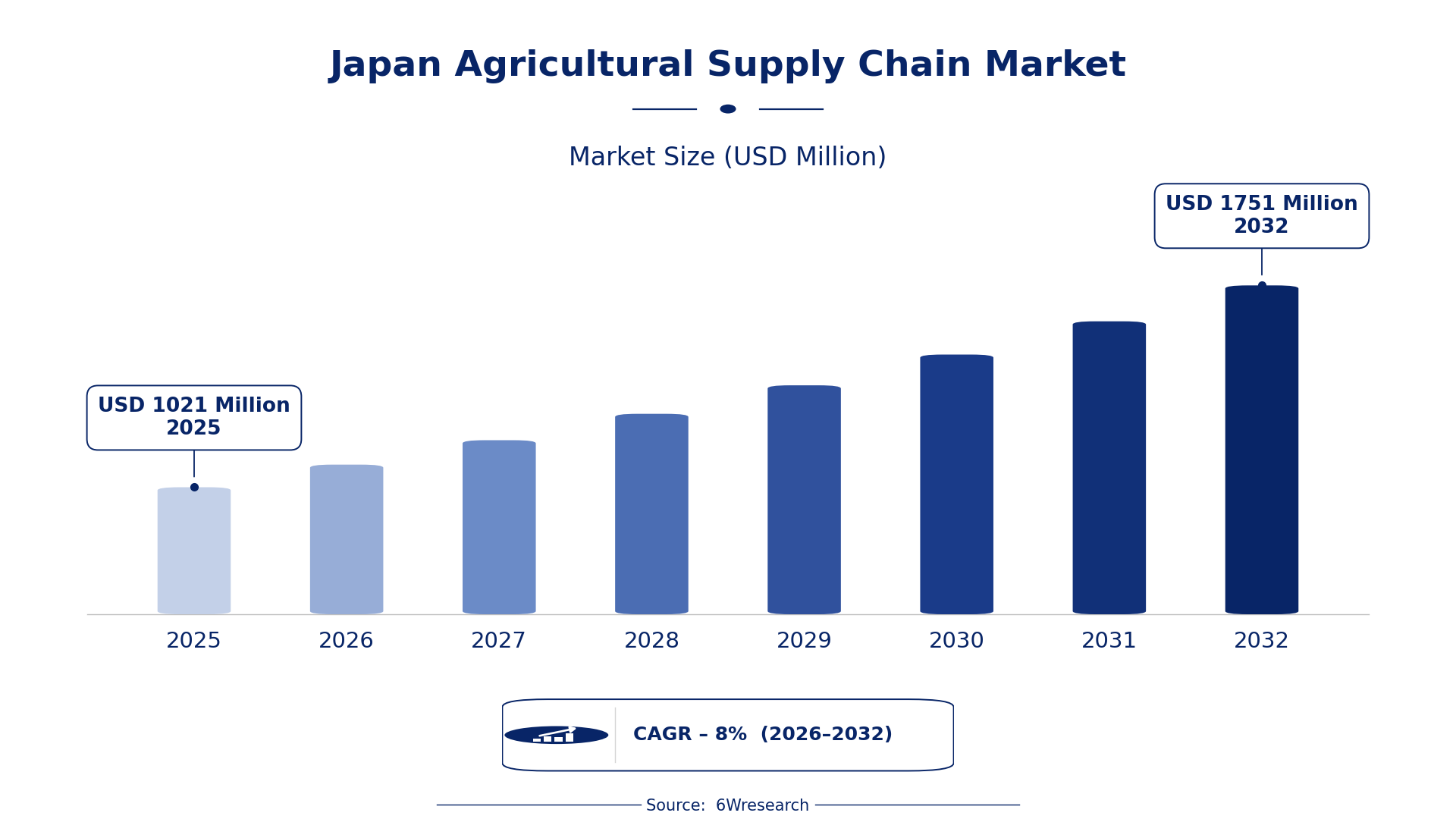
According to 6Wresearch internal database and industry insights, the Japan Agricultural Supply Chain Market was valued at USD 1,021 Million in 2025 and is projected to reach USD 1,751 Million by 2032, growing at a CAGR of approximately 8% during 2026–2032.
Japan Agricultural Supply Chain Market Highlights
| Report Metric | Details |
| Report Name | Japan Agricultural Supply Chain Market (2026-2032) |
| Market Size 2025 | USD 1,021 Million |
| Market Size 2032 | USD 1,751 Million |
| Absolute Growth 2025–2032 | USD 730 Million |
| CAGR 2026–2032 | 8% |
| Peak Annual Growth | 9.0% in 2028 |
| Forecast Period | 2026–2032 |
| Historical Data | 2022–2025 |
| Base Year | 2025 |
| Leading Agricultural Supply Chain Market, 2025 | Farm-to-Table Logistics (38% share) |
| Leading Service Type, 2025 | Cloud-Based (49% share) |
| Leading Platform Type, 2025 | Online Platform (41% share) |
| Leading Distribution Channel, 2025 | Food Retailers (45% share) |
| Fastest-Growing Agricultural Supply Chain Market | Cold Chain Solutions (10.7% CAGR) |
| Fastest-Growing Service Type | Temperature Controlled (10.8% CAGR) |
| Fastest-Growing Platform Type | Direct Sales (11.5% CAGR) |
| Fastest-Growing Distribution Channel | Fresh Produce Exporters (9.9% CAGR) |
| Growing Sector | Food Distribution |
| Key End Users | Urban Consumers, Food Retailers, Fresh Produce Exporters, Agricultural Cooperatives |
Japan Agricultural Supply Chain Market Year-wise Growth Rate and Key Drivers (2022–2032)
This graph illustrates the annual growth rates of the market from 2022 to 2032, highlighting a steady upward trajectory and projected market expansion over the forecast period.
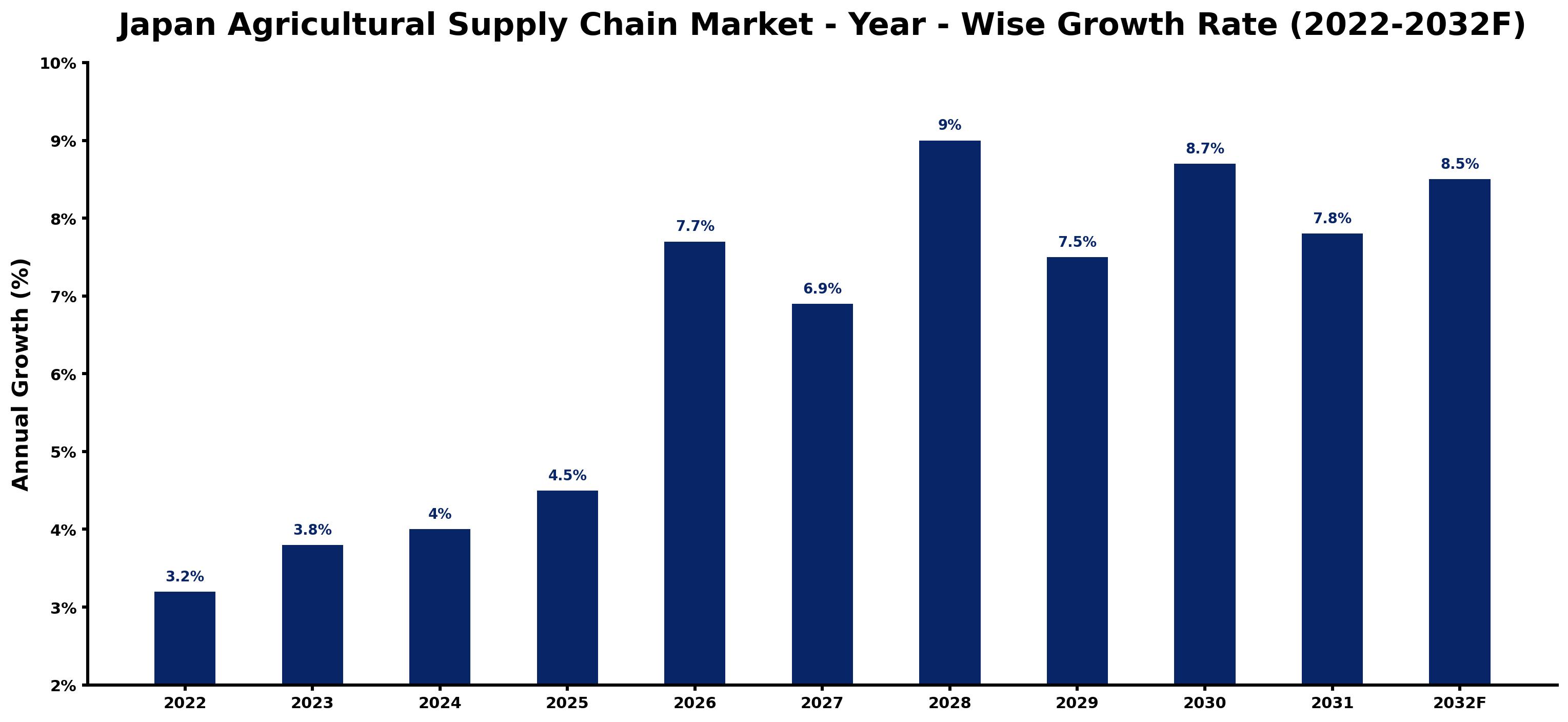
The following figures match every annual growth estimate with the main market development of that year, giving the reasoning behind each rise or slowdown.
| Year | Estimated Annual Growth (%) | Market Rationale |
| 2022 | 3.2 | Demand was steady, reflecting the ongoing need for efficient agricultural logistics. |
| 2023 | 3.8 | Growth accelerated due to increased urban consumption and logistics improvements. |
| 2024 | 4.0 | Continued demand from urban consumers drove further growth in supply chain efficiency. |
| 2025 | 4.5 | The market peaked historically as cold chain solutions gained prominence. |
| 2026 | 7.7 | Demand is expected to surge with the introduction of advanced cold chain technologies. |
| 2027 | 6.9 | Growth is projected to slow slightly as market conditions stabilise after rapid expansion. |
| 2028 | 9.0 | A new peak in growth is expected, driven by rising e-commerce in food. |
| 2029 | 7.5 | Growth will decelerate as the market adjusts to previous rapid increases. |
| 2030 | 8.7 | Demand is expected to increase again, supported by ongoing urbanisation and technological advancements. |
| 2031 | 7.8 | Growth is projected to moderate as the market approaches maturity in several segments. |
| 2032 | 8.5 | Continued urbanisation and innovation in supply chains will sustain demand. |
Note: Market size estimations and growth projections presented in this report are based on 6Wresearch's proprietary forecasting methodology, utilizing the latest available industry data, government publications, and primary research inputs.
Japan Agricultural Supply Chain Market Synopsis
The Agricultural Supply Chain encompasses logistics and technology solutions essential for transporting agricultural products from farms to consumers. Key processes include cold chain management and last-mile delivery, which are critical for maintaining product quality. The Japan Agricultural Supply Chain Market is expanding due to rising urban consumption, with the Tokyo metropolitan area accounting for 30% of food consumption. Advancements in cold chain logistics and the Smart Agriculture Project are driving new demand, improving efficiency and reducing waste in the supply chain.
Market Dynamics Impact Analysis (2026–2032)
| Factor | Type | Impact | Primary Segment Affected |
| Increasing urban population driving demand for efficient logistics solutions | Driver | High | Farm-to-Table Logistics |
| Technological advancements in cold chain management enhancing product quality | Driver | High | Cold Chain Solutions |
| Growing e-commerce market for food products creating new distribution channels | Opportunity | High | Last-Mile Delivery |
| Rising demand for fresh produce exports expanding market reach | Opportunity | Medium | Fresh Produce Exporters |
| Regulatory compliance costs for food safety standards burdening producers | Restraint | High | Cold Chain Solutions |
| Limited infrastructure in rural areas hindering supply chain efficiency | Restraint | Medium | Farm-to-Table Logistics |
| High operational costs affecting profit margins for logistics providers | Challenge | High | Last-Mile Delivery |
| Capacity constraints in cold storage facilities delaying product distribution | Challenge | Medium | Cold Chain Solutions |
Evaluation of Drivers in Japan Agricultural Supply Chain Market (2026–2032)
Below are the drivers that matter most for revenue growth, with supporting evidence.
| Drivers | Primary Segment Affected | Why It Matters (Evidence) |
| Urbanisation increasing demand for fresh food delivery | Last-Mile Delivery | With approximately 92% of Japan's population living in urban areas, demand for efficient last-mile delivery solutions is rising. |
| Technological advancements in cold chain logistics | Cold Chain Solutions | The average temperature for cold storage is maintained at 0-5°C, ensuring quality and reducing waste. |
| Growth in e-commerce food market | Farm-to-Table Logistics | The e-commerce market for food in Japan is projected to grow significantly by 2025, boosting logistics needs. |
| Support from agricultural cooperatives improving supply chain efficiency | Farm-to-Table Logistics | Agricultural Cooperatives connect producers with consumers, driving demand for logistics solutions. |
| Government initiatives promoting food safety standards | Cold Chain Solutions | ISO 22000 is applied in Japan's food safety management systems, increasing operational costs. |
The strongest pull on demand comes from the rising urban population, with approximately 92% of Japan's residents living in cities. This demographic drives the need for efficient last-mile delivery solutions, contributing to a projected growth in the e-commerce food market by 2025. Cold chain logistics advancements ensure product quality during transport. Support from agricultural cooperatives improves supply chain efficiency, connecting producers and consumers effectively. Compliance with food safety standards increases operational costs for logistics providers, impacting their profitability.
Evaluation of Restraints in Japan Agricultural Supply Chain Market
The table below lists the restraints and the evidence behind each.
| Market Restraint | Primary Segment Affected | Why It Matters (Evidence) |
| High compliance costs for food safety regulations affecting profitability | Cold Chain Solutions | Compliance with the Food Sanitation Act increases operational costs for cold chain providers. |
| Limited infrastructure in rural areas impacting logistics efficiency | Farm-to-Table Logistics | Inadequate transport networks in rural regions hinder timely product delivery to urban markets. |
| Seasonal fluctuations in agricultural production affecting supply consistency | Last-Mile Delivery | Variability in crop yields can disrupt supply chains, causing delivery delays. |
| Rising operational costs due to fuel price increases | Last-Mile Delivery | Higher fuel prices directly impact delivery costs, affecting logistics providers' margins. |
| Competition among logistics providers leading to price wars | Farm-to-Table Logistics | Intense competition can erode profit margins, making it difficult for providers to sustain operations. |
Japan Agricultural Supply Chain Market Challenges
Urban consumers in Japan face rising food prices due to intense competition in the agricultural sector, which contributes only 1% to the national GDP and pressures producers to lower prices. Supply chain inefficiencies arise from reliance on over 1,000 cold storage facilities, causing delays that can inflate costs for producers by up to 15%. Technology adoption is stifled by stringent regulations under the Food Sanitation Act, leading to potential waste of 30% of perishable goods. Buyers experience increased monthly food expenses, averaging ¥60,000, as these challenges compound the overall cost of goods.
Trends in the Japan Agricultural Supply Chain Market
The shifts below are changing how Japan Agricultural Supply Chain Market products are bought and supplied.
- Shift towards E-commerce Food Distribution: Urban consumers are increasingly turning to online platforms for food purchases, with the e-commerce food market projected to grow significantly by 2025. This shift is reshaping distribution strategies, compelling logistics providers to adapt to new consumer behaviours.
- Transition to Advanced Cold Chain Technologies: Cold chain solutions are evolving with the integration of IoT technologies, allowing real-time monitoring of perishable goods. The Japan Cold Chain Association promotes best practices, ensuring quality and reducing waste in logistics.
- Emergence of Sustainable Practices in Agriculture: Sustainability is becoming a priority, with the Food Recycling Law encouraging food businesses to reduce waste. This initiative is driving innovations in supply chain practices, aligning with consumer demand for environmentally friendly products.
- Prioritisation of Last-Mile Delivery Solutions: As urban populations grow, logistics providers are focusing on optimising last-mile delivery systems. The Smart Agriculture Project aims to enhance efficiency in agricultural supply chains by 2025, addressing the demand for timely deliveries.
Investment Opportunities in the Japan Agricultural Supply Chain Market
Below are the investment opportunities with the strongest case in the Japan Agricultural Supply Chain Market.
- Growing Demand for Fresh Produce Exports: Fresh produce exporters are seeking efficient logistics solutions to meet international standards. With Japan's agricultural exports reaching approximately ¥1 trillion in 2023, there is an opportunity for investment in cold chain technologies.
- Investment in Cold Chain Infrastructure: Logistics partners are looking to improve cold storage capacities to meet rising demand. With over 1,000 cold storage facilities in Japan, partnerships can facilitate expansion and improve supply chain efficiency.
- Expansion of E-commerce Platforms for Food Products: Food retailers are increasingly investing in online platforms to reach urban consumers. Collaborating with local tech firms can streamline logistics and improve customer engagement in the growing e-commerce market.
- Enhancing Last-Mile Delivery Capabilities: Urban consumers are driving the need for efficient last-mile delivery solutions. Investing in technology and partnerships can help logistics providers meet this demand effectively.
Government Initiatives in the Japan Agricultural Supply Chain Market
The Food Sanitation Act amendment introduced in 2018 mandates HACCP-based hygiene management for food businesses, impacting producers by requiring stringent safety protocols. Compliance with this law is essential for maintaining product quality and consumer trust in the agricultural supply chain.
The Smart Agriculture Project, with a funding target of ¥10 billion by 2025, aims to improve efficiency in agricultural supply chains. The Ministry of Agriculture, Forestry and Fisheries (MAFF) oversees this initiative, promoting technological advancements and sustainability in the sector.
Future Insight of the Japan Agricultural Supply Chain Market
The Smart Agriculture Project will implement new technologies to streamline agricultural supply chains, benefiting buyers and suppliers alike. By 2032, Japan's agricultural exports are expected to reach approximately ¥1 trillion, creating opportunities for producers. Innovations showcased at the Tokyo Food Tech Expo 2023 will improve operational efficiencies and reduce waste. The Logistics Efficiency Program aims to enhance supply chain performance, ensuring better quality and availability of agricultural products for consumers.
Market Segmentation Analysis
Japan Agricultural Supply Chain Market report covers a detailed analysis of the following market segments:
By Agricultural Supply Chain Market – Farm-to-Table Logistics Leads, Cold Chain Solutions Expected to Grow Fastest
According to Saurav Kr Singh, Senior Research Analyst at 6Wresearch, Farm-to-Table Logistics accounted for 38% of the market by agricultural supply chain market in 2025. Farm-to-Table Logistics holds the largest share as it is crucial for connecting producers with consumers directly, particularly in urban regions like Tokyo where food consumption is substantial. The emphasis on fresh, locally sourced products is reinforced by initiatives such as the Smart Agriculture Project. The quickest growth will come from Cold Chain Solutions, forecast to expand at a CAGR of 10.7% between 2026 and 2032. Cold Chain Solutions is experiencing rapid growth due to the heightened need for preserving the quality of perishable goods during transport, with over 1,000 cold storage facilities ensuring effective logistics. The surge in agricultural exports, reaching approximately ¥1 trillion in 2023, further propels this segment's expansion. Suppliers must prioritise the enhancement of cold chain capabilities to satisfy the increasing demand for quality preservation.
By Service Type – Cloud-Based Leads, Temperature Controlled Expected to Grow Fastest
Cloud-Based took 49% of service type revenue in 2025, more than any other category. Cloud-Based services dominate the market as they enable efficient data management across the supply chain, allowing agricultural stakeholders to make informed decisions. This segment is vital for users who require seamless access to information and analytics to optimise operations. Temperature Controlled is projected to grow fastest, at a CAGR of 10.8% during 2026–2032. Temperature Controlled services are growing rapidly as they are essential for maintaining the integrity of perishable items, which is increasingly critical in urban areas with high food consumption. The focus on food safety compliance under standards like ISO 22000 drives this demand. Investing in temperature-controlled solutions will be crucial for suppliers to meet food safety standards and consumer expectations.
By Platform Type – Online Platform Leads, Direct Sales Expected to Grow Fastest
The largest platform type category in 2025 was Online Platform, at 41% of revenue. Online Platforms lead the market as they connect various stakeholders in the supply chain, facilitating transactions and information exchange. Their significance is highlighted by the expanding e-commerce market for food, which is projected to grow substantially by 2025. Direct Sales is set to record the highest CAGR in this split, 11.5% over 2026–2032. Direct Sales is the fastest-growing segment, albeit less common, as it provides a more personal connection between producers and consumers, catering to niche markets. This growth indicates a shift towards more personalised purchasing experiences in agriculture. Suppliers should consider diversifying their sales strategies to include direct sales to capture emerging market trends.
By Distribution Channel – Food Retailers Lead, Fresh Produce Exporters Expected to Grow Fastest
With 45% of distribution channel revenue in 2025, Food Retailers was the largest category. Food Retailers are the primary channel for reaching consumers with agricultural products, representing a considerable portion of food sales in urban areas. Their established networks and customer bases are essential for effective distribution. Over 2026–2032, Fresh Produce Exporters are expected to post the fastest growth, at a CAGR of 9.9%. Fresh Produce Exporters are witnessing the fastest growth, driven by the rising demand for international trade in agricultural goods. The emphasis on global supply chain efficiency and sustainability enhances this segment's prospects. Suppliers should strengthen relationships with fresh produce exporters to leverage international market opportunities.
Key Attractiveness of the Report
- 10 Years of Market Numbers
- Historical Data Starting from 2022 to 2025
- Base Year 2025
- Forecast Data until 2032
- Key Performance Indicators Impacting the Market
- Major Upcoming Developments and Projects
Key Highlights of the Report:
- Japan Agricultural Supply Chain Market Outlook
- Market Size of Japan Agricultural Supply Chain Market, 2025
- Forecast of Japan Agricultural Supply Chain Market, 2032
- Historical Data and Forecast of Japan Agricultural Supply Chain Revenues & Volume for the Period 2022-2032F
- Japan Agricultural Supply Chain Market Trend Evolution
- Japan Agricultural Supply Chain Market Drivers and Challenges
- Japan Agricultural Supply Chain Price Trends
- Japan Agricultural Supply Chain Porter's Five Forces
- Japan Agricultural Supply Chain Industry Life Cycle
- Historical Data and Forecast of Japan Agricultural Supply Chain Market Revenues & Volume By Agricultural Supply Chain Market for the Period 2022-2032F
- Historical Data and Forecast of Japan Agricultural Supply Chain Market Revenues & Volume By Farm-to-Table Logistics for the Period 2022-2032F
- Historical Data and Forecast of Japan Agricultural Supply Chain Market Revenues & Volume By Cold Chain Solutions for the Period 2022-2032F
- Historical Data and Forecast of Japan Agricultural Supply Chain Market Revenues & Volume By Inventory Management Software for the Period 2022-2032F
- Historical Data and Forecast of Japan Agricultural Supply Chain Market Revenues & Volume By Last-Mile Delivery for the Period 2022-2032F
- Historical Data and Forecast of Japan Agricultural Supply Chain Market Revenues & Volume By Service Type for the Period 2022-2032F
- Historical Data and Forecast of Japan Agricultural Supply Chain Market Revenues & Volume By Cloud-Based for the Period 2022-2032F
- Historical Data and Forecast of Japan Agricultural Supply Chain Market Revenues & Volume By Temperature Controlled for the Period 2022-2032F
- Historical Data and Forecast of Japan Agricultural Supply Chain Market Revenues & Volume By ERP-Integrated for the Period 2022-2032F
- Historical Data and Forecast of Japan Agricultural Supply Chain Market Revenues & Volume By App-Based for the Period 2022-2032F
- Historical Data and Forecast of Japan Agricultural Supply Chain Market Revenues & Volume By Platform Type for the Period 2022-2032F
- Historical Data and Forecast of Japan Agricultural Supply Chain Market Revenues & Volume By Online Platform for the Period 2022-2032F
- Historical Data and Forecast of Japan Agricultural Supply Chain Market Revenues & Volume By Direct Sales for the Period 2022-2032F
- Historical Data and Forecast of Japan Agricultural Supply Chain Market Revenues & Volume By SaaS Vendors for the Period 2022-2032F
- Historical Data and Forecast of Japan Agricultural Supply Chain Market Revenues & Volume By Logistics Partners for the Period 2022-2032F
- Historical Data and Forecast of Japan Agricultural Supply Chain Market Revenues & Volume By Distribution Channel for the Period 2022-2032F
- Historical Data and Forecast of Japan Agricultural Supply Chain Market Revenues & Volume By Food Retailers for the Period 2022-2032F
- Historical Data and Forecast of Japan Agricultural Supply Chain Market Revenues & Volume By Fresh Produce Exporters for the Period 2022-2032F
- Historical Data and Forecast of Japan Agricultural Supply Chain Market Revenues & Volume By Agri Distributors for the Period 2022-2032F
- Historical Data and Forecast of Japan Agricultural Supply Chain Market Revenues & Volume By Urban Consumers for the Period 2022-2032F
- Japan Agricultural Supply Chain Import Export Trade Statistics
- Market Opportunity Assessment By Agricultural Supply Chain Market
- Market Opportunity Assessment By Service Type
- Market Opportunity Assessment By Platform Type
- Market Opportunity Assessment By Distribution Channel
- Japan Agricultural Supply Chain Top Companies Market Share
- Japan Agricultural Supply Chain Competitive Benchmarking By Technical and Operational Parameters
- Japan Agricultural Supply Chain Company Profiles
- Japan Agricultural Supply Chain Key Strategic Recommendations
Market Covered
The following segment groups are covered in the report.
By Agricultural Supply Chain Market
- Farm-to-Table Logistics
- Cold Chain Solutions
- Inventory Management Software
- Last-Mile Delivery
By Service Type
- Cloud-Based
- Temperature Controlled
- ERP-Integrated
- App-Based
By Platform Type
- Online Platform
- Direct Sales
- SaaS Vendors
- Logistics Partners
By Distribution Channel
- Food Retailers
- Fresh Produce Exporters
- Agri Distributors
- Urban Consumers































