Japan Agricultural Waste Management Market Size & Growth Rate
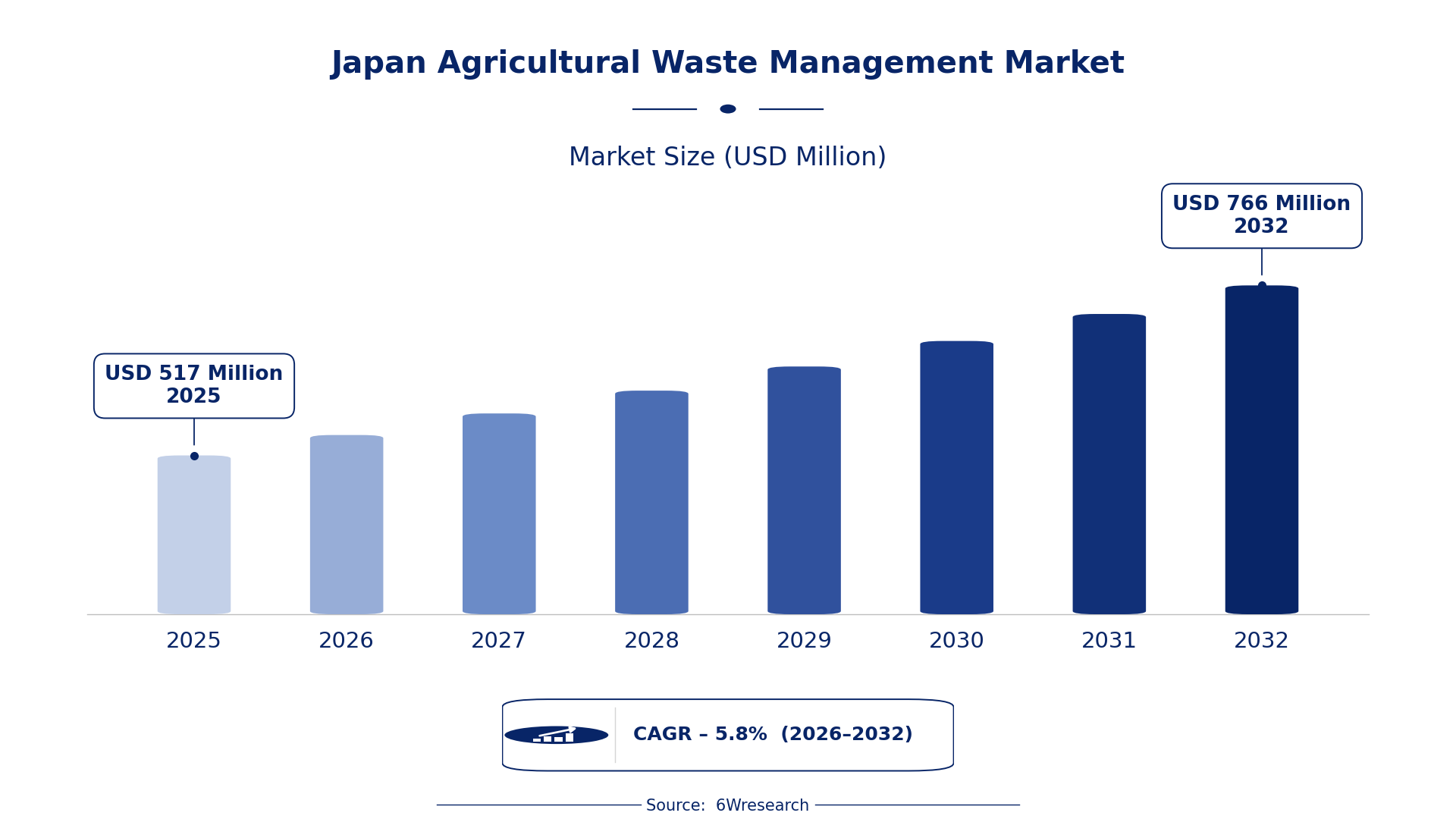
According to 6Wresearch internal database and industry insights, the Japan Agricultural Waste Management Market was valued at USD 517 Million in 2025 and is projected to reach USD 766 Million by 2032, growing at a CAGR of approximately 5.8% during 2026–2032.
Japan Agricultural Waste Management Market Highlights
| Report Metric | Details |
| Report Name | Japan Agricultural Waste Management Market (2026-2032) |
| Market Size 2025 | USD 517 Million |
| Market Size 2032 | USD 766 Million |
| Absolute Growth 2025–2032 | USD 249 Million |
| CAGR 2026–2032 | 5.8% |
| Peak Annual Growth | 6.5% in 2027 |
| Forecast Period | 2026–2032 |
| Historical Data | 2022–2025 |
| Base Year | 2025 |
| Leading Agricultural Waste Management Market, 2025 | Organic Waste (49% share) |
| Leading Waste Type, 2025 | Composting (48% share) |
| Leading Treatment Method, 2025 | Direct Sales (49% share) |
| Leading Distribution Channel, 2025 | Fertilizer Producers (53% share) |
| Fastest-Growing Agricultural Waste Management Market | Animal Waste (7.6% CAGR) |
| Fastest-Growing Waste Type | Biogas Generation (8.6% CAGR) |
| Fastest-Growing Treatment Method | Waste Management Firms (8.3% CAGR) |
| Growing Sector | Organic Waste Recycling |
| Key End Users | Farmers, Agricultural Producers, Waste Management Firms |
Japan Agricultural Waste Management Market Year-wise Growth Rate and Key Drivers (2022–2032)
This graph illustrates the annual growth rates of the market from 2022 to 2032, highlighting a steady upward trajectory and projected market expansion over the forecast period.
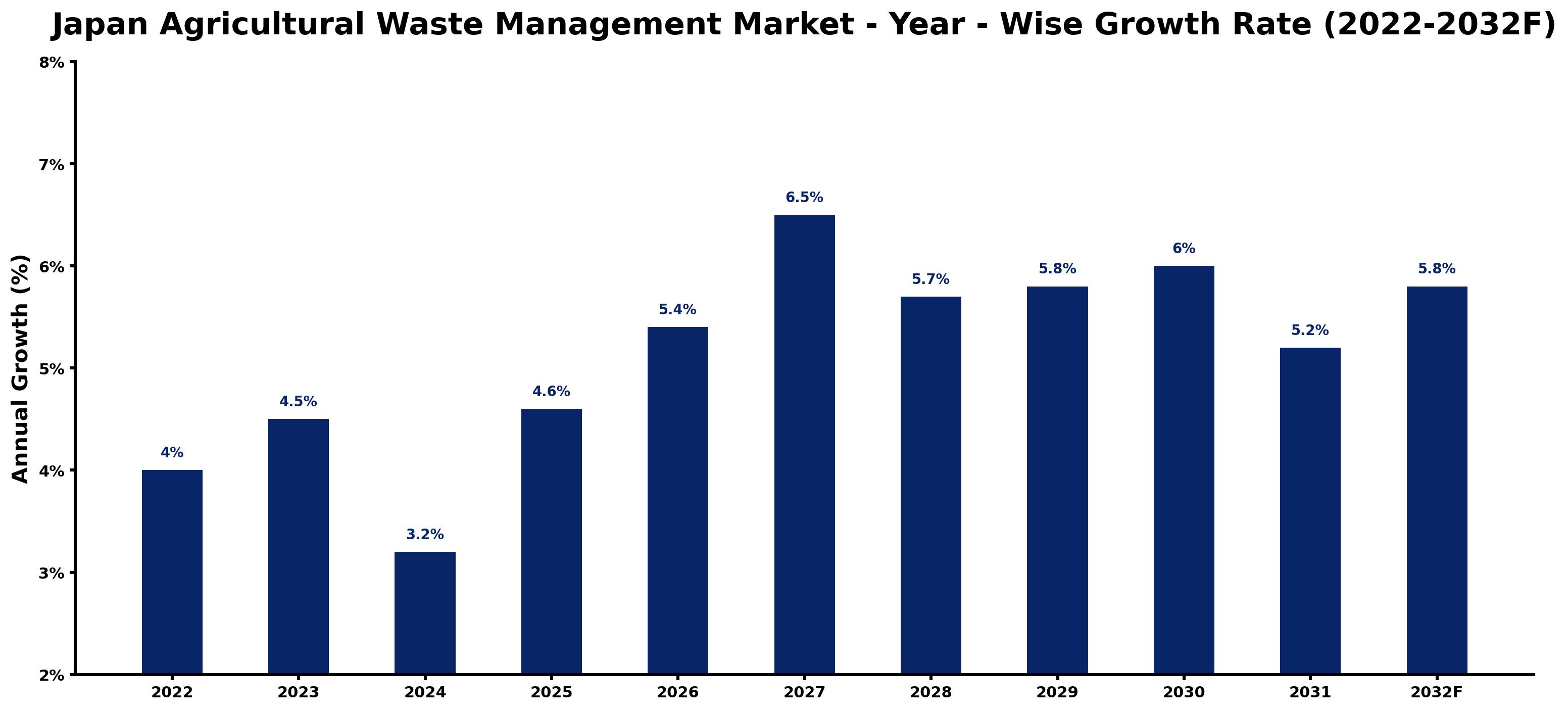
For each year, the table pairs the estimated growth rate with the leading influence on demand, showing how the drivers changed across the period.
| Year | Estimated Annual Growth (%) | Market Rationale |
| 2022 | 4.0 | The market experienced steady growth, driven by increased awareness of waste management practices. |
| 2023 | 4.5 | Demand for agricultural waste management rose as more farmers adopted sustainable practices. |
| 2024 | 3.2 | Growth slowed as some regions faced challenges in implementing new waste management technologies. |
| 2025 | 4.6 | A surge in composting efforts contributed to faster growth compared to the previous year. |
| 2026 | 5.4 | New biogas generation initiatives are expected to spur further market expansion. |
| 2027 | 6.5 | Peak growth will be achieved as investments in waste management infrastructure increase. |
| 2028 | 5.7 | Growth will slow slightly as the market begins to stabilise after rapid expansion. |
| 2029 | 5.8 | A renewed focus on sustainability will see demand rise again, particularly in urban areas. |
| 2030 | 6.0 | The market will continue to grow as more agricultural producers embrace effective waste solutions. |
| 2031 | 5.2 | Growth will slow as market saturation begins to affect new investments in waste management. |
| 2032 | 5.8 | Demand is expected to rise again as new regulations promote sustainable practices. |
Note: Market size estimations and growth projections presented in this report are based on 6Wresearch's proprietary forecasting methodology, utilizing the latest available industry data, government publications, and primary research inputs.
Japan Agricultural Waste Management Market Synopsis
Agricultural waste management involves the collection, treatment, and recycling of waste produced in agriculture, including organic materials and animal waste. Japan produced approximately 20 million tons of agricultural waste in 2022, highlighting the demand for effective management solutions. The market is expanding due to increased awareness of environmental impacts, government initiatives promoting biogas generation, and the need for sustainable practices in agriculture. Key regions like Tokyo and Hokkaido are leading the way in adopting these practices and improving waste management effectiveness.
Market Dynamics Impact Analysis (2026–2032)
| Factor | Type | Impact | Primary Segment Affected |
| Rising awareness of environmental sustainability | Driver | High | Organic Waste |
| Government programs promoting biogas generation | Driver | High | Biogas Generation |
| Growing urbanisation leading to increased organic waste | Opportunity | High | Composting |
| Investment in waste processing technologies | Opportunity | High | Waste Management Firms |
| Regulatory compliance costs for waste treatment | Restraint | Medium | Chemical Waste |
| Limited infrastructure in rural areas for waste management | Restraint | Medium | Animal Waste |
| High initial investment for biogas plants | Challenge | High | Biogas Generation |
| Competition from alternative waste disposal methods | Challenge | Medium | Composting |
Evaluation of Drivers in Japan Agricultural Waste Management Market (2026–2032)
These are the developments adding the most demand over the forecast period.
| Drivers | Primary Segment Affected | Why It Matters (Evidence) |
| Increased focus on organic waste recycling | Organic Waste | Japan aims to increase composting rates to 50% by 2025, prompting farmers to adopt recycling practices. |
| Government initiatives for biogas generation | Biogas Generation | A program launched in 2023 encourages investments in biogas plants, improving waste management capabilities. |
| Rising urbanisation leading to more organic waste | Composting | Urban areas generate substantial organic waste, prompting local governments to promote composting initiatives. |
| Growing demand for sustainable agricultural practices | Animal Waste | Sustainable farming practices are increasingly adopted, driving the need for effective animal waste management. |
| Support from agricultural associations for best practices | Waste Management Firms | The Agricultural Waste Management Association of Japan promotes sustainable practices, increasing demand for waste management services. |
Behind the steady rise in orders sits Japan's commitment to increasing composting rates, targeting 50% by 2025. The growing need for effective management of livestock byproducts is evident as sustainable farming practices gain traction. The Agricultural Waste Management Association of Japan advocates for best practices, further boosting demand for waste management services.
Evaluation of Restraints in Japan Agricultural Waste Management Market
The key brakes on demand, and where they bite hardest, are shown below.
| Market Restraint | Primary Segment Affected | Why It Matters (Evidence) |
| High compliance costs associated with waste treatment regulations | Chemical Waste | The Waste Management and Public Cleansing Act requires strict adherence, raising operational costs for producers. |
| Insufficient waste management infrastructure in rural areas | Animal Waste | Limited facilities hinder effective waste processing, affecting farmers' ability to manage livestock byproducts. |
| High initial investment barriers for biogas plant installations | Biogas Generation | High costs deter small farmers from adopting biogas technology despite its long-term benefits. |
| Competition from alternative waste disposal methods | Composting | Farmers may opt for cheaper disposal options, limiting the growth of composting initiatives. |
| Limited awareness of sustainable practices among producers | Organic Waste | Some agricultural producers lack knowledge about effective waste management, slowing market adoption. |
Japan Agricultural Waste Management Market Challenges
Inefficient supply chain practices impede agricultural waste management in Japan, as many farmers depend on local disposal methods that lack scalability. This leads to processing delays, costing farmers up to 30% of their operational time. High costs stem from outdated technology, with numerous producers unable to invest in modern biogas systems, resulting in inefficient waste treatment and increased expenses. Regulatory hurdles complicate compliance, as the Waste Management and Public Cleansing Law imposes stringent guidelines that can delay project approvals, costing stakeholders valuable time and resources. A lack of awareness regarding compost quality standards under JIS restricts the adoption of effective recycling practices, affecting the overall efficiency of waste treatment.
Trends in the Japan Agricultural Waste Management Market
These developments are changing demand patterns in the Japan Agricultural Waste Management Market.
- Shift from Traditional Disposal to Composting: Since 2023, there has been a notable shift towards composting as farmers recognise its benefits. Approximately 20 million tons of agricultural waste produced annually highlights this trend, resulting in increased demand for composting services.
- Emergence of Biogas Generation as a Key Focus: In 2023, a programme to promote biogas generation was launched, reshaping waste management practices. With 1,200 biogas plants installed by 2023, this trend is gaining momentum.
- Growing Adoption of Sustainable Practices by Farmers: As awareness of environmental impacts increases, more farmers are adopting sustainable practices. This shift is reflected in the rising demand for organic waste recycling, projected to reach 50% by 2025.
- Increased Investment in Waste Management Infrastructure: Investment in waste processing technologies is on the rise, particularly in urban areas. This trend is supported by local governments aiming to improve waste management capabilities, with Tokyo leading the way.
Investment Opportunities in the Japan Agricultural Waste Management Market
Investors looking at the Japan Agricultural Waste Management Market should consider the following areas.
- Gap in Biogas Plant Installations: With 1,200 biogas plants in operation, there is a gap for new installations. Partnering with local farmers to supply biogas technology can meet this demand, particularly in rural areas.
- Growing Need for Composting Services: As Japan aims for a 50% composting rate by 2025, there is a clear opportunity to supply composting solutions. Collaborating with local governments can facilitate market entry and expand service offerings.
- Investment in Waste Management Equipment: The demand for waste management equipment is increasing, particularly among livestock farms. Establishing joint ventures with local equipment dealers can improve market presence and service capabilities.
- Expansion of Organic Waste Recycling Programs: The push for organic waste recycling is creating opportunities for service providers. Engaging with municipalities in key regions like Hokkaido can lead to fruitful partnerships.
Government Initiatives in the Japan Agricultural Waste Management Market
The Waste Management and Public Cleansing Act regulates the treatment and disposal of agricultural waste, ensuring compliance among producers. This law mandates proper waste management practices, compelling farmers to invest in compliant solutions to avoid penalties. The Green Growth Strategy aims to achieve carbon neutrality by 2050, identifying agricultural waste management as a key sector for sustainable development.
In 2023, USD 10 million was allocated to promote biogas generation from agricultural waste. The Ministry of Agriculture, Forestry and Fisheries oversees the implementation of this programme, supporting farmers in adopting biogas technologies and improving waste management practices.
Future Insight of the Japan Agricultural Waste Management Market
By 2032, a shift in agricultural waste management will emerge in Japan, driven by government initiatives that promote biogas generation and composting. The Ministry of Agriculture, Forestry and Fisheries aims to increase composting rates significantly, encouraging suppliers to improve their processes. The installed base of biogas plants, currently at 1,200 units, is expected to expand, enabling the recycling of approximately 20 million tons of agricultural waste annually. Enhanced collaboration among agricultural machinery experts will lead to the adoption of best practices, benefiting both buyers and suppliers in the evolving market.
Market Segmentation Analysis
Japan Agricultural Waste Management Market report covers a detailed analysis of the following market segments:
By Agricultural Waste Management Market – Organic Waste Leads, Animal Waste Expected to Grow Fastest
According to Saurav Kr Singh, Senior Research Analyst at 6Wresearch, Organic Waste accounted for 49% of the market by agricultural waste management market in 2025. The organic waste segment holds the largest share because it directly involves recycling plant materials, which is essential for mitigating agricultural waste. The government's target to increase composting rates to 50% by 2025 reinforces the importance of this segment. Animal Waste is projected to grow fastest, at a CAGR of 7.6% during 2026–2032. Animal waste management is growing rapidly as it is critical for handling livestock byproducts, with 1,200 biogas plants installed by 2023. This trend is expected to persist, driven by the agricultural sector employing over 1.5 million workers and generating considerable waste. Suppliers should prioritise developing solutions for organic and animal waste to align with regulatory and market needs.
By Waste Type – Composting Leads, Biogas Generation Expected to Grow Fastest
With 48% of waste type revenue in 2025, Composting was the largest category. Composting leads the market as a primary method for recycling organic waste, which is essential for improving soil health and reducing environmental impact. The regulation under the Waste Management and Public Cleansing Law ensures a structured approach to composting practices. The quickest growth will come from Biogas Generation, forecast to expand at a CAGR of 8.6% between 2026 and 2032. Biogas generation is the fastest-growing segment, driven by the Ministry of Agriculture, Forestry and Fisheries' programme promoting energy production from agricultural waste. This method not only addresses waste management but also contributes to renewable energy goals. Buyers will benefit from investing in biogas solutions as they align with sustainability initiatives and energy production needs.
By Treatment Method – Direct Sales Leads, Waste Management Firms Expected to Grow Fastest
In 2025, Direct Sales led the treatment method split with a 49% share. Direct sales hold the largest share in the treatment method segment as they provide a straightforward approach for users to acquire agricultural waste management solutions. This method ensures that products reach those who need effective waste processing directly, such as farmers in Tokyo and Kanagawa. Waste Management Firms are set to record the highest CAGR in this split, 8.3% over 2026–2032. Waste management firms are experiencing rapid growth due to the increasing demand for specialised services in processing and recycling agricultural waste. Their crucial role in addressing the challenges of rising agricultural waste levels is exemplified by the government's promotion of biogas generation in 2023. Suppliers should consider partnerships with waste management firms to better serve the growing market for effective waste processing solutions.
By Distribution Channel – Fertilizer Producers Lead and Record the Fastest Growth
Fertilizer Producers took 53% of distribution channel revenue in 2025, more than any other category. Fertilizer producers dominate the distribution channel as they directly use processed agricultural waste for fertiliser production, making them essential to the waste management ecosystem. Their established networks and consistent demand for organic materials significantly contribute to their market share. The same category are also set to grow fastest, at a CAGR of 7.2% during 2026–2032. Fertilizer producers are also the fastest-growing channel, propelled by the rising need for sustainable fertilisers in response to environmental regulations. Their unique position in both waste management and fertiliser production will likely lead to continued growth in this sector. Suppliers should focus on building strong relationships with fertilizer producers to leverage the increasing demand for sustainable agricultural practices.
Key Attractiveness of the Report
- 10 Years of Market Numbers
- Historical Data Starting from 2022 to 2025
- Base Year 2025
- Forecast Data until 2032
- Key Performance Indicators Impacting the Market
- Major Upcoming Developments and Projects
Key Highlights of the Report:
- Japan Agricultural Waste Management Market Outlook
- Market Size of Japan Agricultural Waste Management Market, 2025
- Forecast of Japan Agricultural Waste Management Market, 2032
- Historical Data and Forecast of Japan Agricultural Waste Management Revenues & Volume for the Period 2022-2032F
- Japan Agricultural Waste Management Market Trend Evolution
- Japan Agricultural Waste Management Market Drivers and Challenges
- Japan Agricultural Waste Management Price Trends
- Japan Agricultural Waste Management Porter's Five Forces
- Japan Agricultural Waste Management Industry Life Cycle
- Historical Data and Forecast of Japan Agricultural Waste Management Market Revenues & Volume By Agricultural Waste Management Market for the Period 2022-2032F
- Historical Data and Forecast of Japan Agricultural Waste Management Market Revenues & Volume By Organic Waste for the Period 2022-2032F
- Historical Data and Forecast of Japan Agricultural Waste Management Market Revenues & Volume By Animal Waste for the Period 2022-2032F
- Historical Data and Forecast of Japan Agricultural Waste Management Market Revenues & Volume By Crop Residue for the Period 2022-2032F
- Historical Data and Forecast of Japan Agricultural Waste Management Market Revenues & Volume By Chemical Waste for the Period 2022-2032F
- Historical Data and Forecast of Japan Agricultural Waste Management Market Revenues & Volume By Waste Type for the Period 2022-2032F
- Historical Data and Forecast of Japan Agricultural Waste Management Market Revenues & Volume By Composting for the Period 2022-2032F
- Historical Data and Forecast of Japan Agricultural Waste Management Market Revenues & Volume By Biogas Generation for the Period 2022-2032F
- Historical Data and Forecast of Japan Agricultural Waste Management Market Revenues & Volume By Mulching for the Period 2022-2032F
- Historical Data and Forecast of Japan Agricultural Waste Management Market Revenues & Volume By Safe Disposal for the Period 2022-2032F
- Historical Data and Forecast of Japan Agricultural Waste Management Market Revenues & Volume By Treatment Method for the Period 2022-2032F
- Historical Data and Forecast of Japan Agricultural Waste Management Market Revenues & Volume By Direct Sales for the Period 2022-2032F
- Historical Data and Forecast of Japan Agricultural Waste Management Market Revenues & Volume By Equipment Dealers for the Period 2022-2032F
- Historical Data and Forecast of Japan Agricultural Waste Management Market Revenues & Volume By Online Platforms for the Period 2022-2032F
- Historical Data and Forecast of Japan Agricultural Waste Management Market Revenues & Volume By Waste Management Firms for the Period 2022-2032F
- Historical Data and Forecast of Japan Agricultural Waste Management Market Revenues & Volume By Distribution Channel for the Period 2022-2032F
- Historical Data and Forecast of Japan Agricultural Waste Management Market Revenues & Volume By Fertilizer Producers for the Period 2022-2032F
- Historical Data and Forecast of Japan Agricultural Waste Management Market Revenues & Volume By Livestock Farms for the Period 2022-2032F
- Historical Data and Forecast of Japan Agricultural Waste Management Market Revenues & Volume By Agri Contractors for the Period 2022-2032F
- Historical Data and Forecast of Japan Agricultural Waste Management Market Revenues & Volume By Agri Chem Producers for the Period 2022-2032F
- Japan Agricultural Waste Management Import Export Trade Statistics
- Market Opportunity Assessment By Agricultural Waste Management Market
- Market Opportunity Assessment By Waste Type
- Market Opportunity Assessment By Treatment Method
- Market Opportunity Assessment By Distribution Channel
- Japan Agricultural Waste Management Top Companies Market Share
- Japan Agricultural Waste Management Competitive Benchmarking By Technical and Operational Parameters
- Japan Agricultural Waste Management Company Profiles
- Japan Agricultural Waste Management Key Strategic Recommendations
Market Covered
Segments analysed in this report are listed below.
By Agricultural Waste Management Market
- Organic Waste
- Animal Waste
- Crop Residue
- Chemical Waste
By Waste Type
- Composting
- Biogas Generation
- Mulching
- Safe Disposal
By Treatment Method
- Direct Sales
- Equipment Dealers
- Online Platforms
- Waste Management Firms
By Distribution Channel
- Fertilizer Producers
- Livestock Farms
- Agri Contractors
- Agri Chem Producers































