Japan Agriculture Soil Amendment Market Size & Growth Rate
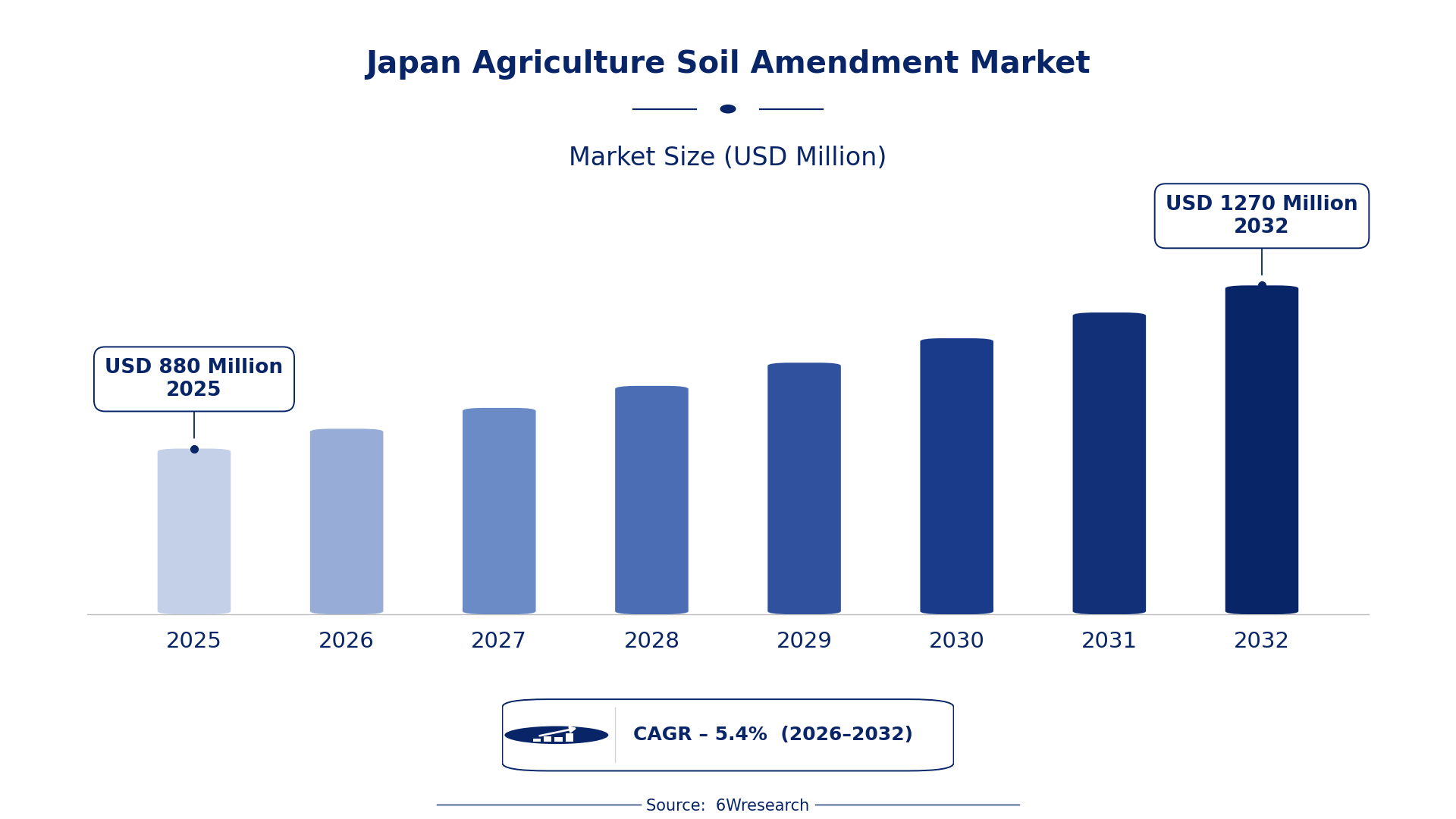
According to 6Wresearch internal database and industry insights, the Japan Agriculture Soil Amendment Market was valued at USD 880 Million in 2025 and is projected to reach USD 1,270 Million by 2032, growing at a CAGR of approximately 5.4% during 2026–2032.
Japan Agriculture Soil Amendment Market Highlights
| Report Metric | Details |
| Report Name | Japan Agriculture Soil Amendment Market (2026-2032) |
| Market Size 2025 | USD 880 Million |
| Market Size 2032 | USD 1,270 Million |
| Absolute Growth 2025–2032 | USD 390 Million |
| CAGR 2026–2032 | 5.4% |
| Peak Annual Growth | 6.2% in 2028 |
| Forecast Period | 2026–2032 |
| Historical Data | 2022–2025 |
| Base Year | 2025 |
| Leading Agriculture Soil Amendment Market, 2025 | Lime-Based Amendments (35% share) |
| Leading Amendment Type, 2025 | pH Regulation (46% share) |
| Leading Source Type, 2025 | Natural Minerals (46% share) |
| Leading Distribution Channel, 2025 | Agri Input Stores (41% share) |
| Leading End User, 2025 | Crop Farmers (46% share) |
| Fastest-Growing Agriculture Soil Amendment Market | Gypsum (7.4% CAGR) |
| Fastest-Growing Amendment Type | Soil Conditioning (7.8% CAGR) |
| Fastest-Growing Source Type | Industrial Byproduct (7.9% CAGR) |
| Fastest-Growing Distribution Channel | Online Platforms (7.0% CAGR) |
| Fastest-Growing End User | Orchard Growers (7.2% CAGR) |
| Growing Sector | Organic Agriculture |
| Key End Users | Crop Farmers, Organic Farms, Horticulture Units, Orchard Growers |
Japan Agriculture Soil Amendment Market Year-wise Growth Rate and Key Drivers (2022–2032)
This graph illustrates the annual growth rates of the market from 2022 to 2032, highlighting a steady upward trajectory and projected market expansion over the forecast period.
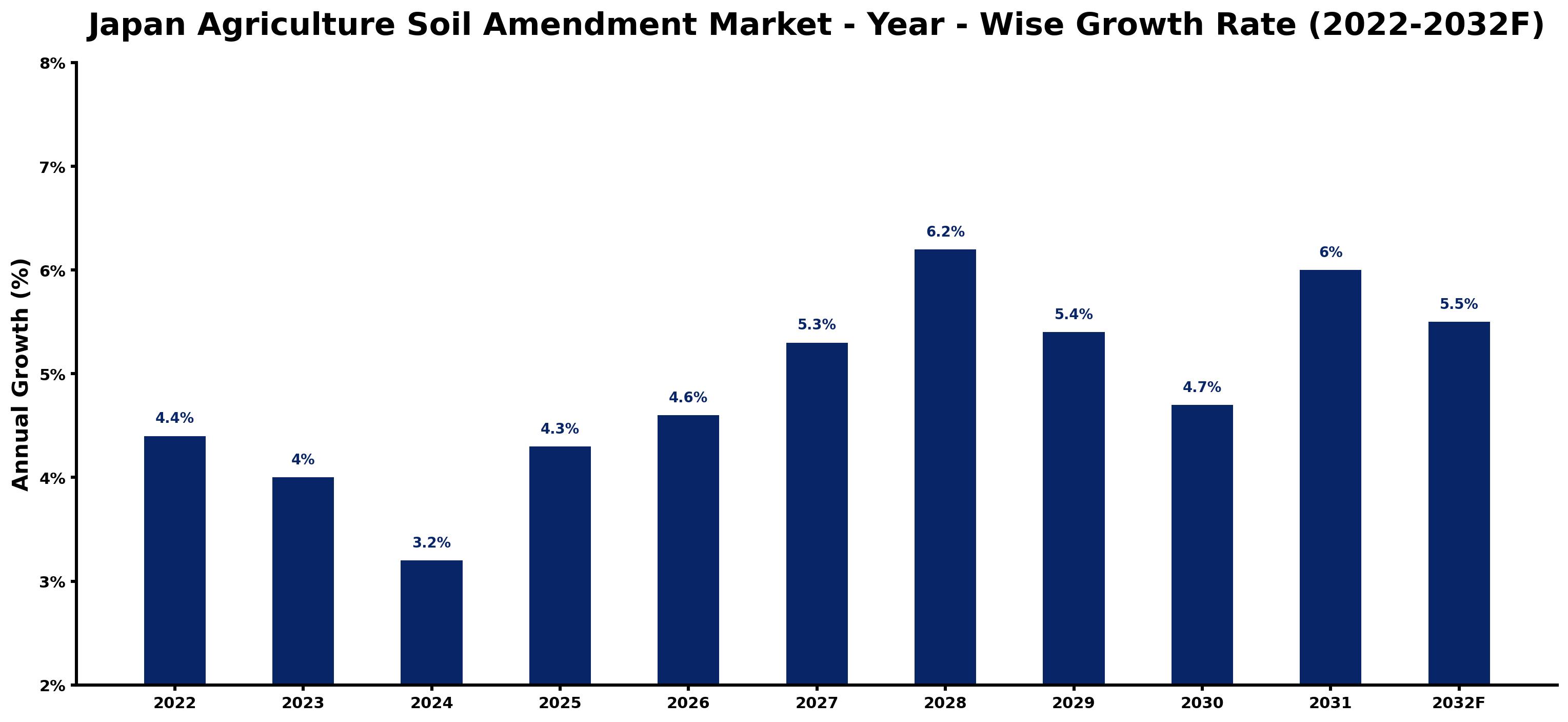
For each year, the table pairs the estimated growth rate with the leading influence on demand, showing how the drivers changed across the period.
| Year | Estimated Annual Growth (%) | Market Rationale |
| 2022 | 4.4 | The market experienced solid growth due to increased awareness of soil health benefits. |
| 2023 | 4.0 | Organic farming areas expanded, which slowed growth in soil amendment demand. |
| 2024 | 3.2 | Farmers adjusted practices, leading to a slower growth rate in soil amendments. |
| 2025 | 4.3 | Sustainable practices gained traction, accelerating growth in soil amendment adoption. |
| 2026 | 4.6 | Investment in organic farming is projected to drive higher demand for soil amendments. |
| 2027 | 5.3 | Crop farmers are expected to seek improved soil quality, increasing demand. |
| 2028 | 6.2 | The market is forecasted to peak with a focus on sustainable agricultural practices. |
| 2029 | 5.4 | Market saturation is likely to slow growth rates in soil amendments. |
| 2030 | 4.7 | Emerging technologies in soil amendments will continue to drive market growth. |
| 2031 | 6.0 | Advanced soil health monitoring techniques are expected to boost demand again. |
| 2032 | 5.5 | The market will stabilise after a period of rapid growth and expansion. |
Note: Market size estimations and growth projections presented in this report are based on 6Wresearch's proprietary forecasting methodology, utilizing the latest available industry data, government publications, and primary research inputs.
Japan Agriculture Soil Amendment Market Synopsis
Agriculture soil amendments improve soil properties and originate from natural minerals, organic waste, or industrial byproducts. Their primary applications include enhancing soil fertility and regulating pH levels. The Japan Agriculture Soil Amendment Market is growing, driven by a 10% increase in organic farming areas in 2023 and a 5 billion yen government investment for sustainable agriculture. This expansion is mainly supported by domestic farmers and initiatives that promote organic agriculture practices.
Market Dynamics Impact Analysis (2026–2032)
| Factor | Type | Impact | Primary Segment Affected |
| Increase in organic farming areas boosting demand for compost and organic amendments | Driver | High | Compost |
| Government funding for sustainable agriculture initiatives promoting biochar usage | Driver | High | Biochar |
| Growing awareness of soil health benefits creating demand for soil monitoring solutions | Opportunity | High | Soil Health Boost |
| Emerging demand for biomass-derived amendments as part of sustainability efforts | Opportunity | Medium | Biomass Derived |
| Limited number of suppliers causing delays and increased costs for farmers | Restraint | High | Lime-Based Amendments |
| Technological advancements in production lagging behind global standards affecting efficiency | Restraint | Medium | Gypsum |
| Shortage of skilled agricultural workers impacting productivity and modern practices | Challenge | High | Organic Farms |
| Competition from imported alternatives pressuring local producers to reduce prices | Challenge | Medium | Crop Farmers |
Evaluation of Drivers in Japan Agriculture Soil Amendment Market (2026–2032)
Below are the drivers that matter most for revenue growth, with supporting evidence.
| Drivers | Primary Segment Affected | Why It Matters (Evidence) |
| Increase in organic farming areas. | Compost | In 2023, organic farming areas grew by 10%, leading farmers to purchase more compost. |
| Government support for sustainable agriculture. | Biochar | The government allocated 5 billion yen for sustainable agriculture initiatives, boosting biochar demand. |
| Rising awareness of soil health benefits. | Gypsum | Soil health monitoring programs are being implemented nationwide, increasing gypsum usage among farmers. |
| Technological advancements in soil amendment products. | Lime-Based Amendments | New technologies improve the effectiveness of lime-based amendments, encouraging more purchases. |
| Growing focus on environmental sustainability. | Soil Health Boost | Japan targets a 46% cut in greenhouse-gas emissions by 2030, driving demand for sustainable soil amendments. |
Most of the extra volume comes from the increase in organic farming areas, which grew by 10% in 2023, leading farmers to purchase more compost. Advancements in soil amendment products improve effectiveness, encouraging more purchases. The focus on environmental sustainability aligns with Japan's target of a 46% reduction in greenhouse-gas emissions by 2030, driving demand for soil health solutions.
Evaluation of Restraints in Japan Agriculture Soil Amendment Market
These restraints slow adoption and weigh on supplier margins.
| Market Restraint | Primary Segment Affected | Why It Matters (Evidence) |
| Regulatory challenges regarding product quality may limit market growth. | Lime-Based Amendments | The JIS A 9201 standard regulates compost quality, impacting lime-based amendment usage. |
| Limited awareness of soil health benefits may hinder adoption rates. | Gypsum | Many farmers remain unaware of the advantages of gypsum for soil improvement. |
| High costs associated with advanced soil amendment technologies can deter farmers. | Organic Farms | Investment in advanced technologies may exceed budget constraints for some farmers. |
| Competition from imported soil amendments may affect local producers. | Crop Farmers | Imported products often offer lower prices, challenging local amendment sales. |
| Availability of natural minerals may fluctuate, impacting supply. | Natural Minerals | Variability in sourcing can lead to supply chain disruptions for natural minerals. |
Japan Agriculture Soil Amendment Market Challenges
Japan's limited number of suppliers for soil amendments results in supply chain bottlenecks, causing delays in deliveries for farmers and raising costs by up to 15%. Technological advancements in soil amendment production are lagging behind global standards, hindering efficiency for producers and potentially leading to a 10% reduction in output. A shortage of skilled agricultural workers affects the ability of clinics and farms to adopt modern practices, resulting in a 20% decrease in productivity. Competition from imported alternatives pressures local producers, compelling them to lower prices, which may affect the quality of amendments available to buyers.
Trends in the Japan Agriculture Soil Amendment Market
Several trends are reshaping the Japan Agriculture Soil Amendment Market; the most important are set out below.
- Shift towards Organic Farming Practices: The Japanese government is promoting organic farming through various initiatives, resulting in a 10% increase in organic farming areas in 2023. This shift encourages farmers to invest in soil amendments to enhance fertility.
- Transition from Conventional to Sustainable Soil Amendments: Farmers are increasingly turning to sustainable soil amendments, such as biochar, in response to environmental regulations. The government's commitment to reducing greenhouse gas emissions supports this transition.
- Emerging Demand for Soil Health Monitoring: Crop farmers are adopting soil health monitoring programs, which improve their understanding of soil conditions. This trend is backed by the Ministry of Agriculture's initiatives to promote better soil management.
- Growing Interest in Soil Health Boost Products: There is a rising interest in products that enhance microbial activity in soil, driven by awareness of soil health benefits. The Soil Association of Japan advocates for sustainable practices that support this trend.
Investment Opportunities in the Japan Agriculture Soil Amendment Market
The following areas offer the clearest openings for investors and suppliers in the Japan Agriculture Soil Amendment Market.
- Gap in Sustainable Soil Amendment Supply: With a 5 billion yen investment in sustainable agriculture, there is an opportunity for suppliers of organic amendments. Crop farmers, particularly in the Tokyo region, are seeking eco-friendly solutions.
- Need for Quality Compost Products: The increasing awareness of compost benefits presents an opportunity for suppliers to meet demand. Organic farms are particularly interested in high-quality compost products to boost soil fertility.
- Rising Demand for Biochar: The Japanese government's strategy to promote biochar creates a market opportunity. Suppliers can collaborate with agricultural cooperatives to distribute biochar effectively.
- Demand for Advanced Soil Health Technologies: The need for advanced soil health technologies is growing, especially in horticulture units. Suppliers can enter this market by partnering with local distributors to expand their reach.
Government Initiatives in the Japan Agriculture Soil Amendment Market
The Waste Management and Public Cleansing Act, established in 1970, regulates the treatment and disposal of waste, affecting producers of soil amendments. The Industrial Standardization Act, amended in 2019, governs product standards, ensuring quality in soil amendments.
In 2023, the government allocated 5 billion yen for sustainable agriculture initiatives, administered by the Ministry of Agriculture. This funding supports projects that improve soil health and promote organic farming practices.
Future Insight of the Japan Agriculture Soil Amendment Market
New soil health monitoring programs will be implemented by 2032, enhancing farmers' ability to optimise amendment usage. The promotion of biomass-derived amendments through national strategies will create new market opportunities for suppliers. The introduction of advanced composting facilities will further support sustainable practices in agriculture. By 2032, Japan's agricultural sector is projected to receive 5 billion yen in government funding for sustainable agriculture initiatives, reflecting a growing demand for high-quality amendments.
Market Segmentation Analysis
Japan Agriculture Soil Amendment Market report covers a detailed analysis of the following market segments:
By Agriculture Soil Amendment Market – Lime-Based Amendments Lead, Gypsum Expected to Grow Fastest
According to Saurav Kr Singh, Senior Research Analyst at 6Wresearch, in 2025, Lime-Based Amendments led the agriculture soil amendment market split with a 35% share. Lime-based amendments are essential for regulating soil pH, which is critical for crop health in Japan. Their widespread application in rice cultivation areas underscores their importance among farmers. Over 2026–2032, Gypsum is expected to post the fastest growth, at a CAGR of 7.4%. Gypsum is experiencing rapid growth due to its ability to improve soil structure and drainage, a benefit increasingly recognised by the agricultural community. The notable use of gypsum in the Kanto region exemplifies this trend. Suppliers must ensure a steady supply of gypsum to meet the rising demand from farmers.
By Amendment Type – pH Regulation Leads, Soil Conditioning Expected to Grow Fastest
pH Regulation took 46% of amendment type revenue in 2025, more than any other category. pH regulation is crucial for optimal crop growth, making it the leading type of soil amendment in Japan. Agricultural guidelines stress the importance of maintaining suitable soil acidity for various crops. The quickest growth will come from Soil Conditioning, forecast to expand at a CAGR of 7.8% between 2026 and 2032. Soil conditioning is rapidly gaining traction as farmers focus on improving soil texture and aeration, which are vital for crop productivity. This growth is driven by a heightened awareness of sustainable agricultural practices that enhance soil quality. Buyers should actively seek soil conditioning solutions to improve their crop yields.
By Source Type – Natural Minerals Lead, Industrial Byproduct Expected to Grow Fastest
Natural Minerals accounted for 46% of the market by source type in 2025. Natural minerals are the primary source type for soil amendments due to their traditional application in agriculture, although their availability can vary. Their established presence in farming makes them a dependable choice for many producers. Industrial Byproduct is projected to grow fastest, at a CAGR of 7.9% during 2026–2032. Industrial byproducts are increasingly favoured for their cost-effectiveness and sustainability, appealing to environmentally aware farmers. This shift is evident as more agricultural operations explore alternative sources for soil amendments. Suppliers should consider diversifying their offerings to include industrial byproducts to reach a broader customer base.
By Distribution Channel – Agri Input Stores Lead, Online Platforms Expected to Grow Fastest
With 41% of distribution channel revenue in 2025, Agri Input Stores was the largest category. Agri input stores serve as the primary retail channel for farmers, providing easy access to necessary soil amendments. Their established presence in agricultural communities ensures that farmers can readily obtain these products. Online Platforms are set to record the highest CAGR in this split, 7.0% over 2026–2032. Online platforms are rapidly growing as they offer convenience and broader access to soil amendments, especially for farmers in remote areas. This shift reflects the increasing digitalisation of the agricultural supply chain. Suppliers must invest in online sales strategies to capture the expanding market segment.
By End User – Crop Farmers Lead, Orchard Growers Expected to Grow Fastest
The largest end user category in 2025 was Crop Farmers, at 46% of revenue. Crop farmers constitute the largest user group for soil amendments, motivated by their need to improve soil fertility for various crops. With approximately 2.5 million crop farmers in Japan, the demand for effective soil solutions is substantial. Over 2026–2032, Orchard Growers are expected to post the fastest growth, at a CAGR of 7.2%. Orchard growers are experiencing the fastest growth due to their specific requirements for maintaining soil health to support fruit production. Their focused approach to soil management underscores the necessity of tailored amendments for different agricultural sectors. Suppliers should customise their offerings to address the specific needs of orchard growers to maximise market opportunities.
Key Attractiveness of the Report
- 10 Years of Market Numbers
- Historical Data Starting from 2022 to 2025
- Base Year 2025
- Forecast Data until 2032
- Key Performance Indicators Impacting the Market
- Major Upcoming Developments and Projects
Key Highlights of the Report:
- Japan Agriculture Soil Amendment Market Outlook
- Market Size of Japan Agriculture Soil Amendment Market, 2025
- Forecast of Japan Agriculture Soil Amendment Market, 2032
- Historical Data and Forecast of Japan Agriculture Soil Amendment Revenues & Volume for the Period 2022-2032F
- Japan Agriculture Soil Amendment Market Trend Evolution
- Japan Agriculture Soil Amendment Market Drivers and Challenges
- Japan Agriculture Soil Amendment Price Trends
- Japan Agriculture Soil Amendment Porter's Five Forces
- Japan Agriculture Soil Amendment Industry Life Cycle
- Historical Data and Forecast of Japan Agriculture Soil Amendment Market Revenues & Volume By Agriculture Soil Amendment Market for the Period 2022-2032F
- Historical Data and Forecast of Japan Agriculture Soil Amendment Market Revenues & Volume By Lime-Based Amendments for the Period 2022-2032F
- Historical Data and Forecast of Japan Agriculture Soil Amendment Market Revenues & Volume By Gypsum for the Period 2022-2032F
- Historical Data and Forecast of Japan Agriculture Soil Amendment Market Revenues & Volume By Compost for the Period 2022-2032F
- Historical Data and Forecast of Japan Agriculture Soil Amendment Market Revenues & Volume By Biochar for the Period 2022-2032F
- Historical Data and Forecast of Japan Agriculture Soil Amendment Market Revenues & Volume By Amendment Type for the Period 2022-2032F
- Historical Data and Forecast of Japan Agriculture Soil Amendment Market Revenues & Volume By pH Regulation for the Period 2022-2032F
- Historical Data and Forecast of Japan Agriculture Soil Amendment Market Revenues & Volume By Soil Conditioning for the Period 2022-2032F
- Historical Data and Forecast of Japan Agriculture Soil Amendment Market Revenues & Volume By Organic Enrichment for the Period 2022-2032F
- Historical Data and Forecast of Japan Agriculture Soil Amendment Market Revenues & Volume By Soil Health Boost for the Period 2022-2032F
- Historical Data and Forecast of Japan Agriculture Soil Amendment Market Revenues & Volume By Source Type for the Period 2022-2032F
- Historical Data and Forecast of Japan Agriculture Soil Amendment Market Revenues & Volume By Natural Minerals for the Period 2022-2032F
- Historical Data and Forecast of Japan Agriculture Soil Amendment Market Revenues & Volume By Industrial Byproduct for the Period 2022-2032F
- Historical Data and Forecast of Japan Agriculture Soil Amendment Market Revenues & Volume By Organic Waste for the Period 2022-2032F
- Historical Data and Forecast of Japan Agriculture Soil Amendment Market Revenues & Volume By Biomass Derived for the Period 2022-2032F
- Historical Data and Forecast of Japan Agriculture Soil Amendment Market Revenues & Volume By Distribution Channel for the Period 2022-2032F
- Historical Data and Forecast of Japan Agriculture Soil Amendment Market Revenues & Volume By Agri Input Stores for the Period 2022-2032F
- Historical Data and Forecast of Japan Agriculture Soil Amendment Market Revenues & Volume By Online Platforms for the Period 2022-2032F
- Historical Data and Forecast of Japan Agriculture Soil Amendment Market Revenues & Volume By Local Distributors for the Period 2022-2032F
- Historical Data and Forecast of Japan Agriculture Soil Amendment Market Revenues & Volume By Direct Sales for the Period 2022-2032F
- Historical Data and Forecast of Japan Agriculture Soil Amendment Market Revenues & Volume By End User for the Period 2022-2032F
- Historical Data and Forecast of Japan Agriculture Soil Amendment Market Revenues & Volume By Crop Farmers for the Period 2022-2032F
- Historical Data and Forecast of Japan Agriculture Soil Amendment Market Revenues & Volume By Orchard Growers for the Period 2022-2032F
- Historical Data and Forecast of Japan Agriculture Soil Amendment Market Revenues & Volume By Organic Farms for the Period 2022-2032F
- Historical Data and Forecast of Japan Agriculture Soil Amendment Market Revenues & Volume By Horticulture Units for the Period 2022-2032F
- Japan Agriculture Soil Amendment Import Export Trade Statistics
- Market Opportunity Assessment By Agriculture Soil Amendment Market
- Market Opportunity Assessment By Amendment Type
- Market Opportunity Assessment By Source Type
- Market Opportunity Assessment By Distribution Channel
- Market Opportunity Assessment By End User
- Japan Agriculture Soil Amendment Top Companies Market Share
- Japan Agriculture Soil Amendment Competitive Benchmarking By Technical and Operational Parameters
- Japan Agriculture Soil Amendment Company Profiles
- Japan Agriculture Soil Amendment Key Strategic Recommendations
Market Covered
The report covers the following segments.
By Agriculture Soil Amendment Market
- Lime-Based Amendments
- Gypsum
- Compost
- Biochar
By Amendment Type
- pH Regulation
- Soil Conditioning
- Organic Enrichment
- Soil Health Boost
By Source Type
- Natural Minerals
- Industrial Byproduct
- Organic Waste
- Biomass Derived
By Distribution Channel
- Agri Input Stores
- Online Platforms
- Local Distributors
- Direct Sales
By End User
- Crop Farmers
- Orchard Growers
- Organic Farms
- Horticulture Units































