Japan Agro Commodities Market Size & Growth Rate
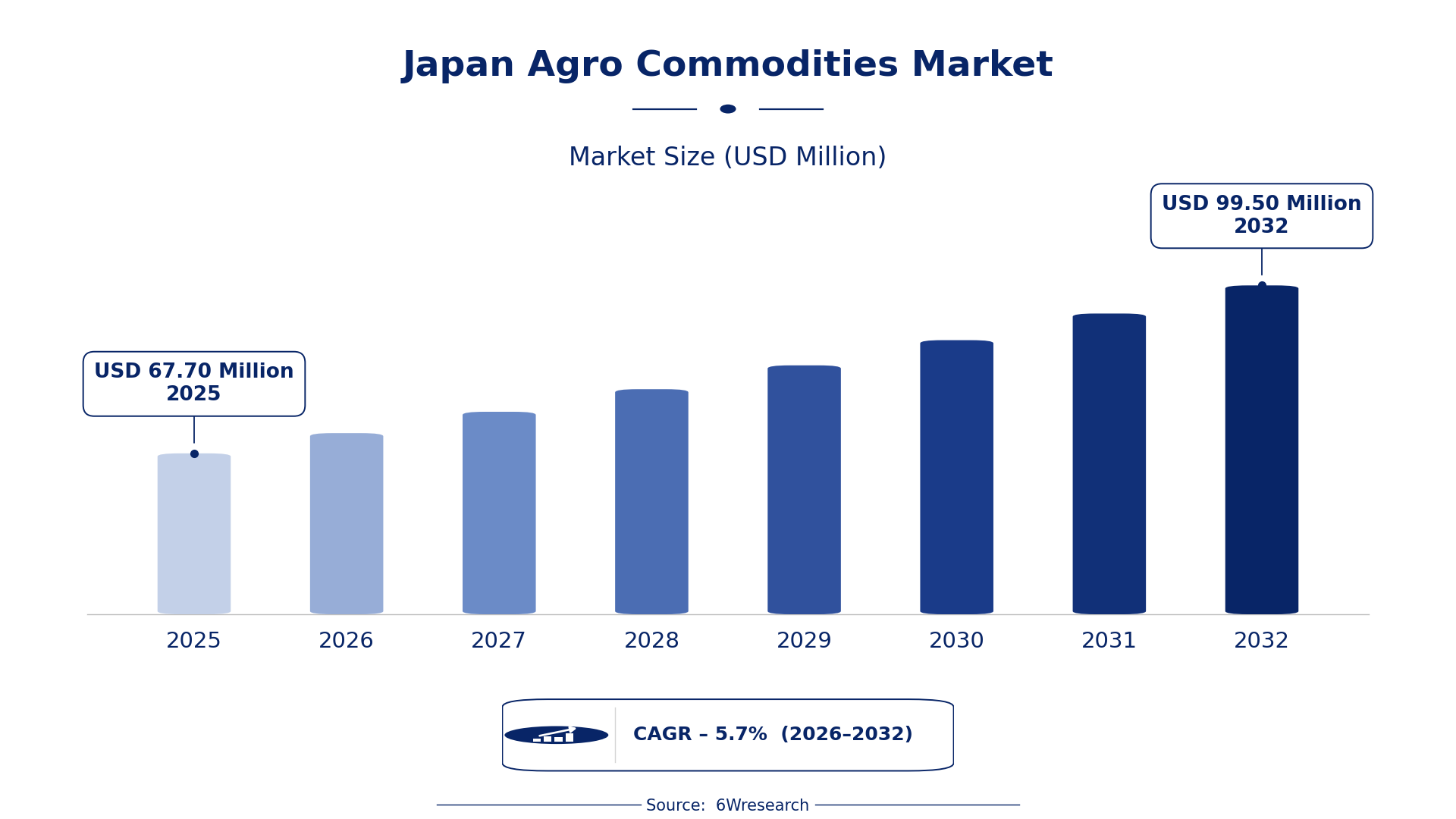
According to 6Wresearch internal database and industry insights, the Japan Agro Commodities Market was valued at USD 67.70 Million in 2025 and is projected to reach USD 99.50 Million by 2032, growing at a CAGR of approximately 5.7% during 2026–2032.
Japan Agro Commodities Market Highlights
| Report Metric | Details |
| Report Name | Japan Agro Commodities Market (2026-2032) |
| Market Size 2025 | USD 67.70 Million |
| Market Size 2032 | USD 99.50 Million |
| Absolute Growth 2025–2032 | USD 31.80 Million |
| CAGR 2026–2032 | 5.7% |
| Peak Annual Growth | 6.4% in 2032 |
| Forecast Period | 2026–2032 |
| Historical Data | 2022–2025 |
| Base Year | 2025 |
| Leading Commodity Type, 2025 | Wheat (37% share) |
| Leading Trade Form, 2025 | Packed Grains (45% share) |
| Leading Distribution Channel, 2025 | E-commerce & Warehouses (45% share) |
| Leading End User, 2025 | Food Processing Companies (48% share) |
| Fastest-Growing Commodity Type | Pulses (7.9% CAGR) |
| Fastest-Growing Trade Form | Crushed/Refined (8.1% CAGR) |
| Fastest-Growing End User | Retail Consumers (7.3% CAGR) |
| Growing Sector | Food Processing |
| Key End Users | Food Processing Companies, Retail Consumers, Edible Oil Manufacturers |
Japan Agro Commodities Market Year-wise Growth Rate and Key Drivers (2022–2032)
This graph illustrates the annual growth rates of the market from 2022 to 2032, highlighting a steady upward trajectory and projected market expansion over the forecast period.
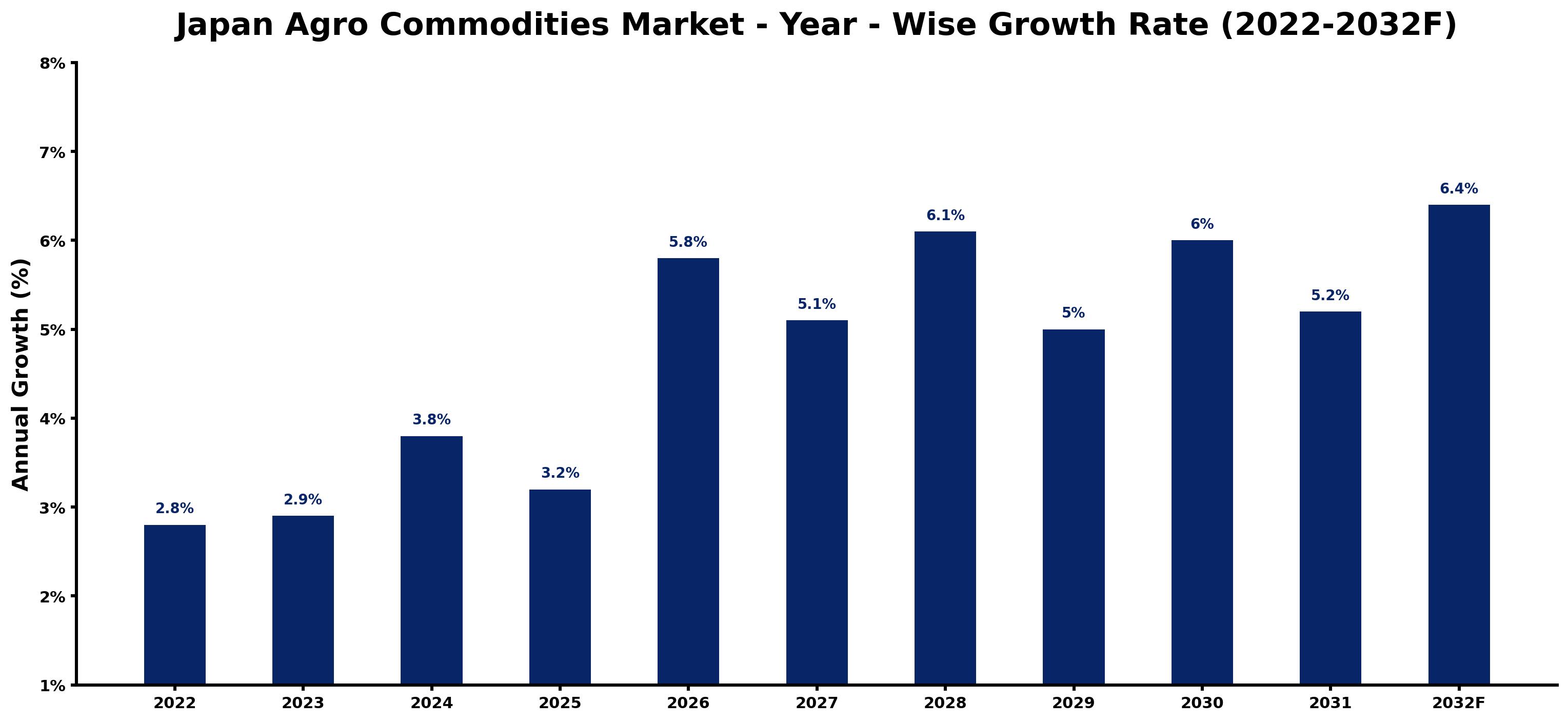
The yearly estimates that follow link every growth rate to its principal driver, so readers can see why the pace changed in each period.
| Year | Estimated Annual Growth (%) | Market Rationale |
| 2022 | 2.8 | The market experienced steady growth with consistent demand from food processing industries. |
| 2023 | 2.9 | Demand increased due to a rise in food consumption among the Japanese population. |
| 2024 | 3.8 | The food processing sector expanded, driving higher demand for agro commodities. |
| 2025 | 3.2 | Growth slowed as the market adjusted to previous high levels of demand. |
| 2026 | 5.8 | The introduction of new agricultural initiatives is expected to boost domestic production. |
| 2027 | 5.1 | Demand growth is projected to moderate as supply chains stabilise after recent expansions. |
| 2028 | 6.1 | Increased consumer interest in health foods will spur demand for diverse agro commodities. |
| 2029 | 5.0 | Growth is expected to decelerate as market saturation begins to take effect in some segments. |
| 2030 | 6.0 | The market is projected to rebound with renewed investments in food processing technologies. |
| 2031 | 5.2 | Growth will slow as competition intensifies among local producers and importers. |
| 2032 | 6.4 | The market is expected to peak with heightened demand for sustainable and local agro products. |
Note: Market size estimations and growth projections presented in this report are based on 6Wresearch's proprietary forecasting methodology, utilizing the latest available industry data, government publications, and primary research inputs.
Japan Agro Commodities Market Synopsis
Agro commodities encompass raw agricultural products traded in bulk, including grains, oilseeds, and pulses, essential for food processing, animal feed, and direct consumption. The Japan Agro Commodities Market is driven by increasing demand from the food processing industry, valued at over 25 trillion JPY, and a growing population of approximately 126 million. Initiatives like the 2023 programme to boost domestic wheat production stimulate investment in local agriculture, ensuring a steady supply to meet consumer needs.
Market Dynamics Impact Analysis (2026–2032)
| Factor | Type | Impact | Primary Segment Affected |
| Growing domestic food processing sector | Driver | High | Food Processing Companies |
| Rise in consumer spending on food products | Driver | High | Retail Consumers |
| Expansion of e-commerce platforms for food distribution | Opportunity | High | E-commerce & Warehouses |
| Increased interest in health-conscious food options | Opportunity | Medium | Retail Consumers |
| Dependence on imports for wheat and oilseeds | Restraint | High | Oilseeds |
| High competition among local producers | Restraint | Medium | Wheat |
| Fluctuating global commodity prices | Challenge | High | Raw Grains |
| Regulatory compliance costs for food safety standards | Challenge | Medium | Food Processing Companies |
Evaluation of Drivers in Japan Agro Commodities Market (2026–2032)
The following drivers explain most of the expected growth.
| Drivers | Primary Segment Affected | Why It Matters (Evidence) |
| Increasing food processing capacity in the Tokyo metropolitan area | Food Processing Companies | The food processing industry in Japan, valued at over 25 trillion JPY, drives demand for raw materials. |
| Rising consumer expenditure on food products | Retail Consumers | The average Japanese consumer spends about 30,000 JPY monthly on food, boosting demand for agro commodities. |
| Growth of e-commerce platforms for food distribution | E-commerce & Warehouses | The expanding network of e-commerce platforms captures 45% of the market share, improving access to agro commodities. |
| Government initiatives to boost domestic wheat production | Wheat | The 2023 programme aims to increase local wheat output, reducing reliance on imports. |
| Health trends influencing food choices | Retail Consumers | Growing consumer interest in health foods is increasing the demand for diverse agro commodities. |
Much of the new demand traces back to the Tokyo metropolitan area, where the food processing industry is valued at over 25 trillion JPY, driving purchases of agro commodities. The average Japanese consumer spends approximately 30,000 JPY monthly on food products, leading to increased demand from retail consumers. E-commerce platforms are expanding rapidly, providing easier access to agro commodities and improving purchasing options for consumers. Rising health-conscious trends are encouraging consumers to seek a variety of agro commodities, influencing purchasing behaviours across the market.
Evaluation of Restraints in Japan Agro Commodities Market
The key brakes on demand, and where they bite hardest, are shown below.
| Market Restraint | Primary Segment Affected | Why It Matters (Evidence) |
| High import dependency for wheat and oilseeds | Oilseeds | Japan imports around 90% of its wheat, making the market vulnerable to global price fluctuations. |
| Intense competition among local producers | Wheat | High competition pressures profit margins for local producers, impacting their market stability. |
| Regulatory compliance costs for food safety standards | Food Processing Companies | Compliance with HACCP-based hygiene management increases operational costs for food processing companies. |
| Limited use of spices in traditional cuisine | Spices | The minor role of spices in Japanese cuisine restricts their market growth potential. |
| Market saturation in certain agro commodity segments | Raw Grains | As demand stabilises, growth in raw grains faces challenges from market saturation. |
Japan Agro Commodities Market Challenges
Buyers face intense competition from imported agro commodities, which undermine local prices and reduce market opportunities. Regulatory pressures, such as the enforcement of ISO 22000 standards, impose compliance costs that can delay product launches by up to six months for food processing companies. Supply chain disruptions in the Kanto region can lead to grain shortages, forcing buyers to pay 10% more for alternative sourcing. Technological advancements in food safety management require significant investments, straining the budgets of smaller suppliers and limiting their competitiveness.
Trends in the Japan Agro Commodities Market
The shifts below are changing how Japan Agro Commodities Market products are bought and supplied.
- Shift from Imported to Locally Sourced Grains: Since 2023, Japan has focused on boosting domestic wheat production, aiming to reduce reliance on imports. The initiative is projected to increase local grain output by 1.3 million tons, aligning with consumer preferences for local products.
- Growth of E-commerce in Food Distribution: The rise of e-commerce platforms has transformed food distribution in Japan, capturing 45% of the market share in 2025. This shift allows consumers greater access to agro commodities, catering to changing shopping behaviours.
- Increased Demand for Health-Conscious Foods: In recent years, there has been a notable shift towards health-conscious food options in Japan. This trend is evidenced by the growing interest in organic and locally sourced agro commodities, reflecting changing consumer preferences.
- Expansion of Food Processing Facilities in Kanto Region: The Kanto region has seen significant investment in food processing facilities, with the Tokyo metropolitan area being a major hub. This growth supports the increasing demand for agro commodities, improving local supply chains.
Investment Opportunities in the Japan Agro Commodities Market
The openings below show where demand in the Japan Agro Commodities Market is visible and how suppliers can enter.
- Collaborations with Local Producers: Now is an opportune time for partnerships with local producers to strengthen supply chains. With 1.3 million tons of wheat produced in 2022, collaboration can improve local sourcing efforts.
- Investment in E-commerce Platforms: With the e-commerce sector growing rapidly, there is a notable gap in online food distribution. Investing in e-commerce platforms can cater to the rising demand for convenient food access.
- Focus on Health-Conscious Product Lines: The increasing consumer interest in health foods presents a lucrative opportunity. Retail consumers are seeking diverse agro commodities that align with health trends, creating a demand for innovative products.
- Expansion in Kanto Region Facilities: Investing in food processing facilities in the Kanto region is timely, given its status as a major hub. This region's growth in food processing can improve local agro commodity supply.
Government Initiatives in the Japan Agro Commodities Market
The Food Recycling Law (2000) mandates food businesses to reduce waste and recycle it into feed, fertiliser, and energy, impacting agro commodity producers by enforcing sustainable practices. The Japanese government promotes local agriculture through subsidies and support programs, ensuring a stable supply of agro commodities, with funding exceeding 10 billion JPY annually.
The Japan Grain Inspection Association oversees the approval of various agro commodity regulations, including quality control measures. The Japan Grain Inspection Association ensures that grains meet safety and quality standards, helping to maintain consumer trust in agro commodities, with over 1,000 inspections conducted annually.
Future Insight of the Japan Agro Commodities Market
Technological advancements in domestic wheat production will transform supply chains by 2032, enhancing local capabilities. The launch of government programs aimed at boosting local agriculture will increase the availability of locally sourced grains. E-commerce platforms will streamline distribution, making agro commodities more accessible to consumers. With Japan producing 1.3 million tons of wheat in 2022, the demand for quality and locally produced items will rise, benefiting suppliers who embrace these changes.
Market Segmentation Analysis
Japan Agro Commodities Market report covers a detailed analysis of the following market segments:
By Commodity Type – Wheat Leads, Pulses Expected to Grow Fastest
According to Saurav Kr Singh, Senior Research Analyst at 6Wresearch, Wheat accounted for 37% of the market by commodity type in 2025. Wheat holds the largest share due to its essential use in food processing and baking, with the Tokyo metropolitan area relying heavily on it for diverse food applications. The significant production of 1.3 million tons in 2022 underlines its importance in meeting domestic demand. The quickest growth will come from Pulses, forecast to expand at a CAGR of 7.9% between 2026 and 2032. Pulses are experiencing rapid growth as they become increasingly popular in health-conscious food products, reflecting a shift in consumer preferences towards nutritious options. The rising awareness of their health benefits among the population is a primary factor driving this trend. Suppliers should increase the availability of pulses to meet the growing consumer interest in health-focused food products.
By Trade Form – Packed Grains Lead, Crushed/Refined Expected to Grow Fastest
In 2025, Packed Grains led the trade form split with a 45% share. Packed Grains dominate the market as they offer convenience for consumers, making it easier to access essential food products. The extensive food processing industry, valued at over 25 trillion JPY, relies heavily on packed grains for various applications. Over 2026–2032, Crushed/Refined is expected to post the fastest growth, at a CAGR of 8.1%. Crushed/Refined products are gaining rapid traction due to their critical role in oil extraction and incorporation into processed food items. The rising demand for healthier oil options is a significant factor propelling this segment's growth. Buyers may benefit from diversifying their sourcing strategies to include crushed/refined products as they become more popular.
By Distribution Channel – E-commerce & Warehouses Lead and Record the Fastest Growth
E-commerce & Warehouses held 45% of the Japan Agro Commodities Market by distribution channel in 2025. E-commerce & Warehouses lead the distribution channel, providing a growing platform for consumers to access a wide range of agro commodities. The robust network of e-commerce platforms in Japan facilitates direct consumer purchases, enhancing market reach. Its lead should widen, with a projected CAGR of 7.7% during 2026–2032, the highest in this split. E-commerce & Warehouses are also the fastest-growing channel, driven by the increasing preference for online shopping among consumers. The convenience offered by these platforms is likely to sustain their growth trajectory. Suppliers should invest in e-commerce capabilities to capitalise on the expanding consumer shift towards online purchasing.
By End User – Food Processing Companies Lead, Retail Consumers Expected to Grow Fastest
The largest end user category in 2025 was Food Processing Companies, at 48% of revenue. Food Processing Companies represent the largest end user segment, as they are major consumers of agro commodities for various food products. Their substantial demand highlights the ongoing reliance on agro commodities within Japan's food industry. Retail Consumers are set to record the highest CAGR in this split, 7.3% over 2026–2032. Retail Consumers are the fastest-growing segment, propelled by the rising trend of packaged food products among households. As preferences shift towards convenience, this segment is expected to expand further. Suppliers must consider the growing retail consumer market when developing their product offerings.
Key Attractiveness of the Report
- 10 Years of Market Numbers
- Historical Data Starting from 2022 to 2025
- Base Year 2025
- Forecast Data until 2032
- Key Performance Indicators Impacting the Market
- Major Upcoming Developments and Projects
Key Highlights of the Report:
- Japan Agro Commodities Market Outlook
- Market Size of Japan Agro Commodities Market, 2025
- Forecast of Japan Agro Commodities Market, 2032
- Historical Data and Forecast of Japan Agro Commodities Revenues & Volume for the Period 2022-2032F
- Japan Agro Commodities Market Trend Evolution
- Japan Agro Commodities Market Drivers and Challenges
- Japan Agro Commodities Price Trends
- Japan Agro Commodities Porter's Five Forces
- Japan Agro Commodities Industry Life Cycle
- Historical Data and Forecast of Japan Agro Commodities Market Revenues & Volume By Commodity Type for the Period 2022-2032F
- Historical Data and Forecast of Japan Agro Commodities Market Revenues & Volume By Wheat for the Period 2022-2032F
- Historical Data and Forecast of Japan Agro Commodities Market Revenues & Volume By Spices for the Period 2022-2032F
- Historical Data and Forecast of Japan Agro Commodities Market Revenues & Volume By Oilseeds for the Period 2022-2032F
- Historical Data and Forecast of Japan Agro Commodities Market Revenues & Volume By Pulses for the Period 2022-2032F
- Historical Data and Forecast of Japan Agro Commodities Market Revenues & Volume By Trade Form for the Period 2022-2032F
- Historical Data and Forecast of Japan Agro Commodities Market Revenues & Volume By Raw Grains for the Period 2022-2032F
- Historical Data and Forecast of Japan Agro Commodities Market Revenues & Volume By Whole/Dried for the Period 2022-2032F
- Historical Data and Forecast of Japan Agro Commodities Market Revenues & Volume By Crushed/Refined for the Period 2022-2032F
- Historical Data and Forecast of Japan Agro Commodities Market Revenues & Volume By Packed Grains for the Period 2022-2032F
- Historical Data and Forecast of Japan Agro Commodities Market Revenues & Volume By Distribution Channel for the Period 2022-2032F
- Historical Data and Forecast of Japan Agro Commodities Market Revenues & Volume By Mandis & Exchanges for the Period 2022-2032F
- Historical Data and Forecast of Japan Agro Commodities Market Revenues & Volume By Export Houses for the Period 2022-2032F
- Historical Data and Forecast of Japan Agro Commodities Market Revenues & Volume By Commodity Brokers for the Period 2022-2032F
- Historical Data and Forecast of Japan Agro Commodities Market Revenues & Volume By E-commerce & Warehouses for the Period 2022-2032F
- Historical Data and Forecast of Japan Agro Commodities Market Revenues & Volume By End User for the Period 2022-2032F
- Historical Data and Forecast of Japan Agro Commodities Market Revenues & Volume By Food Processing Companies for the Period 2022-2032F
- Historical Data and Forecast of Japan Agro Commodities Market Revenues & Volume By International Retail Chains for the Period 2022-2032F
- Historical Data and Forecast of Japan Agro Commodities Market Revenues & Volume By Edible Oil Manufacturers for the Period 2022-2032F
- Historical Data and Forecast of Japan Agro Commodities Market Revenues & Volume By Retail Consumers for the Period 2022-2032F
- Japan Agro Commodities Import Export Trade Statistics
- Market Opportunity Assessment By Commodity Type
- Market Opportunity Assessment By Trade Form
- Market Opportunity Assessment By Distribution Channel
- Market Opportunity Assessment By End User
- Japan Agro Commodities Top Companies Market Share
- Japan Agro Commodities Competitive Benchmarking By Technical and Operational Parameters
- Japan Agro Commodities Company Profiles
- Japan Agro Commodities Key Strategic Recommendations
Market Covered
This report examines the market across the segments below.
By Commodity Type
- Wheat
- Spices
- Oilseeds
- Pulses
By Trade Form
- Raw Grains
- Whole/Dried
- Crushed/Refined
- Packed Grains
By Distribution Channel
- Mandis & Exchanges
- Export Houses
- Commodity Brokers
- E-commerce & Warehouses
By End User
- Food Processing Companies
- International Retail Chains
- Edible Oil Manufacturers
- Retail Consumers































