Japan Agrochemical and Pharmaceutical Raw Materials Market Size & Growth Rate
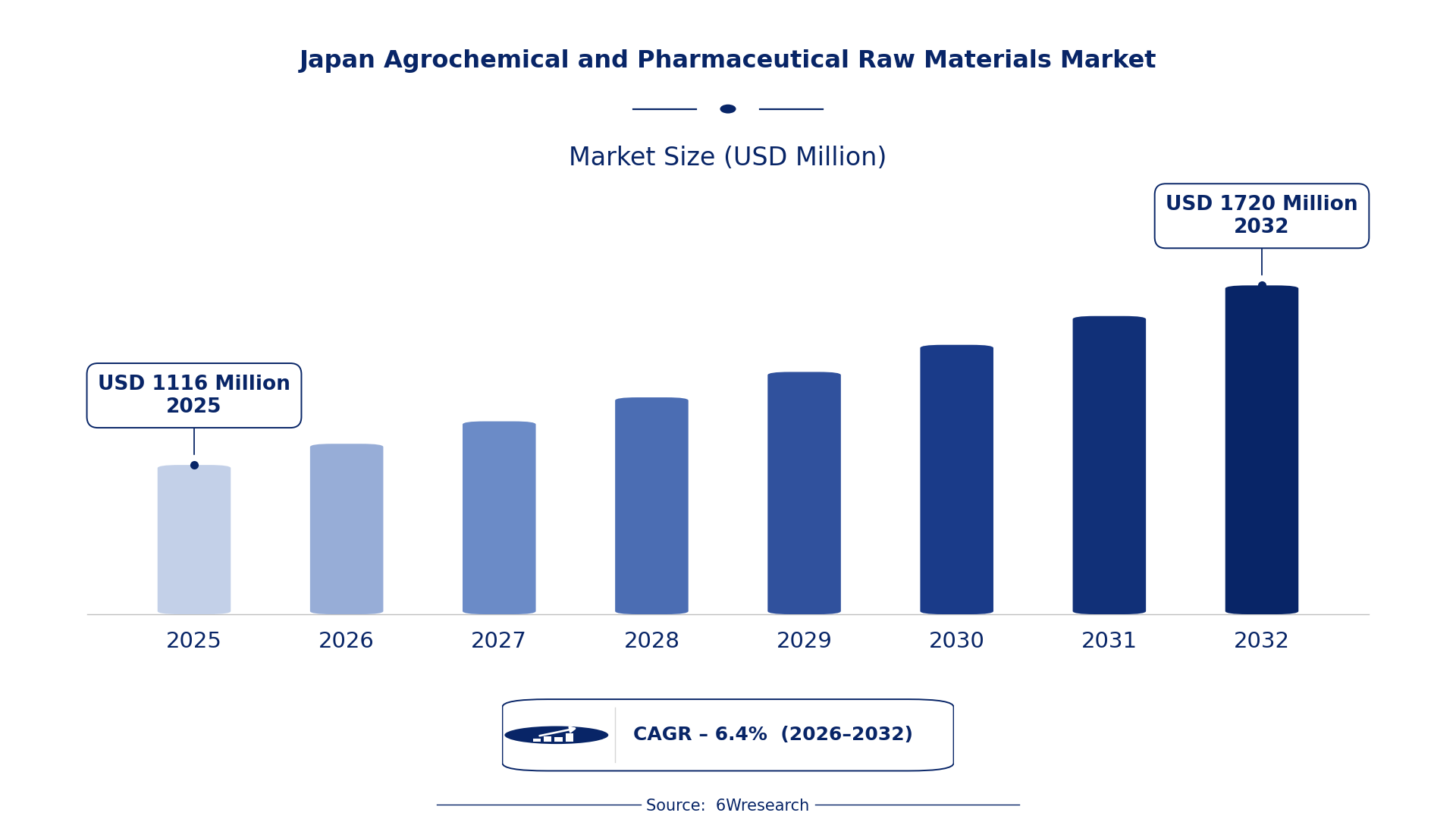
According to 6Wresearch internal database and industry insights, the Japan Agrochemical and Pharmaceutical Raw Materials Market was valued at USD 1,116 Million in 2025 and is projected to reach USD 1,720 Million by 2032, growing at a CAGR of approximately 6.4% during 2026–2032.
Japan Agrochemical and Pharmaceutical Raw Materials Market Highlights
| Report Metric | Details |
| Report Name | Japan Agrochemical and Pharmaceutical Raw Materials Market (2026-2032) |
| Market Size 2025 | USD 1,116 Million |
| Market Size 2032 | USD 1,720 Million |
| Absolute Growth 2025–2032 | USD 604 Million |
| CAGR 2026–2032 | 6.4% |
| Peak Annual Growth | 8.1% in 2032 |
| Forecast Period | 2026–2032 |
| Historical Data | 2022–2025 |
| Base Year | 2025 |
| Leading Raw Material Type, 2025 | Technical Grade Urea (39% share) |
| Leading Application, 2025 | Fertilizers (44% share) |
| Leading Distribution Channel, 2025 | Direct Industrial Sales (51% share) |
| Leading End User, 2025 | Chemical Manufacturers (44% share) |
| Fastest-Growing Raw Material Type | Sulphur Compounds (9.0% CAGR) |
| Fastest-Growing Application | Fungicides (8.7% CAGR) |
| Fastest-Growing Distribution Channel | B2B Supply Platforms (8.1% CAGR) |
| Fastest-Growing End User | Agrochemical Firms (8.3% CAGR) |
| Growing Sector | Agrochemicals |
| Key End Users | Chemical Manufacturers, Agrochemical Firms, Veterinary Medicine Producers |
Japan Agrochemical and Pharmaceutical Raw Materials Market Year-wise Growth Rate and Key Drivers (2022–2032)
This graph illustrates the annual growth rates of the market from 2022 to 2032, highlighting a steady upward trajectory and projected market expansion over the forecast period.
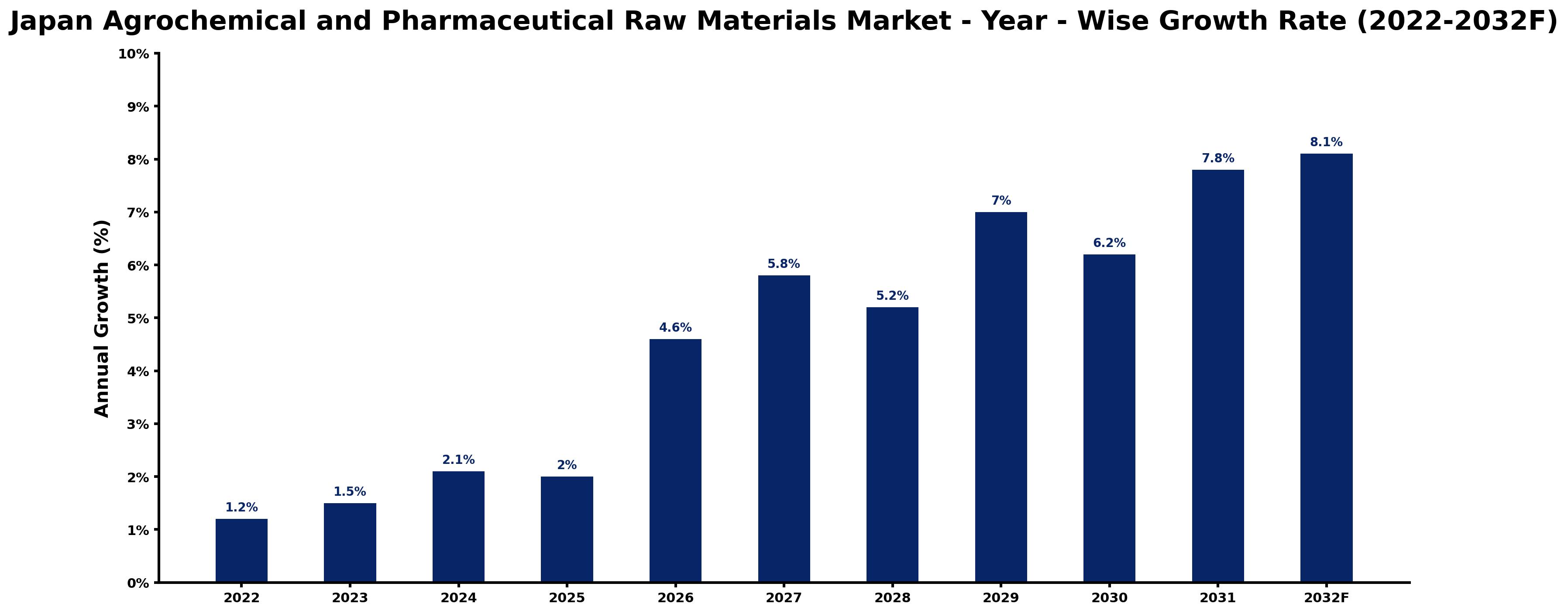
The following figures match every annual growth estimate with the main market development of that year, giving the reasoning behind each rise or slowdown.
| Year | Estimated Annual Growth (%) | Market Rationale |
| 2022 | 1.2 | The market experienced modest growth, reflecting stable demand from domestic agrochemical users. |
| 2023 | 1.5 | Growth accelerated due to increased agricultural output and a rise in fertilizer production. |
| 2024 | 2.1 | Demand continued to strengthen, supported by improved crop yields and favorable weather conditions. |
| 2025 | 2.0 | Growth slowed slightly as the market adjusted to previous gains and demand stabilised. |
| 2026 | 4.6 | The market is expected to rebound with increased investments in sustainable agricultural practices. |
| 2027 | 5.8 | Demand will rise further as agrochemical firms expand their product offerings and capabilities. |
| 2028 | 5.2 | Growth will moderate as the market reaches a more stable phase of development. |
| 2029 | 7.0 | The market is projected to accelerate again, driven by innovations in crop protection products. |
| 2030 | 6.2 | Growth will slow as the market adjusts to the saturation of certain agrochemical segments. |
| 2031 | 7.8 | Demand is expected to rise sharply, driven by increasing agricultural productivity needs. |
| 2032 | 8.1 | The market will peak with strong demand for eco-friendly agrochemical solutions. |
Note: Market size estimations and growth projections presented in this report are based on 6Wresearch's proprietary forecasting methodology, utilizing the latest available industry data, government publications, and primary research inputs.
Japan Agrochemical and Pharmaceutical Raw Materials Market Synopsis
Agrochemical and pharmaceutical raw materials are critical chemical substances utilised in fertilizers, pesticides, and pharmaceuticals. Key factors include the increase in sustainable agricultural practices and the growth of chemical manufacturing in areas like Tokyo, which supports the demand for these raw materials.
Market Dynamics Impact Analysis (2026–2032)
| Factor | Type | Impact | Primary Segment Affected |
| Increasing agricultural productivity due to enhanced fertilizer formulations | Driver | High | Fertilizers |
| Rising demand for crop protection solutions amid climate challenges | Driver | High | Fungicides |
| Growing interest in sustainable agricultural practices among farmers | Opportunity | High | Herbicides |
| Expansion of B2B supply platforms facilitating easier access to raw materials | Opportunity | Medium | B2B Supply Platforms |
| Regulatory compliance costs impacting small-scale producers | Restraint | High | Chemical Manufacturers |
| Limited availability of certain raw materials due to production constraints | Restraint | Medium | Agrochemical Firms |
| Aging workforce in agriculture leading to reduced productivity | Challenge | High | Chemical Manufacturers |
| Competition from synthetic alternatives affecting market share | Challenge | Medium | Veterinary Medicine Producers |
Evaluation of Drivers in Japan Agrochemical and Pharmaceutical Raw Materials Market (2026–2032)
The table below links each growth driver to the segment it affects and the evidence for it.
| Drivers | Primary Segment Affected | Why It Matters (Evidence) |
| Increased production of Technical Grade Urea | Technical Grade Urea | Japan produced 1.2 million tons of fertilizers in 2022, driving demand for nitrogen sources in agriculture. |
| Rising use of Sulphur Compounds in fungicides | Sulphur Compounds | Over 30% of fungicide formulations in Japan contain Sulphur Compounds, boosting their demand. |
| Growing need for veterinary pharmaceuticals | Veterinary Pharma | Japan's national medical care expenditure reached JPY 46.7 trillion in fiscal 2022, increasing demand for animal health products. |
| Expansion of the agrochemical market due to population growth | Agrochemical Firms | With a population of approximately 125 million, Japan's food production needs are driving agrochemical consumption. |
| Development of eco-friendly herbicides | Herbicides | The government aims to increase organic farming to 10% of total farmland by 2030, enhancing herbicide demand. |
Behind the steady rise in orders is the increasing production of fertilizers, which represents a substantial portion of Japan's agricultural output. The growing need for veterinary pharmaceuticals corresponds with Japan's national medical care expenditure reaching JPY 46.7 trillion in fiscal 2022, prompting heightened demand for animal health products. The expanding agrochemical market addresses the food production needs of Japan's 125 million population. The development of eco-friendly herbicides aligns with targets to promote organic farming, further supporting market growth. Additionally, the rising use of Technical Grade Urea in fertilizers improves nitrogen availability, driving further investment in agricultural productivity.
Evaluation of Restraints in Japan Agrochemical and Pharmaceutical Raw Materials Market
The table below lists the restraints and the evidence behind each.
| Market Restraint | Primary Segment Affected | Why It Matters (Evidence) |
| High regulatory compliance costs for agrochemical producers | Chemical Manufacturers | Producers face costs to meet stringent regulations set by the Chemical Substances Control Law, impacting profitability. |
| Limited availability of raw materials due to production issues | Agrochemical Firms | Supply chain disruptions have led to shortages, hindering the production capabilities of agrochemical firms. |
| Aging workforce in agriculture affecting productivity | Chemical Manufacturers | With the average age of farmers over 67, labor shortages are impacting agricultural output and raw material demand. |
| Competition from synthetic alternatives in pharmaceuticals | Veterinary Medicine Producers | Synthetic products are cheaper, making it challenging for producers of natural raw materials to compete. |
| Market saturation in certain agrochemical segments | Fungicides | As the market matures, growth rates are stabilising, limiting opportunities for new entrants. |
Japan Agrochemical and Pharmaceutical Raw Materials Market Challenges
Japan's agricultural sector struggles with a shortage of skilled workers, as the average age of farmers exceeds 67, which hampers productivity and limits the available workforce for agrochemical production. Local producers face intense competition from international markets, forcing them to lower prices, which can lead to compromised quality for buyers seeking reliable supplies. Rising costs of raw materials due to stringent environmental regulations increase production expenses for suppliers, potentially raising prices for end-users. Supply chain disruptions, exacerbated by global events, delay critical agrochemical deliveries, causing production halts for manufacturers reliant on timely shipments.
Trends in the Japan Agrochemical and Pharmaceutical Raw Materials Market
The following changes are redrawing the Japan Agrochemical and Pharmaceutical Raw Materials Market.
- Shift towards Sustainable Agricultural Practices: In 2023, Japan initiated a programme to promote sustainable agricultural practices, aiming to increase eco-friendly farming methods. This shift is expected to boost demand for organic fertilizers by approximately 20%.
- Emergence of B2B Supply Platforms: The rise of B2B supply platforms has transformed how agrochemical firms connect with suppliers, with user engagement growing by 15% since 2021. This trend facilitates easier transactions and access to essential raw materials.
- Growing Demand for Eco-Friendly Herbicides: As Japan targets a 46% reduction in greenhouse-gas emissions by 2030, there is a notable shift towards eco-friendly herbicides. This change is expected to drive a 25% increase in the market for organic herbicides.
- Increased Focus on Crop Protection Solutions: With climate challenges affecting agricultural output, the demand for effective crop protection solutions is rising. Fungicides, essential for protecting staple crops like rice, accounted for 40% of the pesticide market share in 2022.
Investment Opportunities in the Japan Agrochemical and Pharmaceutical Raw Materials Market
The opportunities below stand out in the Japan Agrochemical and Pharmaceutical Raw Materials Market for new entrants and existing suppliers.
- Gap in Organic Fertilizer Supply: With a target of 10% organic farming by 2030, there is a gap in the supply of organic fertilizers. Agrochemical firms should invest in organic product lines to meet this demand, particularly in regions like Hokkaido.
- Need for Advanced Veterinary Pharmaceuticals: The veterinary medicine sector requires advanced raw materials to support animal health. Investment in new veterinary products can cater to the growing demand from veterinary medicine producers in urban areas.
- Expansion of Chemical Manufacturing Facilities: The Tokyo region is experiencing growth in chemical manufacturing facilities, creating opportunities for suppliers of raw materials. Companies can enter this market by establishing local partnerships or joint ventures.
- Investment in Sustainable Crop Protection Products: The increasing focus on sustainability presents opportunities for suppliers of eco-friendly crop protection products. With the government promoting sustainable practices, firms can target agrochemical firms looking to innovate.
Government Initiatives in the Japan Agrochemical and Pharmaceutical Raw Materials Market
The PMD Act, updated in 2014, strengthens the regulatory framework for pharmaceuticals and medical devices, ensuring higher quality and safety standards for agrochemical and pharmaceutical raw materials. This law builds on previous regulations by enforcing stricter compliance measures for manufacturers and importers, with the aim of improving product safety and efficacy.
Agrochemical firms benefit from the Chemical Substances Control Law, which mandates the evaluation of new chemical substances. This law ensures that producers can safely introduce new materials into the market while maintaining environmental standards, with the evaluation process involving multiple agencies to ensure comprehensive oversight.
Future Insight of the Japan Agrochemical and Pharmaceutical Raw Materials Market
A new initiative to develop advanced chemical synthesis facilities will commence in 2024, streamlining production processes and lowering costs for suppliers. The ongoing programme promoting sustainable agricultural practices will increase demand for eco-friendly raw materials, benefiting buyers prioritising compliance with environmental standards. Japan's commitment to decarbonisation, with a planned investment of about JPY 150 trillion over ten years, will drive research into new agrochemical solutions. As agricultural output value approaches approximately 8 trillion yen, suppliers must prepare for a surge in demand for high-quality products.
Market Segmentation Analysis
Japan Agrochemical and Pharmaceutical Raw Materials Market report covers a detailed analysis of the following market segments:
By Raw Material Type – Technical Grade Urea Leads, Sulphur Compounds Expected to Grow Fastest
According to Saurav Kr Singh, Senior Research Analyst at 6Wresearch, Technical Grade Urea accounted for 39% of the market by raw material type in 2025. Technical Grade Urea holds the largest share due to its critical role as a nitrogen source in fertilizers, which are essential for enhancing agricultural productivity. Japan's production of 1.2 million tons of fertilizers in 2022 underscores the significance of this raw material in the agrochemical sector. The quickest growth will come from Sulphur Compounds, forecast to expand at a CAGR of 9.0% between 2026 and 2032. Sulphur Compounds are experiencing rapid growth as they are vital for the manufacturing of fungicides and herbicides, which are crucial for effective crop protection. The recent initiative to promote sustainable agricultural practices in Japan further increases the demand for these compounds, highlighting their importance in pest management. Suppliers must ensure a steady supply of sulphur compounds to address the growing needs of the agrochemical industry.
By Application – Fertilizers Lead, Fungicides Expected to Grow Fastest
The largest application category in 2025 was Fertilizers, at 44% of revenue. Fertilizers lead the market as they are essential for agricultural productivity, directly influencing food supply for Japan's population of around 125 million. The agricultural output value of approximately 8 trillion yen in 2022 underscores the critical role fertilizers play in this sector. Fungicides are projected to grow fastest, at a CAGR of 8.7% during 2026–2032. Fungicides are experiencing the fastest growth due to their importance in protecting crops, particularly rice, a staple in Japan's diet. With the average age of farmers exceeding 67, the pressing need for effective crop protection measures becomes increasingly vital to sustain agricultural productivity. Buyers should focus on sourcing high-quality fungicides to ensure effective crop protection and maintain agricultural output.
By Distribution Channel – Direct Industrial Sales Leads, B2B Supply Platforms Expected to Grow Fastest
Direct Industrial Sales held 51% of the Japan Agrochemical and Pharmaceutical Raw Materials Market by distribution channel in 2025. Direct Industrial Sales is the leading distribution channel as it serves as the primary method for bulk purchases of raw materials by manufacturers. This channel is essential for ensuring that chemical manufacturers receive the necessary supplies to maintain production levels. B2B Supply Platforms are set to record the highest CAGR in this split, 8.1% over 2026–2032. B2B Supply Platforms are growing rapidly, facilitating transactions between suppliers and buyers in the agrochemical market. The 15% increase in user engagement since 2021 indicates a shift towards digital solutions for procurement, reflecting changing buyer preferences. Suppliers must optimise their online presence to effectively engage with buyers through B2B platforms.
By End User – Chemical Manufacturers Lead, Agrochemical Firms Expected to Grow Fastest
Chemical Manufacturers took 44% of end user revenue in 2025, more than any other category. Chemical Manufacturers dominate the end-user segment as they are the main consumers of raw materials necessary for producing agrochemicals and pharmaceuticals. Their large-scale operations require a consistent supply of high-quality raw materials to maintain efficient production processes. Over 2026–2032, Agrochemical Firms are expected to post the fastest growth, at a CAGR of 8.3%. Agrochemical Firms are the fastest-growing end-user group, primarily due to their role as the main users of raw materials in agriculture. The rising focus on sustainable practices and organic farming is driving the demand for innovative agrochemical solutions, propelling this segment's growth. Suppliers should tailor their products to meet the evolving requirements of agrochemical firms to take advantage of this expanding market.
Key Attractiveness of the Report
- 10 Years of Market Numbers
- Historical Data Starting from 2022 to 2025
- Base Year 2025
- Forecast Data until 2032
- Key Performance Indicators Impacting the Market
- Major Upcoming Developments and Projects
Key Highlights of the Report:
- Japan Agrochemical and Pharmaceutical Raw Materials Market Outlook
- Market Size of Japan Agrochemical and Pharmaceutical Raw Materials Market, 2025
- Forecast of Japan Agrochemical and Pharmaceutical Raw Materials Market, 2032
- Historical Data and Forecast of Japan Agrochemical and Pharmaceutical Raw Materials Revenues & Volume for the Period 2022-2032F
- Japan Agrochemical and Pharmaceutical Raw Materials Market Trend Evolution
- Japan Agrochemical and Pharmaceutical Raw Materials Market Drivers and Challenges
- Japan Agrochemical and Pharmaceutical Raw Materials Price Trends
- Japan Agrochemical and Pharmaceutical Raw Materials Porter's Five Forces
- Japan Agrochemical and Pharmaceutical Raw Materials Industry Life Cycle
- Historical Data and Forecast of Japan Agrochemical and Pharmaceutical Raw Materials Market Revenues & Volume By Raw Material Type for the Period 2022-2032F
- Historical Data and Forecast of Japan Agrochemical and Pharmaceutical Raw Materials Market Revenues & Volume By Technical Grade Urea for the Period 2022-2032F
- Historical Data and Forecast of Japan Agrochemical and Pharmaceutical Raw Materials Market Revenues & Volume By Sulphur Compounds for the Period 2022-2032F
- Historical Data and Forecast of Japan Agrochemical and Pharmaceutical Raw Materials Market Revenues & Volume By Alkaloids for the Period 2022-2032F
- Historical Data and Forecast of Japan Agrochemical and Pharmaceutical Raw Materials Market Revenues & Volume By Esters for the Period 2022-2032F
- Historical Data and Forecast of Japan Agrochemical and Pharmaceutical Raw Materials Market Revenues & Volume By Application for the Period 2022-2032F
- Historical Data and Forecast of Japan Agrochemical and Pharmaceutical Raw Materials Market Revenues & Volume By Fertilizers for the Period 2022-2032F
- Historical Data and Forecast of Japan Agrochemical and Pharmaceutical Raw Materials Market Revenues & Volume By Fungicides for the Period 2022-2032F
- Historical Data and Forecast of Japan Agrochemical and Pharmaceutical Raw Materials Market Revenues & Volume By Veterinary Pharma for the Period 2022-2032F
- Historical Data and Forecast of Japan Agrochemical and Pharmaceutical Raw Materials Market Revenues & Volume By Herbicides for the Period 2022-2032F
- Historical Data and Forecast of Japan Agrochemical and Pharmaceutical Raw Materials Market Revenues & Volume By Distribution Channel for the Period 2022-2032F
- Historical Data and Forecast of Japan Agrochemical and Pharmaceutical Raw Materials Market Revenues & Volume By Direct Industrial Sales for the Period 2022-2032F
- Historical Data and Forecast of Japan Agrochemical and Pharmaceutical Raw Materials Market Revenues & Volume By B2B Supply Platforms for the Period 2022-2032F
- Historical Data and Forecast of Japan Agrochemical and Pharmaceutical Raw Materials Market Revenues & Volume By Export Channels for the Period 2022-2032F
- Historical Data and Forecast of Japan Agrochemical and Pharmaceutical Raw Materials Market Revenues & Volume By Chemical Distributors for the Period 2022-2032F
- Historical Data and Forecast of Japan Agrochemical and Pharmaceutical Raw Materials Market Revenues & Volume By End User for the Period 2022-2032F
- Historical Data and Forecast of Japan Agrochemical and Pharmaceutical Raw Materials Market Revenues & Volume By Chemical Manufacturers for the Period 2022-2032F
- Historical Data and Forecast of Japan Agrochemical and Pharmaceutical Raw Materials Market Revenues & Volume By Agrochemical Firms for the Period 2022-2032F
- Historical Data and Forecast of Japan Agrochemical and Pharmaceutical Raw Materials Market Revenues & Volume By Veterinary Medicine Producers for the Period 2022-2032F
- Historical Data and Forecast of Japan Agrochemical and Pharmaceutical Raw Materials Market Revenues & Volume By Contract Manufacturing Companies for the Period 2022-2032F
- Japan Agrochemical and Pharmaceutical Raw Materials Import Export Trade Statistics
- Market Opportunity Assessment By Raw Material Type
- Market Opportunity Assessment By Application
- Market Opportunity Assessment By Distribution Channel
- Market Opportunity Assessment By End User
- Japan Agrochemical and Pharmaceutical Raw Materials Top Companies Market Share
- Japan Agrochemical and Pharmaceutical Raw Materials Competitive Benchmarking By Technical and Operational Parameters
- Japan Agrochemical and Pharmaceutical Raw Materials Company Profiles
- Japan Agrochemical and Pharmaceutical Raw Materials Key Strategic Recommendations
Market Covered
Segments analysed in this report are listed below.
By Raw Material Type
- Technical Grade Urea
- Sulphur Compounds
- Alkaloids
- Esters
By Application
- Fertilizers
- Fungicides
- Veterinary Pharma
- Herbicides
By Distribution Channel
- Direct Industrial Sales
- B2B Supply Platforms
- Export Channels
- Chemical Distributors
By End User
- Chemical Manufacturers
- Agrochemical Firms
- Veterinary Medicine Producers
- Contract Manufacturing Companies































