Japan Agrochemical Bottles Market Size & Growth Rate
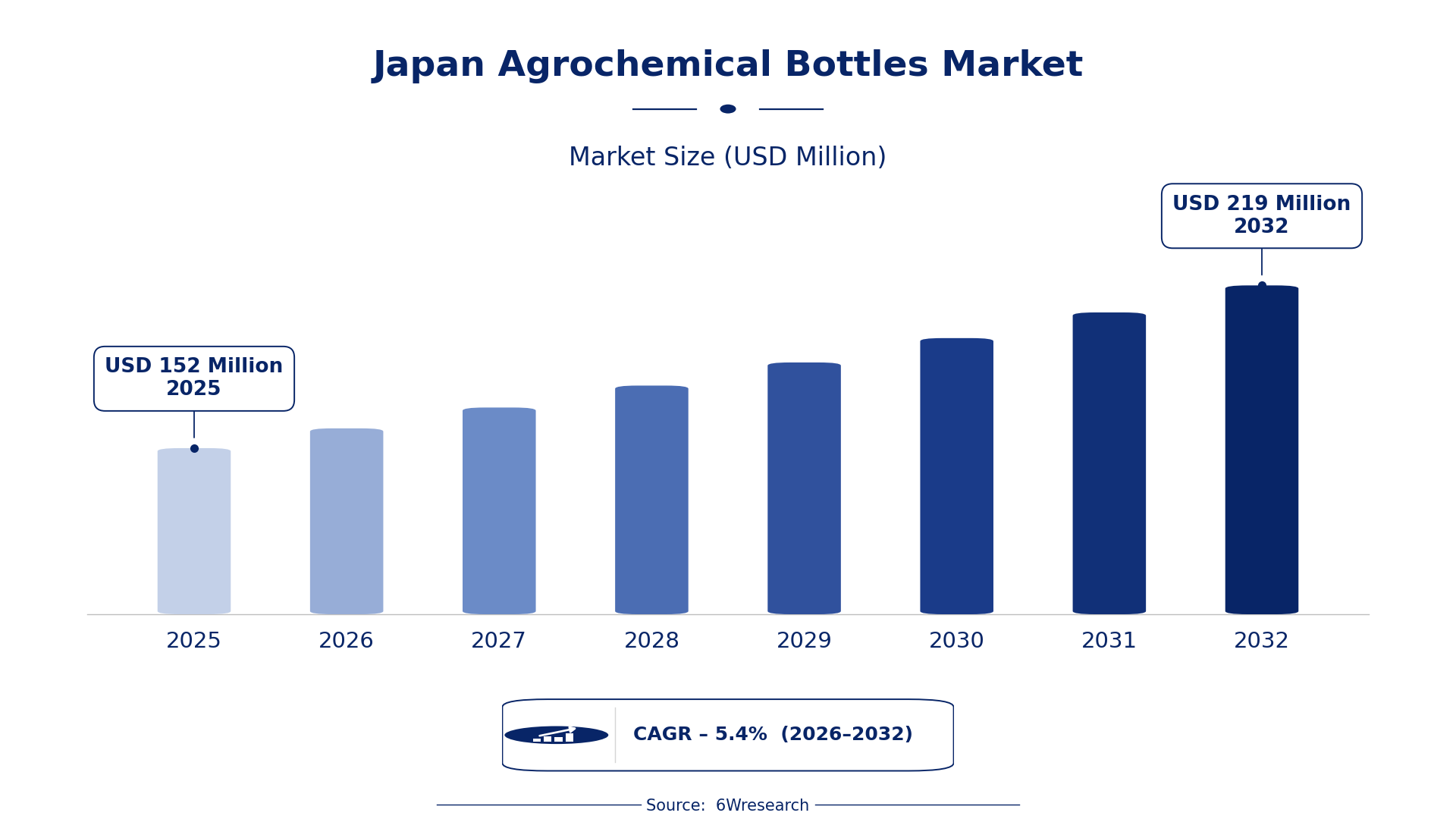
According to 6Wresearch internal database and industry insights, the Japan Agrochemical Bottles Market was valued at USD 152 Million in 2025 and is projected to reach USD 219 Million by 2032, growing at a CAGR of approximately 5.4% during 2026–2032.
Japan Agrochemical Bottles Market Highlights
| Report Metric | Details |
| Report Name | Japan Agrochemical Bottles Market (2026-2032) |
| Market Size 2025 | USD 152 Million |
| Market Size 2032 | USD 219 Million |
| Absolute Growth 2025–2032 | USD 67 Million |
| CAGR 2026–2032 | 5.4% |
| Peak Annual Growth | 6.2% in 2032 |
| Forecast Period | 2026–2032 |
| Historical Data | 2022–2025 |
| Base Year | 2025 |
| Leading Bottle Type, 2025 | HDPE Bottles (39% share) |
| Leading Material Type, 2025 | Plastic (47% share) |
| Leading Distribution Channel, 2025 | Direct Manufacturing Sales (35% share) |
| Leading End User, 2025 | Agrochemical Companies (47% share) |
| Fastest-Growing Bottle Type | PET Bottles (7.6% CAGR) |
| Fastest-Growing Material Type | Glass (8.1% CAGR) |
| Fastest-Growing Distribution Channel | Industrial Wholesalers (7.3% CAGR) |
| Fastest-Growing End User | Liquid Fertilizer Suppliers (7.4% CAGR) |
| Growing Sector | Agrochemical production |
| Key End Users | Agrochemical Companies, Liquid Fertilizer Suppliers, Biostimulant Producers |
Japan Agrochemical Bottles Market Year-wise Growth Rate and Key Drivers (2022–2032)
This graph illustrates the annual growth rates of the market from 2022 to 2032, highlighting a steady upward trajectory and projected market expansion over the forecast period.
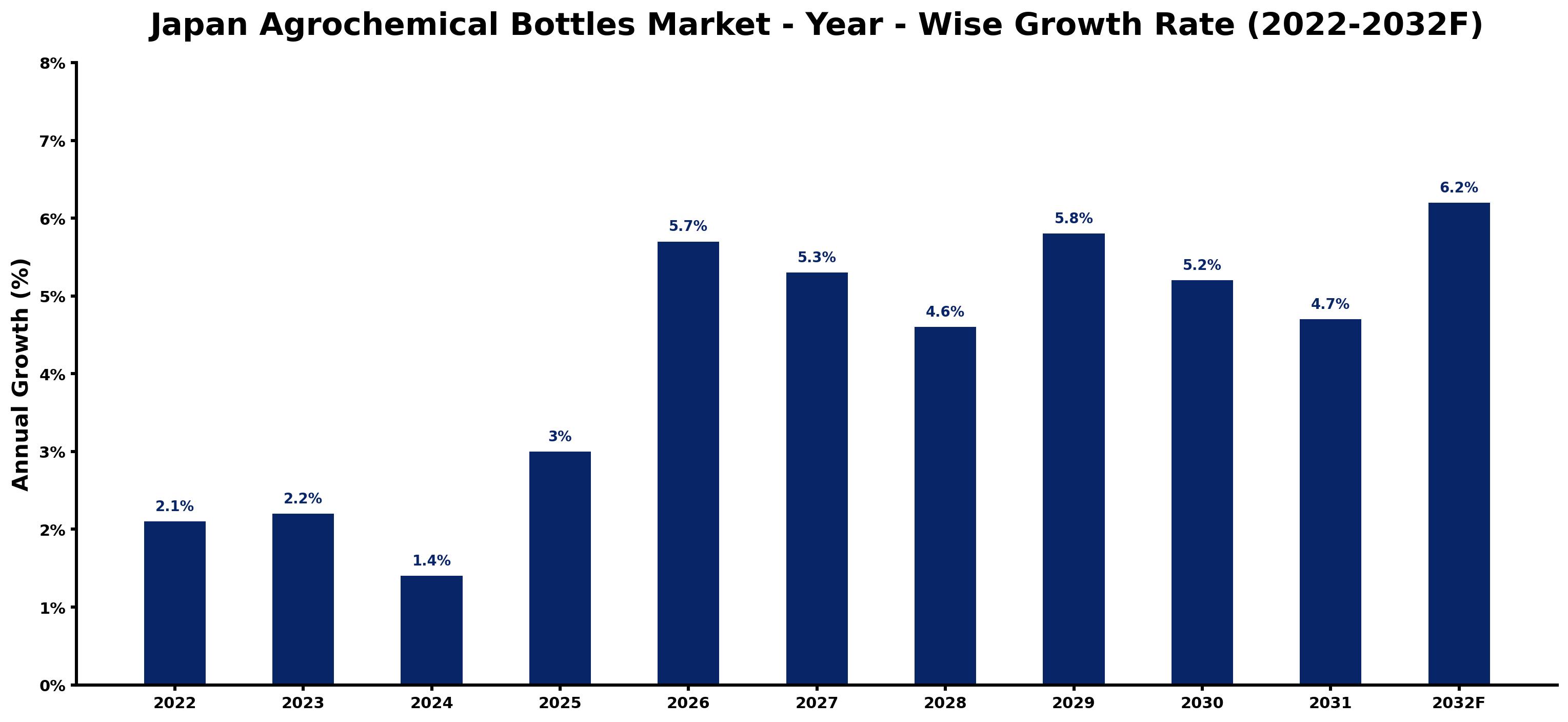
Annual growth estimates for each year appear below with the principal reason behind them, explaining the shifts that set the pace of the market.
| Year | Estimated Annual Growth (%) | Market Rationale |
| 2022 | 2.1 | The market experienced moderate growth due to stable agrochemical production levels. |
| 2023 | 2.2 | Demand increased as agrochemical companies expanded their operations and product lines. |
| 2024 | 1.4 | Growth slowed as market saturation began to affect new investments in packaging. |
| 2025 | 3.0 | Stronger growth occurred as the agrochemical market rebounded with increased production. |
| 2026 | 5.7 | Investment in sustainable packaging solutions is expected to drive higher demand for bottles. |
| 2027 | 5.3 | Growth is projected to slow slightly as companies adjust to new environmental regulations. |
| 2028 | 4.6 | Demand will continue to grow, supported by rising liquid fertilizer production. |
| 2029 | 5.8 | Increased focus on eco-friendly packaging will lead to faster growth in bottle demand. |
| 2030 | 5.2 | Growth is anticipated to slow as competition intensifies among packaging suppliers. |
| 2031 | 4.7 | Demand will remain strong but growth rates are expected to normalise. |
| 2032 | 6.2 | The market is projected to peak with substantial investments in advanced bottle materials. |
Note: Market size estimations and growth projections presented in this report are based on 6Wresearch's proprietary forecasting methodology, utilizing the latest available industry data, government publications, and primary research inputs.
Japan Agrochemical Bottles Market Synopsis
Agrochemical bottles serve as crucial containers crafted from materials like HDPE and PET, intended for the secure storage and transport of agrochemicals such as pesticides and fertilizers. The Japan Agrochemical Bottles Market is expanding due to heightened production of agrochemicals, especially in the Kanto region, which generated around 1.2 million tons in 2022. The government's commitment to eco-friendly initiatives, including a new programme in 2023 promoting sustainable agrochemical use, supports this growth. This blend of factors is propelling demand for effective packaging solutions in the sector.
Market Dynamics Impact Analysis (2026–2032)
| Factor | Type | Impact | Primary Segment Affected |
| Increased production of agrochemicals | Driver | High | HDPE Bottles |
| Growing demand for sustainable packaging solutions | Driver | High | PET Bottles |
| Expansion of liquid fertilizer suppliers | Opportunity | Medium | Liquid Fertilizer Suppliers |
| Rising interest in eco-friendly packaging | Opportunity | Medium | Agrochemical Companies |
| Regulatory compliance costs for packaging | Restraint | High | Glass Bottles |
| Market saturation in traditional packaging types | Restraint | Medium | Jerry Cans |
| High costs of sustainable materials | Challenge | High | Plastic |
| Intense competition among packaging suppliers | Challenge | Medium | PET Bottles |
Evaluation of Drivers in Japan Agrochemical Bottles Market (2026–2032)
The main growth drivers and the segments they affect most are set out below.
| Drivers | Primary Segment Affected | Why It Matters (Evidence) |
| Increased agrochemical production | HDPE Bottles | Japan produced approximately 1.2 million tons of agrochemicals in 2022, driving demand for bulk storage solutions. |
| Shift towards eco-friendly packaging | PET Bottles | The market for liquid fertilizers is expected to grow, increasing the need for secure packaging solutions. |
| Growth in liquid fertilizers | Liquid Fertilizer Suppliers | The liquid fertilizer market is projected to expand, leading to a higher demand for bottles. |
| Focus on quality standards | Glass Bottles | ISO 9001 is a common quality standard for agrochemical packaging, ensuring safety and reliability. |
| Government support for eco-friendly initiatives | Plastic | The Japanese government supports eco-friendly packaging initiatives with subsidies, encouraging adoption among producers. |
Most of the additional volume arises from increased agrochemical production, with Japan producing roughly 1.2 million tons in 2022, driving the need for bulk storage solutions. The liquid fertilizer market is set to grow, creating a higher demand for secure packaging. The trend towards eco-friendly packaging is clear, as the emphasis on quality standards ensures safety and reliability in packaging. The Kanto region's rise in agrochemical production further illustrates this trend, underscoring the growing requirement for effective packaging solutions.
Evaluation of Restraints in Japan Agrochemical Bottles Market
These restraints slow adoption and weigh on supplier margins.
| Market Restraint | Primary Segment Affected | Why It Matters (Evidence) |
| High compliance costs for sustainable packaging | Glass Bottles | Regulatory compliance costs can reach up to 15% of production expenses, impacting profitability for producers. |
| Market saturation in traditional packaging types | Jerry Cans | As the market matures, traditional packaging types face saturation, limiting growth opportunities. |
| Fragility of glass materials | Glass Bottles | Glass bottles are less favored due to their fragility, which affects their market share in agrochemical packaging. |
| Limited consumer awareness of eco-friendly options | Plastic | Many consumers remain unaware of eco-friendly packaging alternatives, hindering market growth. |
| High costs of sustainable materials | Plastic | Sustainable materials can be 20% more expensive than traditional options, affecting pricing strategies. |
Japan Agrochemical Bottles Market Challenges
Buyers encounter limited availability of eco-friendly packaging options, which can elevate costs by up to 15% and narrow their choices. Importers face supply chain disruptions due to strict agrochemical packaging regulations, resulting in delivery delays of up to four weeks, which affects timely distribution to retailers. Producers grapple with rising raw material prices, particularly for HDPE and PET, inflating production costs by about 20%, which compresses profit margins. Skills shortages within the workforce impede producers' ability to innovate, potentially postponing new product launches by six months, affecting market competitiveness.
Trends in the Japan Agrochemical Bottles Market
These developments are changing demand patterns in the Japan Agrochemical Bottles Market.
- Shift Towards Eco-Friendly Packaging: Agrochemical companies are increasingly embracing eco-friendly packaging solutions, with the Japanese government backing these initiatives through subsidies. In 2023, a new initiative was introduced to promote sustainable agrochemical use, reflecting a growing trend in the market.
- Growing Demand for Liquid Fertilizers: The liquid fertilizer market is on the rise, particularly in regions like Kanto, a key hub for agrochemical production. This expansion is anticipated to boost bottle demand, with expectations of increased production levels.
- Increased Use of PET Bottles: PET bottles are gaining popularity due to their lightweight and chemical resistance, representing about 30% of the agrochemical packaging market. This trend is propelled by the need for safer and more efficient storage solutions.
- Regulatory Focus on Quality Standards: The emphasis on quality standards such as ISO 9001 is intensifying, ensuring safety in agrochemical packaging. This regulatory focus is shaping the market, as companies strive to comply with these standards.
Investment Opportunities in the Japan Agrochemical Bottles Market
The following areas offer the clearest openings for investors and suppliers in the Japan Agrochemical Bottles Market.
- Agrochemical Companies Seeking Sustainable Solutions: Agrochemical companies are increasingly pursuing sustainable packaging solutions, with the market for sustainable packaging expected to grow. Collaborating with producers can enhance distribution capabilities and lessen environmental impact.
- Partnerships with Local Producers: Entering the market through partnerships with local producers can ease access to the expanding agrochemical sector. Collaborating with firms in regions like Kanto can strengthen distribution capabilities.
- Investment in Advanced Bottle Materials: Investing in advanced bottle materials that comply with regulatory standards offers a notable opportunity. The focus on eco-friendly solutions is driving demand for effective packaging options.
- Expansion of Distribution Channels: The rise of online marketplaces presents an opportunity for suppliers to connect with a wider audience. With increasing consumer access to agrochemical products, this channel is becoming increasingly important.
Government Initiatives in the Japan Agrochemical Bottles Market
The Plastic Resource Circulation Act, enacted in 2021, promotes the reduction, reuse, and recycling of plastics, enhancing the existing framework established by the Chemical Substances Control Law of 1973. This new measure encourages producers to adopt sustainable practices and ensures compliance with environmental standards. The focus on eco-friendly packaging aligns with Japan's broader sustainability goals, promoting a more responsible agrochemical industry.
In 2023, the Japanese government allocated JPY 150 trillion for public and private decarbonisation investment over the next decade. The Ministry of Agriculture, Forestry and Fisheries oversees agrochemical regulations, ensuring that producers adhere to safety and environmental standards. This funding supports initiatives aimed at improving packaging sustainability and promoting eco-friendly practices in the agrochemical sector.
Future Insight of the Japan Agrochemical Bottles Market
Japan's investment pipeline targets approximately JPY 150 trillion over the next decade, stimulating demand for sustainable agrochemical bottles. By 2032, advancements in recycling technologies will improve lifecycle management of agrochemical bottles, benefiting both suppliers and buyers. The growth of the liquid fertilizers market will further drive bottle demand, creating opportunities for producers to innovate. New regulations will promote eco-friendly packaging, encouraging investments in sustainable materials and improving market conditions.
Market Segmentation Analysis
Japan Agrochemical Bottles Market report covers a detailed analysis of the following market segments:
By Bottle Type – HDPE Bottles Lead, PET Bottles Expected to Grow Fastest
According to Saurav Kr Singh, Senior Research Analyst at 6Wresearch, HDPE Bottles accounted for 39% of the market by bottle type in 2025. HDPE bottles dominate the market because they are ideal for bulk agrochemical storage, essential for large operations. In the Kanto region, a major agrochemical production hub, HDPE bottles are extensively employed for efficient storage solutions. Over 2026–2032, PET Bottles are expected to post the fastest growth, at a CAGR of 7.6%. PET bottles are experiencing rapid growth due to their lightweight and chemical-resistant properties, making them suitable for diverse packaging needs. The increasing demand for liquid fertilizers is significantly driving the adoption of PET bottles in the market. Suppliers should focus on developing PET bottle solutions to meet the rising demand in the liquid fertilizer sector.
By Material Type – Plastic Leads, Glass Expected to Grow Fastest
With 47% of material type revenue in 2025, Plastic was the largest category. Plastic is the leading material for agrochemical bottles, accounting for the majority of the market because of its durability and versatility. This is especially true for HDPE bottles, which are widely used across the agrochemical industry. The quickest growth will come from Glass, forecast to expand at a CAGR of 8.1% between 2026 and 2032. Glass is the fastest-growing material type, appealing to niche markets that prefer eco-friendly packaging alternatives. Recent initiatives promoting sustainable agrochemical practices have increased interest in glass as a viable packaging solution. Buyers may increasingly seek glass packaging options as sustainability considerations gain importance in their purchasing decisions.
By Distribution Channel – Direct Manufacturing Sales Leads, Industrial Wholesalers Expected to Grow Fastest
Direct Manufacturing Sales held 35% of the Japan Agrochemical Bottles Market by distribution channel in 2025. Direct manufacturing sales are the leading distribution channel, serving bulk buyers who require substantial quantities of agrochemical bottles directly from manufacturers. This approach ensures reliability and efficiency for major agrochemical companies in their procurement processes. Industrial Wholesalers are set to record the highest CAGR in this split, 7.3% over 2026–2032. Industrial wholesalers are experiencing rapid growth as they facilitate the distribution of bottles to smaller retailers, thereby broadening market access. Their capacity to offer a variety of packaging solutions is attracting more clients within the agrochemical sector. Suppliers should strengthen partnerships with industrial wholesalers to improve their distribution reach and effectiveness.
By End User – Agrochemical Companies Lead, Liquid Fertilizer Suppliers Expected to Grow Fastest
The largest end user category in 2025 was Agrochemical Companies, at 47% of revenue. Agrochemical companies are the largest end user segment, requiring substantial volumes of bottles for their extensive operations. Their expansive production and distribution networks greatly influence the demand for reliable packaging solutions in the market. Liquid Fertilizer Suppliers are projected to grow fastest, at a CAGR of 7.4% during 2026–2032. Liquid fertilizer suppliers are the fastest-growing end user group, driven by the rising need for secure packaging to maintain product quality. As the market for liquid fertilizers expands, the demand for appropriate packaging solutions will also increase. Suppliers must customise their offerings to meet the specific needs of liquid fertilizer suppliers to capitalise on this growth opportunity.
Key Attractiveness of the Report
- 10 Years of Market Numbers
- Historical Data Starting from 2022 to 2025
- Base Year 2025
- Forecast Data until 2032
- Key Performance Indicators Impacting the Market
- Major Upcoming Developments and Projects
Key Highlights of the Report:
- Japan Agrochemical Bottles Market Outlook
- Market Size of Japan Agrochemical Bottles Market, 2025
- Forecast of Japan Agrochemical Bottles Market, 2032
- Historical Data and Forecast of Japan Agrochemical Bottles Revenues & Volume for the Period 2022-2032F
- Japan Agrochemical Bottles Market Trend Evolution
- Japan Agrochemical Bottles Market Drivers and Challenges
- Japan Agrochemical Bottles Price Trends
- Japan Agrochemical Bottles Porter's Five Forces
- Japan Agrochemical Bottles Industry Life Cycle
- Historical Data and Forecast of Japan Agrochemical Bottles Market Revenues & Volume By Bottle Type for the Period 2022-2032F
- Historical Data and Forecast of Japan Agrochemical Bottles Market Revenues & Volume By HDPE Bottles for the Period 2022-2032F
- Historical Data and Forecast of Japan Agrochemical Bottles Market Revenues & Volume By PET Bottles for the Period 2022-2032F
- Historical Data and Forecast of Japan Agrochemical Bottles Market Revenues & Volume By Glass Bottles for the Period 2022-2032F
- Historical Data and Forecast of Japan Agrochemical Bottles Market Revenues & Volume By Jerry Cans for the Period 2022-2032F
- Historical Data and Forecast of Japan Agrochemical Bottles Market Revenues & Volume By Material Type for the Period 2022-2032F
- Historical Data and Forecast of Japan Agrochemical Bottles Market Revenues & Volume By Plastic for the Period 2022-2032F
- Historical Data and Forecast of Japan Agrochemical Bottles Market Revenues & Volume By Plastic for the Period 2022-2032F
- Historical Data and Forecast of Japan Agrochemical Bottles Market Revenues & Volume By Glass for the Period 2022-2032F
- Historical Data and Forecast of Japan Agrochemical Bottles Market Revenues & Volume By Polyethylene for the Period 2022-2032F
- Historical Data and Forecast of Japan Agrochemical Bottles Market Revenues & Volume By Distribution Channel for the Period 2022-2032F
- Historical Data and Forecast of Japan Agrochemical Bottles Market Revenues & Volume By Direct Manufacturing Sales for the Period 2022-2032F
- Historical Data and Forecast of Japan Agrochemical Bottles Market Revenues & Volume By Industrial Wholesalers for the Period 2022-2032F
- Historical Data and Forecast of Japan Agrochemical Bottles Market Revenues & Volume By Specialty Stores for the Period 2022-2032F
- Historical Data and Forecast of Japan Agrochemical Bottles Market Revenues & Volume By Online Marketplaces for the Period 2022-2032F
- Historical Data and Forecast of Japan Agrochemical Bottles Market Revenues & Volume By End User for the Period 2022-2032F
- Historical Data and Forecast of Japan Agrochemical Bottles Market Revenues & Volume By Agrochemical Companies for the Period 2022-2032F
- Historical Data and Forecast of Japan Agrochemical Bottles Market Revenues & Volume By Liquid Fertilizer Suppliers for the Period 2022-2032F
- Historical Data and Forecast of Japan Agrochemical Bottles Market Revenues & Volume By Biostimulant Producers for the Period 2022-2032F
- Historical Data and Forecast of Japan Agrochemical Bottles Market Revenues & Volume By Bulk Chemical Distributors for the Period 2022-2032F
- Japan Agrochemical Bottles Import Export Trade Statistics
- Market Opportunity Assessment By Bottle Type
- Market Opportunity Assessment By Material Type
- Market Opportunity Assessment By Distribution Channel
- Market Opportunity Assessment By End User
- Japan Agrochemical Bottles Top Companies Market Share
- Japan Agrochemical Bottles Competitive Benchmarking By Technical and Operational Parameters
- Japan Agrochemical Bottles Company Profiles
- Japan Agrochemical Bottles Key Strategic Recommendations
Market Covered
Coverage by segment is as follows.
By Bottle Type
- HDPE Bottles
- PET Bottles
- Glass Bottles
- Jerry Cans
By Material Type
- Plastic
- Glass
- Polyethylene
By Distribution Channel
- Direct Manufacturing Sales
- Industrial Wholesalers
- Specialty Stores
- Online Marketplaces
By End User
- Agrochemical Companies
- Liquid Fertilizer Suppliers
- Biostimulant Producers
- Bulk Chemical Distributors































