Japan Agrochemical Ingredients Market Size & Growth Rate
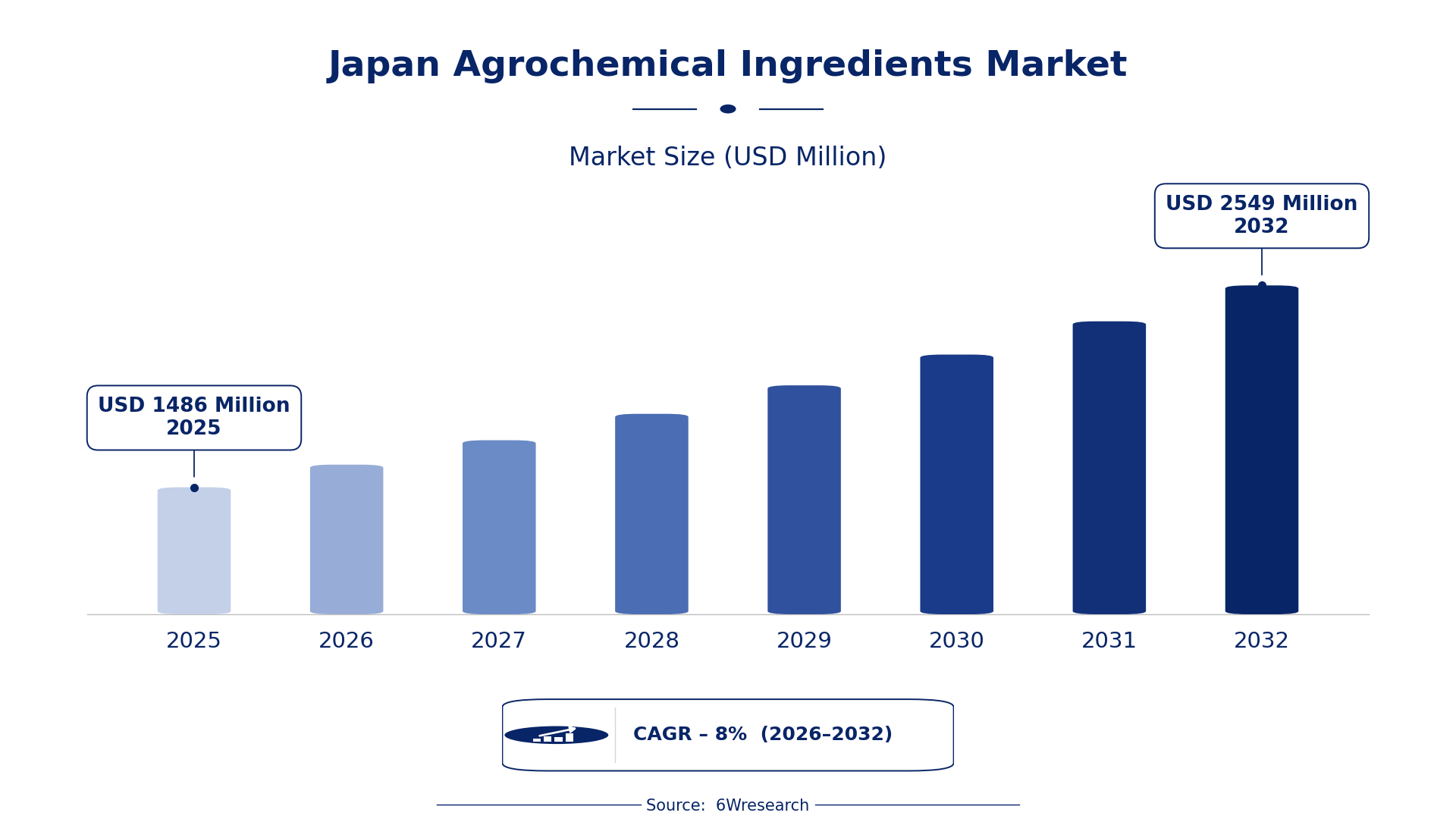
According to 6Wresearch internal database and industry insights, the Japan Agrochemical Ingredients Market was valued at USD 1,486 Million in 2025 and is projected to reach USD 2,549 Million by 2032, growing at a CAGR of approximately 8% during 2026–2032.
Japan Agrochemical Ingredients Market Highlights
| Report Metric | Details |
| Report Name | Japan Agrochemical Ingredients Market (2026-2032) |
| Market Size 2025 | USD 1,486 Million |
| Market Size 2032 | USD 2,549 Million |
| Absolute Growth 2025–2032 | USD 1,063 Million |
| CAGR 2026–2032 | 8% |
| Peak Annual Growth | 8.8% in 2032 |
| Forecast Period | 2026–2032 |
| Historical Data | 2022–2025 |
| Base Year | 2025 |
| Leading Ingredient Type, 2025 | Surfactants (37% share) |
| Leading Usage Area, 2025 | Herbicide Blends (42% share) |
| Leading Distribution Channel, 2025 | Industrial Suppliers (35% share) |
| Leading End User, 2025 | Pesticide Manufacturers (41% share) |
| Fastest-Growing Ingredient Type | Solvents (11.2% CAGR) |
| Fastest-Growing Usage Area | Liquid Formulations (9.6% CAGR) |
| Fastest-Growing Distribution Channel | Direct Sales (10.7% CAGR) |
| Fastest-Growing End User | Agrochemical Blenders (10.4% CAGR) |
| Growing Sector | agriculture |
| Key End Users | Pesticide Manufacturers, Agrochemical Blenders, Crop Protection Firms, Foliar Spray Producers |
Japan Agrochemical Ingredients Market Year-wise Growth Rate and Key Drivers (2022–2032)
This graph illustrates the annual growth rates of the market from 2022 to 2032, highlighting a steady upward trajectory and projected market expansion over the forecast period.
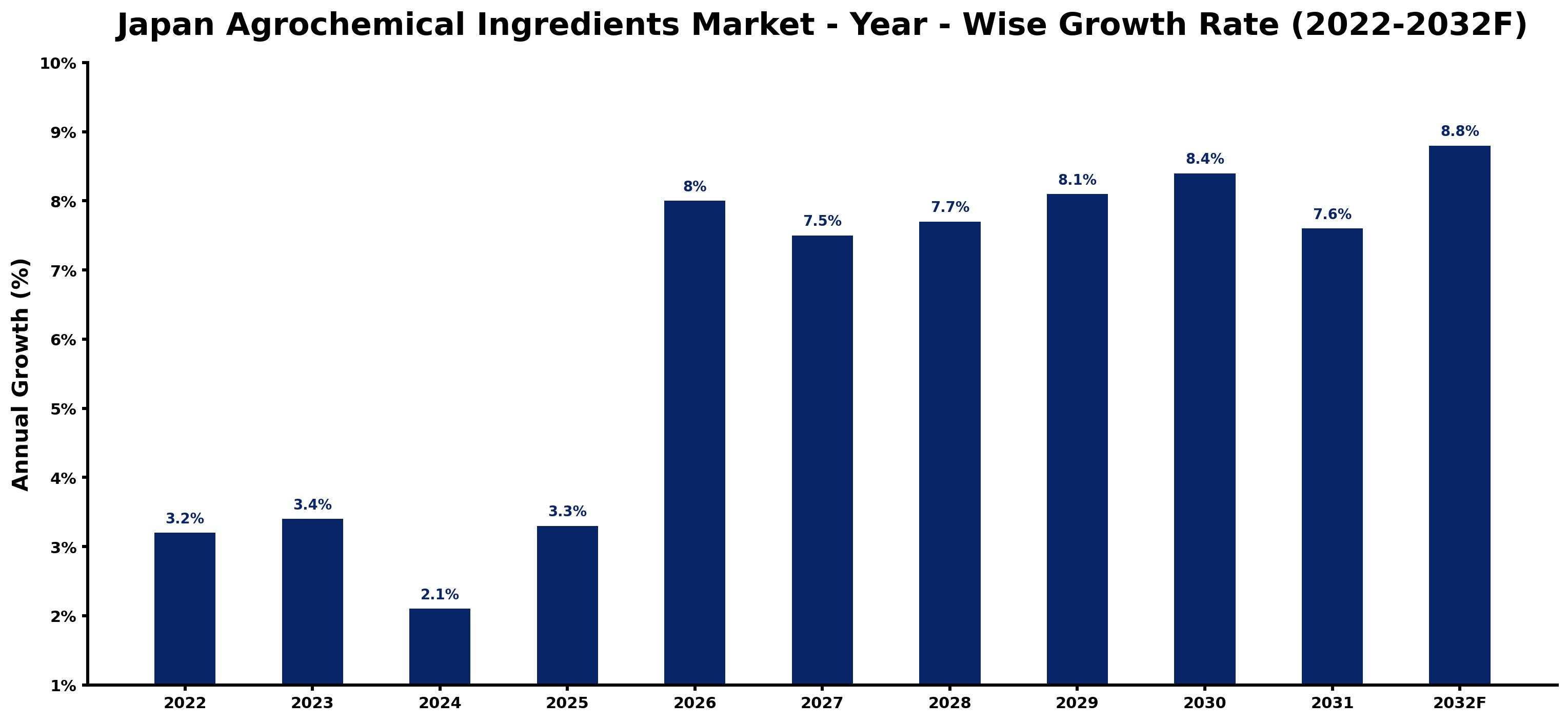
Annual growth estimates for each year appear below with the principal reason behind them, explaining the shifts that set the pace of the market.
| Year | Estimated Annual Growth (%) | Market Rationale |
| 2022 | 3.2 | The market experienced steady growth as agricultural needs remained strong. |
| 2023 | 3.4 | Demand increased due to heightened focus on sustainable agricultural practices. |
| 2024 | 2.1 | Growth slowed as market adjustments to new regulations took effect. |
| 2025 | 3.3 | The market rebounded with increased investments in agrochemical products. |
| 2026 | 8.0 | Demand is expected to surge as precision agriculture technologies gain traction. |
| 2027 | 7.5 | Growth is projected to slow slightly as market saturation begins to set in. |
| 2028 | 7.7 | Demand is anticipated to pick up again with rising agricultural productivity initiatives. |
| 2029 | 8.1 | Growth is expected to accelerate as innovation in agrochemical formulations expands. |
| 2030 | 8.4 | Demand will continue to rise with increasing focus on environmental sustainability. |
| 2031 | 7.6 | Growth is projected to decelerate as competition intensifies in the agrochemical sector. |
| 2032 | 8.8 | Demand is expected to peak as the market adapts to evolving agricultural practices. |
Note: Market size estimations and growth projections presented in this report are based on 6Wresearch's proprietary forecasting methodology, utilizing the latest available industry data, government publications, and primary research inputs.
Japan Agrochemical Ingredients Market Synopsis
Agrochemical ingredients are chemical compounds used in formulating pesticides and fertilizers, improving crop protection and agricultural productivity. The Japan Agrochemical Ingredients Market is projected to grow, driven by the agricultural sector employing approximately 1.5 million people and the government's commitment to sustainable practices. With agrochemical sales expected to reach 300 billion yen by 2025, the market is poised for substantial growth due to rising demand for effective agricultural solutions.
Market Dynamics Impact Analysis (2026–2032)
| Factor | Type | Impact | Primary Segment Affected |
| Increasing demand for sustainable agricultural practices | Driver | High | Herbicide Blends |
| Rising investments in precision agriculture technologies | Driver | High | Liquid Formulations |
| Growing agricultural exports creating new market opportunities | Opportunity | High | Pesticide Manufacturers |
| Emerging trends in organic farming increasing demand for specific formulations | Opportunity | Medium | Agrochemical Blenders |
| Regulatory compliance costs affecting production capacities | Restraint | High | Surfactants |
| Market saturation limiting growth potential for existing products | Restraint | Medium | Insecticides |
| Supply chain disruptions impacting ingredient availability | Challenge | High | Solvents |
| Intense competition leading to price pressures | Challenge | Medium | Emulsifiers |
Evaluation of Drivers in Japan Agrochemical Ingredients Market (2026–2032)
Below are the drivers that matter most for revenue growth, with supporting evidence.
| Drivers | Primary Segment Affected | Why It Matters (Evidence) |
| Rising agricultural productivity | Herbicide Blends | Japan's agricultural sector employs approximately 1.5 million people, driving demand for effective crop protection solutions. |
| Adoption of precision agriculture technologies | Liquid Formulations | The increasing use of precision agriculture technologies is raising demand for effective agrochemical ingredients. |
| Government initiatives promoting sustainable agriculture | Pesticide Manufacturers | The Chemical Substances Control Law aims to improve agricultural sustainability, boosting demand for agrochemical products. |
| Growing agricultural exports | Agrochemical Blenders | Japan's agricultural exports reached $10 billion in 2022, creating opportunities for agrochemical ingredient suppliers. |
| Technological advancements in agrochemical formulations | Surfactants | Pursuing ISO 9001 certification ensures quality and drives demand for effective formulations. |
Spending rises as Japan's agricultural sector employs approximately 1.5 million people, increasing the need for effective crop protection solutions. The growing use of precision agriculture technologies is raising demand for liquid formulations that improve agricultural productivity. Japan's agricultural exports reached $10 billion in 2022, creating new opportunities for suppliers. Advancements in formulations, supported by ISO 9001 certification, ensure quality and drive demand for surfactants.
Evaluation of Restraints in Japan Agrochemical Ingredients Market
The table below lists the restraints and the evidence behind each.
| Market Restraint | Primary Segment Affected | Why It Matters (Evidence) |
| Regulatory compliance costs | Surfactants | Compliance with the Chemical Substances Control Law increases production costs for manufacturers, limiting their competitiveness. |
| Market saturation | Insecticides | Intense competition in the insecticide segment leads to reduced profit margins for producers. |
| Supply chain disruptions | Solvents | Disruptions in the supply chain affect the availability of solvents, impacting production timelines. |
| Limited innovation in existing products | Emulsifiers | A lack of new product development in emulsifiers restricts growth opportunities in this segment. |
| Price pressures from competition | Liquid Formulations | Increased competition in liquid formulations leads to aggressive pricing strategies, affecting profitability. |
Japan Agrochemical Ingredients Market Challenges
Japan produced over 1 million tons of agrochemical products in 2022, yet the adoption of precision agriculture technologies remains low, causing inefficiencies for farmers. A shortage of skilled workers in the agricultural sector, which employs approximately 1.5 million people, hampers the effective use of advanced agrochemical methods, resulting in delayed productivity gains. Compliance with stringent regulations from the Ministry of Agriculture, Forestry and Fisheries imposes high costs on producers, raising prices for buyers. The average farm size in Japan is about 1.5 hectares, restricting economies of scale and making it difficult for smallholders to compete.
Trends in the Japan Agrochemical Ingredients Market
Four trends stand out in the Japan Agrochemical Ingredients Market.
- Shift towards Sustainable Agriculture: Japan is increasingly focusing on sustainable agricultural practices, with agrochemical sales projected to reach 300 billion yen by 2025. This shift is driven by consumer demand for environmentally friendly products.
- Increase in Precision Agriculture Technologies: The adoption of precision agriculture technologies is growing, particularly in the Tokyo region, which is a hub for agrochemical research. This trend is expected to improve crop yields and efficiency.
- Emergence of Organic Farming: There is a notable shift towards organic farming practices in Japan, leading to increased demand for specific agrochemical formulations. The growing consumer preference for organic products is reshaping market dynamics.
- Rising Agricultural Exports: Japan's agricultural exports reached $10 billion in 2022, reflecting strong demand for agrochemical ingredients. This trend indicates potential growth in the agrochemical sector as international markets expand.
Investment Opportunities in the Japan Agrochemical Ingredients Market
The opportunities below stand out in the Japan Agrochemical Ingredients Market for new entrants and existing suppliers.
- Growing Demand for Organic Agrochemicals: With the rise in organic farming, there is an opportunity to supply organic agrochemical formulations. The demand from agrochemical blenders is increasing, making this an attractive market segment for investment.
- Investment in Precision Agriculture Solutions: Now is the time to invest in precision agriculture solutions, as these technologies are gaining traction. Collaborating with agricultural technology firms can open new avenues for growth in this sector.
- Expansion of Agrochemical Exports: Given the $10 billion agricultural export figure, there is an opportunity to expand agrochemical exports. Establishing partnerships with international distributors can facilitate market entry.
- Development of Innovative Formulations: Investing in the development of new agrochemical formulations can meet the evolving needs of farmers. Focusing on the Tokyo region's research capabilities can enhance product offerings.
Government Initiatives in the Japan Agrochemical Ingredients Market
The Chemical Substances Control Law mandates manufacturers to evaluate and control chemical substances, ensuring safety in agrochemical production. Compliance with this law is essential for producers, as it impacts their ability to market products effectively. Additionally, the Industrial Safety and Health Act sets safety measures for hazardous substances, influencing operational practices in the agrochemical sector.
The Ministry of Agriculture, Forestry and Fisheries oversees agrochemical regulations, ensuring compliance with safety standards. Producers must adhere to these regulations to maintain market access, while the Japan Crop Protection Association provides guidance on best practices for agrochemical use.
Future Insight of the Japan Agrochemical Ingredients Market
The shift towards sustainable agriculture will transform the agrochemical sector by 2032, driven by the government's JPY 150 trillion investment in decarbonisation. Suppliers will respond by developing eco-friendly formulations that meet new standards. Increased collaboration in the Tokyo region's research and development hub will facilitate breakthroughs in agrochemical applications. Buyers will experience improved product performance and sustainability, aligning with global market demands for environmentally responsible practices.
Market Segmentation Analysis
Japan Agrochemical Ingredients Market report covers a detailed analysis of the following market segments:
By Ingredient Type – Surfactants Lead, Solvents Expected to Grow Fastest
According to Saurav Kr Singh, Senior Research Analyst at 6Wresearch, with 37% of ingredient type revenue in 2025, Surfactants was the largest category. Surfactants are essential for improving the effectiveness of agrochemical formulations, making them indispensable for manufacturers in Japan. Their widespread use in various agricultural applications, particularly in pesticide production, solidifies their dominant position in the market. The quickest growth will come from Solvents, forecast to expand at a CAGR of 11.2% between 2026 and 2032. The growth of solvents is propelled by their increasing application in the formulation process, which is critical for developing new agrochemical products. The production of over 1 million tons of agrochemical products in 2022 highlights the strong demand for effective formulation methods. Suppliers must focus on ensuring the quality and availability of surfactants to meet the growing demands of pesticide manufacturers.
By Usage Area – Herbicide Blends Lead, Liquid Formulations Expected to Grow Fastest
In 2025, Herbicide Blends led the usage area split with a 42% share. Herbicide blends are the leading application of agrochemical ingredients, crucial for effective weed management in agriculture. Their significance is underscored by Japan's agricultural exports, which reached $10 billion in 2022, reflecting the importance of these blends in the agrochemical sector. Liquid Formulations are set to record the highest CAGR in this split, 9.6% over 2026–2032. Liquid formulations are rapidly gaining traction due to their versatility and common use across various agrochemical products. The government's 'Green Food System Strategy' promotes sustainable practices, further driving the demand for these formulations. Buyers should invest in liquid formulations to align with sustainable agricultural practices and enhance their product offerings.
By Distribution Channel – Industrial Suppliers Lead, Direct Sales Expected to Grow Fastest
Industrial Suppliers held 35% of the Japan Agrochemical Ingredients Market by distribution channel in 2025. Industrial suppliers play a pivotal role in the market by providing essential ingredients directly to manufacturers, ensuring a reliable supply chain for agrochemical production. Their established relationships with pesticide manufacturers facilitate efficient distribution and product availability. Over 2026–2032, Direct Sales is expected to post the fastest growth, at a CAGR of 10.7%. Direct sales are experiencing rapid growth as they provide a streamlined approach for agrochemical products, allowing manufacturers to connect directly with end-users. This method caters to the increasing demand for tailored solutions in agrochemical applications. Suppliers should enhance their direct sales strategies to better connect with manufacturers and address evolving market demands.
By End User – Pesticide Manufacturers Lead, Agrochemical Blenders Expected to Grow Fastest
Pesticide Manufacturers took 41% of end user revenue in 2025, more than any other category. Pesticide manufacturers are the primary end users of agrochemical ingredients, relying on these components for their product formulations. The agricultural sector, which employs approximately 1.5 million people, highlights the critical role these manufacturers play in the industry. Agrochemical Blenders are projected to grow fastest, at a CAGR of 10.4% during 2026–2032. Agrochemical blenders are witnessing the fastest growth due to their vital function in blending various ingredients for final products, addressing diverse agricultural needs. Advancements in agrochemical formulations are likely to further boost their demand. Manufacturers should collaborate with agrochemical blenders to enhance product offerings and meet the specific needs of the agricultural sector.
Key Attractiveness of the Report
- 10 Years of Market Numbers
- Historical Data Starting from 2022 to 2025
- Base Year 2025
- Forecast Data until 2032
- Key Performance Indicators Impacting the Market
- Major Upcoming Developments and Projects
Key Highlights of the Report:
- Japan Agrochemical Ingredients Market Outlook
- Market Size of Japan Agrochemical Ingredients Market, 2025
- Forecast of Japan Agrochemical Ingredients Market, 2032
- Historical Data and Forecast of Japan Agrochemical Ingredients Revenues & Volume for the Period 2022-2032F
- Japan Agrochemical Ingredients Market Trend Evolution
- Japan Agrochemical Ingredients Market Drivers and Challenges
- Japan Agrochemical Ingredients Price Trends
- Japan Agrochemical Ingredients Porter's Five Forces
- Japan Agrochemical Ingredients Industry Life Cycle
- Historical Data and Forecast of Japan Agrochemical Ingredients Market Revenues & Volume By Ingredient Type for the Period 2022-2032F
- Historical Data and Forecast of Japan Agrochemical Ingredients Market Revenues & Volume By Surfactants for the Period 2022-2032F
- Historical Data and Forecast of Japan Agrochemical Ingredients Market Revenues & Volume By Solvents for the Period 2022-2032F
- Historical Data and Forecast of Japan Agrochemical Ingredients Market Revenues & Volume By Emulsifiers for the Period 2022-2032F
- Historical Data and Forecast of Japan Agrochemical Ingredients Market Revenues & Volume By Chelating Agents for the Period 2022-2032F
- Historical Data and Forecast of Japan Agrochemical Ingredients Market Revenues & Volume By Usage Area for the Period 2022-2032F
- Historical Data and Forecast of Japan Agrochemical Ingredients Market Revenues & Volume By Herbicide Blends for the Period 2022-2032F
- Historical Data and Forecast of Japan Agrochemical Ingredients Market Revenues & Volume By Liquid Formulations for the Period 2022-2032F
- Historical Data and Forecast of Japan Agrochemical Ingredients Market Revenues & Volume By Insecticides for the Period 2022-2032F
- Historical Data and Forecast of Japan Agrochemical Ingredients Market Revenues & Volume By Micronutrients for the Period 2022-2032F
- Historical Data and Forecast of Japan Agrochemical Ingredients Market Revenues & Volume By Distribution Channel for the Period 2022-2032F
- Historical Data and Forecast of Japan Agrochemical Ingredients Market Revenues & Volume By Industrial Suppliers for the Period 2022-2032F
- Historical Data and Forecast of Japan Agrochemical Ingredients Market Revenues & Volume By Direct Sales for the Period 2022-2032F
- Historical Data and Forecast of Japan Agrochemical Ingredients Market Revenues & Volume By B2B Marketplace for the Period 2022-2032F
- Historical Data and Forecast of Japan Agrochemical Ingredients Market Revenues & Volume By Online Trade Channels for the Period 2022-2032F
- Historical Data and Forecast of Japan Agrochemical Ingredients Market Revenues & Volume By End User for the Period 2022-2032F
- Historical Data and Forecast of Japan Agrochemical Ingredients Market Revenues & Volume By Pesticide Manufacturers for the Period 2022-2032F
- Historical Data and Forecast of Japan Agrochemical Ingredients Market Revenues & Volume By Agrochemical Blenders for the Period 2022-2032F
- Historical Data and Forecast of Japan Agrochemical Ingredients Market Revenues & Volume By Crop Protection Firms for the Period 2022-2032F
- Historical Data and Forecast of Japan Agrochemical Ingredients Market Revenues & Volume By Foliar Spray Producers for the Period 2022-2032F
- Japan Agrochemical Ingredients Import Export Trade Statistics
- Market Opportunity Assessment By Ingredient Type
- Market Opportunity Assessment By Usage Area
- Market Opportunity Assessment By Distribution Channel
- Market Opportunity Assessment By End User
- Japan Agrochemical Ingredients Top Companies Market Share
- Japan Agrochemical Ingredients Competitive Benchmarking By Technical and Operational Parameters
- Japan Agrochemical Ingredients Company Profiles
- Japan Agrochemical Ingredients Key Strategic Recommendations
Market Covered
This report examines the market across the segments below.
By Ingredient Type
- Surfactants
- Solvents
- Emulsifiers
- Chelating Agents
By Usage Area
- Herbicide Blends
- Liquid Formulations
- Insecticides
- Micronutrients
By Distribution Channel
- Industrial Suppliers
- Direct Sales
- B2B Marketplace
- Online Trade Channels
By End User
- Pesticide Manufacturers
- Agrochemical Blenders
- Crop Protection Firms
- Foliar Spray Producers































