Japan Agrochemical Solvents Market Size & Growth Rate
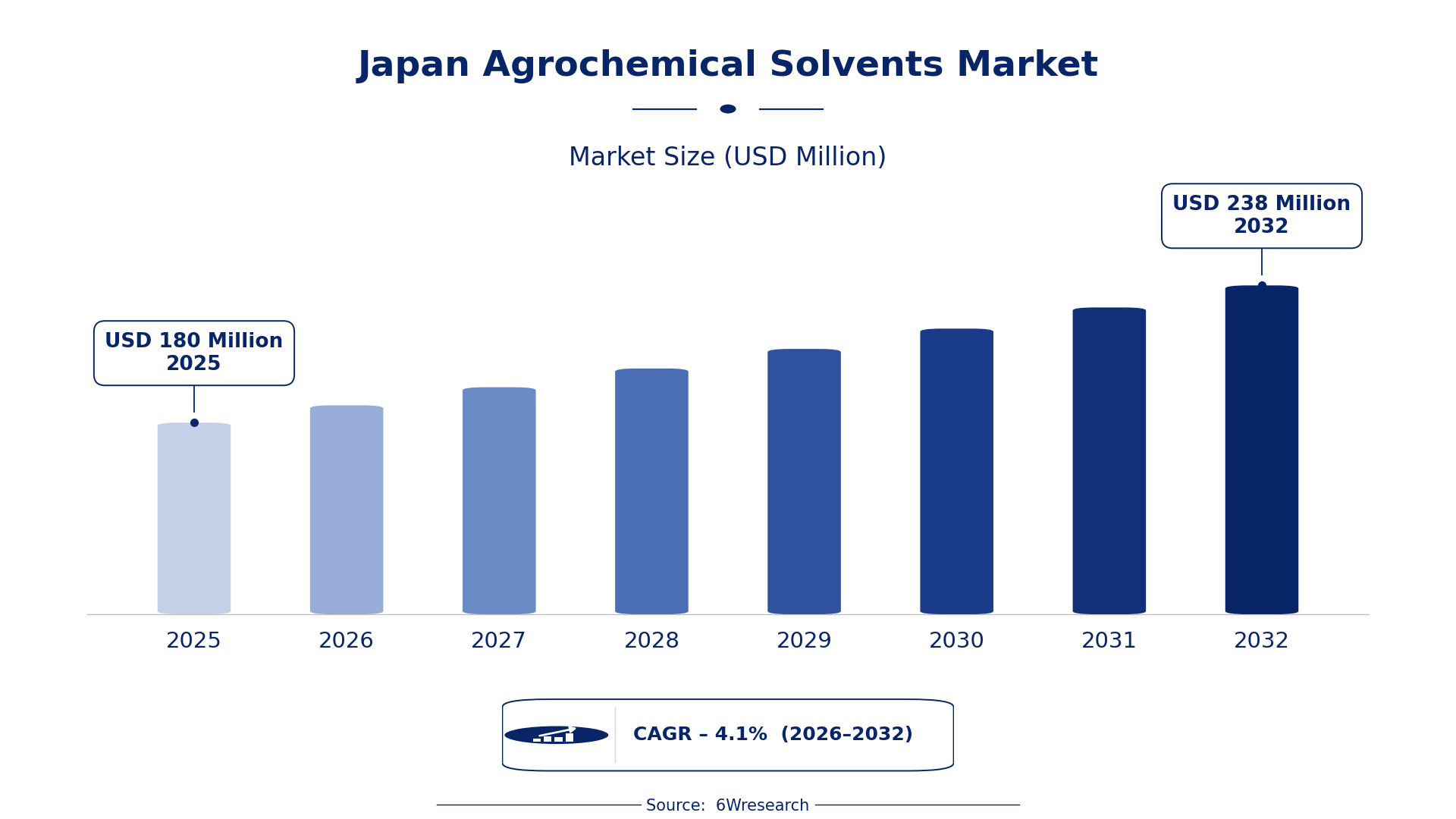
According to 6Wresearch internal database and industry insights, the Japan Agrochemical Solvents Market was valued at USD 180 Million in 2025 and is projected to reach USD 238 Million by 2032, growing at a CAGR of approximately 4.1% during 2026–2032.
Japan Agrochemical Solvents Market Highlights
| Report Metric | Details |
| Report Name | Japan Agrochemical Solvents Market (2026-2032) |
| Market Size 2025 | USD 180 Million |
| Market Size 2032 | USD 238 Million |
| Absolute Growth 2025–2032 | USD 58 Million |
| CAGR 2026–2032 | 4.1% |
| Peak Annual Growth | 5.6% in 2026 |
| Forecast Period | 2026–2032 |
| Historical Data | 2022–2025 |
| Base Year | 2025 |
| Leading Solvent Type, 2025 | Aromatic Solvents (43% share) |
| Leading Application Area, 2025 | Herbicide Blending (52% share) |
| Leading Distribution Channel, 2025 | Industrial Distributors (42% share) |
| Leading End User, 2025 | Agrochemical Manufacturers (51% share) |
| Fastest-Growing Solvent Type | Alcohol-based (5.5% CAGR) |
| Fastest-Growing Application Area | Pesticide Formulation (5.1% CAGR) |
| Fastest-Growing Distribution Channel | Online B2B Platforms (5.2% CAGR) |
| Fastest-Growing End User | Spray Product Companies (5.3% CAGR) |
| Growing Sector | agrochemical manufacturing |
| Key End Users | agrochemical manufacturers, crop protection firms, spray product companies |
Japan Agrochemical Solvents Market Year-wise Growth Rate and Key Drivers (2022–2032)
This graph illustrates the annual growth rates of the market from 2022 to 2032, highlighting a steady upward trajectory and projected market expansion over the forecast period.
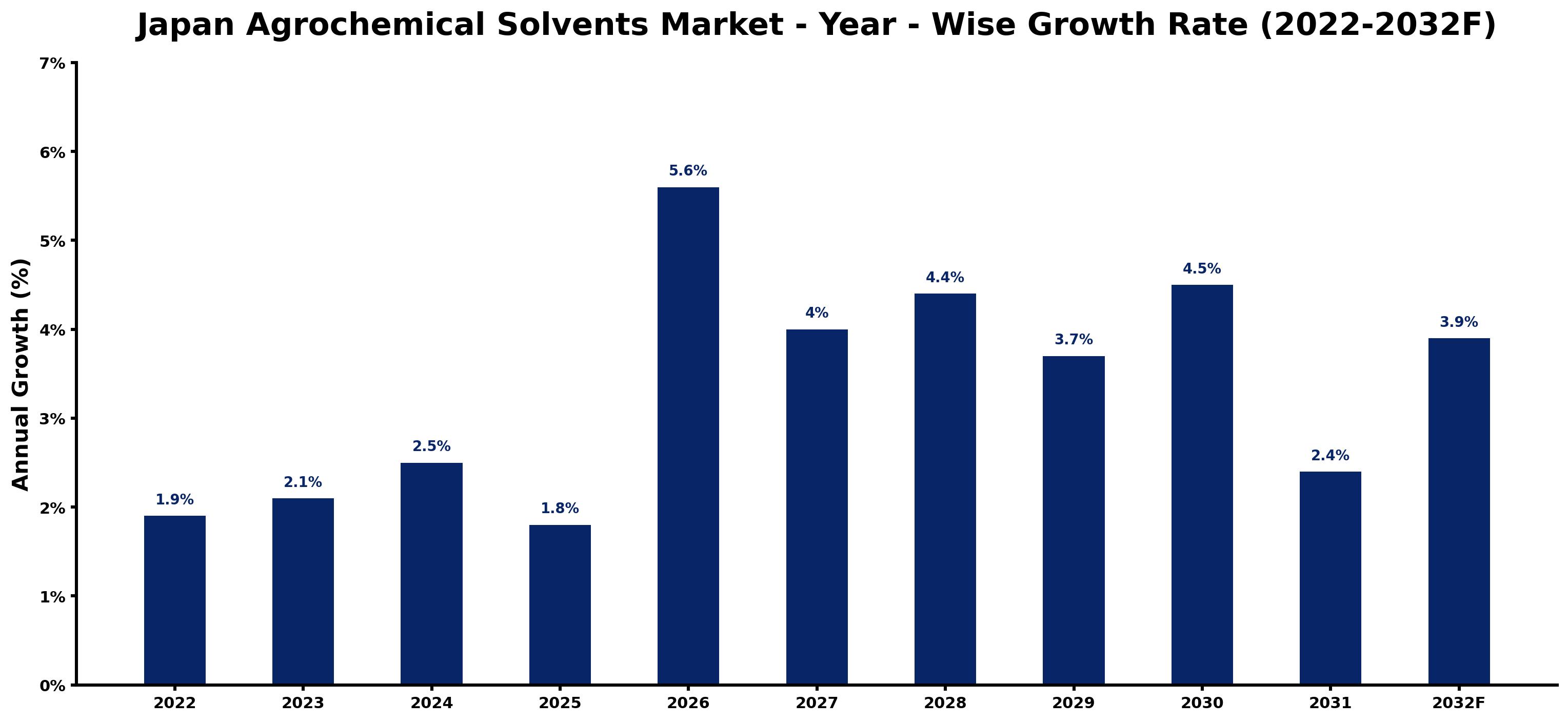
The following figures match every annual growth estimate with the main market development of that year, giving the reasoning behind each rise or slowdown.
| Year | Estimated Annual Growth (%) | Market Rationale |
| 2022 | 1.9 | Demand for agrochemical solvents was stable, reflecting consistent agricultural activity. |
| 2023 | 2.1 | Growth was driven by increased production in the agrochemical sector. |
| 2024 | 2.5 | Demand accelerated as agrochemical manufacturers expanded their product lines. |
| 2025 | 1.8 | Growth slowed due to market saturation in certain solvent types. |
| 2026 | 5.6 | A surge in demand for herbicides is expected to boost growth. |
| 2027 | 4.0 | Market growth is projected to slow as producers face supply chain constraints. |
| 2028 | 4.4 | Rising interest in sustainable agriculture practices will spur demand. |
| 2029 | 3.7 | Growth is anticipated to slow as competition intensifies among manufacturers. |
| 2030 | 4.5 | Increased investment in agrochemical innovations will lead to higher demand. |
| 2031 | 2.4 | Growth is expected to moderate as the market adjusts to new regulations. |
| 2032 | 3.9 | A renewed focus on organic farming practices will stimulate demand. |
Note: Market size estimations and growth projections presented in this report are based on 6Wresearch's proprietary forecasting methodology, utilizing the latest available industry data, government publications, and primary research inputs.
Japan Agrochemical Solvents Market Synopsis
Agrochemical solvents dissolve active ingredients in agrochemical formulations, playing a crucial role in blending herbicides and formulating pesticides. The Japan Agrochemical Solvents Market is growing as domestic agrochemical manufacturers increase production and adopt sustainable agricultural practices. Investments in decarbonisation, targeting JPY 150 trillion over the next decade, are driving the demand for eco-friendly agrochemical solutions, thereby supporting market expansion.
Market Dynamics Impact Analysis (2026–2032)
| Factor | Type | Impact | Primary Segment Affected |
| Growing demand for herbicide blending due to increased agricultural production | Driver | High | Herbicide Blending |
| Expansion of sustainable agriculture practices creating new formulations | Driver | High | Pesticide Formulation |
| Rising investments in agrochemical innovations and formulations | Opportunity | High | Agrochemical Manufacturers |
| Increasing demand for organic farming solutions and related products | Opportunity | Medium | Spray Product Companies |
| Regulatory compliance costs impacting production budgets | Restraint | High | Agrochemical Manufacturers |
| Limited availability of certain solvent types affecting supply | Restraint | Medium | Alcohol-based |
| High costs associated with compliance to new environmental regulations | Challenge | High | Agrochemical Manufacturers |
| Capacity constraints in production facilities limiting output | Challenge | Medium | Industrial Distributors |
Evaluation of Drivers in Japan Agrochemical Solvents Market (2026–2032)
The table below links each growth driver to the segment it affects and the evidence for it.
| Drivers | Primary Segment Affected | Why It Matters (Evidence) |
| Increased agricultural production | Herbicide Blending | This drives demand for effective herbicide formulations, with Japan's agrochemical market valued at approximately 1 trillion JPY in 2022. |
| Growing interest in sustainable agriculture | Pesticide Formulation | This trend encourages agrochemical manufacturers to innovate, aligning with Japan's target for a 46% cut in greenhouse gas emissions by 2030. |
| Investment in advanced agrochemical technologies | Agrochemical Manufacturers | This leads to improved product performance and increased purchasing, with over 200 registered manufacturers in Japan. |
| Expansion of organic farming initiatives | Spray Product Companies | This increases the need for specific formulations, as Japan launched a program to promote organic farming in 2023. |
| Rising consumer demand for eco-friendly products | Fungicide Solutions | This drives manufacturers to develop greener solutions, reflecting changing market preferences. |
A wider customer base explains much of the growth, as increased agricultural production drives demand for herbicides and pesticides. The agrochemical market in Japan was valued at approximately 1 trillion JPY in 2022, prompting manufacturers to innovate in product formulations. Interest in sustainable agriculture practices has led to increased investments in agrochemical technologies, with over 200 registered manufacturers responding to market needs. The push for eco-friendly products is reshaping the market, aligning with consumer preferences.
Evaluation of Restraints in Japan Agrochemical Solvents Market
The table below lists the restraints and the evidence behind each.
| Market Restraint | Primary Segment Affected | Why It Matters (Evidence) |
| High compliance costs associated with environmental regulations | Agrochemical Manufacturers | Such costs can limit budgets for innovation, impacting competitiveness in the market. |
| Limited availability of specific solvent types | Alcohol-based | This scarcity can disrupt production schedules and lead to higher prices for end-users. |
| Market saturation in certain solvent types | Herbicide Blending | This can reduce profit margins for manufacturers, affecting overall market growth. |
| Regulatory changes requiring additional testing and certification | Pesticide Formulation | These requirements can delay product launches, affecting revenue streams for manufacturers. |
| Intense competition among agrochemical manufacturers | Fungicide Solutions | This can lead to price wars, reducing profitability and affecting investment in new products. |
Japan Agrochemical Solvents Market Challenges
Producers face rising costs due to Japan's decarbonisation targets, necessitating substantial investments in cleaner technologies that can inflate production expenses by 20%. Many manufacturers struggle with outdated technology, which hampers their ability to adopt advanced processes, leading to delays in product availability for buyers. Stringent regulations from the Ministry of Agriculture, Forestry and Fisheries create supply chain disruptions, resulting in product launch delays that can cost buyers critical market opportunities. A shortage of skilled workers limits innovation, compelling producers to rely on traditional methods, which can degrade product quality and raise prices for buyers.
Trends in the Japan Agrochemical Solvents Market
The trends below show where the Japan Agrochemical Solvents Market is heading.
- Shift in Agrochemical Focus to Sustainable Practices: Agrochemical manufacturers are increasingly adopting sustainable practices, influenced by consumer demand for eco-friendly products. Japan's 2023 program promoting organic farming is expected to impact product formulations, with an average annual consumption of about 200,000 tons of agrochemicals.
- Rise of Online B2B Platforms for Procurement: Online B2B platforms are becoming a preferred channel for agrochemical procurement, particularly in the Kanto region. These platforms are projected to grow, with a CAGR of 5.2% from 2026 to 2032, facilitating easier access for buyers.
- Increased Demand for Alcohol-based Solvents: Alcohol-based solvents are gaining traction in pesticide formulations, with a CAGR of 5.5% anticipated from 2026 to 2032. Their effectiveness in improving solubility makes them a preferred choice among agrochemical manufacturers.
- Emergence of Advanced Formulations in Fungicides: The market is experiencing a trend towards advanced fungicide formulations, driven by the need for more effective crop protection. Solutions are aligning with Japan's target for carbon neutrality by 2050, influencing product development.
Investment Opportunities in the Japan Agrochemical Solvents Market
The openings below show where demand in the Japan Agrochemical Solvents Market is visible and how suppliers can enter.
- Agrochemical Manufacturers Seeking Innovative Solutions: With the agrochemical market valued at approximately 1 trillion JPY, there is a growing need for new solvent solutions. Agrochemical manufacturers are looking for partners to develop formulations that meet evolving regulatory standards.
- Investment in Sustainable Agriculture Practices: Japan's target of JPY 150 trillion in decarbonisation investment over the next decade presents opportunities for suppliers of eco-friendly agrochemical solvents. Manufacturers are increasingly focused on sustainable practices to align with these goals.
- Expansion of Online Procurement Channels: The rise of online B2B platforms offers a significant opportunity for suppliers to reach agrochemical manufacturers more effectively. This channel is projected to grow, with a CAGR of 5.2% from 2026 to 2032.
- Development of Organic Farming Solutions: As organic farming gains traction, suppliers of agrochemical solvents can capitalise on this trend. The 2023 program promoting organic farming highlights the need for formulations that cater to this growing market.
Government Initiatives in the Japan Agrochemical Solvents Market
The Chemical Substances Control Law, enacted in 1973, mandates the evaluation and control of chemical substances used in agrochemical production. This law ensures that producers adhere to safety standards, impacting the formulation of agrochemical solvents. The GX Promotion Act of 2023 further supports sustainable practices, aligning with Japan's commitment to reducing greenhouse gas emissions by 46% by 2030.
The Ministry of Agriculture, Forestry and Fisheries oversees compliance with agrochemical regulations, ensuring that manufacturers meet safety and environmental standards. In 2023, a new subsidy program was introduced to promote sustainable agriculture practices, providing financial support to agrochemical manufacturers investing in eco-friendly formulations.
Future Insight of the Japan Agrochemical Solvents Market
Emerging technologies will reshape demand for agrochemical solvents by 2032, with the new subsidy program for sustainable agriculture incentivising eco-friendly practices. The introduction of JIS K 0102 will establish quality standards, ensuring suppliers comply with stringent requirements. As the installed base of agricultural machinery is expected to increase to 5 million units, producers will need to adapt their formulations to ensure compatibility with modern equipment. The emphasis on organic farming will influence the types of solvents required, prompting suppliers to innovate in response to evolving agricultural practices.
Market Segmentation Analysis
Japan Agrochemical Solvents Market report covers a detailed analysis of the following market segments:
By Solvent Type – Aromatic Solvents Lead, Alcohol-based Expected to Grow Fastest
According to Saurav Kr Singh, Senior Research Analyst at 6Wresearch, Aromatic Solvents took 43% of solvent type revenue in 2025, more than any other category. Aromatic solvents hold the largest share in Japan due to their essential role in agrochemical formulations, particularly in the Kanto region, a hub for agrochemical manufacturing. Their effectiveness in herbicide blending solidifies their dominant position in the market. Alcohol-based is projected to grow fastest, at a CAGR of 5.5% during 2026–2032. Alcohol-based solvents are experiencing rapid growth as they are increasingly favoured in pesticide formulations, particularly with the recent push for sustainable agricultural practices. The introduction of subsidy programs for sustainable agriculture is expected to further boost this segment's growth. Suppliers should focus on developing alcohol-based solvents to capitalise on the expanding market opportunities.
By Application Area – Herbicide Blending Leads, Pesticide Formulation Expected to Grow Fastest
With 52% of application area revenue in 2025, Herbicide Blending was the largest category. Herbicide blending is the leading application area, crucial for producing effective herbicide products that address Japan's agricultural requirements. The average annual consumption of agrochemicals, around 200,000 tons, underscores the importance of this application in the market. Over 2026–2032, Pesticide Formulation is expected to post the fastest growth, at a CAGR of 5.1%. Pesticide formulation is the fastest-growing application area, propelled by the rising demand for a variety of pesticide products in response to agricultural challenges. The promotion of organic farming practices in Japan is likely to increase the need for advanced pesticide formulations. Buyers should collaborate with suppliers who can provide innovative solutions for pesticide formulation to remain competitive.
By Distribution Channel – Industrial Distributors Lead, Online B2B Platforms Expected to Grow Fastest
Industrial Distributors accounted for 42% of the market by distribution channel in 2025. Industrial distributors are the primary distribution channel, supplying essential agrochemical solvents to manufacturers across Japan. Their established networks and strong relationships with agrochemical companies ensure a reliable supply of products. The quickest growth will come from Online B2B Platforms, forecast to expand at a CAGR of 5.2% between 2026 and 2032. Online B2B platforms are rapidly gaining traction as a preferred distribution channel due to their convenience for procurement, especially for smaller firms aiming to streamline purchasing. The shift towards digital solutions in procurement is expected to sustain this growth. Suppliers must enhance their online presence to effectively reach a broader customer base through digital procurement channels.
By End User – Agrochemical Manufacturers Lead, Spray Product Companies Expected to Grow Fastest
Agrochemical Manufacturers held 51% of the Japan Agrochemical Solvents Market by end user in 2025. Agrochemical manufacturers constitute the largest end user group, as they heavily rely on solvents for formulating a wide range of agrochemical products. The presence of over 200 registered agrochemical companies in Japan highlights the significant demand from this sector. Spray Product Companies are set to record the highest CAGR in this split, 5.3% over 2026–2032. Spray product companies are the fastest-growing end user segment, increasingly utilising solvents to create sprayable products that align with modern agricultural practices. The rising demand for efficient application methods is anticipated to drive further growth in this segment. Suppliers should concentrate on developing tailored solutions for spray product companies to meet the increasing demand for innovative formulations.
Key Attractiveness of the Report
- 10 Years of Market Numbers
- Historical Data Starting from 2022 to 2025
- Base Year 2025
- Forecast Data until 2032
- Key Performance Indicators Impacting the Market
- Major Upcoming Developments and Projects
Key Highlights of the Report:
- Japan Agrochemical Solvents Market Outlook
- Market Size of Japan Agrochemical Solvents Market, 2025
- Forecast of Japan Agrochemical Solvents Market, 2032
- Historical Data and Forecast of Japan Agrochemical Solvents Revenues & Volume for the Period 2022-2032F
- Japan Agrochemical Solvents Market Trend Evolution
- Japan Agrochemical Solvents Market Drivers and Challenges
- Japan Agrochemical Solvents Price Trends
- Japan Agrochemical Solvents Porter's Five Forces
- Japan Agrochemical Solvents Industry Life Cycle
- Historical Data and Forecast of Japan Agrochemical Solvents Market Revenues & Volume By Solvent Type for the Period 2022-2032F
- Historical Data and Forecast of Japan Agrochemical Solvents Market Revenues & Volume By Aromatic Solvents for the Period 2022-2032F
- Historical Data and Forecast of Japan Agrochemical Solvents Market Revenues & Volume By Alcohol-based for the Period 2022-2032F
- Historical Data and Forecast of Japan Agrochemical Solvents Market Revenues & Volume By Ester Solvents for the Period 2022-2032F
- Historical Data and Forecast of Japan Agrochemical Solvents Market Revenues & Volume By Glycol Ethers for the Period 2022-2032F
- Historical Data and Forecast of Japan Agrochemical Solvents Market Revenues & Volume By Application Area for the Period 2022-2032F
- Historical Data and Forecast of Japan Agrochemical Solvents Market Revenues & Volume By Herbicide Blending for the Period 2022-2032F
- Historical Data and Forecast of Japan Agrochemical Solvents Market Revenues & Volume By Pesticide Formulation for the Period 2022-2032F
- Historical Data and Forecast of Japan Agrochemical Solvents Market Revenues & Volume By Fungicide Solutions for the Period 2022-2032F
- Historical Data and Forecast of Japan Agrochemical Solvents Market Revenues & Volume By Emulsifiable Concentrates for the Period 2022-2032F
- Historical Data and Forecast of Japan Agrochemical Solvents Market Revenues & Volume By Distribution Channel for the Period 2022-2032F
- Historical Data and Forecast of Japan Agrochemical Solvents Market Revenues & Volume By Industrial Distributors for the Period 2022-2032F
- Historical Data and Forecast of Japan Agrochemical Solvents Market Revenues & Volume By Online B2B Platforms for the Period 2022-2032F
- Historical Data and Forecast of Japan Agrochemical Solvents Market Revenues & Volume By Direct Manufacturing Sales for the Period 2022-2032F
- Historical Data and Forecast of Japan Agrochemical Solvents Market Revenues & Volume By Specialty Chemical Stores for the Period 2022-2032F
- Historical Data and Forecast of Japan Agrochemical Solvents Market Revenues & Volume By End User for the Period 2022-2032F
- Historical Data and Forecast of Japan Agrochemical Solvents Market Revenues & Volume By Agrochemical Manufacturers for the Period 2022-2032F
- Historical Data and Forecast of Japan Agrochemical Solvents Market Revenues & Volume By Spray Product Companies for the Period 2022-2032F
- Historical Data and Forecast of Japan Agrochemical Solvents Market Revenues & Volume By Fertilizer Companies for the Period 2022-2032F
- Historical Data and Forecast of Japan Agrochemical Solvents Market Revenues & Volume By Crop Protection Firms for the Period 2022-2032F
- Japan Agrochemical Solvents Import Export Trade Statistics
- Market Opportunity Assessment By Solvent Type
- Market Opportunity Assessment By Application Area
- Market Opportunity Assessment By Distribution Channel
- Market Opportunity Assessment By End User
- Japan Agrochemical Solvents Top Companies Market Share
- Japan Agrochemical Solvents Competitive Benchmarking By Technical and Operational Parameters
- Japan Agrochemical Solvents Company Profiles
- Japan Agrochemical Solvents Key Strategic Recommendations
Market Covered
Coverage by segment is as follows.
By Solvent Type
- Aromatic Solvents
- Alcohol-based
- Ester Solvents
- Glycol Ethers
By Application Area
- Herbicide Blending
- Pesticide Formulation
- Fungicide Solutions
- Emulsifiable Concentrates
By Distribution Channel
- Industrial Distributors
- Online B2B Platforms
- Direct Manufacturing Sales
- Specialty Chemical Stores
By End User
- Agrochemical Manufacturers
- Spray Product Companies
- Fertilizer Companies
- Crop Protection Firms































