Japan AgTech AI Market Size & Growth Rate
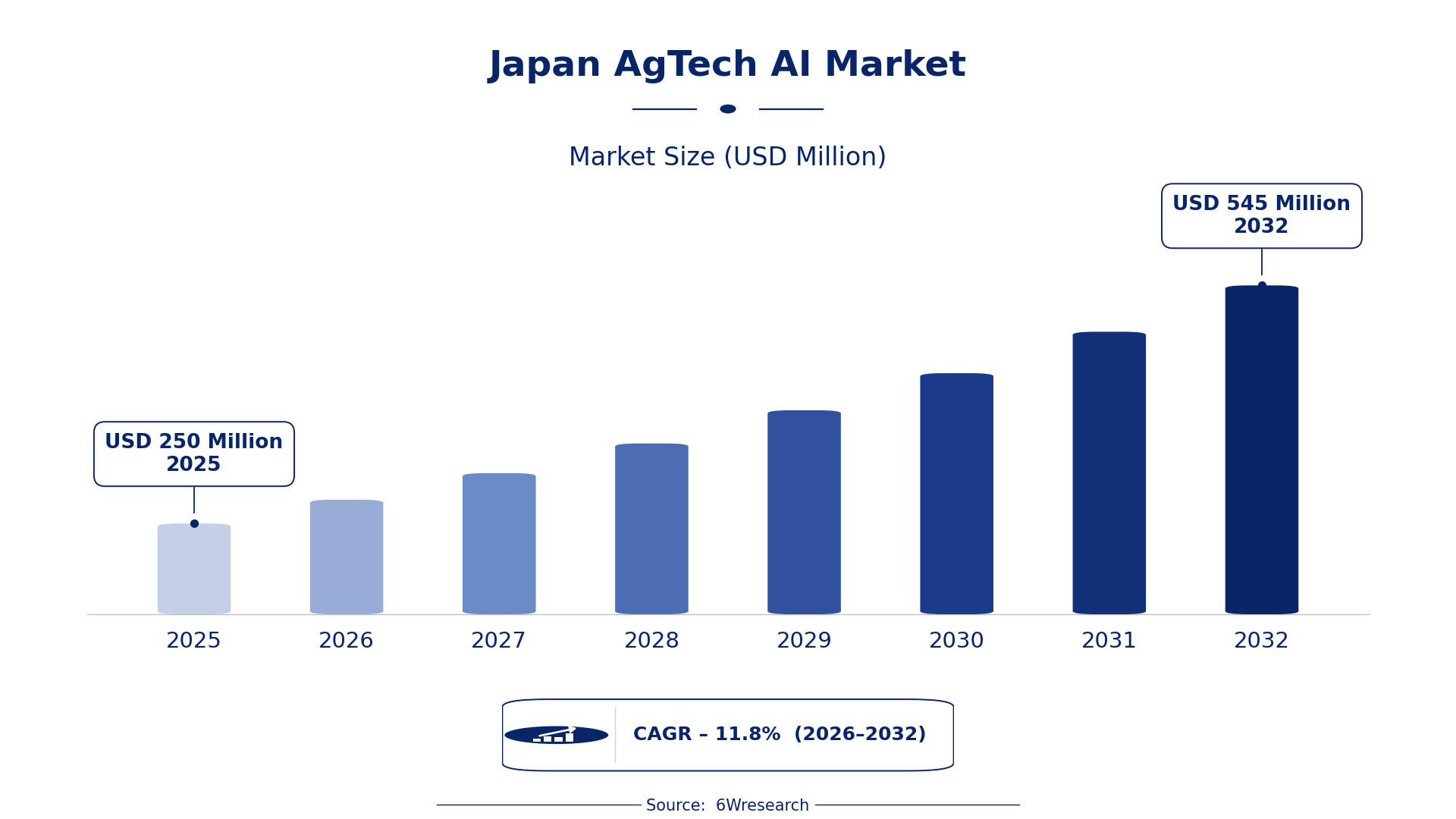
According to 6Wresearch internal database and industry insights, the Japan AgTech AI Market was valued at USD 250 Million in 2025 and is projected to reach USD 545 Million by 2032, growing at a CAGR of approximately 11.8% during 2026–2032.
Japan AgTech AI Market Highlights
| Report Metric | Details |
| Report Name | Japan AgTech AI Market (2026-2032) |
| Market Size 2025 | USD 250 Million |
| Market Size 2032 | USD 545 Million |
| Absolute Growth 2025–2032 | USD 295 Million |
| CAGR 2026–2032 | 11.8% |
| Peak Annual Growth | 12.1% in 2030 |
| Forecast Period | 2026–2032 |
| Historical Data | 2022–2025 |
| Base Year | 2025 |
| Leading Technology Type, 2025 | AI Forecasting Models (41% share) |
| Leading Application Area, 2025 | Yield Prediction (37% share) |
| Leading Distribution Channel, 2025 | SaaS Platforms (44% share) |
| Leading End User, 2025 | Agronomists (45% share) |
| Fastest-Growing Technology Type | ML-based Crop Monitors (17.0% CAGR) |
| Fastest-Growing Application Area | Disease Detection (13.8% CAGR) |
| Fastest-Growing Distribution Channel | Tech Distributors (15.1% CAGR) |
| Fastest-Growing End User | Precision Agriculture Firms (15.5% CAGR) |
| Growing Sector | Agriculture |
| Key End Users | Farmers, Agronomists, Precision Agriculture Firms |
Japan AgTech AI Market Year-wise Growth Rate and Key Drivers (2022–2032)
This graph illustrates the annual growth rates of the market from 2022 to 2032, highlighting a steady upward trajectory and projected market expansion over the forecast period.
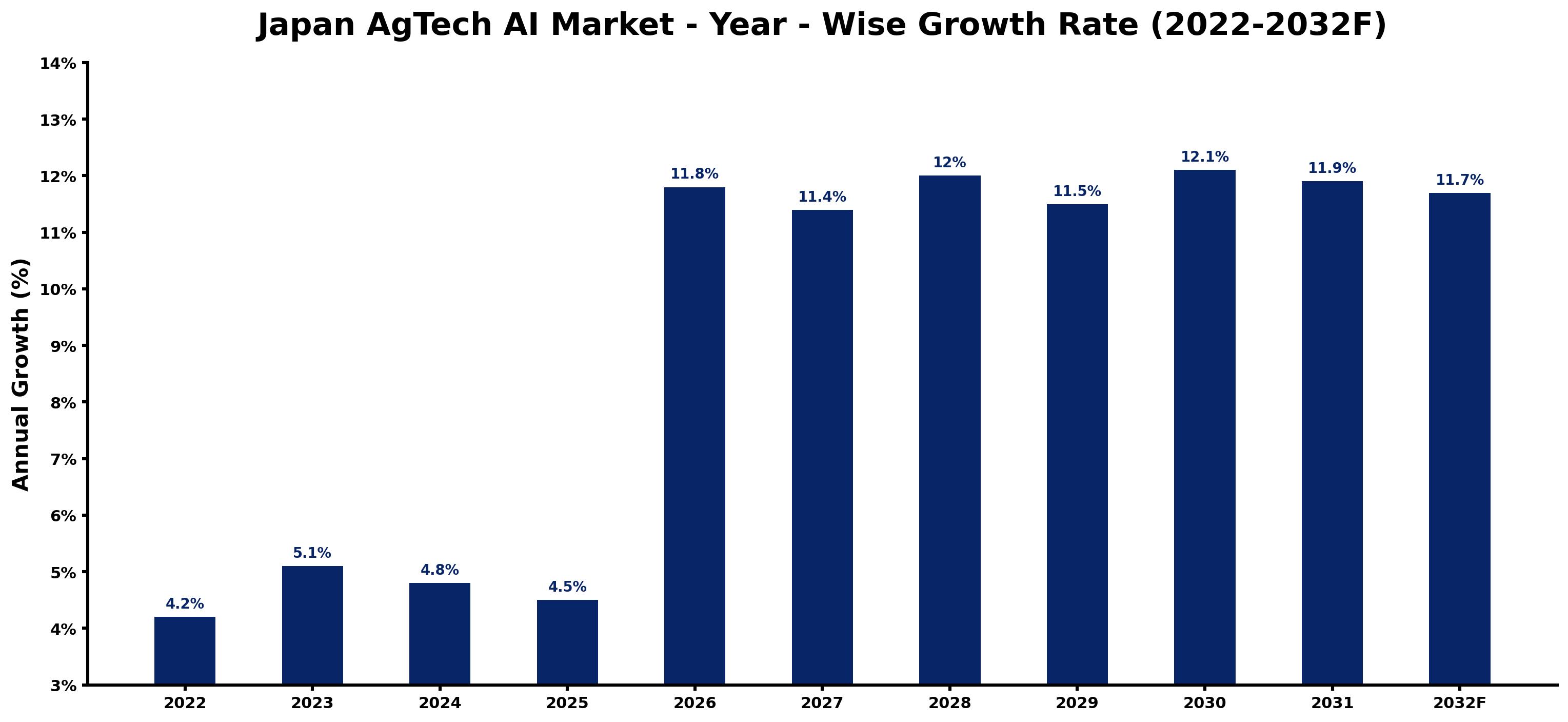
Year by year, the estimates below pair each growth rate with the development that shaped it.
| Year | Estimated Annual Growth (%) | Market Rationale |
| 2022 | 4.2 | The agricultural sector showed steady growth, reflecting ongoing investments in technology. |
| 2023 | 5.1 | The market experienced a boost from increased adoption of precision agriculture technologies. |
| 2024 | 4.8 | Growth slowed as farmers adjusted to new technologies and practices in the field. |
| 2025 | 4.5 | Market expansion continued to decelerate as early adopters saturated the market. |
| 2026 | 11.8 | Demand surged as AI applications became more integrated into farming operations. |
| 2027 | 11.4 | Growth moderated as the market stabilised after rapid technological advancements. |
| 2028 | 12.0 | The market rebounded with renewed interest in precision agriculture solutions. |
| 2029 | 11.5 | Growth is expected to slow slightly as competition intensifies among technology providers. |
| 2030 | 12.1 | The market is projected to peak as AI technologies reach widespread adoption in agriculture. |
| 2031 | 11.9 | Growth will decelerate as the market begins to mature and consolidate. |
| 2032 | 11.7 | Demand is expected to continue rising, albeit at a slower pace as technology becomes standard. |
Note: Market size estimations and growth projections presented in this report are based on 6Wresearch's proprietary forecasting methodology, utilizing the latest available industry data, government publications, and primary research inputs.
Japan AgTech AI Market Synopsis
AgTech AI integrates artificial intelligence technologies into agriculture, focusing on productivity and efficiency through machine learning and data analytics. The agricultural sector in Japan, valued at approximately ¥8 trillion, increasingly adopts precision agriculture technologies, with over 30% of farmers implementing these solutions. The Smart Agriculture Promotion Project aims to improve productivity with AI by 2025, driving demand for advanced agricultural technologies. The rise of agritech startups, now exceeding 200, further supports market growth as they seek to innovate and provide solutions to farmers.
Market Dynamics Impact Analysis (2026–2032)
| Factor | Type | Impact | Primary Segment Affected |
| Growing adoption of precision agriculture technologies | Driver | High | Yield Prediction |
| Increased investment in agricultural innovation | Driver | High | ML-based Crop Monitors |
| Rising demand for data-driven farming solutions | Opportunity | High | Data Intelligence Tools |
| Expansion of agritech startups | Opportunity | Medium | Agri Analytics Startups |
| High initial investment costs for technology implementation | Restraint | High | Vision-based Systems |
| Limited access to advanced technology in rural areas | Restraint | Medium | Soil Quality Analysis |
| Regulatory compliance for new technologies | Challenge | High | SaaS Platforms |
| Need for skilled workforce to operate AI systems | Challenge | Medium | Tech Distributors |
Evaluation of Drivers in Japan AgTech AI Market (2026–2032)
The following drivers explain most of the expected growth.
| Drivers | Primary Segment Affected | Why It Matters (Evidence) |
| Increased adoption of precision farming techniques | Yield Prediction | Over 30% of Japanese farmers are adopting precision agriculture technologies, leading to higher demand for yield prediction tools. |
| Growing investment in agricultural innovation | ML-based Crop Monitors | Japan allocated ¥10 billion for agricultural innovation projects in 2023, boosting demand for monitoring solutions. |
| Rising need for data-driven decision-making | Data Intelligence Tools | With Japan's agricultural sector valued at approximately ¥8 trillion, farmers seek data intelligence tools to optimise operations. |
| Expansion of agritech startups | Agri Analytics Startups | The number of agritech startups in Japan has surpassed 200, indicating a growing market for innovative solutions. |
| Government initiatives promoting smart farming | Vision-based Systems | The Smart Agriculture Promotion Project aims to enhance productivity with AI by 2025, increasing demand for vision-based technologies. |
What keeps demand rising is the increasing adoption of precision farming techniques, with over 30% of farmers implementing these technologies to improve productivity. In 2023, Japan allocated ¥10 billion for agricultural innovation projects, boosting demand for monitoring solutions. The agricultural sector, valued at approximately ¥8 trillion, seeks data intelligence tools to optimise operations. The growth of agritech startups, now exceeding 200, reflects the rising need for practical agricultural solutions.
Evaluation of Restraints in Japan AgTech AI Market
Several factors work against faster growth; the main ones are summarised below.
| Market Restraint | Primary Segment Affected | Why It Matters (Evidence) |
| High initial investment costs for technology implementation | Vision-based Systems | Many farmers face substantial upfront costs, limiting their ability to adopt advanced technologies, with initial investments averaging ¥5 million per farm. |
| Limited access to advanced technology in rural areas | Soil Quality Analysis | Farmers in remote regions struggle to access the latest technologies, hindering their productivity and resulting in lower yields. |
| Regulatory compliance for new technologies | SaaS Platforms | Producers must navigate complex regulations, which can delay technology deployment and increase costs, with approval times extending up to six months. |
| Need for skilled workforce to operate AI systems | Tech Distributors | The shortage of skilled workers in agriculture limits the effective use of AI technologies, impacting operational efficiency for producers. |
| Resistance to change among traditional farmers | ML-based Crop Monitors | Some farmers are hesitant to adopt new technologies, preferring established methods, which slows overall market growth. |
Japan AgTech AI Market Challenges
Producers struggle with a skills gap as 1.3 million agricultural workers lack training in AI technologies, which hampers productivity and raises operational costs. Buyers face high expenses since over 30% of farmers still depend on traditional methods, resulting in lower crop yields and diminished profitability. Regulatory hurdles arise from compliance with JIS Z 8401 standards, prolonging the approval process for new technologies and delaying market entry for suppliers. Competition intensifies with over 200 agritech startups, compelling established producers to innovate rapidly, risking market share if they do not adapt.
Trends in the Japan AgTech AI Market
The shifts below are changing how Japan AgTech AI Market products are bought and supplied.
- Shift towards AI-driven Precision Agriculture: The Smart Agriculture Promotion Project is driving a shift towards AI-driven precision agriculture in Japan, with over 30% of farmers adopting these technologies. This trend is expected to improve productivity and efficiency in the sector.
- Transition from Traditional to Smart Farming: A shift is occurring in Tokyo as traditional farming methods give way to smart farming solutions, with the number of smart farms projected to reach 5,000 by 2025. This change reflects the growing demand for technology integration in agriculture.
- Emergence of Data Intelligence Tools: The year 2023 marked the emergence of data intelligence tools in Japan's agriculture sector, with over 200 agritech startups developing practical solutions. This trend is reshaping decision-making processes among farmers, enhancing their operational capabilities.
- Prioritisation of Disease Detection Technologies: The focus on disease detection technologies has intensified, with the fastest-growing sub-segment, disease detection, projected to grow at 13.8% CAGR. This prioritisation is essential for mitigating crop losses and ensuring food security.
Investment Opportunities in the Japan AgTech AI Market
Investors looking at the Japan AgTech AI Market should consider the following areas.
- Agronomists seeking advanced AI tools: Agronomists in Japan need advanced AI tools to optimise crop management, with the market for such solutions expected to grow significantly. The increasing focus on precision agriculture supports this demand, with a projected market value increase of 20% by 2025.
- Supply of AI-driven Crop Monitoring Solutions: The demand for AI-driven crop monitoring solutions is rising, particularly among precision agriculture firms. Investing in ML-based crop monitors presents a strong opportunity as demand increases, with a projected market growth of 15% annually.
- Timing for Smart Farming Technologies: Now is the ideal time to invest in smart farming technologies, as Japan aims to increase AI usage in agriculture by 40% by 2030. This presents a strong opportunity for technology providers to enter the market.
- Expansion of Smart Farms in Hokkaido: Hokkaido is becoming a hub for smart farming, with the number of smart farms projected to reach 5,000 by 2025. Suppliers can enter this market by partnering with local farmers to provide advanced solutions.
Government Initiatives in the Japan AgTech AI Market
The Waste Management and Public Cleansing Act, enacted in 1970, regulates waste treatment in agriculture, ensuring environmentally friendly practices. This law has paved the way for subsequent measures promoting sustainable agricultural practices, including the AI Promotion Act of 2025, which establishes a framework for the development and use of AI technologies in agriculture, directly benefiting farmers by facilitating technology integration and adoption.
The Digital Agency, established in September 2021, leads the government's digital transformation efforts. It approves funding for agricultural innovation projects, including those that integrate AI technologies, thereby supporting farmers in adopting advanced solutions. The agency's initiatives are vital for increasing the adoption of smart farming technologies across the sector.
Future Insight of the Japan AgTech AI Market
By 2032, the number of smart farms will increase to 5,000, driven by initiatives like the Smart Agriculture Promotion Project. Suppliers will respond to heightened interest in AI technologies as the government aims for a 40% rise in AI usage by 2030. A ¥10 billion allocation for agricultural innovation projects will facilitate the adoption of advanced technologies. The focus on food security will spur collaboration between agricultural cooperatives and technology developers, improving efficiency across the sector.
Market Segmentation Analysis
Japan AgTech AI Market report covers a detailed analysis of the following market segments:
By Technology Type – AI Forecasting Models Lead, ML-based Crop Monitors Expected to Grow Fastest
According to Saurav Kr Singh, Senior Research Analyst at 6Wresearch, AI Forecasting Models took 41% of technology type revenue in 2025, more than any other category. AI Forecasting Models dominate the market due to their critical function in predicting crop yields, which is essential for effective farming strategies. For instance, these models enable farmers to plan their harvests based on historical weather data, ensuring optimal productivity and resource allocation. Over 2026–2032, ML-based Crop Monitors are expected to post the fastest growth, at a CAGR of 17.0%. ML-based Crop Monitors are experiencing rapid growth as farmers increasingly adopt advanced monitoring techniques to maintain crop health. The government's goal of establishing 5,000 smart farms by 2025 significantly contributes to this upward trend. Suppliers must enhance their forecasting capabilities to meet the rising demand from farmers seeking improved yield predictions.
By Application Area – Yield Prediction Leads, Disease Detection Expected to Grow Fastest
Yield Prediction held 37% of the Japan AgTech AI Market by application area in 2025. Yield Prediction holds the largest share as it is vital for farmers to accurately estimate potential harvests, allowing for better planning and resource allocation. This application is particularly crucial in Japan, where food security remains a top priority for the agricultural sector. Disease Detection is set to record the highest CAGR in this split, 13.8% over 2026–2032. Disease Detection is expanding swiftly due to its essential role in the early identification of plant diseases, which helps mitigate substantial crop losses. The adoption of precision agriculture technologies by over 30% of Japanese farmers underscores the importance of this application. Buyers should invest in disease detection technologies to safeguard their crops and maximise overall yield.
By Distribution Channel – SaaS Platforms Lead, Tech Distributors Expected to Grow Fastest
With 44% of distribution channel revenue in 2025, SaaS Platforms was the largest category. SaaS Platforms lead the market by providing subscription-based software solutions that streamline agricultural management for users. This model effectively addresses the needs of agronomists and farmers who seek efficient management tools to enhance productivity. The quickest growth will come from Tech Distributors, forecast to expand at a CAGR of 15.1% between 2026 and 2032. Tech Distributors are the fastest-growing channel as they play a crucial role in delivering AgTech solutions to end-users. The rise of agritech startups, now exceeding 200, highlights the increasing demand for effective distribution methods in the market. Suppliers should strengthen partnerships with tech distributors to expand their market reach and improve accessibility.
By End User – Agronomists Lead, Precision Agriculture Firms Expected to Grow Fastest
In 2025, Agronomists led the end user split with a 45% share. Agronomists represent the largest user group as they leverage advanced tools for both research and practical applications in agriculture, making them key drivers of technology adoption. Their expertise ensures the effective integration of these solutions into farming practices, thereby enhancing productivity. Precision Agriculture Firms are projected to grow fastest, at a CAGR of 15.5% during 2026–2032. Precision Agriculture Firms are rapidly growing as they utilise advanced technologies to improve farming precision and operational efficiency. The government's initiative to increase AI usage by 40% by 2030 will further accelerate this segment's expansion. Suppliers should tailor their offerings to meet the specific needs of precision agriculture firms to capture this growing market.
Key Attractiveness of the Report
- 10 Years of Market Numbers
- Historical Data Starting from 2022 to 2025
- Base Year 2025
- Forecast Data until 2032
- Key Performance Indicators Impacting the Market
- Major Upcoming Developments and Projects
Key Highlights of the Report:
- Japan AgTech AI Market Outlook
- Market Size of Japan AgTech AI Market, 2025
- Forecast of Japan AgTech AI Market, 2032
- Historical Data and Forecast of Japan AgTech AI Revenues & Volume for the Period 2022-2032F
- Japan AgTech AI Market Trend Evolution
- Japan AgTech AI Market Drivers and Challenges
- Japan AgTech AI Price Trends
- Japan AgTech AI Porter's Five Forces
- Japan AgTech AI Industry Life Cycle
- Historical Data and Forecast of Japan AgTech AI Market Revenues & Volume By Technology Type for the Period 2022-2032F
- Historical Data and Forecast of Japan AgTech AI Market Revenues & Volume By AI Forecasting Models for the Period 2022-2032F
- Historical Data and Forecast of Japan AgTech AI Market Revenues & Volume By ML-based Crop Monitors for the Period 2022-2032F
- Historical Data and Forecast of Japan AgTech AI Market Revenues & Volume By Vision-based Systems for the Period 2022-2032F
- Historical Data and Forecast of Japan AgTech AI Market Revenues & Volume By Data Intelligence Tools for the Period 2022-2032F
- Historical Data and Forecast of Japan AgTech AI Market Revenues & Volume By Application Area for the Period 2022-2032F
- Historical Data and Forecast of Japan AgTech AI Market Revenues & Volume By Yield Prediction for the Period 2022-2032F
- Historical Data and Forecast of Japan AgTech AI Market Revenues & Volume By Disease Detection for the Period 2022-2032F
- Historical Data and Forecast of Japan AgTech AI Market Revenues & Volume By Weed Identification for the Period 2022-2032F
- Historical Data and Forecast of Japan AgTech AI Market Revenues & Volume By Soil Quality Analysis for the Period 2022-2032F
- Historical Data and Forecast of Japan AgTech AI Market Revenues & Volume By Distribution Channel for the Period 2022-2032F
- Historical Data and Forecast of Japan AgTech AI Market Revenues & Volume By SaaS Platforms for the Period 2022-2032F
- Historical Data and Forecast of Japan AgTech AI Market Revenues & Volume By Tech Distributors for the Period 2022-2032F
- Historical Data and Forecast of Japan AgTech AI Market Revenues & Volume By Online Marketplaces for the Period 2022-2032F
- Historical Data and Forecast of Japan AgTech AI Market Revenues & Volume By Direct Sales for the Period 2022-2032F
- Historical Data and Forecast of Japan AgTech AI Market Revenues & Volume By End User for the Period 2022-2032F
- Historical Data and Forecast of Japan AgTech AI Market Revenues & Volume By Agronomists for the Period 2022-2032F
- Historical Data and Forecast of Japan AgTech AI Market Revenues & Volume By Precision Agriculture Firms for the Period 2022-2032F
- Historical Data and Forecast of Japan AgTech AI Market Revenues & Volume By Smart Farming Enterprises for the Period 2022-2032F
- Historical Data and Forecast of Japan AgTech AI Market Revenues & Volume By Agri Analytics Startups for the Period 2022-2032F
- Japan AgTech AI Import Export Trade Statistics
- Market Opportunity Assessment By Technology Type
- Market Opportunity Assessment By Application Area
- Market Opportunity Assessment By Distribution Channel
- Market Opportunity Assessment By End User
- Japan AgTech AI Top Companies Market Share
- Japan AgTech AI Competitive Benchmarking By Technical and Operational Parameters
- Japan AgTech AI Company Profiles
- Japan AgTech AI Key Strategic Recommendations
Market Covered
Coverage by segment is as follows.
By Technology Type
- AI Forecasting Models
- ML-based Crop Monitors
- Vision-based Systems
- Data Intelligence Tools
By Application Area
- Yield Prediction
- Disease Detection
- Weed Identification
- Soil Quality Analysis
By Distribution Channel
- SaaS Platforms
- Tech Distributors
- Online Marketplaces
- Direct Sales
By End User
- Agronomists
- Precision Agriculture Firms
- Smart Farming Enterprises
- Agri Analytics Startups































