Japan AI-Based Personalization Engines Market Size & Growth Rate
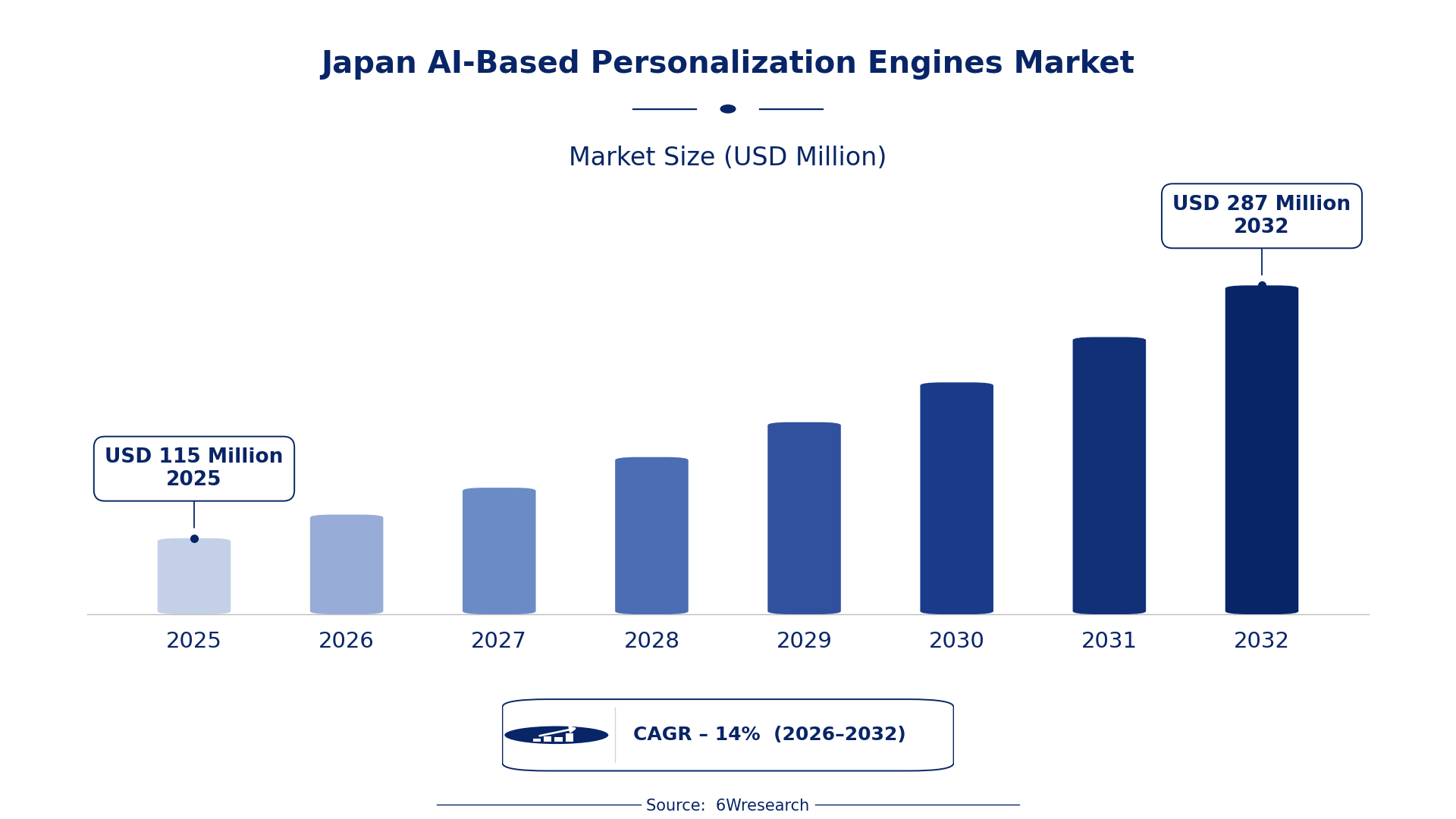
According to 6Wresearch internal database and industry insights, the Japan AI-Based Personalization Engines Market was valued at USD 115 Million in 2025 and is projected to reach USD 287 Million by 2032, growing at a CAGR of approximately 14% during 2026–2032.
Japan AI-Based Personalization Engines Market Highlights
| Report Metric | Details |
| Report Name | Japan AI-Based Personalization Engines Market (2026-2032) |
| Market Size 2025 | USD 115 Million |
| Market Size 2032 | USD 287 Million |
| Absolute Growth 2025–2032 | USD 172 Million |
| CAGR 2026–2032 | 14% |
| Peak Annual Growth | 16.3% in 2032 |
| Forecast Period | 2026–2032 |
| Historical Data | 2022–2025 |
| Base Year | 2025 |
| Leading Solution Type, 2025 | Recommendation Engines (53% share) |
| Leading AI Technology, 2025 | Machine Learning (46% share) |
| Leading Application Area, 2025 | Content Personalization (51% share) |
| Leading Distribution Channel, 2025 | SaaS Platforms (36% share) |
| Leading End User, 2025 | OTT Platforms (48% share) |
| Fastest-Growing Solution Type | Customer Analytics Tools (19.5% CAGR) |
| Fastest-Growing AI Technology | Predictive Analytics (16.6% CAGR) |
| Fastest-Growing Application Area | User Engagement (16.7% CAGR) |
| Fastest-Growing Distribution Channel | Direct Sales (18.3% CAGR) |
| Fastest-Growing End User | E-commerce Firms (18.7% CAGR) |
| Growing Sector | e-commerce |
| Key End Users | digital marketers, e-commerce firms, OTT platforms |
Japan AI-Based Personalization Engines Market Year-wise Growth Rate and Key Drivers (2022–2032)
This graph illustrates the annual growth rates of the market from 2022 to 2032, highlighting a steady upward trajectory and projected market expansion over the forecast period.
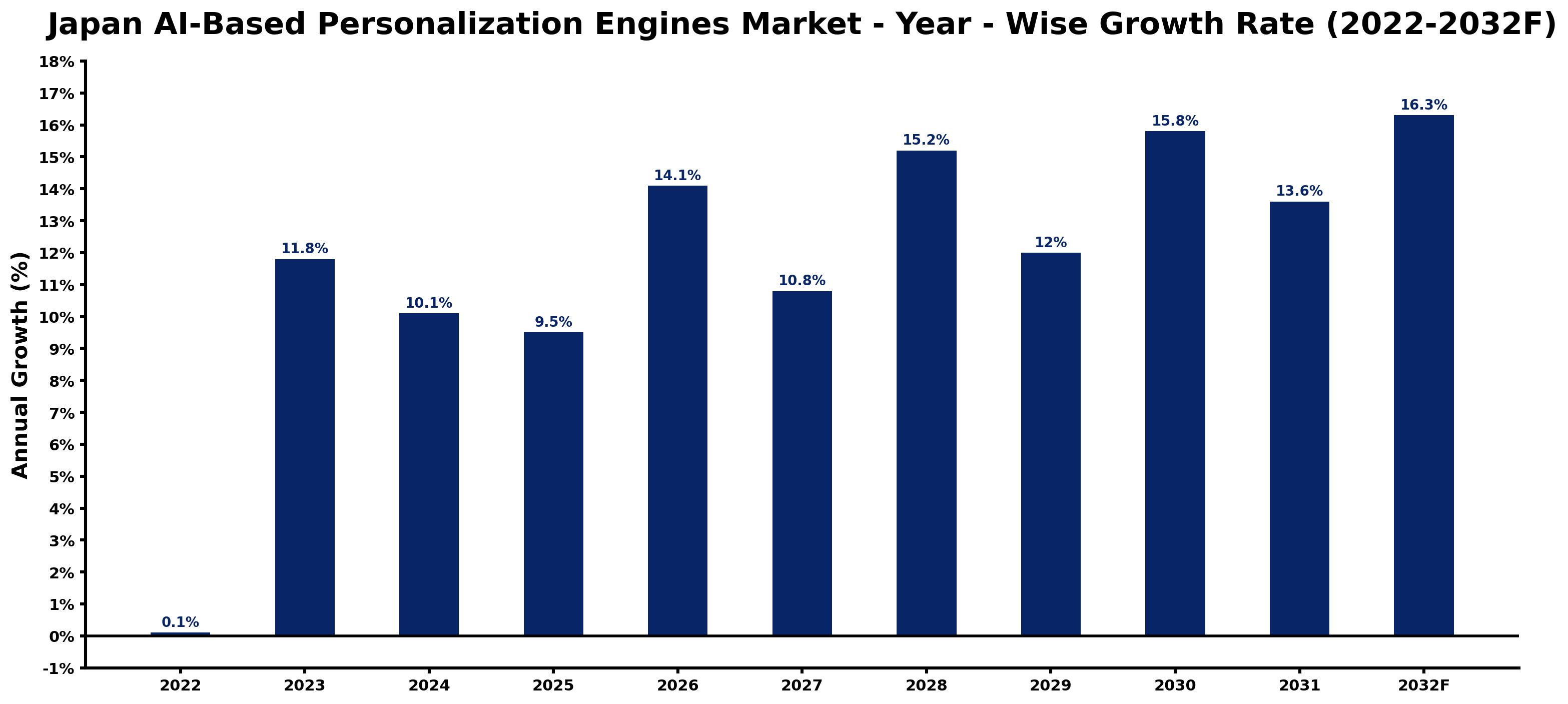
The following figures match every annual growth estimate with the main market development of that year, giving the reasoning behind each rise or slowdown.
| Year | Estimated Annual Growth (%) | Market Rationale |
| 2022 | 0.1 | The market showed minimal growth as adoption was still gaining traction. |
| 2023 | 11.8 | Growth accelerated due to increased interest from e-commerce firms and digital marketers. |
| 2024 | 10.1 | Growth slowed as market saturation began to affect new customer acquisition. |
| 2025 | 9.5 | Continued slowdown reflected a maturing market with fewer new entrants. |
| 2026 | 14.1 | Demand surged as AI capabilities expanded, attracting more users across sectors. |
| 2027 | 10.8 | A slowdown occurred as the market adjusted to the influx of new technologies. |
| 2028 | 15.2 | Growth rebounded with rising subscriptions in the OTT sector driving demand. |
| 2029 | 12.0 | The market experienced slower growth as competition intensified among providers. |
| 2030 | 15.8 | Growth is expected to accelerate again, supported by increasing cloud computing adoption. |
| 2031 | 13.6 | A slowdown is projected as market players focus on differentiation strategies. |
| 2032 | 16.3 | Growth is expected to peak as the demand for personalized experiences reaches new heights. |
Note: Market size estimations and growth projections presented in this report are based on 6Wresearch's proprietary forecasting methodology, utilizing the latest available industry data, government publications, and primary research inputs.
Japan AI-Based Personalization Engines Market Synopsis
AI-Based Personalization Engines are software solutions that tailor user experiences using algorithms and data analytics. They optimise customer engagement and marketing strategies, primarily serving sectors like e-commerce and digital marketing. The Japan AI-Based Personalization Engines Market is expanding due to the booming e-commerce sector, projected to reach ¥19 trillion by 2025, and the digital marketing industry's anticipated growth to ¥1.5 trillion. This demand is further driven by the increasing number of internet users, now over 100 million, along with government initiatives to promote AI adoption across various industries.
Market Dynamics Impact Analysis (2026–2032)
| Factor | Type | Impact | Primary Segment Affected |
| Increased demand for tailored user experiences drives the need for AI-Based Personalization Engines. | Driver | High | Recommendation Engines |
| The rapid growth of the e-commerce sector creates a significant market for personalization solutions. | Driver | High | Customer Analytics Tools |
| The rise of OTT platforms presents new opportunities for personalized content delivery. | Opportunity | High | Content Personalization |
| Growing digital marketing efforts among businesses necessitate advanced personalization tools. | Opportunity | Medium | Marketing Campaigns |
| Market saturation limits the potential for new customer acquisition in established sectors. | Restraint | High | Real-Time Personalization |
| The complexity of integrating AI solutions may deter smaller firms from adoption. | Restraint | Medium | Behavioral Engines |
| High competition among providers may lead to price wars, affecting margins. | Challenge | High | Machine Learning |
| Rapid technological advancements require constant updates, straining resources for companies. | Challenge | Medium | Predictive Analytics |
Evaluation of Drivers in Japan AI-Based Personalization Engines Market (2026–2032)
The table below links each growth driver to the segment it affects and the evidence for it.
| Drivers | Primary Segment Affected | Why It Matters (Evidence) |
| Growing e-commerce market size | Recommendation Engines | Japan's e-commerce market reached ¥19 trillion in 2022, increasing demand for personalized shopping experiences. |
| Expansion of digital marketing strategies | Customer Analytics Tools | The digital marketing industry is projected to grow to ¥1.5 trillion by 2025, driving demand for analytics tools. |
| Increased internet user base | Real-Time Personalization | With over 100 million internet users, the need for real-time personalization is critical for engagement. |
| Government initiatives promoting AI adoption | Behavioral Engines | The Ministry of Internal Affairs and Communications supports AI adoption, enhancing the market for personalization solutions. |
| Rising subscriptions in OTT platforms | Content Personalization | The OTT sector has seen a 20% growth in subscriptions, increasing the need for tailored content delivery. |
Behind the steady rise in orders sits the expansion of Japan's e-commerce market, which reached ¥19 trillion in 2022, driving demand for personalised shopping experiences. The digital marketing industry is projected to grow to ¥1.5 trillion by 2025, prompting businesses to adopt customer analytics tools. The number of internet users in Japan exceeds 100 million, creating a critical need for real-time personalisation to engage customers effectively.
Evaluation of Restraints in Japan AI-Based Personalization Engines Market
The table below lists the restraints and the evidence behind each.
| Market Restraint | Primary Segment Affected | Why It Matters (Evidence) |
| Market saturation limits new customer acquisition opportunities. | Real-Time Personalization | As established players dominate, new entrants struggle to gain market share, slowing growth. |
| Integration complexity may deter smaller firms from adopting AI solutions. | Behavioral Engines | Smaller firms often lack the resources to implement complex AI systems, hindering market expansion. |
| High competition may lead to price wars, affecting profitability. | Machine Learning | As many players enter the market, aggressive pricing strategies can erode margins for all providers. |
| Rapid technological advancements require constant updates and innovation. | Predictive Analytics | Companies must continually invest in new technologies to stay competitive, straining budgets. |
| Consumer privacy concerns may limit data usage for personalization. | Content Personalization | Strict regulations on data protection can restrict the effectiveness of personalization engines. |
Japan AI-Based Personalization Engines Market Challenges
E-commerce firms face high costs due to the lack of real-time personalisation, resulting in a 15% drop in conversion rates. Technology integration issues persist, as many companies struggle with AI implementation, delaying their competitive positioning by up to six months. Supply chain inefficiencies stem from outdated systems, leading to AI strategy deployments taking over 12 months. Regulatory hurdles, particularly adherence to the JIS Q 15001 standard, complicate operations and can incur additional costs for firms aiming to safeguard personal data.
Trends in the Japan AI-Based Personalization Engines Market
The shifts below are changing how Japan AI-Based Personalization Engines Market products are bought and supplied.
- Shift from Traditional Marketing to AI-Driven Personalization: In 2023, the trend towards AI-driven marketing strategies gained traction as digital marketers adopted personalisation tools more widely. This shift is evidenced by the digital marketing industry's projected growth to ¥1.5 trillion by 2025.
- Emergence of Real-Time Personalization: Since 2022, real-time personalisation has become a focal point for OTT platforms, improving user engagement. The sector has experienced a 20% increase in subscriptions, indicating strong demand for tailored content.
- Growth in Predictive Analytics Adoption: Predictive analytics tools are increasingly utilised by over 70% of major e-commerce firms in Japan, improving their ability to forecast user behaviour and tailor marketing strategies effectively.
- Rise of Cloud-Based Solutions for AI: With cloud computing adoption projected to reach 80% by 2025, businesses are increasingly turning to cloud-based AI solutions. This trend supports scalability and flexibility in deploying personalisation engines.
Investment Opportunities in the Japan AI-Based Personalization Engines Market
Investors looking at the Japan AI-Based Personalization Engines Market should consider the following areas.
- E-commerce Firms Seeking Personalization Solutions: E-commerce firms are increasingly looking for AI-based personalisation engines to improve user experience. With the e-commerce market projected to reach ¥19 trillion by 2025, suppliers have a clear opportunity to meet this demand.
- Growing Demand for Real-Time Personalization: The OTT sector's 20% growth in subscriptions highlights the need for real-time personalisation solutions. Suppliers can enter this market by forming partnerships with content providers.
- Investment in Predictive Analytics Tools: With over 70% of major e-commerce firms using predictive analytics, there is a clear opportunity for investment in these tools. Collaborating with digital marketing agencies can facilitate market entry.
- Cloud Providers Expanding AI Capabilities: As cloud computing adoption approaches 80% by 2025, cloud providers are expanding their AI capabilities. Establishing joint ventures with local firms can enhance market presence.
Government Initiatives in the Japan AI-Based Personalization Engines Market
The AI Promotion Act, set to be implemented in 2025, establishes a framework for AI research and development, impacting buyers by ensuring compliance with standards for AI solutions. This act aims to position Japan as a global leader in AI technology, promoting innovation and investment in the sector.
The AI and Data Strategy Council oversees the implementation of AI initiatives across industries, approving funding for projects that enhance AI capabilities. This includes support for SMEs to adopt AI technologies, fostering growth in sectors reliant on personalisation engines.
Future Insight of the Japan AI-Based Personalization Engines Market
Buyers in the digital marketing sector will increasingly adopt AI-based personalisation engines by 2032, driven by the projected growth of the digital marketing industry to ¥1.5 trillion. The government's initiative to boost AI capabilities in SMEs will facilitate the adoption of advanced technologies among smaller firms. Widespread cloud computing adoption, expected to reach 80% by 2025, will enhance access to these engines. As the travel sector recovers, AI-driven solutions will play a crucial role in improving customer experiences across various industries.
Market Segmentation Analysis
Japan AI-Based Personalization Engines Market report covers a detailed analysis of the following market segments:
By Solution Type – Recommendation Engines Lead, Customer Analytics Tools Expected to Grow Fastest
According to Vasu Joshi, Associate Consultant at 6Wresearch, Recommendation Engines accounted for 53% of the market by solution type in 2025. Recommendation Engines dominate the market as they are crucial for providing tailored suggestions, particularly in the e-commerce sector where user experience is vital. Their extensive application among major e-commerce firms showcases their importance in enhancing customer satisfaction. Customer Analytics Tools are set to record the highest CAGR in this split, 19.5% over 2026–2032. Customer Analytics Tools are rapidly growing due to their capacity to deliver essential insights into user data. The increasing number of digital marketers, estimated at 1.2 million, significantly drives the demand for these analytics solutions. Suppliers should enhance their analytics capabilities to meet the rising demand from businesses seeking deeper user insights.
By AI Technology – Machine Learning Leads, Predictive Analytics Expected to Grow Fastest
With 46% of ai technology revenue in 2025, Machine Learning was the largest category. Machine Learning leads the technology segment as it serves as the core foundation for solutions that analyse user behaviour and preferences. Its fundamental role is particularly evident in sectors like e-commerce, where it optimises customer interactions and engagement. Over 2026–2032, Predictive Analytics is expected to post the fastest growth, at a CAGR of 16.6%. Predictive Analytics is experiencing swift growth as it allows businesses to forecast user behaviour, which is essential for improving engagement strategies. The government's AI Strategy 2021 promotes the adoption of such technologies across various sectors, further fuelling this growth. Buyers should invest in predictive analytics to stay competitive and effectively anticipate customer needs.
By Application Area – Content Personalization Leads, User Engagement Expected to Grow Fastest
In 2025, Content Personalization led the application area split with a 51% share. Content Personalization is the leading application area as it is vital for delivering tailored content that resonates with users, especially in the OTT sector. The rise of OTT platforms, which have seen a 20% growth in subscriptions, highlights the importance of personalised content delivery. User Engagement is projected to grow fastest, at a CAGR of 16.7% during 2026–2032. User Engagement is the fastest-growing area as maintaining user interest becomes increasingly critical in a competitive market. The emphasis on enhancing engagement through tailored experiences aligns with trends in the digital marketing industry, projected to grow to ¥1.5 trillion by 2025. Suppliers must prioritise solutions that enhance user engagement to effectively capture the growing market.
By Distribution Channel – SaaS Platforms Lead, Direct Sales Expected to Grow Fastest
SaaS Platforms held 36% of the Japan AI-Based Personalization Engines Market by distribution channel in 2025. SaaS Platforms are the dominant distribution channel, offering a primary delivery model for software solutions that are easily accessible to users. This model aligns well with the increasing cloud computing adoption in Japan, projected to reach 80% by 2025, facilitating broader access. The quickest growth will come from Direct Sales, forecast to expand at a CAGR of 18.3% between 2026 and 2032. Direct Sales is witnessing the fastest growth as businesses seek more personalised interactions with software providers. This trend reflects a growing desire for tailored solutions that meet specific business needs, despite being less common. Suppliers should consider diversifying their distribution strategies to include direct sales approaches to better connect with potential clients.
By End User – OTT Platforms Lead, E-commerce Firms Expected to Grow Fastest
OTT Platforms took 48% of end user revenue in 2025, more than any other category. OTT Platforms hold the largest share among end users, benefiting from a substantial user base that demands personalised experiences. The increasing number of active OTT platforms in Japan, which has reached 30 in 2023, underscores the sector's reliance on personalisation for user retention. E-commerce Firms are set to record the highest CAGR in this split, 18.7% over 2026–2032. E-commerce Firms are the fastest-growing end user segment, leveraging personalisation engines to enhance customer experiences and drive sales. The e-commerce market in Japan reached ¥19 trillion in 2022, indicating robust demand for personalisation solutions. Suppliers should tailor their offerings to meet the specific needs of e-commerce firms to capitalise on this growth opportunity.
Key Attractiveness of the Report
- 10 Years of Market Numbers
- Historical Data Starting from 2022 to 2025
- Base Year 2025
- Forecast Data until 2032
- Key Performance Indicators Impacting the Market
- Major Upcoming Developments and Projects
Key Highlights of the Report:
- Japan AI-Based Personalization Engines Market Outlook
- Market Size of Japan AI-Based Personalization Engines Market, 2025
- Forecast of Japan AI-Based Personalization Engines Market, 2032
- Historical Data and Forecast of Japan AI-Based Personalization Engines Market Revenues & Volume for the Period 2022-2032F
- Japan AI-Based Personalization Engines Market Trend Evolution
- Japan AI-Based Personalization Engines Market Drivers and Challenges
- Japan AI-Based Personalization Engines Market Price Trends
- Japan AI-Based Personalization Engines Market Porter's Five Forces
- Japan AI-Based Personalization Engines Market Industry Life Cycle
- Historical Data and Forecast of Japan AI-Based Personalization Engines Market Revenues & Volume By Solution Type for the Period 2022-2032F
- Historical Data and Forecast of Japan AI-Based Personalization Engines Market Revenues & Volume By Recommendation Engines for the Period 2022-2032F
- Historical Data and Forecast of Japan AI-Based Personalization Engines Market Revenues & Volume By Customer Analytics Tools for the Period 2022-2032F
- Historical Data and Forecast of Japan AI-Based Personalization Engines Market Revenues & Volume By Real-Time Personalization for the Period 2022-2032F
- Historical Data and Forecast of Japan AI-Based Personalization Engines Market Revenues & Volume By Behavioral Engines for the Period 2022-2032F
- Historical Data and Forecast of Japan AI-Based Personalization Engines Market Revenues & Volume By AI Technology for the Period 2022-2032F
- Historical Data and Forecast of Japan AI-Based Personalization Engines Market Revenues & Volume By Machine Learning for the Period 2022-2032F
- Historical Data and Forecast of Japan AI-Based Personalization Engines Market Revenues & Volume By Predictive Analytics for the Period 2022-2032F
- Historical Data and Forecast of Japan AI-Based Personalization Engines Market Revenues & Volume By NLP & AI for the Period 2022-2032F
- Historical Data and Forecast of Japan AI-Based Personalization Engines Market Revenues & Volume By Deep Learning for the Period 2022-2032F
- Historical Data and Forecast of Japan AI-Based Personalization Engines Market Revenues & Volume By Application Area for the Period 2022-2032F
- Historical Data and Forecast of Japan AI-Based Personalization Engines Market Revenues & Volume By Content Personalization for the Period 2022-2032F
- Historical Data and Forecast of Japan AI-Based Personalization Engines Market Revenues & Volume By User Engagement for the Period 2022-2032F
- Historical Data and Forecast of Japan AI-Based Personalization Engines Market Revenues & Volume By Marketing Campaigns for the Period 2022-2032F
- Historical Data and Forecast of Japan AI-Based Personalization Engines Market Revenues & Volume By Ad Targeting for the Period 2022-2032F
- Historical Data and Forecast of Japan AI-Based Personalization Engines Market Revenues & Volume By Distribution Channel for the Period 2022-2032F
- Historical Data and Forecast of Japan AI-Based Personalization Engines Market Revenues & Volume By SaaS Platforms for the Period 2022-2032F
- Historical Data and Forecast of Japan AI-Based Personalization Engines Market Revenues & Volume By Direct Sales for the Period 2022-2032F
- Historical Data and Forecast of Japan AI-Based Personalization Engines Market Revenues & Volume By Cloud Providers for the Period 2022-2032F
- Historical Data and Forecast of Japan AI-Based Personalization Engines Market Revenues & Volume By API Integrations for the Period 2022-2032F
- Historical Data and Forecast of Japan AI-Based Personalization Engines Market Revenues & Volume By End User for the Period 2022-2032F
- Historical Data and Forecast of Japan AI-Based Personalization Engines Market Revenues & Volume By OTT Platforms for the Period 2022-2032F
- Historical Data and Forecast of Japan AI-Based Personalization Engines Market Revenues & Volume By E-commerce Firms for the Period 2022-2032F
- Historical Data and Forecast of Japan AI-Based Personalization Engines Market Revenues & Volume By Digital Marketers for the Period 2022-2032F
- Historical Data and Forecast of Japan AI-Based Personalization Engines Market Revenues & Volume By Media Companies for the Period 2022-2032F
- Japan AI-Based Personalization Engines Market Import Export Trade Statistics
- Market Opportunity Assessment By Solution Type
- Market Opportunity Assessment By AI Technology
- Market Opportunity Assessment By Application Area
- Market Opportunity Assessment By Distribution Channel
- Market Opportunity Assessment By End User
- Japan AI-Based Personalization Engines Market Top Companies Market Share
- Japan AI-Based Personalization Engines Market Competitive Benchmarking By Technical and Operational Parameters
- Japan AI-Based Personalization Engines Market Company Profiles
- Japan AI-Based Personalization Engines Market Key Strategic Recommendations
Market Covered
The report covers the following segments.
By Solution Type
- Recommendation Engines
- Customer Analytics Tools
- Real-Time Personalization
- Behavioral Engines
By AI Technology
- Machine Learning
- Predictive Analytics
- NLP & AI
- Deep Learning
By Application Area
- Content Personalization
- User Engagement
- Marketing Campaigns
- Ad Targeting
By Distribution Channel
- SaaS Platforms
- Direct Sales
- Cloud Providers
- API Integrations
By End User
- OTT Platforms
- E-commerce Firms
- Digital Marketers
- Media Companies































