Japan AI Development Platform Market Size & Growth Rate
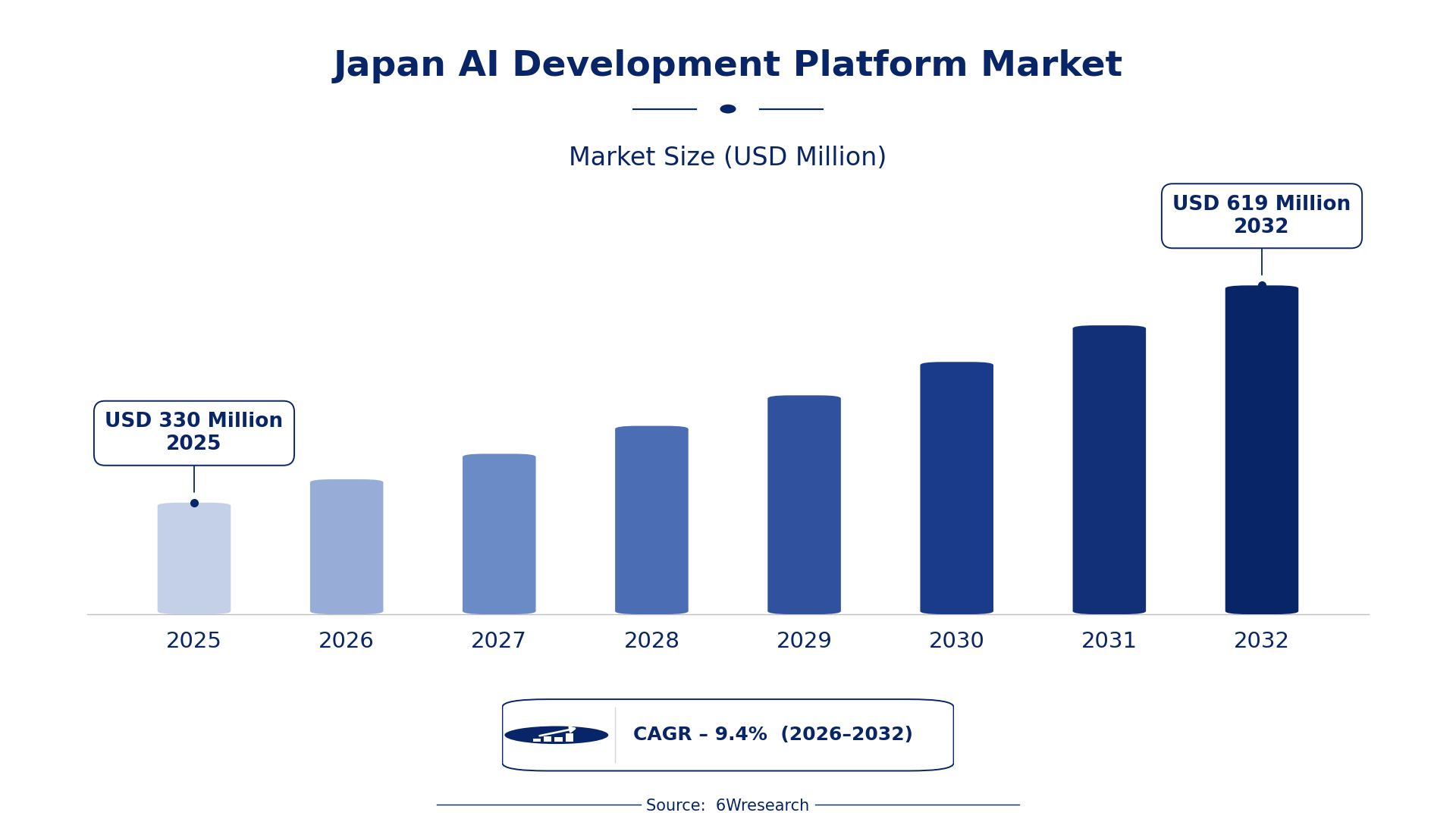
According to 6Wresearch internal database and industry insights, the Japan AI Development Platform Market was valued at USD 330 Million in 2025 and is projected to reach USD 619 Million by 2032, growing at a CAGR of approximately 9.4% during 2026–2032.
Japan AI Development Platform Market Highlights
| Report Metric | Details |
| Report Name | Japan AI Development Platform Market (2026-2032) |
| Market Size 2025 | USD 330 Million |
| Market Size 2032 | USD 619 Million |
| Absolute Growth 2025–2032 | USD 289 Million |
| CAGR 2026–2032 | 9.4% |
| Peak Annual Growth | 10.5% in 2032 |
| Forecast Period | 2026–2032 |
| Historical Data | 2022–2025 |
| Base Year | 2025 |
| Leading Platform Type, 2025 | Low-code AI Platforms (38% share) |
| Leading Development Focus, 2025 | Rapid Prototyping (50% share) |
| Leading Distribution Channel, 2025 | Cloud Subscriptions (37% share) |
| Leading End User, 2025 | Business Analysts (37% share) |
| Fastest-Growing Platform Type | Full-stack AI Tools (13.9% CAGR) |
| Fastest-Growing Development Focus | End-to-end Deployment (12.6% CAGR) |
| Fastest-Growing Distribution Channel | SaaS Portals (12.8% CAGR) |
| Fastest-Growing End User | Data Science Teams (12.9% CAGR) |
| Growing Sector | Healthcare |
| Key End Users | Business Analysts, Data Science Teams, AI Engineers, Healthcare Providers |
Japan AI Development Platform Market Year-wise Growth Rate and Key Drivers (2022–2032)
This graph illustrates the annual growth rates of the market from 2022 to 2032, highlighting a steady upward trajectory and projected market expansion over the forecast period.
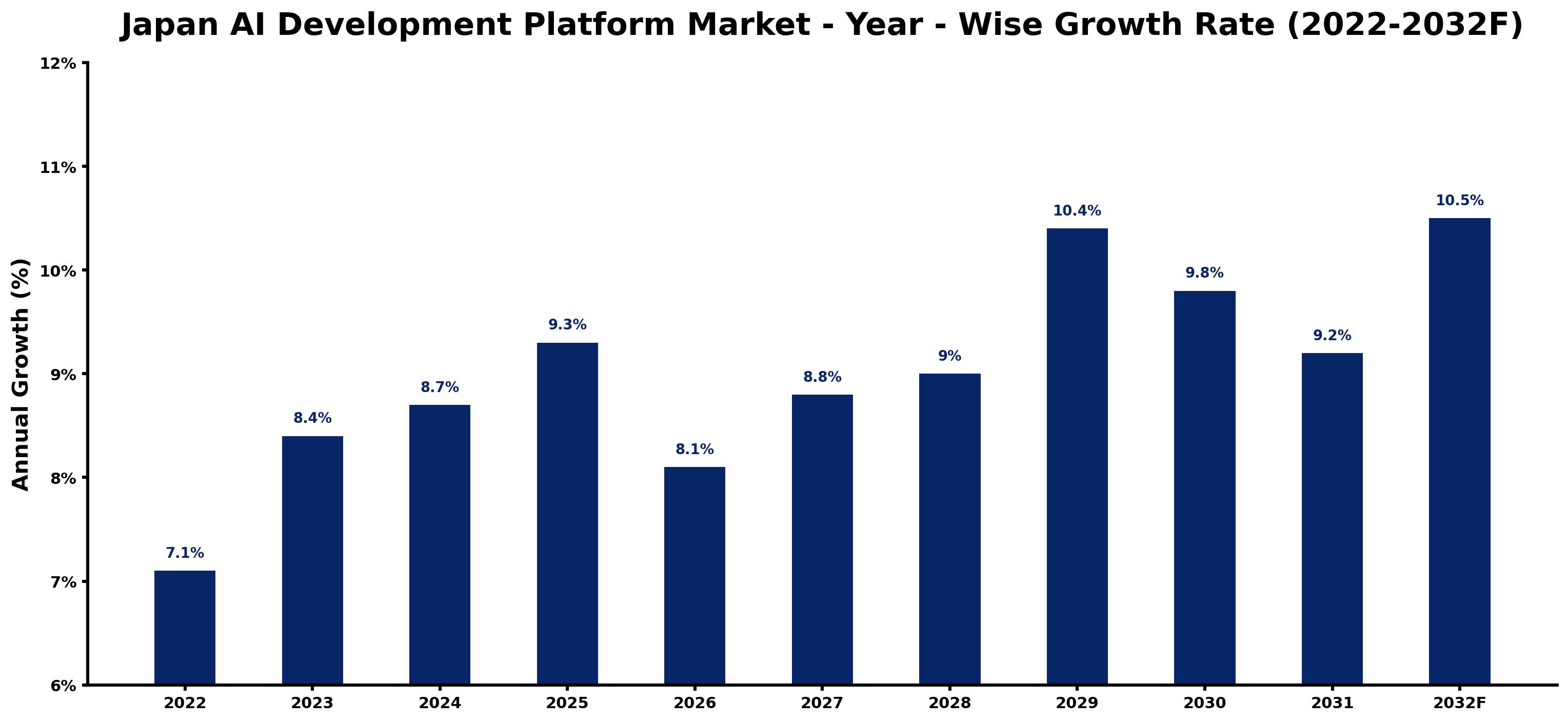
The yearly estimates that follow link every growth rate to its principal driver, so readers can see why the pace changed in each period.
| Year | Estimated Annual Growth (%) | Market Rationale |
| 2022 | 7.1 | The market experienced steady growth, driven by rising adoption of AI technologies. |
| 2023 | 8.4 | Growth accelerated as more businesses recognised the advantages of AI development platforms. |
| 2024 | 8.7 | Demand continued to rise with advancements in cloud computing and AI capabilities. |
| 2025 | 9.3 | The market peaked as the AI sector gained traction across various industries. |
| 2026 | 8.1 | Growth is expected to slow slightly as companies begin to consolidate their AI investments. |
| 2027 | 8.8 | A renewed interest in AI tools will boost growth as more sectors adopt these solutions. |
| 2028 | 9.0 | Demand is projected to increase further, reflecting the ongoing digital transformation in businesses. |
| 2029 | 10.4 | Growth is expected to surge as AI applications expand in the automotive sector, improving productivity. |
| 2030 | 9.8 | A slight slowdown is anticipated as the market matures and competition intensifies. |
| 2031 | 9.2 | Growth will continue but at a slower pace as buyers become more selective in investments. |
| 2032 | 10.5 | Demand is projected to surge again, driven by new AI initiatives and technologies emerging in the market. |
Note: Market size estimations and growth projections presented in this report are based on 6Wresearch's proprietary forecasting methodology, utilizing the latest available industry data, government publications, and primary research inputs.
Japan AI Development Platform Market Synopsis
AI Development Platforms are software solutions that facilitate the creation, deployment, and management of AI applications, primarily used for automating business processes and analysing data. The Japan AI Development Platform Market is growing rapidly, driven by a surge in AI startups surpassing 1,000 and an expanding workforce of over 50,000 AI engineers. The Japanese government's target to increase AI adoption in SMEs by 30% by 2025, coupled with the rise of cloud-based solutions, is propelling demand across various sectors.
Market Dynamics Impact Analysis (2026–2032)
| Factor | Type | Impact | Primary Segment Affected |
| Increasing investment in AI technologies | Driver | High | Full-stack AI Tools |
| Growing demand for cloud-based solutions | Driver | High | Cloud Subscriptions |
| Rising number of AI startups | Opportunity | Medium | Low-code AI Platforms |
| Expansion of AI applications in healthcare | Opportunity | Medium | End-to-end Deployment |
| Shortage of skilled AI professionals | Restraint | High | MLOps Platforms |
| High costs associated with AI implementation | Restraint | Medium | Visual AI Builders |
| Rapid technological advancements | Challenge | High | Full-stack AI Tools |
| Intense competition among AI providers | Challenge | Medium | Cloud Subscriptions |
Evaluation of Drivers in Japan AI Development Platform Market (2026–2032)
The table below links each growth driver to the segment it affects and the evidence for it.
| Drivers | Primary Segment Affected | Why It Matters (Evidence) |
| Increased investment in AI technologies | Full-stack AI Tools | The Japanese government allocated 10 billion yen for AI research funding in 2023, encouraging businesses to adopt advanced AI solutions. |
| Growing demand for cloud-based solutions | Cloud Subscriptions | Over 60% of the AI market share is attributed to cloud-based solutions, facilitating scalable access for users. |
| Expansion of AI applications in healthcare | End-to-end Deployment | AI integration in healthcare is projected to improve patient outcomes by 20%, driving demand for deployment solutions. |
| Rising number of AI startups | Low-code AI Platforms | With over 1,000 AI startups in Japan, there is a growing need for user-friendly development platforms. |
| Increasing workforce of AI engineers | MLOps Platforms | The estimated 50,000 AI engineers in Japan are driving demand for operational tools to manage machine learning models. |
Several shifts outside the market lift sales. The demand for user-friendly development platforms is rising as businesses seek low-code AI solutions. Integration of AI in healthcare is expected to improve patient outcomes by 20%, increasing demand for deployment solutions. The growing number of AI startups, exceeding 1,000, is also driving the need for innovative AI tools.
Evaluation of Restraints in Japan AI Development Platform Market
The main factors holding the market back are set out below.
| Market Restraint | Primary Segment Affected | Why It Matters (Evidence) |
| Shortage of skilled AI professionals | MLOps Platforms | The lack of qualified AI specialists limits the ability of companies to implement advanced AI solutions effectively, leading to project delays. |
| High costs associated with AI implementation | Visual AI Builders | The investment required for AI tools can deter smaller businesses from adopting these technologies, limiting market growth. |
| Intense competition among AI providers | Cloud Subscriptions | The crowded market makes it challenging for new entrants to gain a foothold and attract customers, affecting their viability. |
| Rapid technological advancements | Full-stack AI Tools | Keeping pace with fast-evolving AI technologies can strain resources and hinder development efforts, impacting project timelines. |
| Regulatory compliance requirements | End-to-end Deployment | Adhering to standards like ISO/IEC 27001 increases operational complexity and costs for developers, affecting pricing strategies. |
Japan AI Development Platform Market Challenges
Cloud-based AI solutions represent over 60% of the market share in Japan, leading to reliance on external providers that can delay project timelines for producers. Buyers face challenges in adopting AI technologies effectively, as many lack the necessary expertise, which could cost them potential efficiency gains of up to 30% by 2025. Competition intensifies with over 1,000 AI startups, making it challenging for established players to maintain their market position. Rising operational costs, linked to a projected 15% annual growth in the AI workforce, may erode margins for producers and result in higher prices for buyers.
Trends in the Japan AI Development Platform Market
These developments are changing demand patterns in the Japan AI Development Platform Market.
- Shift from Traditional to Cloud-based AI Solutions: Business Analysts are increasingly adopting cloud-based AI tools, with over 60% of the market share attributed to these solutions. This shift improves accessibility and scalability for users.
- Transition from Manual to Automated AI Development: Since 2023, the rise of low-code AI platforms has enabled users to create applications without extensive coding knowledge, streamlining the development process and attracting a broader user base.
- AI Integration in Healthcare Accelerating: Healthcare facilities are increasingly adopting AI technologies, aiming to improve patient outcomes. The demand for AI tools in this sector is projected to grow significantly, reflecting a growing trend.
- Emergence of AI Startups Driving Innovation: The number of AI startups in Japan exceeded 1,000 in 2023, driving innovation and competition in the AI development space, which is essential for market growth.
Investment Opportunities in the Japan AI Development Platform Market
The openings below show where demand in the Japan AI Development Platform Market is visible and how suppliers can enter.
- Gap in AI Development Skills: With an estimated 50,000 AI engineers, there exists a gap in skilled professionals. Investing in training programs can help bridge this gap, especially in Tokyo, which is a hub for AI development.
- Timing for AI Adoption in SMEs: The Japanese government's goal to increase AI adoption in SMEs by 30% by 2025 presents an opportunity for suppliers to provide tailored solutions to small and medium enterprises.
- Entry into the Healthcare Sector: The integration of AI in healthcare is expected to boost productivity by 20%. Suppliers can partner with healthcare facilities to offer AI development platforms tailored to their needs.
- Focus on Cloud-based Solutions: With over 60% of the market share in cloud-based AI solutions, there is a clear opportunity for investment in scalable AI platforms for various sectors.
Government Initiatives in the Japan AI Development Platform Market
The AI Promotion Act, enacted in 2025, establishes a national framework for AI research and development, ensuring that producers comply with standards that improve the safety and effectiveness of AI technologies. This act aims to streamline the regulatory environment for AI developers, making it easier for them to innovate and bring solutions to market.
In 2023, the Japanese government allocated 10 billion yen for AI research funding, administered by the Ministry of Economy, Trade and Industry (METI). This funding supports projects that enhance AI capabilities across various sectors, encouraging collaboration between public and private entities.
Future Insight of the Japan AI Development Platform Market
Investment in AI development is on the rise, with the Japanese government aiming for a 30% increase in AI adoption among SMEs by 2025, generating substantial demand for platforms. By 2032, the integration of AI in healthcare will improve patient outcomes, benefiting both buyers and suppliers. The Ministry of Economy, Trade and Industry's AI strategy will drive further advancements in the sector, creating new opportunities for platform providers. Enhanced collaboration among over 200 tech incubators will ensure a continuous supply of advanced AI solutions.
Market Segmentation Analysis
Japan AI Development Platform Market report covers a detailed analysis of the following market segments:
By Platform Type – Low-code AI Platforms Lead, Full-stack AI Tools Expected to Grow Fastest
According to Saurav Kr Singh, Senior Research Analyst at 6Wresearch, Low-code AI Platforms held 38% of the Japan AI Development Platform Market by platform type in 2025. Low-code AI Platforms dominate the market as they allow users to create applications without needing extensive coding knowledge, making them highly accessible. This is particularly advantageous in sectors like finance, where rapid application development is essential for maintaining competitiveness. Full-stack AI Tools are projected to grow fastest, at a CAGR of 13.9% during 2026–2032. Full-stack AI Tools are experiencing rapid growth due to their ability to provide comprehensive solutions that streamline the entire application lifecycle, appealing to organisations focused on efficiency. As projects become more complex, the demand for these all-in-one tools will likely continue to increase, further widening the lead of low-code platforms. Suppliers should enhance the capabilities of full-stack tools to meet the growing demand from businesses seeking comprehensive solutions.
By Development Focus – Rapid Prototyping Leads, End-to-end Deployment Expected to Grow Fastest
In 2025, Rapid Prototyping led the development focus split with a 50% share. Rapid Prototyping holds the largest share as it enables organisations to quickly validate concepts, which is crucial in Japan's fast-paced tech environment. This approach is particularly favoured in industries such as automotive, where quick iterations are essential for driving innovation. The quickest growth will come from End-to-end Deployment, forecast to expand at a CAGR of 12.6% between 2026 and 2032. End-to-end Deployment is the fastest-growing segment as it meets the need for seamless transitions from development to production, a priority for many companies. The increasing demand for integrated solutions in sectors like healthcare is propelling this growth, indicating a trend towards comprehensive development processes. Buyers will benefit from solutions that streamline the entire development process, ensuring faster time-to-market for applications.
By Distribution Channel – Cloud Subscriptions Lead, SaaS Portals Expected to Grow Fastest
With 37% of distribution channel revenue in 2025, Cloud Subscriptions was the largest category. Cloud Subscriptions lead the market by providing scalable access to tools, which is vital for businesses looking to reduce infrastructure costs. This model is particularly beneficial for SMEs, allowing them to leverage advanced technologies without incurring heavy upfront investments. Over 2026–2032, SaaS Portals are expected to post the fastest growth, at a CAGR of 12.8%. SaaS Portals are rapidly expanding as they offer flexibility and ease of access, catering to the rising demand for on-demand solutions. The increasing trend towards remote work and distributed teams is accelerating this shift towards SaaS models, indicating a long-term change in distribution preferences. Suppliers should enhance their SaaS offerings to capture the growing preference for flexible, cloud-based solutions among users.
By End User – Business Analysts Lead, Data Science Teams Expected to Grow Fastest
Business Analysts took 37% of end user revenue in 2025, more than any other category. Business Analysts constitute the largest user group as they employ tools for data analysis and informed decision-making, which is critical across various sectors. Their role in interpreting data insights makes them pivotal in driving adoption throughout organisations. Data Science Teams are set to record the highest CAGR in this split, 12.9% over 2026–2032. Data Science Teams represent the fastest-growing segment, relying heavily on platforms for model development and advanced analytics. As organisations increasingly recognise the value of data-driven insights, the demand for skilled data science professionals continues to rise, further driving this segment's growth. Suppliers should tailor their products to meet the specific needs of data science teams, ensuring they have the tools necessary for advanced model development.
Key Attractiveness of the Report
- 10 Years of Market Numbers
- Historical Data Starting from 2022 to 2025
- Base Year 2025
- Forecast Data until 2032
- Key Performance Indicators Impacting the Market
- Major Upcoming Developments and Projects
Key Highlights of the Report:
- Japan AI Development Platform Market Outlook
- Market Size of Japan AI Development Platform Market, 2025
- Forecast of Japan AI Development Platform Market, 2032
- Historical Data and Forecast of Japan AI Development Platform Revenues & Volume for the Period 2022-2032F
- Japan AI Development Platform Market Trend Evolution
- Japan AI Development Platform Market Drivers and Challenges
- Japan AI Development Platform Price Trends
- Japan AI Development Platform Porter's Five Forces
- Japan AI Development Platform Industry Life Cycle
- Historical Data and Forecast of Japan AI Development Platform Market Revenues & Volume By Platform Type for the Period 2022-2032F
- Historical Data and Forecast of Japan AI Development Platform Market Revenues & Volume By Low-code AI Platforms for the Period 2022-2032F
- Historical Data and Forecast of Japan AI Development Platform Market Revenues & Volume By Full-stack AI Tools for the Period 2022-2032F
- Historical Data and Forecast of Japan AI Development Platform Market Revenues & Volume By MLOps Platforms for the Period 2022-2032F
- Historical Data and Forecast of Japan AI Development Platform Market Revenues & Volume By Visual AI Builders for the Period 2022-2032F
- Historical Data and Forecast of Japan AI Development Platform Market Revenues & Volume By Development Focus for the Period 2022-2032F
- Historical Data and Forecast of Japan AI Development Platform Market Revenues & Volume By Rapid Prototyping for the Period 2022-2032F
- Historical Data and Forecast of Japan AI Development Platform Market Revenues & Volume By End-to-end Deployment for the Period 2022-2032F
- Historical Data and Forecast of Japan AI Development Platform Market Revenues & Volume By Pipeline Management for the Period 2022-2032F
- Historical Data and Forecast of Japan AI Development Platform Market Revenues & Volume By Drag & Drop Models for the Period 2022-2032F
- Historical Data and Forecast of Japan AI Development Platform Market Revenues & Volume By Distribution Channel for the Period 2022-2032F
- Historical Data and Forecast of Japan AI Development Platform Market Revenues & Volume By Cloud Subscriptions for the Period 2022-2032F
- Historical Data and Forecast of Japan AI Development Platform Market Revenues & Volume By SaaS Portals for the Period 2022-2032F
- Historical Data and Forecast of Japan AI Development Platform Market Revenues & Volume By Tech Distributors for the Period 2022-2032F
- Historical Data and Forecast of Japan AI Development Platform Market Revenues & Volume By Online Marketplaces for the Period 2022-2032F
- Historical Data and Forecast of Japan AI Development Platform Market Revenues & Volume By End User for the Period 2022-2032F
- Historical Data and Forecast of Japan AI Development Platform Market Revenues & Volume By Business Analysts for the Period 2022-2032F
- Historical Data and Forecast of Japan AI Development Platform Market Revenues & Volume By Data Science Teams for the Period 2022-2032F
- Historical Data and Forecast of Japan AI Development Platform Market Revenues & Volume By AI Engineers for the Period 2022-2032F
- Historical Data and Forecast of Japan AI Development Platform Market Revenues & Volume By Citizen Developers for the Period 2022-2032F
- Japan AI Development Platform Import Export Trade Statistics
- Market Opportunity Assessment By Platform Type
- Market Opportunity Assessment By Development Focus
- Market Opportunity Assessment By Distribution Channel
- Market Opportunity Assessment By End User
- Japan AI Development Platform Top Companies Market Share
- Japan AI Development Platform Competitive Benchmarking By Technical and Operational Parameters
- Japan AI Development Platform Company Profiles
- Japan AI Development Platform Key Strategic Recommendations
Market Covered
Coverage by segment is as follows.
By Platform Type
- Low-code AI Platforms
- Full-stack AI Tools
- MLOps Platforms
- Visual AI Builders
By Development Focus
- Rapid Prototyping
- End-to-end Deployment
- Pipeline Management
- Drag & Drop Models
By Distribution Channel
- Cloud Subscriptions
- SaaS Portals
- Tech Distributors
- Online Marketplaces
By End User
- Business Analysts
- Data Science Teams
- AI Engineers
- Citizen Developers































