Japan AI Hardware Platforms Market Size & Growth Rate
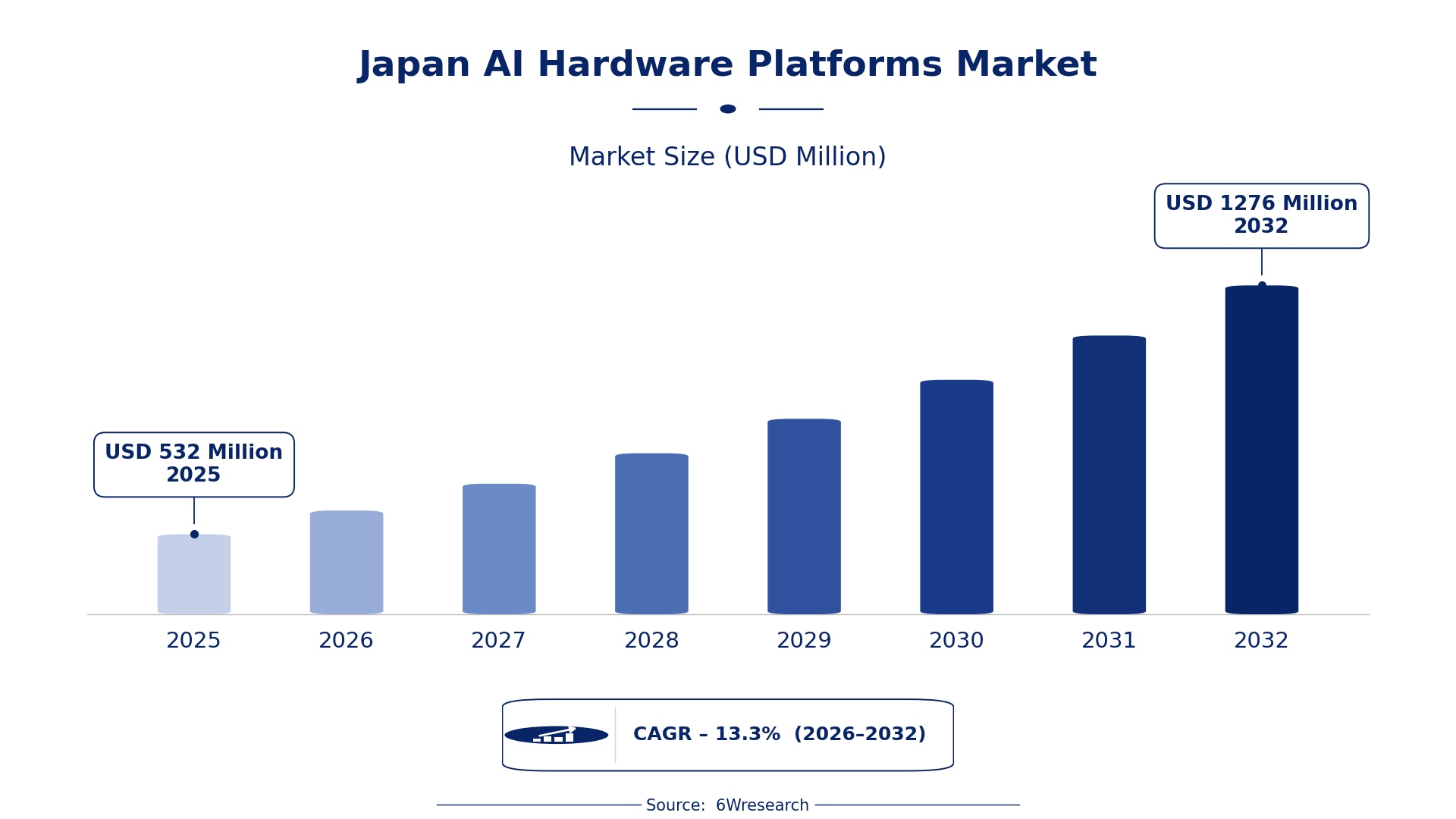
According to 6Wresearch internal database and industry insights, the Japan AI Hardware Platforms Market was valued at USD 532 Million in 2025 and is projected to reach USD 1,276 Million by 2032, growing at a CAGR of approximately 13.3% during 2026–2032.
Japan AI Hardware Platforms Market Highlights
| Report Metric | Details |
| Report Name | Japan AI Hardware Platforms Market (2026-2032) |
| Market Size 2025 | USD 532 Million |
| Market Size 2032 | USD 1,276 Million |
| Absolute Growth 2025–2032 | USD 744 Million |
| CAGR 2026–2032 | 13.3% |
| Peak Annual Growth | 14.1% in 2026 |
| Forecast Period | 2026–2032 |
| Historical Data | 2022–2025 |
| Base Year | 2025 |
| Leading Platform Type, 2025 | Modular AI Boards (46% share) |
| Leading Integration Type, 2025 | Plug-and-Play Systems (39% share) |
| Leading Distribution Channel, 2025 | IoT Hardware Stores (44% share) |
| Leading End User, 2025 | AI Product Developers (47% share) |
| Fastest-Growing Platform Type | System-on-Chip (SoC) (19.0% CAGR) |
| Fastest-Growing Integration Type | Embedded Processing (18.4% CAGR) |
| Fastest-Growing Distribution Channel | Tech Distributors (16.6% CAGR) |
| Fastest-Growing End User | Robotics Manufacturers (17.5% CAGR) |
| Growing Sector | AI technology development |
| Key End Users | AI product developers, robotics manufacturers, educational institutions, industrial AI integrators |
Japan AI Hardware Platforms Market Year-wise Growth Rate and Key Drivers (2022–2032)
This graph illustrates the annual growth rates of the market from 2022 to 2032, highlighting a steady upward trajectory and projected market expansion over the forecast period.
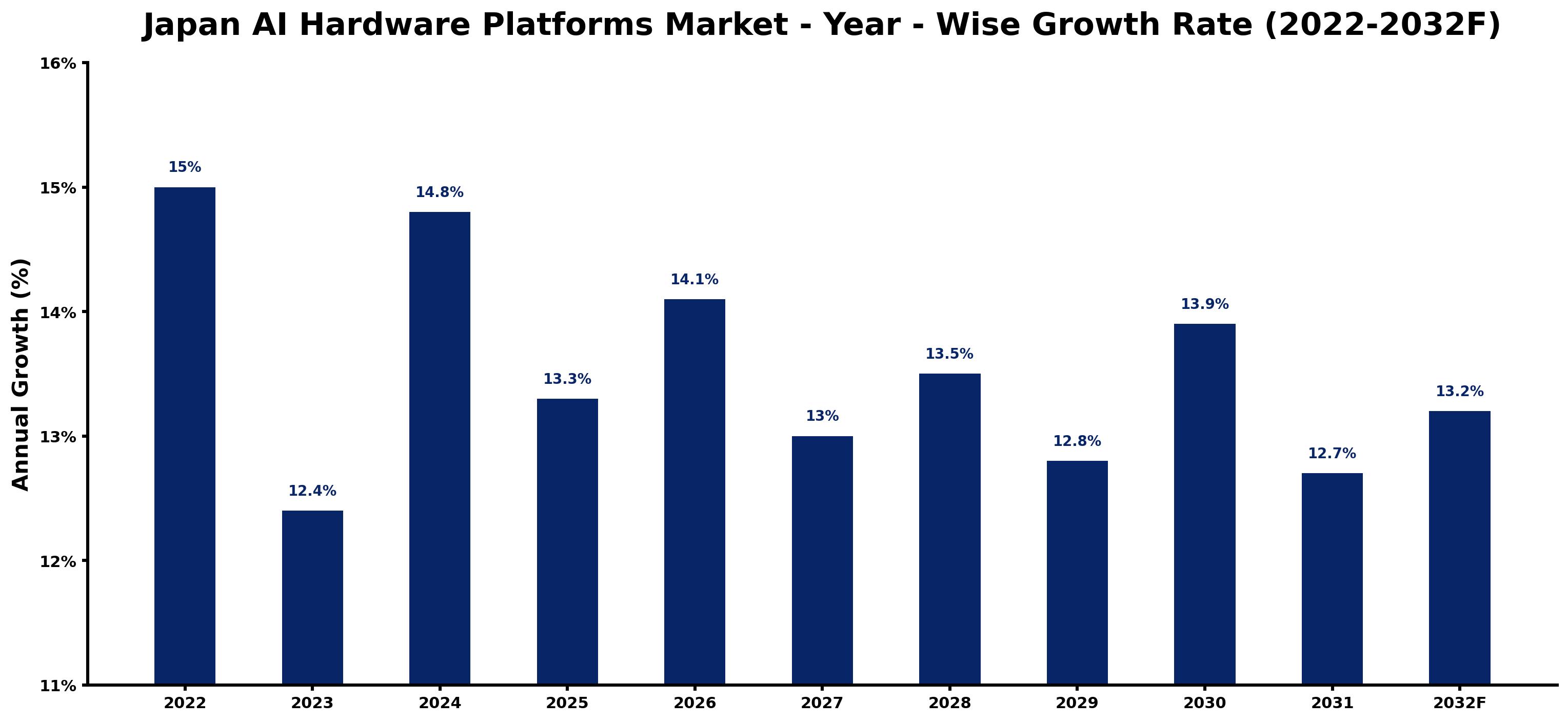
The table below sets out the estimated growth rate for each year and the main factor behind it.
| Year | Estimated Annual Growth (%) | Market Rationale |
| 2022 | 15.0 | The market experienced strong demand from AI product developers and robotics manufacturers. |
| 2023 | 12.4 | Growth slowed as the market adjusted after the peak demand in 2022. |
| 2024 | 14.8 | A rebound in demand occurred due to increased AI applications across sectors. |
| 2025 | 13.3 | Market growth decelerated as competition intensified among hardware suppliers. |
| 2026 | 14.1 | The market is expected to accelerate with new investments in AI technologies. |
| 2027 | 13.0 | Growth is projected to slow as the market stabilises after rapid expansion. |
| 2028 | 13.5 | An increase in AI integration in smart cities will drive demand further. |
| 2029 | 12.8 | Growth is anticipated to slow as market saturation begins to take effect. |
| 2030 | 13.9 | A resurgence in demand is expected due to advancements in AI capabilities. |
| 2031 | 12.7 | Growth will moderate as the market reaches a more mature phase. |
| 2032 | 13.2 | The market is projected to grow as new applications for AI hardware emerge. |
Note: Market size estimations and growth projections presented in this report are based on 6Wresearch's proprietary forecasting methodology, utilizing the latest available industry data, government publications, and primary research inputs.
Japan AI Hardware Platforms Market Synopsis
AI Hardware Platforms are advanced technologies designed to support various artificial intelligence applications, including machine learning, data processing, and robotics. The Japan AI Hardware Platforms Market is expanding due to rising demand from urban technology developers and initiatives by the Ministry of Economy, Trade and Industry. With over 1,000 AI startups focusing on hardware solutions and a projected 20% rise in AI product developers by 2025, the market is set for considerable growth, particularly in urban regions like Tokyo and Osaka.
Market Dynamics Impact Analysis (2026–2032)
| Factor | Type | Impact | Primary Segment Affected |
| Increased investment in AI research and development drives demand for advanced hardware solutions. | Driver | High | AI Workstations |
| The rise of IoT applications necessitates efficient AI Edge Kits for data processing. | Driver | High | AI Edge Kits |
| The demand for AI Workstations is growing as educational institutions adopt advanced technology for research. | Opportunity | High | AI Workstations |
| SMEs are increasingly seeking Pre-configured Platforms for rapid deployment of AI solutions. | Opportunity | Medium | Pre-configured Platforms |
| High costs associated with advanced AI hardware may limit accessibility for smaller companies. | Restraint | High | Modular AI Boards |
| Supply chain disruptions can affect the availability of critical components for AI hardware. | Restraint | Medium | System-on-Chip (SoC) |
| Competition among suppliers may lead to price wars, affecting profit margins for manufacturers. | Challenge | High | AI Product Developers |
| Rapid technological advancements can outpace current hardware capabilities, creating a gap in performance. | Challenge | Medium | AI Workstations |
Evaluation of Drivers in Japan AI Hardware Platforms Market (2026–2032)
The following drivers explain most of the expected growth.
| Drivers | Primary Segment Affected | Why It Matters (Evidence) |
| Increased funding for AI research boosts demand for AI Workstations. | AI Workstations | In 2023, a program launched by METI increased AI research funding by 5 billion yen, boosting purchases. |
| Urban expansion drives the need for AI Edge Kits in smart city projects. | AI Edge Kits | Tokyo's smart city initiatives are increasing the demand for AI Edge Kits to support IoT applications. |
| The growth of AI startups fuels demand for Modular AI Boards in various applications. | Modular AI Boards | With over 1,000 AI startups in Japan, the need for efficient Modular AI Boards is rising. |
| Educational institutions are investing in AI Workstations for research and development. | AI Workstations | Universities are adopting AI Workstations to improve their research capabilities, with a growing number of installations. |
| The integration of AI in robotics is increasing demand for System-on-Chip (SoC) technologies. | System-on-Chip (SoC) | The Robotics Industry Association of Japan promotes AI integration, driving SoC technology adoption. |
Purchasing is picking up as increased funding for AI research boosts demand for AI Workstations, with a 5 billion yen boost from METI in 2023. Urban expansion in Tokyo drives demand for AI Edge Kits, essential for smart city projects. The presence of numerous AI startups in Japan fuels the need for Modular AI Boards across various applications. Educational institutions are investing in AI Workstations to improve research capabilities, while the Robotics Industry Association promotes AI integration, increasing adoption of System-on-Chip technologies.
Evaluation of Restraints in Japan AI Hardware Platforms Market
Several factors work against faster growth; the main ones are summarised below.
| Market Restraint | Primary Segment Affected | Why It Matters (Evidence) |
| High costs of advanced AI hardware limit accessibility for smaller companies. | Modular AI Boards | The average price of Modular AI Boards can exceed 500,000 yen, making it challenging for SMEs. |
| Supply chain disruptions affect the availability of critical components for AI hardware. | System-on-Chip (SoC) | Recent global shortages have delayed the delivery of essential components for SoC production. |
| Intense competition among suppliers can impact profit margins. | AI Product Developers | Price reductions due to competition are squeezing margins for AI hardware producers. |
| Rapid technological advancements can outpace current hardware capabilities. | AI Workstations | As new AI technologies emerge, existing workstations may become obsolete, affecting buyer confidence. |
| Limited awareness of AI hardware capabilities among potential users restricts market growth. | AI Edge Kits | Many SMEs are unaware of the benefits of AI Edge Kits, hindering adoption rates. |
Japan AI Hardware Platforms Market Challenges
Buyers face high costs from strict regulations on data security, as compliance with ISO/IEC 27001 can necessitate infrastructure upgrades costing up to 10 million yen. Suppliers encounter rising production costs due to advanced semiconductor processes, which increase hardware prices by 15%, impacting buyers' budgets. Skills shortages in AI technology hinder suppliers' capacity to meet demand, extending project timelines by an average of six months for buyers. Technology adoption lags, with only 2 million units of AI hardware installed, limiting accessibility for buyers in key urban areas like Tokyo and Osaka.
Trends in the Japan AI Hardware Platforms Market
Buyers and suppliers in the Japan AI Hardware Platforms Market are adjusting to the following trends.
- Shift from Traditional to AI-Driven Solutions: Since 2022, there has been a notable shift towards AI-driven solutions in industrial applications, particularly in Osaka, where AI adoption has increased by 30%.
- Emergence of AI Edge Kits: In 2023, the demand for AI Edge Kits surged due to IoT expansion, with urban areas seeing a 25% increase in installations.
- Growing Adoption of Modular AI Boards: The trend towards modularity began in 2022, with Modular AI Boards gaining popularity, especially in tech hubs like Tokyo, where demand rose by 40%.
- Increased Focus on Data Security Standards: The adoption of ISO/IEC 27001 standards for data security in AI applications has gained traction since 2021, with compliance rates reaching 60% among developers.
Investment Opportunities in the Japan AI Hardware Platforms Market
Investors looking at the Japan AI Hardware Platforms Market should consider the following areas.
- Collaborations with Educational Institutions: Partnering with universities can open new markets, with a projected 20% increase in AI product developers by 2025 in Tokyo.
- Investment in AI Edge Kits: With demand for AI Edge Kits on the rise, suppliers can target urban areas for distribution, particularly in Osaka, where installations are increasing.
- Expansion of Pre-configured Platforms for SMEs: The growing number of SMEs seeking quick deployment solutions presents an opportunity, especially in regions like Tokyo, where adoption is increasing.
- Development of System-on-Chip Technologies: Investing in System-on-Chip technologies can meet the rising demand from robotics manufacturers, projected to grow by 17.5% by 2032.
Government Initiatives in the Japan AI Hardware Platforms Market
The Semiconductor and Digital Industry Strategy, launched in June 2021, aims to secure domestic semiconductor manufacturing, strengthening the capabilities of AI hardware producers. This strategy complements existing laws by providing a framework for innovation and investment in semiconductor technologies, essential for AI hardware development. In 2023, METI allocated 5 billion yen to support AI research funding, benefiting startups and established firms alike.
The Digital Agency, established in September 2021, supports the digital transformation of various sectors, including AI. It provides funding and resources to AI product developers, enabling them to adopt advanced technologies and improve their offerings. In 2023, the agency approved multiple projects aimed at enhancing AI infrastructure, benefiting both startups and established companies.
Future Insight of the Japan AI Hardware Platforms Market
Universities and research institutions will increasingly utilise AI hardware platforms, improving research capabilities and attracting tech-savvy students. By 2032, the demand for AI hardware will rise significantly, supporting various applications in smart cities. The METI programme will inject an additional 5 billion yen into AI research funding, driving innovation among startups. As the Japan AI Strategy aims to double investment by 2025, suppliers will benefit from increased funding, enabling them to develop advanced technologies that meet the expanding market needs.
Market Segmentation Analysis
Japan AI Hardware Platforms Market report covers a detailed analysis of the following market segments:
By Platform Type – Modular AI Boards Lead, System-on-Chip (SoC) Expected to Grow Fastest
According to Saurav Kr Singh, Senior Research Analyst at 6Wresearch, Modular AI Boards took 46% of platform type revenue in 2025, more than any other category. Modular AI Boards hold the largest share due to their versatility across numerous applications, attracting a wide range of users including tech startups and established enterprises. This is particularly evident in urban areas like Tokyo, which is a hub for AI innovation. System-on-Chip (SoC) is projected to grow fastest, at a CAGR of 19.0% during 2026–2032. System-on-Chip (SoC) is experiencing rapid growth as they are increasingly embedded into devices, enhancing efficiency and performance. The surge in smart device usage in everyday life is a key factor driving this trend. Suppliers should focus on advancing SoC technologies to meet the growing demand from manufacturers.
By Integration Type – Plug-and-Play Systems Lead, Embedded Processing Expected to Grow Fastest
Plug-and-Play Systems accounted for 39% of the market by integration type in 2025. Plug-and-Play Systems dominate the market by facilitating easier integration, making them appealing for businesses that require quick deployment. Their straightforward design is particularly beneficial for small and medium enterprises looking to adopt new technologies with minimal technical barriers. Embedded Processing is set to record the highest CAGR in this split, 18.4% over 2026–2032. Embedded Processing is the fastest growing segment due to its essential role in integrating technology into smart devices, which are increasingly sought after. The expansion of smart city initiatives across Japan is significantly boosting this demand for efficient processing. Buyers will benefit from investing in embedded solutions that improve the functionality of their smart devices.
By Distribution Channel – IoT Hardware Stores Lead, Tech Distributors Expected to Grow Fastest
In 2025, IoT Hardware Stores led the distribution channel split with a 44% share. IoT Hardware Stores lead the distribution channel as they provide essential components for AI hardware, catering to a wide customer base including hobbyists and professionals. Their presence in urban areas ensures accessibility for users looking to build or upgrade AI systems. Over 2026–2032, Tech Distributors are expected to post the fastest growth, at a CAGR of 16.6%. Tech Distributors are growing rapidly as they supply a diverse range of AI hardware to various sectors, responding to the increasing demand for integrated solutions. Their ability to reach multiple industries positions them well for future growth. Suppliers should strengthen relationships with tech distributors to expand their market reach.
By End User – AI Product Developers Lead, Robotics Manufacturers Expected to Grow Fastest
With 47% of end user revenue in 2025, AI Product Developers was the largest category. AI Product Developers represent the largest segment as they are the main users of AI platforms, driving demand for advanced hardware solutions. Their focus on innovation and application development is particularly strong in urban centres like Tokyo, where technology thrives. The quickest growth will come from Robotics Manufacturers, forecast to expand at a CAGR of 17.5% between 2026 and 2032. Robotics Manufacturers are the fastest growing end user group as they increasingly integrate AI into their automation products. The rising need for robotics in industries such as manufacturing and logistics is propelling this growth. Suppliers must tailor their offerings to meet the specific needs of robotics manufacturers to capitalise on this trend.
Key Attractiveness of the Report
- 10 Years of Market Numbers
- Historical Data Starting from 2022 to 2025
- Base Year 2025
- Forecast Data until 2032
- Key Performance Indicators Impacting the Market
- Major Upcoming Developments and Projects
Key Highlights of the Report:
- Japan AI Hardware Platforms Market Outlook
- Market Size of Japan AI Hardware Platforms Market, 2025
- Forecast of Japan AI Hardware Platforms Market, 2032
- Historical Data and Forecast of Japan AI Hardware Platforms Revenues & Volume for the Period 2022-2032F
- Japan AI Hardware Platforms Market Trend Evolution
- Japan AI Hardware Platforms Market Drivers and Challenges
- Japan AI Hardware Platforms Price Trends
- Japan AI Hardware Platforms Porter's Five Forces
- Japan AI Hardware Platforms Industry Life Cycle
- Historical Data and Forecast of Japan AI Hardware Platforms Market Revenues & Volume By Platform Type for the Period 2022-2032F
- Historical Data and Forecast of Japan AI Hardware Platforms Market Revenues & Volume By Modular AI Boards for the Period 2022-2032F
- Historical Data and Forecast of Japan AI Hardware Platforms Market Revenues & Volume By System-on-Chip (SoC) for the Period 2022-2032F
- Historical Data and Forecast of Japan AI Hardware Platforms Market Revenues & Volume By AI Edge Kits for the Period 2022-2032F
- Historical Data and Forecast of Japan AI Hardware Platforms Market Revenues & Volume By AI Workstations for the Period 2022-2032F
- Historical Data and Forecast of Japan AI Hardware Platforms Market Revenues & Volume By Integration Type for the Period 2022-2032F
- Historical Data and Forecast of Japan AI Hardware Platforms Market Revenues & Volume By Plug-and-Play Systems for the Period 2022-2032F
- Historical Data and Forecast of Japan AI Hardware Platforms Market Revenues & Volume By Embedded Processing for the Period 2022-2032F
- Historical Data and Forecast of Japan AI Hardware Platforms Market Revenues & Volume By Pre-configured Platforms for the Period 2022-2032F
- Historical Data and Forecast of Japan AI Hardware Platforms Market Revenues & Volume By Multi-GPU Integration for the Period 2022-2032F
- Historical Data and Forecast of Japan AI Hardware Platforms Market Revenues & Volume By Distribution Channel for the Period 2022-2032F
- Historical Data and Forecast of Japan AI Hardware Platforms Market Revenues & Volume By IoT Hardware Stores for the Period 2022-2032F
- Historical Data and Forecast of Japan AI Hardware Platforms Market Revenues & Volume By Tech Distributors for the Period 2022-2032F
- Historical Data and Forecast of Japan AI Hardware Platforms Market Revenues & Volume By Developer Marketplaces for the Period 2022-2032F
- Historical Data and Forecast of Japan AI Hardware Platforms Market Revenues & Volume By OEM and Resellers for the Period 2022-2032F
- Historical Data and Forecast of Japan AI Hardware Platforms Market Revenues & Volume By End User for the Period 2022-2032F
- Historical Data and Forecast of Japan AI Hardware Platforms Market Revenues & Volume By AI Product Developers for the Period 2022-2032F
- Historical Data and Forecast of Japan AI Hardware Platforms Market Revenues & Volume By Robotics Manufacturers for the Period 2022-2032F
- Historical Data and Forecast of Japan AI Hardware Platforms Market Revenues & Volume By Industrial AI Integrators for the Period 2022-2032F
- Historical Data and Forecast of Japan AI Hardware Platforms Market Revenues & Volume By Data Center Architects for the Period 2022-2032F
- Japan AI Hardware Platforms Import Export Trade Statistics
- Market Opportunity Assessment By Platform Type
- Market Opportunity Assessment By Integration Type
- Market Opportunity Assessment By Distribution Channel
- Market Opportunity Assessment By End User
- Japan AI Hardware Platforms Top Companies Market Share
- Japan AI Hardware Platforms Competitive Benchmarking By Technical and Operational Parameters
- Japan AI Hardware Platforms Company Profiles
- Japan AI Hardware Platforms Key Strategic Recommendations
Market Covered
The study includes the following segmentation.
By Platform Type
- Modular AI Boards
- System-on-Chip (SoC)
- AI Edge Kits
- AI Workstations
By Integration Type
- Plug-and-Play Systems
- Embedded Processing
- Pre-configured Platforms
- Multi-GPU Integration
By Distribution Channel
- IoT Hardware Stores
- Tech Distributors
- Developer Marketplaces
- OEM and Resellers
By End User
- AI Product Developers
- Robotics Manufacturers
- Industrial AI Integrators
- Data Center Architects































