Japan AI Imaging Market Size & Growth Rate
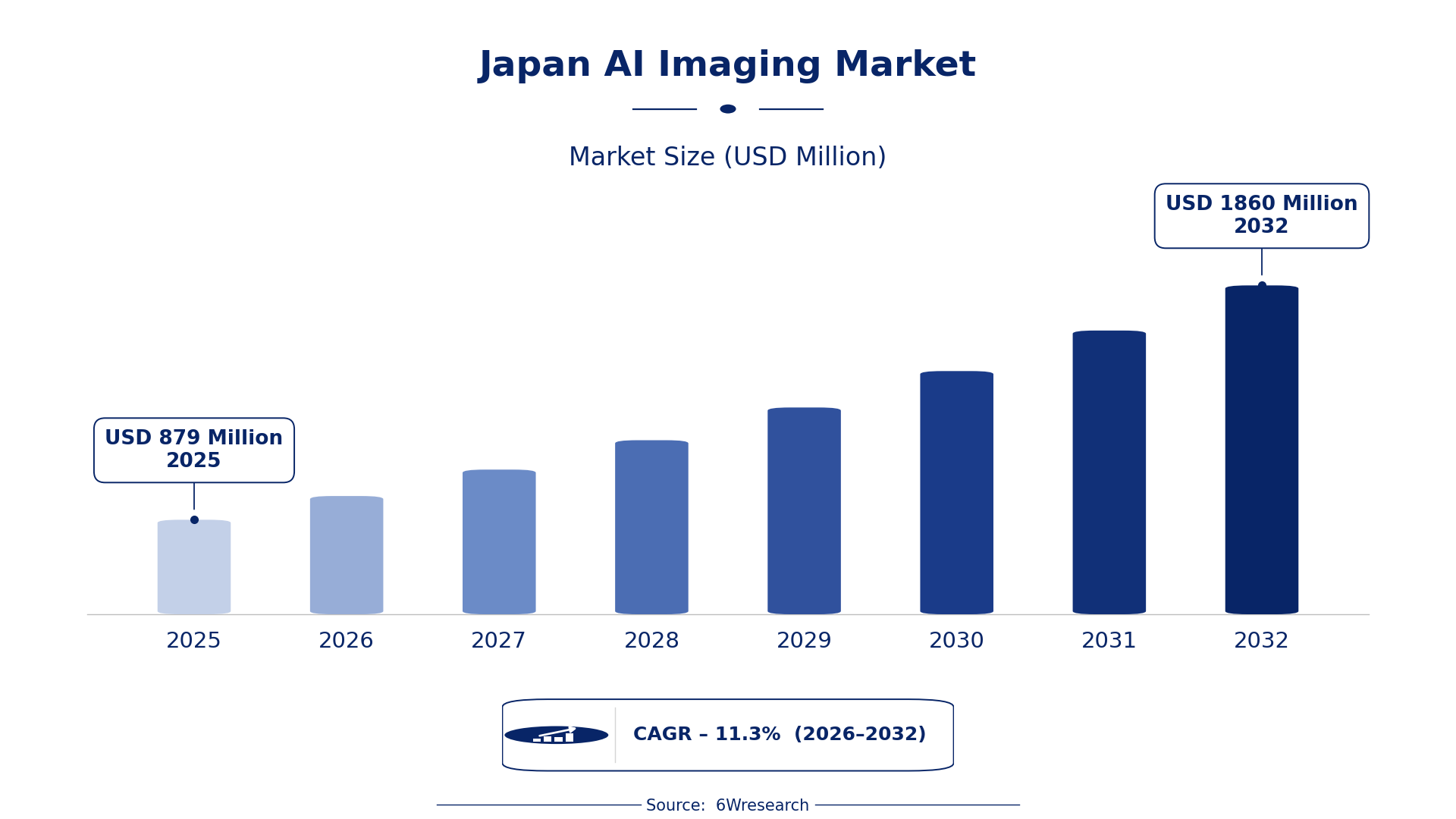
According to 6Wresearch internal database and industry insights, the Japan AI Imaging Market was valued at USD 879 Million in 2025 and is projected to reach USD 1,860 Million by 2032, growing at a CAGR of approximately 11.3% during 2026–2032.
Japan AI Imaging Market Highlights
| Report Metric | Details |
| Report Name | Japan AI Imaging Market (2026-2032) |
| Market Size 2025 | USD 879 Million |
| Market Size 2032 | USD 1,860 Million |
| Absolute Growth 2025–2032 | USD 981 Million |
| CAGR 2026–2032 | 11.3% |
| Peak Annual Growth | 13.0% in 2026 |
| Forecast Period | 2026–2032 |
| Historical Data | 2022–2025 |
| Base Year | 2025 |
| Leading Imaging Type, 2025 | Medical Imaging (34% share) |
| Leading AI Technique, 2025 | Deep Learning (40% share) |
| Leading Distribution Channel, 2025 | Health IT Portals (34% share) |
| Leading End User, 2025 | Hospitals & Diagnostic Labs (43% share) |
| Fastest-Growing Imaging Type | Satellite Imaging (15.3% CAGR) |
| Fastest-Growing AI Technique | Object Detection (15.0% CAGR) |
| Fastest-Growing Distribution Channel | Aerospace Vendors (14.3% CAGR) |
| Fastest-Growing End User | Space & Defense Agencies (14.6% CAGR) |
| Growing Sector | Healthcare |
| Key End Users | Hospitals, Diagnostic Labs, Research Institutions, Manufacturing Firms |
Japan AI Imaging Market Year-wise Growth Rate and Key Drivers (2022–2032)
This graph illustrates the annual growth rates of the market from 2022 to 2032, highlighting a steady upward trajectory and projected market expansion over the forecast period.
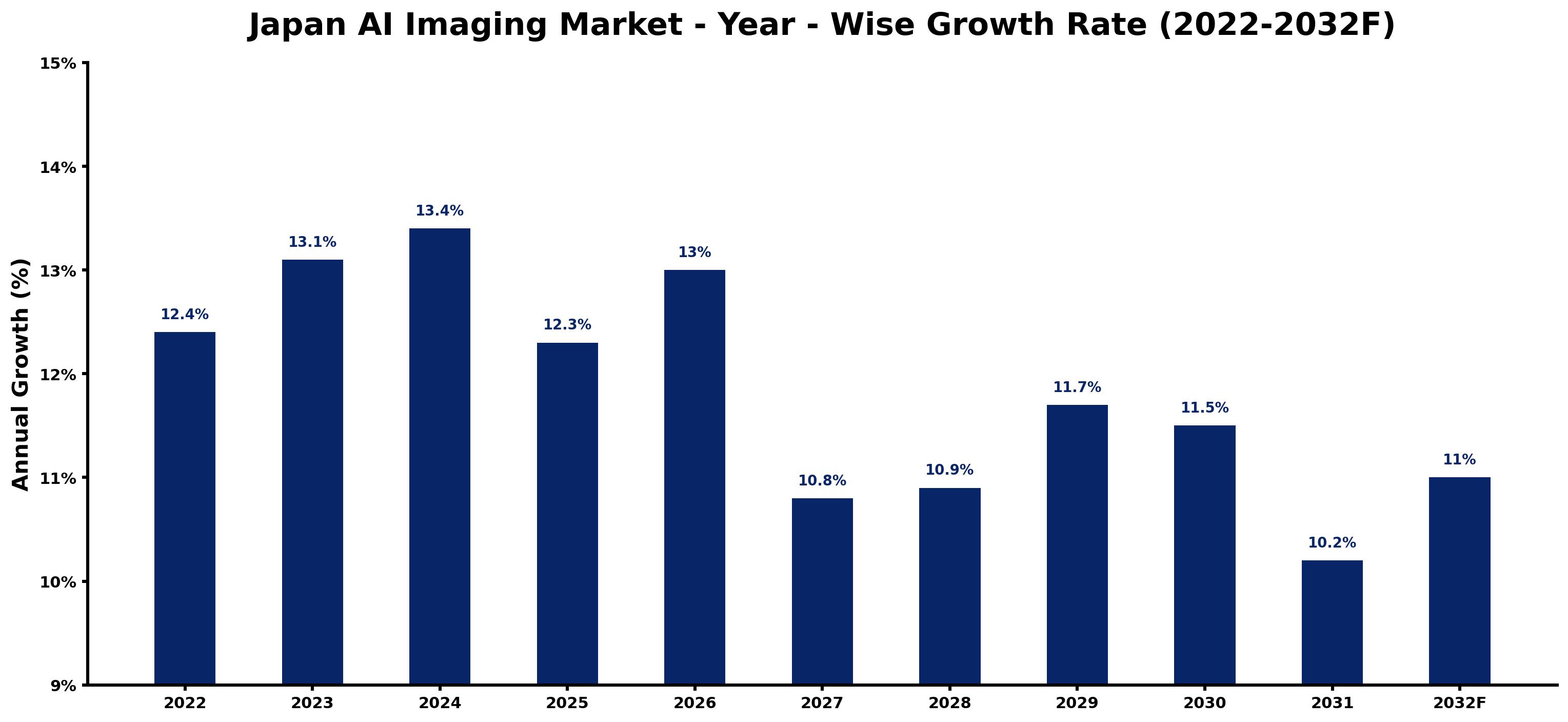
Annual growth estimates for each year appear below with the principal reason behind them, explaining the shifts that set the pace of the market.
| Year | Estimated Annual Growth (%) | Market Rationale |
| 2022 | 12.4 | The market experienced solid growth due to increasing healthcare demands and technological advancements. |
| 2023 | 13.1 | Growth accelerated as healthcare facilities adopted more AI imaging solutions for diagnostics. |
| 2024 | 13.4 | The market continued to expand rapidly, driven by innovations in imaging technologies and increased investments. |
| 2025 | 12.3 | Growth slowed slightly as the market began to stabilise after reaching a peak in the previous year. |
| 2026 | 13.0 | The market is expected to rebound with renewed investments in AI technologies for healthcare applications. |
| 2027 | 10.8 | Growth is projected to decelerate as the market adjusts to saturation in certain segments of AI imaging. |
| 2028 | 10.9 | A slight increase in growth is expected as new applications in industrial inspection emerge. |
| 2029 | 11.7 | The market will see further growth driven by advancements in satellite imaging technologies. |
| 2030 | 11.5 | Growth is projected to moderate as competition intensifies among imaging technology providers. |
| 2031 | 10.2 | The market will continue to expand, albeit at a slower pace due to market maturation. |
| 2032 | 11.0 | Growth is expected to pick up again as new healthcare initiatives are introduced to improve imaging capabilities. |
Note: Market size estimations and growth projections presented in this report are based on 6Wresearch's proprietary forecasting methodology, utilizing the latest available industry data, government publications, and primary research inputs.
Japan AI Imaging Market Synopsis
AI Imaging in Japan involves advanced technologies that improve imaging processes across sectors like healthcare and industrial inspection. The Japan AI Imaging Market is expanding due to high demand from hospitals and diagnostic labs, which are at the forefront of adopting medical imaging solutions. In 2023, Japan's health expenditure reached 10 trillion yen, underscoring the importance of medical technologies. The Tokyo metropolitan area serves as a hub for innovation, hosting numerous hospitals and research institutions that propel market growth.
Market Dynamics Impact Analysis (2026–2032)
| Factor | Type | Impact | Primary Segment Affected |
| Increasing healthcare expenditure drives demand for medical imaging solutions. | Driver | High | Medical Imaging |
| Growing adoption of AI technologies in various sectors creates new applications. | Driver | High | Satellite Imaging |
| High demand for advanced imaging solutions presents opportunities for innovation. | Opportunity | High | Industrial Inspection |
| Emerging applications in scientific research create new market segments. | Opportunity | Medium | Microscopic Imaging |
| Regulatory challenges can delay the approval of new imaging technologies. | Restraint | High | Medical Imaging |
| High competition among imaging technology providers can limit market entry. | Restraint | Medium | Satellite Imaging |
| High costs of advanced imaging equipment can deter smaller healthcare facilities. | Challenge | High | Medical Imaging |
| Limited access to cutting-edge technologies in rural areas hampers growth. | Challenge | Medium | Industrial Inspection |
Evaluation of Drivers in Japan AI Imaging Market (2026–2032)
The main growth drivers and the segments they affect most are set out below.
| Drivers | Primary Segment Affected | Why It Matters (Evidence) |
| Increased healthcare spending | Medical Imaging | Japan's health expenditure reached 10 trillion yen in 2023, driving demand for imaging solutions. |
| Growing patient population | Medical Imaging | Japan's population of approximately 125 million increases the demand for medical imaging services. |
| Rising demand for quality assurance | Industrial Inspection | Manufacturers require advanced imaging solutions to ensure product quality and compliance. |
| Increased research funding | Microscopic Imaging | Institutions are investing in AI imaging research, supporting innovation in imaging processes. |
| Technological advancements in AI | Satellite Imaging | The adoption of AI technologies attracts investments from various sectors, creating new applications. |
Spending rises because Japan's health expenditure reached 10 trillion yen in 2023, boosting demand for medical imaging solutions. The population of approximately 125 million drives healthcare facilities to adopt advanced imaging technologies for diagnostics. Increased funding for research supports innovation in imaging processes. The demand for quality assurance in manufacturing propels the adoption of AI imaging solutions, as manufacturers require advanced technologies to ensure compliance and product quality.
Evaluation of Restraints in Japan AI Imaging Market
Several factors work against faster growth; the main ones are summarised below.
| Market Restraint | Primary Segment Affected | Why It Matters (Evidence) |
| Regulatory hurdles slow the approval process for new imaging technologies. | Medical Imaging | The PMD Act regulates the approval of medical devices, impacting market entry. |
| High competition limits market share for new entrants. | Satellite Imaging | Numerous established players dominate the market, making it challenging for newcomers. |
| Cost barriers restrict access to advanced imaging equipment. | Industrial Inspection | High prices deter smaller manufacturers from adopting new technologies. |
| Limited awareness of AI imaging benefits hampers adoption rates. | Microscopic Imaging | Many research labs remain unaware of the advancements in AI imaging technologies. |
| Complex integration processes can delay implementation. | Medical Imaging | Healthcare facilities face challenges in integrating new AI systems with existing workflows. |
Japan AI Imaging Market Challenges
Limited local manufacturing of AI imaging components leads to supply disruptions for healthcare facilities, causing delays in patient diagnostics. This situation arises because many suppliers rely on overseas imports, which can take weeks to arrive, costing facilities valuable time and resources. Technological integration poses a challenge; numerous healthcare institutions lack the necessary infrastructure to implement advanced AI imaging systems, hindering the rollout of new diagnostic capabilities. Regulatory compliance complicates operations; the Ministry of Health, Labour and Welfare enforces stringent standards, resulting in increased costs for facilities striving to meet ISO 13485 requirements. Skills shortages in AI technology impede progress; with few universities focusing on this field, healthcare providers struggle to find qualified personnel, affecting their operational efficiency.
Trends in the Japan AI Imaging Market
Four trends stand out in the Japan AI Imaging Market.
- Shift from Traditional Imaging to AI-Driven Solutions: Healthcare facilities are increasingly adopting AI-driven imaging solutions, with a notable rise in usage reported in 2023. This trend is particularly evident in hospitals within the Tokyo metropolitan area, which are leading the integration of AI technologies.
- Transition from Manual to Automated Imaging Processes: Hospitals are moving towards automated imaging processes to improve efficiency. In 2023, approximately 60% of diagnostic labs in Japan implemented automation, streamlining workflows and reducing human error.
- Emergence of AI in Industrial Quality Control: The industrial sector is integrating AI imaging for quality control, with projected growth in adoption by 2025. This shift is apparent in manufacturing hubs across Japan, where firms are prioritising quality assurance.
- Growing Focus on Satellite Imaging for Environmental Monitoring: There is a rising emphasis on satellite imaging for environmental monitoring, with a significant increase in applications reported in 2023. This trend aligns with Japan's commitment to sustainability and responsible resource management.
Investment Opportunities in the Japan AI Imaging Market
The following areas offer the clearest openings for investors and suppliers in the Japan AI Imaging Market.
- High Demand for Medical Imaging Solutions: With Japan's health expenditure reaching 10 trillion yen, there is a gap in medical imaging solutions. Hospitals and diagnostic labs represent prime targets for investment, with opportunities for local partnerships to supply advanced technologies.
- Emerging Applications in Industrial Inspection: The industrial sector is increasingly adopting AI imaging for quality assurance, presenting a gap for suppliers. Smart manufacturing firms are seeking advanced solutions, making this an opportune time for investment.
- Growth in Satellite Imaging for Environmental Applications: The projected increase in satellite imaging applications offers a gap for new providers. Space and defence agencies are looking for advanced imaging solutions, creating opportunities for partnerships and technology supply.
- Investment in AI Imaging Research: Funding for AI imaging research has increased, creating opportunities for collaboration. Research labs are actively seeking partnerships to develop new technologies, making this a timely investment area.
Government Initiatives in the Japan AI Imaging Market
The Long-Term Care Insurance Act, enacted in 1997 and in force since 2000, funds essential nursing care services for the elderly, ensuring access to necessary medical imaging. The PMD Act, renamed in 2014, regulates the approval and quality of medical devices, creating a compliant market environment for AI Imaging technologies.
The Pharmaceuticals and Medical Devices Agency reviews applications for imaging devices, ensuring they meet safety and efficacy standards. The Japan Medical Imaging and Radiological Systems Manufacturers Association supports industry growth through advocacy and innovation, promoting advancements in medical imaging technologies.
Future Insight of the Japan AI Imaging Market
Healthcare facilities will transform their operations by 2032, driven by government programs aimed at integrating AI imaging technologies. The Tokyo University of Science will lead research initiatives, producing skilled graduates to support this shift. By 2025, the Aerospace and Defence sector will adopt AI imaging for satellite applications, creating new avenues for collaboration. The average number of patients undergoing imaging procedures is projected to increase to 1 million annually, prompting suppliers to innovate and expand their offerings to meet evolving needs.
Market Segmentation Analysis
Japan AI Imaging Market report covers a detailed analysis of the following market segments:
By Imaging Type – Medical Imaging Leads, Satellite Imaging Expected to Grow Fastest
According to Saurav Kr Singh, Senior Research Analyst at 6Wresearch, the largest imaging type category in 2025 was Medical Imaging, at 34% of revenue. Medical Imaging holds the largest share due to its critical role in diagnostics and treatment planning, with over 1 million patients undergoing imaging procedures annually in Japan. The Tokyo metropolitan area, a hub for healthcare innovation, hosts numerous hospitals and research institutions that heavily invest in these technologies. Satellite Imaging is projected to grow fastest, at a CAGR of 15.3% during 2026–2032. Satellite Imaging is experiencing rapid growth as the Aerospace and Defense industry in Japan is projected to utilise AI imaging for satellite applications by 2025. This sector's increasing focus on earth observation and environmental monitoring drives the demand for advanced imaging solutions. Suppliers should prioritise the development of imaging technologies tailored for the healthcare sector to capture the growing market.
By AI Technique – Deep Learning Leads, Object Detection Expected to Grow Fastest
Deep Learning accounted for 40% of the market by ai technique in 2025. Deep Learning commands the largest share because it is fundamental for enhancing image analysis accuracy across various applications. Its widespread adoption in healthcare facilities, particularly in hospitals, underscores its critical role in improving diagnostic capabilities. Over 2026–2032, Object Detection is expected to post the fastest growth, at a CAGR of 15.0%. Object Detection is witnessing rapid growth as it is essential for identifying features in images, particularly in healthcare and aerospace sectors. The increasing need for precise feature identification will further drive advancements in this area, leading to more sophisticated imaging solutions. Suppliers must prioritise the development of advanced techniques that enhance image analysis to satisfy the rising demands across multiple sectors.
By Distribution Channel – Health IT Portals Lead, Aerospace Vendors Expected to Grow Fastest
Health IT Portals took 34% of distribution channel revenue in 2025, more than any other category. Health IT Portals dominate the distribution channel since they are crucial for accessing and managing medical imaging data, facilitating seamless integration within healthcare systems. The importance of these portals is underscored by Japan's significant health expenditure, which propels investment in digital solutions. The quickest growth will come from Aerospace Vendors, forecast to expand at a CAGR of 14.3% between 2026 and 2032. Aerospace Vendors represent the fastest-growing channel, employing imaging for design and monitoring purposes, reflecting the increasing integration of imaging technologies in the aerospace industry. This trend indicates a shift towards more advanced imaging applications beyond traditional healthcare uses. Suppliers should explore partnerships with aerospace vendors to capitalise on opportunities in the expanding imaging solutions market.
By End User – Hospitals & Diagnostic Labs Lead, Space & Defense Agencies Expected to Grow Fastest
With 43% of end user revenue in 2025, Hospitals & Diagnostic Labs was the largest category. Hospitals & Diagnostic Labs are the primary users of medical imaging technologies, relying on these solutions for accurate diagnostics and treatment planning. Japan's robust healthcare infrastructure supports a high demand for advanced imaging systems in these facilities, solidifying their leading position. Space & Defense Agencies are set to record the highest CAGR in this split, 14.6% over 2026–2032. Space & Defense Agencies are rapidly embracing imaging technologies, as they rely on imaging for surveillance and reconnaissance, which is increasingly crucial for national security. This growth highlights a broader acceptance of imaging technologies across diverse applications. Buyers in the healthcare sector should remain aware of advancements in imaging technologies from other industries to enhance their operational capabilities.
Key Attractiveness of the Report
- 10 Years of Market Numbers
- Historical Data Starting from 2022 to 2025
- Base Year 2025
- Forecast Data until 2032
- Key Performance Indicators Impacting the Market
- Major Upcoming Developments and Projects
Key Highlights of the Report:
- Japan AI Imaging Market Outlook
- Market Size of Japan AI Imaging Market, 2025
- Forecast of Japan AI Imaging Market, 2032
- Historical Data and Forecast of Japan AI Imaging Revenues & Volume for the Period 2022-2032F
- Japan AI Imaging Market Trend Evolution
- Japan AI Imaging Market Drivers and Challenges
- Japan AI Imaging Price Trends
- Japan AI Imaging Porter's Five Forces
- Japan AI Imaging Industry Life Cycle
- Historical Data and Forecast of Japan AI Imaging Market Revenues & Volume By Imaging Type for the Period 2022-2032F
- Historical Data and Forecast of Japan AI Imaging Market Revenues & Volume By Medical Imaging for the Period 2022-2032F
- Historical Data and Forecast of Japan AI Imaging Market Revenues & Volume By Satellite Imaging for the Period 2022-2032F
- Historical Data and Forecast of Japan AI Imaging Market Revenues & Volume By Industrial Inspection for the Period 2022-2032F
- Historical Data and Forecast of Japan AI Imaging Market Revenues & Volume By Microscopic Imaging for the Period 2022-2032F
- Historical Data and Forecast of Japan AI Imaging Market Revenues & Volume By AI Technique for the Period 2022-2032F
- Historical Data and Forecast of Japan AI Imaging Market Revenues & Volume By Deep Learning for the Period 2022-2032F
- Historical Data and Forecast of Japan AI Imaging Market Revenues & Volume By Object Detection for the Period 2022-2032F
- Historical Data and Forecast of Japan AI Imaging Market Revenues & Volume By Vision AI for the Period 2022-2032F
- Historical Data and Forecast of Japan AI Imaging Market Revenues & Volume By Super-Resolution AI for the Period 2022-2032F
- Historical Data and Forecast of Japan AI Imaging Market Revenues & Volume By Distribution Channel for the Period 2022-2032F
- Historical Data and Forecast of Japan AI Imaging Market Revenues & Volume By Health IT Portals for the Period 2022-2032F
- Historical Data and Forecast of Japan AI Imaging Market Revenues & Volume By Aerospace Vendors for the Period 2022-2032F
- Historical Data and Forecast of Japan AI Imaging Market Revenues & Volume By Smart Manufacturing Firms for the Period 2022-2032F
- Historical Data and Forecast of Japan AI Imaging Market Revenues & Volume By Scientific Equipment Dealers for the Period 2022-2032F
- Historical Data and Forecast of Japan AI Imaging Market Revenues & Volume By End User for the Period 2022-2032F
- Historical Data and Forecast of Japan AI Imaging Market Revenues & Volume By Hospitals & Diagnostic Labs for the Period 2022-2032F
- Historical Data and Forecast of Japan AI Imaging Market Revenues & Volume By Space & Defense Agencies for the Period 2022-2032F
- Historical Data and Forecast of Japan AI Imaging Market Revenues & Volume By Quality Control Departments for the Period 2022-2032F
- Historical Data and Forecast of Japan AI Imaging Market Revenues & Volume By Research Labs for the Period 2022-2032F
- Japan AI Imaging Import Export Trade Statistics
- Market Opportunity Assessment By Imaging Type
- Market Opportunity Assessment By AI Technique
- Market Opportunity Assessment By Distribution Channel
- Market Opportunity Assessment By End User
- Japan AI Imaging Top Companies Market Share
- Japan AI Imaging Competitive Benchmarking By Technical and Operational Parameters
- Japan AI Imaging Company Profiles
- Japan AI Imaging Key Strategic Recommendations
Market Covered
The report covers the following segments.
By Imaging Type
- Medical Imaging
- Satellite Imaging
- Industrial Inspection
- Microscopic Imaging
By AI Technique
- Deep Learning
- Object Detection
- Vision AI
- Super-Resolution AI
By Distribution Channel
- Health IT Portals
- Aerospace Vendors
- Smart Manufacturing Firms
- Scientific Equipment Dealers
By End User
- Hospitals & Diagnostic Labs
- Space & Defense Agencies
- Quality Control Departments
- Research Labs































