Japan AI in Air Traffic Management Market Size & Growth Rate
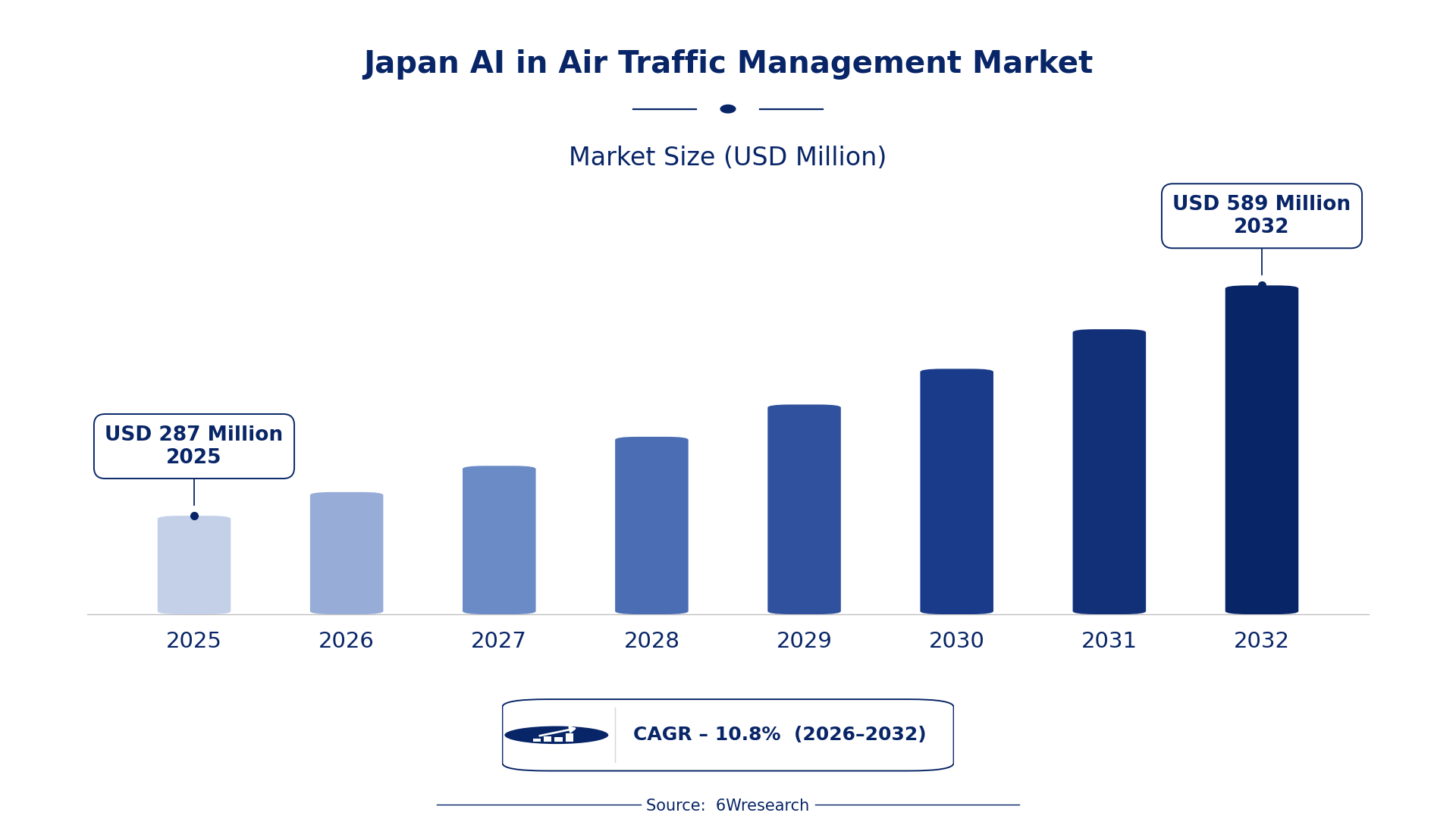
According to 6Wresearch internal database and industry insights, the Japan AI in Air Traffic Management Market was valued at USD 287 Million in 2025 and is projected to reach USD 589 Million by 2032, growing at a CAGR of approximately 10.8% during 2026–2032.
Japan AI in Air Traffic Management Market Highlights
| Report Metric | Details |
| Report Name | Japan AI in Air Traffic Management Market (2026-2032) |
| Market Size 2025 | USD 287 Million |
| Market Size 2032 | USD 589 Million |
| Absolute Growth 2025–2032 | USD 302 Million |
| CAGR 2026–2032 | 10.8% |
| Peak Annual Growth | 11.5% in 2029 |
| Forecast Period | 2026–2032 |
| Historical Data | 2022–2025 |
| Base Year | 2025 |
| Leading Application Area, 2025 | Flight Scheduling (41% share) |
| Leading AI Type, 2025 | Real-time AI Systems (38% share) |
| Leading Distribution Channel, 2025 | Government Contracts (37% share) |
| Leading End User, 2025 | Airport Authorities (41% share) |
| Fastest-Growing Application Area | Route Optimization (12.8% CAGR) |
| Fastest-Growing Distribution Channel | Aviation Tech Platforms (13.2% CAGR) |
| Fastest-Growing End User | Air Traffic Controllers (13.8% CAGR) |
| Growing Sector | Aviation |
| Key End Users | Airport Authorities, Air Traffic Controllers, Civil Aviation Departments |
Japan AI in Air Traffic Management Market Year-wise Growth Rate and Key Drivers (2022–2032)
This graph illustrates the annual growth rates of the market from 2022 to 2032, highlighting a steady upward trajectory and projected market expansion over the forecast period.
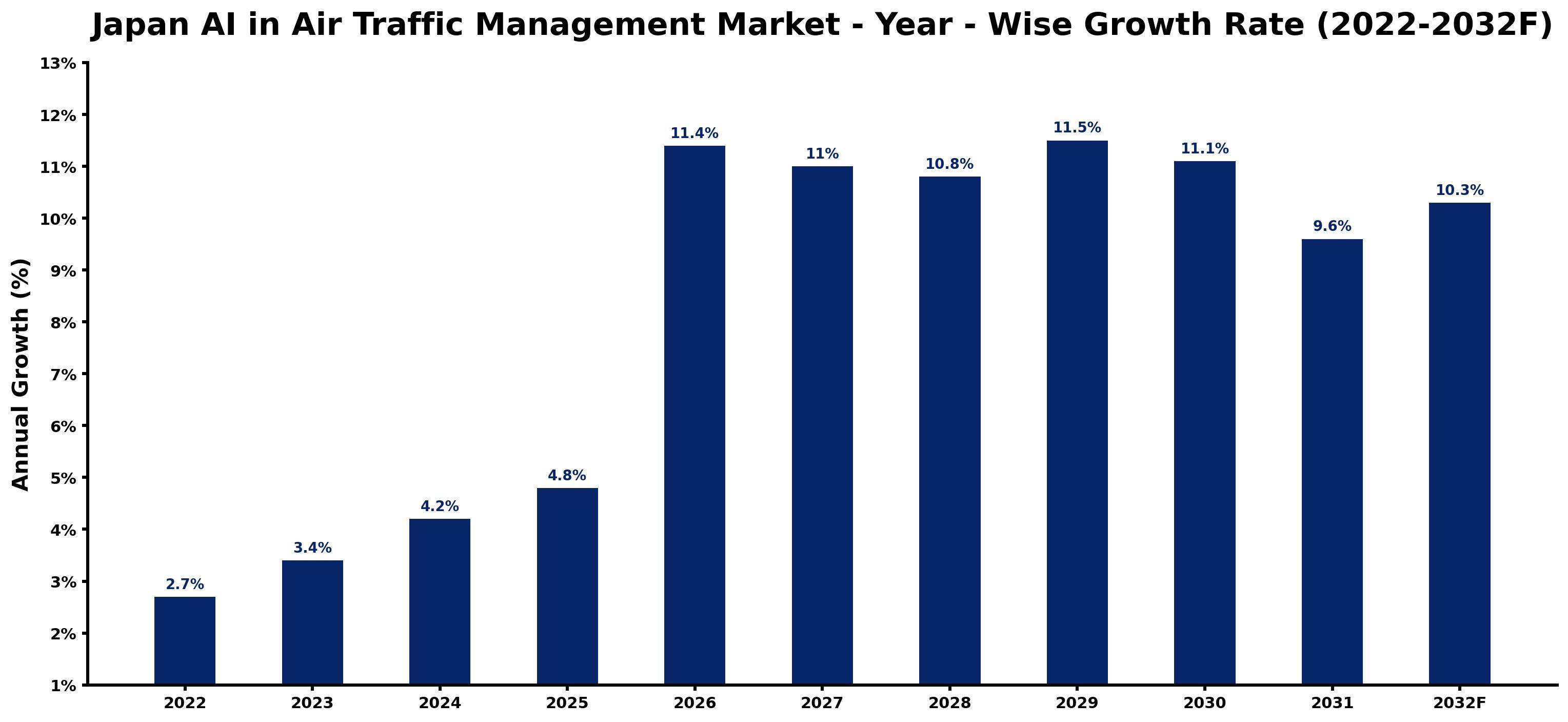
Annual growth estimates for each year appear below with the principal reason behind them, explaining the shifts that set the pace of the market.
| Year | Estimated Annual Growth (%) | Market Rationale |
| 2022 | 2.7 | The market experienced steady growth due to ongoing modernization efforts in air traffic management. |
| 2023 | 3.4 | Increased investments in AI technologies contributed to a faster growth rate than the previous year. |
| 2024 | 4.2 | Demand for collision avoidance systems rose, further accelerating market growth. |
| 2025 | 4.8 | The implementation of advanced algorithms led to improved flight scheduling, boosting growth rates. |
| 2026 | 11.4 | A rise in AI integration into air traffic systems is anticipated to drive demand higher. |
| 2027 | 11.0 | Growth is projected to slow slightly as the market adjusts to new technology implementations. |
| 2028 | 10.8 | Continued investment in AI solutions is expected to result in another year of slower growth. |
| 2029 | 11.5 | The market is expected to see a resurgence in growth as new AI applications are adopted. |
| 2030 | 11.1 | A slight slowdown is anticipated as the market stabilises after rapid expansion. |
| 2031 | 9.6 | Growth is projected to continue decelerating as the market matures and competition intensifies. |
| 2032 | 10.3 | A renewed focus on AI advancements is expected to drive growth in the coming year. |
Note: Market size estimations and growth projections presented in this report are based on 6Wresearch's proprietary forecasting methodology, utilizing the latest available industry data, government publications, and primary research inputs.
Japan AI in Air Traffic Management Market Synopsis
AI in Air Traffic Management utilises artificial intelligence technologies to improve operational efficiency and safety through advanced algorithms and machine learning. The Japan AI in Air Traffic Management Market is expanding, driven by government contracts and modernization projects. With over 100 million passengers served annually, the demand for AI solutions is rising, particularly in flight scheduling and collision avoidance. The integration of AI technologies into air traffic control systems is projected to reach 40% by 2025, indicating market potential.
Market Dynamics Impact Analysis (2026–2032)
| Factor | Type | Impact | Primary Segment Affected |
| Growing passenger traffic and the need for efficient operations | Driver | High | Flight Scheduling |
| Increased focus on safety and accident prevention | Driver | High | Collision Avoidance |
| Investment in AI technologies by government agencies | Opportunity | High | Government Contracts |
| Expansion of AI applications in aviation technology | Opportunity | Medium | Aviation Tech Platforms |
| High initial costs of AI implementation | Restraint | High | Real-time AI Systems |
| Limited availability of skilled professionals in AI | Restraint | Medium | Aviation Tech Platforms |
| Compliance with stringent safety regulations | Challenge | High | Air Traffic Controllers |
| Capacity limitations in existing air traffic infrastructure | Challenge | Medium | Civil Aviation Departments |
Evaluation of Drivers in Japan AI in Air Traffic Management Market (2026–2032)
Key forces behind demand, with the segment each one moves most, are listed below.
| Drivers | Primary Segment Affected | Why It Matters (Evidence) |
| Increasing passenger traffic necessitates better scheduling systems | Flight Scheduling | Japan's air traffic management system serves over 100 million passengers annually, driving demand for optimized schedules. |
| Rising safety concerns push for advanced collision avoidance | Collision Avoidance | The high air traffic density in urban areas necessitates effective safety solutions to prevent accidents. |
| Government investments in modernization projects | Government Contracts | In 2023, Japan invested ¥10 billion in upgrading air traffic control systems, boosting AI adoption. |
| Integration of AI technologies into existing systems | Real-time AI Systems | AI technologies are projected to be integrated into 40% of Japan's air traffic control systems by 2025. |
| Adoption of international safety standards | Surveillance & Monitoring | AI applications in air traffic are governed by JIS Q 9001 standards, ensuring compliance and safety. |
Buyers are adding capacity as Japan's air traffic management system serves over 100 million passengers annually, driving demand for optimised flight scheduling. The high air traffic density in urban areas necessitates advanced collision avoidance systems. In 2023, Japan allocated ¥10 billion for upgrading air traffic control systems, boosting AI adoption. AI technologies are projected to be integrated into 40% of air traffic control systems by 2025, improving operational capabilities. Compliance with JIS Q 9001 standards ensures that AI applications meet safety requirements, encouraging investment in these technologies.
Evaluation of Restraints in Japan AI in Air Traffic Management Market
The following restraints limit how fast demand can grow.
| Market Restraint | Primary Segment Affected | Why It Matters (Evidence) |
| High initial costs of AI implementation limit widespread adoption | Real-time AI Systems | The substantial investment required for AI technologies can deter smaller airports from adopting these systems. |
| Limited availability of skilled professionals hampers growth | Aviation Tech Platforms | A shortage of qualified personnel in AI and aviation technology restricts the ability to implement advanced systems. |
| Compliance with stringent safety regulations increases operational complexity | Air Traffic Controllers | Adhering to safety standards complicates the integration of new AI technologies into existing workflows. |
| Existing infrastructure may not support advanced AI systems | Civil Aviation Departments | Outdated air traffic control systems can hinder the effective deployment of AI solutions. |
| Resistance to change among traditional air traffic management stakeholders | Collision Avoidance | Some stakeholders may hesitate to adopt AI technologies due to concerns about reliability and safety. |
Japan AI in Air Traffic Management Market Challenges
A primary obstacle for producers is the shortage of skilled professionals in AI technologies, which stems from educational programmes not keeping pace with rapid advancements, delaying project timelines. Importers and distributors face high costs for upgrading air traffic control systems, with ¥10 billion invested in 2023, straining their budgets and forcing them to seek additional funding. Increased competition from emerging markets pressures buyers to demand lower prices, which can lead to reduced investments in safety and efficiency improvements. The Tokyo area, with the highest air traffic density, creates additional challenges for all stakeholders in managing congestion effectively.
Trends in the Japan AI in Air Traffic Management Market
Below are the shifts with the largest effect on the Japan AI in Air Traffic Management Market.
- Shift towards AI-Driven Decision Making: Since 2023, the integration of AI in air traffic management has accelerated, with Japan's Civil Aviation Bureau promoting AI technologies. This shift is set to improve operational efficiency, with AI applications projected to be integrated into 40% of systems by 2025.
- Transition from Traditional to AI-Based Systems: In 2023, Japan hosted the International Air Transport Association's conference on AI technologies, showcasing the move from traditional air traffic management to AI-based systems. This transition is poised to improve safety and efficiency.
- Emergence of Real-time AI Systems: The adoption of real-time AI systems began in 2022, with a projected CAGR of 13.6% through 2032. This trend is driven by the need for immediate decision-making in air traffic control, enhancing operational capabilities.
- Focus on Collision Avoidance Technologies: The emphasis on collision avoidance technologies has grown since 2023, driven by increasing air traffic density in urban areas. This focus is crucial for ensuring aircraft safety and preventing accidents.
Investment Opportunities in the Japan AI in Air Traffic Management Market
The opportunities below stand out in the Japan AI in Air Traffic Management Market for new entrants and existing suppliers.
- Partnerships with Government Agencies: With Japan investing ¥10 billion in air traffic control upgrades, there is an opportunity for partnerships with government agencies to supply AI solutions. Collaborating with local authorities can facilitate market entry.
- Investment in AI Training Programs: The current shortage of skilled professionals presents an opportunity to invest in AI training programs. By targeting aviation technology institutes, suppliers can help bridge the skills gap and promote AI adoption.
- Expansion into Regional Airports: As major airports modernise, regional airports represent a gap in AI integration. Suppliers can target these facilities, where AI solutions can improve operational efficiency and safety.
- Development of AI Safety Assessment Tools: With growing compliance requirements, there is a demand for AI safety assessment tools. Developing these tools can meet the needs of air traffic controllers and civil aviation departments.
Government Initiatives in the Japan AI in Air Traffic Management Market
The Digital Agency, established in September 2021, leads the digital transformation in Japan, setting standards for AI in air traffic management. This agency complements existing regulations like the Building Energy Efficiency Act, which mandates energy efficiency in new infrastructure, thereby supporting AI integration in air traffic systems. The GX Basic Policy, adopted in 2023, aims for approximately JPY 150 trillion of public-private decarbonisation investment over the next decade, further enhancing the framework for AI technologies.
Airport authorities are utilising the Digital Agency's initiatives to implement AI technologies effectively. By following the guidelines set by the Japan Civil Aviation Bureau, these authorities can ensure compliance while improving operational efficiency through AI.
Future Insight of the Japan AI in Air Traffic Management Market
A national strategy for AI in aviation will drive suppliers to adopt advanced technologies by 2026. By 2025, 40% of air traffic control systems will integrate AI, enhancing operational efficiency. New standards set by the Japan Civil Aviation Bureau will ensure consistent quality and safety in AI applications. Buyers will experience optimised flight schedules and improved surveillance capabilities, ultimately leading to safer air travel.
Market Segmentation Analysis
Japan AI in Air Traffic Management Market report covers a detailed analysis of the following market segments:
By Application Area – Flight Scheduling Leads, Route Optimization Expected to Grow Fastest
According to Saurav Kr Singh, Senior Research Analyst at 6Wresearch, in 2025, Flight Scheduling led the application area split with a 41% share. Flight scheduling holds the largest share due to its critical role in optimising operations and reducing delays, particularly in high-traffic regions such as Tokyo. This is evident as Japan's air traffic management system serves over 100 million passengers annually, highlighting the importance of efficient scheduling. The quickest growth will come from Route Optimization, forecast to expand at a CAGR of 12.8% between 2026 and 2032. Route optimization is experiencing rapid growth as it directly enhances fuel efficiency and shortens flight times, which is essential for airlines facing rising operational costs. The expected integration of AI technologies into 40% of air traffic control systems by 2025 will significantly streamline these processes. Suppliers should focus on developing solutions that improve flight scheduling and route optimisation to meet the increasing demands from airport authorities.
By AI Type – Real-time AI Systems Lead and Record the Fastest Growth
Real-time AI Systems accounted for 38% of the market by ai type in 2025. Real-time AI systems lead the market as they are essential for immediate decision-making in air traffic control, ensuring safety and efficiency during operations. Their integration into 40% of air traffic control systems by 2025 underscores their critical importance in enhancing operational capabilities. The same category are also set to grow fastest, at a CAGR of 13.6% during 2026–2032. The growth of real-time AI systems is expected to continue as they are vital for adapting to changing air traffic conditions and improving safety. Japan's substantial investment of ¥10 billion in upgrading air traffic control systems in 2023 exemplifies this ongoing trend. Buyers should prioritise the adoption of real-time AI systems to improve operational efficiency and safety in air traffic management.
By Distribution Channel – Government Contracts Lead, Aviation Tech Platforms Expected to Grow Fastest
Government Contracts held 37% of the Japan AI in Air Traffic Management Market by distribution channel in 2025. Government contracts represent the largest share as they provide crucial funding for AI implementations in air traffic management, particularly through national strategies and modernisation efforts. This funding is vital for the continuous advancement of air traffic technologies in Japan. Over 2026–2032, Aviation Tech Platforms are expected to post the fastest growth, at a CAGR of 13.2%. Aviation tech platforms are rapidly gaining traction as they offer the necessary infrastructure for AI applications in air traffic management, addressing the growing demand for sophisticated solutions. Their emergence is crucial for facilitating the integration of AI technologies across the sector. Suppliers should consider partnerships with aviation tech platforms to expand their reach and effectiveness in delivering AI solutions.
By End User – Airport Authorities Lead, Air Traffic Controllers Expected to Grow Fastest
The largest end user category in 2025 was Airport Authorities, at 41% of revenue. Airport authorities dominate the market as key stakeholders responsible for implementing AI solutions that enhance operational efficiency and improve passenger experiences. Their pivotal role in managing airports positions them as the primary purchasers of AI technologies. Air Traffic Controllers are set to record the highest CAGR in this split, 13.8% over 2026–2032. Air traffic controllers are witnessing the fastest growth as the main users of AI tools, benefiting directly from enhanced management capabilities in air traffic operations. Their reliance on AI for real-time decision-making will continue to drive demand. Suppliers must tailor their offerings to meet the specific needs of airport authorities and air traffic controllers to capitalise on market opportunities.
Key Attractiveness of the Report
- 10 Years of Market Numbers
- Historical Data Starting from 2022 to 2025
- Base Year 2025
- Forecast Data until 2032
- Key Performance Indicators Impacting the Market
- Major Upcoming Developments and Projects
Key Highlights of the Report:
- Japan AI in Air Traffic Management Market Outlook
- Market Size of Japan AI in Air Traffic Management Market, 2025
- Forecast of Japan AI in Air Traffic Management Market, 2032
- Historical Data and Forecast of Japan AI in Air Traffic Management Revenues & Volume for the Period 2022-2032F
- Japan AI in Air Traffic Management Market Trend Evolution
- Japan AI in Air Traffic Management Market Drivers and Challenges
- Japan AI in Air Traffic Management Price Trends
- Japan AI in Air Traffic Management Porter's Five Forces
- Japan AI in Air Traffic Management Industry Life Cycle
- Historical Data and Forecast of Japan AI in Air Traffic Management Market Revenues & Volume By Application Area for the Period 2022-2032F
- Historical Data and Forecast of Japan AI in Air Traffic Management Market Revenues & Volume By Flight Scheduling for the Period 2022-2032F
- Historical Data and Forecast of Japan AI in Air Traffic Management Market Revenues & Volume By Collision Avoidance for the Period 2022-2032F
- Historical Data and Forecast of Japan AI in Air Traffic Management Market Revenues & Volume By Route Optimization for the Period 2022-2032F
- Historical Data and Forecast of Japan AI in Air Traffic Management Market Revenues & Volume By Surveillance & Monitoring for the Period 2022-2032F
- Historical Data and Forecast of Japan AI in Air Traffic Management Market Revenues & Volume By AI Type for the Period 2022-2032F
- Historical Data and Forecast of Japan AI in Air Traffic Management Market Revenues & Volume By Predictive Analytics for the Period 2022-2032F
- Historical Data and Forecast of Japan AI in Air Traffic Management Market Revenues & Volume By Real-time AI Systems for the Period 2022-2032F
- Historical Data and Forecast of Japan AI in Air Traffic Management Market Revenues & Volume By Reinforcement Learning for the Period 2022-2032F
- Historical Data and Forecast of Japan AI in Air Traffic Management Market Revenues & Volume By Vision AI for the Period 2022-2032F
- Historical Data and Forecast of Japan AI in Air Traffic Management Market Revenues & Volume By Distribution Channel for the Period 2022-2032F
- Historical Data and Forecast of Japan AI in Air Traffic Management Market Revenues & Volume By Aviation Tech Platforms for the Period 2022-2032F
- Historical Data and Forecast of Japan AI in Air Traffic Management Market Revenues & Volume By Direct Aviation Vendors for the Period 2022-2032F
- Historical Data and Forecast of Japan AI in Air Traffic Management Market Revenues & Volume By Government Contracts for the Period 2022-2032F
- Historical Data and Forecast of Japan AI in Air Traffic Management Market Revenues & Volume By Defense Distributors for the Period 2022-2032F
- Historical Data and Forecast of Japan AI in Air Traffic Management Market Revenues & Volume By End User for the Period 2022-2032F
- Historical Data and Forecast of Japan AI in Air Traffic Management Market Revenues & Volume By Airport Authorities for the Period 2022-2032F
- Historical Data and Forecast of Japan AI in Air Traffic Management Market Revenues & Volume By Air Traffic Controllers for the Period 2022-2032F
- Historical Data and Forecast of Japan AI in Air Traffic Management Market Revenues & Volume By Civil Aviation Departments for the Period 2022-2032F
- Historical Data and Forecast of Japan AI in Air Traffic Management Market Revenues & Volume By Aerospace & Defense Organizations for the Period 2022-2032F
- Japan AI in Air Traffic Management Import Export Trade Statistics
- Market Opportunity Assessment By Application Area
- Market Opportunity Assessment By AI Type
- Market Opportunity Assessment By Distribution Channel
- Market Opportunity Assessment By End User
- Japan AI in Air Traffic Management Top Companies Market Share
- Japan AI in Air Traffic Management Competitive Benchmarking By Technical and Operational Parameters
- Japan AI in Air Traffic Management Company Profiles
- Japan AI in Air Traffic Management Key Strategic Recommendations
Market Covered
The study includes the following segmentation.
By Application Area
- Flight Scheduling
- Collision Avoidance
- Route Optimization
- Surveillance & Monitoring
By AI Type
- Predictive Analytics
- Real-time AI Systems
- Reinforcement Learning
- Vision AI
By Distribution Channel
- Aviation Tech Platforms
- Direct Aviation Vendors
- Government Contracts
- Defense Distributors
By End User
- Airport Authorities
- Air Traffic Controllers
- Civil Aviation Departments
- Aerospace & Defense Organizations































