Japan AI in Athlete Performance Market Size & Growth Rate
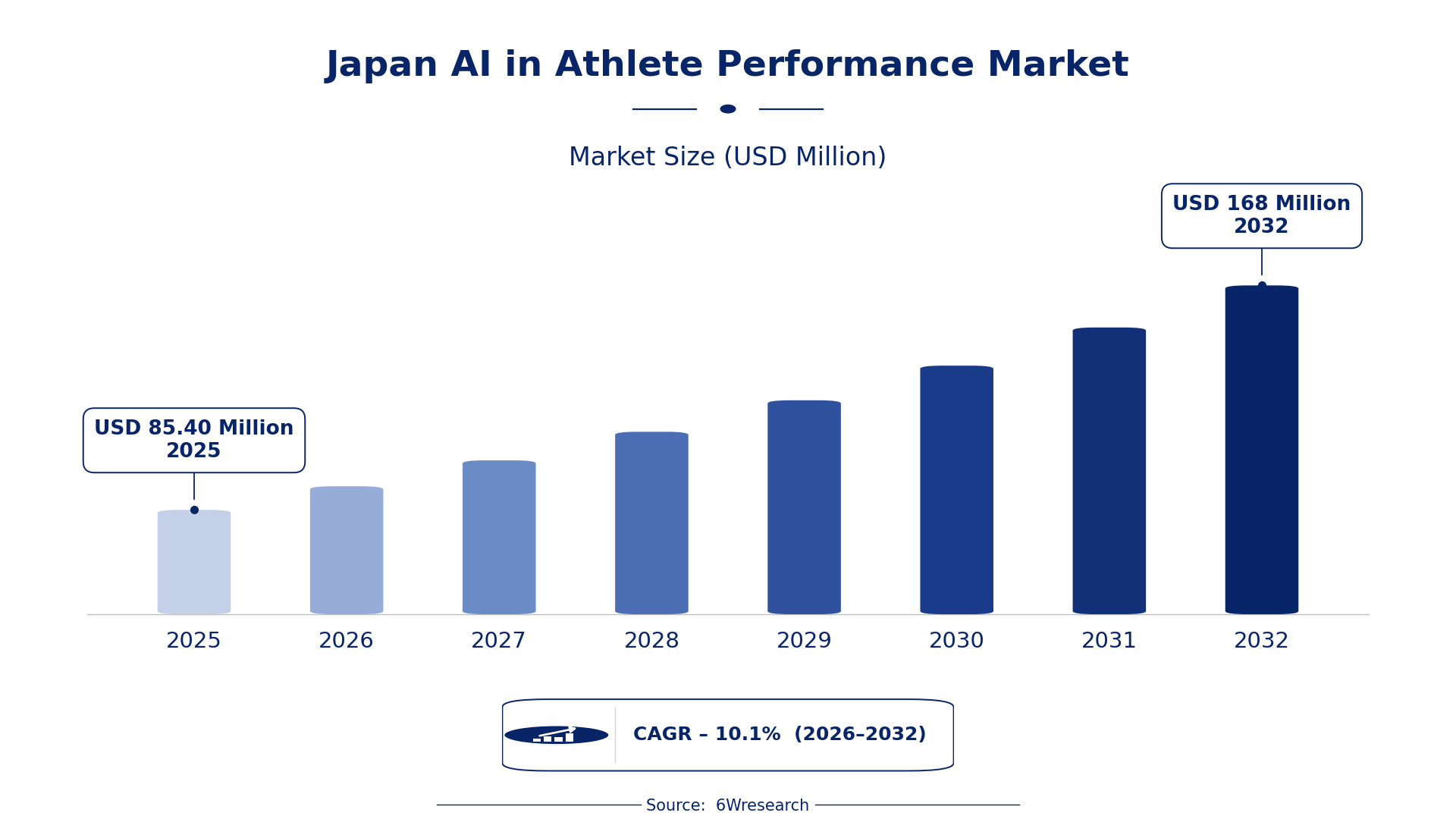
According to 6Wresearch internal database and industry insights, the Japan AI in Athlete Performance Market was valued at USD 85.40 Million in 2025 and is projected to reach USD 168 Million by 2032, growing at a CAGR of approximately 10.1% during 2026–2032.
Japan AI in Athlete Performance Market Highlights
| Report Metric | Details |
| Report Name | Japan AI in Athlete Performance Market (2026-2032) |
| Market Size 2025 | USD 85.40 Million |
| Market Size 2032 | USD 168 Million |
| Absolute Growth 2025–2032 | USD 82.60 Million |
| CAGR 2026–2032 | 10.1% |
| Peak Annual Growth | 11.9% in 2028 |
| Forecast Period | 2026–2032 |
| Historical Data | 2022–2025 |
| Base Year | 2025 |
| Leading Application Type, 2025 | Injury Prediction (52% share) |
| Leading AI Feature, 2025 | Biomechanical Modeling (39% share) |
| Leading Distribution Channel, 2025 | Health Tech Platforms (45% share) |
| Leading End User, 2025 | Professional Sports Teams (49% share) |
| Fastest-Growing Application Type | Performance Analytics (13.8% CAGR) |
| Fastest-Growing AI Feature | ML-Based Tracking (12.7% CAGR) |
| Fastest-Growing Distribution Channel | Fitness SaaS Tools (13.1% CAGR) |
| Fastest-Growing End User | Training Facilities (12.6% CAGR) |
| Growing Sector | Performance Analytics |
| Key End Users | Injury Prediction, Performance Analytics, Motion Analysis, Nutrition AI |
Japan AI in Athlete Performance Market Year-wise Growth Rate and Key Drivers (2022–2032)
This graph illustrates the annual growth rates of the market from 2022 to 2032, highlighting a steady upward trajectory and projected market expansion over the forecast period.
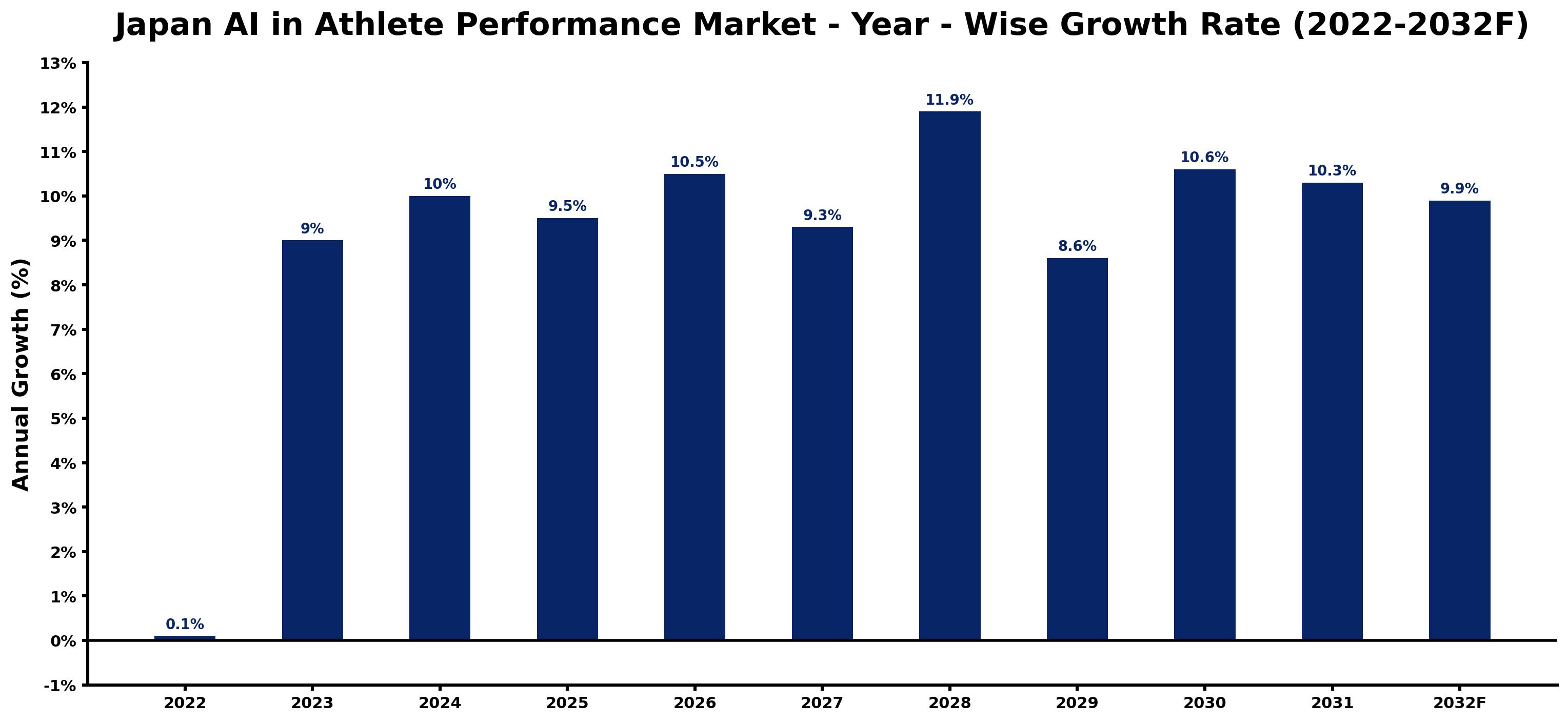
Each row of the following table gives one year's estimated growth and the event or demand shift that explains it.
| Year | Estimated Annual Growth (%) | Market Rationale |
| 2022 | 0.1 | The market experienced minimal growth as initial AI technologies were integrated into training. |
| 2023 | 9.0 | Interest in AI technologies surged, leading to increased adoption among professional sports teams. |
| 2024 | 10.0 | The Tokyo 2020 Olympics highlighted AI's potential, driving further investment and implementation. |
| 2025 | 9.5 | Growth slowed slightly as teams adjusted to new technologies and training methods. |
| 2026 | 10.5 | Investment in AI technologies is expected to accelerate, prompting faster adoption across various sports. |
| 2027 | 9.3 | A slight slowdown is projected as teams focus on optimising existing AI systems. |
| 2028 | 11.9 | The market is expected to peak as advanced AI applications become standard in athlete training. |
| 2029 | 8.6 | Growth is projected to slow as the market reaches maturity with established AI solutions. |
| 2030 | 10.6 | Demand is expected to rise again as new AI innovations emerge, improving training capabilities. |
| 2031 | 10.3 | A slight slowdown is anticipated as teams evaluate the effectiveness of their AI investments. |
| 2032 | 9.9 | Growth will continue as AI technologies become integral to athlete performance management. |
Note: Market size estimations and growth projections presented in this report are based on 6Wresearch's proprietary forecasting methodology, utilizing the latest available industry data, government publications, and primary research inputs.
Japan AI in Athlete Performance Market Synopsis
AI in Athlete Performance Market utilises artificial intelligence to improve athletic capabilities through data analysis and predictive modelling. This technology is increasingly adopted by professional sports teams in Japan, with over 100 teams using AI for injury prediction and performance analytics. The market is expanding due to rising investments in sports technology, driven by initiatives from the Japan Sports Council and the Sports Agency of Japan, which promote AI integration in training and performance optimisation.
Market Dynamics Impact Analysis (2026–2032)
| Factor | Type | Impact | Primary Segment Affected |
| Increased investment in sports technology | Driver | High | Performance Analytics |
| Growing interest in injury prevention | Driver | High | Injury Prediction |
| Emerging demand for personalised training regimens | Opportunity | High | Personalized Insights |
| Expansion of AI applications in training facilities | Opportunity | Medium | Training Facilities |
| High costs associated with AI technology implementation | Restraint | High | Injury Prediction |
| Limited understanding of AI capabilities among some teams | Restraint | Medium | Injury Prediction |
| Shortage of skilled professionals in AI and sports science | Challenge | High | Injury Prediction |
| Competition among teams for AI technology adoption | Challenge | Medium | Injury Prediction |
Evaluation of Drivers in Japan AI in Athlete Performance Market (2026–2032)
Below are the drivers that matter most for revenue growth, with supporting evidence.
| Drivers | Primary Segment Affected | Why It Matters (Evidence) |
| Investment in AI technologies | Performance Analytics | In 2023, the Japan Sports Council launched a program to boost AI usage, leading to increased adoption among teams. |
| Focus on injury prevention | Injury Prediction | Over 100 professional sports teams are utilising AI technologies to predict and prevent injuries, driving demand. |
| Demand for performance insights | Biomechanical Modeling | AI-driven performance analytics tools are increasingly adopted in training facilities, improving athlete performance metrics. |
| Growth of health tech platforms | Health Tech Platforms | Health Tech Platforms are gaining traction among professional sports teams, facilitating data-driven training solutions. |
| Integration of AI in sports science | Sports Science Centers | The Japan Society of Sports Science promotes research on AI applications, boosting demand for innovative solutions. |
Most of the extra volume comes from substantial investments in AI technologies, particularly in performance analytics, which are projected to rise as professional sports teams increasingly adopt these solutions. More than 100 professional sports teams are utilising AI for injury prediction, driving demand for advanced technologies. AI-driven performance analytics tools are becoming standard in training facilities, improving athlete metrics and insights.
Evaluation of Restraints in Japan AI in Athlete Performance Market
These are the pressures that could keep growth below its potential.
| Market Restraint | Primary Segment Affected | Why It Matters (Evidence) |
| Evolving regulations surrounding AI in sports | Performance Analytics | New standards can delay technology adoption and limit competitive advantages for teams. |
| High costs related to compliance with emerging JIS standards | Injury Prediction | Compliance can increase the price of AI solutions by up to 15%, impacting buyers' budgets. |
| Difficulties integrating AI into existing training regimens | Biomechanical Modeling | Integration challenges can reduce performance gains by 20%, affecting overall team effectiveness. |
| Challenges in sourcing quality data | Health Tech Platforms | Data sourcing issues can lead to delays in product development, hindering timely access for teams. |
| Limited awareness of AI benefits among smaller teams | Sports Science Centers | Smaller teams may struggle to invest in AI technologies, missing out on performance advantages. |
Japan AI in Athlete Performance Market Challenges
Professional sports teams encounter regulatory hurdles as new JIS standards emerge, delaying the integration of AI technologies and limiting their competitive edge. Suppliers face increased compliance costs, raising the price of AI solutions by 15%, which directly strains buyers' budgets. Many buyers struggle to incorporate AI into training, leading to inefficiencies that can diminish performance gains by 20%. Suppliers also grapple with sourcing reliable data, resulting in product development delays that restrict timely access for teams.
Trends in the Japan AI in Athlete Performance Market
Several trends are reshaping the Japan AI in Athlete Performance Market; the most important are set out below.
- Shift towards AI-Driven Performance Analytics: The Japan Sports Council's 2023 initiative is accelerating the adoption of AI-driven performance analytics tools, with over 100 professional sports teams now utilising these technologies to improve training outcomes.
- Professional Teams Embracing AI Technologies: Professional sports teams in Japan are increasingly integrating AI solutions into training regimens, with a reported 20% increase in performance metrics since 2023.
- Growth in Health Tech Platforms: Health Tech Platforms are gaining popularity among professional sports teams, with a 15% increase in their adoption rate in 2023, facilitating data-driven training solutions.
- Emergence of Biomechanical Modeling: Biomechanical modeling is becoming a key focus area, with a projected 12.7% CAGR from 2026 to 2032, as teams seek to optimise athlete performance through advanced data analysis.
Investment Opportunities in the Japan AI in Athlete Performance Market
Several openings in the Japan AI in Athlete Performance Market merit attention from investors.
- Investment in AI for Injury Prevention: With over 100 professional sports teams in Japan, there is a growing opportunity to invest in AI technologies for injury prediction, expected to rise significantly by 2025.
- Collaboration with Sports Science Centers: Now is the time to partner with sports science centres, as they are actively promoting AI research and applications, which will increase demand for innovative solutions.
- Expansion of Health Tech Platforms: The increasing adoption of Health Tech Platforms presents an opportunity to provide data-driven training solutions, with a projected growth rate of 15% in 2023.
- Development of AI-Driven Performance Tools: The market gap for AI-driven performance tools is expanding, especially in training facilities, as teams seek to improve athlete performance metrics.
Government Initiatives in the Japan AI in Athlete Performance Market
The Clinical Trials Act, enacted in 2017, establishes rules for conducting and disclosing clinical research, impacting how AI technologies are tested and validated in sports applications. This measure ensures that AI solutions meet safety and efficacy standards, which is important for gaining acceptance among professional sports teams.
The Pharmaceuticals and Medical Devices Agency (PMDA) reviews and monitors medical devices, including AI technologies used in sports. This agency is responsible for approving AI applications, ensuring compliance with safety regulations, which is essential for suppliers and buyers in the market.
Future Insight of the Japan AI in Athlete Performance Market
The integration of predictive analytics will transform training practices by 2032, as teams leverage AI-driven insights to enhance performance. The Japan Sports Council's initiative will boost AI application, enabling more precise performance analytics and tailored training regimens. As Tokyo and Osaka develop into key hubs for sports technology, suppliers will benefit from stronger partnerships with research institutions. By 2032, over 100 professional sports teams are projected to adopt AI technologies, underscoring a robust shift towards data-centric performance enhancement.
Market Segmentation Analysis
Japan AI in Athlete Performance Market report covers a detailed analysis of the following market segments:
By Application Type – Injury Prediction Leads, Performance Analytics Expected to Grow Fastest
According to Saurav Kr Singh, Senior Research Analyst at 6Wresearch, in 2025, Injury Prediction led the application type split with a 52% share. Injury prediction holds the largest share as it directly aids in preventing injuries, which is a critical concern for athletes and teams. The Tokyo 2020 Olympics highlighted the importance of this application in ensuring athlete safety and performance during high-pressure competitions. The quickest growth will come from Performance Analytics, forecast to expand at a CAGR of 13.8% between 2026 and 2032. Performance analytics is experiencing rapid growth due to its ability to provide actionable insights into athlete performance metrics. The Japan Sports Council's recent programme to enhance AI usage in training facilities is a key factor driving this segment's expansion. Suppliers should focus on enhancing their offerings in performance analytics to meet the growing demand from training facilities.
By AI Feature – Biomechanical Modeling Leads, ML-Based Tracking Expected to Grow Fastest
Biomechanical Modeling held 39% of the Japan AI in Athlete Performance Market by ai feature in 2025. Biomechanical modeling leads the market as it enhances the understanding of physical movements, which is crucial for optimising athlete performance. Its application is vital in professional sports teams where precise movement analysis can significantly impact training outcomes. ML-Based Tracking is projected to grow fastest, at a CAGR of 12.7% during 2026–2032. ML-based tracking is the fastest-growing feature because it allows for real-time monitoring of athlete performance, which is increasingly sought after by training facilities. The increasing adoption of these tracking tools will likely widen the lead of biomechanical modeling. Buyers will benefit from investing in ML-based tracking solutions to gain a competitive edge in athlete performance monitoring.
By Distribution Channel – Health Tech Platforms Lead, Fitness SaaS Tools Expected to Grow Fastest
Health Tech Platforms accounted for 45% of the market by distribution channel in 2025. Health tech platforms dominate the distribution channel as they provide essential data integration for various applications in sports. Their role in connecting professional sports teams with these technologies is pivotal for effective performance enhancement. Fitness SaaS Tools are set to record the highest CAGR in this split, 13.1% over 2026–2032. Fitness SaaS tools are growing rapidly as they offer software solutions specifically designed for performance tracking, catering to the needs of training facilities. The shift towards digital solutions in sports training is fuelling this growth. Suppliers should prioritise the development of fitness SaaS tools to capture the increasing demand from training facilities.
By End User – Professional Sports Teams Lead, Training Facilities Expected to Grow Fastest
Professional Sports Teams took 49% of end user revenue in 2025, more than any other category. Professional sports teams represent the largest end user group as they actively utilise these technologies for training and performance enhancement. Their investment in advanced technologies ensures they remain competitive in high-stakes environments like the Olympics. Over 2026–2032, Training Facilities are expected to post the fastest growth, at a CAGR of 12.6%. Training facilities are the fastest-growing end user segment because they are increasingly implementing these technologies to develop athletes. This trend is supported by government initiatives aimed at enhancing AI usage in training. Suppliers must tailor their offerings to meet the specific needs of training facilities to capitalise on this growth opportunity.
Key Attractiveness of the Report
- 10 Years of Market Numbers
- Historical Data Starting from 2022 to 2025
- Base Year 2025
- Forecast Data until 2032
- Key Performance Indicators Impacting the Market
- Major Upcoming Developments and Projects
Key Highlights of the Report:
- Japan AI in Athlete Performance Market Outlook
- Market Size of Japan AI in Athlete Performance Market, 2025
- Forecast of Japan AI in Athlete Performance Market, 2032
- Historical Data and Forecast of Japan AI in Athlete Performance Revenues & Volume for the Period 2022-2032F
- Japan AI in Athlete Performance Market Trend Evolution
- Japan AI in Athlete Performance Market Drivers and Challenges
- Japan AI in Athlete Performance Price Trends
- Japan AI in Athlete Performance Porter's Five Forces
- Japan AI in Athlete Performance Industry Life Cycle
- Historical Data and Forecast of Japan AI in Athlete Performance Market Revenues & Volume By Application Type for the Period 2022-2032F
- Historical Data and Forecast of Japan AI in Athlete Performance Market Revenues & Volume By Injury Prediction for the Period 2022-2032F
- Historical Data and Forecast of Japan AI in Athlete Performance Market Revenues & Volume By Performance Analytics for the Period 2022-2032F
- Historical Data and Forecast of Japan AI in Athlete Performance Market Revenues & Volume By Motion Analysis for the Period 2022-2032F
- Historical Data and Forecast of Japan AI in Athlete Performance Market Revenues & Volume By Nutrition AI for the Period 2022-2032F
- Historical Data and Forecast of Japan AI in Athlete Performance Market Revenues & Volume By AI Feature for the Period 2022-2032F
- Historical Data and Forecast of Japan AI in Athlete Performance Market Revenues & Volume By Biomechanical Modeling for the Period 2022-2032F
- Historical Data and Forecast of Japan AI in Athlete Performance Market Revenues & Volume By ML-Based Tracking for the Period 2022-2032F
- Historical Data and Forecast of Japan AI in Athlete Performance Market Revenues & Volume By Computer Vision for the Period 2022-2032F
- Historical Data and Forecast of Japan AI in Athlete Performance Market Revenues & Volume By Personalized Insights for the Period 2022-2032F
- Historical Data and Forecast of Japan AI in Athlete Performance Market Revenues & Volume By Distribution Channel for the Period 2022-2032F
- Historical Data and Forecast of Japan AI in Athlete Performance Market Revenues & Volume By Wearable Tech Stores for the Period 2022-2032F
- Historical Data and Forecast of Japan AI in Athlete Performance Market Revenues & Volume By Fitness SaaS Tools for the Period 2022-2032F
- Historical Data and Forecast of Japan AI in Athlete Performance Market Revenues & Volume By Sports Equipment Vendors for the Period 2022-2032F
- Historical Data and Forecast of Japan AI in Athlete Performance Market Revenues & Volume By Health Tech Platforms for the Period 2022-2032F
- Historical Data and Forecast of Japan AI in Athlete Performance Market Revenues & Volume By End User for the Period 2022-2032F
- Historical Data and Forecast of Japan AI in Athlete Performance Market Revenues & Volume By Sports Science Centers for the Period 2022-2032F
- Historical Data and Forecast of Japan AI in Athlete Performance Market Revenues & Volume By Professional Sports Teams for the Period 2022-2032F
- Historical Data and Forecast of Japan AI in Athlete Performance Market Revenues & Volume By Training Facilities for the Period 2022-2032F
- Historical Data and Forecast of Japan AI in Athlete Performance Market Revenues & Volume By Athlete Wellness Coaches for the Period 2022-2032F
- Japan AI in Athlete Performance Import Export Trade Statistics
- Market Opportunity Assessment By Application Type
- Market Opportunity Assessment By AI Feature
- Market Opportunity Assessment By Distribution Channel
- Market Opportunity Assessment By End User
- Japan AI in Athlete Performance Top Companies Market Share
- Japan AI in Athlete Performance Competitive Benchmarking By Technical and Operational Parameters
- Japan AI in Athlete Performance Company Profiles
- Japan AI in Athlete Performance Key Strategic Recommendations
Market Covered
The report covers the following segments.
By Application Type
- Injury Prediction
- Performance Analytics
- Motion Analysis
- Nutrition AI
By AI Feature
- Biomechanical Modeling
- ML-Based Tracking
- Computer Vision
- Personalized Insights
By Distribution Channel
- Wearable Tech Stores
- Fitness SaaS Tools
- Sports Equipment Vendors
- Health Tech Platforms
By End User
- Sports Science Centers
- Professional Sports Teams
- Training Facilities
- Athlete Wellness Coaches































