Japan AI in Biopharma Market Size & Growth Rate
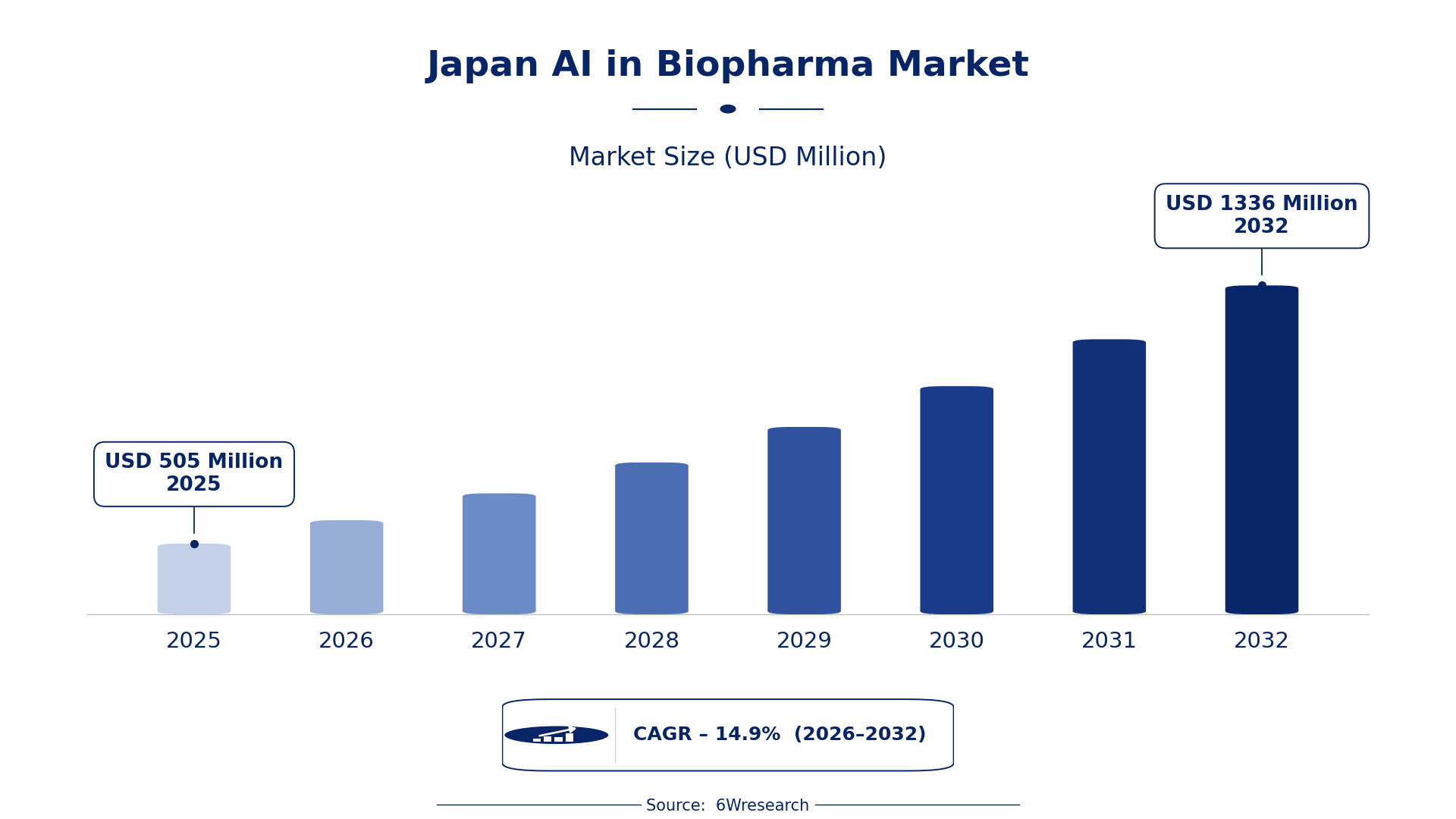
According to 6Wresearch internal database and industry insights, the Japan AI in Biopharma Market was valued at USD 505 Million in 2025 and is projected to reach USD 1,336 Million by 2032, growing at a CAGR of approximately 14.9% during 2026–2032.
Japan AI in Biopharma Market Highlights
| Report Metric | Details |
| Report Name | Japan AI in Biopharma Market (2026-2032) |
| Market Size 2025 | USD 505 Million |
| Market Size 2032 | USD 1,336 Million |
| Absolute Growth 2025–2032 | USD 831 Million |
| CAGR 2026–2032 | 14.9% |
| Peak Annual Growth | 17.3% in 2026 |
| Forecast Period | 2026–2032 |
| Historical Data | 2022–2025 |
| Base Year | 2025 |
| Leading Application Area, 2025 | Drug Target Discovery (48% share) |
| Leading AI Technique, 2025 | Deep Learning (50% share) |
| Leading Distribution Channel, 2025 | Biotech SaaS Platforms (38% share) |
| Leading End User, 2025 | Biopharmaceutical Companies (41% share) |
| Fastest-Growing Application Area | Biomarker Identification (17.8% CAGR) |
| Fastest-Growing AI Technique | Predictive Analytics (18.5% CAGR) |
| Fastest-Growing End User | Clinical Research Organizations (19.1% CAGR) |
| Growing Sector | biopharmaceutical research and development |
| Key End Users | biopharmaceutical companies, clinical research organizations, regulatory compliance teams |
Japan AI in Biopharma Market Year-wise Growth Rate and Key Drivers (2022–2032)
This graph illustrates the annual growth rates of the market from 2022 to 2032, highlighting a steady upward trajectory and projected market expansion over the forecast period.
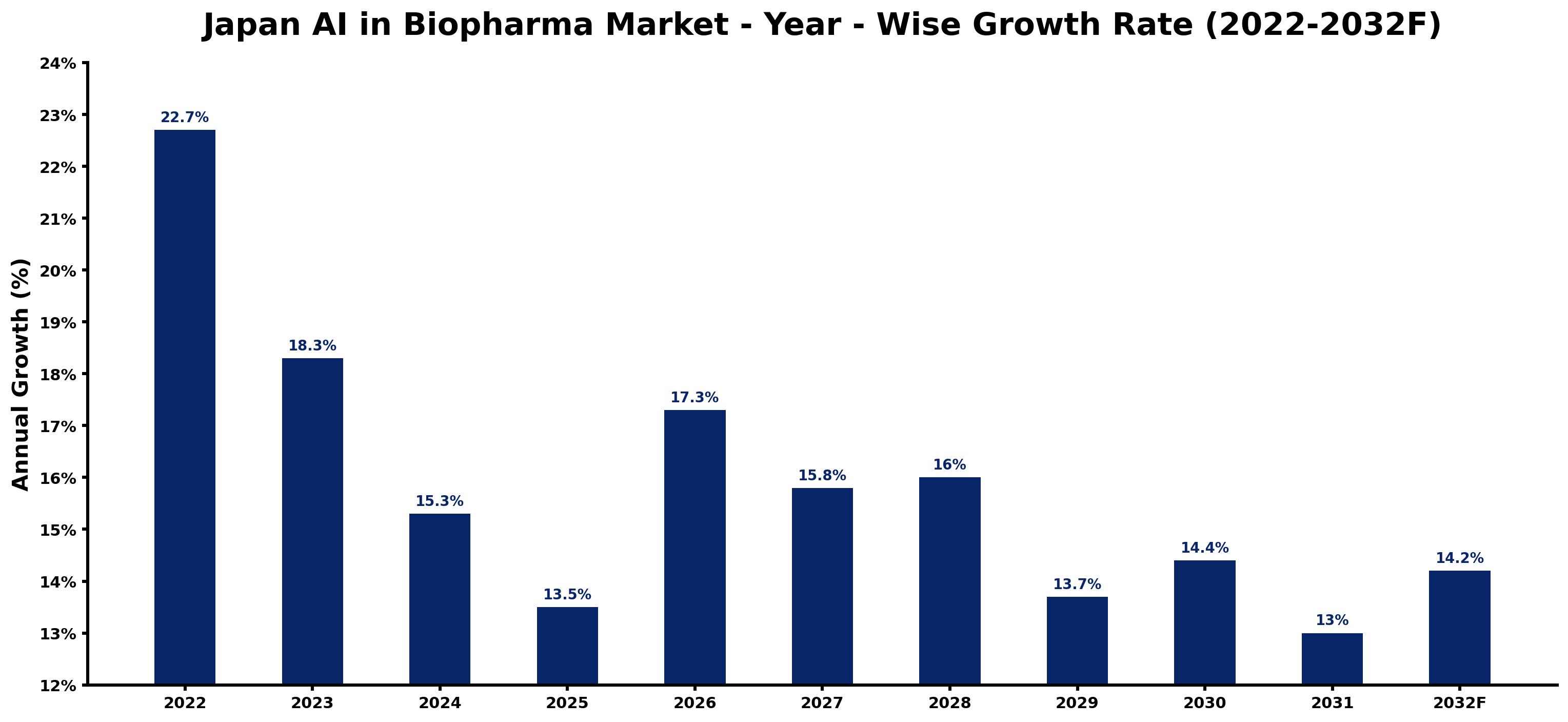
The table below sets out the estimated growth rate for each year and the main factor behind it.
| Year | Estimated Annual Growth (%) | Market Rationale |
| 2022 | 22.7 | The market experienced strong growth due to increased AI adoption in drug discovery. |
| 2023 | 18.3 | Growth slowed as firms adjusted to new AI technologies and methodologies. |
| 2024 | 15.3 | Expansion continued but at a reduced pace as companies focused on integration. |
| 2025 | 13.5 | Growth decelerated further as the market stabilised after rapid advancements. |
| 2026 | 17.3 | The market is expected to rebound with renewed interest in AI tools for trials. |
| 2027 | 15.8 | Growth will slow again as firms face challenges in scaling AI applications. |
| 2028 | 16.0 | A slight increase in growth is projected as more firms adopt AI solutions. |
| 2029 | 13.7 | The market is expected to slow as companies reassess their AI strategies. |
| 2030 | 14.4 | Growth will pick up as AI applications in biopharma become more established. |
| 2031 | 13.0 | The market is projected to slow again as competition intensifies among firms. |
| 2032 | 14.2 | Growth is expected to accelerate as advanced AI solutions gain traction. |
Note: Market size estimations and growth projections presented in this report are based on 6Wresearch's proprietary forecasting methodology, utilizing the latest available industry data, government publications, and primary research inputs.
Japan AI in Biopharma Market Synopsis
AI in Biopharma refers to the application of artificial intelligence technologies in the biopharmaceutical industry to improve drug discovery, clinical trials, and regulatory processes. The Japan AI in Biopharma Market, valued at approximately $40 billion, is experiencing robust demand from over 200 domestic companies. Key growth drivers include the adoption of AI for drug target discovery and clinical trial optimisation, with a national strategy for AI in healthcare launched in 2023 to support these advancements.
Market Dynamics Impact Analysis (2026–2032)
| Factor | Type | Impact | Primary Segment Affected |
| Increased adoption of AI technologies in drug discovery | Driver | High | Drug Target Discovery |
| Growing demand for efficient clinical trial designs | Driver | High | Clinical Trial Design |
| Rising investment in AI research and development | Opportunity | High | Biomarker Identification |
| Expansion of AI tools in clinical research organizations | Opportunity | Medium | Pharmacovigilance |
| Challenges in integrating AI with existing systems | Restraint | High | Clinical Trial Design |
| Limited availability of skilled professionals in AI | Restraint | Medium | Drug Target Discovery |
| High costs associated with AI implementation | Challenge | High | Pharmacovigilance |
| Regulatory hurdles in AI application for drug approval | Challenge | Medium | Biomarker Identification |
Evaluation of Drivers in Japan AI in Biopharma Market (2026–2032)
Demand rests on the following drivers, each shown with the segment it touches most.
| Drivers | Primary Segment Affected | Why It Matters (Evidence) |
| Growing investment in AI technologies | Drug Target Discovery | This investment drives demand for advanced tools to identify potential drug targets, with over 70% of biopharmaceutical companies reporting AI usage. |
| Need for efficient clinical trial processes | Clinical Trial Design | AI optimizes trial designs, improving outcomes, as evidenced by over 1,000 trials conducted annually using AI technologies. |
| Rising focus on drug safety monitoring | Pharmacovigilance | AI enhances safety monitoring, with 70% of companies using AI for drug safety assessments. |
| Demand for biomarker identification | Biomarker Identification | AI aids in discovering biomarkers, with a CAGR of 17.8% expected in this area. |
| Adoption of AI tools in R&D | Clinical Trial Design | The installed base of AI tools in clinical trials is over 50%, indicating strong demand for these technologies. |
Purchasing is picking up as biopharmaceutical companies increasingly invest in AI technologies for drug discovery and clinical trials. In 2023, over 70% of firms reported using AI, reflecting a strong shift towards data-driven decision-making. The installed base of AI tools in clinical trials exceeds 50%, improving efficiency and outcomes. This strategic focus is expected to drive further adoption of AI technologies across the sector, particularly in trial design, which is projected to grow as more companies recognise its benefits.
Evaluation of Restraints in Japan AI in Biopharma Market
The main factors holding the market back are set out below.
| Market Restraint | Primary Segment Affected | Why It Matters (Evidence) |
| Integration challenges with existing systems | Clinical Trial Design | Many companies struggle to integrate AI with traditional processes, delaying project timelines and increasing costs. |
| Shortage of skilled AI professionals | Drug Target Discovery | The lack of qualified personnel limits the ability to fully utilise AI technologies, impacting research outcomes. |
| High implementation costs of AI solutions | Pharmacovigilance | Investment required for AI tools can deter smaller firms from adopting these technologies. |
| Regulatory uncertainties surrounding AI applications | Biomarker Identification | Unclear guidelines from regulatory bodies create hesitation among companies to implement AI solutions. |
| Data privacy concerns in AI usage | Clinical Trial Design | Strict regulations on data handling complicate AI integration, slowing down innovation. |
Japan AI in Biopharma Market Challenges
Limited access to AI technologies hampers buyers in the biopharmaceutical sector, as many domestic companies struggle to invest in advanced tools, delaying drug discovery processes by up to six months. Regulatory hurdles arise from the Pharmaceuticals and Medical Devices Agency's stringent guidelines, extending approval timelines by 20% for clinical trials. Supply chain inefficiencies stem from reliance on outdated data systems, increasing operational costs by 15% for clinical research organisations. Intense competition among over 200 biopharmaceutical companies leads to price wars, forcing smaller firms to reduce R&D budgets by up to 25%.
Trends in the Japan AI in Biopharma Market
Buyers and suppliers in the Japan AI in Biopharma Market are adjusting to the following trends.
- Shift from Traditional to AI-Driven Drug Discovery: In 2023, over 70% of biopharmaceutical companies reported using AI for drug discovery, reflecting a shift from traditional methods. This transition improves efficiency and accelerates the drug development process.
- Emergence of Predictive Analytics in Clinical Trials: The adoption of predictive analytics has surged, with a projected CAGR of 18.5% from 2026 to 2032. This trend is driven by the need for improved trial outcomes and efficiency in clinical research.
- Increased Focus on Pharmacovigilance: Pharmacovigilance is becoming a priority, with 70% of companies employing AI to monitor drug safety. This trend highlights the growing importance of ensuring drug safety in the biopharmaceutical sector.
- Expansion of Biotech SaaS Platforms: Biotech SaaS platforms are gaining traction, holding a 38% market share in 2025. This growth is driven by the demand for accessible AI tools in biopharma applications.
Investment Opportunities in the Japan AI in Biopharma Market
The openings below show where demand in the Japan AI in Biopharma Market is visible and how suppliers can enter.
- Collaborations with Clinical Research Organizations: Now is an ideal time for partnerships, as over 1,000 clinical trials are conducted annually. Collaborating with these organisations can facilitate AI tool adoption and integration.
- Investment in AI Research and Development: With ¥10 billion allocated for AI research in healthcare in 2023, there is a substantial opportunity to invest in advanced AI solutions for biopharma applications.
- Supply of AI Tools for Drug Safety Monitoring: The demand for AI tools in pharmacovigilance is rising, providing opportunities for suppliers to develop solutions that improve drug safety monitoring.
- Navigating Approval Pathways for AI Applications: Understanding the approval pathways for AI technologies in drug development is essential. Engaging with regulatory agencies can facilitate smoother integration of AI solutions.
Government Initiatives in the Japan AI in Biopharma Market
The national strategy for AI in healthcare launched in 2023 adds support to existing laws, such as the Clinical Trials Act of 2017. This strategy aims to improve the integration of AI technologies in drug development processes, ensuring that biopharmaceutical companies can effectively utilise advanced tools.
In 2023, the government allocated ¥10 billion for AI research in healthcare, administered by the Japan Agency for Medical Research and Development. This funding supports projects that aim to improve AI applications in drug discovery and clinical trials, benefiting both producers and buyers in the biopharmaceutical sector.
Future Insight of the Japan AI in Biopharma Market
Hospitals will increasingly adopt AI in their operational workflows, enhancing patient outcomes and streamlining processes. By 2032, over 70% of biopharmaceutical companies will apply AI for drug discovery, improving efficiency in research and development. The government’s ¥10 billion allocation for AI research in healthcare will encourage suppliers to create innovative solutions. National strategies for AI in healthcare will promote collaboration among clinical research organisations, leading to a more competitive market that benefits buyers through enhanced product offerings.
Market Segmentation Analysis
Japan AI in Biopharma Market report covers a detailed analysis of the following market segments:
By Application Area – Drug Target Discovery Leads, Biomarker Identification Expected to Grow Fastest
According to Saurav Kr Singh, Senior Research Analyst at 6Wresearch, with 48% of application area revenue in 2025, Drug Target Discovery was the largest category. Drug target discovery is the leading application as it plays a crucial role in identifying viable drug candidates essential for the success of biopharmaceutical companies. The importance of this application is underscored by the fact that 70% of biopharmaceutical companies in Japan are actively using AI for this purpose. The quickest growth will come from Biomarker Identification, forecast to expand at a CAGR of 17.8% between 2026 and 2032. The rapid growth of biomarker identification is fuelled by the increasing demand for precise diagnostics, with AI significantly enhancing the discovery process. This trend is evident as companies in Japan strive to improve their diagnostic capabilities through advanced methodologies. Suppliers should focus on developing specialised solutions that address the needs of drug target discovery and biomarker identification.
By AI Technique – Deep Learning Leads, Predictive Analytics Expected to Grow Fastest
Deep Learning accounted for 50% of the market by ai technique in 2025. Deep learning leads the market due to its extensive application in analysing complex datasets, providing valuable insights for drug development. Its capability to process vast biological data effectively makes it an indispensable tool within the biopharmaceutical industry. Predictive Analytics is projected to grow fastest, at a CAGR of 18.5% during 2026–2032. Predictive analytics is witnessing rapid growth as it forecasts outcomes in drug development, which is crucial for minimising time and costs. The increasing reliance on data-driven decision-making in Japan's biopharmaceutical sector further accelerates the adoption of this technique. This signals to suppliers the need to enhance predictive analytics capabilities to align with the growing demands of biopharmaceutical companies.
By Distribution Channel – Biotech SaaS Platforms Lead and Record the Fastest Growth
The largest distribution channel category in 2025 was Biotech SaaS Platforms, at 38% of revenue. Biotech SaaS platforms dominate the market as they provide essential tools that streamline various biopharmaceutical applications, making them crucial for companies. Their accessibility and scalability are significant factors contributing to their widespread adoption in the industry. Biotech SaaS Platforms are also forecast to expand faster than any other category, at a CAGR of 16.3% over 2026–2032. The growth of biotech SaaS platforms is accelerating as they offer integrated solutions that improve efficiency in drug development processes. Their adaptability to the changing needs of biopharmaceutical companies ensures their ongoing relevance and market expansion. This underscores the importance for suppliers to develop versatile and user-friendly SaaS solutions tailored to the biopharma sector.
By End User – Biopharmaceutical Companies Lead, Clinical Research Organizations Expected to Grow Fastest
In 2025, Biopharmaceutical Companies led the end user split with a 41% share. Biopharmaceutical companies constitute the largest user group of AI technologies, directly engaging in drug development and benefiting from AI applications. Their proactive adoption of AI solutions highlights the critical role these technologies play in enhancing their operations. Over 2026–2032, Clinical Research Organizations are expected to post the fastest growth, at a CAGR of 19.1%. Clinical research organizations represent the fastest-growing user segment, leveraging AI to optimise clinical trial processes and improve overall efficiency. The increasing number of trials conducted annually in Japan reflects the growing dependence on AI within these organisations. This trend indicates that suppliers should customise their offerings to meet the specific needs of both biopharmaceutical companies and clinical research organisations.
Key Attractiveness of the Report
- 10 Years of Market Numbers
- Historical Data Starting from 2022 to 2025
- Base Year 2025
- Forecast Data until 2032
- Key Performance Indicators Impacting the Market
- Major Upcoming Developments and Projects
Key Highlights of the Report:
- Japan AI in Biopharma Market Outlook
- Market Size of Japan AI in Biopharma Market, 2025
- Forecast of Japan AI in Biopharma Market, 2032
- Historical Data and Forecast of Japan AI in Biopharma Revenues & Volume for the Period 2022-2032F
- Japan AI in Biopharma Market Trend Evolution
- Japan AI in Biopharma Market Drivers and Challenges
- Japan AI in Biopharma Price Trends
- Japan AI in Biopharma Porter's Five Forces
- Japan AI in Biopharma Industry Life Cycle
- Historical Data and Forecast of Japan AI in Biopharma Market Revenues & Volume By Application Area for the Period 2022-2032F
- Historical Data and Forecast of Japan AI in Biopharma Market Revenues & Volume By Drug Target Discovery for the Period 2022-2032F
- Historical Data and Forecast of Japan AI in Biopharma Market Revenues & Volume By Clinical Trial Design for the Period 2022-2032F
- Historical Data and Forecast of Japan AI in Biopharma Market Revenues & Volume By Biomarker Identification for the Period 2022-2032F
- Historical Data and Forecast of Japan AI in Biopharma Market Revenues & Volume By Pharmacovigilance for the Period 2022-2032F
- Historical Data and Forecast of Japan AI in Biopharma Market Revenues & Volume By AI Technique for the Period 2022-2032F
- Historical Data and Forecast of Japan AI in Biopharma Market Revenues & Volume By Deep Learning for the Period 2022-2032F
- Historical Data and Forecast of Japan AI in Biopharma Market Revenues & Volume By Predictive Analytics for the Period 2022-2032F
- Historical Data and Forecast of Japan AI in Biopharma Market Revenues & Volume By Pattern Recognition for the Period 2022-2032F
- Historical Data and Forecast of Japan AI in Biopharma Market Revenues & Volume By NLP-based Monitoring for the Period 2022-2032F
- Historical Data and Forecast of Japan AI in Biopharma Market Revenues & Volume By Distribution Channel for the Period 2022-2032F
- Historical Data and Forecast of Japan AI in Biopharma Market Revenues & Volume By Biotech SaaS Platforms for the Period 2022-2032F
- Historical Data and Forecast of Japan AI in Biopharma Market Revenues & Volume By B2B Research Networks for the Period 2022-2032F
- Historical Data and Forecast of Japan AI in Biopharma Market Revenues & Volume By Direct Enterprise Sales for the Period 2022-2032F
- Historical Data and Forecast of Japan AI in Biopharma Market Revenues & Volume By Online AI Suites for the Period 2022-2032F
- Historical Data and Forecast of Japan AI in Biopharma Market Revenues & Volume By End User for the Period 2022-2032F
- Historical Data and Forecast of Japan AI in Biopharma Market Revenues & Volume By Biopharmaceutical Companies for the Period 2022-2032F
- Historical Data and Forecast of Japan AI in Biopharma Market Revenues & Volume By Clinical Research Organizations for the Period 2022-2032F
- Historical Data and Forecast of Japan AI in Biopharma Market Revenues & Volume By Molecular Labs for the Period 2022-2032F
- Historical Data and Forecast of Japan AI in Biopharma Market Revenues & Volume By Regulatory Compliance Teams for the Period 2022-2032F
- Japan AI in Biopharma Import Export Trade Statistics
- Market Opportunity Assessment By Application Area
- Market Opportunity Assessment By AI Technique
- Market Opportunity Assessment By Distribution Channel
- Market Opportunity Assessment By End User
- Japan AI in Biopharma Top Companies Market Share
- Japan AI in Biopharma Competitive Benchmarking By Technical and Operational Parameters
- Japan AI in Biopharma Company Profiles
- Japan AI in Biopharma Key Strategic Recommendations
Market Covered
Coverage by segment is as follows.
By Application Area
- Drug Target Discovery
- Clinical Trial Design
- Biomarker Identification
- Pharmacovigilance
By AI Technique
- Deep Learning
- Predictive Analytics
- Pattern Recognition
- NLP-based Monitoring
By Distribution Channel
- Biotech SaaS Platforms
- B2B Research Networks
- Direct Enterprise Sales
- Online AI Suites
By End User
- Biopharmaceutical Companies
- Clinical Research Organizations
- Molecular Labs
- Regulatory Compliance Teams































