Japan AI in Cardiovascular Imaging Market Size & Growth Rate
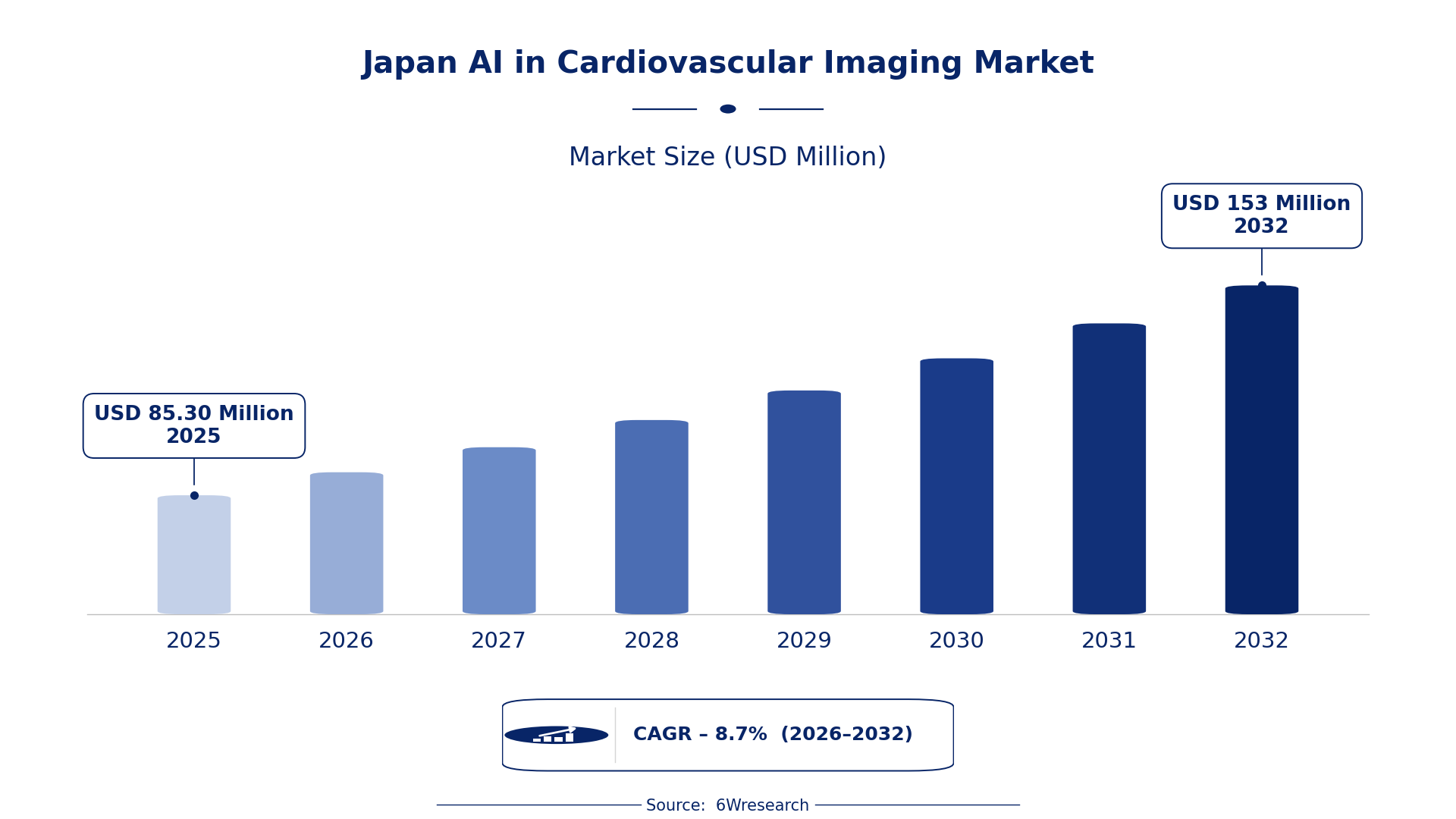
According to 6Wresearch internal database and industry insights, the Japan AI in Cardiovascular Imaging Market was valued at USD 85.30 Million in 2025 and is projected to reach USD 153 Million by 2032, growing at a CAGR of approximately 8.7% during 2026–2032.
Japan AI in Cardiovascular Imaging Market Highlights
| Report Metric | Details |
| Report Name | Japan AI in Cardiovascular Imaging Market (2026-2032) |
| Market Size 2025 | USD 85.30 Million |
| Market Size 2032 | USD 153 Million |
| Absolute Growth 2025–2032 | USD 67.70 Million |
| CAGR 2026–2032 | 8.7% |
| Peak Annual Growth | 10.6% in 2032 |
| Forecast Period | 2026–2032 |
| Historical Data | 2022–2025 |
| Base Year | 2025 |
| Leading Imaging Type, 2025 | Echocardiography (45% share) |
| Leading AI Functionality, 2025 | Image Segmentation (38% share) |
| Leading Distribution Channel, 2025 | HealthTech Platforms (41% share) |
| Leading End User, 2025 | Hospitals (42% share) |
| Fastest-Growing Imaging Type | CT Angiography (12.9% CAGR) |
| Fastest-Growing AI Functionality | Anomaly Detection (12.0% CAGR) |
| Fastest-Growing End User | Heart Care Clinics (11.3% CAGR) |
| Growing Sector | cardiovascular care |
| Key End Users | hospitals, cardiologists, heart care clinics, medical imaging vendors |
Japan AI in Cardiovascular Imaging Market Year-wise Growth Rate and Key Drivers (2022–2032)
This graph illustrates the annual growth rates of the market from 2022 to 2032, highlighting a steady upward trajectory and projected market expansion over the forecast period.
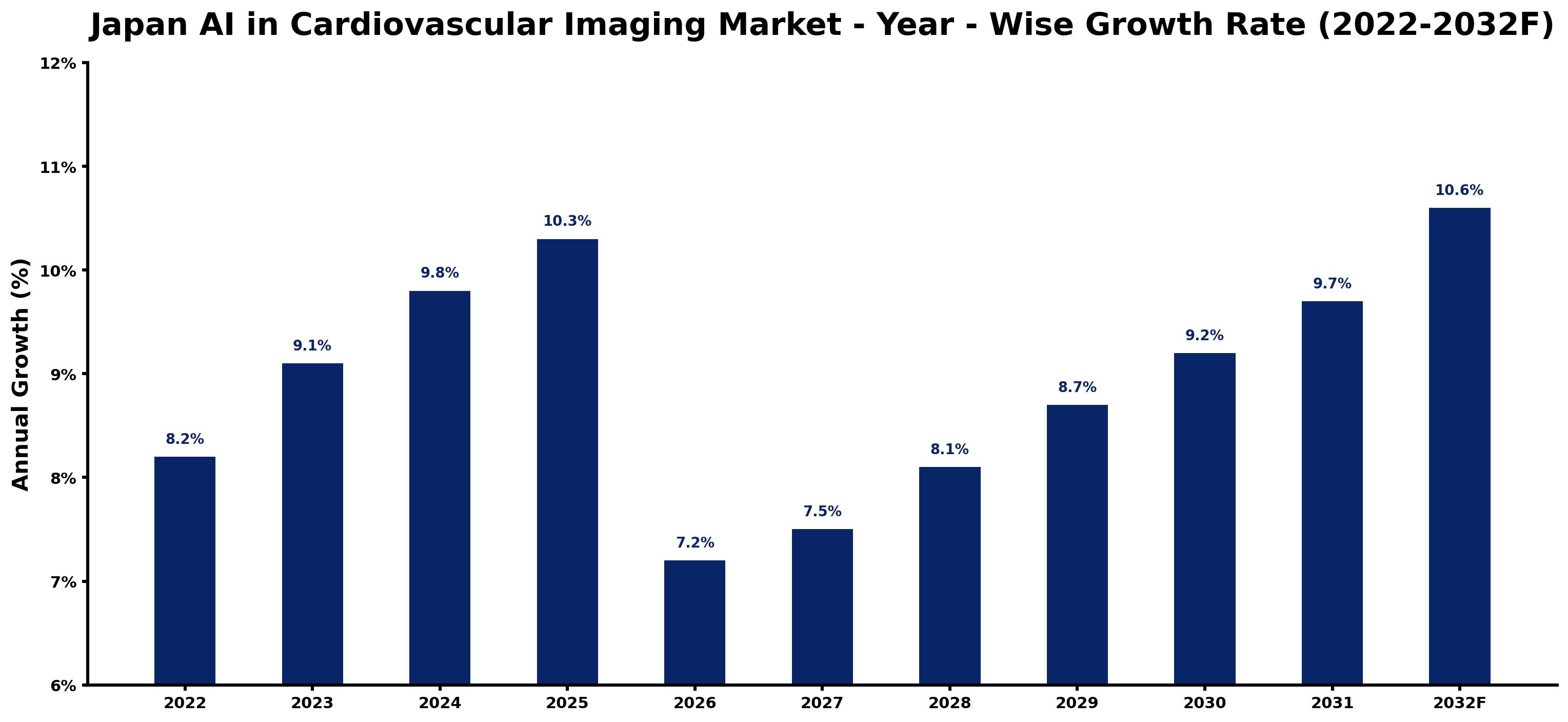
Each row of the following table gives one year's estimated growth and the event or demand shift that explains it.
| Year | Estimated Annual Growth (%) | Market Rationale |
| 2022 | 8.2 | The market showed steady growth with increasing healthcare demands. |
| 2023 | 9.1 | Growth accelerated due to heightened adoption of AI technologies in imaging. |
| 2024 | 9.8 | Continued investment in advanced imaging techniques spurred further growth. |
| 2025 | 10.3 | The market peaked as hospitals expanded AI capabilities in diagnostics. |
| 2026 | 7.2 | A slowdown occurred as the market adjusted to previous rapid growth. |
| 2027 | 7.5 | Demand increased again as healthcare providers sought improved imaging solutions. |
| 2028 | 8.1 | The market continued to grow with advancements in AI algorithms. |
| 2029 | 8.7 | Healthcare providers increasingly adopted AI tools for efficiency. |
| 2030 | 9.2 | Growth was supported by rising patient populations requiring cardiovascular care. |
| 2031 | 9.7 | The market expanded as new technologies improved imaging accuracy. |
| 2032 | 10.6 | Peak growth was driven by widespread adoption of AI in hospitals. |
Note: Market size estimations and growth projections presented in this report are based on 6Wresearch's proprietary forecasting methodology, utilizing the latest available industry data, government publications, and primary research inputs.
Japan AI in Cardiovascular Imaging Market Synopsis
AI in Cardiovascular Imaging refers to the application of artificial intelligence technologies to enhance diagnostic imaging of the heart through machine learning algorithms trained on extensive medical image datasets. The Japan AI in Cardiovascular Imaging Market is growing due to the increasing population over 65 years, which is approximately 28% of the total population. A government program launched in 2023 aims to advance AI in medical imaging, driving demand from healthcare providers and research institutions. The market is also supported by over 8,000 hospitals providing cardiovascular care, highlighting the significant need for advanced imaging solutions.
Market Dynamics Impact Analysis (2026–2032)
| Factor | Type | Impact | Primary Segment Affected |
| Increasing adoption of AI technologies in hospitals | Driver | High | Echocardiography |
| Growing elderly population requiring advanced imaging solutions | Driver | High | Cardiac MRI |
| Expansion of HealthTech platforms offering integrated imaging solutions | Opportunity | High | HealthTech Platforms |
| Investment in AI research and development for healthcare | Opportunity | High | Medical Imaging Vendors |
| Limited awareness of AI benefits among some healthcare providers | Restraint | Medium | Direct Healthcare Providers |
| High initial costs of implementing AI technologies | Restraint | Medium | Hospitals |
| Resistance to change from traditional imaging methods | Challenge | High | Cardiologists |
| Shortage of trained professionals for AI tool usage | Challenge | Medium | Heart Care Clinics |
Evaluation of Drivers in Japan AI in Cardiovascular Imaging Market (2026–2032)
The main growth drivers and the segments they affect most are set out below.
| Drivers | Primary Segment Affected | Why It Matters (Evidence) |
| Growing elderly population | Cardiac MRI | Approximately 28% of Japan's population is over 65, increasing the need for advanced imaging solutions. |
| Rising demand for accurate diagnostics | Echocardiography | Hospitals are investing in AI technologies to improve diagnostic accuracy for cardiovascular diseases. |
| Advancements in AI technology | Anomaly Detection | Innovations in machine learning enhance the ability to identify cardiac abnormalities. |
| Integration of HealthTech platforms | HealthTech Platforms | Over 200 services are available, providing integrated solutions for cardiovascular imaging. |
| Government funding for AI research | Medical Imaging Vendors | A $10 million initiative in 2023 supports the development of AI in healthcare. |
Volumes grow on the back of a significant elderly population, with approximately 28% of Japan's total population over 65 years, driving demand for advanced imaging solutions. Hospitals are increasingly investing in AI technologies to improve diagnostic accuracy, particularly in echocardiography, which remains the most common imaging technique. Innovations in machine learning are enhancing anomaly detection capabilities, enabling more precise identification of cardiac abnormalities. The integration of over 200 HealthTech platforms is providing integrated solutions for cardiovascular imaging, further boosting demand.
Evaluation of Restraints in Japan AI in Cardiovascular Imaging Market
Below are the constraints most often cited by buyers and suppliers, with the segment each affects.
| Market Restraint | Primary Segment Affected | Why It Matters (Evidence) |
| Limited awareness of AI benefits | Direct Healthcare Providers | Some healthcare providers lack knowledge about the advantages of AI, hindering adoption. |
| High initial costs of AI implementation | Hospitals | The costs associated with integrating AI technologies can deter hospitals from investing. |
| Resistance to traditional imaging methods | Cardiologists | Some cardiologists prefer established techniques, slowing the adoption of AI tools. |
| Shortage of trained professionals | Heart Care Clinics | A lack of skilled personnel to operate AI tools limits their effective use. |
| Regulatory hurdles in AI integration | Medical Imaging Vendors | Complex regulations can delay the approval of new AI technologies in imaging. |
Japan AI in Cardiovascular Imaging Market Challenges
Over 30,000 cardiologists in Japan face a skills gap in AI technologies, which obstructs effective tool integration and slows diagnostic advancements for hospitals. Many facilities continue to rely on outdated technology, prolonging upgrade times and raising costs for healthcare providers. Non-compliance with ISO 13485 standards presents regulatory challenges for producers, leading to extended approval times for new AI solutions and restricting options for clinics. Supply chain disruptions for essential imaging components can postpone project timelines, affecting the availability of advanced imaging services for patients.
Trends in the Japan AI in Cardiovascular Imaging Market
The trends below show where the Japan AI in Cardiovascular Imaging Market is heading.
- Shift from Traditional to AI-Driven Imaging: Healthcare providers are increasingly adopting AI-driven imaging techniques, with over 8,000 hospitals in Japan integrating these technologies to improve diagnostic accuracy.
- Rise in HealthTech Platforms: The number of HealthTech platforms has surged, with over 200 services available in Japan, facilitating the integration of AI in cardiovascular imaging.
- Increased Use of Cardiac MRI: Cardiac MRI is now used in over 50% of advanced heart disease cases in urban hospitals, reflecting a shift towards more detailed imaging techniques.
- Growing Demand for Anomaly Detection: Anomaly detection technologies are becoming essential, driven by advancements in AI, with hospitals increasingly relying on these tools for accurate diagnostics.
Investment Opportunities in the Japan AI in Cardiovascular Imaging Market
The opportunities below stand out in the Japan AI in Cardiovascular Imaging Market for new entrants and existing suppliers.
- Expansion of HealthTech Platforms: The Tokyo Metropolitan area is experiencing growth in HealthTech platforms, with over 200 services available, creating opportunities for investment in integrated imaging solutions.
- Investment in AI Research: With a $10 million government initiative for AI research in healthcare, medical imaging vendors have the opportunity to develop advanced solutions.
- Partnerships with Hospitals: Hospitals are actively pursuing AI solutions, offering opportunities for partnerships to provide advanced imaging technologies.
- Development of AI Diagnostic Tools: There is an increasing need for AI diagnostic tools in heart care clinics, presenting opportunities for investment in specialised software and services.
Government Initiatives in the Japan AI in Cardiovascular Imaging Market
The 2023 initiative by the Ministry of Health seeks to advance AI in medical imaging, building on the Clinical Trials Act of 2017, which established rules for clinical research. This new measure supports the integration of AI technologies in healthcare, ensuring adherence to established standards and improving diagnostic capabilities for healthcare providers.
The Pharmaceuticals and Medical Devices Agency (PMDA) evaluates medical devices, including AI tools, to ensure they meet safety and efficacy standards. The agency is crucial in approving new AI solutions for cardiovascular imaging, facilitating their integration into clinical practice.
Future Insight of the Japan AI in Cardiovascular Imaging Market
The launch of new AI research programmes will reshape cardiovascular imaging by 2032. A government initiative is set to allocate substantial funding for AI research, facilitating the development of more sophisticated imaging algorithms. HealthTech services are projected to surpass 300, broadening access to advanced diagnostic tools for buyers. Consequently, hospitals and clinics will see improved diagnostic accuracy and treatment planning, which will enhance patient outcomes.
Market Segmentation Analysis
Japan AI in Cardiovascular Imaging Market report covers a detailed analysis of the following market segments:
By Imaging Type – Echocardiography Leads, CT Angiography Expected to Grow Fastest
According to Saurav Kr Singh, Senior Research Analyst at 6Wresearch, Echocardiography took 45% of imaging type revenue in 2025, more than any other category. Echocardiography holds the largest share as it is the primary imaging technique for assessing heart function, widely used across Japan's extensive network of over 8,000 hospitals. Its established role in routine cardiovascular evaluations ensures a steady demand from healthcare providers. The quickest growth will come from CT Angiography, forecast to expand at a CAGR of 12.9% between 2026 and 2032. CT Angiography is experiencing rapid growth due to its capability to provide detailed visualisation of coronary arteries, which is essential for diagnosing advanced heart conditions. The high concentration of heart care clinics in urban areas is further driving its adoption. Suppliers should focus on enhancing echocardiography capabilities to maintain its market leadership.
By AI Functionality – Image Segmentation Leads, Anomaly Detection Expected to Grow Fastest
The largest ai functionality category in 2025 was Image Segmentation, at 38% of revenue. Image Segmentation leads the market because it is essential for isolating relevant anatomical structures in images, thereby improving diagnostic accuracy. This functionality is increasingly preferred by healthcare providers who aim to enhance patient outcomes. Anomaly Detection is set to record the highest CAGR in this split, 12.0% over 2026–2032. Anomaly Detection is the fastest-growing segment as it is crucial for identifying abnormalities in cardiac images, facilitating timely interventions. The rising incidence of cardiovascular diseases in Japan is significantly boosting its demand. Buyers will benefit from investing in advanced anomaly detection tools to enhance diagnostic precision.
By Distribution Channel – HealthTech Platforms Lead and Record the Fastest Growth
With 41% of distribution channel revenue in 2025, HealthTech Platforms was the largest category. HealthTech Platforms dominate the distribution channel by providing integrated solutions for cardiovascular imaging, which streamline workflows for healthcare providers. Their comprehensive service offerings make them the preferred choice among hospitals and clinics. HealthTech Platforms are also forecast to expand faster than any other category, at a CAGR of 11.5% over 2026–2032. HealthTech Platforms are also the fastest-growing channel due to the increasing adoption of digital solutions in healthcare. Ongoing government initiatives aimed at enhancing AI in medical imaging are further propelling their growth. Suppliers should prioritise partnerships with HealthTech Platforms to optimise their market presence.
By End User – Hospitals Lead, Heart Care Clinics Expected to Grow Fastest
Hospitals accounted for 42% of the market by end user in 2025. Hospitals account for the largest share as they implement AI solutions in their imaging departments, catering to a wide patient base. Their capacity to invest in advanced technologies ensures they remain at the forefront of cardiovascular care. Heart Care Clinics are projected to grow fastest, at a CAGR of 11.3% during 2026–2032. Heart Care Clinics are the fastest-growing end user segment as they utilise advanced imaging for patient diagnosis and treatment, addressing the specific needs of cardiovascular patients. The concentration of these clinics in urban areas is driving their rapid expansion. Suppliers must tailor their offerings to meet the unique requirements of heart care clinics to capture emerging opportunities.
Key Attractiveness of the Report
- 10 Years of Market Numbers
- Historical Data Starting from 2022 to 2025
- Base Year 2025
- Forecast Data until 2032
- Key Performance Indicators Impacting the Market
- Major Upcoming Developments and Projects
Key Highlights of the Report:
- Japan AI in Cardiovascular Imaging Market Outlook
- Market Size of Japan AI in Cardiovascular Imaging Market, 2025
- Forecast of Japan AI in Cardiovascular Imaging Market, 2032
- Historical Data and Forecast of Japan AI in Cardiovascular Imaging Revenues & Volume for the Period 2022-2032F
- Japan AI in Cardiovascular Imaging Market Trend Evolution
- Japan AI in Cardiovascular Imaging Market Drivers and Challenges
- Japan AI in Cardiovascular Imaging Price Trends
- Japan AI in Cardiovascular Imaging Porter's Five Forces
- Japan AI in Cardiovascular Imaging Industry Life Cycle
- Historical Data and Forecast of Japan AI in Cardiovascular Imaging Market Revenues & Volume By Imaging Type for the Period 2022-2032F
- Historical Data and Forecast of Japan AI in Cardiovascular Imaging Market Revenues & Volume By Echocardiography for the Period 2022-2032F
- Historical Data and Forecast of Japan AI in Cardiovascular Imaging Market Revenues & Volume By CT Angiography for the Period 2022-2032F
- Historical Data and Forecast of Japan AI in Cardiovascular Imaging Market Revenues & Volume By Cardiac MRI for the Period 2022-2032F
- Historical Data and Forecast of Japan AI in Cardiovascular Imaging Market Revenues & Volume By Ultrasound Analysis for the Period 2022-2032F
- Historical Data and Forecast of Japan AI in Cardiovascular Imaging Market Revenues & Volume By AI Functionality for the Period 2022-2032F
- Historical Data and Forecast of Japan AI in Cardiovascular Imaging Market Revenues & Volume By Image Segmentation for the Period 2022-2032F
- Historical Data and Forecast of Japan AI in Cardiovascular Imaging Market Revenues & Volume By Anomaly Detection for the Period 2022-2032F
- Historical Data and Forecast of Japan AI in Cardiovascular Imaging Market Revenues & Volume By Risk Stratification for the Period 2022-2032F
- Historical Data and Forecast of Japan AI in Cardiovascular Imaging Market Revenues & Volume By Measurement Automation for the Period 2022-2032F
- Historical Data and Forecast of Japan AI in Cardiovascular Imaging Market Revenues & Volume By Distribution Channel for the Period 2022-2032F
- Historical Data and Forecast of Japan AI in Cardiovascular Imaging Market Revenues & Volume By HealthTech Platforms for the Period 2022-2032F
- Historical Data and Forecast of Japan AI in Cardiovascular Imaging Market Revenues & Volume By Medical Imaging Vendors for the Period 2022-2032F
- Historical Data and Forecast of Japan AI in Cardiovascular Imaging Market Revenues & Volume By SaaS Diagnostic Tools for the Period 2022-2032F
- Historical Data and Forecast of Japan AI in Cardiovascular Imaging Market Revenues & Volume By Direct Healthcare Providers for the Period 2022-2032F
- Historical Data and Forecast of Japan AI in Cardiovascular Imaging Market Revenues & Volume By End User for the Period 2022-2032F
- Historical Data and Forecast of Japan AI in Cardiovascular Imaging Market Revenues & Volume By Cardiologists for the Period 2022-2032F
- Historical Data and Forecast of Japan AI in Cardiovascular Imaging Market Revenues & Volume By Heart Care Clinics for the Period 2022-2032F
- Historical Data and Forecast of Japan AI in Cardiovascular Imaging Market Revenues & Volume By Hospitals for the Period 2022-2032F
- Historical Data and Forecast of Japan AI in Cardiovascular Imaging Market Revenues & Volume By Radiology Departments for the Period 2022-2032F
- Japan AI in Cardiovascular Imaging Import Export Trade Statistics
- Market Opportunity Assessment By Imaging Type
- Market Opportunity Assessment By AI Functionality
- Market Opportunity Assessment By Distribution Channel
- Market Opportunity Assessment By End User
- Japan AI in Cardiovascular Imaging Top Companies Market Share
- Japan AI in Cardiovascular Imaging Competitive Benchmarking By Technical and Operational Parameters
- Japan AI in Cardiovascular Imaging Company Profiles
- Japan AI in Cardiovascular Imaging Key Strategic Recommendations
Market Covered
The study includes the following segmentation.
By Imaging Type
- Echocardiography
- CT Angiography
- Cardiac MRI
- Ultrasound Analysis
By AI Functionality
- Image Segmentation
- Anomaly Detection
- Risk Stratification
- Measurement Automation
By Distribution Channel
- HealthTech Platforms
- Medical Imaging Vendors
- SaaS Diagnostic Tools
- Direct Healthcare Providers
By End User
- Cardiologists
- Heart Care Clinics
- Hospitals
- Radiology Departments































