Japan AI in Clinical Decision Support Market Size & Growth Rate
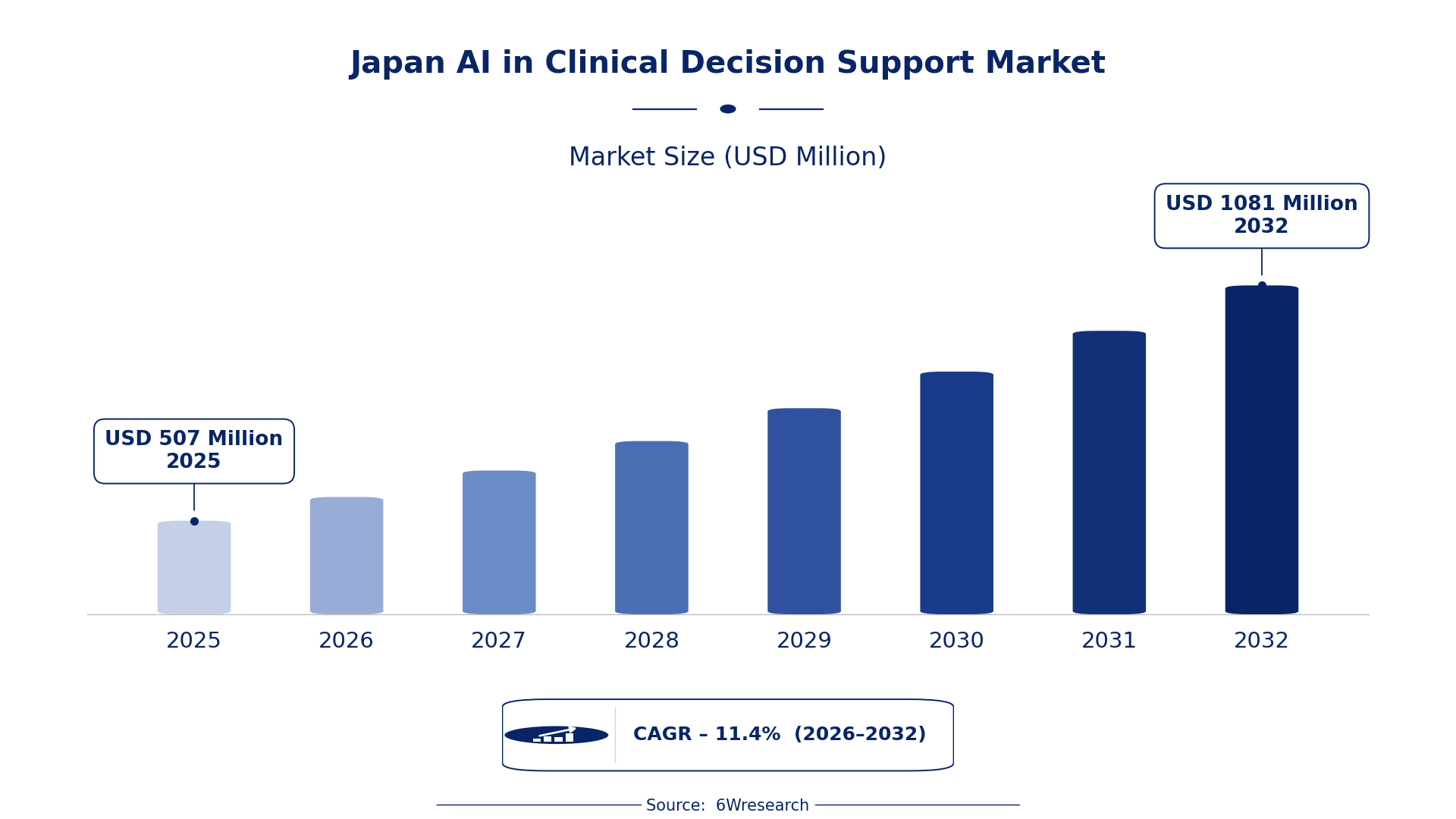
According to 6Wresearch internal database and industry insights, the Japan AI in Clinical Decision Support Market was valued at USD 507 Million in 2025 and is projected to reach USD 1,081 Million by 2032, growing at a CAGR of approximately 11.4% during 2026–2032.
Japan AI in Clinical Decision Support Market Highlights
| Report Metric | Details |
| Report Name | Japan AI in Clinical Decision Support Market (2026-2032) |
| Market Size 2025 | USD 507 Million |
| Market Size 2032 | USD 1,081 Million |
| Absolute Growth 2025–2032 | USD 574 Million |
| CAGR 2026–2032 | 11.4% |
| Peak Annual Growth | 14.6% in 2026 |
| Forecast Period | 2026–2032 |
| Historical Data | 2022–2025 |
| Base Year | 2025 |
| Leading Support Type, 2025 | Diagnosis Assistance (37% share) |
| Leading AI Method, 2025 | Deep Neural Networks (49% share) |
| Leading Distribution Channel, 2025 | Clinical SaaS Platforms (49% share) |
| Leading End User, 2025 | Hospitals & Clinics (42% share) |
| Fastest-Growing Support Type | Prognostic Analytics (15.3% CAGR) |
| Fastest-Growing AI Method | Predictive AI (15.7% CAGR) |
| Fastest-Growing End User | Healthcare Providers (14.4% CAGR) |
| Growing Sector | Healthcare Providers |
| Key End Users | Hospitals & Clinics, Healthcare Providers, Emergency Response Teams, General Practitioners |
Japan AI in Clinical Decision Support Market Year-wise Growth Rate and Key Drivers (2022–2032)
This graph illustrates the annual growth rates of the market from 2022 to 2032, highlighting a steady upward trajectory and projected market expansion over the forecast period.
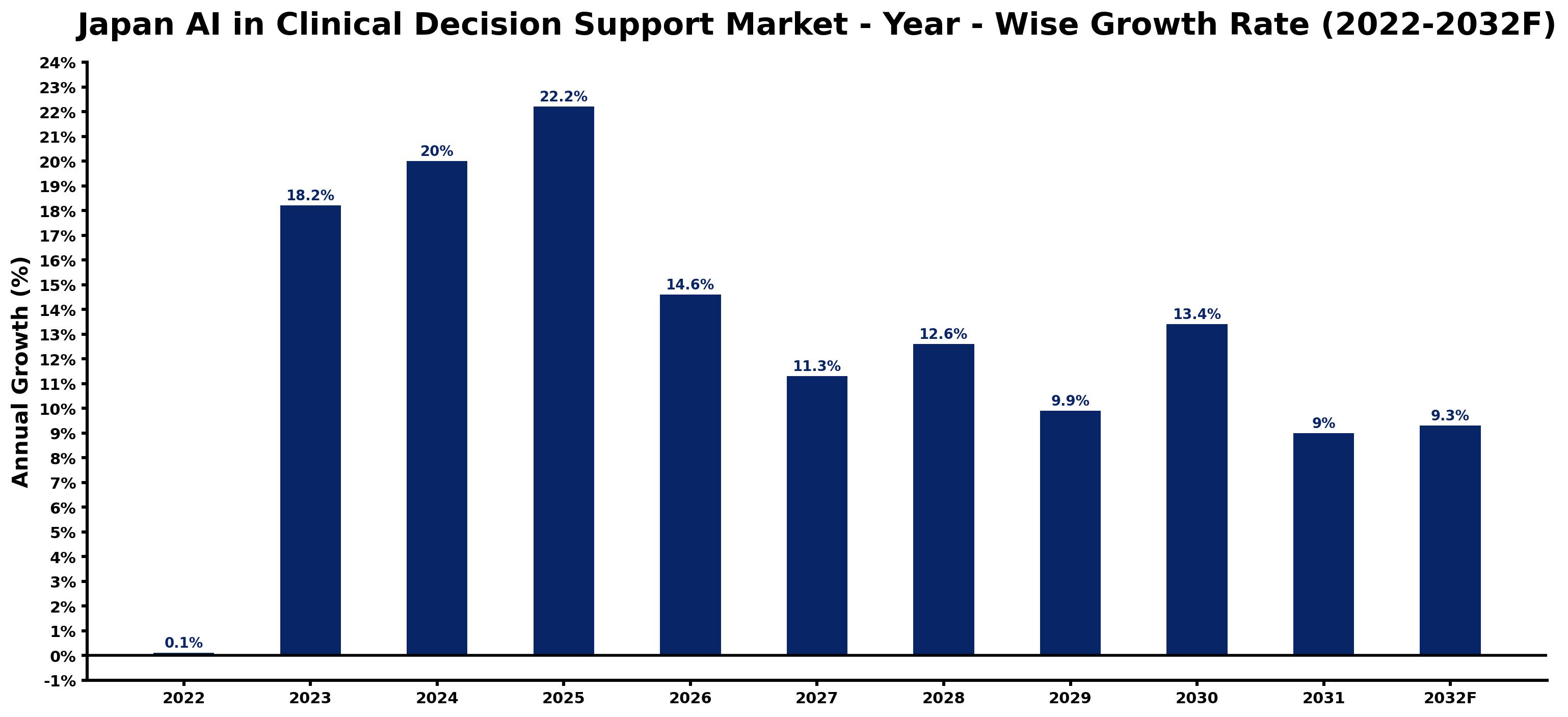
Below, each year's estimated growth is shown next to the factor that most influenced it.
| Year | Estimated Annual Growth (%) | Market Rationale |
| 2022 | 0.1 | The market exhibited minimal growth due to initial integration phases of AI technologies. |
| 2023 | 18.2 | Demand surged as hospitals began adopting AI for diagnostic assistance and treatment optimization. |
| 2024 | 20.0 | Continued investment in AI technologies propelled growth, especially in urban healthcare facilities. |
| 2025 | 22.2 | The peak growth year saw widespread implementation of AI tools across numerous hospitals. |
| 2026 | 14.6 | Growth is expected to slow as the market stabilises after the rapid adoption phase. |
| 2027 | 11.3 | Demand will continue to rise, though at a reduced rate as market saturation approaches. |
| 2028 | 12.6 | Increased focus on predictive analytics will drive renewed interest in AI solutions. |
| 2029 | 9.9 | A slight slowdown is projected as hospitals reassess their AI integration strategies. |
| 2030 | 13.4 | Growth is expected to rebound as new AI applications emerge, improving clinical decision-making. |
| 2031 | 9.0 | The market will experience slower growth as competition intensifies among AI providers. |
| 2032 | 9.3 | Demand is projected to increase again as healthcare providers seek advanced AI capabilities. |
Note: Market size estimations and growth projections presented in this report are based on 6Wresearch's proprietary forecasting methodology, utilizing the latest available industry data, government publications, and primary research inputs.
Japan AI in Clinical Decision Support Market Synopsis
AI in Clinical Decision Support employs advanced algorithms to assist healthcare professionals in making informed decisions. This technology improves diagnostic accuracy, predicts patient outcomes, and optimises treatment plans. The Japan AI in Clinical Decision Support Market is expanding, driven by the increasing number of hospitals adopting AI solutions, particularly in urban areas like Tokyo, where over 8,100 healthcare facilities utilise these technologies. The national medical care expenditure, approximately JPY 46.7 trillion, fuels investments in AI-driven healthcare solutions, creating a more efficient healthcare system.
Market Dynamics Impact Analysis (2026–2032)
| Factor | Type | Impact | Primary Segment Affected |
| The ageing population drives demand for improved healthcare solutions. | Driver | High | Diagnosis Assistance |
| The integration of AI in hospitals enhances operational efficiency. | Driver | High | Clinical SaaS Platforms |
| Urban hospitals are increasingly adopting AI technologies to improve patient care. | Opportunity | High | Health Information Systems |
| Healthcare providers are seeking partnerships to enhance AI capabilities. | Opportunity | High | Predictive AI |
| Limited awareness of AI benefits constrains adoption in rural areas. | Restraint | Medium | Treatment Optimization |
| Data security concerns may hinder AI implementation in healthcare settings. | Restraint | Medium | Alert Systems |
| High initial investment costs deter smaller healthcare facilities from adopting AI. | Challenge | High | Hospitals & Clinics |
| The rapid pace of technological change creates challenges for integration. | Challenge | Medium | Emergency Response Teams |
Evaluation of Drivers in Japan AI in Clinical Decision Support Market (2026–2032)
Demand rests on the following drivers, each shown with the segment it touches most.
| Drivers | Primary Segment Affected | Why It Matters (Evidence) |
| Growing elderly population increases the need for accurate diagnosis. | Diagnosis Assistance | 29.3% of Japan's population was aged 65 or older in September 2024, leading to higher demand for AI-driven diagnostic tools. |
| Investment in AI technologies improves treatment planning capabilities. | Treatment Optimization | Japan's national medical care expenditure was about JPY 46.7 trillion in fiscal 2022, prompting hospitals to adopt AI for better treatment outcomes. |
| Increased urbanisation drives AI adoption in healthcare facilities. | Clinical SaaS Platforms | The Tokyo region leads in AI adoption with over 1,500 healthcare facilities, creating a strong market for SaaS solutions. |
| Healthcare providers are focusing on predictive analytics to improve patient care. | Predictive AI | Predictive analytics is a focus area in 70% of healthcare providers, indicating a shift towards data-driven decision-making. |
| The demand for real-time monitoring systems is rising among emergency teams. | Alert Systems | Emergency Response Teams increasingly rely on AI for real-time decision making, improving patient outcomes during critical situations. |
Much of the new demand traces back to the increasing elderly population, with 29.3% aged 65 or older as of September 2024. This demographic shift drives hospitals to adopt AI for diagnosis assistance, particularly in urban areas where advanced technologies are being integrated. The national medical care expenditure of approximately JPY 46.7 trillion in fiscal 2022 has led to substantial investments in AI for treatment optimisation. A growing trend among healthcare providers shows that 70% focus on predictive analytics to improve patient care and operational efficiency, indicating a shift towards more efficient healthcare practices.
Evaluation of Restraints in Japan AI in Clinical Decision Support Market
The key brakes on demand, and where they bite hardest, are shown below.
| Market Restraint | Primary Segment Affected | Why It Matters (Evidence) |
| High training costs for healthcare professionals hinder AI adoption. | Diagnosis Assistance | Hospitals must invest up to JPY 1.5 billion annually to upskill staff, delaying implementation by up to six months. |
| Regulatory hurdles impede progress in AI integration. | Clinical SaaS Platforms | Compliance with ISO 27001 standards can take over a year, straining resources for hospitals. |
| Competition from international markets pressures local producers. | Predictive AI | Local producers must innovate rapidly, risking potential market share losses if they fail to keep pace. |
| Technology integration challenges arise from outdated health information systems. | Treatment Optimization | These complications result in inefficiencies that can cost hospitals millions in operational delays. |
| Limited awareness among healthcare providers about AI capabilities. | Alert Systems | This lack of knowledge restricts the adoption of AI tools, affecting overall market growth. |
Japan AI in Clinical Decision Support Market Challenges
High training costs for healthcare professionals can reach JPY 1.5 billion annually per hospital, creating barriers to effective AI implementation and delaying patient care. Compliance with ISO 27001 standards often takes over a year, consuming valuable resources and extending project timelines for hospitals. Local producers encounter fierce competition from international markets, risking a 15% market share loss if they fail to innovate rapidly. Technology integration challenges persist as many facilities still depend on outdated health information systems, resulting in inefficiencies that can cost hospitals up to JPY 3 trillion in operational delays.
Trends in the Japan AI in Clinical Decision Support Market
Four trends stand out in the Japan AI in Clinical Decision Support Market.
- Shift from Traditional to AI-Driven Diagnostics: Tokyo is experiencing a shift from traditional diagnostic methods to AI-driven solutions, with over 60% of hospitals reporting AI usage for diagnosis assistance. This transition is expected to improve patient outcomes.
- Increase in Predictive Analytics Adoption: Healthcare providers are increasingly adopting predictive analytics, with 70% focusing on this area. This trend is reshaping patient care strategies, particularly in urban hospitals, where data-driven decision-making is becoming standard.
- Growth of Clinical SaaS Platforms: The adoption of Clinical SaaS Platforms is rising, especially in urban healthcare facilities. This shift is supported by the Tokyo Medical Association, which promotes AI in clinical decision-making, improving service delivery.
- Expansion of AI-Based Clinical Tools: The number of AI-based clinical decision support tools available has surpassed 200 in 2023. This growth reflects the increasing integration of AI technologies in healthcare, driven by the demand for improved patient management.
Investment Opportunities in the Japan AI in Clinical Decision Support Market
The following areas offer the clearest openings for investors and suppliers in the Japan AI in Clinical Decision Support Market.
- Partnerships with Urban Hospitals: Partnering with urban hospitals presents a key opportunity, as over 8,100 facilities are integrating AI solutions. This market is projected to grow, supported by the need for improved patient care.
- Investment in Predictive Analytics: Investing in predictive analytics tools is a key opportunity, with 70% of healthcare providers focusing on this area. Collaborating with healthcare providers can facilitate entry into this expanding market.
- Development of AI Training Programs: There is a growing need for AI training programs for healthcare professionals, as high training costs hinder adoption. Establishing training partnerships can address this gap and improve AI integration.
- Expansion of AI Integration Services: The demand for AI integration services is increasing, particularly among hospitals seeking to modernise their systems. Targeting urban healthcare facilities can yield substantial returns, given the ongoing technological advancements.
Government Initiatives in the Japan AI in Clinical Decision Support Market
The Medical Care Act of 1948 establishes standards for hospitals and clinics, including facilities and staffing requirements. This law has laid the groundwork for healthcare regulations, ensuring quality in medical services and promoting the integration of advanced technologies.
In 2023, the government allocated ¥5 billion for AI healthcare initiatives, administered by the Ministry of Health, Labour and Welfare. This funding supports the development and integration of AI technologies in healthcare, improving service delivery across the sector.
Future Insight of the Japan AI in Clinical Decision Support Market
New clinical decision support tools will emerge by 2032, driven by initiatives like the ¥5 billion allocated for AI healthcare projects. Urban hospitals will implement advanced algorithms to enhance diagnostic accuracy and optimise treatment plans. Integration with modern health information systems will facilitate quicker decision-making for medical professionals. As the Tokyo region maintains its lead in AI adoption, partnerships between healthcare facilities and technology developers will create a more streamlined healthcare environment.
Market Segmentation Analysis
Japan AI in Clinical Decision Support Market report covers a detailed analysis of the following market segments:
By Support Type – Diagnosis Assistance Leads, Prognostic Analytics Expected to Grow Fastest
According to Saurav Kr Singh, Senior Research Analyst at 6Wresearch, with 37% of support type revenue in 2025, Diagnosis Assistance was the largest category. Diagnosis assistance holds the largest share as it plays a critical role in improving diagnostic accuracy across healthcare facilities. With over 60% of hospitals employing this method, it is integral to clinical decision-making in Japan. The quickest growth will come from Prognostic Analytics, forecast to expand at a CAGR of 15.3% between 2026 and 2032. Prognostic analytics is rapidly growing due to its importance in predicting disease progression, increasingly prioritised by healthcare providers. This trend is evident as 70% of providers focus on predictive analytics to enhance patient outcomes. Suppliers should prioritise developing solutions that strengthen diagnostic and prognostic capabilities to meet increasing demand.
By AI Method – Deep Neural Networks Lead, Predictive AI Expected to Grow Fastest
Deep Neural Networks accounted for 49% of the market by ai method in 2025. Deep neural networks lead the market as they are extensively used for complex data analysis, making them vital in healthcare applications. Their ability to handle large datasets effectively has resulted in widespread adoption among healthcare providers. Predictive AI is projected to grow fastest, at a CAGR of 15.7% during 2026–2032. Predictive AI is experiencing the fastest growth owing to its role in anticipating patient needs and risks, essential for proactive healthcare management. The rising focus on patient-centric care further propels this trend. Buyers should seek solutions that leverage deep neural networks and predictive capabilities to maintain a competitive edge.
By Distribution Channel – Clinical SaaS Platforms Lead and Record the Fastest Growth
In 2025, Clinical SaaS Platforms led the distribution channel split with a 49% share. Clinical SaaS platforms dominate the distribution channel as they serve as the primary method for delivering AI solutions in healthcare, providing convenient access for end users. Their widespread adoption in urban hospitals underscores their significance in the market. Clinical SaaS Platforms are also forecast to expand faster than any other category, at a CAGR of 14.3% over 2026–2032. Clinical SaaS platforms are also the fastest growing segment, reflecting a shift towards cloud-based solutions that offer flexibility and scalability. This trend aligns with the increasing demand for efficient healthcare delivery models. Suppliers must invest in robust SaaS offerings to capitalise on the growing preference for cloud-based solutions.
By End User – Hospitals & Clinics Lead, Healthcare Providers Expected to Grow Fastest
Hospitals & Clinics took 42% of end user revenue in 2025, more than any other category. Hospitals and clinics represent the largest end user segment as they are the main consumers of AI technologies in clinical settings, utilising these tools to enhance patient care. Their extensive infrastructure supports effective integration of AI solutions. Over 2026–2032, Healthcare Providers are expected to post the fastest growth, at a CAGR of 14.4%. Healthcare providers are the fastest growing segment, employing AI to improve patient care and operational efficiency. This growth is driven by the rising need for advanced decision support tools across various healthcare settings. Suppliers should tailor their offerings to meet the specific needs of hospitals and healthcare providers to maximise market penetration.
Key Attractiveness of the Report
- 10 Years of Market Numbers
- Historical Data Starting from 2022 to 2025
- Base Year 2025
- Forecast Data until 2032
- Key Performance Indicators Impacting the Market
- Major Upcoming Developments and Projects
Key Highlights of the Report:
- Japan AI in Clinical Decision Support Market Outlook
- Market Size of Japan AI in Clinical Decision Support Market, 2025
- Forecast of Japan AI in Clinical Decision Support Market, 2032
- Historical Data and Forecast of Japan AI in Clinical Decision Support Revenues & Volume for the Period 2022-2032F
- Japan AI in Clinical Decision Support Market Trend Evolution
- Japan AI in Clinical Decision Support Market Drivers and Challenges
- Japan AI in Clinical Decision Support Price Trends
- Japan AI in Clinical Decision Support Porter's Five Forces
- Japan AI in Clinical Decision Support Industry Life Cycle
- Historical Data and Forecast of Japan AI in Clinical Decision Support Market Revenues & Volume By Support Type for the Period 2022-2032F
- Historical Data and Forecast of Japan AI in Clinical Decision Support Market Revenues & Volume By Diagnosis Assistance for the Period 2022-2032F
- Historical Data and Forecast of Japan AI in Clinical Decision Support Market Revenues & Volume By Prognostic Analytics for the Period 2022-2032F
- Historical Data and Forecast of Japan AI in Clinical Decision Support Market Revenues & Volume By Treatment Optimization for the Period 2022-2032F
- Historical Data and Forecast of Japan AI in Clinical Decision Support Market Revenues & Volume By Alert Systems for the Period 2022-2032F
- Historical Data and Forecast of Japan AI in Clinical Decision Support Market Revenues & Volume By AI Method for the Period 2022-2032F
- Historical Data and Forecast of Japan AI in Clinical Decision Support Market Revenues & Volume By Deep Neural Networks for the Period 2022-2032F
- Historical Data and Forecast of Japan AI in Clinical Decision Support Market Revenues & Volume By Predictive AI for the Period 2022-2032F
- Historical Data and Forecast of Japan AI in Clinical Decision Support Market Revenues & Volume By Reinforcement Learning for the Period 2022-2032F
- Historical Data and Forecast of Japan AI in Clinical Decision Support Market Revenues & Volume By Rule-based Engines for the Period 2022-2032F
- Historical Data and Forecast of Japan AI in Clinical Decision Support Market Revenues & Volume By Distribution Channel for the Period 2022-2032F
- Historical Data and Forecast of Japan AI in Clinical Decision Support Market Revenues & Volume By Clinical SaaS Platforms for the Period 2022-2032F
- Historical Data and Forecast of Japan AI in Clinical Decision Support Market Revenues & Volume By Health Information Systems for the Period 2022-2032F
- Historical Data and Forecast of Japan AI in Clinical Decision Support Market Revenues & Volume By Online Medical Suites for the Period 2022-2032F
- Historical Data and Forecast of Japan AI in Clinical Decision Support Market Revenues & Volume By Hospital IT Vendors for the Period 2022-2032F
- Historical Data and Forecast of Japan AI in Clinical Decision Support Market Revenues & Volume By End User for the Period 2022-2032F
- Historical Data and Forecast of Japan AI in Clinical Decision Support Market Revenues & Volume By Hospitals & Clinics for the Period 2022-2032F
- Historical Data and Forecast of Japan AI in Clinical Decision Support Market Revenues & Volume By Healthcare Providers for the Period 2022-2032F
- Historical Data and Forecast of Japan AI in Clinical Decision Support Market Revenues & Volume By General Practitioners for the Period 2022-2032F
- Historical Data and Forecast of Japan AI in Clinical Decision Support Market Revenues & Volume By Emergency Response Teams for the Period 2022-2032F
- Japan AI in Clinical Decision Support Import Export Trade Statistics
- Market Opportunity Assessment By Support Type
- Market Opportunity Assessment By AI Method
- Market Opportunity Assessment By Distribution Channel
- Market Opportunity Assessment By End User
- Japan AI in Clinical Decision Support Top Companies Market Share
- Japan AI in Clinical Decision Support Competitive Benchmarking By Technical and Operational Parameters
- Japan AI in Clinical Decision Support Company Profiles
- Japan AI in Clinical Decision Support Key Strategic Recommendations
Market Covered
Segments analysed in this report are listed below.
By Support Type
- Diagnosis Assistance
- Prognostic Analytics
- Treatment Optimization
- Alert Systems
By AI Method
- Deep Neural Networks
- Predictive AI
- Reinforcement Learning
- Rule-based Engines
By Distribution Channel
- Clinical SaaS Platforms
- Health Information Systems
- Online Medical Suites
- Hospital IT Vendors
By End User
- Hospitals & Clinics
- Healthcare Providers
- General Practitioners
- Emergency Response Teams































