Japan AI in Crop Monitoring Market Size & Growth Rate
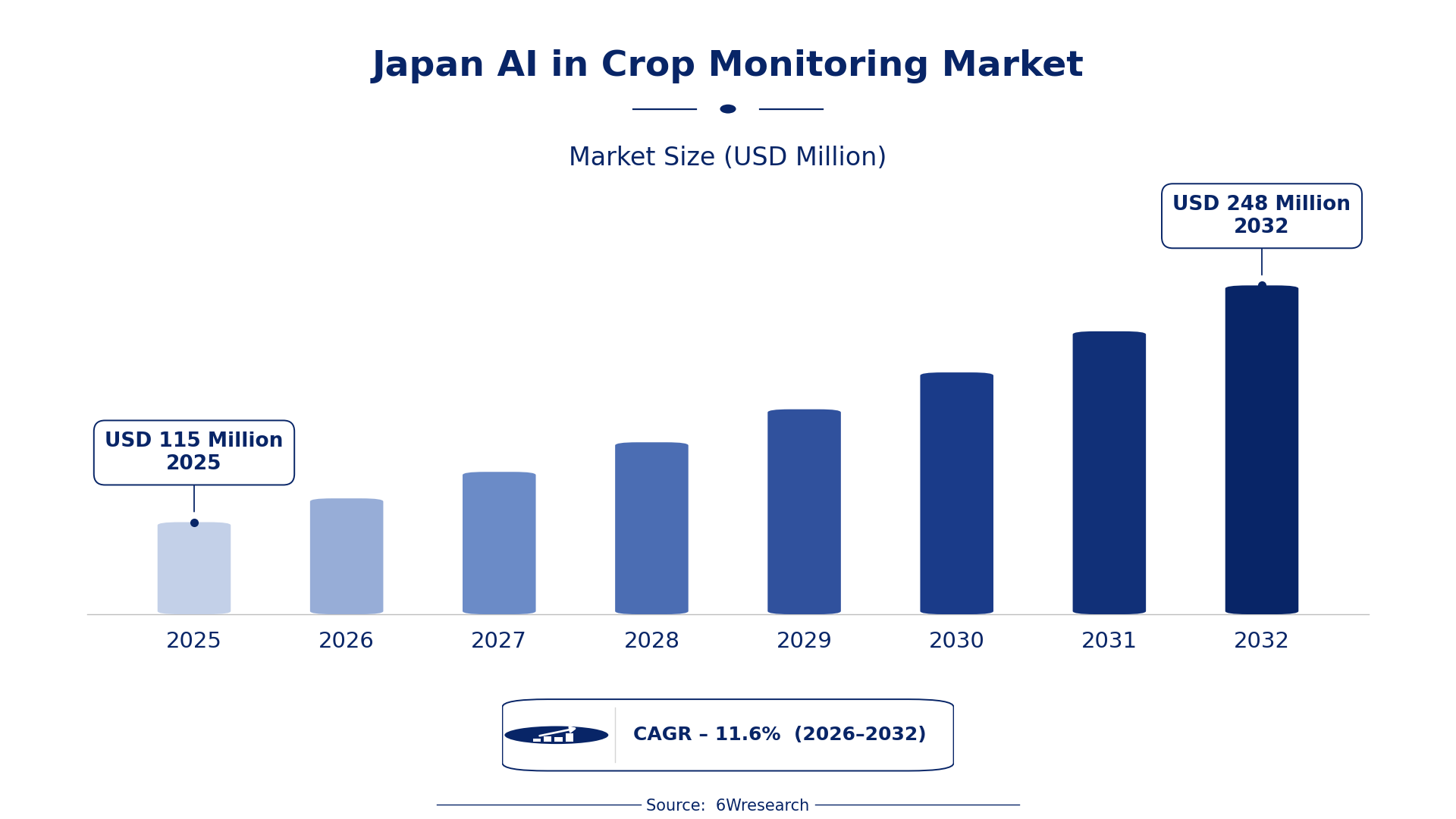
According to 6Wresearch internal database and industry insights, the Japan AI in Crop Monitoring Market was valued at USD 115 Million in 2025 and is projected to reach USD 248 Million by 2032, growing at a CAGR of approximately 11.6% during 2026–2032.
Japan AI in Crop Monitoring Market Highlights
| Report Metric | Details |
| Report Name | Japan AI in Crop Monitoring Market (2026-2032) |
| Market Size 2025 | USD 115 Million |
| Market Size 2032 | USD 248 Million |
| Absolute Growth 2025–2032 | USD 133 Million |
| CAGR 2026–2032 | 11.6% |
| Peak Annual Growth | 14.7% in 2026 |
| Forecast Period | 2026–2032 |
| Historical Data | 2022–2025 |
| Base Year | 2025 |
| Leading Monitoring Type, 2025 | Pest & Disease Detection (45% share) |
| Leading Technology Used, 2025 | Vision AI + ML (46% share) |
| Leading Distribution Channel, 2025 | Agri-Tech Platforms (36% share) |
| Leading End User, 2025 | Precision Farmers (44% share) |
| Fastest-Growing Monitoring Type | Soil Health Monitoring (15.8% CAGR) |
| Fastest-Growing Technology Used | Sensor + AI Analytics (16.8% CAGR) |
| Fastest-Growing Distribution Channel | Online Farming Apps (14.7% CAGR) |
| Fastest-Growing End User | Agri Consultants (14.5% CAGR) |
| Growing Sector | Precision Agriculture |
| Key End Users | Farmers, Agricultural Consultants, Commercial Farms, Contract Farming Companies |
Japan AI in Crop Monitoring Market Year-wise Growth Rate and Key Drivers (2022–2032)
This graph illustrates the annual growth rates of the market from 2022 to 2032, highlighting a steady upward trajectory and projected market expansion over the forecast period.
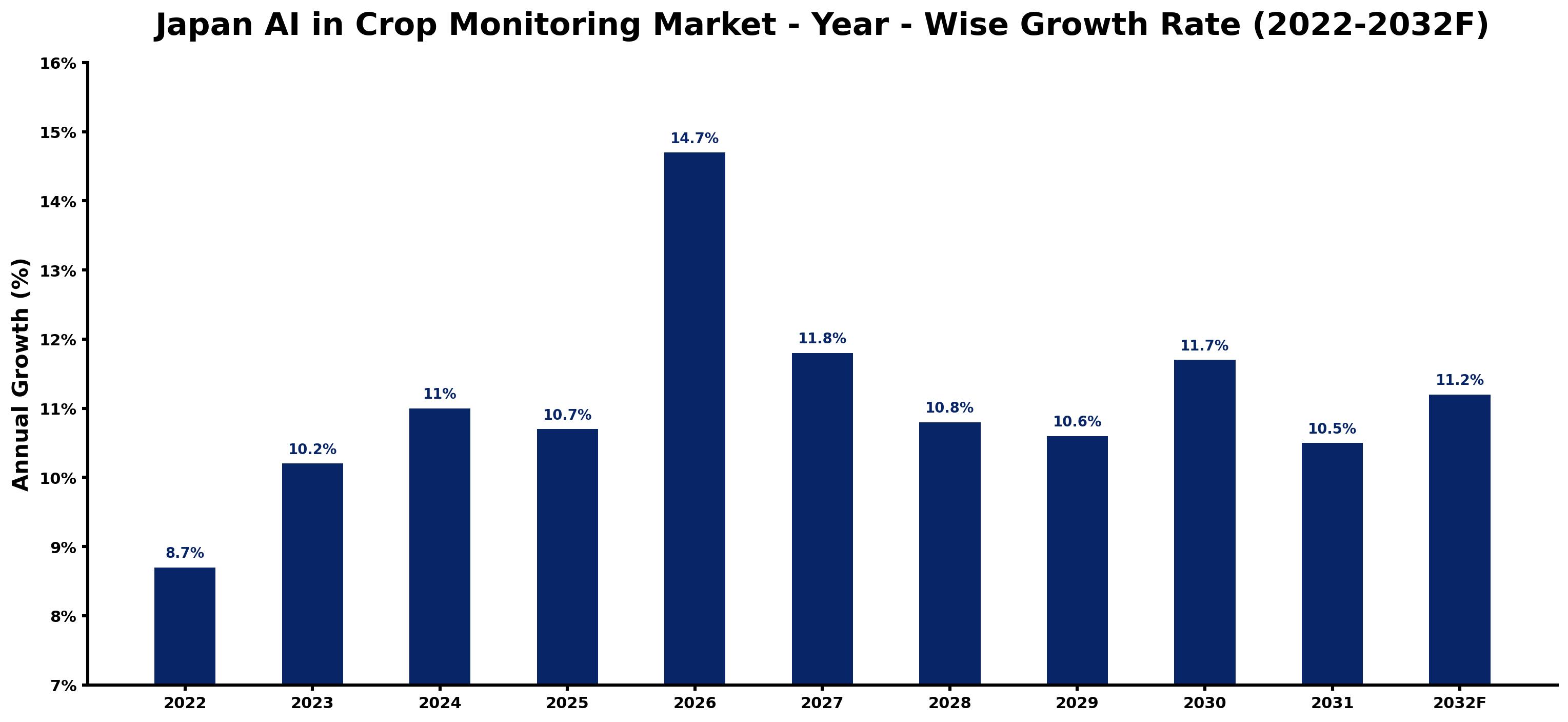
The table below sets out the estimated growth rate for each year and the main factor behind it.
| Year | Estimated Annual Growth (%) | Market Rationale |
| 2022 | 8.7 | The market experienced steady growth as farmers began adopting AI technologies. |
| 2023 | 10.2 | Increased adoption of precision agriculture techniques contributed to faster growth. |
| 2024 | 11.0 | The implementation of new digital agriculture initiatives further accelerated growth. |
| 2025 | 10.7 | Growth slowed slightly as the market began to stabilise after rapid expansion. |
| 2026 | 14.7 | A surge in investment in AI technologies drove growth this year. |
| 2027 | 11.8 | Growth slowed as the market adjusted to the rapid influx of new technologies. |
| 2028 | 10.8 | Continued investments in precision agriculture maintained a steady growth rate. |
| 2029 | 10.6 | The market saw a slight slowdown as saturation in some areas began to occur. |
| 2030 | 11.7 | Growth accelerated again as new AI applications gained traction among farmers. |
| 2031 | 10.5 | A gradual slowdown occurred as the market matured and competition intensified. |
| 2032 | 11.2 | The market is expected to see renewed growth driven by emerging technologies. |
Note: Market size estimations and growth projections presented in this report are based on 6Wresearch's proprietary forecasting methodology, utilizing the latest available industry data, government publications, and primary research inputs.
Japan AI in Crop Monitoring Market Synopsis
AI in Crop Monitoring involves the application of artificial intelligence to improve agricultural practices, focusing on crop health monitoring, resource optimisation, and predictive analytics. In Japan, the agriculture sector, with around 1.5 million farmers, is increasingly adopting AI technologies. The Japan AI in Crop Monitoring Market is expanding due to the growing demand for precision agriculture, supported by government initiatives like the digital agriculture programme launched in 2023, which aims to boost smart agriculture adoption by 30% by 2025.
Market Dynamics Impact Analysis (2026–2032)
| Factor | Type | Impact | Primary Segment Affected |
| Rising demand for precision agriculture technologies | Driver | High | Pest & Disease Detection |
| Increased investment in agricultural innovation | Driver | High | Soil Health Monitoring |
| Growing need for efficient farming practices | Opportunity | High | Agri-Tech Platforms |
| Expansion of agri-tech startups focusing on AI solutions | Opportunity | Medium | Online Farming Apps |
| Aging farmer population leading to technology adoption | Restraint | High | Commercial Farms |
| Limited awareness of AI benefits among traditional farmers | Restraint | Medium | Precision Farmers |
| High initial investment costs for AI technologies | Challenge | High | Agri Consultants |
| Slow integration of AI solutions into existing farming practices | Challenge | Medium | Contract Farming Companies |
Evaluation of Drivers in Japan AI in Crop Monitoring Market (2026–2032)
Below are the drivers that matter most for revenue growth, with supporting evidence.
| Drivers | Primary Segment Affected | Why It Matters (Evidence) |
| Increased precision farming adoption | Pest & Disease Detection | Approximately 400,000 hectares of farmland utilise precision agriculture techniques, leading to higher demand for monitoring solutions. |
| Government initiatives promoting digital agriculture | Soil Health Monitoring | The government allocated ¥10 billion for agricultural innovation, encouraging farmers to adopt AI technologies. |
| Rising agricultural output value | Agri-Tech Platforms | Japan's agricultural output was valued at ¥8 trillion in 2022, driving demand for efficient farming solutions. |
| Growing number of agri-tech startups | Online Farming Apps | The increasing presence of startups focusing on AI solutions improves access to technology for farmers. |
| Need for improved crop yield management | Commercial Farms | With an average farm size of 1.5 hectares, efficient monitoring is essential for maximising yield. |
Most of the extra volume comes from increased precision farming adoption, with approximately 400,000 hectares of farmland utilising advanced techniques. The allocation of ¥10 billion for agricultural innovation encourages farmers to adopt AI technologies, resulting in a higher demand for solutions like pest and disease detection. Japan's agricultural output, valued at ¥8 trillion in 2022, drives the need for efficient farming practices. The growing number of agri-tech startups focusing on AI solutions improves access to technology, while the average farm size necessitates effective monitoring for commercial operations.
Evaluation of Restraints in Japan AI in Crop Monitoring Market
These are the pressures that could keep growth below its potential.
| Market Restraint | Primary Segment Affected | Why It Matters (Evidence) |
| High initial investment costs for AI technologies | Agri Consultants | The average cost of implementing AI solutions can deter smaller farms from adoption, limiting market growth. |
| Limited awareness of AI benefits among traditional farmers | Precision Farmers | Many traditional farmers lack knowledge about AI applications, hindering their willingness to invest in new technologies. |
| Aging farmer population leading to technology adoption challenges | Commercial Farms | With an average farmer age of 67 years, reluctance to adopt new technologies slows market growth. |
| Slow integration of AI solutions into existing farming practices | Contract Farming Companies | The complexity of integrating AI with traditional farming methods can delay implementation and reduce efficiency. |
| Regulatory hurdles for new technology adoption | Agri-Tech Platforms | Compliance with standards like JIS Z 8401 complicates the introduction of new AI solutions. |
Japan AI in Crop Monitoring Market Challenges
Buyers face high costs when integrating AI technologies in crop monitoring, with expenses reaching up to ¥10 million for advanced systems, which limits access for smaller farms. Regulatory hurdles arise from the need to comply with JIS Z 8401 for data management, which can delay project timelines and inflate costs for farmers. Skills shortages exist as the average age of farmers is 67, resulting in insufficient familiarity with AI tools and hindering effective implementation. Supply chain disruptions occur due to reliance on a limited number of agri-tech startups, causing delays in technology deployment and impacting productivity for producers.
Trends in the Japan AI in Crop Monitoring Market
Buyers and suppliers in the Japan AI in Crop Monitoring Market are adjusting to the following trends.
- Shift from Traditional to Precision Agriculture: In Hokkaido, farmers are increasingly adopting precision agriculture techniques, with over 400,000 hectares now utilising these methods. This shift is vital for improving resource management and crop yields.
- Transition from Manual to AI-Driven Monitoring: Since 2023, the introduction of AI-driven monitoring systems has transformed crop health assessments, enabling farmers to make informed decisions based on real-time data.
- Emergence of Agri-Tech Startups: The Tokyo region has become a hub for agri-tech innovation, with a growing number of startups focusing on AI solutions for farming. This trend is reshaping agricultural practices in Japan.
- Increase in Government Support for Digital Agriculture: In 2023, the government launched a digital agriculture initiative, aiming for a 30% increase in smart agriculture adoption by 2025, which will impact farming practices.
Investment Opportunities in the Japan AI in Crop Monitoring Market
The following opportunities in the Japan AI in Crop Monitoring Market pair current demand with a clear way in.
- Supply AI Monitoring Solutions: With the growing need for precision agriculture, there is an opportunity to supply AI monitoring solutions for crop health. The government aims for a 30% increase in smart agriculture adoption by 2025.
- Invest in Agri-Tech Platforms: Investing in agri-tech platforms can meet the needs of farmers seeking efficient solutions. Collaborating with local agricultural consultants in regions like Tohoku can facilitate market entry.
- Provide Training for AI Technologies: There is a growing need for training programs on AI technologies for farmers. Engaging with precision farmers in Hokkaido can improve adoption rates and outcomes.
- Develop Online Farming Applications: The demand for online farming applications is increasing, particularly among younger farmers. Partnering with agri-tech startups in urban areas can help tap into this growing market.
Government Initiatives in the Japan AI in Crop Monitoring Market
The Semiconductor and Digital Industry Strategy, established by METI in June 2021, aims to secure domestic semiconductor manufacturing, which is important for AI technology development in agriculture. This measure supports producers by ensuring access to essential components for AI systems and includes funding for research and development projects.
In 2023, the government allocated ¥10 billion for agricultural innovation, administered by the Ministry of Agriculture. This funding supports projects that promote AI technology adoption among farmers, facilitating improved monitoring and resource management.
Future Insight of the Japan AI in Crop Monitoring Market
By 2032, a notable shift will occur as the government aims for a 30% increase in smart agriculture adoption, elevating demand for AI solutions. New subsidy programs for AI technology will motivate producers to invest in modern tools, improving operational efficiency. The Tokyo region will solidify its role as an agri-tech hub, fostering collaboration between startups and established farms. Enhanced precision agriculture techniques will lead to improved resource management, benefiting both buyers and suppliers.
Market Segmentation Analysis
Japan AI in Crop Monitoring Market report covers a detailed analysis of the following market segments:
By Monitoring Type – Pest & Disease Detection Leads, Soil Health Monitoring Expected to Grow Fastest
According to Saurav Kr Singh, Senior Research Analyst at 6Wresearch, Pest & Disease Detection held 45% of the Japan AI in Crop Monitoring Market by monitoring type in 2025. Pest & Disease Detection commands the largest share due to its critical role in enabling timely interventions for crop health. This technology is particularly essential for farmers in regions like Hokkaido, where pest threats can drastically affect yields. Soil Health Monitoring is projected to grow fastest, at a CAGR of 15.8% during 2026–2032. Soil Health Monitoring is experiencing rapid growth as farmers increasingly prioritise optimising crop yield and resource management. The government's initiatives aimed at promoting sustainable practices and smart agriculture are significantly propelling this trend. Suppliers should focus on developing advanced solutions for soil health monitoring to meet the rising demand.
By Technology Used – Vision AI + ML Leads, Sensor + AI Analytics Expected to Grow Fastest
In 2025, Vision AI + ML led the technology used split with a 46% share. Vision AI + ML holds the leading position as it is vital for image analysis and pattern recognition in crops. This technology is widely employed by farmers seeking precise data for effective decision-making. The quickest growth will come from Sensor + AI Analytics, forecast to expand at a CAGR of 16.8% between 2026 and 2032. Sensor + AI Analytics is the fastest-growing segment due to its capability to integrate real-time data for informed decision-making. The surge of agri-tech startups concentrating on sensor technologies is greatly contributing to this growth. Buyers should consider investing in sensor technologies to gain real-time insights that can enhance agricultural outcomes.
By Distribution Channel – Agri-Tech Platforms Lead, Online Farming Apps Expected to Grow Fastest
Agri-Tech Platforms took 36% of distribution channel revenue in 2025, more than any other category. Agri-Tech Platforms dominate the market by offering farmers easy access to advanced tools, facilitating the adoption of modern agricultural technologies. These platforms address a diverse range of farmer needs across Japan, making them essential. Online Farming Apps are set to record the highest CAGR in this split, 14.7% over 2026–2032. Online Farming Apps are rapidly gaining traction as they enable farmers to monitor crops remotely, providing convenience and timely updates. The increase in smartphone usage among farmers is a significant factor in this trend. Suppliers need to strengthen their online presence and enhance app functionalities to engage the growing online farming community.
By End User – Precision Farmers Lead, Agri Consultants Expected to Grow Fastest
With 44% of end user revenue in 2025, Precision Farmers was the largest category. Precision Farmers represent the largest share as they utilise technology to improve farming efficiency, which directly impacts productivity. This group plays a crucial role in adopting modern solutions for superior crop management. Over 2026–2032, Agri Consultants are expected to post the fastest growth, at a CAGR of 14.5%. Agri Consultants are the fastest-growing segment as they offer vital guidance on the implementation of advanced agricultural technologies. The rising complexity of these technologies fuels the demand for expert consultancy services. Suppliers should aim to establish partnerships with agri consultants to facilitate the integration of their technologies among farmers.
Key Attractiveness of the Report
- 10 Years of Market Numbers
- Historical Data Starting from 2022 to 2025
- Base Year 2025
- Forecast Data until 2032
- Key Performance Indicators Impacting the Market
- Major Upcoming Developments and Projects
Key Highlights of the Report:
- Japan AI in Crop Monitoring Market Outlook
- Market Size of Japan AI in Crop Monitoring Market, 2025
- Forecast of Japan AI in Crop Monitoring Market, 2032
- Historical Data and Forecast of Japan AI in Crop Monitoring Revenues & Volume for the Period 2022-2032F
- Japan AI in Crop Monitoring Market Trend Evolution
- Japan AI in Crop Monitoring Market Drivers and Challenges
- Japan AI in Crop Monitoring Price Trends
- Japan AI in Crop Monitoring Porter's Five Forces
- Japan AI in Crop Monitoring Industry Life Cycle
- Historical Data and Forecast of Japan AI in Crop Monitoring Market Revenues & Volume By Monitoring Type for the Period 2022-2032F
- Historical Data and Forecast of Japan AI in Crop Monitoring Market Revenues & Volume By Pest & Disease Detection for the Period 2022-2032F
- Historical Data and Forecast of Japan AI in Crop Monitoring Market Revenues & Volume By Soil Health Monitoring for the Period 2022-2032F
- Historical Data and Forecast of Japan AI in Crop Monitoring Market Revenues & Volume By Growth Stage Detection for the Period 2022-2032F
- Historical Data and Forecast of Japan AI in Crop Monitoring Market Revenues & Volume By Weather Impact Analysis for the Period 2022-2032F
- Historical Data and Forecast of Japan AI in Crop Monitoring Market Revenues & Volume By Technology Used for the Period 2022-2032F
- Historical Data and Forecast of Japan AI in Crop Monitoring Market Revenues & Volume By Vision AI + ML for the Period 2022-2032F
- Historical Data and Forecast of Japan AI in Crop Monitoring Market Revenues & Volume By Sensor + AI Analytics for the Period 2022-2032F
- Historical Data and Forecast of Japan AI in Crop Monitoring Market Revenues & Volume By Satellite + AI for the Period 2022-2032F
- Historical Data and Forecast of Japan AI in Crop Monitoring Market Revenues & Volume By Predictive Modeling for the Period 2022-2032F
- Historical Data and Forecast of Japan AI in Crop Monitoring Market Revenues & Volume By Distribution Channel for the Period 2022-2032F
- Historical Data and Forecast of Japan AI in Crop Monitoring Market Revenues & Volume By Agri-Tech Platforms for the Period 2022-2032F
- Historical Data and Forecast of Japan AI in Crop Monitoring Market Revenues & Volume By Online Farming Apps for the Period 2022-2032F
- Historical Data and Forecast of Japan AI in Crop Monitoring Market Revenues & Volume By Direct B2B Platforms for the Period 2022-2032F
- Historical Data and Forecast of Japan AI in Crop Monitoring Market Revenues & Volume By Agro-Software Vendors for the Period 2022-2032F
- Historical Data and Forecast of Japan AI in Crop Monitoring Market Revenues & Volume By End User for the Period 2022-2032F
- Historical Data and Forecast of Japan AI in Crop Monitoring Market Revenues & Volume By Precision Farmers for the Period 2022-2032F
- Historical Data and Forecast of Japan AI in Crop Monitoring Market Revenues & Volume By Agri Consultants for the Period 2022-2032F
- Historical Data and Forecast of Japan AI in Crop Monitoring Market Revenues & Volume By Contract Farming Companies for the Period 2022-2032F
- Historical Data and Forecast of Japan AI in Crop Monitoring Market Revenues & Volume By Commercial Farms for the Period 2022-2032F
- Japan AI in Crop Monitoring Import Export Trade Statistics
- Market Opportunity Assessment By Monitoring Type
- Market Opportunity Assessment By Technology Used
- Market Opportunity Assessment By Distribution Channel
- Market Opportunity Assessment By End User
- Japan AI in Crop Monitoring Top Companies Market Share
- Japan AI in Crop Monitoring Competitive Benchmarking By Technical and Operational Parameters
- Japan AI in Crop Monitoring Company Profiles
- Japan AI in Crop Monitoring Key Strategic Recommendations
Market Covered
The report covers the following segments.
By Monitoring Type
- Pest & Disease Detection
- Soil Health Monitoring
- Growth Stage Detection
- Weather Impact Analysis
By Technology Used
- Vision AI + ML
- Sensor + AI Analytics
- Satellite + AI
- Predictive Modeling
By Distribution Channel
- Agri-Tech Platforms
- Online Farming Apps
- Direct B2B Platforms
- Agro-Software Vendors
By End User
- Precision Farmers
- Agri Consultants
- Contract Farming Companies
- Commercial Farms































