Japan AI in Defense Market Size & Growth Rate
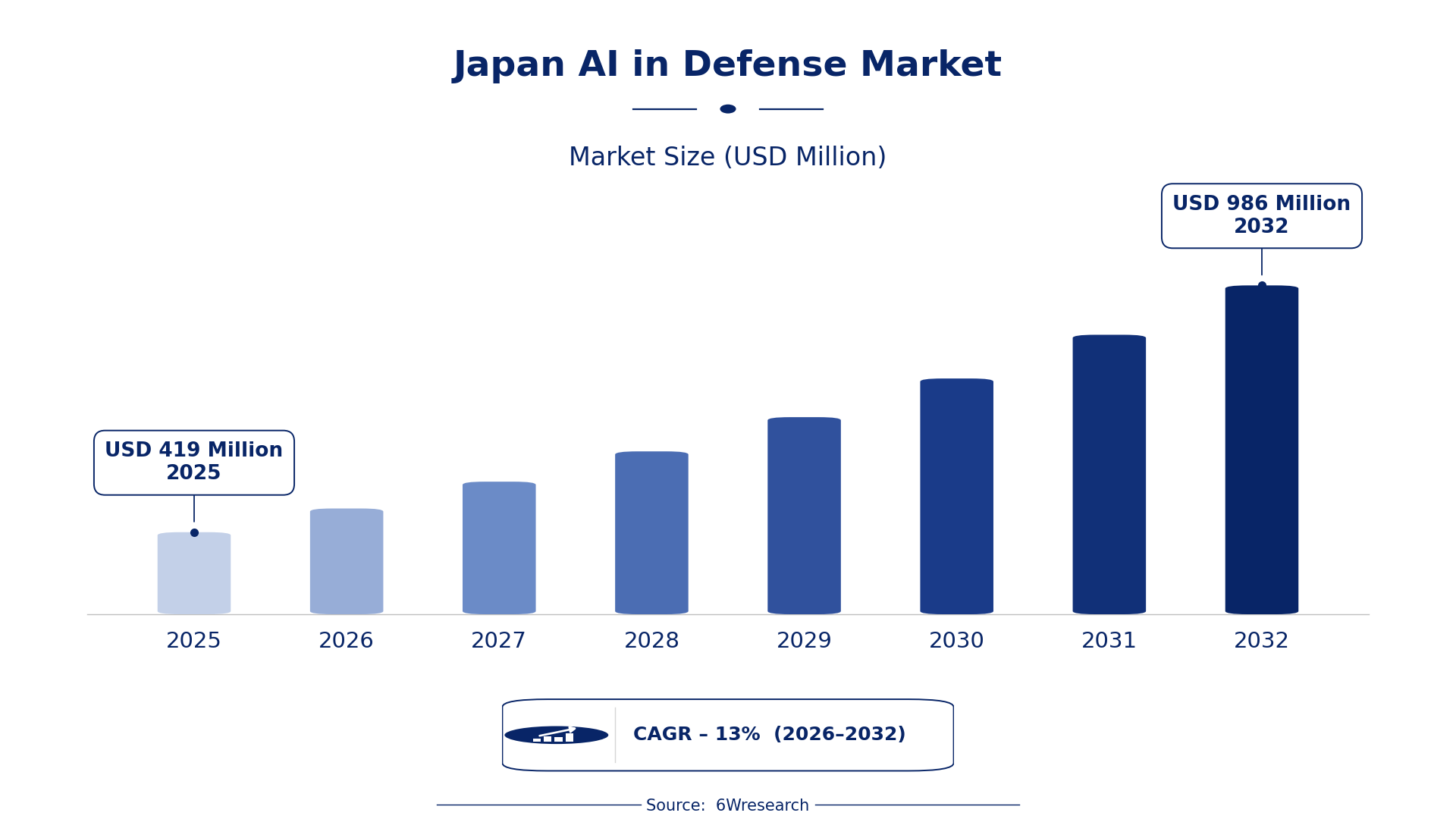
According to 6Wresearch internal database and industry insights, the Japan AI in Defense Market was valued at USD 419 Million in 2025 and is projected to reach USD 986 Million by 2032, growing at a CAGR of approximately 13% during 2026–2032.
Japan AI in Defense Market Highlights
| Report Metric | Details |
| Report Name | Japan AI in Defense Market (2026-2032) |
| Market Size 2025 | USD 419 Million |
| Market Size 2032 | USD 986 Million |
| Absolute Growth 2025–2032 | USD 567 Million |
| CAGR 2026–2032 | 13% |
| Peak Annual Growth | 15.5% in 2032 |
| Forecast Period | 2026–2032 |
| Historical Data | 2022–2025 |
| Base Year | 2025 |
| Leading Application Area, 2025 | Surveillance Systems (43% share) |
| Leading AI Module Type, 2025 | Computer Vision (45% share) |
| Leading Distribution Channel, 2025 | Military Contractors (51% share) |
| Leading End User, 2025 | Defense Intelligence Units (38% share) |
| Fastest-Growing Application Area | Autonomous Navigation (16.3% CAGR) |
| Fastest-Growing AI Module Type | Reinforcement Learning (19.3% CAGR) |
| Fastest-Growing Distribution Channel | Defense OEMs (17.3% CAGR) |
| Fastest-Growing End User | Armed Forces (17.2% CAGR) |
| Growing Sector | defense technology |
| Key End Users | Defense Intelligence Units, Armed Forces, Military Contractors, Defense Labs |
Japan AI in Defense Market Year-wise Growth Rate and Key Drivers (2022–2032)
This graph illustrates the annual growth rates of the market from 2022 to 2032, highlighting a steady upward trajectory and projected market expansion over the forecast period.
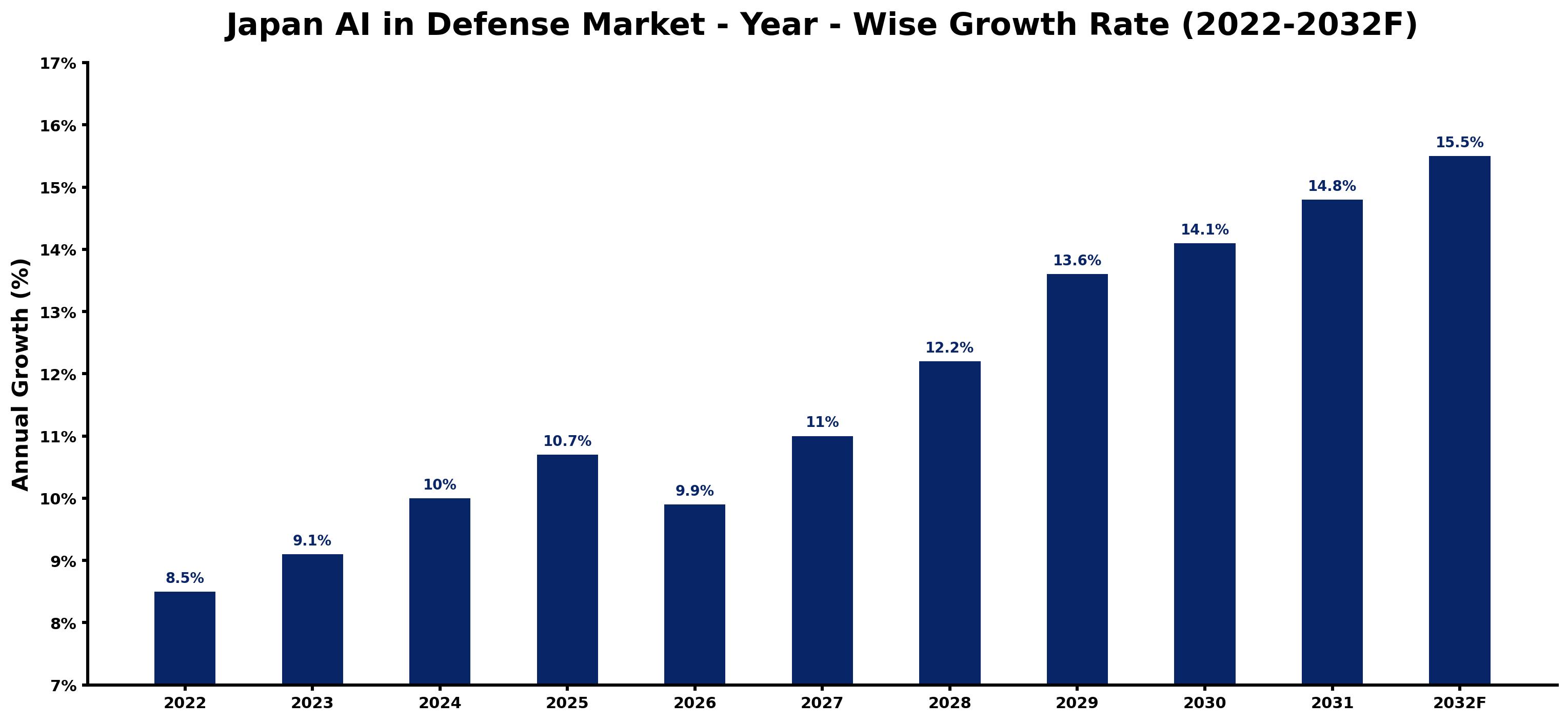
Annual growth estimates for each year appear below with the principal reason behind them, explaining the shifts that set the pace of the market.
| Year | Estimated Annual Growth (%) | Market Rationale |
| 2022 | 8.5 | The market experienced steady growth due to increased military spending. |
| 2023 | 9.1 | Demand rose as the Self-Defense Forces integrated more AI technologies. |
| 2024 | 10.0 | The introduction of new surveillance systems boosted interest in AI applications. |
| 2025 | 10.7 | Growth accelerated as the government prioritised AI in national defense strategy. |
| 2026 | 9.9 | A slight slowdown occurred as the market is expected to stabilise after rapid expansion. |
| 2027 | 11.0 | Demand increased as military contractors expanded their technology offerings. |
| 2028 | 12.2 | The focus on autonomous navigation systems is projected to drive further growth in the sector. |
| 2029 | 13.6 | Rising investments in command control systems will contribute to market expansion. |
| 2030 | 14.1 | The market is expected to continue growing with advancements in decision-making AI systems. |
| 2031 | 14.8 | Increased collaboration with research institutions is projected to spur innovation in AI applications. |
| 2032 | 15.5 | The peak growth rate is expected to be achieved as AI capabilities are fully integrated. |
Note: Market size estimations and growth projections presented in this report are based on 6Wresearch's proprietary forecasting methodology, utilizing the latest available industry data, government publications, and primary research inputs.
Japan AI in Defense Market Synopsis
AI in Defense refers to the application of artificial intelligence technologies in military operations, including surveillance, threat detection, and autonomous systems. The Japan AI in Defense Market is projected to grow, driven by a defense budget of approximately 6.8 trillion yen in 2023 and a focus on integrating AI technologies into military operations. Key factors include government initiatives for AI systems and the ongoing demand from defense intelligence units for improved data analysis capabilities.
Market Dynamics Impact Analysis (2026–2032)
| Factor | Type | Impact | Primary Segment Affected |
| Increased defense budget allocation | Driver | High | Surveillance Systems |
| Integration of AI technologies in military operations | Driver | High | Command Control Systems |
| Growing need for advanced threat detection capabilities | Opportunity | High | Threat Detection |
| Rising demand for autonomous navigation systems in unmanned vehicles | Opportunity | High | Autonomous Navigation |
| Limited funding for AI research in smaller defense firms | Restraint | Medium | Computer Vision |
| Challenges in adapting existing systems to incorporate AI | Restraint | Medium | Command Control Systems |
| High costs of AI technology implementation | Challenge | High | Surveillance Systems |
| Shortage of skilled personnel in AI development | Challenge | Medium | Threat Detection |
Evaluation of Drivers in Japan AI in Defense Market (2026–2032)
The following drivers explain most of the expected growth.
| Drivers | Primary Segment Affected | Why It Matters (Evidence) |
| Increased defense budget | Surveillance Systems | Japan's defense budget for 2023 is approximately 6.8 trillion yen, leading to higher investments in surveillance technologies. |
| Integration of AI in military operations | Command Control Systems | A program for AI in military operations has been initiated, improving efficiency and decision-making processes. |
| Focus on threat detection | Threat Detection | AI in threat detection is prioritised in national defense strategy, driving demand for advanced systems and technologies. |
| Demand for autonomous systems | Autonomous Navigation | Testing of autonomous navigation systems is increasing the need for related technologies and capabilities. |
| Collaboration with research institutions | Computer Vision | Collaborative efforts with research institutions are promoting innovation in computer vision applications, creating new opportunities for technology providers. |
Buyers are adding capacity as Japan's defense budget for 2023 is approximately 6.8 trillion yen, prompting increased investment in surveillance technologies. AI in threat detection is prioritised in national defense strategy, driving demand for advanced systems. Testing of autonomous navigation systems is increasing the need for related technologies. Collaborative efforts with research institutions are promoting innovation in computer vision applications, creating new opportunities for technology providers in the defense sector.
Evaluation of Restraints in Japan AI in Defense Market
Several factors work against faster growth; the main ones are summarised below.
| Market Restraint | Primary Segment Affected | Why It Matters (Evidence) |
| Limited funding for smaller defense firms | Computer Vision | Smaller defense firms face funding challenges, restricting their ability to develop AI technologies. |
| Difficulty in adapting existing systems | Command Control Systems | Integrating AI into legacy systems poses challenges, hindering operational efficiency and requiring additional resources. |
| High costs of AI technology implementation | Surveillance Systems | The implementation costs of AI technologies can be prohibitive for some defense units, limiting their procurement options. |
| Shortage of skilled AI personnel | Threat Detection | A lack of skilled personnel in AI development limits the growth of threat detection capabilities and slows project timelines. |
| Regulatory hurdles in AI deployment | Autonomous Navigation | Regulatory challenges can delay the deployment of autonomous navigation systems in defense, affecting operational readiness. |
Japan AI in Defense Market Challenges
High competition among defense contractors drives up costs for buyers, as aggressive bidding for government contracts can inflate project expenses by up to 15%. Regulatory frameworks complicate AI integration, leading to delays in project timelines for suppliers, which can extend delivery schedules by three months. A lack of skilled professionals in AI hampers the deployment of advanced systems, resulting in slower adoption rates for military training institutions. Lengthy procurement processes hinder buyers' access to AI solutions, potentially delaying project initiation by up to six months.
Trends in the Japan AI in Defense Market
Below are the shifts with the largest effect on the Japan AI in Defense Market.
- Shift Towards Autonomous Systems: In 2023, the Air Self-Defense Force began testing autonomous navigation systems, reflecting a shift towards automation in defense operations. This trend is expected to improve operational capabilities as the technology matures.
- Increased Focus on Real-Time Decision Making: Defense intelligence units are prioritising real-time decision-making AI systems, with the government allocating 2 billion yen for AI research in defense labs in 2023. This emphasis is reshaping operational strategies and enhancing efficiency.
- Growing Collaboration with Research Institutions: In 2023, research institutions started collaborating with the government on AI projects, leading to innovative applications in military operations. This partnership is vital for advancing defense technologies and capabilities, with funding reaching 1.5 billion yen.
- Expansion of AI Training Initiatives: The government supports initiatives for AI training in military applications, aiming to improve workforce capabilities. This focus is essential for ensuring effective implementation of AI technologies in defense, with an investment of 500 million yen.
Investment Opportunities in the Japan AI in Defense Market
Where to invest in the Japan AI in Defense Market: the main openings are set out below.
- Investment in AI Research and Development: With the government allocating 2 billion yen for AI research in defense labs in 2023, there is a strong opportunity for investment in AI technologies for military applications, particularly in surveillance and threat detection.
- Supply of Autonomous Navigation Technologies: The Air Self-Defense Force's testing of autonomous navigation systems creates a demand for suppliers of advanced navigation technologies, particularly in Tokyo's defense technology hub, where innovation is thriving.
- Enhancement of Threat Detection Systems: The prioritisation of AI in threat detection opens opportunities for suppliers to develop advanced systems, particularly for defense intelligence units looking to improve data analysis and operational effectiveness.
- Development of Command Control Systems: The need for improved command control systems presents an opportunity for investment in AI technologies, especially among military contractors aiming to enhance operational efficiency and responsiveness.
Government Initiatives in the Japan AI in Defense Market
The GX Promotion Act of 2023 establishes a legal framework for integrating AI in defense, providing clear guidelines for AI applications in military contexts. This measure aims to streamline processes and ensure compliance with safety standards for AI technologies, improving the overall efficiency of military operations. The government has allocated significant resources to support these initiatives, including funding for AI research and development projects amounting to 2 billion yen.
Defense intelligence units actively utilise funding from the Ministry of Defense to implement AI systems for data analysis and threat detection. This practical application of government support is essential for improving operational capabilities and ensuring that military operations are equipped with the latest technological advancements. The ongoing collaboration between the government and defense units fosters a more innovative environment for AI integration, with funding reaching 1.5 billion yen.
Future Insight of the Japan AI in Defense Market
Investment in AI for defense will rise significantly by 2032, driven by government funding and partnerships with research institutions. The Ministry of Defense's emphasis on real-time decision-making systems will improve operational capabilities across military branches. Adoption of ISO standards will streamline compliance for suppliers, boosting their efficiency. As the Japan Defense Agency prioritises AI in national strategies, buyers will benefit from more effective surveillance and data analysis technologies.
Market Segmentation Analysis
Japan AI in Defense Market report covers a detailed analysis of the following market segments:
By Application Area – Surveillance Systems Lead, Autonomous Navigation Expected to Grow Fastest
According to Saurav Kr Singh, Senior Research Analyst at 6Wresearch, Surveillance Systems accounted for 43% of the market by application area in 2025. Surveillance Systems dominate the market due to their essential function in monitoring and reconnaissance tasks for the Self-Defense Forces. The Ministry of Defense's initiative for AI-enhanced surveillance highlights the strong demand for these capabilities. Over 2026–2032, Autonomous Navigation is expected to post the fastest growth, at a CAGR of 16.3%. Autonomous Navigation is witnessing swift growth as it is vital for unmanned systems and vehicles, with the Air Self-Defense Force actively testing these technologies in 2023. This emphasis on automation will likely strengthen the position of Surveillance Systems. Suppliers should focus on developing advanced surveillance solutions to cater to the increasing requirements of the defense sector.
By AI Module Type – Computer Vision Leads, Reinforcement Learning Expected to Grow Fastest
Computer Vision held 45% of the Japan AI in Defense Market by ai module type in 2025. Computer Vision leads the sector as it is crucial for interpreting visual data, which is important for various military applications. Its integration into existing systems has been a primary objective for the Japan Defense Agency. Reinforcement Learning is projected to grow fastest, at a CAGR of 19.3% during 2026–2032. Reinforcement Learning is on the rise as it is employed in optimising operational strategies, reflecting the military's need for adaptable solutions. Progress in this area will further support the established use of Computer Vision. Buyers should prioritise investments in modules that improve visual data interpretation and operational effectiveness.
By Distribution Channel – Military Contractors Lead, Defense OEMs Expected to Grow Fastest
The largest distribution channel category in 2025 was Military Contractors, at 51% of revenue. Military Contractors dominate the market as they are the primary providers of defense technology, ensuring that the Self-Defense Forces receive the necessary systems and support. Their established relationships with the government facilitate procurement processes. Defense OEMs are set to record the highest CAGR in this split, 17.3% over 2026–2032. Defense OEMs are the fastest-growing segment as manufacturers of defense systems are increasingly integrating AI into their products. This trend will further solidify the position of Military Contractors in the market. Suppliers must strengthen partnerships with military contractors to effectively penetrate the defense market.
By End User – Defense Intelligence Units Lead, Armed Forces Expected to Grow Fastest
Defense Intelligence Units took 38% of end user revenue in 2025, more than any other category. Defense Intelligence Units represent the largest segment of users for technologies aimed at intelligence gathering, underscoring their vital role in national security. Their ongoing initiatives emphasise the importance of AI in enhancing data analysis capabilities. The quickest growth will come from Armed Forces, forecast to expand at a CAGR of 17.2% between 2026 and 2032. The Armed Forces are rapidly integrating AI technologies, positioning them as the fastest-growing segment as they plan to expand AI usage in various operations by 2026. This growth will reinforce the leadership of Defense Intelligence Units. Buyers should align their investments with the evolving demands of the Armed Forces to maintain relevance.
Key Attractiveness of the Report
- 10 Years of Market Numbers
- Historical Data Starting from 2022 to 2025
- Base Year 2025
- Forecast Data until 2032
- Key Performance Indicators Impacting the Market
- Major Upcoming Developments and Projects
Key Highlights of the Report:
- Japan AI in Defense Market Outlook
- Market Size of Japan AI in Defense Market, 2025
- Forecast of Japan AI in Defense Market, 2032
- Historical Data and Forecast of Japan AI in Defense Revenues & Volume for the Period 2022-2032F
- Japan AI in Defense Market Trend Evolution
- Japan AI in Defense Market Drivers and Challenges
- Japan AI in Defense Price Trends
- Japan AI in Defense Porter's Five Forces
- Japan AI in Defense Industry Life Cycle
- Historical Data and Forecast of Japan AI in Defense Market Revenues & Volume By Application Area for the Period 2022-2032F
- Historical Data and Forecast of Japan AI in Defense Market Revenues & Volume By Surveillance Systems for the Period 2022-2032F
- Historical Data and Forecast of Japan AI in Defense Market Revenues & Volume By Autonomous Navigation for the Period 2022-2032F
- Historical Data and Forecast of Japan AI in Defense Market Revenues & Volume By Threat Detection for the Period 2022-2032F
- Historical Data and Forecast of Japan AI in Defense Market Revenues & Volume By Command Control Systems for the Period 2022-2032F
- Historical Data and Forecast of Japan AI in Defense Market Revenues & Volume By AI Module Type for the Period 2022-2032F
- Historical Data and Forecast of Japan AI in Defense Market Revenues & Volume By Computer Vision for the Period 2022-2032F
- Historical Data and Forecast of Japan AI in Defense Market Revenues & Volume By Reinforcement Learning for the Period 2022-2032F
- Historical Data and Forecast of Japan AI in Defense Market Revenues & Volume By Pattern Recognition for the Period 2022-2032F
- Historical Data and Forecast of Japan AI in Defense Market Revenues & Volume By Real-time Decision AI for the Period 2022-2032F
- Historical Data and Forecast of Japan AI in Defense Market Revenues & Volume By Distribution Channel for the Period 2022-2032F
- Historical Data and Forecast of Japan AI in Defense Market Revenues & Volume By Military Contractors for the Period 2022-2032F
- Historical Data and Forecast of Japan AI in Defense Market Revenues & Volume By Defense OEMs for the Period 2022-2032F
- Historical Data and Forecast of Japan AI in Defense Market Revenues & Volume By Online Military Tech Portals for the Period 2022-2032F
- Historical Data and Forecast of Japan AI in Defense Market Revenues & Volume By Government Procurement for the Period 2022-2032F
- Historical Data and Forecast of Japan AI in Defense Market Revenues & Volume By End User for the Period 2022-2032F
- Historical Data and Forecast of Japan AI in Defense Market Revenues & Volume By Defense Intelligence Units for the Period 2022-2032F
- Historical Data and Forecast of Japan AI in Defense Market Revenues & Volume By Armed Forces for the Period 2022-2032F
- Historical Data and Forecast of Japan AI in Defense Market Revenues & Volume By Defense Labs for the Period 2022-2032F
- Historical Data and Forecast of Japan AI in Defense Market Revenues & Volume By Air & Missile Defense Centers for the Period 2022-2032F
- Japan AI in Defense Import Export Trade Statistics
- Market Opportunity Assessment By Application Area
- Market Opportunity Assessment By AI Module Type
- Market Opportunity Assessment By Distribution Channel
- Market Opportunity Assessment By End User
- Japan AI in Defense Top Companies Market Share
- Japan AI in Defense Competitive Benchmarking By Technical and Operational Parameters
- Japan AI in Defense Company Profiles
- Japan AI in Defense Key Strategic Recommendations
Market Covered
The study includes the following segmentation.
By Application Area
- Surveillance Systems
- Autonomous Navigation
- Threat Detection
- Command Control Systems
By AI Module Type
- Computer Vision
- Reinforcement Learning
- Pattern Recognition
- Real-time Decision AI
By Distribution Channel
- Military Contractors
- Defense OEMs
- Online Military Tech Portals
- Government Procurement
By End User
- Defense Intelligence Units
- Armed Forces
- Defense Labs
- Air & Missile Defense Centers































