Japan AI in Diagnostic Imaging Market Size & Growth Rate
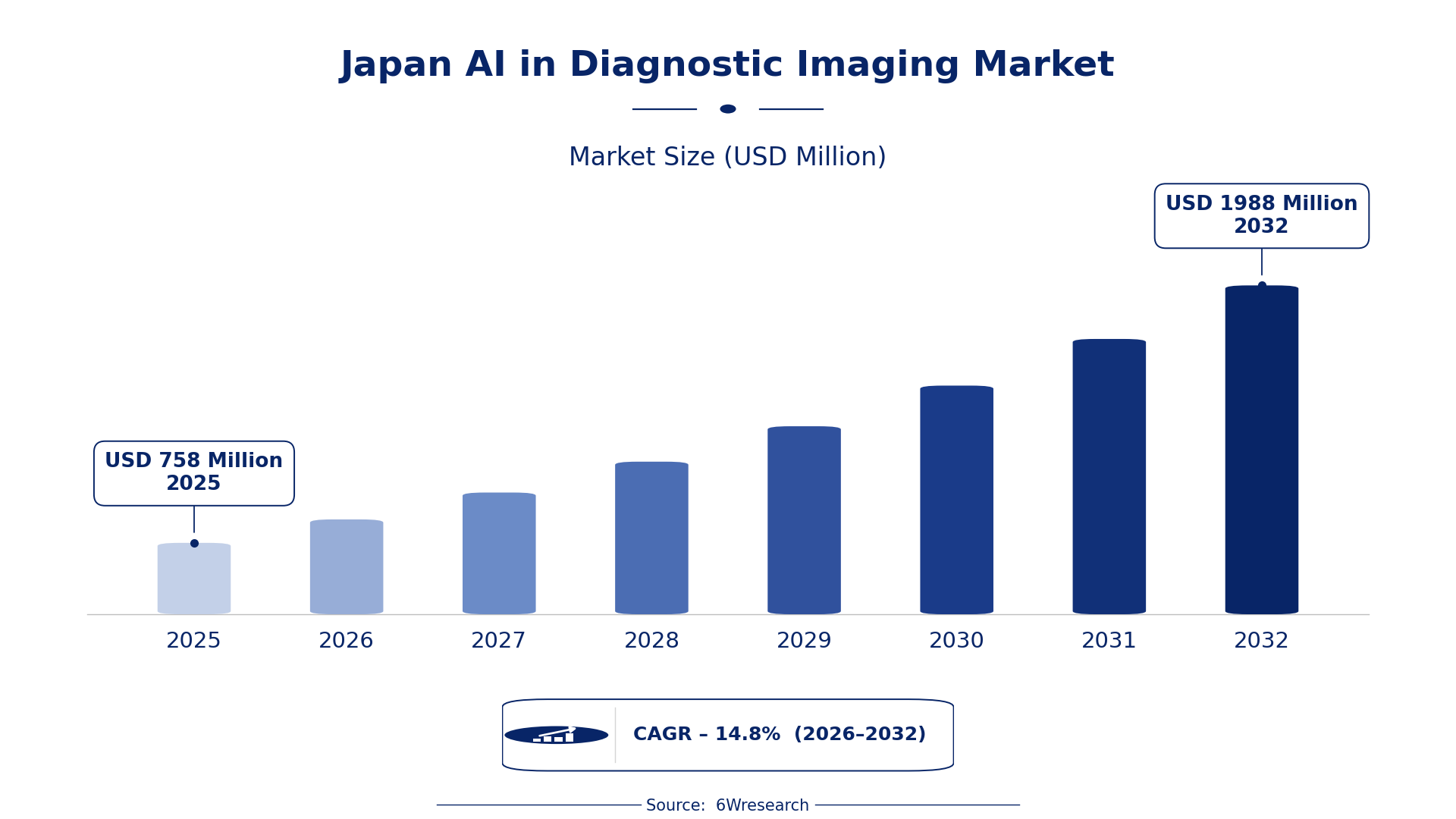
According to 6Wresearch internal database and industry insights, the Japan AI in Diagnostic Imaging Market was valued at USD 758 Million in 2025 and is projected to reach USD 1,988 Million by 2032, growing at a CAGR of approximately 14.8% during 2026–2032.
Japan AI in Diagnostic Imaging Market Highlights
| Report Metric | Details |
| Report Name | Japan AI in Diagnostic Imaging Market (2026-2032) |
| Market Size 2025 | USD 758 Million |
| Market Size 2032 | USD 1,988 Million |
| Absolute Growth 2025–2032 | USD 1,230 Million |
| CAGR 2026–2032 | 14.8% |
| Peak Annual Growth | 15.5% in 2032 |
| Forecast Period | 2026–2032 |
| Historical Data | 2022–2025 |
| Base Year | 2025 |
| Leading Imaging Type, 2025 | Chest X-rays (45% share) |
| Leading AI Application, 2025 | Disease Classification (40% share) |
| Leading Distribution Channel, 2025 | Radiology IT Systems (53% share) |
| Leading End User, 2025 | Diagnostic Labs (43% share) |
| Fastest-Growing Imaging Type | MRI & CT Scan (20.8% CAGR) |
| Fastest-Growing AI Application | Anomaly Highlighting (17.2% CAGR) |
| Fastest-Growing Distribution Channel | Health SaaS Platforms (19.2% CAGR) |
| Fastest-Growing End User | Hospitals (18.9% CAGR) |
| Growing Sector | diagnostic imaging |
| Key End Users | hospitals, diagnostic labs, breast care clinics, ophthalmology centers |
Japan AI in Diagnostic Imaging Market Year-wise Growth Rate and Key Drivers (2022–2032)
This graph illustrates the annual growth rates of the market from 2022 to 2032, highlighting a steady upward trajectory and projected market expansion over the forecast period.
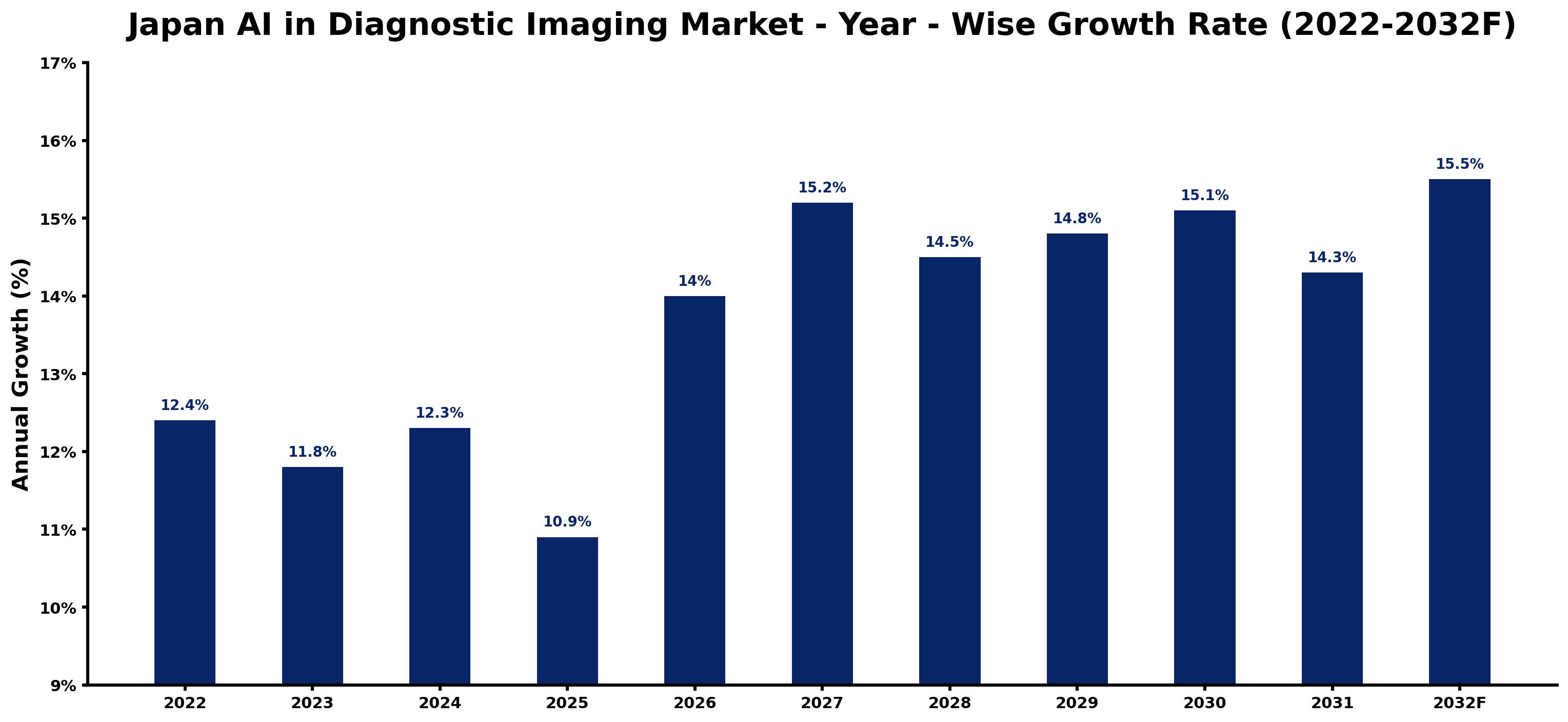
The following figures match every annual growth estimate with the main market development of that year, giving the reasoning behind each rise or slowdown.
| Year | Estimated Annual Growth (%) | Market Rationale |
| 2022 | 12.4 | The market demonstrated strong growth due to rising healthcare expenditure and technology adoption. |
| 2023 | 11.8 | Growth slowed as healthcare providers adjusted to new AI technologies and integration processes. |
| 2024 | 12.3 | Demand increased as hospitals expanded their AI capabilities, improving diagnostic accuracy. |
| 2025 | 10.9 | Growth slowed as market saturation began to impact the speed of new technology adoption. |
| 2026 | 14.0 | Demand surged as the integration program is expected to gain momentum across hospitals. |
| 2027 | 15.2 | Growth is projected to accelerate with increased investments in AI technologies and expanding healthcare infrastructure. |
| 2028 | 14.5 | Growth is anticipated to slow as competition intensifies among AI solution providers in the diagnostic imaging space. |
| 2029 | 14.8 | Demand is expected to increase as more hospitals adopt AI systems to improve operational efficiency. |
| 2030 | 15.1 | Growth will continue as healthcare providers seek advanced solutions to meet patient needs. |
| 2031 | 14.3 | Growth is projected to slow as the market matures, leading to increased focus on quality and standards. |
| 2032 | 15.5 | Demand will surge as the installed base of AI-enabled devices expands. |
Note: Market size estimations and growth projections presented in this report are based on 6Wresearch's proprietary forecasting methodology, utilizing the latest available industry data, government publications, and primary research inputs.
Japan AI in Diagnostic Imaging Market Synopsis
AI in Diagnostic Imaging involves applying artificial intelligence to improve medical image analysis through machine learning algorithms. The Japan AI in Diagnostic Imaging Market is growing due to increased healthcare expenditure, with ¥42 trillion allocated in 2022, and the incorporation of AI technologies in hospitals. The plan to implement AI in 500 hospitals by 2025 acts as a primary driver, along with a rising number of diagnostic labs adopting advanced imaging technologies.
Market Dynamics Impact Analysis (2026–2032)
| Factor | Type | Impact | Primary Segment Affected |
| Rising healthcare expenditure | Driver | High | Disease Classification |
| Integration of AI technologies in hospitals | Driver | High | MRI & CT Scan |
| Growing demand for advanced diagnostic technologies | Opportunity | High | Diagnostic Labs |
| Increased adoption of AI-enabled imaging devices | Opportunity | High | Radiology IT Systems |
| Competition among AI solution providers | Restraint | Medium | Anomaly Highlighting |
| Market saturation impacting growth rates | Restraint | Medium | Cancer Risk Detection |
| High costs of implementing AI solutions | Challenge | High | Health SaaS Platforms |
| Regulatory hurdles for new AI technologies | Challenge | High | AI-enabled Devices |
Evaluation of Drivers in Japan AI in Diagnostic Imaging Market (2026–2032)
The table below links each growth driver to the segment it affects and the evidence for it.
| Drivers | Primary Segment Affected | Why It Matters (Evidence) |
| Increased healthcare spending | Disease Classification | Japan's national medical care expenditure reached about JPY 46.7 trillion in fiscal 2022, boosting demand for diagnostic technologies. |
| Expansion of AI integration programs | MRI & CT Scan | The initiative to integrate AI into 500 hospitals by 2025 is expected to lead to higher adoption rates. |
| Growing number of diagnostic labs | Diagnostic Labs | Over 1,000 diagnostic labs in Japan are utilizing advanced imaging technologies, increasing the demand for AI solutions. |
| Rising number of MRI machines | Radiology IT Systems | Approximately 6,000 MRI machines in Japan support AI applications, improving diagnostic capabilities and workflow efficiency. |
| Support from professional societies | Anomaly Highlighting | Standards for AI in imaging are promoted to improve diagnostic accuracy and encourage adoption. |
Much of the new demand traces back to increased healthcare spending, with Japan's national medical care expenditure reaching about JPY 46.7 trillion in fiscal 2022. The installed base of MRI machines supports AI applications, improving diagnostic capabilities. Professional societies promote standards that improve accuracy, encouraging more healthcare providers to adopt AI technologies. The growing number of diagnostic labs utilizing advanced imaging technologies further increases demand for AI solutions.
Evaluation of Restraints in Japan AI in Diagnostic Imaging Market
These restraints slow adoption and weigh on supplier margins.
| Market Restraint | Primary Segment Affected | Why It Matters (Evidence) |
| High implementation costs for AI solutions | Health SaaS Platforms | The costs associated with integrating AI technologies can deter smaller facilities from adopting these solutions, limiting market growth. |
| Intense competition among AI providers | Anomaly Highlighting | The presence of numerous AI solution providers can lead to price wars, affecting profitability for all players in the market. |
| Market saturation impacting growth rates | Cancer Risk Detection | As more facilities adopt AI technologies, the growth rate may slow due to diminishing returns on investment. |
| Regulatory hurdles for new technologies | AI-enabled Devices | Stringent regulations can delay the approval and integration of new AI solutions, hindering market expansion. |
| Limited awareness among healthcare providers | Disease Classification | Some healthcare providers may lack knowledge about the benefits of AI, resulting in slower adoption rates. |
Japan AI in Diagnostic Imaging Market Challenges
High development costs for AI in diagnostic imaging present a major hurdle for producers, as initial investments can exceed JPY 1 billion, limiting technological advancements. A skills gap affects importers and distributors, with only 30% of radiologists trained in AI applications, resulting in slower adoption of these technologies. Buyers face rising healthcare costs, with Japan's national medical care expenditure at JPY 46.7 trillion in 2022, which restricts their ability to invest in advanced diagnostic solutions. Supply chain challenges arise from the approximately 6,000 MRI machines available, which constrains the rollout of AI technologies across healthcare facilities.
Trends in the Japan AI in Diagnostic Imaging Market
The following changes are redrawing the Japan AI in Diagnostic Imaging Market.
- Tokyo Leading AI Adoption in Diagnostic Imaging: Tokyo is at the forefront of adopting AI in diagnostic imaging, with a notable increase in AI-enabled devices. The installed base of these devices is projected to grow significantly by 2025.
- Standards for AI in Imaging: The Japan Radiological Society is promoting standards for AI in imaging, enhancing diagnostic accuracy. This trend is evident as breast cancer screening rates have reached around 70%.
- AI Transforming Disease Classification: The integration of AI technologies in diagnostic labs is transforming disease classification processes, improving accuracy and efficiency. In 2023, over 1,000 diagnostic labs are utilizing these advanced imaging technologies.
- Investment in AI Healthcare Initiatives: The Japanese government allocated ¥1 billion for AI healthcare initiatives in 2023, supporting innovation in diagnostic imaging technologies and encouraging further investment.
Investment Opportunities in the Japan AI in Diagnostic Imaging Market
Below are the investment opportunities with the strongest case in the Japan AI in Diagnostic Imaging Market.
- Supply AI-Enabled Imaging Devices: The demand for AI-enabled imaging devices is increasing, with a projected growth in the installed base by 2025. Diagnostic labs represent a key buyer group, and local partnerships can facilitate market entry.
- Invest in AI Integration Services: Healthcare facilities are seeking AI integration services to improve their diagnostic capabilities. The growing number of hospitals in Tokyo and Osaka presents opportunities for service providers.
- Develop AI Solutions for Cancer Risk Detection: With breast cancer screening rates around 70%, there is a gap in AI solutions for cancer risk detection. Collaborating with hospitals can help address this need.
- Expand Health SaaS Platforms: The rise of digital health solutions creates opportunities for Health SaaS platforms. Targeting diagnostic labs and hospitals can lead to successful market penetration.
Government Initiatives in the Japan AI in Diagnostic Imaging Market
The Long-Term Care Insurance Act, effective since 2000, supports services for older individuals, indirectly boosting the demand for healthcare services, which benefits AI in diagnostic imaging. The Clinical Trials Act, in effect from 2018, establishes rules for clinical research, ensuring that AI technologies undergo thorough testing before market entry.
The Pharmaceuticals and Medical Devices Agency (PMDA) reviews pharmaceuticals and medical devices, including AI technologies, ensuring their safety and efficacy. The Japan Agency for Medical Research and Development (AMED) funds medical research and development, supporting projects that incorporate AI into healthcare practices.
Future Insight of the Japan AI in Diagnostic Imaging Market
A policy-driven shift will accelerate the integration of AI technologies into 500 hospitals by 2025, improving diagnostic capabilities. This initiative will encourage suppliers to create more AI-driven solutions tailored to the specific needs of healthcare providers. By 2032, advancements in machine learning and data analysis will result in an increase in AI-enabled imaging devices, with the installed base expected to grow considerably. The Japan Radiological Society will continue to set standards, ensuring quality diagnostics and building trust among healthcare practitioners.
Market Segmentation Analysis
Japan AI in Diagnostic Imaging Market report covers a detailed analysis of the following market segments:
By Imaging Type – Chest X-rays Lead, MRI & CT Scan Expected to Grow Fastest
According to Saurav Kr Singh, Senior Research Analyst at 6Wresearch, the largest imaging type category in 2025 was Chest X-rays, at 45% of revenue. Chest X-rays hold the largest share due to their widespread use for diagnosing respiratory conditions, making them indispensable in both hospitals and outpatient settings. The extensive installed base of approximately 6,000 MRI machines facilitates the demand for various imaging types in the market. The quickest growth will come from MRI & CT Scan, forecast to expand at a CAGR of 20.8% between 2026 and 2032. The MRI and CT scan segment is growing rapidly as these technologies offer critical detailed imaging across numerous medical fields. The Ministry of Health's initiative to integrate AI into 500 hospitals by 2025 is expected to significantly enhance this segment's growth. Suppliers should focus on advancing MRI and CT scan technologies to meet the increasing market demand.
By AI Application – Disease Classification Leads, Anomaly Highlighting Expected to Grow Fastest
Disease Classification accounted for 40% of the market by ai application in 2025. Disease classification leads the market as it is crucial for categorising various health conditions, which is fundamental for effective patient management and treatment. Its widespread use in diagnostic labs and hospitals solidifies its dominant market position. Anomaly Highlighting is projected to grow fastest, at a CAGR of 17.2% during 2026–2032. Anomaly highlighting is experiencing swift growth because it aids in identifying unusual findings in images, thereby improving diagnostic accuracy. The support from the Japan Radiological Society for AI standards is likely to further accelerate this application. Buyers should seek AI solutions that incorporate advanced anomaly highlighting capabilities to improve diagnostic precision.
By Distribution Channel – Radiology IT Systems Lead, Health SaaS Platforms Expected to Grow Fastest
Radiology IT Systems took 53% of distribution channel revenue in 2025, more than any other category. Radiology IT systems dominate the distribution channel as they are essential for managing imaging workflows, making them vital for diagnostic facilities. Their established presence in over 1,000 diagnostic labs reinforces their leading position in the market. Health SaaS Platforms are set to record the highest CAGR in this split, 19.2% over 2026–2032. Health SaaS platforms are the fastest-growing channel, providing cloud-based solutions that streamline imaging processes and enhance operational efficiency. The increasing demand for remote access to imaging data is driving this rapid growth in the sector. Suppliers should consider incorporating Health SaaS platforms in their offerings to capture the expanding market segment.
By End User – Diagnostic Labs Lead, Hospitals Expected to Grow Fastest
With 43% of end user revenue in 2025, Diagnostic Labs was the largest category. Diagnostic labs are the leading end user as they are primary users of diagnostic imaging technologies, relying on accurate imaging for a variety of tests. The substantial number of diagnostic labs in Japan supports their dominant market share. Over 2026–2032, Hospitals are expected to post the fastest growth, at a CAGR of 18.9%. Hospitals are the fastest-growing end user, as they are primary settings for diagnostic imaging and are increasingly adopting advanced technologies. The push for AI integration in hospitals is expected to significantly accelerate this trend. Suppliers should prioritise partnerships with hospitals to capitalise on the rising demand for advanced diagnostic imaging solutions.
Key Attractiveness of the Report
- 10 Years of Market Numbers
- Historical Data Starting from 2022 to 2025
- Base Year 2025
- Forecast Data until 2032
- Key Performance Indicators Impacting the Market
- Major Upcoming Developments and Projects
Key Highlights of the Report:
- Japan AI in Diagnostic Imaging Market Outlook
- Market Size of Japan AI in Diagnostic Imaging Market, 2025
- Forecast of Japan AI in Diagnostic Imaging Market, 2032
- Historical Data and Forecast of Japan AI in Diagnostic Imaging Revenues & Volume for the Period 2022-2032F
- Japan AI in Diagnostic Imaging Market Trend Evolution
- Japan AI in Diagnostic Imaging Market Drivers and Challenges
- Japan AI in Diagnostic Imaging Price Trends
- Japan AI in Diagnostic Imaging Porter's Five Forces
- Japan AI in Diagnostic Imaging Industry Life Cycle
- Historical Data and Forecast of Japan AI in Diagnostic Imaging Market Revenues & Volume By Imaging Type for the Period 2022-2032F
- Historical Data and Forecast of Japan AI in Diagnostic Imaging Market Revenues & Volume By Chest X-rays for the Period 2022-2032F
- Historical Data and Forecast of Japan AI in Diagnostic Imaging Market Revenues & Volume By MRI & CT Scan for the Period 2022-2032F
- Historical Data and Forecast of Japan AI in Diagnostic Imaging Market Revenues & Volume By Mammography for the Period 2022-2032F
- Historical Data and Forecast of Japan AI in Diagnostic Imaging Market Revenues & Volume By Retinal Imaging for the Period 2022-2032F
- Historical Data and Forecast of Japan AI in Diagnostic Imaging Market Revenues & Volume By AI Application for the Period 2022-2032F
- Historical Data and Forecast of Japan AI in Diagnostic Imaging Market Revenues & Volume By Disease Classification for the Period 2022-2032F
- Historical Data and Forecast of Japan AI in Diagnostic Imaging Market Revenues & Volume By Anomaly Highlighting for the Period 2022-2032F
- Historical Data and Forecast of Japan AI in Diagnostic Imaging Market Revenues & Volume By Cancer Risk Detection for the Period 2022-2032F
- Historical Data and Forecast of Japan AI in Diagnostic Imaging Market Revenues & Volume By Vision AI for the Period 2022-2032F
- Historical Data and Forecast of Japan AI in Diagnostic Imaging Market Revenues & Volume By Distribution Channel for the Period 2022-2032F
- Historical Data and Forecast of Japan AI in Diagnostic Imaging Market Revenues & Volume By Radiology IT Systems for the Period 2022-2032F
- Historical Data and Forecast of Japan AI in Diagnostic Imaging Market Revenues & Volume By Health SaaS Platforms for the Period 2022-2032F
- Historical Data and Forecast of Japan AI in Diagnostic Imaging Market Revenues & Volume By AI-enabled Devices for the Period 2022-2032F
- Historical Data and Forecast of Japan AI in Diagnostic Imaging Market Revenues & Volume By Medical Imaging Resellers for the Period 2022-2032F
- Historical Data and Forecast of Japan AI in Diagnostic Imaging Market Revenues & Volume By End User for the Period 2022-2032F
- Historical Data and Forecast of Japan AI in Diagnostic Imaging Market Revenues & Volume By Diagnostic Labs for the Period 2022-2032F
- Historical Data and Forecast of Japan AI in Diagnostic Imaging Market Revenues & Volume By Hospitals for the Period 2022-2032F
- Historical Data and Forecast of Japan AI in Diagnostic Imaging Market Revenues & Volume By Breast Care Clinics for the Period 2022-2032F
- Historical Data and Forecast of Japan AI in Diagnostic Imaging Market Revenues & Volume By Ophthalmology Centers for the Period 2022-2032F
- Japan AI in Diagnostic Imaging Import Export Trade Statistics
- Market Opportunity Assessment By Imaging Type
- Market Opportunity Assessment By AI Application
- Market Opportunity Assessment By Distribution Channel
- Market Opportunity Assessment By End User
- Japan AI in Diagnostic Imaging Top Companies Market Share
- Japan AI in Diagnostic Imaging Competitive Benchmarking By Technical and Operational Parameters
- Japan AI in Diagnostic Imaging Company Profiles
- Japan AI in Diagnostic Imaging Key Strategic Recommendations
Market Covered
Segments analysed in this report are listed below.
By Imaging Type
- Chest X-rays
- MRI & CT Scan
- Mammography
- Retinal Imaging
By AI Application
- Disease Classification
- Anomaly Highlighting
- Cancer Risk Detection
- Vision AI
By Distribution Channel
- Radiology IT Systems
- Health SaaS Platforms
- AI-enabled Devices
- Medical Imaging Resellers
By End User
- Diagnostic Labs
- Hospitals
- Breast Care Clinics
- Ophthalmology Centers































