Japan AI in Emergency Medicine Market Size & Growth Rate
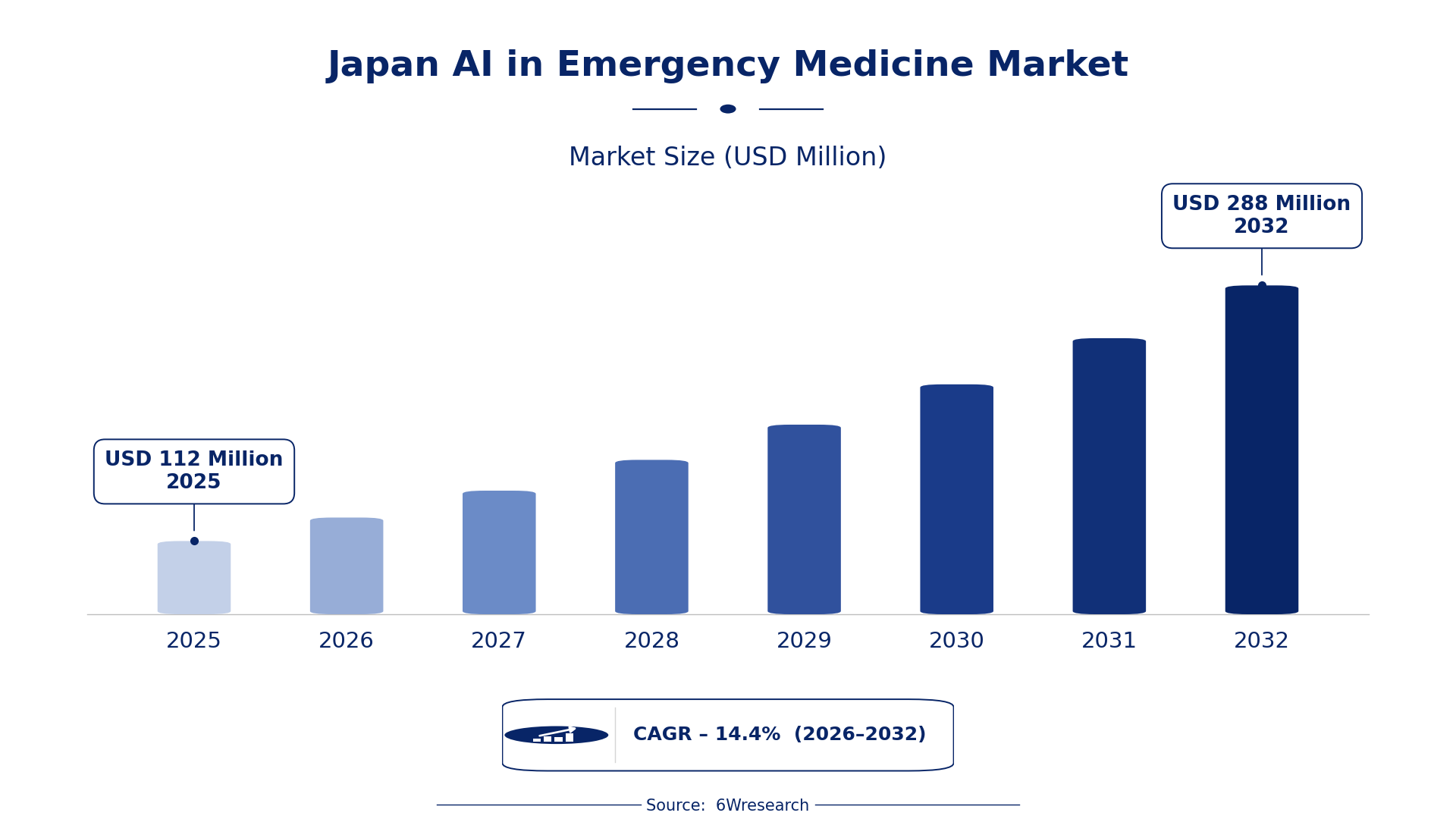
According to 6Wresearch internal database and industry insights, the Japan AI in Emergency Medicine Market was valued at USD 112 Million in 2025 and is projected to reach USD 288 Million by 2032, growing at a CAGR of approximately 14.4% during 2026–2032.
Japan AI in Emergency Medicine Market Highlights
| Report Metric | Details |
| Report Name | Japan AI in Emergency Medicine Market (2026-2032) |
| Market Size 2025 | USD 112 Million |
| Market Size 2032 | USD 288 Million |
| Absolute Growth 2025–2032 | USD 176 Million |
| CAGR 2026–2032 | 14.4% |
| Peak Annual Growth | 16.1% in 2032 |
| Forecast Period | 2026–2032 |
| Historical Data | 2022–2025 |
| Base Year | 2025 |
| Leading Use Case, 2025 | Triage Optimization (50% share) |
| Leading AI Solution Type, 2025 | Real-Time Decision AI (35% share) |
| Leading Distribution Channel, 2025 | Emergency SaaS Tools (49% share) |
| Leading End User, 2025 | ER Doctors (47% share) |
| Fastest-Growing Use Case | Diagnosis Support (19.3% CAGR) |
| Fastest-Growing AI Solution Type | NLP & Imaging AI (17.1% CAGR) |
| Fastest-Growing Distribution Channel | HealthTech Distributors (18.4% CAGR) |
| Fastest-Growing End User | Trauma Centers (18.6% CAGR) |
| Growing Sector | Emergency Services |
| Key End Users | Emergency Departments, Trauma Centers, ER Doctors, EMS Services |
Japan AI in Emergency Medicine Market Year-wise Growth Rate and Key Drivers (2022–2032)
This graph illustrates the annual growth rates of the market from 2022 to 2032, highlighting a steady upward trajectory and projected market expansion over the forecast period.
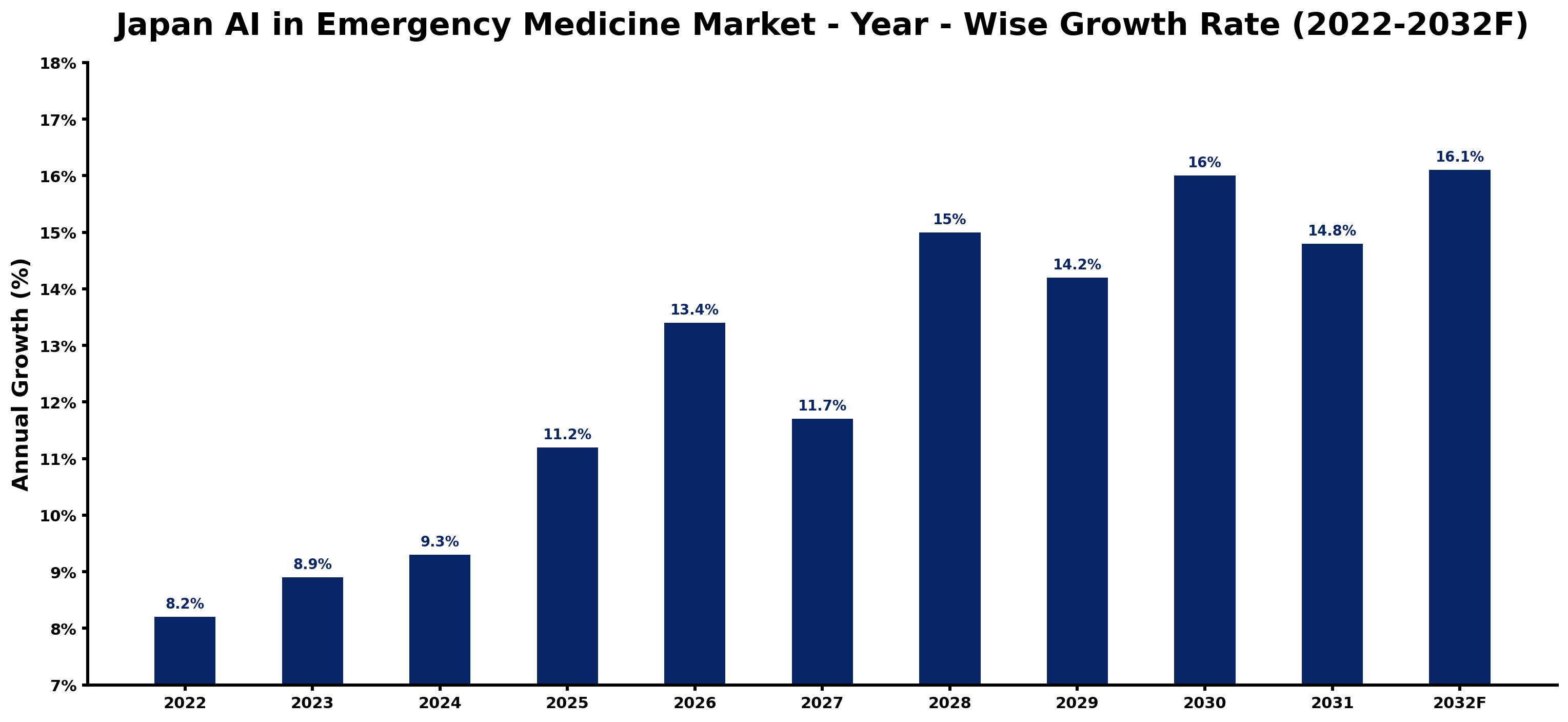
For each year, the table pairs the estimated growth rate with the leading influence on demand, showing how the drivers changed across the period.
| Year | Estimated Annual Growth (%) | Market Rationale |
| 2022 | 8.2 | The market experienced steady growth due to increased healthcare investments. |
| 2023 | 8.9 | Demand rose as healthcare providers adopted more AI technologies in emergency care. |
| 2024 | 9.3 | Growth accelerated with advancements in AI algorithms and medical data usage. |
| 2025 | 11.2 | The market peaked as hospitals expanded AI applications for patient management. |
| 2026 | 13.4 | Growth is expected to continue, driven by rising investments in healthcare technology. |
| 2027 | 11.7 | The growth rate is projected to slow as market maturity begins to set in. |
| 2028 | 15.0 | Demand is expected to surge again with new AI solutions improving operational efficiency. |
| 2029 | 14.2 | Growth is projected to slow slightly as the market adjusts to new technologies. |
| 2030 | 16.0 | The market is expected to rebound with significant advancements in real-time decision-making AI. |
| 2031 | 14.8 | Growth is projected to slow again as the market stabilises around established technologies. |
| 2032 | 16.1 | The market is expected to peak due to widespread adoption of AI in emergency services. |
Note: Market size estimations and growth projections presented in this report are based on 6Wresearch's proprietary forecasting methodology, utilizing the latest available industry data, government publications, and primary research inputs.
Japan AI in Emergency Medicine Market Synopsis
AI in Emergency Medicine utilises artificial intelligence technologies to improve emergency care, including patient triage and diagnosis support. In Japan, the demand is driven by an ageing population, with 29.3% aged 65 or older, and substantial healthcare investments, evidenced by a national medical care expenditure of about JPY 46.7 trillion in fiscal 2022. The 'Next-Generation Medical Infrastructure Act' aims to promote AI adoption by allowing anonymisation of medical data, further stimulating market growth.
Market Dynamics Impact Analysis (2026–2032)
| Factor | Type | Impact | Primary Segment Affected |
| Increasing adoption of AI technologies in emergency departments | Driver | High | Emergency Departments |
| Growing demand for real-time decision-making in emergency care | Driver | High | Real-Time Decision AI |
| Expansion of trauma centers adopting AI solutions | Opportunity | High | Trauma Centers |
| Investment in AI-driven emergency SaaS tools | Opportunity | High | Emergency SaaS Tools |
| Limited integration of AI in existing hospital IT systems | Restraint | Medium | Hospital IT Systems |
| Regulatory hurdles for AI technology approvals | Restraint | Medium | Triage Optimization |
| Shortage of skilled professionals in AI technology | Challenge | High | Emergency Departments |
| High costs associated with AI implementation | Challenge | Medium | Emergency SaaS Tools |
Evaluation of Drivers in Japan AI in Emergency Medicine Market (2026–2032)
These are the developments adding the most demand over the forecast period.
| Drivers | Primary Segment Affected | Why It Matters (Evidence) |
| Aging population increasing emergency service demand | Emergency Departments | 29.3% of Japan's population was aged 65 or older in September 2024, leading to more emergency cases. |
| Investment in healthcare technology | Real-Time Decision AI | Japan's national medical care expenditure was about JPY 46.7 trillion in fiscal 2022, boosting AI technology adoption. |
| Advancements in AI algorithms | Diagnosis Support | New AI technologies improve diagnostic accuracy, prompting hospitals to invest in these solutions. |
| Implementation of the Next-Generation Medical Infrastructure Act | Emergency SaaS Tools | This act allows anonymisation of medical data, facilitating AI adoption in emergency medicine. |
| Rise in the number of trauma centers | Trauma Centers | As of 2023, there are over 800 trauma centers in Japan, many adopting AI technologies. |
Spending rises because of the increasing ageing population, which is leading to a higher demand for emergency services. In 2023, 29.3% of Japan's population was aged 65 or older, prompting hospitals to improve their emergency care capabilities. The national medical care expenditure reached about JPY 46.7 trillion in fiscal 2022, driving investments in AI technologies. With over 800 trauma centers adopting AI solutions in 2023, hospitals are improving their operational efficiency. Advancements in AI algorithms are also improving diagnostic accuracy, prompting healthcare providers to invest in these solutions.
Evaluation of Restraints in Japan AI in Emergency Medicine Market
The following restraints limit how fast demand can grow.
| Market Restraint | Primary Segment Affected | Why It Matters (Evidence) |
| Integration challenges with existing hospital IT systems | Hospital IT Systems | Many hospitals face difficulties integrating new AI technologies, limiting their effectiveness. |
| Regulatory hurdles for AI technology approvals | Triage Optimization | Strict regulations delay the introduction of new AI solutions in emergency medicine. |
| Limited awareness of AI benefits among healthcare providers | Trauma Centers | Some providers remain hesitant to adopt AI due to a lack of understanding of its advantages. |
| High costs associated with AI implementation | Emergency SaaS Tools | The investment required for AI tools can deter smaller healthcare facilities. |
| Shortage of skilled professionals in AI technology | Emergency Departments | A lack of trained personnel hinders the effective implementation of AI in emergency services. |
Japan AI in Emergency Medicine Market Challenges
In 2023, hospitals face operational costs rising by 15% due to reliance on outdated technology, limiting their ability to implement AI solutions effectively. Supply chain bottlenecks arise from the limited availability of advanced AI tools, delaying clinics' implementation timelines by an average of six months. Increased competition among healthcare providers to adopt AI technologies can lead to price wars, which squeeze profit margins for suppliers. Regulatory challenges related to ISO 13485 can extend the time to market for AI applications, causing delays that hinder hospitals’ efforts to improve emergency services.
Trends in the Japan AI in Emergency Medicine Market
The shifts below are changing how Japan AI in Emergency Medicine Market products are bought and supplied.
- Smart Healthcare Initiative Promoting AI Adoption: The 'Smart Healthcare' initiative encourages the use of AI for better patient outcomes in emergency care. In 2023, over 800 trauma centres began adopting AI technologies, improving their operational efficiency.
- Shift Towards Real-Time Decision AI: Since 2023, there has been a notable shift towards real-time decision-making AI in emergency medicine. Hospitals increasingly rely on AI to improve patient triage and diagnosis.
- Growing Use of Emergency SaaS Tools: The adoption of emergency SaaS tools is on the rise, with 49% of the distribution channel share in 2025. This trend reflects a growing preference for software solutions that streamline emergency management.
- Focus on Enhanced Patient Triage: In recent years, there has been a strong emphasis on improving patient triage processes. The integration of AI technologies is helping emergency departments prioritise patients based on urgency.
Investment Opportunities in the Japan AI in Emergency Medicine Market
Investors looking at the Japan AI in Emergency Medicine Market should consider the following areas.
- Partnerships with local hospitals for AI integration: There is an opportunity for partnerships with local hospitals to implement AI solutions, targeting the 1,200 emergency departments across Japan.
- Investment in AI-driven emergency SaaS tools: The gap in AI adoption presents a chance to invest in emergency SaaS tools, targeting the 1,200 emergency departments across Japan.
- Joint ventures with trauma centers: As over 800 trauma centres are adopting AI technologies, forming joint ventures can facilitate the integration of AI into their operations.
- Supply of AI diagnostic tools: The increasing demand for accurate diagnosis creates an opportunity to supply AI diagnostic tools to healthcare providers.
Government Initiatives in the Japan AI in Emergency Medicine Market
The 'Next-Generation Medical Infrastructure Act' aims to promote AI adoption in healthcare by allowing certified bodies to anonymise medical data. This measure improves upon the existing Medical Care Act of 1948, which sets standards for hospitals and clinics, ensuring better patient outcomes and efficient emergency care. The act encourages the integration of AI in emergency medicine by facilitating data sharing and enhancing research capabilities.
The Pharmaceuticals and Medical Devices Agency (PMDA) reviews pharmaceuticals and medical devices, including AI technologies. This agency plays a key role in approving AI solutions for emergency medicine, ensuring safety and efficacy for healthcare providers. Additionally, the Japan Agency for Medical Research and Development (AMED) funds medical research and development, supporting AI integration in emergency services.
Future Insight of the Japan AI in Emergency Medicine Market
By 2032, AI technologies will revolutionise patient triage processes, driven by the 'Digital Agency' promoting AI integration in healthcare systems. The integration of AI in around 1,200 emergency departments will enhance patient outcomes, exemplified by the average ambulance response time of under 8 minutes in urban areas. New standards will emerge to ensure AI applications meet strict safety and efficacy requirements. Initiatives like 'Smart Healthcare' will further accelerate AI adoption, creating a more efficient emergency care system that benefits both buyers and suppliers.
Market Segmentation Analysis
Japan AI in Emergency Medicine Market report covers a detailed analysis of the following market segments:
By Use Case – Triage Optimization Leads, Diagnosis Support Expected to Grow Fastest
According to Saurav Kr Singh, Senior Research Analyst at 6Wresearch, Triage Optimization accounted for 50% of the market by use case in 2025. Triage optimization holds the largest share as it is crucial for prioritising patient care during emergencies, ensuring that critical cases receive immediate attention. In Japan, with a significant elderly population requiring urgent care, effective triage is essential for managing patient flow in hospitals. Diagnosis Support is projected to grow fastest, at a CAGR of 19.3% during 2026–2032. The diagnosis support segment is growing rapidly due to its vital role in providing accurate assessments in high-pressure situations. As emergency cases become more complex, the demand for advanced diagnostic tools is increasing to support healthcare professionals. This trend suggests that suppliers should focus on enhancing capabilities in triage and diagnosis to meet the growing demands of emergency care.
By AI Solution Type – Real-Time Decision AI Leads, NLP & Imaging AI Expected to Grow Fastest
The largest ai solution type category in 2025 was Real-Time Decision AI, at 35% of revenue. Real-time decision AI commands the largest share as it is integral for making instant medical decisions in emergencies, where timely responses are critical. This technology is particularly vital in urban areas like Tokyo, where rapid ambulance response times are essential for patient survival. NLP & Imaging AI is set to record the highest CAGR in this split, 17.1% over 2026–2032. NLP and imaging AI are witnessing the fastest growth as they improve the interpretation of medical data, which is increasingly important for accurate diagnostics. The rising complexity of emergency cases necessitates these advanced tools for effective patient management. Suppliers should prioritise the development of real-time decision-making and imaging technologies to align with the urgent needs of emergency medical services.
By Distribution Channel – Emergency SaaS Tools Lead, HealthTech Distributors Expected to Grow Fastest
Emergency SaaS Tools took 49% of distribution channel revenue in 2025, more than any other category. Emergency SaaS tools dominate the market as they provide essential software solutions for emergency management, facilitating effective communication among healthcare providers. Their widespread use across Japan's hospitals highlights their critical role in enhancing emergency care efficiency. The quickest growth will come from HealthTech Distributors, forecast to expand at a CAGR of 18.4% between 2026 and 2032. HealthTech distributors are experiencing the fastest growth as they ensure that advanced technologies reach healthcare providers efficiently. The increasing reliance on technology in emergency care is driving demand for effective distribution channels. This suggests that suppliers should strengthen partnerships with distributors to enhance the reach of their solutions in emergency medicine.
By End User – ER Doctors Lead, Trauma Centers Expected to Grow Fastest
With 47% of end user revenue in 2025, ER Doctors was the largest category. ER doctors represent the largest user group for tools in emergency settings, as they are on the front lines of patient care and rely heavily on technology for decision-making. Their direct involvement in treatment underscores the importance of advancements in improving emergency care outcomes. Over 2026–2032, Trauma Centers are expected to post the fastest growth, at a CAGR of 18.6%. Trauma centers are experiencing the fastest growth in adoption as they significantly benefit from advanced applications that streamline patient management. The critical nature of trauma cases necessitates the rapid integration of technologies in these facilities. This trend indicates that suppliers should focus on tailoring solutions to meet the specific needs of ER doctors and trauma centers.
Key Attractiveness of the Report
- 10 Years of Market Numbers
- Historical Data Starting from 2022 to 2025
- Base Year 2025
- Forecast Data until 2032
- Key Performance Indicators Impacting the Market
- Major Upcoming Developments and Projects
Key Highlights of the Report:
- Japan AI in Emergency Medicine Market Outlook
- Market Size of Japan AI in Emergency Medicine Market, 2025
- Forecast of Japan AI in Emergency Medicine Market, 2032
- Historical Data and Forecast of Japan AI in Emergency Medicine Revenues & Volume for the Period 2022-2032F
- Japan AI in Emergency Medicine Market Trend Evolution
- Japan AI in Emergency Medicine Market Drivers and Challenges
- Japan AI in Emergency Medicine Price Trends
- Japan AI in Emergency Medicine Porter's Five Forces
- Japan AI in Emergency Medicine Industry Life Cycle
- Historical Data and Forecast of Japan AI in Emergency Medicine Market Revenues & Volume By Use Case for the Period 2022-2032F
- Historical Data and Forecast of Japan AI in Emergency Medicine Market Revenues & Volume By Triage Optimization for the Period 2022-2032F
- Historical Data and Forecast of Japan AI in Emergency Medicine Market Revenues & Volume By Diagnosis Support for the Period 2022-2032F
- Historical Data and Forecast of Japan AI in Emergency Medicine Market Revenues & Volume By Ambulance Routing for the Period 2022-2032F
- Historical Data and Forecast of Japan AI in Emergency Medicine Market Revenues & Volume By Patient Prioritization for the Period 2022-2032F
- Historical Data and Forecast of Japan AI in Emergency Medicine Market Revenues & Volume By AI Solution Type for the Period 2022-2032F
- Historical Data and Forecast of Japan AI in Emergency Medicine Market Revenues & Volume By Real-Time Decision AI for the Period 2022-2032F
- Historical Data and Forecast of Japan AI in Emergency Medicine Market Revenues & Volume By NLP & Imaging AI for the Period 2022-2032F
- Historical Data and Forecast of Japan AI in Emergency Medicine Market Revenues & Volume By Predictive AI + GIS for the Period 2022-2032F
- Historical Data and Forecast of Japan AI in Emergency Medicine Market Revenues & Volume By Risk Stratification for the Period 2022-2032F
- Historical Data and Forecast of Japan AI in Emergency Medicine Market Revenues & Volume By Distribution Channel for the Period 2022-2032F
- Historical Data and Forecast of Japan AI in Emergency Medicine Market Revenues & Volume By Emergency SaaS Tools for the Period 2022-2032F
- Historical Data and Forecast of Japan AI in Emergency Medicine Market Revenues & Volume By HealthTech Distributors for the Period 2022-2032F
- Historical Data and Forecast of Japan AI in Emergency Medicine Market Revenues & Volume By Integrated Healthcare Systems for the Period 2022-2032F
- Historical Data and Forecast of Japan AI in Emergency Medicine Market Revenues & Volume By Hospital IT Systems for the Period 2022-2032F
- Historical Data and Forecast of Japan AI in Emergency Medicine Market Revenues & Volume By End User for the Period 2022-2032F
- Historical Data and Forecast of Japan AI in Emergency Medicine Market Revenues & Volume By ER Doctors for the Period 2022-2032F
- Historical Data and Forecast of Japan AI in Emergency Medicine Market Revenues & Volume By Trauma Centers for the Period 2022-2032F
- Historical Data and Forecast of Japan AI in Emergency Medicine Market Revenues & Volume By EMS Services for the Period 2022-2032F
- Historical Data and Forecast of Japan AI in Emergency Medicine Market Revenues & Volume By Emergency Departments for the Period 2022-2032F
- Japan AI in Emergency Medicine Import Export Trade Statistics
- Market Opportunity Assessment By Use Case
- Market Opportunity Assessment By AI Solution Type
- Market Opportunity Assessment By Distribution Channel
- Market Opportunity Assessment By End User
- Japan AI in Emergency Medicine Top Companies Market Share
- Japan AI in Emergency Medicine Competitive Benchmarking By Technical and Operational Parameters
- Japan AI in Emergency Medicine Company Profiles
- Japan AI in Emergency Medicine Key Strategic Recommendations
Market Covered
This report examines the market across the segments below.
By Use Case
- Triage Optimization
- Diagnosis Support
- Ambulance Routing
- Patient Prioritization
By AI Solution Type
- Real-Time Decision AI
- NLP & Imaging AI
- Predictive AI + GIS
- Risk Stratification
By Distribution Channel
- Emergency SaaS Tools
- HealthTech Distributors
- Integrated Healthcare Systems
- Hospital IT Systems
By End User
- ER Doctors
- Trauma Centers
- EMS Services
- Emergency Departments































