Japan AI in Enterprise Software Market Size & Growth Rate
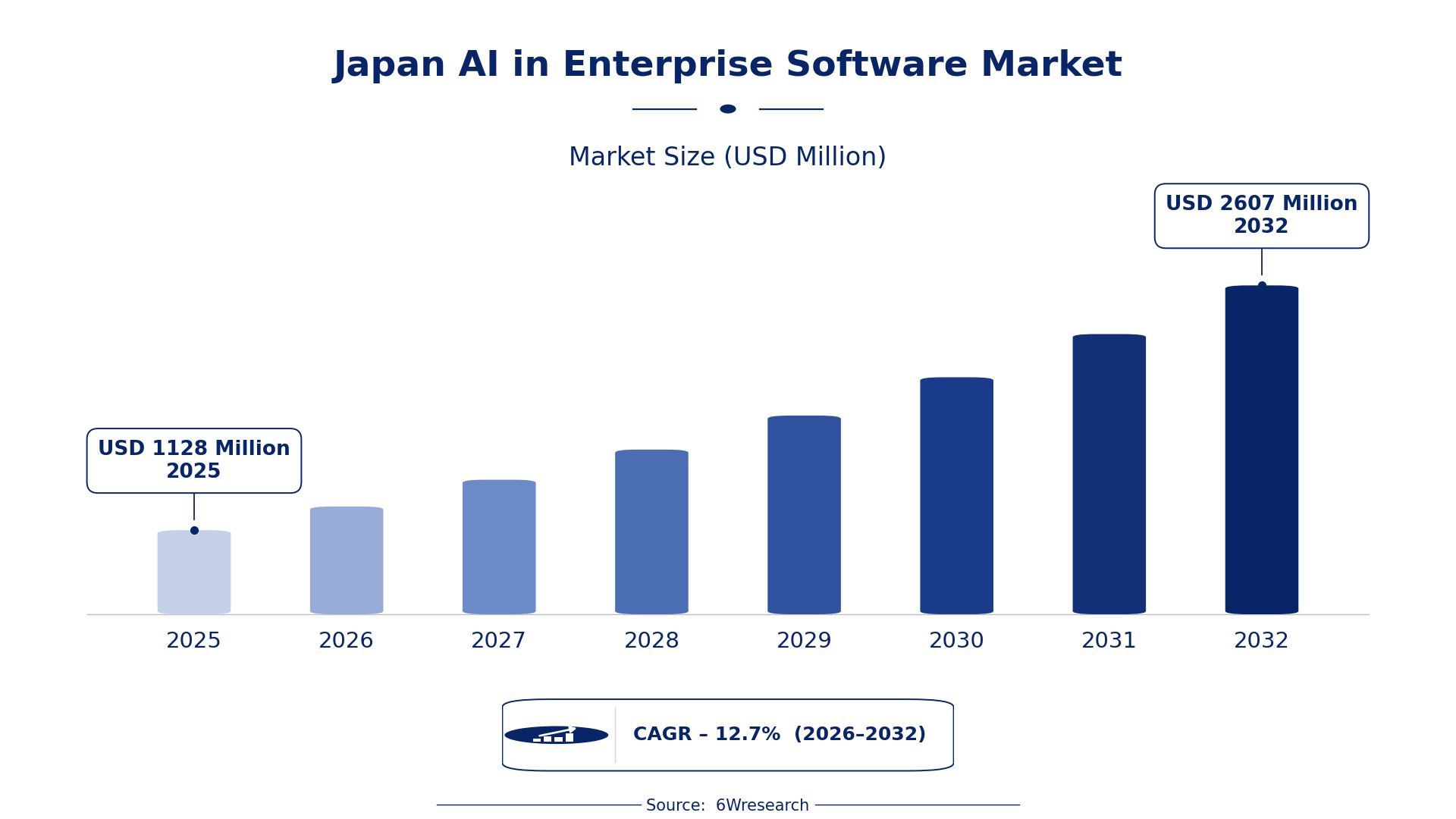
According to 6Wresearch internal database and industry insights, the Japan AI in Enterprise Software Market was valued at USD 1,128 Million in 2025 and is projected to reach USD 2,607 Million by 2032, growing at a CAGR of approximately 12.7% during 2026–2032.
Japan AI in Enterprise Software Market Highlights
| Report Metric | Details |
| Report Name | Japan AI in Enterprise Software Market (2026-2032) |
| Market Size 2025 | USD 1,128 Million |
| Market Size 2032 | USD 2,607 Million |
| Absolute Growth 2025–2032 | USD 1,479 Million |
| CAGR 2026–2032 | 12.7% |
| Peak Annual Growth | 13.8% in 2028 |
| Forecast Period | 2026–2032 |
| Historical Data | 2022–2025 |
| Base Year | 2025 |
| Leading Software Type, 2025 | CRM with AI (44% share) |
| Leading AI Functionality, 2025 | Task Automation (35% share) |
| Leading Distribution Channel, 2025 | SaaS Portals (47% share) |
| Leading End User, 2025 | Large Enterprises (47% share) |
| Fastest-Growing Software Type | HR Software (18.1% CAGR) |
| Fastest-Growing AI Functionality | Demand Forecasting (17.1% CAGR) |
| Fastest-Growing End User | Consulting Firms (16.1% CAGR) |
| Growing Sector | enterprise software |
| Key End Users | large enterprises, HR departments, consulting firms, marketing teams |
Japan AI in Enterprise Software Market Year-wise Growth Rate and Key Drivers (2022–2032)
This graph illustrates the annual growth rates of the market from 2022 to 2032, highlighting a steady upward trajectory and projected market expansion over the forecast period.
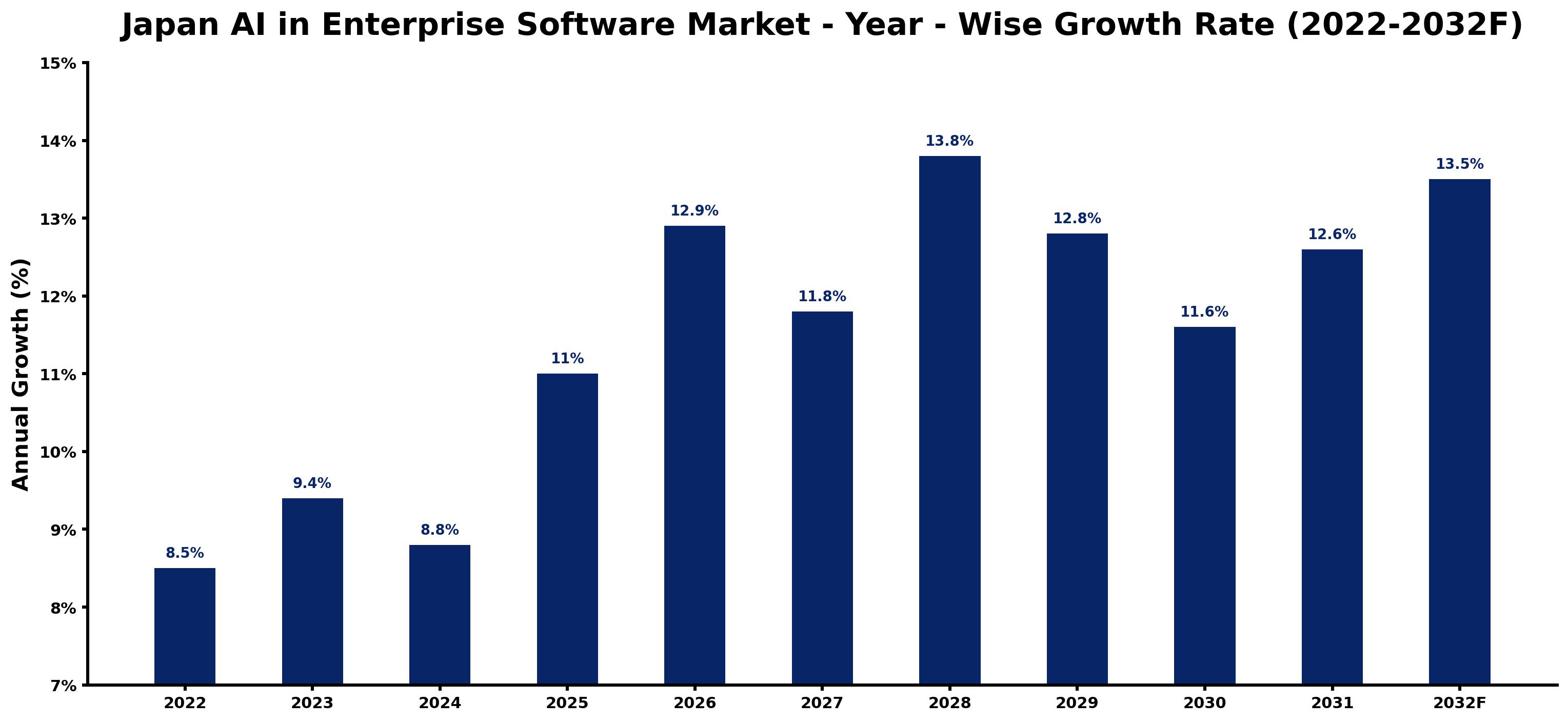
The table below sets out the estimated growth rate for each year and the main factor behind it.
| Year | Estimated Annual Growth (%) | Market Rationale |
| 2022 | 8.5 | The market experienced steady growth, driven by increased AI integration in enterprise software. |
| 2023 | 9.4 | Demand rose as more businesses adopted AI technologies to improve operational efficiency. |
| 2024 | 8.8 | Growth slowed slightly due to a temporary market saturation in certain sectors. |
| 2025 | 11.0 | The market saw an uptick as large enterprises accelerated AI implementation. |
| 2026 | 12.9 | Continued investment in AI capabilities is expected to drive faster growth in enterprise software. |
| 2027 | 11.8 | Growth is projected to moderate as companies focus on optimising existing AI solutions. |
| 2028 | 13.8 | The peak growth year reflects heightened demand for innovative AI applications in business. |
| 2029 | 12.8 | Growth is anticipated to slow as the market begins to stabilise after rapid expansion. |
| 2030 | 11.6 | A further slowdown is expected as businesses reassess their AI strategies. |
| 2031 | 12.6 | Demand is projected to increase again as new AI functionalities become available. |
| 2032 | 13.5 | The market will maintain strong growth as AI adoption becomes mainstream. |
Note: Market size estimations and growth projections presented in this report are based on 6Wresearch's proprietary forecasting methodology, utilizing the latest available industry data, government publications, and primary research inputs.
Japan AI in Enterprise Software Market Synopsis
AI in Enterprise Software integrates artificial intelligence into business applications to improve decision-making and operational efficiency. This market is expanding rapidly, driven by the increasing adoption of AI technologies among large enterprises, with over 70% already implementing these solutions. The Tokyo region accounts for 40% of demand, supported by initiatives such as the AI Strategy 2021, which promotes AI integration across various sectors. As businesses seek to optimise processes and improve customer relations, the Japan AI in Enterprise Software Market is poised for notable growth.
Market Dynamics Impact Analysis (2026–2032)
| Factor | Type | Impact | Primary Segment Affected |
| Increased adoption of AI technologies among large enterprises | Driver | High | CRM with AI |
| Growing demand for task automation to enhance operational efficiency | Driver | High | Task Automation |
| Rising need for advanced analytics in decision-making processes | Opportunity | High | Demand Forecasting |
| Expansion of AI education and training programs in universities | Opportunity | High | HR Software |
| High costs associated with AI implementation and maintenance | Restraint | Medium | ERP with AI |
| Limited availability of skilled AI professionals in the market | Restraint | Medium | HR Software |
| Challenges in integrating AI with existing legacy systems | Challenge | Medium | Project Management Tools |
| Rapid technological advancements leading to obsolescence of current solutions | Challenge | Medium | CRM with AI |
Evaluation of Drivers in Japan AI in Enterprise Software Market (2026–2032)
These are the developments adding the most demand over the forecast period.
| Drivers | Primary Segment Affected | Why It Matters (Evidence) |
| Growing demand for CRM software | CRM with AI | Over 70% of large enterprises in Japan have adopted AI technologies, leading to increased purchases of CRM solutions. |
| Need for task automation in business processes | Task Automation | AI-driven task automation can improve efficiency by 30% by 2025, prompting more businesses to invest. |
| Investment in AI capabilities for competitive advantage | HR Software | The average annual salary for AI specialists in Japan is around 10 million JPY, indicating high demand for skilled professionals. |
| Focus on enhancing customer insights through AI | Customer Insight Engine | The demand for CRM software is growing at an estimated rate of 15% annually, driving purchases. |
| Integration of AI in project management tools | Project Management Tools | AI in project management tools is expected to improve efficiency by 30% by 2025, attracting more buyers. |
Behind the steady rise in orders lies a marked increase in AI adoption among large enterprises, with over 70% integrating AI technologies into their operations. The demand for CRM software is growing at an estimated rate of 15% annually, as businesses aim to strengthen customer relationships. AI-driven task automation is projected to boost efficiency by 30% by 2025, prompting more businesses to invest in these solutions. The competitive market for skilled professionals is underscored by the average annual salary for AI specialists in Japan, which stands at around 10 million JPY. The integration of AI in project management tools is attracting more buyers, as companies look to streamline their processes and improve outcomes.
Evaluation of Restraints in Japan AI in Enterprise Software Market
Below are the constraints most often cited by buyers and suppliers, with the segment each affects.
| Market Restraint | Primary Segment Affected | Why It Matters (Evidence) |
| High costs associated with AI implementation | ERP with AI | The average annual budget for AI research and development in Japan is approximately 100 billion JPY, making it costly for businesses. |
| Limited availability of skilled AI professionals | HR Software | The average salary for AI specialists is around 10 million JPY, which can deter companies from hiring. |
| Integration challenges with legacy systems | Project Management Tools | Many companies face difficulties integrating AI solutions with existing systems, which can slow down adoption. |
| Concerns over data security and compliance | CRM with AI | Companies must comply with ISO/IEC 27001, a standard for information security management. |
| Resistance to change within organisations | Task Automation | Some businesses hesitate to adopt new technologies due to fear of disruption in workflows. |
Japan AI in Enterprise Software Market Challenges
High competition among software providers raises prices, compelling producers to allocate larger budgets for AI integration, which can strain financial resources. Many buyers in Japan grapple with the complexity of AI technologies, resulting in deployment times averaging six months, delaying operational benefits and reducing productivity. Rising salaries for AI specialists, averaging 10 million JPY annually, inflate labour costs for suppliers, which can be passed on to producers, increasing overall project expenses. Limited availability of skilled professionals restricts suppliers' capacity to meet demand, causing project delays that hinder buyers' timelines and operational efficiency.
Trends in the Japan AI in Enterprise Software Market
These developments are changing demand patterns in the Japan AI in Enterprise Software Market.
- Shift from Traditional to AI-Driven Solutions: Since 2021, there has been a marked shift towards AI-driven solutions in enterprise software, as reflected in the Tokyo region's 40% share of Japan's enterprise software demand.
- Emergence of AI-Driven HR Software: The adoption of AI-driven HR software has surged, with over 60% of HR departments now using these tools, reflecting a growing trend towards automation in talent management.
- Growth of SaaS Portals for Software Distribution: SaaS Portals have become the leading distribution channel, holding a 47% share in 2025, driven by demand for flexible and scalable software solutions among enterprises.
- Increased Focus on Customer Insight Engines: As of 2023, the demand for Customer Insight Engines has risen, with businesses seeking to better understand customer behaviour, reflecting the growing need for data-driven decision-making.
Investment Opportunities in the Japan AI in Enterprise Software Market
Below are the investment opportunities with the strongest case in the Japan AI in Enterprise Software Market.
- Timing for Investment in AI Solutions: With over 70% of large enterprises adopting AI, now is the ideal time to invest in AI solutions that improve operational efficiency, particularly in the Tokyo region, which accounts for 40% of demand.
- Gap in AI Education and Training: As Japan launched a national program to improve AI education in universities, there is a significant opportunity to invest in training programs for AI specialists, addressing the skills gap in the market.
- Partnerships for AI Integration: Local partnerships with consulting firms can facilitate the integration of AI solutions in businesses. This is particularly relevant in the Tokyo region, where demand for AI technologies is high.
- Investment in AI-Driven Project Management Tools: The expected improvement in efficiency by 30% in project management tools by 2025 presents a promising opportunity for suppliers to develop and market these solutions.
Government Initiatives in the Japan AI in Enterprise Software Market
The AI Promotion Act (2025) provides a national framework for AI research, development, and use, adding clarity to previous laws by offering guidelines for AI integration in businesses. This act supports the ongoing efforts of the Digital Agency, which promotes AI adoption through various initiatives and funding opportunities.
In 2023, the annual budget for AI research and development in Japan is approximately 100 billion JPY, allocated by the Ministry of Economy, Trade and Industry. This funding supports projects aimed at improving AI capabilities across industries, ensuring that businesses can effectively implement AI technologies.
Future Insight of the Japan AI in Enterprise Software Market
The national program for AI education in universities will establish a stronger talent pool by 2032, equipping suppliers with skilled professionals. AI capabilities in ERP systems are expected to improve efficiency by 30% by 2025, benefiting both buyers and suppliers. The Digital Agency's backing of AI initiatives will facilitate the development of advanced applications in enterprise software, promoting innovation. By 2032, the demand for AI-driven solutions will continue to rise, creating new opportunities for investment and growth in the market.
Market Segmentation Analysis
Japan AI in Enterprise Software Market report covers a detailed analysis of the following market segments:
By Software Type – CRM with AI Leads, HR Software Expected to Grow Fastest
According to Saurav Kr Singh, Senior Research Analyst at 6Wresearch, CRM with AI took 44% of software type revenue in 2025, more than any other category. CRM with AI holds the largest share as it is essential for managing customer relationships, particularly in sectors like retail and services. Over 70% of large enterprises in Japan have adopted AI technologies, showcasing the critical role of CRM systems in their operations. HR Software is set to record the highest CAGR in this split, 18.1% over 2026–2032. The HR Software segment is experiencing rapid growth due to its critical role in talent management and recruitment, with adoption rates exceeding 60% among HR departments. This trend indicates a strong focus on optimising human resources in response to competitive pressures. Suppliers should prioritise CRM and HR software development to meet the increasing demand from large enterprises.
By AI Functionality – Task Automation Leads, Demand Forecasting Expected to Grow Fastest
Task Automation held 35% of the Japan AI in Enterprise Software Market by ai functionality in 2025. Task Automation holds the largest share as it is crucial for enhancing operational efficiency by reducing manual workloads across various industries. This is evidenced by the adoption rate, where over 70% of large enterprises in Japan have implemented task automation in their processes. Over 2026–2032, Demand Forecasting is expected to post the fastest growth, at a CAGR of 17.1%. Demand Forecasting is witnessing rapid growth due to its essential role in enabling businesses to anticipate market trends and adjust strategies accordingly. This functionality's significance is underscored by the increasing competition in the market, where accurate demand predictions are vital for maintaining an edge. Buyers must prioritise functionalities that drive efficiency to stay competitive in the evolving market.
By Distribution Channel – SaaS Portals Lead and Record the Fastest Growth
SaaS Portals accounted for 47% of the market by distribution channel in 2025. SaaS Portals dominate the distribution channel as they offer seamless access to a wide range of enterprise software solutions, making deployment more efficient for users. The popularity of SaaS Portals is reflected in their widespread adoption among businesses seeking easy access to necessary tools. Its lead should widen, with a projected CAGR of 14.6% during 2026–2032, the highest in this split. SaaS Portals are also the fastest-growing channel, propelled by their user-friendly nature and the increasing shift towards cloud-based solutions. This trend indicates a strong future reliance on SaaS as businesses continue to embrace digital transformation. Suppliers should enhance their SaaS offerings to align with the growing demand for accessible and scalable software solutions.
By End User – Large Enterprises Lead, Consulting Firms Expected to Grow Fastest
In 2025, Large Enterprises led the end user split with a 47% share. Large Enterprises represent the largest segment of end users, as they require robust software solutions to manage their complex operations effectively. Their substantial investments in technology upgrades and integration further solidify their dominant position in the market. Consulting Firms are projected to grow fastest, at a CAGR of 16.1% during 2026–2032. Consulting Firms are the fastest-growing end user group, leveraging software to optimise project delivery and enhance client services. This trend highlights a shift towards technology reliance in consulting, indicating a growing market opportunity for tailored solutions. Suppliers need to customise their offerings to meet the unique requirements of consulting firms, which are increasingly integrating enterprise software into their operations.
Key Attractiveness of the Report
- 10 Years of Market Numbers
- Historical Data Starting from 2022 to 2025
- Base Year 2025
- Forecast Data until 2032
- Key Performance Indicators Impacting the Market
- Major Upcoming Developments and Projects
Key Highlights of the Report:
- Japan AI in Enterprise Software Market Outlook
- Market Size of Japan AI in Enterprise Software Market, 2025
- Forecast of Japan AI in Enterprise Software Market, 2032
- Historical Data and Forecast of Japan AI in Enterprise Software Revenues & Volume for the Period 2022-2032F
- Japan AI in Enterprise Software Market Trend Evolution
- Japan AI in Enterprise Software Market Drivers and Challenges
- Japan AI in Enterprise Software Price Trends
- Japan AI in Enterprise Software Porter's Five Forces
- Japan AI in Enterprise Software Industry Life Cycle
- Historical Data and Forecast of Japan AI in Enterprise Software Market Revenues & Volume By Software Type for the Period 2022-2032F
- Historical Data and Forecast of Japan AI in Enterprise Software Market Revenues & Volume By ERP with AI for the Period 2022-2032F
- Historical Data and Forecast of Japan AI in Enterprise Software Market Revenues & Volume By CRM with AI for the Period 2022-2032F
- Historical Data and Forecast of Japan AI in Enterprise Software Market Revenues & Volume By HR Software for the Period 2022-2032F
- Historical Data and Forecast of Japan AI in Enterprise Software Market Revenues & Volume By Project Management Tools for the Period 2022-2032F
- Historical Data and Forecast of Japan AI in Enterprise Software Market Revenues & Volume By AI Functionality for the Period 2022-2032F
- Historical Data and Forecast of Japan AI in Enterprise Software Market Revenues & Volume By Demand Forecasting for the Period 2022-2032F
- Historical Data and Forecast of Japan AI in Enterprise Software Market Revenues & Volume By Customer Insight Engine for the Period 2022-2032F
- Historical Data and Forecast of Japan AI in Enterprise Software Market Revenues & Volume By Talent Prediction for the Period 2022-2032F
- Historical Data and Forecast of Japan AI in Enterprise Software Market Revenues & Volume By Task Automation for the Period 2022-2032F
- Historical Data and Forecast of Japan AI in Enterprise Software Market Revenues & Volume By Distribution Channel for the Period 2022-2032F
- Historical Data and Forecast of Japan AI in Enterprise Software Market Revenues & Volume By SaaS Portals for the Period 2022-2032F
- Historical Data and Forecast of Japan AI in Enterprise Software Market Revenues & Volume By Direct Software Vendors for the Period 2022-2032F
- Historical Data and Forecast of Japan AI in Enterprise Software Market Revenues & Volume By Online B2B Platforms for the Period 2022-2032F
- Historical Data and Forecast of Japan AI in Enterprise Software Market Revenues & Volume By Subscription Licensing for the Period 2022-2032F
- Historical Data and Forecast of Japan AI in Enterprise Software Market Revenues & Volume By End User for the Period 2022-2032F
- Historical Data and Forecast of Japan AI in Enterprise Software Market Revenues & Volume By Large Enterprises for the Period 2022-2032F
- Historical Data and Forecast of Japan AI in Enterprise Software Market Revenues & Volume By Marketing Teams for the Period 2022-2032F
- Historical Data and Forecast of Japan AI in Enterprise Software Market Revenues & Volume By HR Departments for the Period 2022-2032F
- Historical Data and Forecast of Japan AI in Enterprise Software Market Revenues & Volume By Consulting Firms for the Period 2022-2032F
- Japan AI in Enterprise Software Import Export Trade Statistics
- Market Opportunity Assessment By Software Type
- Market Opportunity Assessment By AI Functionality
- Market Opportunity Assessment By Distribution Channel
- Market Opportunity Assessment By End User
- Japan AI in Enterprise Software Top Companies Market Share
- Japan AI in Enterprise Software Competitive Benchmarking By Technical and Operational Parameters
- Japan AI in Enterprise Software Company Profiles
- Japan AI in Enterprise Software Key Strategic Recommendations
Market Covered
Coverage by segment is as follows.
By Software Type
- ERP with AI
- CRM with AI
- HR Software
- Project Management Tools
By AI Functionality
- Demand Forecasting
- Customer Insight Engine
- Talent Prediction
- Task Automation
By Distribution Channel
- SaaS Portals
- Direct Software Vendors
- Online B2B Platforms
- Subscription Licensing
By End User
- Large Enterprises
- Marketing Teams
- HR Departments
- Consulting Firms































