Japan AI in Financial Analytics Market Size & Growth Rate
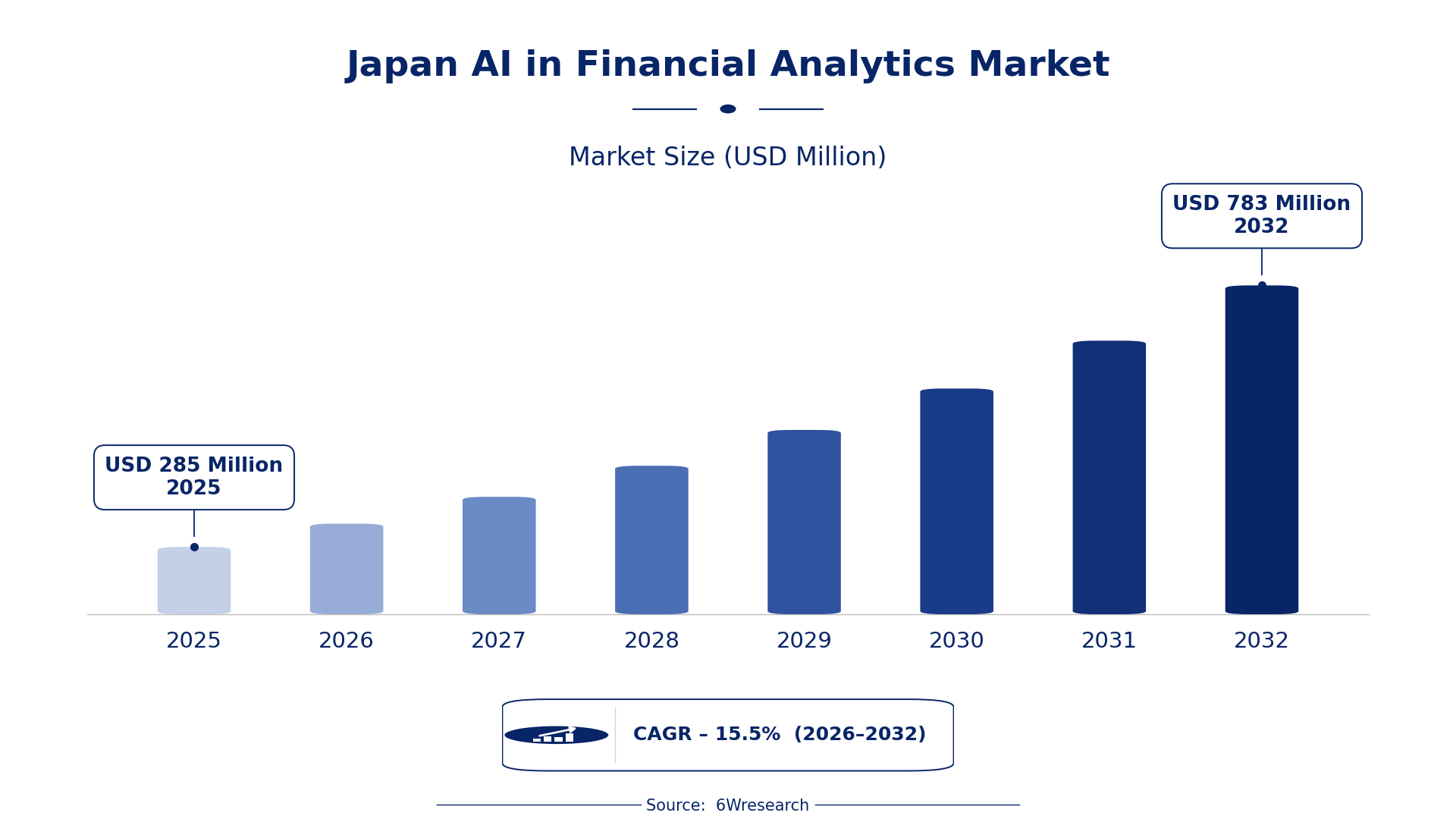
According to 6Wresearch internal database and industry insights, the Japan AI in Financial Analytics Market was valued at USD 285 Million in 2025 and is projected to reach USD 783 Million by 2032, growing at a CAGR of approximately 15.5% during 2026–2032.
Japan AI in Financial Analytics Market Highlights
| Report Metric | Details |
| Report Name | Japan AI in Financial Analytics Market (2026-2032) |
| Market Size 2025 | USD 285 Million |
| Market Size 2032 | USD 783 Million |
| Absolute Growth 2025–2032 | USD 498 Million |
| CAGR 2026–2032 | 15.5% |
| Peak Annual Growth | 16.6% in 2029 |
| Forecast Period | 2026–2032 |
| Historical Data | 2022–2025 |
| Base Year | 2025 |
| Leading Application Type, 2025 | Real-Time Reporting (47% share) |
| Leading AI Technique, 2025 | Predictive Analytics (50% share) |
| Leading Distribution Channel, 2025 | Fintech SaaS Platforms (36% share) |
| Leading End User, 2025 | Investment Banks (37% share) |
| Fastest-Growing Application Type | Portfolio Analysis (20.4% CAGR) |
| Fastest-Growing AI Technique | Machine Learning (19.8% CAGR) |
| Fastest-Growing Distribution Channel | Cloud-Based Analytics (20.2% CAGR) |
| Fastest-Growing End User | Lending Institutions (19.6% CAGR) |
| Growing Sector | Financial Services |
| Key End Users | Fintech Companies, Investment Banks, Lending Institutions, Asset Managers |
Japan AI in Financial Analytics Market Year-wise Growth Rate and Key Drivers (2022–2032)
This graph illustrates the annual growth rates of the market from 2022 to 2032, highlighting a steady upward trajectory and projected market expansion over the forecast period.
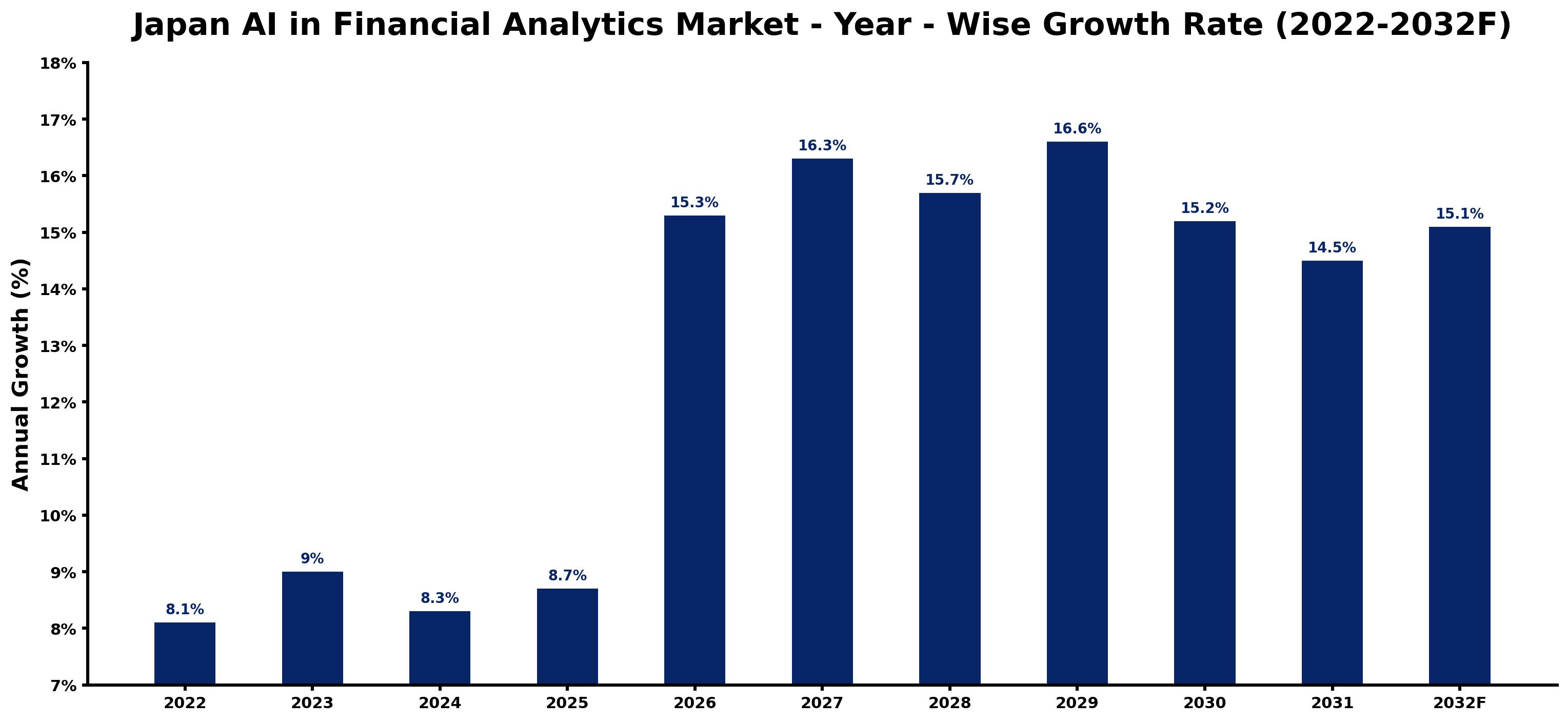
The yearly estimates that follow link every growth rate to its principal driver, so readers can see why the pace changed in each period.
| Year | Estimated Annual Growth (%) | Market Rationale |
| 2022 | 8.1 | The market showed steady growth, driven by increased adoption of AI technologies in financial services. |
| 2023 | 9.0 | Growth accelerated as financial institutions invested more in AI for credit scoring and risk assessment. |
| 2024 | 8.3 | A slight slowdown occurred as firms adjusted to market dynamics and competition increased. |
| 2025 | 8.7 | Demand picked up again as firms sought real-time reporting solutions to enhance decision-making. |
| 2026 | 15.3 | Investment is expected to surge as AI technologies begin to reshape financial analytics practices. |
| 2027 | 16.3 | Growth will continue as machine learning applications gain traction in the financial sector. |
| 2028 | 15.7 | A slight slowdown is projected as the market matures and competition intensifies further. |
| 2029 | 16.6 | The peak year will see rapid advancements in predictive analytics technologies and their applications. |
| 2030 | 15.2 | Growth is expected to slow as the market stabilises after reaching its peak performance. |
| 2031 | 14.5 | Demand will continue to grow but at a slower rate as new entrants emerge in the sector. |
| 2032 | 15.1 | The market is projected to see renewed interest as investment in AI technologies rises. |
Note: Market size estimations and growth projections presented in this report are based on 6Wresearch's proprietary forecasting methodology, utilizing the latest available industry data, government publications, and primary research inputs.
Japan AI in Financial Analytics Market Synopsis
AI in Financial Analytics employs advanced algorithms and machine learning to analyse financial data, improving decision-making across various sectors. The Japan AI in Financial Analytics Market is expanding due to rising investments in AI technologies, particularly in credit scoring and portfolio management. With over 1,200 registered fintech companies and a digital finance strategy launched in 2023, the market is set for growth, especially within the fintech and banking sectors.
Market Dynamics Impact Analysis (2026–2032)
| Factor | Type | Impact | Primary Segment Affected |
| Growing adoption of AI technologies in credit scoring | Driver | High | Credit Scoring |
| Increased investment in predictive analytics solutions | Driver | High | Predictive Analytics |
| Expansion of fintech companies in Japan | Opportunity | High | Fintech SaaS Platforms |
| Rising demand for real-time reporting tools | Opportunity | Medium | Real-Time Reporting |
| Regulatory compliance costs for financial institutions | Restraint | High | Real-Time Reporting |
| Shortage of skilled professionals in AI and finance | Restraint | Medium | Real-Time Reporting |
| High costs associated with AI implementation | Challenge | High | Real-Time Reporting |
| Capacity limitations in existing financial analytics infrastructure | Challenge | Medium | Real-Time Reporting |
Evaluation of Drivers in Japan AI in Financial Analytics Market (2026–2032)
Demand rests on the following drivers, each shown with the segment it touches most.
| Drivers | Primary Segment Affected | Why It Matters (Evidence) |
| Increased AI integration in credit scoring processes | Credit Scoring | Around 70% of Japanese banks now utilise AI for credit scoring, improving efficiency and accuracy. |
| Rising investment in predictive analytics tools | Predictive Analytics | Investment in AI technologies in Japan's financial sector reached ¥100 billion in 2022, reflecting strong market demand. |
| Growth of fintech companies driving demand for analytics | Fintech SaaS Platforms | Japan had approximately 1,200 registered fintech companies in 2022, expanding market opportunities for analytics solutions. |
| Demand for real-time reporting solutions | Real-Time Reporting | Real-time reporting is essential for timely decision-making, increasing its adoption among financial firms. |
| Adoption of machine learning for data analysis | Machine Learning | Machine learning is integral in automating financial data analysis, enhancing operational capabilities across the sector. |
Spending rises because the integration of AI technologies in credit scoring has become prevalent, with around 70% of Japanese banks adopting these solutions. Investment in predictive analytics tools reached ¥100 billion in 2022, reflecting a strong market shift towards advanced analytics. The fintech sector, with approximately 1,200 registered companies, is driving demand for analytics solutions that improve decision-making. Real-time reporting has emerged as essential for timely financial insights, pushing firms to invest in these technologies. The growing use of machine learning applications is automating financial data analysis, further enhancing operational capabilities within the financial services sector.
Evaluation of Restraints in Japan AI in Financial Analytics Market
The main factors holding the market back are set out below.
| Market Restraint | Primary Segment Affected | Why It Matters (Evidence) |
| High compliance costs for financial institutions | Real-Time Reporting | Regulatory compliance costs impact budgets for technology investments, limiting available resources for innovation. |
| Limited availability of skilled professionals in AI | Real-Time Reporting | A shortage of skilled professionals hampers the growth of AI implementation in financial analytics. |
| High initial investment costs for AI technologies | Real-Time Reporting | The high costs associated with AI implementation deter smaller firms from adopting these solutions. |
| Capacity limitations in existing financial analytics infrastructure | Real-Time Reporting | Many firms face challenges in upgrading their infrastructure to support advanced analytics capabilities. |
| Market saturation in some financial analytics segments | Real-Time Reporting | Saturation in certain areas limits growth potential for new entrants and innovations. |
Japan AI in Financial Analytics Market Challenges
In 2022, investment in AI technologies in Japan's financial sector reached ¥100 billion, yet producers face high development costs that restrict innovation for smaller firms. Buyers experience delays in adopting AI solutions due to insufficient understanding of the technology, which can prolong decision-making times in financial operations. Integration challenges arise as the financial services sector struggles to connect AI with legacy systems, costing banks considerable time and resources. Skills shortages in data science and machine learning create a talent gap that can hinder projects for firms reliant on advanced analytics.
Trends in the Japan AI in Financial Analytics Market
Four trends stand out in the Japan AI in Financial Analytics Market.
- Launch of AI Promotion Act: In 2025, the government established the AI Promotion Act to create a framework for AI research and development. This initiative is expected to drive the adoption of AI technologies across the financial sector, with increased investment anticipated.
- Shift towards Real-Time Reporting: Financial institutions are increasingly prioritising real-time reporting solutions, essential for timely decision-making. Approximately 47% of firms are now focused on integrating these tools into their operations, reflecting a notable market shift.
- Rise of Machine Learning Applications: Machine learning applications are becoming more prevalent in financial analytics, with a projected CAGR of 19.8%. This trend illustrates a growing reliance on automated data analysis for improved financial decision-making.
- Expansion of Fintech SaaS Platforms: Fintech SaaS platforms are gaining traction, holding a 36% market share in 2025. This growth indicates a shift towards cloud-based solutions for financial analytics, improving accessibility and scalability.
Investment Opportunities in the Japan AI in Financial Analytics Market
Several openings in the Japan AI in Financial Analytics Market merit attention from investors.
- Local Partnerships for AI Implementation: Now is the time to collaborate with local fintech firms to implement AI solutions effectively. With 1,200 fintech companies in Japan, partnerships can enhance market entry and accelerate technology adoption.
- Investment in Cloud-Based Analytics Facilities: Investment in cloud-based analytics facilities is crucial, with the market gap showing a 20.2% growth rate. Targeting fintech hubs in Tokyo can provide valuable opportunities for suppliers.
- Focus on Real-Time Reporting Tools: The demand for real-time reporting tools is rising, with firms investing heavily in these solutions. This trend presents opportunities for suppliers to develop advanced reporting technologies that meet market needs.
- Expansion in Lending Institutions: Lending institutions are increasingly adopting AI for credit assessments, with a projected growth rate of 19.6%. Focusing on this sector can yield substantial returns for analytics providers.
Government Initiatives in the Japan AI in Financial Analytics Market
The AI Promotion Act, enacted in 2025, builds on existing regulations to create a framework for AI research and development. This law mandates that financial institutions adopt AI technologies, ensuring compliance with national standards and improving their operational capabilities in analytics.
The Financial Services Agency oversees the implementation of the AI Promotion Act, facilitating the integration of AI in financial services. This agency supports firms in navigating compliance requirements and provides guidance on best practices, ensuring effective use of AI technologies in financial analytics.
Future Insight of the Japan AI in Financial Analytics Market
AI technologies will reshape financial analytics by 2032, as the implementation of ISO 20022 improves data exchange efficiency. The government's digital finance strategy will drive fintech innovation, resulting in new solutions that optimise financial operations. Currently, around 70% of Japanese banks utilise AI for credit scoring, and this figure is expected to rise as technology advances. The Tokyo Metropolitan Area will continue to be a central hub for attracting talent and investment, further enhancing the capabilities of financial analytics.
Market Segmentation Analysis
Japan AI in Financial Analytics Market report covers a detailed analysis of the following market segments:
By Application Type – Real-Time Reporting Leads, Portfolio Analysis Expected to Grow Fastest
According to Saurav Kr Singh, Senior Research Analyst at 6Wresearch, with 47% of application type revenue in 2025, Real-Time Reporting was the largest category. Real-Time Reporting is essential for timely financial decision-making, making it a preferred choice among financial institutions. Its widespread use in the Tokyo Metropolitan Area highlights its importance in enhancing operational efficiency within the financial services sector. Portfolio Analysis is set to record the highest CAGR in this split, 20.4% over 2026–2032. Portfolio Analysis is experiencing rapid growth as firms increasingly prioritise assessing investment portfolios and performance. The surge in fintech companies in Japan is creating a strong demand for advanced portfolio management solutions. This trend suggests that suppliers should focus on developing tools that provide real-time insights and robust portfolio analysis.
By AI Technique – Predictive Analytics Leads, Machine Learning Expected to Grow Fastest
Predictive Analytics took 50% of ai technique revenue in 2025, more than any other category. Predictive Analytics is widely used for forecasting financial trends and risks, establishing it as a key component of financial analytics in Japan. Its strong adoption among over 70% of Japanese banks underscores its effectiveness in anticipating market movements. Over 2026–2032, Machine Learning is expected to post the fastest growth, at a CAGR of 19.8%. Machine Learning is rapidly gaining traction as it automates financial data analysis, significantly enhancing efficiency. The government's recent digital finance strategy is accelerating its adoption among analytics providers. Suppliers should concentrate on improving machine learning capabilities to address the growing demand for automated financial analysis.
By Distribution Channel – Fintech SaaS Platforms Lead, Cloud-Based Analytics Expected to Grow Fastest
Fintech SaaS Platforms held 36% of the Japan AI in Financial Analytics Market by distribution channel in 2025. Fintech SaaS Platforms serve as the primary delivery method for financial analytics tools, catering to a diverse range of users in Japan's financial services sector. Their flexibility and accessibility have made them the go-to choice for many firms. The quickest growth will come from Cloud-Based Analytics, forecast to expand at a CAGR of 20.2% between 2026 and 2032. Cloud-Based Analytics is rapidly gaining popularity as it enables scalable financial data processing, essential for handling large datasets. The increasing reliance on cloud solutions among fintech companies is driving this growth. This suggests that suppliers should invest in cloud-based solutions to align with market trends and customer preferences.
By End User – Investment Banks Lead, Lending Institutions Expected to Grow Fastest
The largest end user category in 2025 was Investment Banks, at 37% of revenue. Investment Banks utilise analytics for market analysis and trading strategies, making them a dominant force in the financial analytics market. Their complex operations and need for precise data analysis contribute to their substantial share in the sector. Lending Institutions are projected to grow fastest, at a CAGR of 19.6% during 2026–2032. Lending Institutions are experiencing rapid growth as they increasingly use analytics for credit assessment and risk management. The heightened focus on risk mitigation in lending practices is propelling their demand for advanced analytics tools. This indicates that suppliers should tailor their offerings to meet the specific needs of lending institutions.
Key Attractiveness of the Report
- 10 Years of Market Numbers
- Historical Data Starting from 2022 to 2025
- Base Year 2025
- Forecast Data until 2032
- Key Performance Indicators Impacting the Market
- Major Upcoming Developments and Projects
Key Highlights of the Report:
- Japan AI in Financial Analytics Market Outlook
- Market Size of Japan AI in Financial Analytics Market, 2025
- Forecast of Japan AI in Financial Analytics Market, 2032
- Historical Data and Forecast of Japan AI in Financial Analytics Revenues & Volume for the Period 2022-2032F
- Japan AI in Financial Analytics Market Trend Evolution
- Japan AI in Financial Analytics Market Drivers and Challenges
- Japan AI in Financial Analytics Price Trends
- Japan AI in Financial Analytics Porter's Five Forces
- Japan AI in Financial Analytics Industry Life Cycle
- Historical Data and Forecast of Japan AI in Financial Analytics Market Revenues & Volume By Application Type for the Period 2022-2032F
- Historical Data and Forecast of Japan AI in Financial Analytics Market Revenues & Volume By Portfolio Analysis for the Period 2022-2032F
- Historical Data and Forecast of Japan AI in Financial Analytics Market Revenues & Volume By Credit Scoring for the Period 2022-2032F
- Historical Data and Forecast of Japan AI in Financial Analytics Market Revenues & Volume By Budget Optimization for the Period 2022-2032F
- Historical Data and Forecast of Japan AI in Financial Analytics Market Revenues & Volume By Real-Time Reporting for the Period 2022-2032F
- Historical Data and Forecast of Japan AI in Financial Analytics Market Revenues & Volume By AI Technique for the Period 2022-2032F
- Historical Data and Forecast of Japan AI in Financial Analytics Market Revenues & Volume By Predictive Analytics for the Period 2022-2032F
- Historical Data and Forecast of Japan AI in Financial Analytics Market Revenues & Volume By Machine Learning for the Period 2022-2032F
- Historical Data and Forecast of Japan AI in Financial Analytics Market Revenues & Volume By Anomaly Detection for the Period 2022-2032F
- Historical Data and Forecast of Japan AI in Financial Analytics Market Revenues & Volume By Natural Language Gen for the Period 2022-2032F
- Historical Data and Forecast of Japan AI in Financial Analytics Market Revenues & Volume By Distribution Channel for the Period 2022-2032F
- Historical Data and Forecast of Japan AI in Financial Analytics Market Revenues & Volume By Fintech SaaS Platforms for the Period 2022-2032F
- Historical Data and Forecast of Japan AI in Financial Analytics Market Revenues & Volume By Banking Software Vendors for the Period 2022-2032F
- Historical Data and Forecast of Japan AI in Financial Analytics Market Revenues & Volume By Online Financial Tools for the Period 2022-2032F
- Historical Data and Forecast of Japan AI in Financial Analytics Market Revenues & Volume By Cloud-Based Analytics for the Period 2022-2032F
- Historical Data and Forecast of Japan AI in Financial Analytics Market Revenues & Volume By End User for the Period 2022-2032F
- Historical Data and Forecast of Japan AI in Financial Analytics Market Revenues & Volume By Asset Managers for the Period 2022-2032F
- Historical Data and Forecast of Japan AI in Financial Analytics Market Revenues & Volume By Lending Institutions for the Period 2022-2032F
- Historical Data and Forecast of Japan AI in Financial Analytics Market Revenues & Volume By CFO Offices for the Period 2022-2032F
- Historical Data and Forecast of Japan AI in Financial Analytics Market Revenues & Volume By Investment Banks for the Period 2022-2032F
- Japan AI in Financial Analytics Import Export Trade Statistics
- Market Opportunity Assessment By Application Type
- Market Opportunity Assessment By AI Technique
- Market Opportunity Assessment By Distribution Channel
- Market Opportunity Assessment By End User
- Japan AI in Financial Analytics Top Companies Market Share
- Japan AI in Financial Analytics Competitive Benchmarking By Technical and Operational Parameters
- Japan AI in Financial Analytics Company Profiles
- Japan AI in Financial Analytics Key Strategic Recommendations
Market Covered
The study includes the following segmentation.
By Application Type
- Portfolio Analysis
- Credit Scoring
- Budget Optimization
- Real-Time Reporting
By AI Technique
- Predictive Analytics
- Machine Learning
- Anomaly Detection
- Natural Language Gen
By Distribution Channel
- Fintech SaaS Platforms
- Banking Software Vendors
- Online Financial Tools
- Cloud-Based Analytics
By End User
- Asset Managers
- Lending Institutions
- CFO Offices
- Investment Banks































