Japan AI in Financial Trading Market Size & Growth Rate
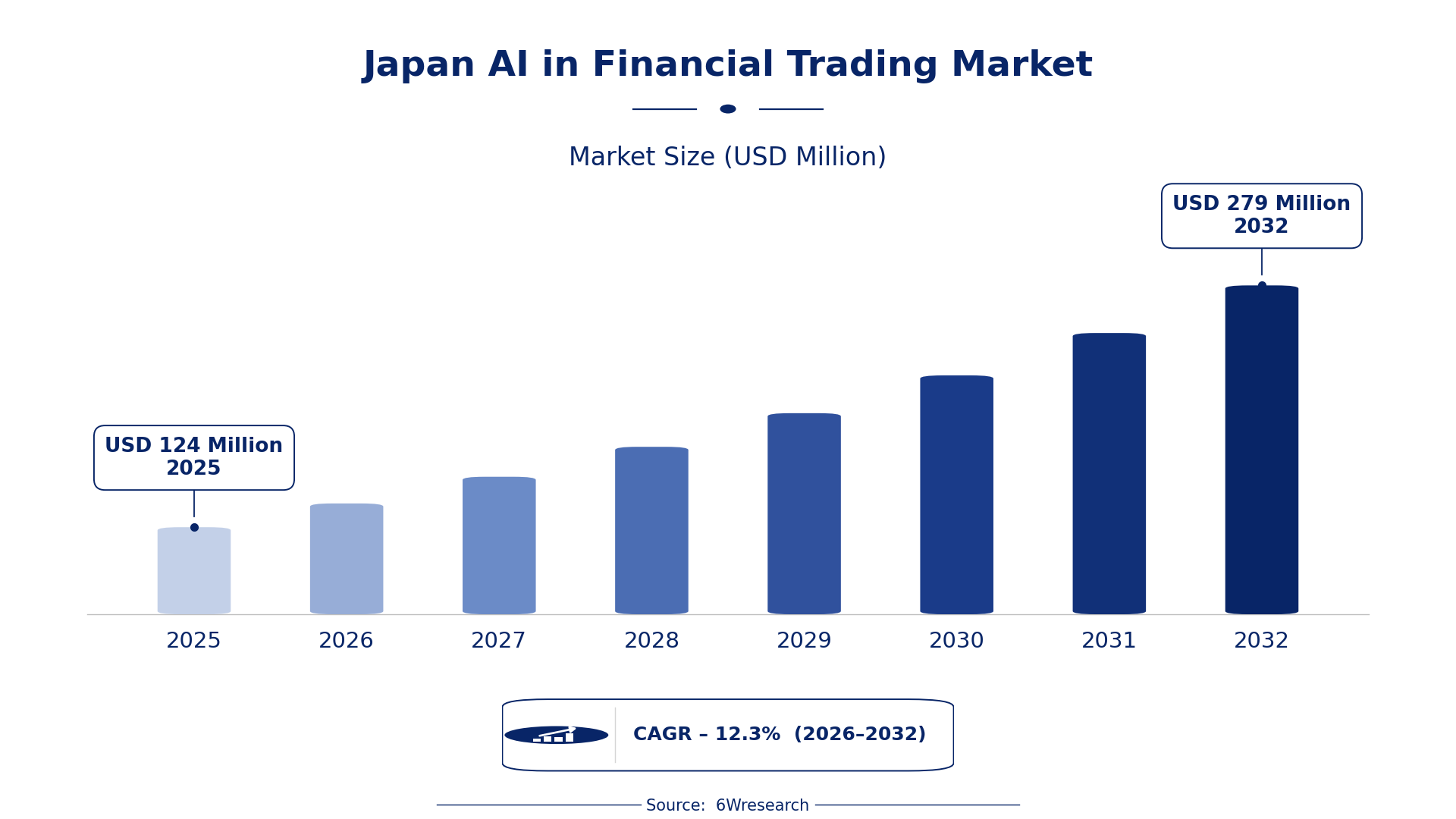
According to 6Wresearch internal database and industry insights, the Japan AI in Financial Trading Market was valued at USD 124 Million in 2025 and is projected to reach USD 279 Million by 2032, growing at a CAGR of approximately 12.3% during 2026–2032.
Japan AI in Financial Trading Market Highlights
| Report Metric | Details |
| Report Name | Japan AI in Financial Trading Market (2026-2032) |
| Market Size 2025 | USD 124 Million |
| Market Size 2032 | USD 279 Million |
| Absolute Growth 2025–2032 | USD 155 Million |
| CAGR 2026–2032 | 12.3% |
| Peak Annual Growth | 15.6% in 2029 |
| Forecast Period | 2026–2032 |
| Historical Data | 2022–2025 |
| Base Year | 2025 |
| Leading Trading Type, 2025 | Algorithmic Trading (43% share) |
| Leading AI Engine Type, 2025 | Deep Learning Algorithms (48% share) |
| Leading Distribution Channel, 2025 | Direct Fintech Vendors (34% share) |
| Leading End User, 2025 | Institutional Traders (39% share) |
| Fastest-Growing Trading Type | Crypto Trading Bots (17.4% CAGR) |
| Fastest-Growing AI Engine Type | Predictive Models (18.2% CAGR) |
| Fastest-Growing Distribution Channel | Cloud Platforms (16.3% CAGR) |
| Fastest-Growing End User | Quantitative Analysts (16.0% CAGR) |
| Growing Sector | financial trading |
| Key End Users | institutional traders, hedge funds, quantitative analysts, fintech vendors |
Japan AI in Financial Trading Market Year-wise Growth Rate and Key Drivers (2022–2032)
This graph illustrates the annual growth rates of the market from 2022 to 2032, highlighting a steady upward trajectory and projected market expansion over the forecast period.
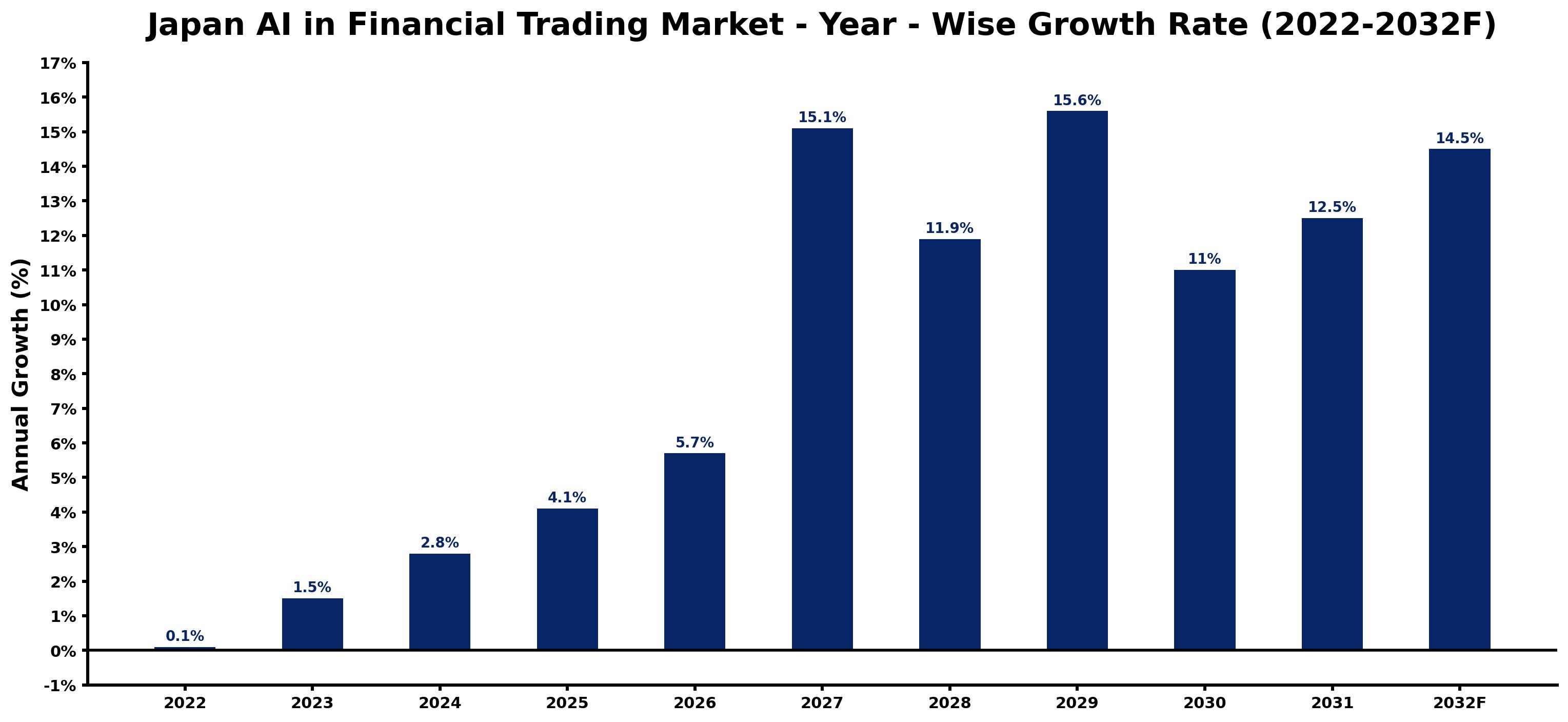
Year by year, the estimates below pair each growth rate with the development that shaped it.
| Year | Estimated Annual Growth (%) | Market Rationale |
| 2022 | 0.1 | The market experienced initial adoption of AI technologies, with minimal activity observed. |
| 2023 | 1.5 | Growth accelerated as institutional investors began integrating AI into trading strategies. |
| 2024 | 2.8 | Increased interest from fintech innovations contributed to faster growth rates. |
| 2025 | 4.1 | The introduction of new AI-driven tools improved trading efficiency and strategies. |
| 2026 | 5.7 | Demand is rising as more traders adopt algorithmic solutions for better performance. |
| 2027 | 15.1 | A surge in high-frequency trading activities boosted market growth. |
| 2028 | 11.9 | Growth slowed as the market began to stabilise after rapid advancements. |
| 2029 | 15.6 | The peak growth rate was driven by substantial investments in AI technologies. |
| 2030 | 11.0 | The market continues to grow, although at a slower pace compared to previous years. |
| 2031 | 12.5 | Demand remains strong as new AI applications are developed for trading. |
| 2032 | 14.5 | The market is expected to expand as more users adopt AI-driven trading solutions. |
Note: Market size estimations and growth projections presented in this report are based on 6Wresearch's proprietary forecasting methodology, utilizing the latest available industry data, government publications, and primary research inputs.
Japan AI in Financial Trading Market Synopsis
AI in Financial Trading employs advanced algorithms and machine learning to analyse market data and execute trades. In Japan, the financial market is valued at approximately 6 trillion USD, with over 70% of trades executed using algorithmic strategies. This market is expanding as institutional investors pursue competitive advantages and fintech innovations improve trading processes. The Tokyo Stock Exchange, which hosts over 3,500 companies, offers extensive opportunities for AI applications, while government initiatives promote digital transformation in finance.
Market Dynamics Impact Analysis (2026–2032)
| Factor | Type | Impact | Primary Segment Affected |
| Rising adoption of algorithmic trading strategies among institutional investors | Driver | High | Algorithmic Trading |
| Increased investments in fintech innovations for trading efficiency | Driver | High | Crypto Trading Bots |
| Growing demand for AI-driven trading solutions among hedge funds | Opportunity | High | High-Frequency Trading |
| Need for advanced predictive models to enhance trading accuracy | Opportunity | High | Predictive Models |
| Regulatory scrutiny on AI applications in trading practices | Restraint | Medium | Algorithmic Trading |
| Challenges in integrating AI with existing trading platforms | Restraint | Medium | Crypto Trading Bots |
| High costs associated with developing and maintaining AI systems | Challenge | High | High-Frequency Trading |
| Limited understanding of AI technologies among traditional traders | Challenge | Medium | Algorithmic Trading |
Evaluation of Drivers in Japan AI in Financial Trading Market (2026–2032)
The main growth drivers and the segments they affect most are set out below.
| Drivers | Primary Segment Affected | Why It Matters (Evidence) |
| Increased algorithmic trading adoption | Algorithmic Trading | Over 70% of trades in Japan are executed using algorithmic strategies, leading to higher demand for AI solutions. |
| Growing interest in crypto trading | Crypto Trading Bots | The rise of cryptocurrencies has led to a 17.4% CAGR in this segment as traders seek automated solutions. |
| Demand for improved trading strategies | High-Frequency Trading | Hedge funds are investing heavily in AI to execute trades at high speeds, driving market growth. |
| Need for predictive analytics in trading | Predictive Models | AI-driven predictive models are essential for forecasting market trends, increasing their adoption among traders. |
| Expansion of fintech solutions | Direct Fintech Vendors | More than 100 fintech vendors in Japan are integrating AI into trading platforms, boosting market demand. |
Purchasing is picking up as institutional investors increasingly adopt algorithmic trading strategies, with over 70% of trades executed using these methods. The Tokyo Stock Exchange, a hub for hedge funds, is a key driver of this trend. The growing interest in cryptocurrencies has led to a notable rise in crypto trading bots, reflecting a shift in trading practices. AI-driven predictive models are becoming essential for traders seeking to forecast market trends accurately. The integration of AI solutions by over 100 fintech vendors is improving trading efficiency across the sector.
Evaluation of Restraints in Japan AI in Financial Trading Market
Several factors work against faster growth; the main ones are summarised below.
| Market Restraint | Primary Segment Affected | Why It Matters (Evidence) |
| Regulatory scrutiny on AI applications in trading practices | Algorithmic Trading | The Financial Services Agency regulates AI usage, which may limit innovation and speed of adoption. |
| Challenges in integrating AI with existing trading platforms | Crypto Trading Bots | Many trading platforms struggle to incorporate AI solutions effectively, hindering growth. |
| High costs associated with developing and maintaining AI systems | High-Frequency Trading | The investment required for AI technology can deter smaller firms from entering the market. |
| Limited understanding of AI technologies among traditional traders | Algorithmic Trading | A lack of familiarity with AI tools can slow down adoption rates among conventional traders. |
| Concerns over data privacy and security in AI applications | Predictive Models | Regulatory requirements regarding data handling can complicate the deployment of AI-driven solutions. |
Japan AI in Financial Trading Market Challenges
Algorithmic trading strategies dominate Japan's financial market, but fierce competition among trading firms compresses profit margins, making survival challenging for smaller players. Buyers face high costs for sophisticated AI tools, which can exceed 500,000 USD, limiting access for smaller trading firms. A shortage of qualified professionals in AI and finance hampers growth, with over 60% of firms struggling to recruit suitable candidates, causing project delays of up to six months. Regulatory requirements complicate operations, leading to annual compliance costs that can reach 200,000 USD for firms navigating these complexities.
Trends in the Japan AI in Financial Trading Market
Buyers and suppliers in the Japan AI in Financial Trading Market are adjusting to the following trends.
- Shift towards AI-driven Trading Strategies: Tokyo is experiencing a shift towards AI-driven trading strategies, with over 70% of trades executed using algorithmic methods. This trend is reshaping trading practices as firms seek competitive advantages through automation.
- Emergence of Predictive Models in Trading: The introduction of advanced predictive models is transforming trading practices in Japan. With a projected CAGR of 18.2%, these models are increasingly adopted by quantitative analysts to improve market predictions.
- Growth of Crypto Trading Bots: The rise of cryptocurrencies is leading to increased adoption of crypto trading bots in Japan. This segment is projected to grow at a CAGR of 17.4%, reflecting the evolving trading environment.
- Integration of AI by Fintech Vendors: Direct fintech vendors are increasingly integrating AI into trading platforms, with over 100 vendors offering AI-driven solutions. This integration is set to streamline trading processes and improve user experience.
Investment Opportunities in the Japan AI in Financial Trading Market
Where to invest in the Japan AI in Financial Trading Market: the main openings are set out below.
- Institutional Traders seeking AI solutions: Institutional traders are increasingly looking for AI-driven trading solutions, with the market valued at approximately 6 trillion USD. This presents an opportunity for fintech vendors to supply advanced tools.
- Timing aligns with digital transformation efforts: With government initiatives supporting digital transformation, now is an ideal time to invest in AI technologies for trading. The Tokyo Metropolitan Government aims to boost AI technology in finance by 2025.
- Gap in AI adoption among traditional traders: Many traditional traders still rely on manual processes, indicating a gap in AI adoption. This gap represents an opportunity for vendors to provide training and AI solutions.
- Growing demand from hedge funds: Hedge funds are heavily investing in AI technologies for trading efficiency, which creates a demand for AI solutions. Collaborating with these funds can lead to valuable partnerships.
Government Initiatives in the Japan AI in Financial Trading Market
The AI Promotion Act (2025) establishes a national framework for AI research, development, and use, enhancing previous regulations under the Financial Instruments and Exchange Act. This new law aims to create a conducive environment for AI applications in trading, ensuring that producers comply with safety and ethical standards while promoting innovation in the financial sector.
The Financial Services Agency oversees the implementation of the AI Promotion Act, approving AI-driven trading solutions and monitoring compliance. By funding research initiatives, the agency supports the development of advanced trading algorithms, ensuring that the financial market remains competitive and efficient. This includes evaluating over 100 fintech vendors integrating AI into their platforms.
Future Insight of the Japan AI in Financial Trading Market
New fintech innovation hubs will emerge, enhancing the integration of AI in financial trading. By 2032, the Tokyo Stock Exchange will likely see over 3,500 listed companies utilising AI to refine trading strategies. Government initiatives will encourage collaboration between fintech vendors and traditional financial institutions, promoting a more integrated approach. As retail trading interest grows among Japan's population, suppliers must create intuitive AI-driven solutions to cater to this expanding market.
Market Segmentation Analysis
Japan AI in Financial Trading Market report covers a detailed analysis of the following market segments:
By Trading Type – Algorithmic Trading Leads, Crypto Trading Bots Expected to Grow Fastest
According to Saurav Kr Singh, Senior Research Analyst at 6Wresearch, with 43% of trading type revenue in 2025, Algorithmic Trading was the largest category. Algorithmic trading holds the largest share due to its essential role in automating trading strategies, which is crucial for institutional investors executing a substantial portion of trades in Japan. This method is particularly prevalent among trading firms located in Tokyo, a major financial hub. Crypto Trading Bots are set to record the highest CAGR in this split, 17.4% over 2026–2032. Crypto trading bots are experiencing rapid growth as interest in cryptocurrency investments rises among retail traders in Japan. The increasing demand for automated trading solutions in this segment is expected to surge, given the population of approximately 125 million. Suppliers should focus on developing tailored solutions for both algorithmic trading and crypto trading bots to capture the expanding market.
By AI Engine Type – Deep Learning Algorithms Lead, Predictive Models Expected to Grow Fastest
Deep Learning Algorithms held 48% of the Japan AI in Financial Trading Market by ai engine type in 2025. Deep learning algorithms lead the market as they are vital for efficiently processing large volumes of market data, a necessity for successful trading. Their integration into various trading strategies makes them indispensable for traders operating in Japan's competitive environment. Predictive Models are projected to grow fastest, at a CAGR of 18.2% during 2026–2032. Predictive models are witnessing rapid growth due to their critical role in forecasting market trends, especially in a volatile trading landscape. The increasing need for precise predictions is driving their adoption among traders seeking to enhance their strategies. Buyers should prioritise solutions that incorporate deep learning and predictive models to maintain a competitive edge.
By Distribution Channel – Direct Fintech Vendors Lead, Cloud Platforms Expected to Grow Fastest
The largest distribution channel category in 2025 was Direct Fintech Vendors, at 34% of revenue. Direct fintech vendors dominate the market by providing tailored solutions directly to traders, effectively addressing their specific requirements. This direct engagement is particularly advantageous in Japan's dynamic financial trading environment, where responsiveness is key. The quickest growth will come from Cloud Platforms, forecast to expand at a CAGR of 16.3% between 2026 and 2032. Cloud platforms are quickly gaining traction as they offer scalable access to trading applications, facilitating the implementation of advanced strategies. Their flexibility and cost-effectiveness attract a diverse range of traders looking for efficient solutions. Suppliers must enhance their cloud offerings to meet the rising demand for accessible trading solutions.
By End User – Institutional Traders Lead, Quantitative Analysts Expected to Grow Fastest
In 2025, Institutional Traders led the end user split with a 39% share. Institutional traders account for the largest segment of AI users in trading, utilising advanced technologies to gain a competitive advantage. Their high trading volumes necessitate sophisticated tools to optimise their strategies effectively. Over 2026–2032, Quantitative Analysts are expected to post the fastest growth, at a CAGR of 16.0%. Quantitative analysts are experiencing the fastest growth in AI adoption as they aim to refine their trading models with advanced techniques. The increasing complexity of market data drives their need for AI-driven solutions. Suppliers should tailor their offerings to address the specific requirements of institutional traders and quantitative analysts to maximise market reach.
Key Attractiveness of the Report
- 10 Years of Market Numbers
- Historical Data Starting from 2022 to 2025
- Base Year 2025
- Forecast Data until 2032
- Key Performance Indicators Impacting the Market
- Major Upcoming Developments and Projects
Key Highlights of the Report:
- Japan AI in Financial Trading Market Outlook
- Market Size of Japan AI in Financial Trading Market, 2025
- Forecast of Japan AI in Financial Trading Market, 2032
- Historical Data and Forecast of Japan AI in Financial Trading Revenues & Volume for the Period 2022-2032F
- Japan AI in Financial Trading Market Trend Evolution
- Japan AI in Financial Trading Market Drivers and Challenges
- Japan AI in Financial Trading Price Trends
- Japan AI in Financial Trading Porter's Five Forces
- Japan AI in Financial Trading Industry Life Cycle
- Historical Data and Forecast of Japan AI in Financial Trading Market Revenues & Volume By Trading Type for the Period 2022-2032F
- Historical Data and Forecast of Japan AI in Financial Trading Market Revenues & Volume By High-Frequency Trading for the Period 2022-2032F
- Historical Data and Forecast of Japan AI in Financial Trading Market Revenues & Volume By Algorithmic Trading for the Period 2022-2032F
- Historical Data and Forecast of Japan AI in Financial Trading Market Revenues & Volume By Sentiment-Based Trading for the Period 2022-2032F
- Historical Data and Forecast of Japan AI in Financial Trading Market Revenues & Volume By Crypto Trading Bots for the Period 2022-2032F
- Historical Data and Forecast of Japan AI in Financial Trading Market Revenues & Volume By AI Engine Type for the Period 2022-2032F
- Historical Data and Forecast of Japan AI in Financial Trading Market Revenues & Volume By Deep Learning Algorithms for the Period 2022-2032F
- Historical Data and Forecast of Japan AI in Financial Trading Market Revenues & Volume By Predictive Models for the Period 2022-2032F
- Historical Data and Forecast of Japan AI in Financial Trading Market Revenues & Volume By NLP Analysis for the Period 2022-2032F
- Historical Data and Forecast of Japan AI in Financial Trading Market Revenues & Volume By Autonomous Agents for the Period 2022-2032F
- Historical Data and Forecast of Japan AI in Financial Trading Market Revenues & Volume By Distribution Channel for the Period 2022-2032F
- Historical Data and Forecast of Japan AI in Financial Trading Market Revenues & Volume By Direct Fintech Vendors for the Period 2022-2032F
- Historical Data and Forecast of Japan AI in Financial Trading Market Revenues & Volume By Cloud Platforms for the Period 2022-2032F
- Historical Data and Forecast of Japan AI in Financial Trading Market Revenues & Volume By Market Data Platforms for the Period 2022-2032F
- Historical Data and Forecast of Japan AI in Financial Trading Market Revenues & Volume By Crypto Exchange APIs for the Period 2022-2032F
- Historical Data and Forecast of Japan AI in Financial Trading Market Revenues & Volume By End User for the Period 2022-2032F
- Historical Data and Forecast of Japan AI in Financial Trading Market Revenues & Volume By Institutional Traders for the Period 2022-2032F
- Historical Data and Forecast of Japan AI in Financial Trading Market Revenues & Volume By Quantitative Analysts for the Period 2022-2032F
- Historical Data and Forecast of Japan AI in Financial Trading Market Revenues & Volume By Hedge Funds for the Period 2022-2032F
- Historical Data and Forecast of Japan AI in Financial Trading Market Revenues & Volume By Individual Traders for the Period 2022-2032F
- Japan AI in Financial Trading Import Export Trade Statistics
- Market Opportunity Assessment By Trading Type
- Market Opportunity Assessment By AI Engine Type
- Market Opportunity Assessment By Distribution Channel
- Market Opportunity Assessment By End User
- Japan AI in Financial Trading Top Companies Market Share
- Japan AI in Financial Trading Competitive Benchmarking By Technical and Operational Parameters
- Japan AI in Financial Trading Company Profiles
- Japan AI in Financial Trading Key Strategic Recommendations
Market Covered
The study includes the following segmentation.
By Trading Type
- High-Frequency Trading
- Algorithmic Trading
- Sentiment-Based Trading
- Crypto Trading Bots
By AI Engine Type
- Deep Learning Algorithms
- Predictive Models
- NLP Analysis
- Autonomous Agents
By Distribution Channel
- Direct Fintech Vendors
- Cloud Platforms
- Market Data Platforms
- Crypto Exchange APIs
By End User
- Institutional Traders
- Quantitative Analysts
- Hedge Funds
- Individual Traders































