Japan AI in Fleet Management Market Size & Growth Rate
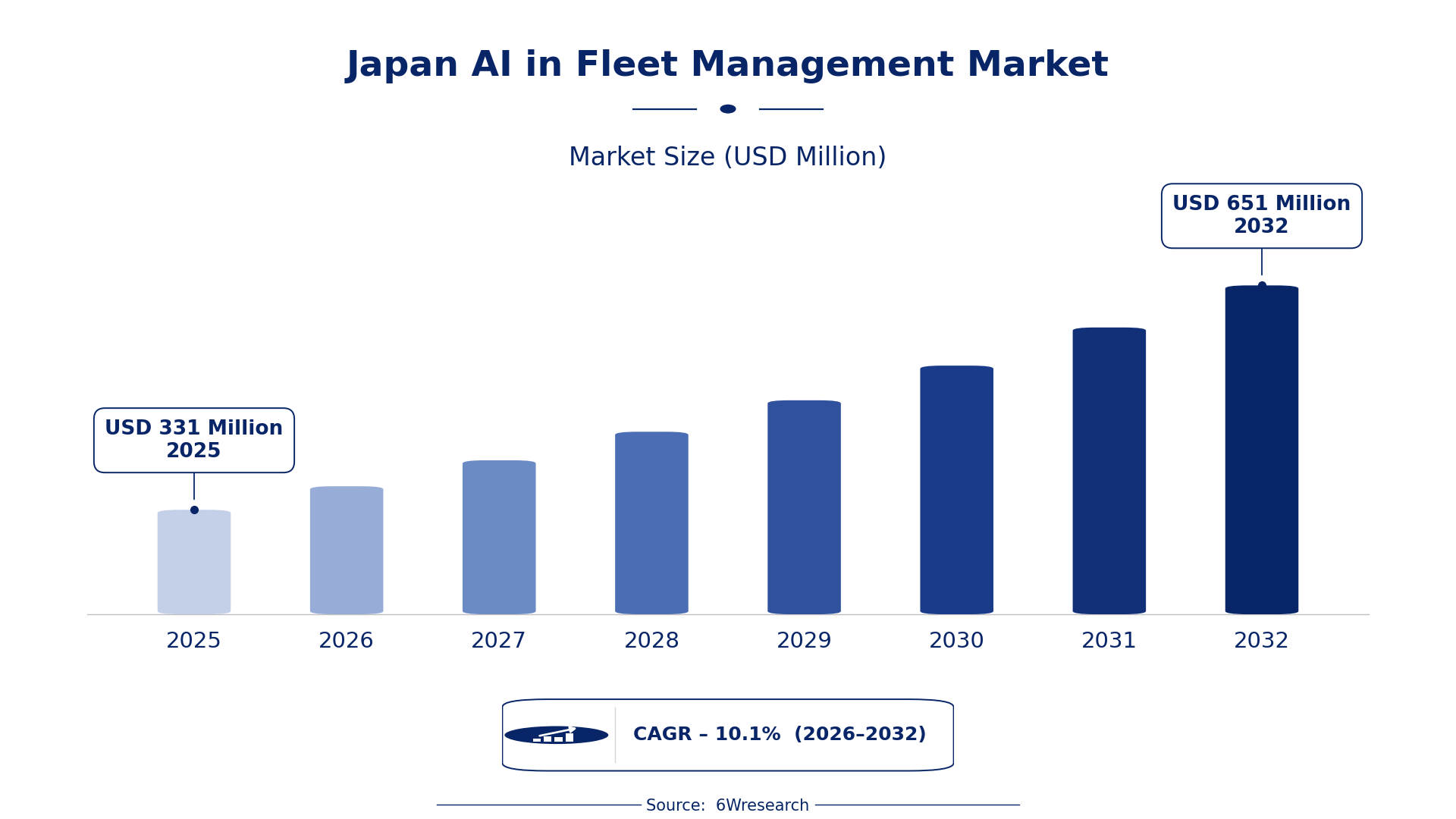
According to 6Wresearch internal database and industry insights, the Japan AI in Fleet Management Market was valued at USD 331 Million in 2025 and is projected to reach USD 651 Million by 2032, growing at a CAGR of approximately 10.1% during 2026–2032.
Japan AI in Fleet Management Market Highlights
| Report Metric | Details |
| Report Name | Japan AI in Fleet Management Market (2026-2032) |
| Market Size 2025 | USD 331 Million |
| Market Size 2032 | USD 651 Million |
| Absolute Growth 2025–2032 | USD 320 Million |
| CAGR 2026–2032 | 10.1% |
| Peak Annual Growth | 12.6% in 2028 |
| Forecast Period | 2026–2032 |
| Historical Data | 2022–2025 |
| Base Year | 2025 |
| Leading Fleet Type, 2025 | Public Transport (54% share) |
| Leading AI Application, 2025 | Route Optimization (42% share) |
| Leading Distribution Channel, 2025 | SaaS Fleet Platforms (47% share) |
| Leading End User, 2025 | Logistics Companies (38% share) |
| Fastest-Growing AI Application | Predictive Maintenance (13.8% CAGR) |
| Fastest-Growing Distribution Channel | Online Transport Systems (12.7% CAGR) |
| Fastest-Growing End User | Government Transport Agencies (12.6% CAGR) |
| Growing Sector | logistics |
| Key End Users | logistics companies, government transport agencies, freight operators |
Japan AI in Fleet Management Market Year-wise Growth Rate and Key Drivers (2022–2032)
This graph illustrates the annual growth rates of the market from 2022 to 2032, highlighting a steady upward trajectory and projected market expansion over the forecast period.
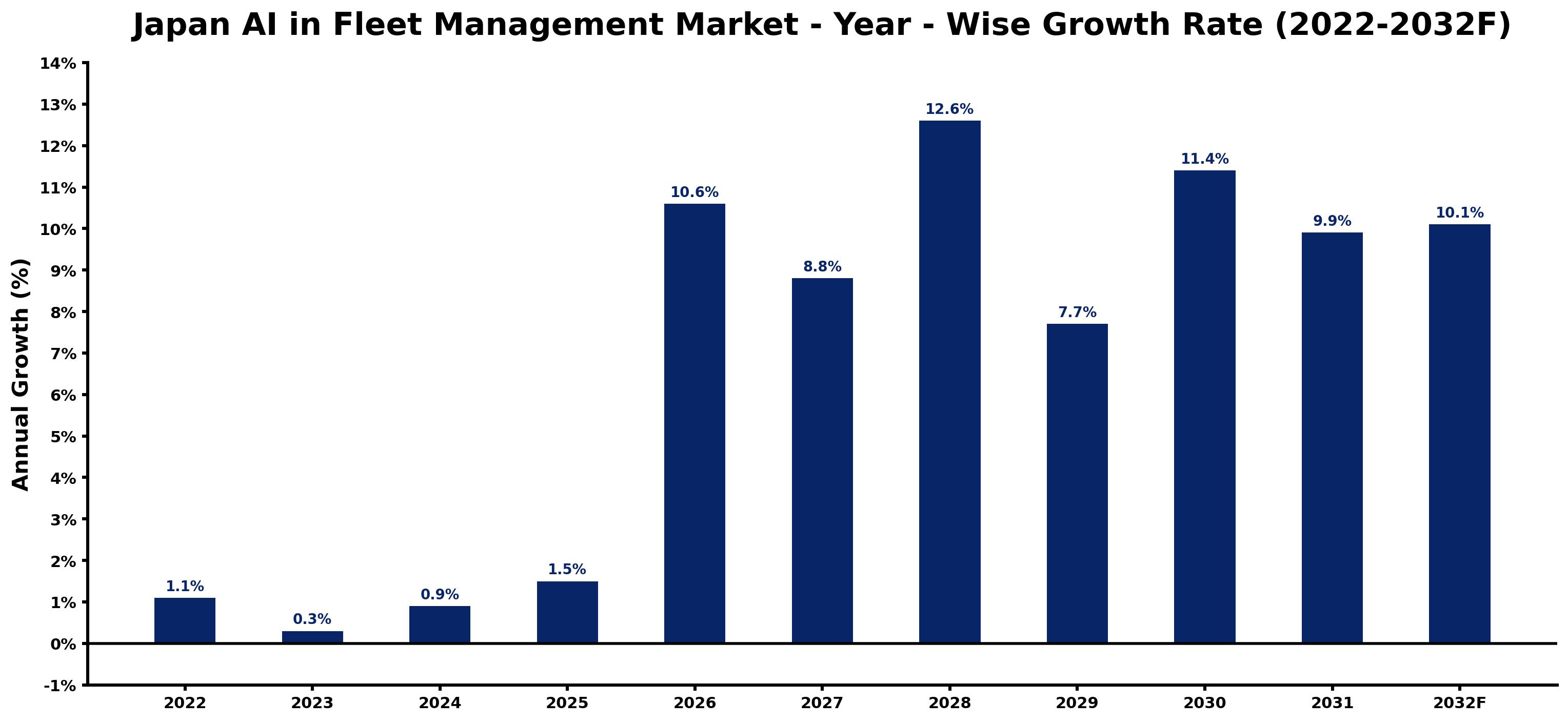
Each row of the following table gives one year's estimated growth and the event or demand shift that explains it.
| Year | Estimated Annual Growth (%) | Market Rationale |
| 2022 | 1.1 | The market experienced moderate growth due to ongoing technological adoption. |
| 2023 | 0.3 | Growth slowed as companies adjusted to new AI technologies and integration processes. |
| 2024 | 0.9 | Increased investments in fleet management technology led to a faster growth rate. |
| 2025 | 1.5 | The market saw improved performance driven by rising demand for efficiency. |
| 2026 | 10.6 | Growth is expected to accelerate as logistics companies adopt AI solutions for operational improvements. |
| 2027 | 8.8 | The growth rate will slow as the market begins to stabilise after rapid expansion. |
| 2028 | 12.6 | A peak in growth is projected due to heightened interest in AI for fleet optimisation. |
| 2029 | 7.7 | Growth will slow as the market adjusts to the peak demand levels. |
| 2030 | 11.4 | The market is expected to experience renewed growth as new technologies emerge and are adopted. |
| 2031 | 9.9 | Growth will decelerate slightly as market conditions stabilise after previous peaks. |
| 2032 | 10.1 | Demand is projected to grow steadily as AI technologies become more mainstream. |
Note: Market size estimations and growth projections presented in this report are based on 6Wresearch's proprietary forecasting methodology, utilizing the latest available industry data, government publications, and primary research inputs.
Japan AI in Fleet Management Market Synopsis
AI in Fleet Management optimises fleet operations through advanced algorithms and real-time monitoring, improving efficiency and safety. The Japan AI in Fleet Management Market is expanding due to a logistics industry valued at approximately ¥10 trillion and increasing adoption of AI technologies. Key drivers include the need for cost reduction and improved operational efficiency among logistics companies and public transport agencies, which are implementing AI solutions to improve service delivery and reduce emissions.
Market Dynamics Impact Analysis (2026–2032)
| Factor | Type | Impact | Primary Segment Affected |
| Rising demand for operational efficiency in logistics drives AI adoption. | Driver | High | Logistics Companies |
| Government initiatives promote smart transport systems, boosting AI integration. | Driver | High | Government Transport Agencies |
| Growing urbanisation in Tokyo and Osaka creates a need for efficient fleet solutions. | Opportunity | High | Public Transport |
| Incentives for AI adoption in public transport encourage investment in technology. | Opportunity | Medium | Logistics Companies |
| High initial investment costs can deter smaller companies from adopting AI. | Restraint | High | Delivery Fleets |
| Limited awareness of AI benefits among traditional fleet operators hampers growth. | Restraint | Medium | Trucking & Haulage |
| Integration challenges with existing systems can delay AI implementation. | Challenge | High | SaaS Fleet Platforms |
| The average age of commercial vehicles is around 10 years, limiting upgrades. | Challenge | Medium | Public Transport |
Evaluation of Drivers in Japan AI in Fleet Management Market (2026–2032)
These are the developments adding the most demand over the forecast period.
| Drivers | Primary Segment Affected | Why It Matters (Evidence) |
| Increased focus on efficiency in logistics drives AI adoption. | Logistics Companies | Fleet management software adoption among logistics companies exceeds 60% in urban areas. |
| Government initiatives promote smart transport systems, boosting AI integration. | Government Transport Agencies | The Ministry of Land, Infrastructure, Transport and Tourism supports AI for public transport. |
| Growing demand for predictive maintenance reduces downtime and costs. | Predictive Maintenance | The average age of commercial vehicles in Japan is around 10 years. |
| Rising fuel costs encourage fleet operators to optimise routes. | Route Optimization | Delivery fleets are essential for optimising routes and reducing fuel consumption. |
| Technological advancements in AI improve fleet management capabilities. | SaaS Fleet Platforms | The Japan Trucking Association supports AI integration in trucking operations. |
Most of the extra volume comes from logistics companies seeking operational efficiency, with fleet management software adoption exceeding 60% in urban areas. The average age of commercial vehicles in Japan is around 10 years, creating demand for predictive maintenance solutions. Rising fuel costs further encourage fleet operators to optimise routes, while advancements in AI technology improve overall logistics efficiency.
Evaluation of Restraints in Japan AI in Fleet Management Market
The main factors holding the market back are set out below.
| Market Restraint | Primary Segment Affected | Why It Matters (Evidence) |
| High initial investment costs deter smaller companies from adopting AI. | Delivery Fleets | Many smaller delivery companies cannot afford the upfront costs of AI technology. |
| Limited awareness of AI benefits among traditional fleet operators hampers growth. | Trucking & Haulage | Traditional operators often underestimate the potential efficiency gains from AI. |
| Integration challenges with existing systems can delay AI implementation. | SaaS Fleet Platforms | Many companies struggle to integrate new AI solutions with legacy systems. |
| The average age of commercial vehicles is around 10 years, limiting upgrades. | Public Transport | Older vehicles may not support advanced AI technologies, hindering adoption. |
| Regulatory hurdles can slow the implementation of new technologies. | Government Transport Agencies | Compliance with existing regulations may delay the adoption of AI solutions. |
Japan AI in Fleet Management Market Challenges
Buyers incur increased operational costs due to supply chain disruptions from outdated fleet management systems, which can raise expenses by 10%. Suppliers face rising costs as the average age of commercial vehicles is around 10 years, leading to higher maintenance expenses that can add an extra 10% to their annual budgets. Skills shortages in AI and data analytics hinder suppliers' ability to implement advanced technologies, resulting in a 20% slower adoption rate in urban areas. Buyers experience inefficiencies from fluctuating demand, potentially wasting up to 25% of operational resources due to mismanaged fleet operations.
Trends in the Japan AI in Fleet Management Market
Four trends stand out in the Japan AI in Fleet Management Market.
- Launch of AI Adoption Incentive Programme: In 2023, Japan initiated a programme to incentivise AI adoption in public transport, aiming to improve operational efficiency. This initiative is projected to support the goal of reducing CO2 emissions by 26% by 2030.
- Shift Towards Predictive Maintenance: The logistics sector is increasingly adopting predictive maintenance strategies, driven by the need to minimise downtime. This trend is notable among logistics companies, with a growing focus on AI solutions to improve vehicle reliability and reduce operational costs.
- Expansion of Route Optimization Technologies: Route optimization technologies are gaining traction, particularly in urban areas like Tokyo and Osaka. The increasing demand for efficient delivery solutions is prompting logistics companies to invest in AI-driven route planning tools, improving fuel efficiency and reducing delivery times.
- Increased Adoption of SaaS Fleet Platforms: SaaS fleet platforms are becoming popular among logistics companies, driven by their scalability and ease of use. Over 60% of logistics firms in urban areas are now utilising these platforms, reflecting a shift in fleet management practices.
Investment Opportunities in the Japan AI in Fleet Management Market
Several openings in the Japan AI in Fleet Management Market merit attention from investors.
- Investment in Public Transport AI Solutions: Tokyo's public transport sector is seeking AI solutions to improve efficiency. With the government aiming to reduce CO2 emissions by 26% by 2030, there is a strong opportunity for suppliers of AI technologies to enter this market.
- Growth in Predictive Maintenance Services: The aging fleet in Japan presents a strong opportunity for predictive maintenance services. Logistics companies are increasingly looking for solutions to minimise downtime, creating demand for advanced AI-driven maintenance technologies.
- Expansion of Route Optimization Software: With urbanisation in Tokyo and Osaka, there is a pressing need for route optimization software. Suppliers can tap into this demand by partnering with logistics companies to provide tailored AI solutions.
- Development of AI-Driven Fleet Management Platforms: The logistics sector is ripe for AI-driven fleet management platforms, particularly in urban areas. Companies can enter this market by collaborating with local tech firms to develop scalable solutions.
Government Initiatives in the Japan AI in Fleet Management Market
The Digital Agency, established in September 2021, leads government digital transformation efforts. This agency sets common system standards that impact fleet management technology, ensuring that AI solutions align with national objectives. The GX Basic Policy, adopted in 2023, aims for about JPY 150 trillion of public-private decarbonisation investment over the next decade, supporting the integration of AI in fleet management.
Government Transport Agencies, such as the Ministry of Land, Infrastructure, Transport and Tourism, utilise the Industrial Standardization Act to ensure compliance with JIS standards for fleet management technologies. These agencies oversee the implementation of smart transport systems, promoting AI adoption among public transport operators to improve service efficiency and reduce emissions.
Future Insight of the Japan AI in Fleet Management Market
AI-driven technologies will reshape fleet management by 2032, with real-time monitoring systems becoming standard across logistics operations. The government's initiative to incentivise AI adoption in transport will improve efficiency and cut emissions, benefiting both buyers and suppliers. Fleet management software usage will surpass 60% in urban areas, streamlining operations. The emphasis on ISO 9001 certification among service providers will ensure higher quality standards, building trust and reliability in the market.
Market Segmentation Analysis
Japan AI in Fleet Management Market report covers a detailed analysis of the following market segments:
By Fleet Type – Public Transport Leads and Records the Fastest Growth
According to Saurav Kr Singh, Senior Research Analyst at 6Wresearch, in 2025, Public Transport led the fleet type split with a 54% share. Public Transport holds the largest share due to its crucial role in managing schedules and improving service efficiency across major cities like Tokyo and Osaka. The government's initiatives to promote smart transport systems further reinforce its significance in fleet management. The same category is also set to grow fastest, at a CAGR of 12.0% during 2026–2032. As Public Transport continues to lead, its growth will be sustained by ongoing government efforts to enhance efficiency and reduce emissions in urban areas. This alignment with national objectives ensures that the demand for solutions will continue to rise. Suppliers should focus on developing tailored solutions for public transport to capture this increasing demand.
By AI Application – Route Optimization Leads, Predictive Maintenance Expected to Grow Fastest
The largest ai application category in 2025 was Route Optimization, at 42% of revenue. Route Optimization is the leading application as it is fundamental for improving delivery times and reducing operational costs in the logistics sector. Its widespread adoption among logistics companies highlights its critical importance in fleet management. Predictive Maintenance is set to record the highest CAGR in this split, 13.8% over 2026–2032. Predictive Maintenance is experiencing rapid growth due to its direct impact on minimising downtime and maintenance costs, which is increasingly vital for fleet operators. As companies aim to enhance operational efficiency, this application will gain more traction. Buyers should prioritise investments in predictive maintenance technologies to enhance fleet reliability and reduce costs.
By Distribution Channel – SaaS Fleet Platforms Lead, Online Transport Systems Expected to Grow Fastest
SaaS Fleet Platforms held 47% of the Japan AI in Fleet Management Market by distribution channel in 2025. SaaS Fleet Platforms dominate the market as they are widely adopted for their ease of use and scalability, making them an attractive option for many fleet operators. This model allows for seamless integration of solutions into existing operations. Online Transport Systems are projected to grow fastest, at a CAGR of 12.7% during 2026–2032. Online Transport Systems are growing quickly as they support fleet management through enhanced connectivity and data sharing, although they are not the primary focus. This trend indicates a shift towards more integrated solutions in fleet management. Suppliers must consider enhancing their SaaS offerings to maintain competitive advantage in a rapidly changing market.
By End User – Logistics Companies Lead, Government Transport Agencies Expected to Grow Fastest
Logistics Companies took 38% of end user revenue in 2025, more than any other category. Logistics Companies represent the largest segment as they are the primary users of technology for achieving operational efficiency and cost savings. Their significant investment in technology underscores the importance of these solutions in their daily operations. The quickest growth will come from Government Transport Agencies, forecast to expand at a CAGR of 12.6% between 2026 and 2032. Government Transport Agencies are the fastest-growing end user, utilising technology for optimising public transport systems in line with national sustainability goals. This focus on efficiency will drive further adoption of solutions in the sector. Suppliers should engage with government agencies to develop solutions that align with public transport optimisation initiatives.
Key Attractiveness of the Report
- 10 Years of Market Numbers
- Historical Data Starting from 2022 to 2025
- Base Year 2025
- Forecast Data until 2032
- Key Performance Indicators Impacting the Market
- Major Upcoming Developments and Projects
Key Highlights of the Report:
- Japan AI in Fleet Management Market Outlook
- Market Size of Japan AI in Fleet Management Market, 2025
- Forecast of Japan AI in Fleet Management Market, 2032
- Historical Data and Forecast of Japan AI in Fleet Management Revenues & Volume for the Period 2022-2032F
- Japan AI in Fleet Management Market Trend Evolution
- Japan AI in Fleet Management Market Drivers and Challenges
- Japan AI in Fleet Management Price Trends
- Japan AI in Fleet Management Porter's Five Forces
- Japan AI in Fleet Management Industry Life Cycle
- Historical Data and Forecast of Japan AI in Fleet Management Market Revenues & Volume By Fleet Type for the Period 2022-2032F
- Historical Data and Forecast of Japan AI in Fleet Management Market Revenues & Volume By Delivery Fleets for the Period 2022-2032F
- Historical Data and Forecast of Japan AI in Fleet Management Market Revenues & Volume By Public Transport for the Period 2022-2032F
- Historical Data and Forecast of Japan AI in Fleet Management Market Revenues & Volume By Trucking & Haulage for the Period 2022-2032F
- Historical Data and Forecast of Japan AI in Fleet Management Market Revenues & Volume By Car Rental Fleets for the Period 2022-2032F
- Historical Data and Forecast of Japan AI in Fleet Management Market Revenues & Volume By AI Application for the Period 2022-2032F
- Historical Data and Forecast of Japan AI in Fleet Management Market Revenues & Volume By Route Optimization for the Period 2022-2032F
- Historical Data and Forecast of Japan AI in Fleet Management Market Revenues & Volume By Predictive Maintenance for the Period 2022-2032F
- Historical Data and Forecast of Japan AI in Fleet Management Market Revenues & Volume By Driver Behavior Analysis for the Period 2022-2032F
- Historical Data and Forecast of Japan AI in Fleet Management Market Revenues & Volume By Asset Utilization AI for the Period 2022-2032F
- Historical Data and Forecast of Japan AI in Fleet Management Market Revenues & Volume By Distribution Channel for the Period 2022-2032F
- Historical Data and Forecast of Japan AI in Fleet Management Market Revenues & Volume By SaaS Fleet Platforms for the Period 2022-2032F
- Historical Data and Forecast of Japan AI in Fleet Management Market Revenues & Volume By Online Transport Systems for the Period 2022-2032F
- Historical Data and Forecast of Japan AI in Fleet Management Market Revenues & Volume By Fleet Hardware Vendors for the Period 2022-2032F
- Historical Data and Forecast of Japan AI in Fleet Management Market Revenues & Volume By Mobility Tech Resellers for the Period 2022-2032F
- Historical Data and Forecast of Japan AI in Fleet Management Market Revenues & Volume By End User for the Period 2022-2032F
- Historical Data and Forecast of Japan AI in Fleet Management Market Revenues & Volume By Logistics Companies for the Period 2022-2032F
- Historical Data and Forecast of Japan AI in Fleet Management Market Revenues & Volume By Government Transport Agencies for the Period 2022-2032F
- Historical Data and Forecast of Japan AI in Fleet Management Market Revenues & Volume By Freight Operators for the Period 2022-2032F
- Historical Data and Forecast of Japan AI in Fleet Management Market Revenues & Volume By Car Leasing Firms for the Period 2022-2032F
- Japan AI in Fleet Management Import Export Trade Statistics
- Market Opportunity Assessment By Fleet Type
- Market Opportunity Assessment By AI Application
- Market Opportunity Assessment By Distribution Channel
- Market Opportunity Assessment By End User
- Japan AI in Fleet Management Top Companies Market Share
- Japan AI in Fleet Management Competitive Benchmarking By Technical and Operational Parameters
- Japan AI in Fleet Management Company Profiles
- Japan AI in Fleet Management Key Strategic Recommendations
Market Covered
This report examines the market across the segments below.
By Fleet Type
- Delivery Fleets
- Public Transport
- Trucking & Haulage
- Car Rental Fleets
By AI Application
- Route Optimization
- Predictive Maintenance
- Driver Behavior Analysis
- Asset Utilization AI
By Distribution Channel
- SaaS Fleet Platforms
- Online Transport Systems
- Fleet Hardware Vendors
- Mobility Tech Resellers
By End User
- Logistics Companies
- Government Transport Agencies
- Freight Operators
- Car Leasing Firms































