Japan AI in Heart Disease Diagnosis Market Size & Growth Rate
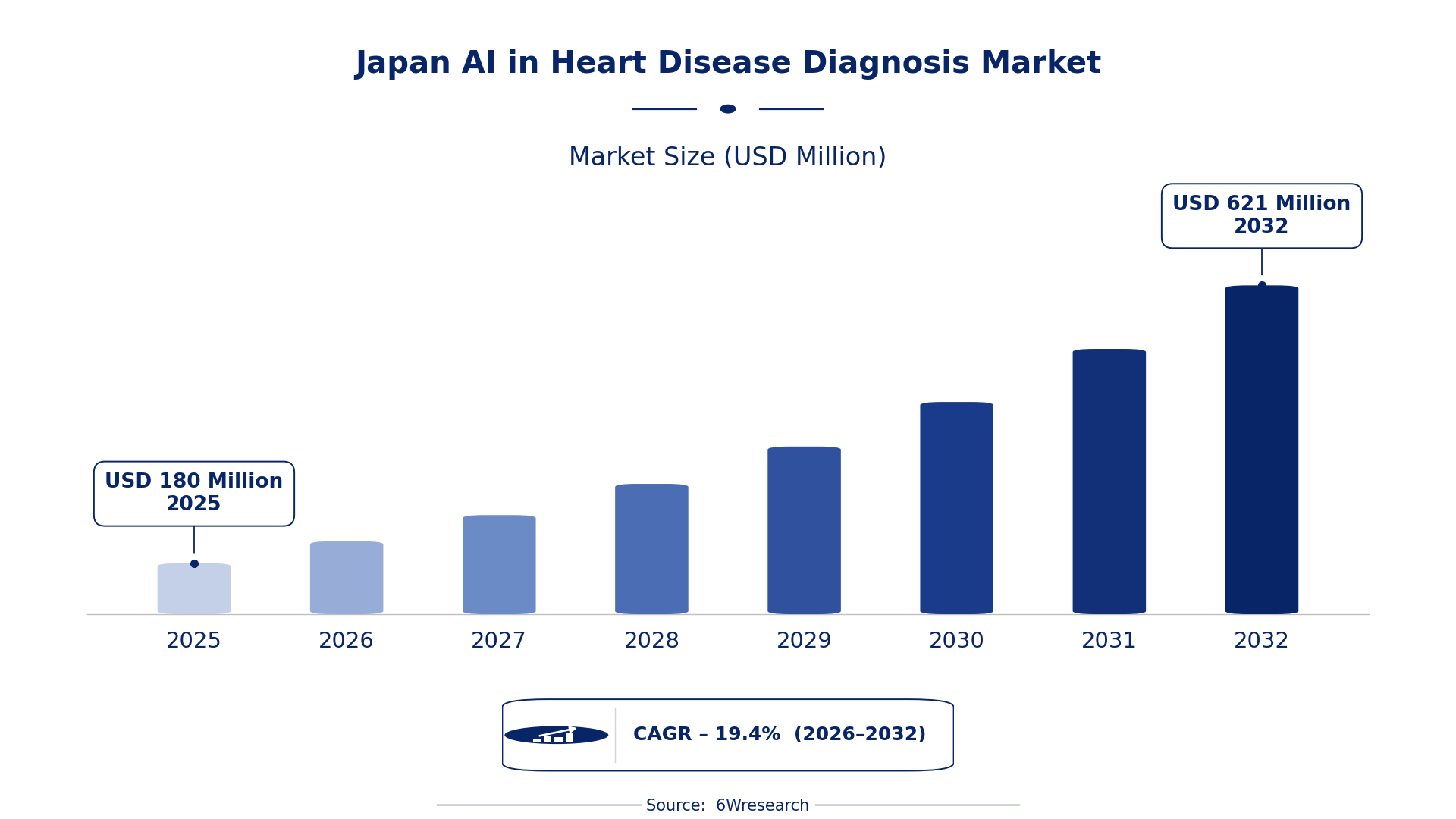
According to 6Wresearch internal database and industry insights, the Japan AI in Heart Disease Diagnosis Market was valued at USD 180 Million in 2025 and is projected to reach USD 621 Million by 2032, growing at a CAGR of approximately 19.4% during 2026–2032.
Japan AI in Heart Disease Diagnosis Market Highlights
| Report Metric | Details |
| Report Name | Japan AI in Heart Disease Diagnosis Market (2026-2032) |
| Market Size 2025 | USD 180 Million |
| Market Size 2032 | USD 621 Million |
| Absolute Growth 2025–2032 | USD 441 Million |
| CAGR 2026–2032 | 19.4% |
| Peak Annual Growth | 20.3% in 2026 |
| Forecast Period | 2026–2032 |
| Historical Data | 2022–2025 |
| Base Year | 2025 |
| Leading Diagnosis Method, 2025 | Risk Prediction (40% share) |
| Leading AI Feature, 2025 | Deep Learning Models (41% share) |
| Leading Distribution Channel, 2025 | Health SaaS Platforms (41% share) |
| Leading End User, 2025 | Cardiology Clinics (50% share) |
| Fastest-Growing Diagnosis Method | Wearable Heart Monitoring (28.0% CAGR) |
| Fastest-Growing AI Feature | Predictive Modeling (25.2% CAGR) |
| Fastest-Growing End User | Patients & Remote Monitoring (25.1% CAGR) |
| Growing Sector | Healthcare |
| Key End Users | Cardiology Clinics, Diagnostic Labs, Patients & Remote Monitoring |
Japan AI in Heart Disease Diagnosis Market Year-wise Growth Rate and Key Drivers (2022–2032)
This graph illustrates the annual growth rates of the market from 2022 to 2032, highlighting a steady upward trajectory and projected market expansion over the forecast period.
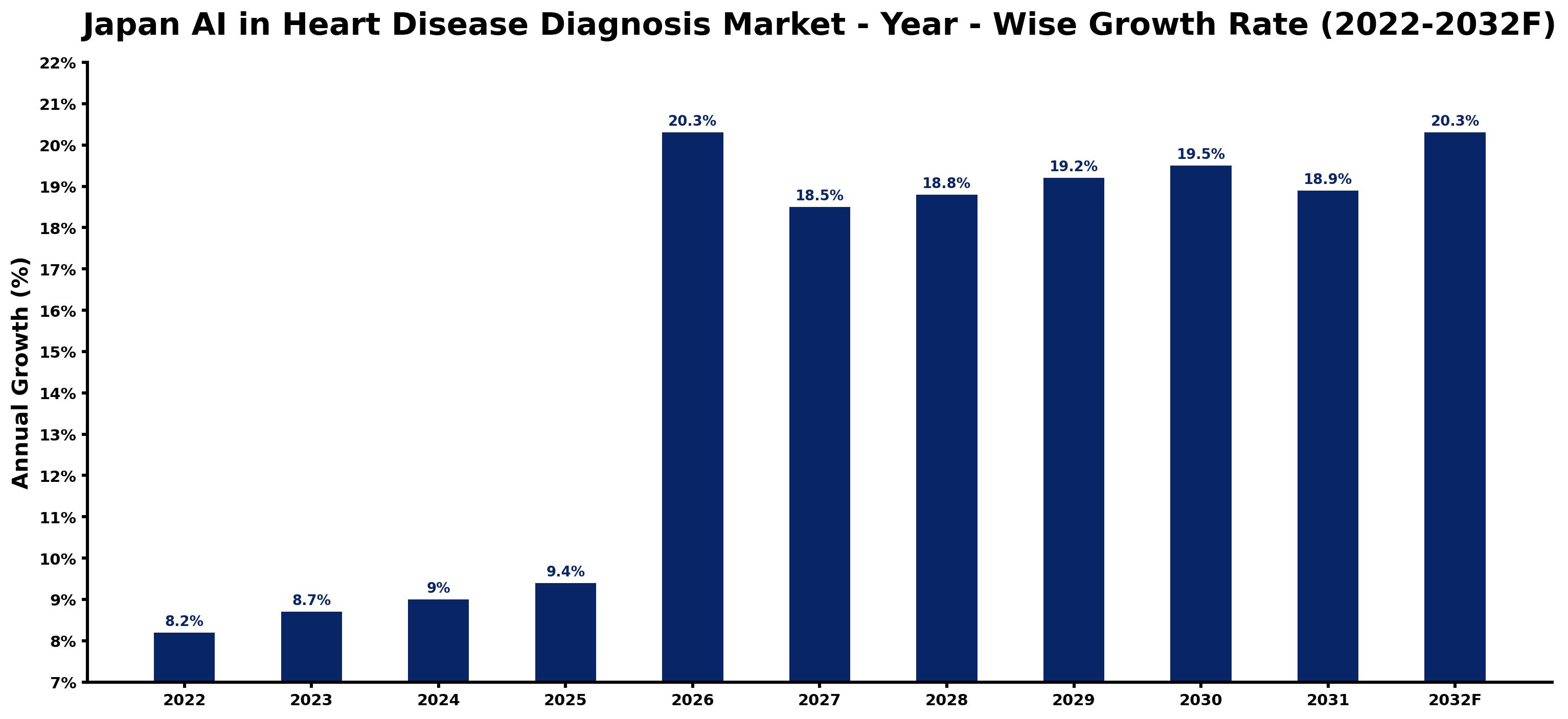
The yearly estimates that follow link every growth rate to its principal driver, so readers can see why the pace changed in each period.
| Year | Estimated Annual Growth (%) | Market Rationale |
| 2022 | 8.2 | The market exhibited steady growth due to increasing adoption of AI technologies in healthcare. |
| 2023 | 8.7 | Growth accelerated as more cardiology clinics integrated AI for enhanced diagnostics. |
| 2024 | 9.0 | The rise in remote patient monitoring drove further demand for AI solutions. |
| 2025 | 9.4 | AI applications in heart disease diagnosis gained traction among healthcare providers. |
| 2026 | 20.3 | A surge in investment in AI healthcare technologies significantly boosted growth. |
| 2027 | 18.5 | Growth slowed as the market began to stabilise after rapid expansion. |
| 2028 | 18.8 | Demand increased again due to advancements in AI algorithms and applications. |
| 2029 | 19.2 | Continued integration of AI in healthcare maintained a positive growth trend. |
| 2030 | 19.5 | The market saw sustained growth as healthcare facilities expanded AI capabilities. |
| 2031 | 18.9 | A slight slowdown occurred as the market matured and competition intensified. |
| 2032 | 20.3 | Growth rebounded as new technologies and applications in AI emerged. |
Note: Market size estimations and growth projections presented in this report are based on 6Wresearch's proprietary forecasting methodology, utilizing the latest available industry data, government publications, and primary research inputs.
Japan AI in Heart Disease Diagnosis Market Synopsis
AI in Heart Disease Diagnosis utilises artificial intelligence to analyse medical data for detecting and managing heart diseases. This technology improves diagnostic accuracy, predicts patient outcomes, and supports remote monitoring, making it crucial in Japan's healthcare sector. The Japan AI in Heart Disease Diagnosis Market is expanding due to a growing aging population, increased healthcare expenditure of JPY 46.7 trillion in fiscal 2022, and a rising number of cardiology clinics adopting AI technologies, particularly in urban areas like Tokyo.
Market Dynamics Impact Analysis (2026–2032)
| Factor | Type | Impact | Primary Segment Affected |
| Increasing healthcare expenditure drives investments in AI technologies. | Driver | High | Cardiology Clinics |
| The aging population creates demand for advanced diagnostic tools. | Driver | High | Patients & Remote Monitoring |
| Growing need for remote monitoring solutions presents opportunities for AI integration. | Opportunity | High | Wearable Heart Monitoring |
| Expansion of AI capabilities in diagnostics offers new market avenues. | Opportunity | Medium | Health SaaS Platforms |
| High costs of AI implementation can limit accessibility for smaller clinics. | Restraint | High | Cardiology Clinics |
| Regulatory compliance requirements can delay AI product approvals. | Restraint | Medium | Diagnostic Labs |
| Limited technical expertise in AI can hinder effective implementation. | Challenge | High | Health Tech Stores |
| Competition among AI solutions may pressure pricing and margins. | Challenge | Medium | Medical Software Vendors |
Evaluation of Drivers in Japan AI in Heart Disease Diagnosis Market (2026–2032)
The table below links each growth driver to the segment it affects and the evidence for it.
| Drivers | Primary Segment Affected | Why It Matters (Evidence) |
| Rising healthcare expenditure supports investment in AI technologies. | Cardiology Clinics | Japan's national medical care expenditure was about JPY 46.7 trillion in fiscal 2022. |
| The aging population increases the need for advanced diagnostic solutions. | Patients & Remote Monitoring | 29.3% of Japan's population was aged 65 or older in September 2024. |
| Growing adoption of AI in diagnostics improves operational efficiency. | Diagnostic Labs | Over 1,000 diagnostic labs in Japan are implementing AI solutions. |
| Technological advancements in AI algorithms improve diagnostic accuracy. | Risk Prediction | AI models are increasingly used to predict heart disease risk based on patient data. |
| Remote monitoring solutions are becoming essential for patient care. | Wearable Heart Monitoring | In 2023, the number of patients monitored remotely using AI reached 1 million. |
Orders keep climbing as healthcare expenditure rises, supporting investments in AI technologies across cardiology clinics. The aging population, with 29.3% aged 65 or older, drives demand for advanced diagnostic solutions. More than 1,000 diagnostic labs are implementing AI solutions, enabling timely data analysis. Advancements in AI algorithms lead to improved accuracy in predicting patient outcomes, while the number of patients monitored remotely using AI reached 1 million in 2023, highlighting the growing need for effective patient management tools.
Evaluation of Restraints in Japan AI in Heart Disease Diagnosis Market
The table below lists the restraints and the evidence behind each.
| Market Restraint | Primary Segment Affected | Why It Matters (Evidence) |
| High costs of AI implementation limit accessibility for smaller clinics. | Cardiology Clinics | Many smaller clinics struggle to afford advanced AI diagnostic tools. |
| Regulatory compliance requirements delay AI product approvals. | Diagnostic Labs | The complex approval process can extend the time to market for new technologies. |
| Limited technical expertise in AI hinders effective implementation. | Health Tech Stores | Staff may lack the necessary skills to deploy and manage AI solutions. |
| Data privacy concerns restrict the use of patient data for AI training. | Wearable Heart Monitoring | Strict regulations on data usage can limit AI's effectiveness in monitoring. |
| Market competition pressures pricing and profit margins. | Medical Software Vendors | Intense competition can lead to reduced prices for AI diagnostic tools. |
Japan AI in Heart Disease Diagnosis Market Challenges
In 2022, Japan's national medical care expenditure reached about JPY 46.7 trillion, pressuring clinics to seek cost-effective AI solutions for heart disease diagnosis. Many buyers struggle to integrate AI technologies due to a shortage of skilled personnel, causing delays that can extend implementation timelines by several months. Producers face intense competition as they rush to adopt AI, which can compromise the quality of diagnostic tools and services. Rising development and maintenance costs for AI technologies may increase expenses for buyers, resulting in higher prices for advanced diagnostic solutions.
Trends in the Japan AI in Heart Disease Diagnosis Market
Below are the shifts with the largest effect on the Japan AI in Heart Disease Diagnosis Market.
- Shift from Traditional to AI-Driven Diagnostics: In 2023, cardiology clinics began adopting AI-driven diagnostics as traditional methods proved less efficient. This shift is reflected as over 100 clinics now utilise AI technologies, improving diagnostic accuracy.
- Emergence of Remote Patient Monitoring: The trend towards remote patient monitoring gained momentum in 2023, with 1 million patients using AI for health tracking. This change reflects the increasing demand for real-time health insights.
- Integration of AI in Cardiac Imaging: Since 2022, AI has been increasingly integrated into cardiac imaging, improving analysis and interpretation. This integration is supported by advancements in imaging technologies and AI algorithms.
- Adoption of Predictive Modeling Techniques: Beginning in 2023, predictive modeling techniques became a focal point in heart disease management. This shift is driven by the need for better patient outcome forecasting.
Investment Opportunities in the Japan AI in Heart Disease Diagnosis Market
The following areas offer the clearest openings for investors and suppliers in the Japan AI in Heart Disease Diagnosis Market.
- Timing is Right for AI Solutions: With Japan's healthcare expenditure at JPY 46.7 trillion, there is a gap in AI adoption. Investing in AI diagnostic tools for cardiology clinics can meet this demand.
- Growing Demand for Remote Monitoring: The remote patient monitoring sector reached 1 million users in 2023, indicating a strong market opportunity. Suppliers can focus on developing AI-driven wearable technologies for health tracking.
- Expansion of AI in Diagnostic Labs: The increasing number of diagnostic labs implementing AI solutions presents a timely investment opportunity. Collaborating with these labs can enhance service offerings and market reach.
- Health SaaS Platforms on the Rise: With a projected growth of 20.9%, investing in Health SaaS platforms is timely. These platforms can provide AI-driven diagnostic tools to a wide range of healthcare providers.
Government Initiatives in the Japan AI in Heart Disease Diagnosis Market
The Next-Generation Medical Infrastructure Act, enacted in 2017, allows certified bodies to anonymise medical data for research and product development, strengthening the regulatory framework established by the PMD Act. This measure facilitates innovation in AI diagnostics by streamlining data usage for development purposes.
Healthcare providers, particularly cardiology clinics, benefit from the funding allocated by the Japan Agency for Medical Research and Development (AMED). In 2023, AMED allocated ¥5 billion for AI healthcare research, supporting the integration of AI technologies in clinical settings.
Future Insight of the Japan AI in Heart Disease Diagnosis Market
Clinics will transform their operations by integrating AI technologies for heart disease diagnosis by 2032. The Japanese government's strategy to promote digital health technologies by 2025 will stimulate investment in AI solutions across the healthcare sector. With the number of patients monitored remotely using AI projected to exceed 2 million by 2025, patient management will significantly improve. Research initiatives from institutions like Tokyo Medical University will drive advancements in AI applications, ensuring that buyers benefit from enhanced diagnostic capabilities.
Market Segmentation Analysis
Japan AI in Heart Disease Diagnosis Market report covers a detailed analysis of the following market segments:
By Diagnosis Method – Risk Prediction Leads, Wearable Heart Monitoring Expected to Grow Fastest
According to Saurav Kr Singh, Senior Research Analyst at 6Wresearch, Risk Prediction held 40% of the Japan AI in Heart Disease Diagnosis Market by diagnosis method in 2025. Risk Prediction holds the largest share due to its critical role in identifying high-risk patients, especially in urban areas with advanced healthcare systems. The extensive use of AI in over 1,000 diagnostic labs in Japan highlights its significance in early disease intervention. Over 2026–2032, Wearable Heart Monitoring is expected to post the fastest growth, at a CAGR of 28.0%. Wearable Heart Monitoring is rapidly expanding as more individuals adopt personal health devices, with 1 million patients monitored remotely in 2023. This trend reflects a growing emphasis on proactive health management, which will likely further strengthen the lead of risk prediction. Suppliers should concentrate on developing solutions that meet the increasing demand for wearable health technologies.
By AI Feature – Deep Learning Models Lead, Predictive Modeling Expected to Grow Fastest
Deep Learning Models accounted for 41% of the market by ai feature in 2025. Deep Learning Models dominate the market as they are essential for analysing complex medical data, significantly enhancing diagnostic accuracy. Their widespread application in over 100 cardiology clinics demonstrates their effectiveness in clinical environments throughout Japan. The quickest growth will come from Predictive Modeling, forecast to expand at a CAGR of 25.2% between 2026 and 2032. Predictive Modeling is experiencing swift growth as healthcare providers increasingly utilise historical data to anticipate patient outcomes. This method's integration into healthcare systems is becoming crucial for personalised patient care, thereby supporting the ongoing lead of deep learning models. Buyers will gain from solutions that incorporate advanced predictive capabilities to optimise patient management.
By Distribution Channel – Health SaaS Platforms Lead and Record the Fastest Growth
With 41% of distribution channel revenue in 2025, Health SaaS Platforms was the largest category. Health SaaS Platforms lead the market by offering easy access to diagnostic tools through cloud services, making them highly convenient for healthcare providers. This model is particularly advantageous for the numerous hospitals in Japan, facilitating efficient data management and utilisation. Its lead should widen, with a projected CAGR of 20.9% during 2026–2032, the highest in this split. Health SaaS Platforms are also the fastest-growing segment, as their adaptability and scalability meet the rising demand for AI solutions in healthcare. This growth aligns with the Japanese government's commitment to digital health technologies, reinforcing their market position. Suppliers must enhance their offerings to satisfy the increasing expectations for integrated healthcare solutions.
By End User – Cardiology Clinics Lead, Patients & Remote Monitoring Expected to Grow Fastest
Cardiology Clinics took 50% of end user revenue in 2025, more than any other category. Cardiology Clinics are the primary users of AI technologies for diagnosing heart diseases, reflecting their specialised services. Their significant presence in urban centres with advanced medical facilities underscores the importance of AI in improving patient care outcomes. Patients & Remote Monitoring is set to record the highest CAGR in this split, 25.1% over 2026–2032. Patients & Remote Monitoring is the fastest-growing segment, propelled by the rising number of patients benefiting from AI-assisted remote monitoring solutions. This shift towards patient-centric care models will further support the role of cardiology clinics in healthcare. Suppliers should prioritise solutions that enable remote monitoring to align with the changing needs of patients.
Key Attractiveness of the Report
- 10 Years of Market Numbers
- Historical Data Starting from 2022 to 2025
- Base Year 2025
- Forecast Data until 2032
- Key Performance Indicators Impacting the Market
- Major Upcoming Developments and Projects
Key Highlights of the Report:
- Japan AI in Heart Disease Diagnosis Market Outlook
- Market Size of Japan AI in Heart Disease Diagnosis Market, 2025
- Forecast of Japan AI in Heart Disease Diagnosis Market, 2032
- Historical Data and Forecast of Japan AI in Heart Disease Diagnosis Revenues & Volume for the Period 2022-2032F
- Japan AI in Heart Disease Diagnosis Market Trend Evolution
- Japan AI in Heart Disease Diagnosis Market Drivers and Challenges
- Japan AI in Heart Disease Diagnosis Price Trends
- Japan AI in Heart Disease Diagnosis Porter's Five Forces
- Japan AI in Heart Disease Diagnosis Industry Life Cycle
- Historical Data and Forecast of Japan AI in Heart Disease Diagnosis Market Revenues & Volume By Diagnosis Method for the Period 2022-2032F
- Historical Data and Forecast of Japan AI in Heart Disease Diagnosis Market Revenues & Volume By ECG Interpretation for the Period 2022-2032F
- Historical Data and Forecast of Japan AI in Heart Disease Diagnosis Market Revenues & Volume By Cardiac Imaging for the Period 2022-2032F
- Historical Data and Forecast of Japan AI in Heart Disease Diagnosis Market Revenues & Volume By Risk Prediction for the Period 2022-2032F
- Historical Data and Forecast of Japan AI in Heart Disease Diagnosis Market Revenues & Volume By Wearable Heart Monitoring for the Period 2022-2032F
- Historical Data and Forecast of Japan AI in Heart Disease Diagnosis Market Revenues & Volume By AI Feature for the Period 2022-2032F
- Historical Data and Forecast of Japan AI in Heart Disease Diagnosis Market Revenues & Volume By Signal Processing AI for the Period 2022-2032F
- Historical Data and Forecast of Japan AI in Heart Disease Diagnosis Market Revenues & Volume By Deep Learning Models for the Period 2022-2032F
- Historical Data and Forecast of Japan AI in Heart Disease Diagnosis Market Revenues & Volume By Predictive Modeling for the Period 2022-2032F
- Historical Data and Forecast of Japan AI in Heart Disease Diagnosis Market Revenues & Volume By Real-Time Analytics for the Period 2022-2032F
- Historical Data and Forecast of Japan AI in Heart Disease Diagnosis Market Revenues & Volume By Distribution Channel for the Period 2022-2032F
- Historical Data and Forecast of Japan AI in Heart Disease Diagnosis Market Revenues & Volume By Health SaaS Platforms for the Period 2022-2032F
- Historical Data and Forecast of Japan AI in Heart Disease Diagnosis Market Revenues & Volume By Imaging Equipment Providers for the Period 2022-2032F
- Historical Data and Forecast of Japan AI in Heart Disease Diagnosis Market Revenues & Volume By Medical Software Vendors for the Period 2022-2032F
- Historical Data and Forecast of Japan AI in Heart Disease Diagnosis Market Revenues & Volume By Health Tech Stores for the Period 2022-2032F
- Historical Data and Forecast of Japan AI in Heart Disease Diagnosis Market Revenues & Volume By End User for the Period 2022-2032F
- Historical Data and Forecast of Japan AI in Heart Disease Diagnosis Market Revenues & Volume By Cardiology Clinics for the Period 2022-2032F
- Historical Data and Forecast of Japan AI in Heart Disease Diagnosis Market Revenues & Volume By Diagnostic Labs for the Period 2022-2032F
- Historical Data and Forecast of Japan AI in Heart Disease Diagnosis Market Revenues & Volume By Heart Disease Centers for the Period 2022-2032F
- Historical Data and Forecast of Japan AI in Heart Disease Diagnosis Market Revenues & Volume By Patients & Remote Monitoring for the Period 2022-2032F
- Japan AI in Heart Disease Diagnosis Import Export Trade Statistics
- Market Opportunity Assessment By Diagnosis Method
- Market Opportunity Assessment By AI Feature
- Market Opportunity Assessment By Distribution Channel
- Market Opportunity Assessment By End User
- Japan AI in Heart Disease Diagnosis Top Companies Market Share
- Japan AI in Heart Disease Diagnosis Competitive Benchmarking By Technical and Operational Parameters
- Japan AI in Heart Disease Diagnosis Company Profiles
- Japan AI in Heart Disease Diagnosis Key Strategic Recommendations
Market Covered
Segments analysed in this report are listed below.
By Diagnosis Method
- ECG Interpretation
- Cardiac Imaging
- Risk Prediction
- Wearable Heart Monitoring
By AI Feature
- Signal Processing AI
- Deep Learning Models
- Predictive Modeling
- Real-Time Analytics
By Distribution Channel
- Health SaaS Platforms
- Imaging Equipment Providers
- Medical Software Vendors
- Health Tech Stores
By End User
- Cardiology Clinics
- Diagnostic Labs
- Heart Disease Centers
- Patients & Remote Monitoring































