Japan AI in Hospital Management Market Size & Growth Rate
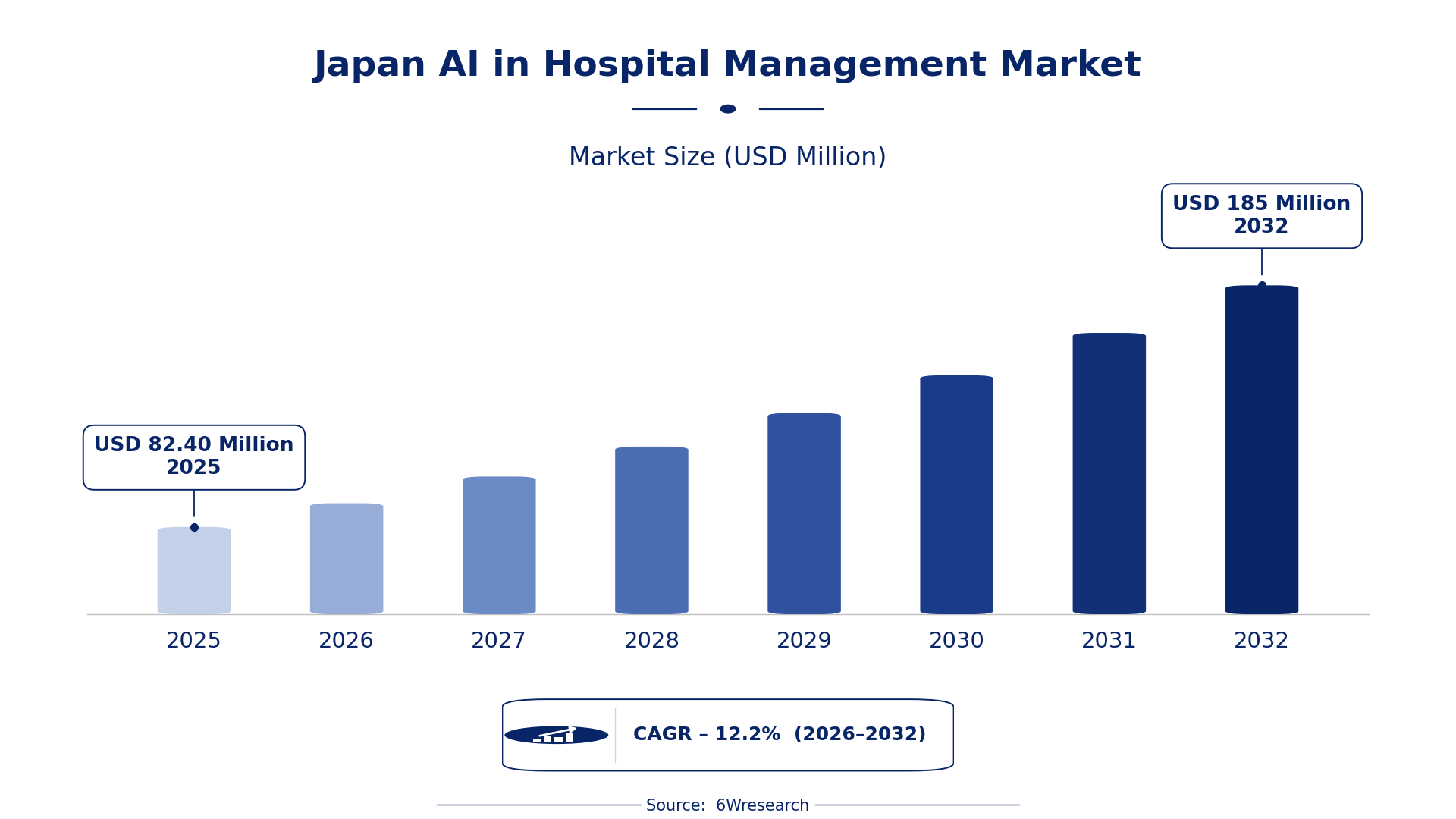
According to 6Wresearch internal database and industry insights, the Japan AI in Hospital Management Market was valued at USD 82.40 Million in 2025 and is projected to reach USD 185 Million by 2032, growing at a CAGR of approximately 12.2% during 2026–2032.
Japan AI in Hospital Management Market Highlights
| Report Metric | Details |
| Report Name | Japan AI in Hospital Management Market (2026-2032) |
| Market Size 2025 | USD 82.40 Million |
| Market Size 2032 | USD 185 Million |
| Absolute Growth 2025–2032 | USD 102.60 Million |
| CAGR 2026–2032 | 12.2% |
| Peak Annual Growth | 13.4% in 2032 |
| Forecast Period | 2026–2032 |
| Historical Data | 2022–2025 |
| Base Year | 2025 |
| Leading Software Type, 2025 | Hospital ERP (42% share) |
| Leading AI Feature, 2025 | Workflow Automation (41% share) |
| Leading Distribution Channel, 2025 | SaaS Health Platforms (35% share) |
| Leading End User, 2025 | Hospital Admins (47% share) |
| Fastest-Growing Software Type | Resource Scheduling (17.3% CAGR) |
| Fastest-Growing AI Feature | Predictive AI Scheduling (17.0% CAGR) |
| Fastest-Growing End User | Emergency & OPD Departments (16.4% CAGR) |
| Growing Sector | Healthcare Services |
| Key End Users | Hospital Administrators, Emergency Departments, Multi-Specialty Hospitals |
Japan AI in Hospital Management Market Year-wise Growth Rate and Key Drivers (2022–2032)
This graph illustrates the annual growth rates of the market from 2022 to 2032, highlighting a steady upward trajectory and projected market expansion over the forecast period.
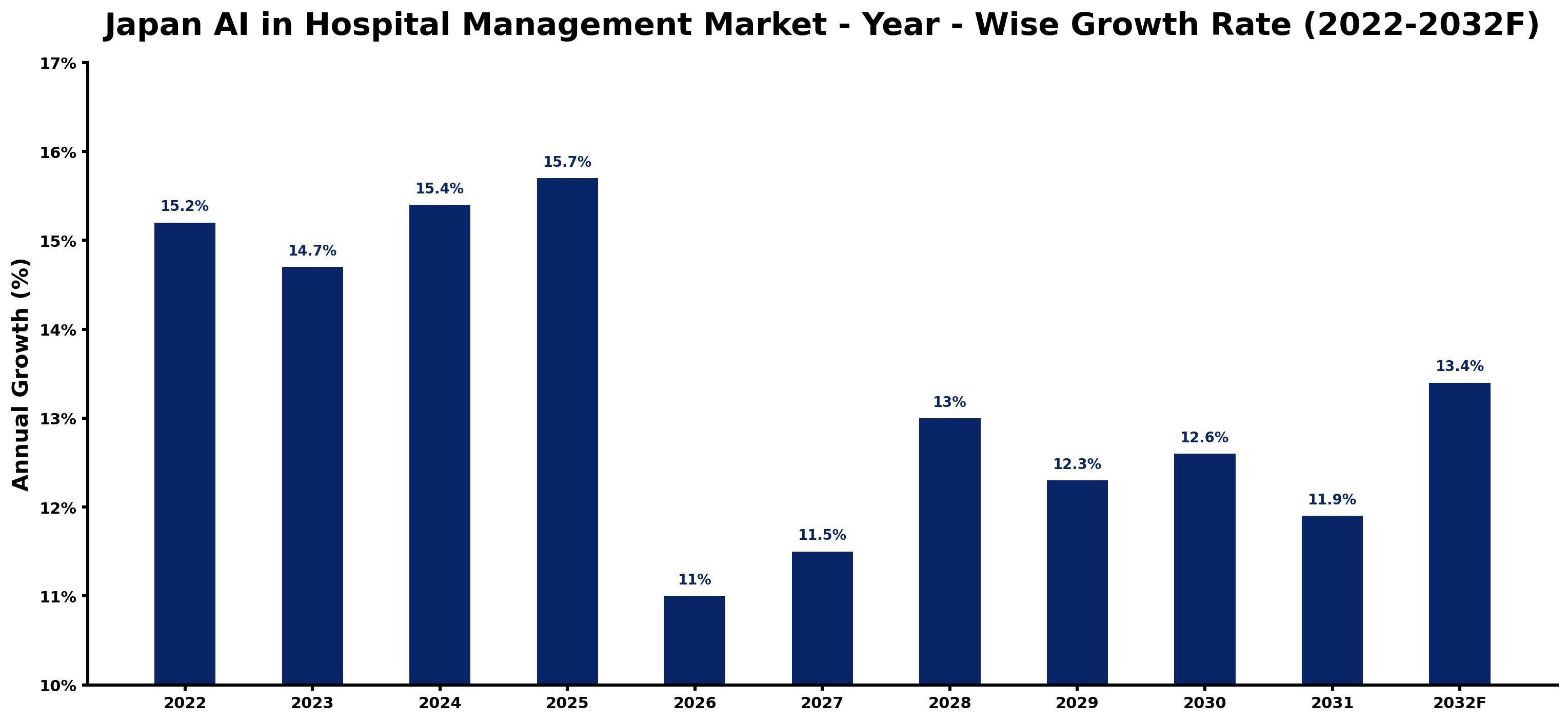
Below, each year's estimated growth is shown next to the factor that most influenced it.
| Year | Estimated Annual Growth (%) | Market Rationale |
| 2022 | 15.2 | The market exhibited strong growth due to increased AI adoption in hospitals. |
| 2023 | 14.7 | Growth slowed as hospitals adjusted to new technologies and operational changes. |
| 2024 | 15.4 | Demand accelerated with more hospitals implementing AI solutions for efficiency. |
| 2025 | 15.7 | The market peaked as hospitals maximised AI for patient management and resource allocation. |
| 2026 | 11.0 | Growth is expected to slow as market saturation begins to affect new AI implementations. |
| 2027 | 11.5 | Demand will increase as hospitals seek to improve operational efficiencies further. |
| 2028 | 13.0 | Growth is projected to resume as technological advancements in AI become more accessible. |
| 2029 | 12.3 | The market is expected to experience a slight slowdown as competition intensifies among providers. |
| 2030 | 12.6 | Growth will pick up as hospitals focus on improving patient care through AI. |
| 2031 | 11.9 | Demand is projected to moderate as hospitals refine their AI strategies and implementations. |
| 2032 | 13.4 | Growth will accelerate again as hospitals aim for full AI integration by 2035. |
Note: Market size estimations and growth projections presented in this report are based on 6Wresearch's proprietary forecasting methodology, utilizing the latest available industry data, government publications, and primary research inputs.
Japan AI in Hospital Management Market Synopsis
AI in Hospital Management integrates advanced technologies into hospital operations to improve efficiency and patient care. Factors such as the increasing adoption of AI technologies in over 8,000 hospitals and government initiatives to promote AI integration are fuelling this growth.
Market Dynamics Impact Analysis (2026–2032)
| Factor | Type | Impact | Primary Segment Affected |
| Increasing demand for efficient hospital operations | Driver | High | Hospital ERP |
| Technological advancements in AI solutions | Driver | High | Resource Scheduling |
| Growing healthcare expenditure | Opportunity | High | Billing & Insurance |
| Rising patient expectations for care quality | Opportunity | High | Patient Flow Management |
| Challenges in integrating AI with existing systems | Restraint | High | Workflow Automation |
| Limited skilled workforce for AI implementation | Restraint | Medium | Predictive AI Scheduling |
| High initial investment costs for AI systems | Challenge | High | SaaS Health Platforms |
| Regulatory compliance and data security concerns | Challenge | Medium | NLP & Automation |
Evaluation of Drivers in Japan AI in Hospital Management Market (2026–2032)
The following drivers explain most of the expected growth.
| Drivers | Primary Segment Affected | Why It Matters (Evidence) |
| Ageing population requiring improved healthcare services | Patient Flow Management | With 29.3% of the population aged 65 or older, hospitals are investing in AI to manage patient flow efficiently. |
| Government initiatives promoting AI in healthcare | Billing & Insurance | The government allocated ¥10 billion in 2023 for healthcare IT advancements, driving hospitals to adopt AI for billing processes. |
| Increased healthcare expenditure leading to higher budgets | Resource Scheduling | Japan's national medical care expenditure reached JPY 46.7 trillion in 2022, enabling hospitals to invest in AI solutions. |
| Need for operational efficiency in hospitals | Workflow Automation | Over 8,100 hospitals in Japan are adopting AI technologies to streamline administrative tasks and improve efficiency. |
| Rising patient care quality expectations | Emergency & OPD Departments | AI applications in emergency departments have reduced patient wait times by 15%, enhancing care quality. |
Orders keep climbing as Japan's ageing population drives hospitals to improve operational efficiency. The national medical care expenditure reached JPY 46.7 trillion in 2022, enabling hospitals to invest in AI for various applications. Over 8,100 hospitals are adopting AI technologies to streamline operations, while emergency departments report a 15% reduction in patient wait times due to AI applications. This trend indicates a strong commitment to improving healthcare delivery through technology and enhancing patient care quality.
Evaluation of Restraints in Japan AI in Hospital Management Market
The following restraints limit how fast demand can grow.
| Market Restraint | Primary Segment Affected | Why It Matters (Evidence) |
| Integration challenges with existing hospital systems | Workflow Automation | Many hospitals face difficulties in integrating AI solutions with legacy systems, which can delay implementation by up to 12 months. |
| Shortage of skilled professionals for AI deployment | Predictive AI Scheduling | The lack of trained personnel hampers the effective deployment of AI technologies in hospitals, increasing reliance on external consultants. |
| High initial costs for AI technology adoption | SaaS Health Platforms | The investment required for AI systems can deter some hospitals from adopting these technologies, limiting access to advanced patient care solutions. |
| Concerns regarding data security and compliance | NLP & Automation | Hospitals must navigate complex regulations to ensure data security, complicating AI implementation and increasing costs. |
| Limited awareness of AI benefits among hospital staff | Billing & Insurance | Some hospital staff may not fully understand AI's advantages, leading to resistance in adoption and delaying implementation. |
Japan AI in Hospital Management Market Challenges
Regulatory hurdles hinder producers from rapidly implementing AI technologies in hospitals, delaying integration timelines by up to 12 months. Competition among hospitals intensifies as many strive to adopt AI, forcing them to invest heavily in technology to remain competitive. A shortage of skilled AI professionals creates bottlenecks for hospitals, increasing reliance on external consultants and inflating operational costs by 20%. High implementation costs associated with AI systems deter smaller hospitals from investing, limiting access to advanced patient care solutions for approximately 125 million residents who require healthcare services.
Trends in the Japan AI in Hospital Management Market
The following changes are redrawing the Japan AI in Hospital Management Market.
- Shift towards AI-Driven Patient Management Systems: The Tokyo metropolitan area is leading the shift towards AI-driven patient management systems, with over 1,000 hospitals implementing AI solutions. This trend is projected to improve operational efficiency, as hospitals seek to enhance patient care.
- Transition from Traditional to AI-Based Billing Processes: In 2022, the adoption of AI in billing processes increased efficiency by approximately 20%. This shift is seen in multi-specialty hospitals, which are increasingly automating their billing systems to streamline operations.
- Emergency Departments Adopting AI for Triage: Since 2023, emergency departments have increasingly implemented AI applications for patient triage, resulting in a 15% decrease in average wait times. This trend highlights the growing reliance on AI to improve patient care and operational efficiency.
- Increased Focus on AI in Healthcare Education: The Health IT Strategy Council has been promoting AI education initiatives since 2023, aiming to improve the workforce's understanding of AI applications. This effort is important for addressing the skills gap in AI deployment across hospitals.
Investment Opportunities in the Japan AI in Hospital Management Market
Investors looking at the Japan AI in Hospital Management Market should consider the following areas.
- AI Solutions for Resource Scheduling: With Japan's healthcare expenditure projected to reach ¥44 trillion by 2025, there is an opportunity to supply AI solutions for resource scheduling. Hospitals are actively seeking partners to improve operational efficiency.
- Investment in AI for Billing Automation: The current gap in billing automation presents an opportunity for investment in AI technologies. Multi-specialty hospitals are looking for solutions to streamline their billing processes and improve efficiency.
- AI-Driven Patient Flow Management Systems: As over 1,000 hospitals implement AI-driven patient flow management systems, the demand for these solutions is rising. Companies can enter this market by collaborating with local healthcare providers.
- Expansion of AI in Emergency Departments: The growing reliance on AI in emergency departments creates a demand for advanced AI applications. Suppliers can explore opportunities by establishing joint ventures with hospitals to develop tailored solutions.
Government Initiatives in the Japan AI in Hospital Management Market
The Medical Care Act of 1948 established foundational standards for hospitals, including staffing and facilities, which have evolved to include AI integration. The PMD Act, amended in 2014, regulates the approval and quality of medical devices, ensuring that AI technologies meet safety standards for healthcare applications and benefit hospital operations.
In 2023, the government allocated ¥10 billion for healthcare IT advancements, including AI integration, managed by the Ministry of Health, Labour and Welfare. This funding aims to support hospitals in adopting AI technologies and improving healthcare delivery.
Future Insight of the Japan AI in Hospital Management Market
Investment in healthcare IT is set to surge, with ¥10 billion allocated in 2023 for AI advancements, driving demand for solutions. By 2032, the integration of AI in hospitals will streamline operations, enabling facilities to reduce patient wait times significantly. The national strategy aims for a 50% increase in AI adoption by 2025, improving efficiency across the sector. As predictive analytics tools become standard, hospitals will enhance patient management, benefiting both buyers and suppliers.
Market Segmentation Analysis
Japan AI in Hospital Management Market report covers a detailed analysis of the following market segments:
By Software Type – Hospital ERP Leads, Resource Scheduling Expected to Grow Fastest
According to Saurav Kr Singh, Senior Research Analyst at 6Wresearch, in 2025, Hospital ERP led the software type split with a 42% share. Hospital ERP holds the largest share owing to its essential function in managing hospital resources and operations effectively. Its widespread implementation across Japan's extensive network of hospitals underscores its critical role in enhancing operational performance. Over 2026–2032, Resource Scheduling is expected to post the fastest growth, at a CAGR of 17.3%. Resource Scheduling is experiencing rapid growth as it is crucial for optimising staff and patient scheduling. The increasing complexity of hospital operations necessitates advanced scheduling solutions, propelling its swift adoption. Suppliers should focus on developing features that enhance resource optimisation to meet the growing demand.
By AI Feature – Workflow Automation Leads, Predictive AI Scheduling Expected to Grow Fastest
Workflow Automation held 41% of the Japan AI in Hospital Management Market by ai feature in 2025. Workflow Automation leads the market as it is vital for streamlining administrative workflows within hospitals, thus improving overall operational efficiency. Its extensive use across healthcare facilities highlights its necessity in managing administrative tasks effectively. Predictive AI Scheduling is projected to grow fastest, at a CAGR of 17.0% during 2026–2032. Predictive AI Scheduling is rapidly gaining traction because it assists in anticipating patient needs and scheduling accordingly, which is essential for improving patient care. The trend towards proactive management in healthcare is a significant factor in its accelerated uptake. Buyers should prioritise solutions that include predictive capabilities to enhance patient management and operational efficiency.
By Distribution Channel – SaaS Health Platforms Lead and Record the Fastest Growth
SaaS Health Platforms took 35% of distribution channel revenue in 2025, more than any other category. SaaS Health Platforms dominate the distribution channel as they provide cloud-based solutions that are highly accessible for hospital management. Their flexibility and scalability make them the preferred choice among hospitals across Japan. Its lead should widen, with a projected CAGR of 16.0% during 2026–2032, the highest in this split. SaaS Health Platforms are also the fastest-growing segment due to their ability to offer real-time data access and management capabilities. The ongoing shift towards digital solutions in healthcare is propelling their rapid adoption. Suppliers must ensure their platforms are user-friendly and integrate seamlessly with existing hospital systems to capture market share.
By End User – Hospital Admins Lead, Emergency & OPD Departments Expected to Grow Fastest
Hospital Admins accounted for 47% of the market by end user in 2025. Hospital Admins constitute the largest user group as they are the primary operators of tools for managing hospital operations. Their direct involvement in decision-making processes significantly shapes the demand for tailored solutions in the market. The quickest growth will come from Emergency & OPD Departments, forecast to expand at a CAGR of 16.4% between 2026 and 2032. Emergency and OPD Departments are the fastest-growing user group as they increasingly rely on technology to enhance patient care and operational efficiency. The pressing need for improved management solutions in these areas is a key driver of their growth. Suppliers should tailor their offerings to meet the specific demands of emergency and outpatient departments to capitalise on this growth.
Key Attractiveness of the Report
- 10 Years of Market Numbers
- Historical Data Starting from 2022 to 2025
- Base Year 2025
- Forecast Data until 2032
- Key Performance Indicators Impacting the Market
- Major Upcoming Developments and Projects
Key Highlights of the Report:
- Japan AI in Hospital Management Market Outlook
- Market Size of Japan AI in Hospital Management Market, 2025
- Forecast of Japan AI in Hospital Management Market, 2032
- Historical Data and Forecast of Japan AI in Hospital Management Revenues & Volume for the Period 2022-2032F
- Japan AI in Hospital Management Market Trend Evolution
- Japan AI in Hospital Management Market Drivers and Challenges
- Japan AI in Hospital Management Price Trends
- Japan AI in Hospital Management Porter's Five Forces
- Japan AI in Hospital Management Industry Life Cycle
- Historical Data and Forecast of Japan AI in Hospital Management Market Revenues & Volume By Software Type for the Period 2022-2032F
- Historical Data and Forecast of Japan AI in Hospital Management Market Revenues & Volume By Hospital ERP for the Period 2022-2032F
- Historical Data and Forecast of Japan AI in Hospital Management Market Revenues & Volume By Resource Scheduling for the Period 2022-2032F
- Historical Data and Forecast of Japan AI in Hospital Management Market Revenues & Volume By Billing & Insurance for the Period 2022-2032F
- Historical Data and Forecast of Japan AI in Hospital Management Market Revenues & Volume By Patient Flow Management for the Period 2022-2032F
- Historical Data and Forecast of Japan AI in Hospital Management Market Revenues & Volume By AI Feature for the Period 2022-2032F
- Historical Data and Forecast of Japan AI in Hospital Management Market Revenues & Volume By Workflow Automation for the Period 2022-2032F
- Historical Data and Forecast of Japan AI in Hospital Management Market Revenues & Volume By Predictive AI Scheduling for the Period 2022-2032F
- Historical Data and Forecast of Japan AI in Hospital Management Market Revenues & Volume By NLP & Automation for the Period 2022-2032F
- Historical Data and Forecast of Japan AI in Hospital Management Market Revenues & Volume By Data-Driven Triage for the Period 2022-2032F
- Historical Data and Forecast of Japan AI in Hospital Management Market Revenues & Volume By Distribution Channel for the Period 2022-2032F
- Historical Data and Forecast of Japan AI in Hospital Management Market Revenues & Volume By SaaS Health Platforms for the Period 2022-2032F
- Historical Data and Forecast of Japan AI in Hospital Management Market Revenues & Volume By Health IT Integrators for the Period 2022-2032F
- Historical Data and Forecast of Japan AI in Hospital Management Market Revenues & Volume By Online HealthTech Suites for the Period 2022-2032F
- Historical Data and Forecast of Japan AI in Hospital Management Market Revenues & Volume By B2B Healthcare Vendors for the Period 2022-2032F
- Historical Data and Forecast of Japan AI in Hospital Management Market Revenues & Volume By End User for the Period 2022-2032F
- Historical Data and Forecast of Japan AI in Hospital Management Market Revenues & Volume By Hospital Admins for the Period 2022-2032F
- Historical Data and Forecast of Japan AI in Hospital Management Market Revenues & Volume By Multi-Specialty Hospitals for the Period 2022-2032F
- Historical Data and Forecast of Japan AI in Hospital Management Market Revenues & Volume By Finance & Insurance Units for the Period 2022-2032F
- Historical Data and Forecast of Japan AI in Hospital Management Market Revenues & Volume By Emergency & OPD Departments for the Period 2022-2032F
- Japan AI in Hospital Management Import Export Trade Statistics
- Market Opportunity Assessment By Software Type
- Market Opportunity Assessment By AI Feature
- Market Opportunity Assessment By Distribution Channel
- Market Opportunity Assessment By End User
- Japan AI in Hospital Management Top Companies Market Share
- Japan AI in Hospital Management Competitive Benchmarking By Technical and Operational Parameters
- Japan AI in Hospital Management Company Profiles
- Japan AI in Hospital Management Key Strategic Recommendations
Market Covered
The following segment groups are covered in the report.
By Software Type
- Hospital ERP
- Resource Scheduling
- Billing & Insurance
- Patient Flow Management
By AI Feature
- Workflow Automation
- Predictive AI Scheduling
- NLP & Automation
- Data-Driven Triage
By Distribution Channel
- SaaS Health Platforms
- Health IT Integrators
- Online HealthTech Suites
- B2B Healthcare Vendors
By End User
- Hospital Admins
- Multi-Specialty Hospitals
- Finance & Insurance Units
- Emergency & OPD Departments































