Japan AI in Military Operations Market Size & Growth Rate
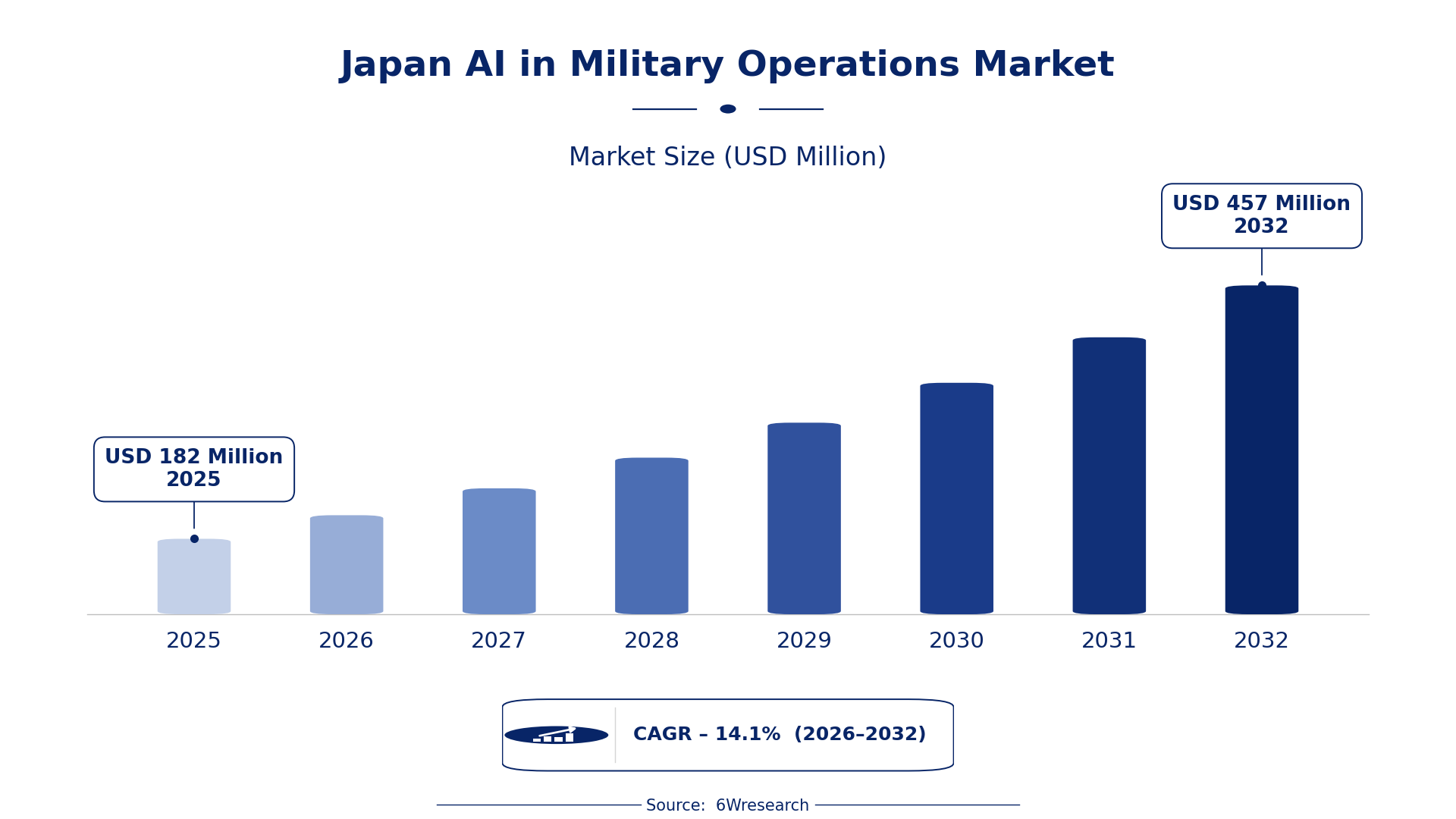
According to 6Wresearch internal database and industry insights, the Japan AI in Military Operations Market was valued at USD 182 Million in 2025 and is projected to reach USD 457 Million by 2032, growing at a CAGR of approximately 14.1% during 2026–2032.
Japan AI in Military Operations Market Highlights
| Report Metric | Details |
| Report Name | Japan AI in Military Operations Market (2026-2032) |
| Market Size 2025 | USD 182 Million |
| Market Size 2032 | USD 457 Million |
| Absolute Growth 2025–2032 | USD 275 Million |
| CAGR 2026–2032 | 14.1% |
| Peak Annual Growth | 15.5% in 2026 |
| Forecast Period | 2026–2032 |
| Historical Data | 2022–2025 |
| Base Year | 2025 |
| Leading Operation Type, 2025 | Surveillance & Recon (36% share) |
| Leading AI Capability, 2025 | Threat Detection Systems (43% share) |
| Leading Distribution Channel, 2025 | Government Procurement (40% share) |
| Leading End User, 2025 | Armed Forces (39% share) |
| Fastest-Growing Operation Type | Battlefield Management (19.8% CAGR) |
| Fastest-Growing AI Capability | Predictive Analytics (17.5% CAGR) |
| Fastest-Growing Distribution Channel | Military AI Vendors (17.9% CAGR) |
| Fastest-Growing End User | Tactical Command Centers (17.3% CAGR) |
| Growing Sector | Military Intelligence |
| Key End Users | Armed Forces, Defense Contractors, Military Intelligence Units, Tactical Command Centers |
Japan AI in Military Operations Market Year-wise Growth Rate and Key Drivers (2022–2032)
This graph illustrates the annual growth rates of the market from 2022 to 2032, highlighting a steady upward trajectory and projected market expansion over the forecast period.
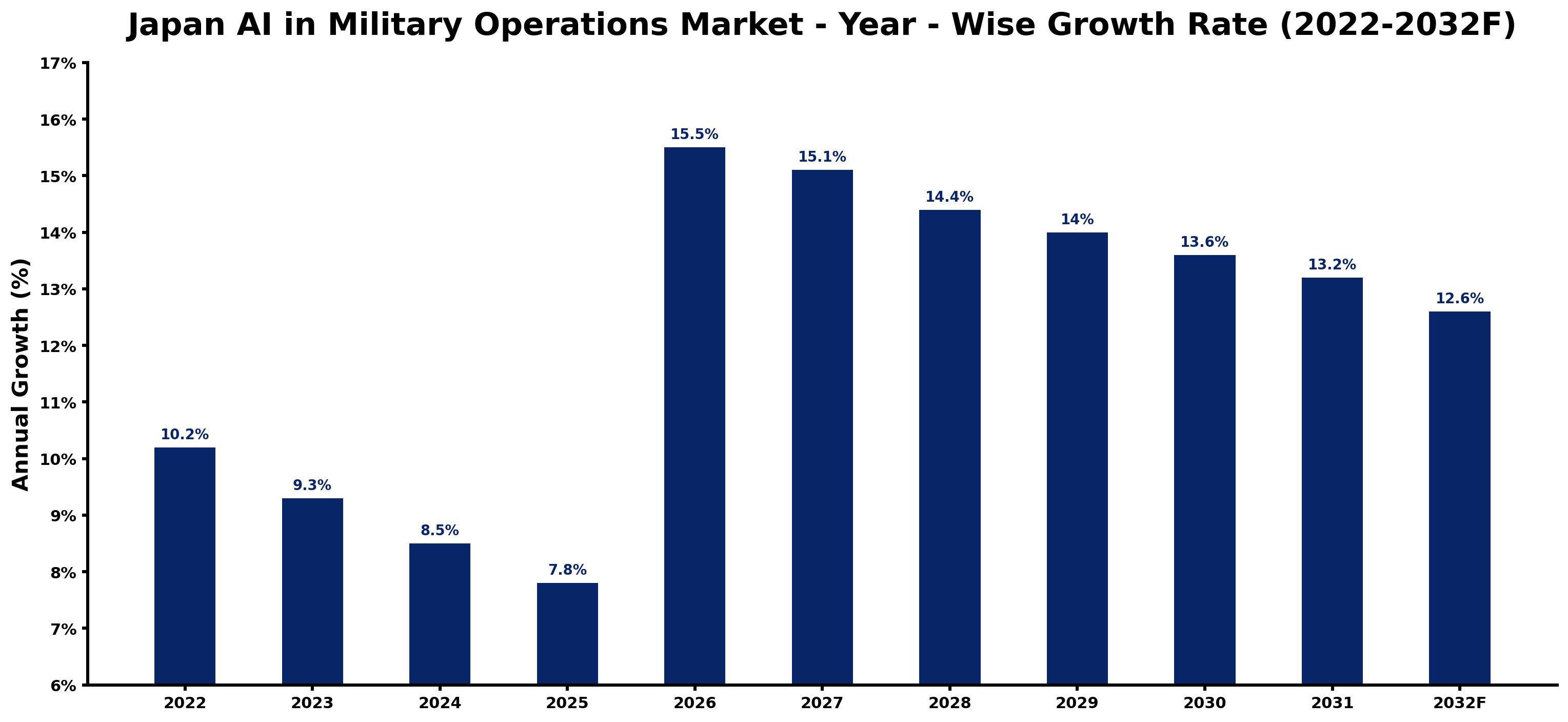
Annual growth estimates for each year appear below with the principal reason behind them, explaining the shifts that set the pace of the market.
| Year | Estimated Annual Growth (%) | Market Rationale |
| 2022 | 10.2 | The market showed strong activity with substantial investments in military technology. |
| 2023 | 9.3 | Growth slowed as the Ministry of Defense focused on implementing new programs. |
| 2024 | 8.5 | The market continued to expand with ongoing efforts to integrate AI technologies. |
| 2025 | 7.8 | Investment in AI technologies was essential for improving military operations. |
| 2026 | 15.5 | Demand surged as the government is expected to accelerate AI adoption in military operations. |
| 2027 | 15.1 | Growth is expected to decelerate slightly as the market adjusts to emerging technologies. |
| 2028 | 14.4 | The market is projected to maintain momentum with increasing applications of AI in defense. |
| 2029 | 14.0 | Demand is expected to continue rising, supported by military modernization efforts. |
| 2030 | 13.6 | The market is projected to grow steadily as AI systems become more integrated. |
| 2031 | 13.2 | Growth is expected to slow as the market matures and technology adoption stabilises. |
| 2032 | 12.6 | The market is projected to grow as AI capabilities expand further. |
Note: Market size estimations and growth projections presented in this report are based on 6Wresearch's proprietary forecasting methodology, utilizing the latest available industry data, government publications, and primary research inputs.
Japan AI in Military Operations Market Synopsis
AI in Military Operations involves integrating artificial intelligence technologies to improve military capabilities through advanced algorithms and machine learning techniques. The Japan AI in Military Operations Market is expanding due to a defence budget of approximately 6.8 trillion yen, with substantial investments in AI integration by the Ministry of Defence. The establishment of a Cyber Defence Unit in 2022 and ongoing collaborations with international partners are driving demand for advanced military technologies, leading to increased procurement of AI solutions. This growth is supported by the active adoption of AI for surveillance and reconnaissance missions by the Japan Self-Defense Forces.
Market Dynamics Impact Analysis (2026–2032)
| Factor | Type | Impact | Primary Segment Affected |
| Increased defence budget allocation | Driver | High | Surveillance & Recon |
| Growing emphasis on cyber defense | Driver | High | Cyber Defense |
| Rising need for advanced threat detection | Opportunity | High | Threat Detection Systems |
| Expansion of tactical command capabilities | Opportunity | High | Tactical Command Centers |
| High costs of AI technology integration | Restraint | Medium | Autonomous Weapons |
| Limited availability of skilled personnel | Restraint | Medium | Battlefield Management |
| Compliance with stringent military standards | Challenge | High | Cyber Defense |
| Capacity constraints in AI development | Challenge | High | Surveillance & Recon |
Evaluation of Drivers in Japan AI in Military Operations Market (2026–2032)
Below are the drivers that matter most for revenue growth, with supporting evidence.
| Drivers | Primary Segment Affected | Why It Matters (Evidence) |
| Increased defence budget allocation | Surveillance & Recon | Japan's defence budget for 2023 is approximately 6.8 trillion yen, enabling improved surveillance capabilities. |
| Growing emphasis on cyber defense | Cyber Defense | The establishment of a Cyber Defense Unit in 2022 has heightened focus on AI for cybersecurity measures. |
| Demand for autonomous systems | Autonomous Weapons | The Japan Self-Defense Forces are actively adopting AI for precision strikes, reducing human risk during operations. |
| Collaborations with international partners | Defense Contractors | Defense contractors are collaborating internationally, facilitating AI technology development and integration. |
| Investment in battlefield management systems | Battlefield Management | AI in battlefield management is being tested in joint exercises with allied forces, improving operational coordination. |
A wider customer base explains much of the growth, as Japan's defence budget for 2023 is approximately 6.8 trillion yen, facilitating investments in advanced technologies. The focus on cybersecurity has intensified following the establishment of a Cyber Defense Unit in 2022, prompting military intelligence units to adopt AI for improved threat detection. Collaborations between defense contractors and international partners are driving innovation in AI technologies, which increases demand. The integration of AI into autonomous weapons reduces human risk during operations, while the emphasis on battlefield management systems improves coordination among tactical command centers. Overall, these factors contribute to a rapidly evolving market.
Evaluation of Restraints in Japan AI in Military Operations Market
These restraints slow adoption and weigh on supplier margins.
| Market Restraint | Primary Segment Affected | Why It Matters (Evidence) |
| High costs of AI technology integration | Autonomous Weapons | The integration of AI technologies incurs substantial costs, limiting procurement by military units. |
| Limited availability of skilled personnel | Battlefield Management | A shortage of skilled personnel hampers the effective implementation of AI systems in military operations, affecting project timelines. |
| Compliance with stringent military standards | Cyber Defense | Strict compliance requirements increase the complexity and cost of deploying AI solutions, impacting procurement decisions. |
| Dependence on advanced technology suppliers | Threat Detection Systems | Reliance on external suppliers for AI technologies can delay project timelines and increase costs for military units. |
| Slow adoption of new technologies | Surveillance & Recon | Cautious adoption of new technologies by military units can hinder overall market growth, affecting operational readiness. |
Japan AI in Military Operations Market Challenges
Japan's strict regulations on military technology complicate the integration of AI in operations, causing delays for producers. Compliance with these regulations can prolong project timelines by up to 18 months, reducing military readiness. Supply chain issues arise from reliance on specific technology imports, leading to increased costs for buyers; for example, delays in AI component deliveries can inflate project budgets by 20%. Buyers face challenges in adapting to evolving standards set by the Japan Defence Agency, resulting in compliance costs that may exceed 10% of project expenses. Competition among defence contractors intensifies as they rush to meet the 2025 AI integration deadline, forcing heavy R&D investments that strain resources.
Trends in the Japan AI in Military Operations Market
These developments are changing demand patterns in the Japan AI in Military Operations Market.
- Shift from Traditional to AI-Driven Surveillance: The Japan Self-Defense Forces are transitioning towards AI-driven surveillance systems, focusing on real-time intelligence gathering. In 2022, investments were made to integrate AI technologies into existing systems, reflecting a strategic shift in operational capabilities.
- Transition to Autonomous Weapon Systems: The adoption of autonomous weapon systems is becoming a priority for Japan's armed forces. By 2025, the Ministry of Defence plans to implement AI technologies in precision strikes, improving operational effectiveness.
- Emerging Focus on Cybersecurity Integration: The establishment of the Cyber Defence Unit in 2022 marks a shift towards integrating AI in cybersecurity measures. This initiative aims to strengthen national security against increasing cyber threats, with investments expected to rise.
- Prioritisation of Tactical Command Enhancements: Tactical command centres are increasingly prioritising AI for operational decision-making. By 2024, the Japan Self-Defense Forces plan to deploy AI systems in these centres, reflecting a strategic shift in military operations.
Investment Opportunities in the Japan AI in Military Operations Market
The following opportunities in the Japan AI in Military Operations Market pair current demand with a clear way in.
- Armed Forces seeking advanced AI solutions: The Japan Self-Defense Forces are projected to invest heavily in AI technologies, with an anticipated increase of 15% annually through 2025, creating opportunities for suppliers.
- Growing demand for threat detection capabilities: With Japan's defence budget at approximately 6.8 trillion yen, there is a notable gap in advanced threat detection systems, presenting opportunities for military AI vendors.
- Tokyo as a hub for defense technology: Tokyo is a key region for defence technology development, with numerous military contractors seeking partnerships to improve AI capabilities, creating entry points for local collaborations.
- Joint ventures for AI development: The increasing collaboration between defence contractors and international partners offers opportunities for joint ventures in AI development, facilitating technology transfer and innovation.
Government Initiatives in the Japan AI in Military Operations Market
The AI Promotion Act, set to be implemented in 2025, adds clarity to previous laws by providing guidelines for military applications of AI technologies. This act aims to streamline processes and encourage innovation, directly impacting the integration of AI in military operations and improving procurement efficiency.
The Japan Defence Agency is responsible for approving AI technologies for military use. It funds research initiatives and sets standards for AI applications in military operations, ensuring compliance with national security requirements and facilitating the adoption of advanced technologies.
Future Insight of the Japan AI in Military Operations Market
Advancements in AI for military operations will reshape demand by 2032, particularly through improved surveillance systems. The Japan Self-Defense Forces plan to deploy AI systems in command centres by 2024, which will streamline operational processes. Investment in AI is projected to rise by 15% annually through 2025, driving collaboration with international partners. The establishment of a Cyber Defence Unit in 2022 will enhance Japan's national security framework, leading to more robust strategies against cyber threats.
Market Segmentation Analysis
Japan AI in Military Operations Market report covers a detailed analysis of the following market segments:
By Operation Type – Surveillance & Recon Leads, Battlefield Management Expected to Grow Fastest
According to Saurav Kr Singh, Senior Research Analyst at 6Wresearch, the largest operation type category in 2025 was Surveillance & Recon, at 36% of revenue. Surveillance and reconnaissance hold the largest share due to their critical role in real-time intelligence gathering for military operations. The Japan Self-Defense Forces are actively adopting these technologies to enhance situational awareness and operational effectiveness. Over 2026–2032, Battlefield Management is expected to post the fastest growth, at a CAGR of 19.8%. The battlefield management segment is experiencing rapid growth as it is crucial for coordinating military operations effectively. Recent joint exercises with allied forces are testing applications in this area, further driving its adoption. Suppliers should focus on developing advanced solutions for battlefield management to meet the increasing demand from military operations.
By AI Capability – Threat Detection Systems Lead, Predictive Analytics Expected to Grow Fastest
Threat Detection Systems held 43% of the Japan AI in Military Operations Market by ai capability in 2025. Threat detection systems dominate the market as they are essential for promptly identifying and neutralising threats in military contexts. Their direct application in enhancing national security makes them a priority for the Japan Defense Agency. Predictive Analytics is projected to grow fastest, at a CAGR of 17.5% during 2026–2032. Predictive analytics is growing swiftly as it aids in forecasting potential threats and outcomes, which is becoming increasingly vital for military strategy. The emphasis on forecasting capabilities is pushing more investments into this area. Buyers will benefit from investing in predictive analytics to improve threat assessment and operational readiness.
By Distribution Channel – Government Procurement Leads, Military AI Vendors Expected to Grow Fastest
Government Procurement took 40% of distribution channel revenue in 2025, more than any other category. Government procurement is the leading channel for acquiring military technologies, reflecting the structured approach of Japan's defense budget allocation. This channel ensures that military operations receive the necessary funding and resources for advanced technologies. Military AI Vendors are set to record the highest CAGR in this split, 17.9% over 2026–2032. Military AI vendors are rapidly expanding as specialised suppliers of technologies for defence, responding to the increasing demand for tailored solutions. Their direct engagement with military needs is driving their growth. Suppliers must establish strong relationships with military AI vendors to effectively navigate the procurement landscape.
By End User – Armed Forces Lead, Tactical Command Centers Expected to Grow Fastest
With 39% of end user revenue in 2025, Armed Forces was the largest category. The armed forces represent the largest end-user of technologies in operations, as they are the primary beneficiaries of enhanced military capabilities. Their ongoing commitment to modernising operations through integration underscores their dominant position. The quickest growth will come from Tactical Command Centers, forecast to expand at a CAGR of 17.3% between 2026 and 2032. Tactical command centers are experiencing the fastest growth as they utilise these technologies for operational decision-making, reflecting the need for improved efficiency in military strategies. This focus on decision-making capabilities is attracting more investments. Buyers should prioritise solutions that enhance decision-making processes in tactical command centers.
Key Attractiveness of the Report
- 10 Years of Market Numbers
- Historical Data Starting from 2022 to 2025
- Base Year 2025
- Forecast Data until 2032
- Key Performance Indicators Impacting the Market
- Major Upcoming Developments and Projects
Key Highlights of the Report:
- Japan AI in Military Operations Market Outlook
- Market Size of Japan AI in Military Operations Market, 2025
- Forecast of Japan AI in Military Operations Market, 2032
- Historical Data and Forecast of Japan AI in Military Operations Revenues & Volume for the Period 2022-2032F
- Japan AI in Military Operations Market Trend Evolution
- Japan AI in Military Operations Market Drivers and Challenges
- Japan AI in Military Operations Price Trends
- Japan AI in Military Operations Porter's Five Forces
- Japan AI in Military Operations Industry Life Cycle
- Historical Data and Forecast of Japan AI in Military Operations Market Revenues & Volume By Operation Type for the Period 2022-2032F
- Historical Data and Forecast of Japan AI in Military Operations Market Revenues & Volume By Surveillance & Recon for the Period 2022-2032F
- Historical Data and Forecast of Japan AI in Military Operations Market Revenues & Volume By Autonomous Weapons for the Period 2022-2032F
- Historical Data and Forecast of Japan AI in Military Operations Market Revenues & Volume By Battlefield Management for the Period 2022-2032F
- Historical Data and Forecast of Japan AI in Military Operations Market Revenues & Volume By Cyber Defense for the Period 2022-2032F
- Historical Data and Forecast of Japan AI in Military Operations Market Revenues & Volume By AI Capability for the Period 2022-2032F
- Historical Data and Forecast of Japan AI in Military Operations Market Revenues & Volume By Computer Vision for the Period 2022-2032F
- Historical Data and Forecast of Japan AI in Military Operations Market Revenues & Volume By Reinforcement Learning for the Period 2022-2032F
- Historical Data and Forecast of Japan AI in Military Operations Market Revenues & Volume By Predictive Analytics for the Period 2022-2032F
- Historical Data and Forecast of Japan AI in Military Operations Market Revenues & Volume By Threat Detection Systems for the Period 2022-2032F
- Historical Data and Forecast of Japan AI in Military Operations Market Revenues & Volume By Distribution Channel for the Period 2022-2032F
- Historical Data and Forecast of Japan AI in Military Operations Market Revenues & Volume By Defense Contractors for the Period 2022-2032F
- Historical Data and Forecast of Japan AI in Military Operations Market Revenues & Volume By Government Procurement for the Period 2022-2032F
- Historical Data and Forecast of Japan AI in Military Operations Market Revenues & Volume By Military AI Vendors for the Period 2022-2032F
- Historical Data and Forecast of Japan AI in Military Operations Market Revenues & Volume By Secure Software Providers for the Period 2022-2032F
- Historical Data and Forecast of Japan AI in Military Operations Market Revenues & Volume By End User for the Period 2022-2032F
- Historical Data and Forecast of Japan AI in Military Operations Market Revenues & Volume By Military Intelligence Units for the Period 2022-2032F
- Historical Data and Forecast of Japan AI in Military Operations Market Revenues & Volume By Armed Forces for the Period 2022-2032F
- Historical Data and Forecast of Japan AI in Military Operations Market Revenues & Volume By Tactical Command Centers for the Period 2022-2032F
- Historical Data and Forecast of Japan AI in Military Operations Market Revenues & Volume By Cybersecurity Divisions for the Period 2022-2032F
- Japan AI in Military Operations Import Export Trade Statistics
- Market Opportunity Assessment By Operation Type
- Market Opportunity Assessment By AI Capability
- Market Opportunity Assessment By Distribution Channel
- Market Opportunity Assessment By End User
- Japan AI in Military Operations Top Companies Market Share
- Japan AI in Military Operations Competitive Benchmarking By Technical and Operational Parameters
- Japan AI in Military Operations Company Profiles
- Japan AI in Military Operations Key Strategic Recommendations
Market Covered
Coverage by segment is as follows.
By Operation Type
- Surveillance & Recon
- Autonomous Weapons
- Battlefield Management
- Cyber Defense
By AI Capability
- Computer Vision
- Reinforcement Learning
- Predictive Analytics
- Threat Detection Systems
By Distribution Channel
- Defense Contractors
- Government Procurement
- Military AI Vendors
- Secure Software Providers
By End User
- Military Intelligence Units
- Armed Forces
- Tactical Command Centers
- Cybersecurity Divisions































