Japan AI in Neurosurgery Market Size & Growth Rate
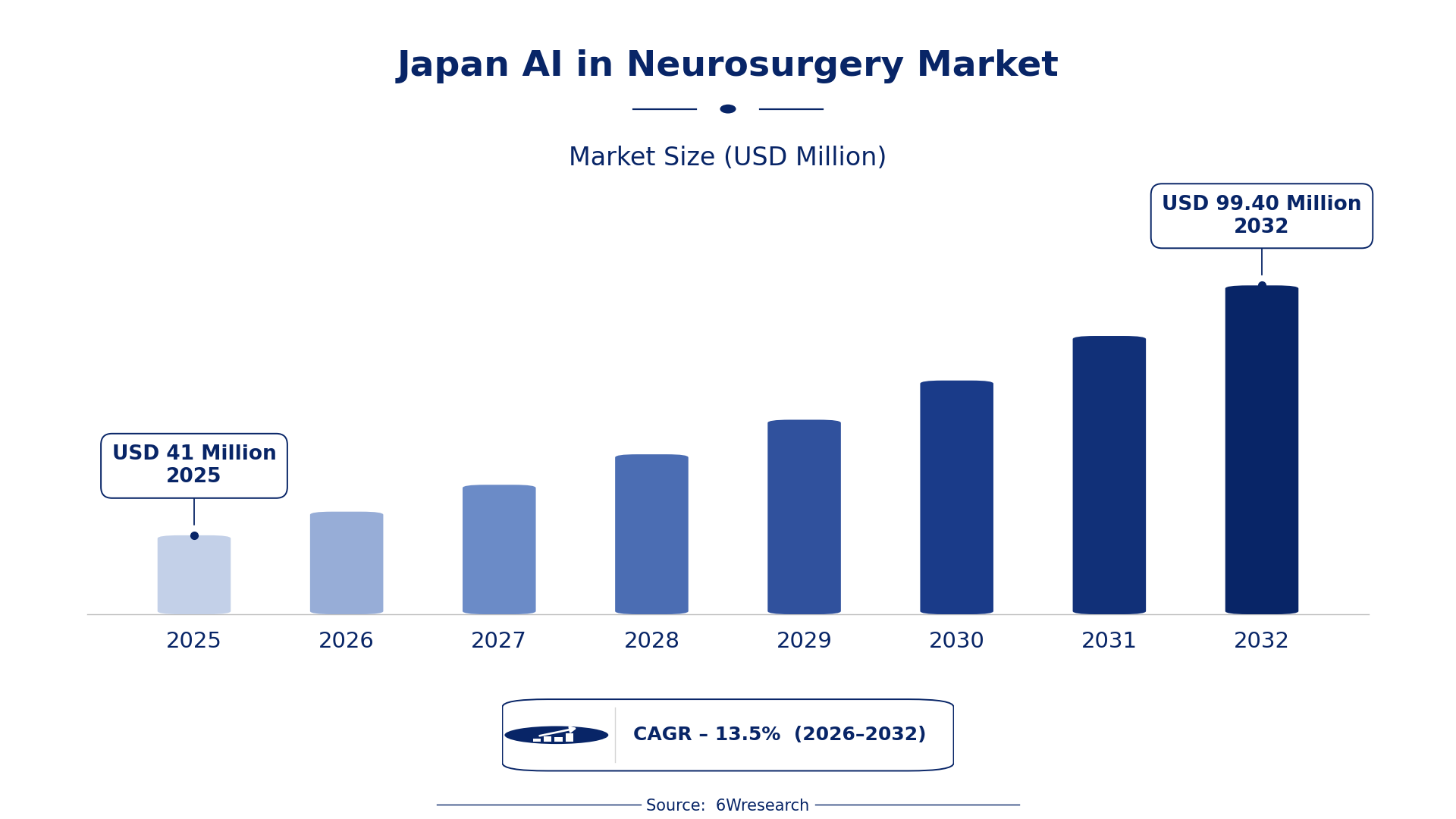
According to 6Wresearch internal database and industry insights, the Japan AI in Neurosurgery Market was valued at USD 41 Million in 2025 and is projected to reach USD 99.40 Million by 2032, growing at a CAGR of approximately 13.5% during 2026–2032.
Japan AI in Neurosurgery Market Highlights
| Report Metric | Details |
| Report Name | Japan AI in Neurosurgery Market (2026-2032) |
| Market Size 2025 | USD 41 Million |
| Market Size 2032 | USD 99.40 Million |
| Absolute Growth 2025–2032 | USD 58.40 Million |
| CAGR 2026–2032 | 13.5% |
| Peak Annual Growth | 15.8% in 2026 |
| Forecast Period | 2026–2032 |
| Historical Data | 2022–2025 |
| Base Year | 2025 |
| Leading Application Type, 2025 | Tumor Detection (45% share) |
| Leading AI Technology, 2025 | Deep Learning (46% share) |
| Leading Distribution Channel, 2025 | HealthTech Platforms (48% share) |
| Leading End User, 2025 | Neurosurgery Departments (47% share) |
| Fastest-Growing Application Type | Pre-op Planning (17.8% CAGR) |
| Fastest-Growing Distribution Channel | Surgical Robot Providers (17.1% CAGR) |
| Fastest-Growing End User | Neuro Health Institutes (16.6% CAGR) |
| Growing Sector | Neurosurgery |
| Key End Users | Neurosurgery Departments, Specialized Hospitals, Brain Clinics, Neuro Health Institutes |
Japan AI in Neurosurgery Market Year-wise Growth Rate and Key Drivers (2022–2032)
This graph illustrates the annual growth rates of the market from 2022 to 2032, highlighting a steady upward trajectory and projected market expansion over the forecast period.
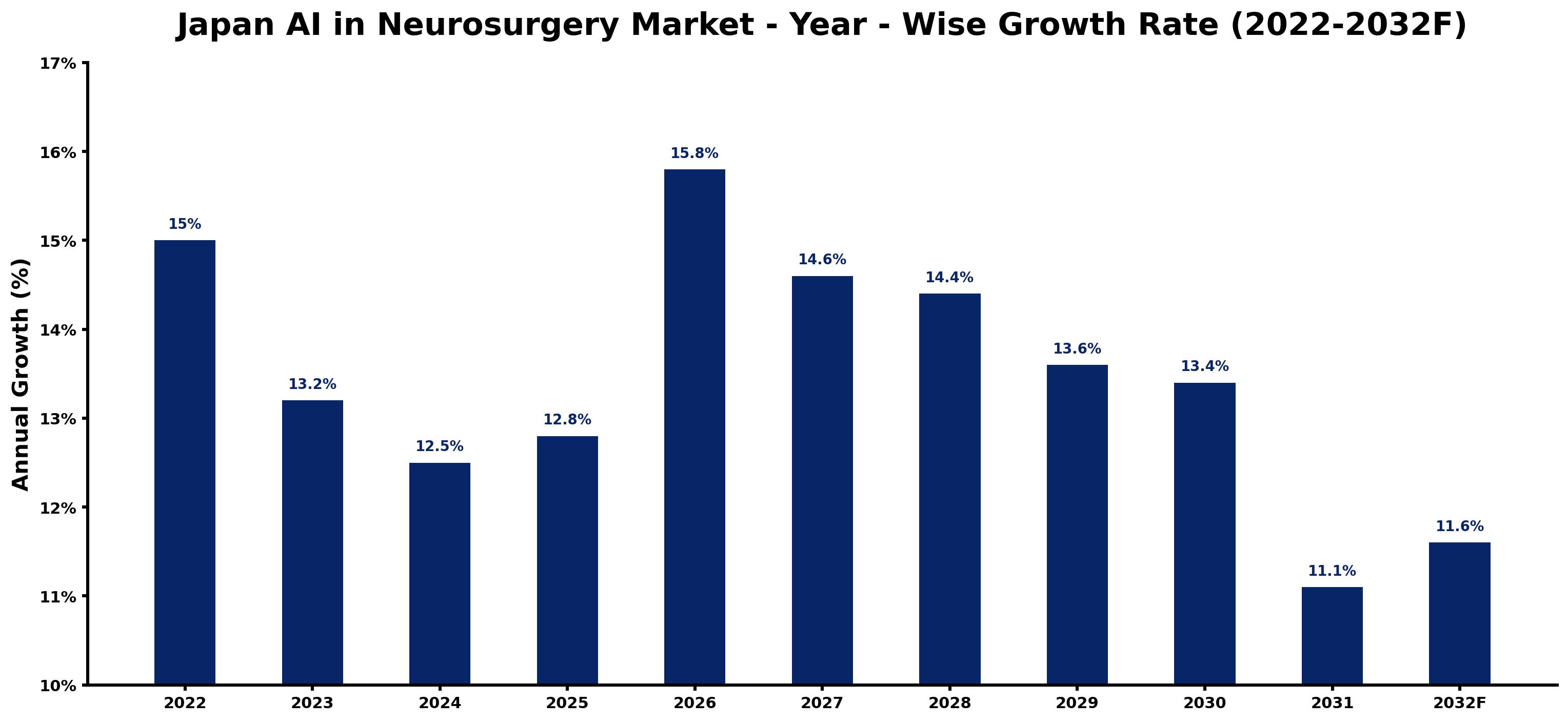
Below, each year's estimated growth is shown next to the factor that most influenced it.
| Year | Estimated Annual Growth (%) | Market Rationale |
| 2022 | 15.0 | The market showed strong demand due to increased adoption of AI technologies in surgical practices. |
| 2023 | 13.2 | Growth slowed slightly as hospitals adjusted to integrating new AI systems into existing workflows. |
| 2024 | 12.5 | The market continued to grow, albeit at a slower pace, as healthcare providers refined their AI strategies. |
| 2025 | 12.8 | Demand picked up as more specialized hospitals implemented advanced neurosurgical technologies. |
| 2026 | 15.8 | Growth accelerated as robotic assistance systems gained traction in neurosurgery departments nationwide. |
| 2027 | 14.6 | The market experienced a slowdown as competition intensified among AI technology providers. |
| 2028 | 14.4 | Growth continued to decelerate as hospitals evaluated the effectiveness of AI implementations. |
| 2029 | 13.6 | The market maintained growth, driven by ongoing investments in AI-driven diagnostic tools. |
| 2030 | 13.4 | Demand increased modestly as healthcare providers sought to improve surgical outcomes with AI. |
| 2031 | 11.1 | Growth slowed as market saturation began to affect new technology adoption rates. |
| 2032 | 11.6 | The market is expected to rebound slightly as new AI applications in neurosurgery emerge. |
Note: Market size estimations and growth projections presented in this report are based on 6Wresearch's proprietary forecasting methodology, utilizing the latest available industry data, government publications, and primary research inputs.
Japan AI in Neurosurgery Market Synopsis
AI in Neurosurgery involves the application of artificial intelligence to improve surgical procedures, patient outcomes, and workflows. The Japan AI in Neurosurgery Market is expanding, driven by over 100 specialised hospitals equipped with advanced technologies that cater to the needs of an ageing population. Increased funding for AI research and the adoption of robotic assistance systems are transforming surgical practices across the country, creating opportunities for healthcare providers and technology developers alike.
Market Dynamics Impact Analysis (2026–2032)
| Factor | Type | Impact | Primary Segment Affected |
| Growing elderly demographic requiring neurosurgical care | Driver | High | Neurosurgery Departments |
| Increased funding for AI research in healthcare | Driver | High | HealthTech Platforms |
| Investment in robotic assistance systems for surgeries | Opportunity | High | Robotic Assistance |
| Expansion of AI-driven diagnostic imaging tools | Opportunity | High | Diagnostic Imaging Suites |
| Integration challenges of AI technologies in existing workflows | Restraint | High | Pre-op Planning |
| High costs associated with advanced AI systems | Restraint | Medium | Tumor Detection |
| Shortage of skilled professionals trained in AI applications | Challenge | High | Deep Learning |
| Intense competition among AI technology providers | Challenge | Medium | Surgical Robot Providers |
Evaluation of Drivers in Japan AI in Neurosurgery Market (2026–2032)
The table below links each growth driver to the segment it affects and the evidence for it.
| Drivers | Primary Segment Affected | Why It Matters (Evidence) |
| Increasing elderly population in Japan | Neurosurgery Departments | This demographic shift leads to higher demand for neurosurgical procedures, driving hospitals to adopt AI technologies, with over 125 million people in the country. |
| Funding programs for AI research in healthcare | HealthTech Platforms | Government initiatives support the development of AI solutions, encouraging healthcare providers to invest, with substantial resources allocated in 2023. |
| Adoption of robotic assistance systems | Robotic Assistance | These systems improve surgical precision, prompting hospitals to integrate advanced technologies into their operations, with numerous hospitals implementing these systems. |
| Growth of AI-driven diagnostic imaging tools | Diagnostic Imaging Suites | Enhanced imaging capabilities improve diagnostic accuracy, leading to increased purchases of AI technologies, with over 200 diagnostic imaging suites utilizing AI. |
| Development of predictive AI models | Pre-op Planning | These models assist in surgical outcome forecasting, encouraging neurosurgeons to implement AI solutions, with over 50 active research projects focusing on this area. |
Buyers are adding capacity as the elderly population in Japan increases, resulting in heightened demand for neurosurgical procedures. The integration of robotic assistance systems enhances surgical precision, which is critical for neurosurgery departments. AI-driven diagnostic imaging tools are now utilized in over 200 diagnostic imaging suites, improving diagnostic accuracy significantly. Furthermore, predictive AI models are being developed to assist in surgical planning, driving further adoption among neurosurgeons.
Evaluation of Restraints in Japan AI in Neurosurgery Market
The following restraints limit how fast demand can grow.
| Market Restraint | Primary Segment Affected | Why It Matters (Evidence) |
| Integration challenges of AI technologies into existing workflows | Pre-op Planning | Healthcare providers face difficulties in seamlessly incorporating AI into their current systems, delaying implementation and affecting surgical outcomes. |
| High costs associated with advanced AI systems | Tumor Detection | The financial burden of acquiring and maintaining AI technologies can deter hospitals from investing, often reaching up to 20% of total surgical expenses. |
| Limited availability of qualified personnel | Deep Learning | The shortage of skilled professionals hampers the effective use of AI technologies in neurosurgery, resulting in over 30% of surgeries not utilizing advanced tools. |
| Regulatory hurdles for AI in healthcare | Robotic Assistance | Compliance with strict regulations can slow down the approval process for new AI technologies, impacting the timely availability of innovations. |
| Market saturation affecting new technology adoption rates | Surgical Robot Providers | As the market matures, hospitals may become hesitant to invest in additional AI solutions, leading to slower growth in technology adoption. |
Japan AI in Neurosurgery Market Challenges
Robotic assistance systems in neurosurgery encounter regulatory hurdles, as compliance with ISO 13485 can delay product approvals by up to six months, affecting producers' ability to launch new technologies. A skills gap exists among neurosurgeons, with over 30% of surgeries not employing advanced AI tools, which limits operational efficiency for hospitals. High costs associated with advanced AI technologies can account for 20% of total surgical expenses, compelling buyers to allocate additional budgets for essential equipment. Inconsistent AI integration across facilities also leads to fragmented patient care and suboptimal outcomes.
Trends in the Japan AI in Neurosurgery Market
Below are the shifts with the largest effect on the Japan AI in Neurosurgery Market.
- Shift from Traditional to AI-Driven Surgical Procedures: In 2023, over 500 neurosurgeons in Japan began integrating AI tools into their practices, reflecting a shift towards technology-driven surgical methods.
- Emergence of Predictive AI Models in Neurosurgery: The development of predictive AI models is gaining traction, with over 50 active research projects focusing on improving surgical outcomes in Japan.
- Growth of HealthTech Platforms Offering AI Solutions: As of 2023, over 30 HealthTech platforms provide integrated AI solutions for neurosurgery, indicating a trend towards technological support.
- Increase in Robotic Assistance Adoption: Robotic assistance in neurosurgery is on the rise, with numerous hospitals implementing these systems to improve surgical precision and efficiency.
Investment Opportunities in the Japan AI in Neurosurgery Market
Where to invest in the Japan AI in Neurosurgery Market: the main openings are set out below.
- Investment in AI-Driven Diagnostic Imaging Tools: With over 200 diagnostic imaging suites using AI, there is an opportunity to supply advanced imaging technologies to improve diagnostic accuracy.
- Supply of Robotic Assistance Systems: The growing adoption of robotic systems in surgeries presents a chance to invest in this technology, particularly among specialized hospitals.
- Development of Predictive AI Solutions: As predictive AI models become essential for surgical planning, there is a demand for effective solutions, particularly from neurosurgery departments.
- Expansion of HealthTech Platforms: With the rise of over 30 HealthTech platforms, opportunities exist to partner with these platforms to deliver integrated AI solutions.
Government Initiatives in the Japan AI in Neurosurgery Market
The AI Promotion Act, established in 2025, introduces a national framework for AI research and development, assisting healthcare providers in adopting AI technologies while ensuring compliance with safety and efficacy standards. In 2023, the government allocated substantial resources to support AI research, benefiting specialised hospitals and neurosurgery departments.
The Ministry of Health, Labour and Welfare oversees funding programmes for AI in healthcare, approving initiatives that enhance surgical practices. In 2023, the government allocated significant resources to support AI research, benefiting specialised hospitals and neurosurgery departments.
Future Insight of the Japan AI in Neurosurgery Market
Healthcare providers will undergo a transformation in AI application, with over 150 brain clinics adopting AI-driven diagnostic imaging tools by 2032. The integration of robotic assistance will improve surgical precision, leading to better patient outcomes in various hospitals. Research initiatives led by institutions like the Tokyo Medical University will drive advancements in AI applications, ultimately benefiting healthcare providers. Government funding for AI in healthcare will support progress, ensuring that buyers have access to improved technologies.
Market Segmentation Analysis
Japan AI in Neurosurgery Market report covers a detailed analysis of the following market segments:
By Application Type – Tumor Detection Leads, Pre-op Planning Expected to Grow Fastest
According to Saurav Kr Singh, Senior Research Analyst at 6Wresearch, Tumor Detection held 45% of the Japan AI in Neurosurgery Market by application type in 2025. Tumor detection holds the largest share as it plays a crucial role in identifying and diagnosing brain tumors early, which is essential for effective treatment. This application is widely utilised across Japan, particularly in the Tokyo region where numerous health institutes focus on AI advancements. The quickest growth will come from Pre-op Planning, forecast to expand at a CAGR of 17.8% between 2026 and 2032. Pre-operative planning is rapidly gaining traction because it ensures comprehensive preparation for surgical procedures, which can lead to better patient outcomes. The increase in active research projects, exceeding 50, is driving growth in this segment. Suppliers should focus on developing pre-operative planning tools to meet the rising demands of the market.
By AI Technology – Deep Learning Leads and Records the Fastest Growth
Deep Learning took 46% of ai technology revenue in 2025, more than any other category. Deep learning is the leading technology as it is vital for analysing complex imaging data, which is a cornerstone of modern neurosurgery. Its extensive application among over 500 neurosurgeons highlights its critical role in enhancing surgical practices. Deep Learning is also forecast to expand faster than any other category, at a CAGR of 15.0% over 2026–2032. Deep learning is also the fastest-growing segment, with its applications expanding significantly through ongoing research and development efforts. This continuous advancement ensures that its market lead will continue to widen. Suppliers must enhance their deep learning capabilities to remain competitive in this evolving market.
By Distribution Channel – HealthTech Platforms Lead, Surgical Robot Providers Expected to Grow Fastest
HealthTech Platforms accounted for 48% of the market by distribution channel in 2025. HealthTech platforms dominate the distribution channel by providing essential integrated solutions for neurosurgical applications, making them crucial for healthcare providers. The existence of over 30 platforms offering AI solutions underscores their pivotal role in the market. Surgical Robot Providers are set to record the highest CAGR in this split, 17.1% over 2026–2032. Surgical robot providers are witnessing the fastest growth due to the increasing demand for essential robotic systems in surgical procedures. Support from various health initiatives is further propelling this segment's expansion. This indicates that suppliers should form strong partnerships with surgical robot providers to improve market penetration.
By End User – Neurosurgery Departments Lead, Neuro Health Institutes Expected to Grow Fastest
With 47% of end user revenue in 2025, Neurosurgery Departments was the largest category. Neurosurgery departments are the primary users of AI technologies in surgical settings, solidifying their leading position in the market. Their widespread adoption of AI tools is evident in numerous health institutes across Japan. Over 2026–2032, Neuro Health Institutes are expected to post the fastest growth, at a CAGR of 16.6%. Neuro health institutes are rapidly expanding as they concentrate on research and application of AI in neurosurgery, indicating a growing focus on innovation. Their contributions to advancing AI applications are likely to drive further growth in this sector. This suggests that suppliers should target neuro health institutes to leverage research-driven advancements.
Key Attractiveness of the Report
- 10 Years of Market Numbers
- Historical Data Starting from 2022 to 2025
- Base Year 2025
- Forecast Data until 2032
- Key Performance Indicators Impacting the Market
- Major Upcoming Developments and Projects
Key Highlights of the Report:
- Japan AI in Neurosurgery Market Outlook
- Market Size of Japan AI in Neurosurgery Market, 2025
- Forecast of Japan AI in Neurosurgery Market, 2032
- Historical Data and Forecast of Japan AI in Neurosurgery Revenues & Volume for the Period 2022-2032F
- Japan AI in Neurosurgery Market Trend Evolution
- Japan AI in Neurosurgery Market Drivers and Challenges
- Japan AI in Neurosurgery Price Trends
- Japan AI in Neurosurgery Porter's Five Forces
- Japan AI in Neurosurgery Industry Life Cycle
- Historical Data and Forecast of Japan AI in Neurosurgery Market Revenues & Volume By Application Type for the Period 2022-2032F
- Historical Data and Forecast of Japan AI in Neurosurgery Market Revenues & Volume By Brain Imaging Analysis for the Period 2022-2032F
- Historical Data and Forecast of Japan AI in Neurosurgery Market Revenues & Volume By Robotic Assistance for the Period 2022-2032F
- Historical Data and Forecast of Japan AI in Neurosurgery Market Revenues & Volume By Tumor Detection for the Period 2022-2032F
- Historical Data and Forecast of Japan AI in Neurosurgery Market Revenues & Volume By Pre-op Planning for the Period 2022-2032F
- Historical Data and Forecast of Japan AI in Neurosurgery Market Revenues & Volume By AI Technology for the Period 2022-2032F
- Historical Data and Forecast of Japan AI in Neurosurgery Market Revenues & Volume By Deep Learning for the Period 2022-2032F
- Historical Data and Forecast of Japan AI in Neurosurgery Market Revenues & Volume By Precision Mapping for the Period 2022-2032F
- Historical Data and Forecast of Japan AI in Neurosurgery Market Revenues & Volume By Vision AI for the Period 2022-2032F
- Historical Data and Forecast of Japan AI in Neurosurgery Market Revenues & Volume By Predictive AI for the Period 2022-2032F
- Historical Data and Forecast of Japan AI in Neurosurgery Market Revenues & Volume By Distribution Channel for the Period 2022-2032F
- Historical Data and Forecast of Japan AI in Neurosurgery Market Revenues & Volume By HealthTech Platforms for the Period 2022-2032F
- Historical Data and Forecast of Japan AI in Neurosurgery Market Revenues & Volume By Surgical Robot Providers for the Period 2022-2032F
- Historical Data and Forecast of Japan AI in Neurosurgery Market Revenues & Volume By Diagnostic Imaging Suites for the Period 2022-2032F
- Historical Data and Forecast of Japan AI in Neurosurgery Market Revenues & Volume By Online Neurosurgical Tools for the Period 2022-2032F
- Historical Data and Forecast of Japan AI in Neurosurgery Market Revenues & Volume By End User for the Period 2022-2032F
- Historical Data and Forecast of Japan AI in Neurosurgery Market Revenues & Volume By Neurosurgery Departments for the Period 2022-2032F
- Historical Data and Forecast of Japan AI in Neurosurgery Market Revenues & Volume By Specialized Hospitals for the Period 2022-2032F
- Historical Data and Forecast of Japan AI in Neurosurgery Market Revenues & Volume By Brain Clinics for the Period 2022-2032F
- Historical Data and Forecast of Japan AI in Neurosurgery Market Revenues & Volume By Neuro Health Institutes for the Period 2022-2032F
- Japan AI in Neurosurgery Import Export Trade Statistics
- Market Opportunity Assessment By Application Type
- Market Opportunity Assessment By AI Technology
- Market Opportunity Assessment By Distribution Channel
- Market Opportunity Assessment By End User
- Japan AI in Neurosurgery Top Companies Market Share
- Japan AI in Neurosurgery Competitive Benchmarking By Technical and Operational Parameters
- Japan AI in Neurosurgery Company Profiles
- Japan AI in Neurosurgery Key Strategic Recommendations
Market Covered
Coverage by segment is as follows.
By Application Type
- Brain Imaging Analysis
- Robotic Assistance
- Tumor Detection
- Pre-op Planning
By AI Technology
- Deep Learning
- Precision Mapping
- Vision AI
- Predictive AI
By Distribution Channel
- HealthTech Platforms
- Surgical Robot Providers
- Diagnostic Imaging Suites
- Online Neurosurgical Tools
By End User
- Neurosurgery Departments
- Specialized Hospitals
- Brain Clinics
- Neuro Health Institutes































