Japan AI in Telehealth Market Size & Growth Rate
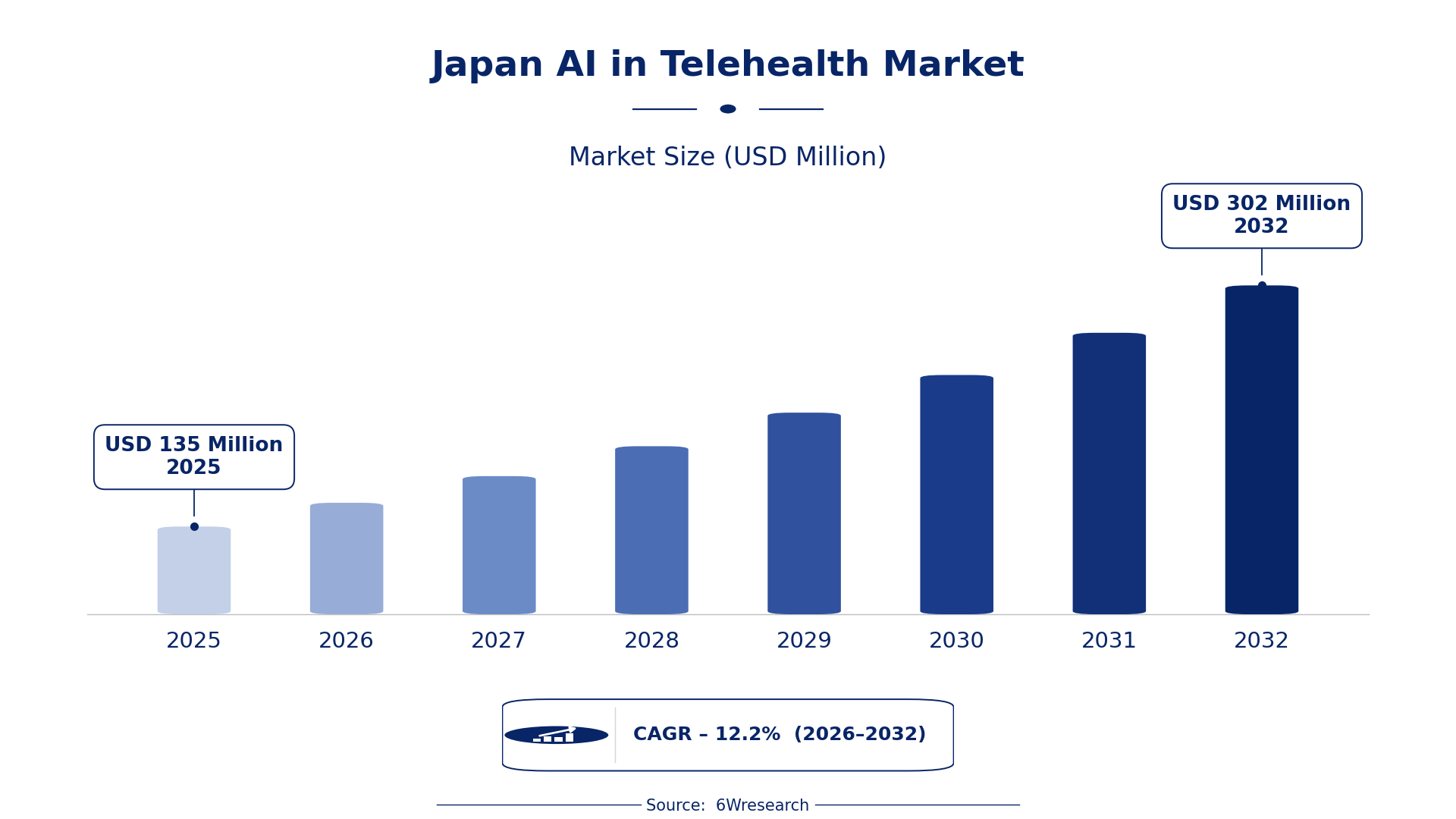
According to 6Wresearch internal database and industry insights, the Japan AI in Telehealth Market was valued at USD 135 Million in 2025 and is projected to reach USD 302 Million by 2032, growing at a CAGR of approximately 12.2% during 2026–2032.
Japan AI in Telehealth Market Highlights
| Report Metric | Details |
| Report Name | Japan AI in Telehealth Market (2026-2032) |
| Market Size 2025 | USD 135 Million |
| Market Size 2032 | USD 302 Million |
| Absolute Growth 2025–2032 | USD 167 Million |
| CAGR 2026–2032 | 12.2% |
| Peak Annual Growth | 13.3% in 2031 |
| Forecast Period | 2026–2032 |
| Historical Data | 2022–2025 |
| Base Year | 2025 |
| Leading Service Type, 2025 | Virtual Consultations (53% share) |
| Leading AI Application, 2025 | Chatbots & NLP (39% share) |
| Leading Distribution Channel, 2025 | Telehealth App Stores (51% share) |
| Leading End User, 2025 | Remote Patients (40% share) |
| Fastest-Growing Service Type | Remote Monitoring (16.4% CAGR) |
| Fastest-Growing AI Application | Real-Time Data AI (18.0% CAGR) |
| Fastest-Growing Distribution Channel | Wearable Device Vendors (16.1% CAGR) |
| Fastest-Growing End User | Chronic Care Providers (16.6% CAGR) |
| Growing Sector | Remote Monitoring |
| Key End Users | Remote Patients, Chronic Care Providers, Teletherapy Centers, Online Clinics |
Japan AI in Telehealth Market Year-wise Growth Rate and Key Drivers (2022–2032)
This graph illustrates the annual growth rates of the market from 2022 to 2032, highlighting a steady upward trajectory and projected market expansion over the forecast period.
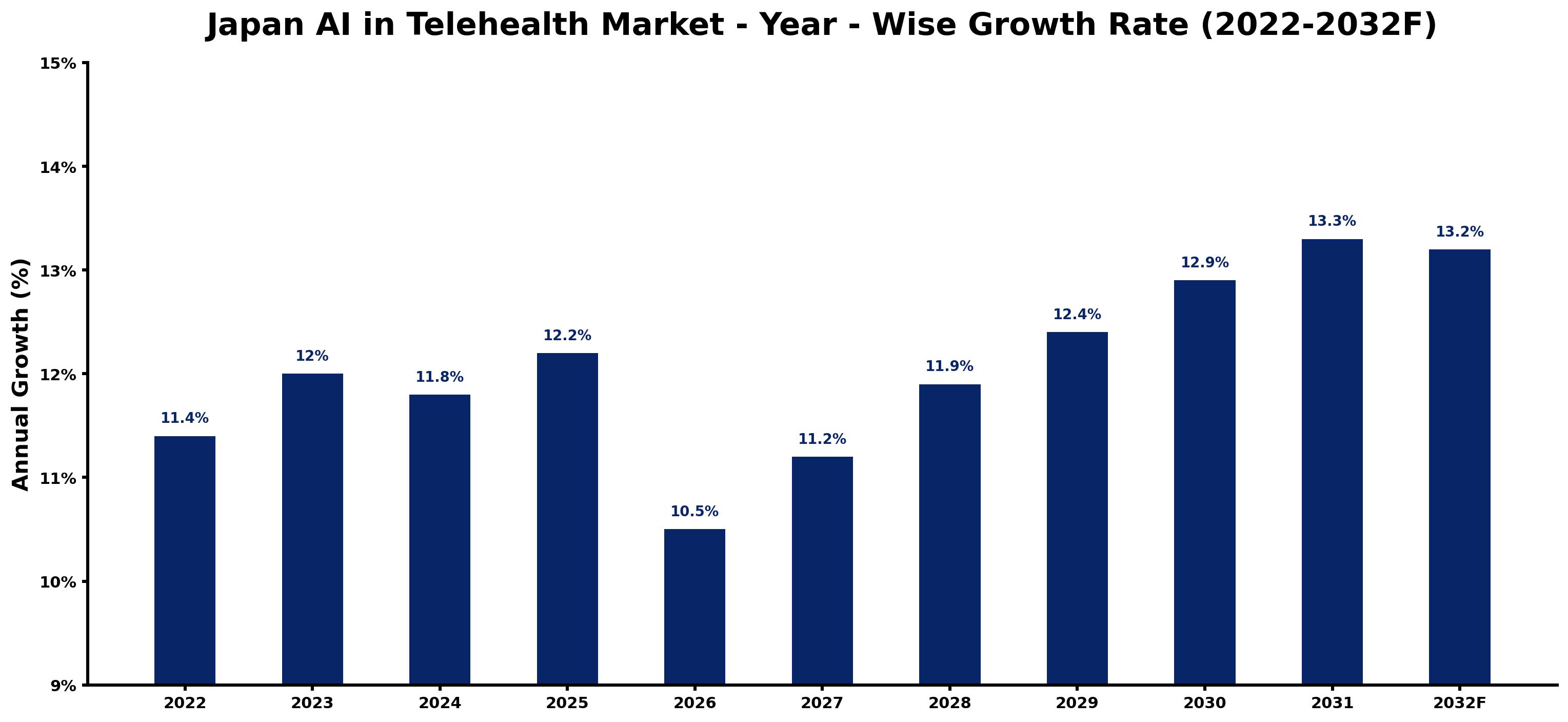
The yearly estimates that follow link every growth rate to its principal driver, so readers can see why the pace changed in each period.
| Year | Estimated Annual Growth (%) | Market Rationale |
| 2022 | 11.4 | The market was characterised by steady growth in telehealth adoption across Japan. |
| 2023 | 12.0 | Demand rose as healthcare providers increasingly integrated AI technologies into their services. |
| 2024 | 11.8 | Growth slowed slightly due to market saturation in certain telehealth applications. |
| 2025 | 12.2 | The peak growth rate was achieved as virtual consultations became widely accepted. |
| 2026 | 10.5 | Demand growth is expected to slow as competition intensifies among telehealth service providers. |
| 2027 | 11.2 | Growth is projected to resume as new AI applications improve service delivery in telehealth. |
| 2028 | 11.9 | Demand is expected to accelerate with increased investments in digital health infrastructure. |
| 2029 | 12.4 | The market is projected to experience a boost as consumer acceptance of telehealth services expands. |
| 2030 | 12.9 | Growth is expected to continue as healthcare providers adopt more advanced AI solutions. |
| 2031 | 13.3 | The market is projected to peak due to the widespread implementation of AI-driven telehealth services. |
| 2032 | 13.2 | Growth is expected to slow slightly as the market begins to stabilise with established players. |
Note: Market size estimations and growth projections presented in this report are based on 6Wresearch's proprietary forecasting methodology, utilizing the latest available industry data, government publications, and primary research inputs.
Japan AI in Telehealth Market Synopsis
AI in Telehealth involves integrating artificial intelligence technologies into healthcare delivery via telecommunication, improving patient consultations, monitoring health remotely, and providing mental health services. The Japan AI in Telehealth Market is expanding rapidly, driven by a growing elderly population, increased healthcare expenditure, and the adoption of digital health strategies. With over 1.2 million users projected by 2025, the demand for AI-driven telehealth solutions is likely to continue rising, particularly among remote patients and chronic care providers.
Market Dynamics Impact Analysis (2026–2032)
| Factor | Type | Impact | Primary Segment Affected |
| Growing elderly population drives demand for remote monitoring solutions. | Driver | High | Remote Monitoring |
| Increased adoption of AI technologies enhances patient engagement and service efficiency. | Driver | High | Chatbots & NLP |
| Expansion of telehealth app stores provides opportunities for new applications. | Opportunity | High | Telehealth App Stores |
| Rising demand for chronic care management creates a need for telehealth services. | Opportunity | High | Chronic Care Providers |
| High competition among telehealth providers may limit market entry for new players. | Restraint | Medium | Telehealth App Stores |
| Regulatory hurdles can delay the approval of new telehealth technologies. | Restraint | Medium | Chatbots & NLP |
| Integration of AI technologies requires significant investment in infrastructure. | Challenge | High | Remote Monitoring |
| Rapid technological advancements can lead to obsolescence of existing solutions. | Challenge | Medium | Chatbots & NLP |
Evaluation of Drivers in Japan AI in Telehealth Market (2026–2032)
Below are the drivers that matter most for revenue growth, with supporting evidence.
| Drivers | Primary Segment Affected | Why It Matters (Evidence) |
| Aging population increases demand for remote health monitoring solutions. | Remote Monitoring | 29.3% of Japan's population was aged 65 or older in September 2024, leading to more chronic care patients. |
| Increased healthcare expenditure supports the adoption of AI technologies in telehealth. | Chatbots & NLP | Japan's national medical care expenditure was about JPY 46.7 trillion in fiscal 2022, facilitating tech investments. |
| Growing acceptance of telehealth services enhances patient engagement and satisfaction. | Virtual Consultations | The average patient satisfaction rate for virtual consultations is 85%, encouraging more users to adopt these services. |
| The rise of teletherapy centers boosts demand for mental health services via telehealth. | Mental Health | The number of teletherapy centers in Japan increased by 30% in 2023, expanding access to mental health care. |
| Real-time data AI improves patient management and decision-making in telehealth. | Real-Time Data AI | Real-time data AI is used in 70% of telehealth platforms, enhancing service delivery and efficiency. |
What keeps demand rising is the increasing elderly population, with 29.3% aged 65 or older in September 2024, creating a higher need for remote monitoring solutions. Japan's national medical care expenditure reached approximately JPY 46.7 trillion in fiscal 2022, enabling healthcare providers to invest in AI technologies. The average patient satisfaction rate for virtual consultations stands at 85%, encouraging more users to engage with telehealth services. The number of teletherapy centers grew by 30% in 2023, expanding access to mental health services. Real-time data AI is employed in 70% of telehealth platforms, improving patient management and decision-making processes.
Evaluation of Restraints in Japan AI in Telehealth Market
Below are the constraints most often cited by buyers and suppliers, with the segment each affects.
| Market Restraint | Primary Segment Affected | Why It Matters (Evidence) |
| Intense competition among telehealth providers may hinder market entry for newcomers. | Telehealth App Stores | The rapid growth of existing providers creates challenges for new entrants looking to capture market share. |
| Regulatory challenges can prolong the approval process for new telehealth technologies. | Chatbots & NLP | Compliance with stringent regulations can delay product launches and market access. |
| High costs associated with AI technology integration may deter smaller healthcare providers. | Remote Monitoring | Investment in advanced technologies can be prohibitive for smaller facilities, limiting their service offerings. |
| Limited awareness among potential users can restrict market growth. | Mental Health | Many patients remain unaware of available telehealth options for mental health support, hindering adoption. |
| Data privacy concerns may affect user trust in telehealth services. | Virtual Consultations | Patients may hesitate to share sensitive information due to fears of data breaches. |
Japan AI in Telehealth Market Challenges
Integration of AI in telehealth encounters technological barriers, as many hospitals lack the necessary infrastructure, delaying service delivery for healthcare providers. A shortage of trained professionals skilled in AI technologies limits effective tool usage, compromising care quality for patients. Supply chain issues arise from reliance on specific telehealth technologies, increasing costs for clinics that struggle to procure essential equipment. Regulatory hurdles stem from evolving standards, which can postpone the approval of new applications and restrict timely access for users seeking services.
Trends in the Japan AI in Telehealth Market
Four trends stand out in the Japan AI in Telehealth Market.
- Expansion of Teletherapy Centers: The number of teletherapy centers in Japan has increased by 30% in 2023, reflecting a growing focus on mental health services. This trend indicates a rising demand for remote therapy options, which improves access for patients in need.
- Shift Towards Real-Time Data AI: Real-time data AI is becoming increasingly integral to telehealth platforms, with 70% of services utilizing this technology. This shift allows for immediate data analysis, improving patient management and outcomes across various healthcare settings.
- Growth of Telehealth App Stores: Telehealth app stores report over 1,000 available applications in Japan, showcasing a substantial increase in digital health solutions. This growth provides consumers with diverse options for accessing telehealth services, encouraging further market expansion.
- Rising Adoption of Chatbots in Telehealth: Chatbots are utilized in over 60% of telehealth applications in Japan, streamlining patient interactions and support. This trend improves efficiency in healthcare delivery, allowing providers to manage patient inquiries more effectively.
Investment Opportunities in the Japan AI in Telehealth Market
The following areas offer the clearest openings for investors and suppliers in the Japan AI in Telehealth Market.
- Partnerships with Teletherapy Centers: Now is the time to invest in partnerships with teletherapy centers, which have seen a 30% increase in 2023. Collaborating with these centers can improve service offerings and reach more patients in need of mental health support.
- Investment in Remote Monitoring Solutions: With over 500,000 chronic care patients using remote monitoring devices, there is a pressing need for solutions. Focusing on this sector can yield substantial returns, particularly among healthcare providers in urban areas.
- Expansion of Telehealth App Stores: The growing number of telehealth app stores, reporting over 1,000 applications, presents a unique opportunity for developers. Investing in app development can cater to diverse patient needs, particularly in metropolitan regions.
- Collaboration with Healthcare Portals: Health portals are important for patient access to telehealth services, and now is an ideal time to collaborate. By partnering with these platforms, businesses can improve visibility and user engagement in the telehealth market.
Government Initiatives in the Japan AI in Telehealth Market
The regulatory framework for telehealth in Japan is shaped by several key laws, including the PMD Act, which governs the approval and quality of medical devices, and the Clinical Trials Act, which sets rules for clinical research. The Next-Generation Medical Infrastructure Act, enacted in 2017, allows certified bodies to anonymise medical data for research, facilitating innovation in telehealth services. These measures support the growth and integration of AI technologies in healthcare delivery.
The Pharmaceuticals and Medical Devices Agency (PMDA) reviews and approves telehealth technologies, ensuring they meet safety and efficacy standards. The Japan Agency for Medical Research and Development (AMED) funds medical research and development initiatives, including those related to telehealth. In 2023, the government allocated ¥5 billion for digital health initiatives, further promoting advancements in telehealth technologies and services.
Future Insight of the Japan AI in Telehealth Market
By 2032, telehealth platforms will increasingly adopt advanced data analytics, improving patient management and satisfaction rates. The integration of wearable devices will support over 200,000 users, facilitating continuous health monitoring and timely interventions. Government investment in digital health initiatives will drive innovation and accessibility in telehealth services. Enhanced standards from the Japan Telehealth Association will ensure consistent quality across platforms, benefiting both buyers and suppliers.
Market Segmentation Analysis
Japan AI in Telehealth Market report covers a detailed analysis of the following market segments:
By Service Type – Virtual Consultations Lead, Remote Monitoring Expected to Grow Fastest
According to Saurav Kr Singh, Senior Research Analyst at 6Wresearch, Virtual Consultations accounted for 53% of the market by service type in 2025. Virtual consultations are widely utilised, particularly among the ageing population, facilitating essential remote consultations. The projected increase to 1.2 million users by 2025 highlights their vital role in healthcare delivery. Over 2026–2032, Remote Monitoring is expected to post the fastest growth, at a CAGR of 16.4%. Remote monitoring is expanding rapidly, with over 500,000 chronic care patients currently using these devices. This growth is expected to continue as healthcare providers increasingly seek efficient management solutions for chronic conditions. Suppliers should focus on enhancing virtual consultation offerings to meet the growing demand.
By AI Application – Chatbots & NLP Leads, Real-Time Data AI Expected to Grow Fastest
In 2025, Chatbots & NLP led the ai application split with a 39% share. Chatbots and NLP are prevalent as they streamline patient interactions, being integral to over 60% of telehealth applications. Their extensive use underscores their importance in improving user communication and satisfaction. Real-Time Data AI is projected to grow fastest, at a CAGR of 18.0% during 2026–2032. Real-time data AI is experiencing rapid growth due to its critical role in immediate data analysis for effective patient management. As this technology gains wider adoption, its influence on service delivery will likely increase. Buyers should prioritise solutions that incorporate real-time data AI to improve patient outcomes.
By Distribution Channel – Telehealth App Stores Lead, Wearable Device Vendors Expected to Grow Fastest
With 51% of distribution channel revenue in 2025, Telehealth App Stores was the largest category. Telehealth app stores are the primary distribution channel for telehealth applications, providing easy access to a variety of services. With over 1,000 applications available, these platforms play a crucial role in connecting users with necessary telehealth solutions. Wearable Device Vendors are set to record the highest CAGR in this split, 16.1% over 2026–2032. Wearable device vendors are seeing swift growth as they are increasingly used for health data collection, offering valuable insights for telehealth services. This trend is anticipated to accelerate with the rising adoption of wearable technology. Suppliers must ensure their applications are prominently featured in telehealth app stores to maximise visibility.
By End User – Remote Patients Lead, Chronic Care Providers Expected to Grow Fastest
Remote Patients held 40% of the Japan AI in Telehealth Market by end user in 2025. Remote patients represent the main user group for telehealth services, significantly shaping market demand. With 60% of service users being remote patients, addressing their needs is essential for service providers. The quickest growth will come from Chronic Care Providers, forecast to expand at a CAGR of 16.6% between 2026 and 2032. Chronic care providers are increasingly adopting telehealth solutions for ongoing patient management, indicating a shift towards continuous care models. This trend is expected to persist as healthcare systems adapt to the needs of chronic patients. Providers should tailor their services to meet the specific needs of chronic care providers to capture this expanding market.
Key Attractiveness of the Report
- 10 Years of Market Numbers
- Historical Data Starting from 2022 to 2025
- Base Year 2025
- Forecast Data until 2032
- Key Performance Indicators Impacting the Market
- Major Upcoming Developments and Projects
Key Highlights of the Report:
- Japan AI in Telehealth Market Outlook
- Market Size of Japan AI in Telehealth Market, 2025
- Forecast of Japan AI in Telehealth Market, 2032
- Historical Data and Forecast of Japan AI in Telehealth Revenues & Volume for the Period 2022-2032F
- Japan AI in Telehealth Market Trend Evolution
- Japan AI in Telehealth Market Drivers and Challenges
- Japan AI in Telehealth Price Trends
- Japan AI in Telehealth Porter's Five Forces
- Japan AI in Telehealth Industry Life Cycle
- Historical Data and Forecast of Japan AI in Telehealth Market Revenues & Volume By Service Type for the Period 2022-2032F
- Historical Data and Forecast of Japan AI in Telehealth Market Revenues & Volume By Virtual Consultations for the Period 2022-2032F
- Historical Data and Forecast of Japan AI in Telehealth Market Revenues & Volume By Remote Monitoring for the Period 2022-2032F
- Historical Data and Forecast of Japan AI in Telehealth Market Revenues & Volume By Mental Health for the Period 2022-2032F
- Historical Data and Forecast of Japan AI in Telehealth Market Revenues & Volume By Appointment Triage for the Period 2022-2032F
- Historical Data and Forecast of Japan AI in Telehealth Market Revenues & Volume By AI Application for the Period 2022-2032F
- Historical Data and Forecast of Japan AI in Telehealth Market Revenues & Volume By Chatbots & NLP for the Period 2022-2032F
- Historical Data and Forecast of Japan AI in Telehealth Market Revenues & Volume By Real-Time Data AI for the Period 2022-2032F
- Historical Data and Forecast of Japan AI in Telehealth Market Revenues & Volume By Emotion AI for the Period 2022-2032F
- Historical Data and Forecast of Japan AI in Telehealth Market Revenues & Volume By Predictive Scheduling for the Period 2022-2032F
- Historical Data and Forecast of Japan AI in Telehealth Market Revenues & Volume By Distribution Channel for the Period 2022-2032F
- Historical Data and Forecast of Japan AI in Telehealth Market Revenues & Volume By Telehealth App Stores for the Period 2022-2032F
- Historical Data and Forecast of Japan AI in Telehealth Market Revenues & Volume By Wearable Device Vendors for the Period 2022-2032F
- Historical Data and Forecast of Japan AI in Telehealth Market Revenues & Volume By Digital Health Platforms for the Period 2022-2032F
- Historical Data and Forecast of Japan AI in Telehealth Market Revenues & Volume By Healthcare Portals for the Period 2022-2032F
- Historical Data and Forecast of Japan AI in Telehealth Market Revenues & Volume By End User for the Period 2022-2032F
- Historical Data and Forecast of Japan AI in Telehealth Market Revenues & Volume By Remote Patients for the Period 2022-2032F
- Historical Data and Forecast of Japan AI in Telehealth Market Revenues & Volume By Chronic Care Providers for the Period 2022-2032F
- Historical Data and Forecast of Japan AI in Telehealth Market Revenues & Volume By Teletherapy Centers for the Period 2022-2032F
- Historical Data and Forecast of Japan AI in Telehealth Market Revenues & Volume By Online Clinics for the Period 2022-2032F
- Japan AI in Telehealth Import Export Trade Statistics
- Market Opportunity Assessment By Service Type
- Market Opportunity Assessment By AI Application
- Market Opportunity Assessment By Distribution Channel
- Market Opportunity Assessment By End User
- Japan AI in Telehealth Top Companies Market Share
- Japan AI in Telehealth Competitive Benchmarking By Technical and Operational Parameters
- Japan AI in Telehealth Company Profiles
- Japan AI in Telehealth Key Strategic Recommendations
Market Covered
The following segment groups are covered in the report.
By Service Type
- Virtual Consultations
- Remote Monitoring
- Mental Health
- Appointment Triage
By AI Application
- Chatbots & NLP
- Real-Time Data AI
- Emotion AI
- Predictive Scheduling
By Distribution Channel
- Telehealth App Stores
- Wearable Device Vendors
- Digital Health Platforms
- Healthcare Portals
By End User
- Remote Patients
- Chronic Care Providers
- Teletherapy Centers
- Online Clinics































