Japan AI Model Development Tools Market Size & Growth Rate
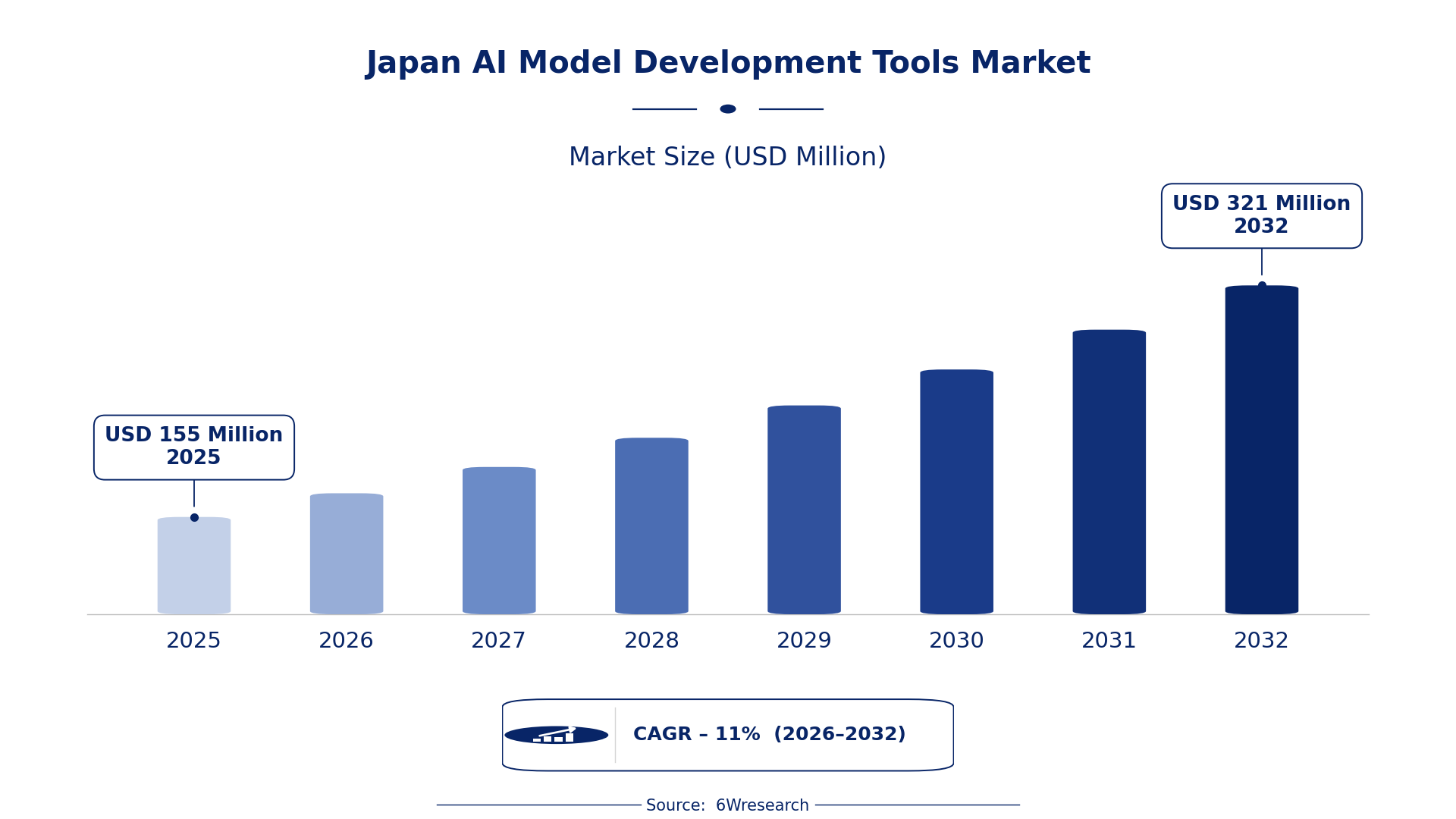
According to 6Wresearch internal database and industry insights, the Japan AI Model Development Tools Market was valued at USD 155 Million in 2025 and is projected to reach USD 321 Million by 2032, growing at a CAGR of approximately 11% during 2026–2032.
Japan AI Model Development Tools Market Highlights
| Report Metric | Details |
| Report Name | Japan AI Model Development Tools Market (2026-2032) |
| Market Size 2025 | USD 155 Million |
| Market Size 2032 | USD 321 Million |
| Absolute Growth 2025–2032 | USD 166 Million |
| CAGR 2026–2032 | 11% |
| Peak Annual Growth | 13.3% in 2029 |
| Forecast Period | 2026–2032 |
| Historical Data | 2022–2025 |
| Base Year | 2025 |
| Leading Tool Type, 2025 | No-Code AI Builders (50% share) |
| Leading Core Feature, 2025 | Drag & Drop Models (44% share) |
| Leading Distribution Channel, 2025 | Cloud AI Platforms (40% share) |
| Leading End User, 2025 | Product Managers (49% share) |
| Fastest-Growing Tool Type | MLOps Frameworks (16.3% CAGR) |
| Fastest-Growing Core Feature | End-to-End Workflow (14.7% CAGR) |
| Fastest-Growing Distribution Channel | AI Tool Marketplaces (15.0% CAGR) |
| Fastest-Growing End User | AI Engineers (14.9% CAGR) |
| Growing Sector | technology and research sectors |
| Key End Users | data scientists, AI engineers, product managers |
Japan AI Model Development Tools Market Year-wise Growth Rate and Key Drivers (2022–2032)
This graph illustrates the annual growth rates of the market from 2022 to 2032, highlighting a steady upward trajectory and projected market expansion over the forecast period.
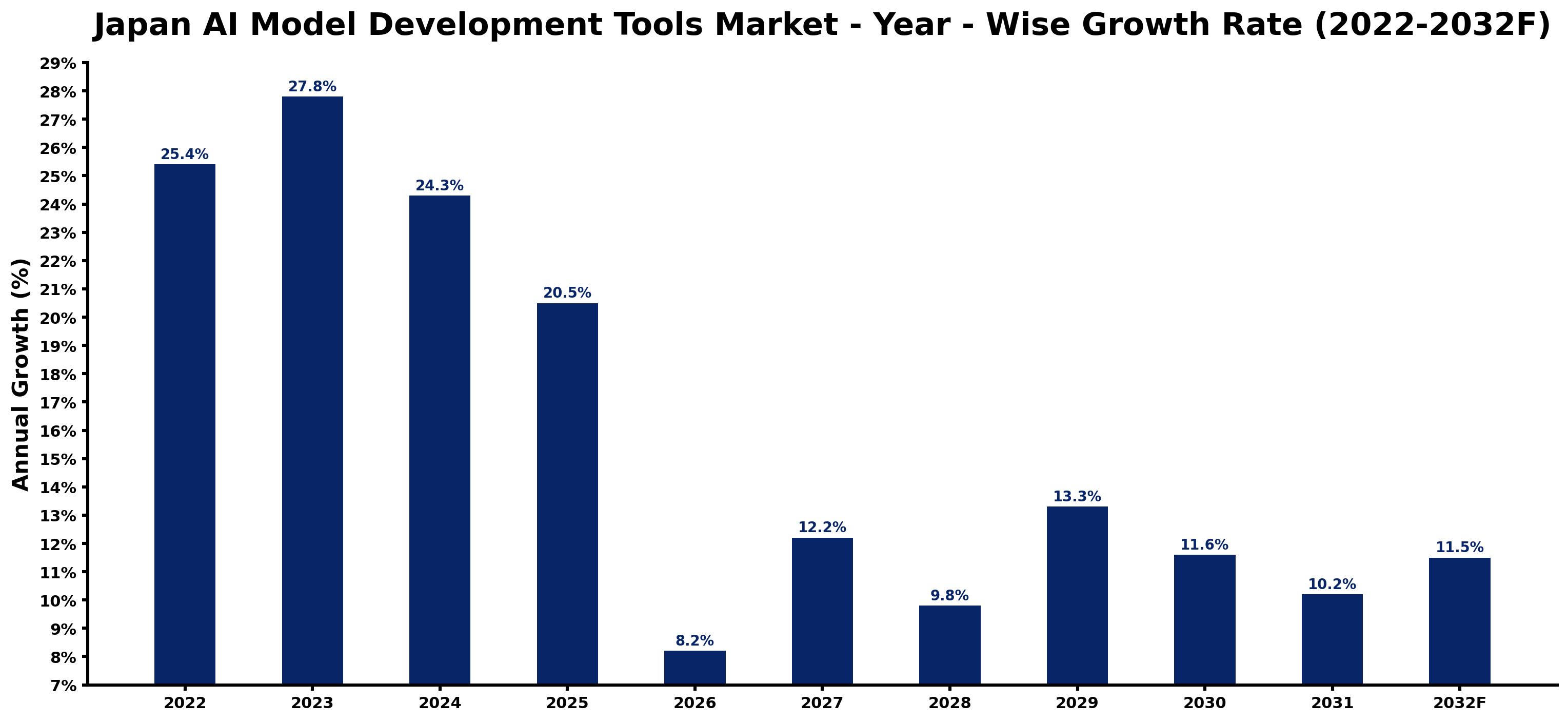
Below, each year's estimated growth is shown next to the factor that most influenced it.
| Year | Estimated Annual Growth (%) | Market Rationale |
| 2022 | 25.4 | The market experienced strong demand from technology sectors and research institutions. |
| 2023 | 27.8 | Growth accelerated due to increased AI adoption across various industries. |
| 2024 | 24.3 | Demand continued but slowed as market saturation began to impact growth rates. |
| 2025 | 20.5 | The market maintained growth, though at a reduced pace as competition intensified. |
| 2026 | 8.2 | Growth is expected to slow further as companies reassess their AI investments amid economic uncertainty. |
| 2027 | 12.2 | A rebound in investment in AI technologies is projected to spur renewed growth in the market. |
| 2028 | 9.8 | Market growth is anticipated to decelerate again as buyers become more selective in tool adoption. |
| 2029 | 13.3 | Increased enterprise spending on AI tools will lead to a resurgence in market growth. |
| 2030 | 11.6 | Growth is projected to moderate as the market begins to stabilise after rapid expansion. |
| 2031 | 10.2 | The market will continue to grow, albeit at a slower pace as maturity sets in. |
| 2032 | 11.5 | A renewed focus on advanced AI capabilities is expected to drive growth. |
Note: Market size estimations and growth projections presented in this report are based on 6Wresearch's proprietary forecasting methodology, utilizing the latest available industry data, government publications, and primary research inputs.
Japan AI Model Development Tools Market Synopsis
AI Model Development Tools are software solutions designed to facilitate the creation, training, and deployment of artificial intelligence models. These solutions improve productivity in AI projects and support collaboration among teams. The Japan AI Model Development Tools Market is growing due to rising demand from technology and research sectors, with approximately 50,000 data scientists in the country. The AI Strategy 2022 promotes AI adoption across various industries, further accelerating this growth.
Market Dynamics Impact Analysis (2026–2032)
| Factor | Type | Impact | Primary Segment Affected |
| Increasing investment in AI technologies | Driver | High | MLOps Frameworks |
| Growing number of AI startups | Driver | High | No-Code AI Builders |
| Expansion of AI research initiatives | Opportunity | High | Visual AI Designers |
| Rising demand for scalable AI solutions | Opportunity | High | Cloud AI Platforms |
| Limited awareness of AI tools among smaller firms | Restraint | Medium | Code-based Platforms |
| Competition from open-source alternatives | Restraint | Medium | AI Tool Marketplaces |
| Shortage of skilled AI professionals | Challenge | High | No-Code AI Builders |
| High costs associated with advanced AI tools | Challenge | Medium | No-Code AI Builders |
Evaluation of Drivers in Japan AI Model Development Tools Market (2026–2032)
Demand rests on the following drivers, each shown with the segment it touches most.
| Drivers | Primary Segment Affected | Why It Matters (Evidence) |
| Increased funding for AI research and development | MLOps Frameworks | The Japanese government allocated 10 billion yen to AI initiatives, boosting demand for MLOps frameworks in automotive sectors. |
| Rising number of AI startups | No-Code AI Builders | The 30% increase in AI startups since 2020 has led to greater adoption of no-code tools for model development. |
| Growing emphasis on data security standards | Visual AI Designers | ISO/IEC 27001 compliance drives demand for visual AI design tools that ensure data protection. |
| Expansion of cloud infrastructure | Cloud AI Platforms | The growth of cloud services in Japan has enhanced the scalability and accessibility of AI model development. |
| Increased collaboration among AI developers | Code-based Platforms | The Japan AI Association's initiatives have fostered collaboration, increasing the need for code-based platforms. |
Several shifts outside the market lift sales. Increased funding for AI research and development has led to a rise in demand for MLOps frameworks, particularly in the automotive sector, where investments reached 10 billion yen. The growth of AI startups, which increased by 30% since 2020, boosts the adoption of no-code AI builders. Compliance with ISO/IEC 27001 drives interest in visual AI design tools that ensure data protection.
Evaluation of Restraints in Japan AI Model Development Tools Market
These are the pressures that could keep growth below its potential.
| Market Restraint | Primary Segment Affected | Why It Matters (Evidence) |
| Limited awareness of AI tools among smaller firms | Code-based Platforms | Many smaller firms lack knowledge of advanced AI tools, resulting in lower adoption rates. |
| Competition from open-source alternatives | AI Tool Marketplaces | Open-source platforms provide cost-effective solutions, limiting the market share of commercial tools. |
| High costs associated with advanced AI tools | No-Code AI Builders | The investment required for advanced tools deters potential buyers, particularly SMEs. |
| Shortage of skilled AI professionals | Data Scientists | The estimated 50,000 data scientists in Japan are insufficient to meet the growing demand for AI expertise. |
| Regulatory compliance challenges | MLOps Frameworks | Complex regulations surrounding data usage can hinder the adoption of MLOps frameworks. |
Japan AI Model Development Tools Market Challenges
In Japan, around 50,000 data scientists face intense competition from a rapidly increasing number of AI startups, which have surged by 30% since 2020, leading to potential wage inflation and talent shortages for producers. Compliance with ISO/IEC 27001 for data security complicates operations for distributors, often causing project delays that can extend timelines by up to 20%. Buyers encounter challenges due to stringent regulations from the Digital Agency of Japan, which can slow the adoption of new AI tools and cost them valuable time in project execution. Skills shortages in AI development hinder progress, forcing clinics to rely on outdated technologies and limiting their operational efficiency.
Trends in the Japan AI Model Development Tools Market
The shifts below are changing how Japan AI Model Development Tools Market products are bought and supplied.
- Shift from Traditional to Cloud-Based Development: Tokyo is experiencing a shift towards cloud-based AI model development, driven by the need for scalability. In 2023, the AI Expo Tokyo showcased numerous cloud solutions, reflecting this trend.
- Transition from Code-Based to No-Code Solutions: The rise of no-code AI builders is transforming development practices, allowing non-technical users to create models. This shift is clear in the increasing adoption rates among small enterprises, which have risen by 25%.
- Growing Emphasis on Data Security Standards: The focus on ISO/IEC 27001 compliance is reshaping AI model development practices. This standard is becoming crucial for companies handling sensitive data, influencing tool selection and usage rates.
- Emergence of Collaborative AI Development Platforms: The Japan AI Association's initiatives are promoting collaboration among developers, leading to the emergence of new platforms. This trend is expected to improve innovation and efficiency in AI projects.
Investment Opportunities in the Japan AI Model Development Tools Market
The opportunities below stand out in the Japan AI Model Development Tools Market for new entrants and existing suppliers.
- Timing for AI Adoption: With the AI Strategy 2022 in place, now is the ideal time for investment in AI model development tools. The Japanese government aims to increase AI adoption across industries, creating a demand gap of 50 million USD.
- Supply of Scalable Cloud Solutions: There is a growing need for scalable cloud AI platforms to support diverse projects. The increasing number of technology firms in Tokyo presents a notable opportunity for suppliers to meet this demand.
- Focus on Data Security Tools: The emphasis on ISO/IEC 27001 compliance highlights the demand for secure AI development tools. Companies in the finance sector are particularly keen on these solutions, driving market growth by 20%.
- Investment in AI Training Programs: The shortage of skilled professionals creates a need for training programs in AI development. Educational institutions like the Tokyo Institute of Technology are expanding their AI courses, aiming to increase enrollment by 30%.
Government Initiatives in the Japan AI Model Development Tools Market
The AI Promotion Act, established in 2025, aims to create a national framework for AI research and development, building on earlier initiatives like the AI Strategy 2022. This act seeks to streamline processes and promote collaboration among stakeholders in AI, directly benefiting AI Model Development Tools and their buyers.
The Ministry of Internal Affairs and Communications oversees the implementation of AI policies and funds various initiatives to support AI development. This agency plays a key role in approving projects that align with national AI goals, ensuring that AI Model Development Tools meet regulatory standards.
Future Insight of the Japan AI Model Development Tools Market
By 2032, advanced AI development facilities will emerge across Japan, supported by AI research initiatives from the Ministry of Internal Affairs and Communications. The AI Strategy 2022 will promote collaboration among AI developers, driving innovation and productivity. MLOps frameworks will gain traction in automotive and manufacturing sectors, streamlining processes and improving deployment times. With the Tokyo Institute of Technology expanding its AI courses, a new wave of skilled professionals will enter the market, benefiting both buyers and suppliers.
Market Segmentation Analysis
Japan AI Model Development Tools Market report covers a detailed analysis of the following market segments:
By Tool Type – No-Code AI Builders Lead, MLOps Frameworks Expected to Grow Fastest
According to Saurav Kr Singh, Senior Research Analyst at 6Wresearch, in 2025, No-Code AI Builders led the tool type split with a 50% share. No-Code AI Builders hold the largest market share as they empower users without programming skills to create models easily, appealing to a broad audience. This accessibility is particularly beneficial in sectors like education, where the ability to quickly prototype is essential. MLOps Frameworks are set to record the highest CAGR in this split, 16.3% over 2026–2032. MLOps Frameworks are experiencing rapid growth due to the increasing demand for efficient deployment and management of models, especially in the automotive sector. This trend aligns with Japan's heightened focus on AI initiatives and research, ensuring sustained interest in these frameworks. Suppliers must focus on user-friendly features to attract a wider range of customers.
By Core Feature – Drag & Drop Models Lead, End-to-End Workflow Expected to Grow Fastest
Drag & Drop Models took 44% of core feature revenue in 2025, more than any other category. Drag & Drop Models lead the market because they enable easy assembly of models without extensive coding knowledge, appealing to non-technical users. This simplicity has become critical for teams aiming to accelerate project timelines and improve collaboration. Over 2026–2032, End-to-End Workflow is expected to post the fastest growth, at a CAGR of 14.7%. End-to-End Workflow is rapidly gaining traction as it supports the entire lifecycle of model development, which is essential for organisations seeking operational efficiency. The comprehensive nature of this feature addresses the complexities of modern projects effectively. Buyers will benefit from tools that simplify development while providing comprehensive support throughout the project lifecycle.
By Distribution Channel – Cloud AI Platforms Lead, AI Tool Marketplaces Expected to Grow Fastest
With 40% of distribution channel revenue in 2025, Cloud AI Platforms was the largest category. Cloud AI Platforms lead the market by providing scalable resources for AI model training and deployment, which is critical for organisations with varying project demands. Their flexibility and accessibility have made them the preferred choice for many users. AI Tool Marketplaces are projected to grow fastest, at a CAGR of 15.0% during 2026–2032. AI Tool Marketplaces are growing rapidly as they offer a variety of tools, catering to diverse user needs and preferences. This growth is indicative of a shift towards more accessible and varied solutions in the AI development space. Suppliers should consider expanding their presence in marketplaces to reach a broader audience and meet changing customer preferences.
By End User – Product Managers Lead, AI Engineers Expected to Grow Fastest
Product Managers held 49% of the Japan AI Model Development Tools Market by end user in 2025. Product Managers are the largest user group as they oversee project development and implementation, ensuring alignment with business objectives. Their role is crucial in bridging the gap between technical teams and stakeholders to achieve successful project outcomes. The quickest growth will come from AI Engineers, forecast to expand at a CAGR of 14.9% between 2026 and 2032. AI Engineers are experiencing the fastest growth as they directly engage with model development, reflecting the increasing need for specialised skills in the industry. Their expertise is vital for enhancing capabilities across diverse sectors. Vendors should tailor their offerings to meet the specific needs of AI Engineers to capitalise on this expanding user segment.
Key Attractiveness of the Report
- 10 Years of Market Numbers
- Historical Data Starting from 2022 to 2025
- Base Year 2025
- Forecast Data until 2032
- Key Performance Indicators Impacting the Market
- Major Upcoming Developments and Projects
Key Highlights of the Report:
- Japan AI Model Development Tools Market Outlook
- Market Size of Japan AI Model Development Tools Market, 2025
- Forecast of Japan AI Model Development Tools Market, 2032
- Historical Data and Forecast of Japan AI Model Development Tools Revenues & Volume for the Period 2022-2032F
- Japan AI Model Development Tools Market Trend Evolution
- Japan AI Model Development Tools Market Drivers and Challenges
- Japan AI Model Development Tools Price Trends
- Japan AI Model Development Tools Porter's Five Forces
- Japan AI Model Development Tools Industry Life Cycle
- Historical Data and Forecast of Japan AI Model Development Tools Market Revenues & Volume By Tool Type for the Period 2022-2032F
- Historical Data and Forecast of Japan AI Model Development Tools Market Revenues & Volume By No-Code AI Builders for the Period 2022-2032F
- Historical Data and Forecast of Japan AI Model Development Tools Market Revenues & Volume By MLOps Frameworks for the Period 2022-2032F
- Historical Data and Forecast of Japan AI Model Development Tools Market Revenues & Volume By Code-based Platforms for the Period 2022-2032F
- Historical Data and Forecast of Japan AI Model Development Tools Market Revenues & Volume By Visual AI Designers for the Period 2022-2032F
- Historical Data and Forecast of Japan AI Model Development Tools Market Revenues & Volume By Core Feature for the Period 2022-2032F
- Historical Data and Forecast of Japan AI Model Development Tools Market Revenues & Volume By Drag & Drop Models for the Period 2022-2032F
- Historical Data and Forecast of Japan AI Model Development Tools Market Revenues & Volume By End-to-End Workflow for the Period 2022-2032F
- Historical Data and Forecast of Japan AI Model Development Tools Market Revenues & Volume By Customizable Model Building for the Period 2022-2032F
- Historical Data and Forecast of Japan AI Model Development Tools Market Revenues & Volume By GUI-Based Model Tuning for the Period 2022-2032F
- Historical Data and Forecast of Japan AI Model Development Tools Market Revenues & Volume By Distribution Channel for the Period 2022-2032F
- Historical Data and Forecast of Japan AI Model Development Tools Market Revenues & Volume By Cloud AI Platforms for the Period 2022-2032F
- Historical Data and Forecast of Japan AI Model Development Tools Market Revenues & Volume By AI Tool Marketplaces for the Period 2022-2032F
- Historical Data and Forecast of Japan AI Model Development Tools Market Revenues & Volume By Open Source Hubs for the Period 2022-2032F
- Historical Data and Forecast of Japan AI Model Development Tools Market Revenues & Volume By SaaS Toolkits for the Period 2022-2032F
- Historical Data and Forecast of Japan AI Model Development Tools Market Revenues & Volume By End User for the Period 2022-2032F
- Historical Data and Forecast of Japan AI Model Development Tools Market Revenues & Volume By Product Managers for the Period 2022-2032F
- Historical Data and Forecast of Japan AI Model Development Tools Market Revenues & Volume By AI Engineers for the Period 2022-2032F
- Historical Data and Forecast of Japan AI Model Development Tools Market Revenues & Volume By Data Scientists for the Period 2022-2032F
- Historical Data and Forecast of Japan AI Model Development Tools Market Revenues & Volume By Citizen Developers for the Period 2022-2032F
- Japan AI Model Development Tools Import Export Trade Statistics
- Market Opportunity Assessment By Tool Type
- Market Opportunity Assessment By Core Feature
- Market Opportunity Assessment By Distribution Channel
- Market Opportunity Assessment By End User
- Japan AI Model Development Tools Top Companies Market Share
- Japan AI Model Development Tools Competitive Benchmarking By Technical and Operational Parameters
- Japan AI Model Development Tools Company Profiles
- Japan AI Model Development Tools Key Strategic Recommendations
Market Covered
This report examines the market across the segments below.
By Tool Type
- No-Code AI Builders
- MLOps Frameworks
- Code-based Platforms
- Visual AI Designers
By Core Feature
- Drag & Drop Models
- End-to-End Workflow
- Customizable Model Building
- GUI-Based Model Tuning
By Distribution Channel
- Cloud AI Platforms
- AI Tool Marketplaces
- Open Source Hubs
- SaaS Toolkits
By End User
- Product Managers
- AI Engineers
- Data Scientists
- Citizen Developers































