Japan AI Navigation Software Market Size & Growth Rate
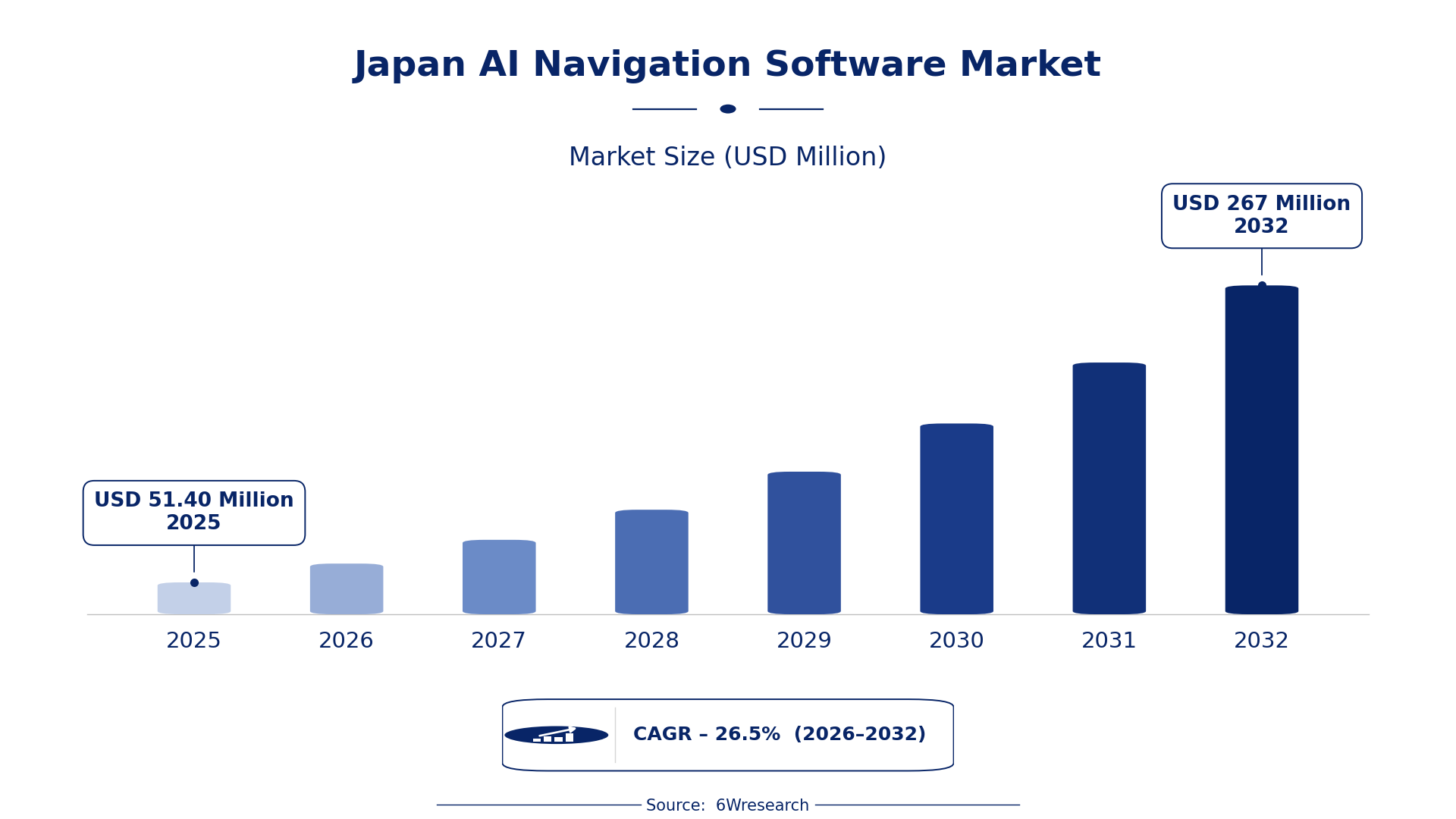
According to 6Wresearch internal database and industry insights, the Japan AI Navigation Software Market was valued at USD 51.40 Million in 2025 and is projected to reach USD 267 Million by 2032, growing at a CAGR of approximately 26.5% during 2026–2032.
Japan AI Navigation Software Market Highlights
| Report Metric | Details |
| Report Name | Japan AI Navigation Software Market (2026-2032) |
| Market Size 2025 | USD 51.40 Million |
| Market Size 2032 | USD 267 Million |
| Absolute Growth 2025–2032 | USD 215.60 Million |
| CAGR 2026–2032 | 26.5% |
| Peak Annual Growth | 27.8% in 2032 |
| Forecast Period | 2026–2032 |
| Historical Data | 2022–2025 |
| Base Year | 2025 |
| Leading Software Type, 2025 | Autonomous Driving (40% share) |
| Leading Feature Set, 2025 | Path Planning (44% share) |
| Leading Distribution Channel, 2025 | Mobility SaaS Platforms (44% share) |
| Leading End User, 2025 | EV Manufacturers (39% share) |
| Fastest-Growing Software Type | Drone Navigation (29.1% CAGR) |
| Fastest-Growing Feature Set | Real-Time Adaptation (27.9% CAGR) |
| Fastest-Growing Distribution Channel | UAV Software Vendors (28.5% CAGR) |
| Fastest-Growing End User | Aerospace Tech Companies (28.5% CAGR) |
| Growing Sector | automotive and aerospace |
| Key End Users | automotive manufacturers, aerospace tech companies, agricultural firms, logistics providers |
Japan AI Navigation Software Market Year-wise Growth Rate and Key Drivers (2022–2032)
This graph illustrates the annual growth rates of the market from 2022 to 2032, highlighting a steady upward trajectory and projected market expansion over the forecast period.
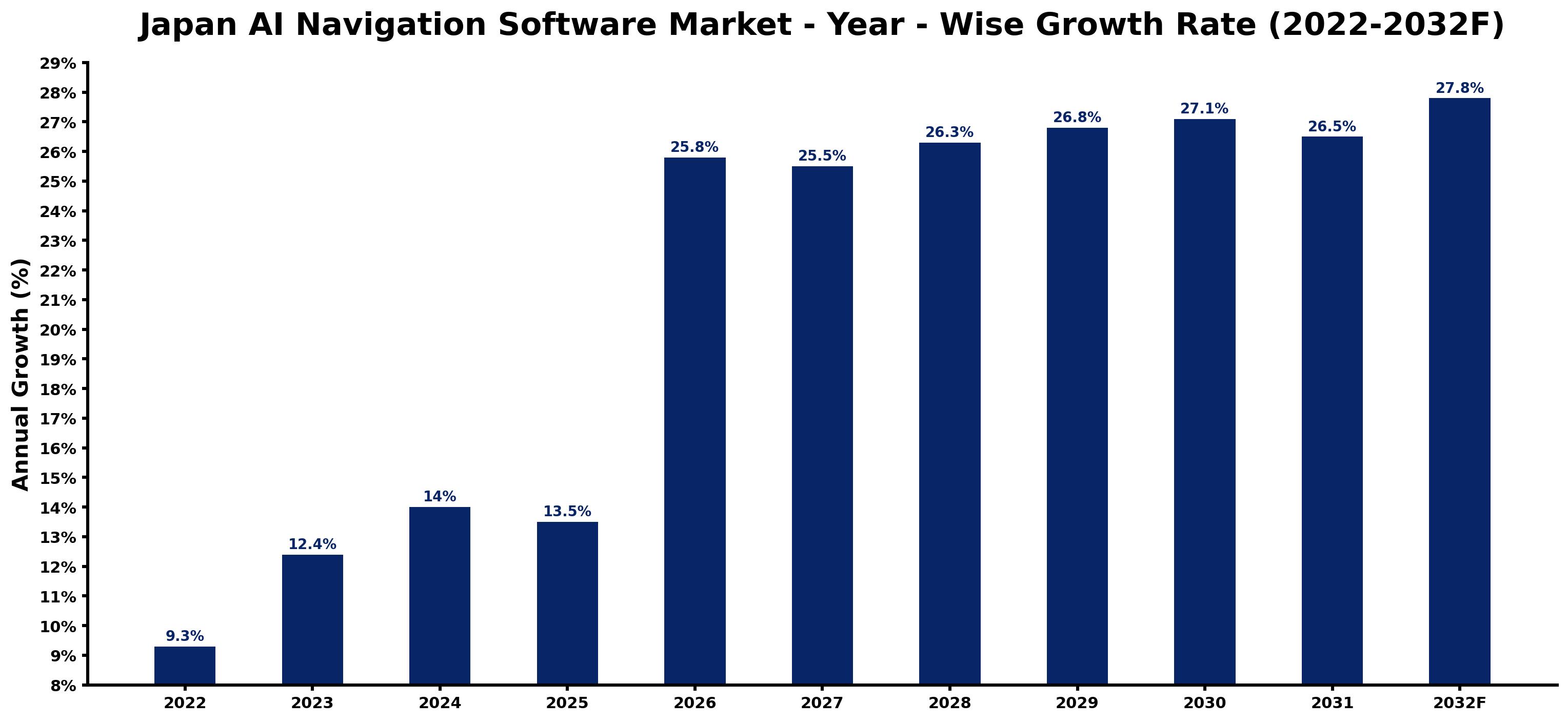
Below, each year's estimated growth is shown next to the factor that most influenced it.
| Year | Estimated Annual Growth (%) | Market Rationale |
| 2022 | 9.3 | The market showed steady growth due to rising interest in AI technologies. |
| 2023 | 12.4 | Demand increased as investments in autonomous driving technology accelerated. |
| 2024 | 14.0 | Growth continued with heightened activity in the aerospace sector. |
| 2025 | 13.5 | A slowdown occurred as the market adjusted to previous rapid growth rates. |
| 2026 | 25.8 | The market is expected to rebound strongly as AI adoption in various sectors surges. |
| 2027 | 25.5 | Growth will remain strong, although slightly slower than the previous year. |
| 2028 | 26.3 | Demand is projected to rise as real-time adaptation technologies gain traction. |
| 2029 | 26.8 | The market will expand further with increased drone usage in agriculture. |
| 2030 | 27.1 | Growth is anticipated to continue as urban areas embrace autonomous vehicle testing. |
| 2031 | 26.5 | The market will see a slight slowdown as it stabilises after rapid expansion. |
| 2032 | 27.8 | Demand is expected to peak as the government pushes for widespread autonomous vehicle deployment. |
Note: Market size estimations and growth projections presented in this report are based on 6Wresearch's proprietary forecasting methodology, utilizing the latest available industry data, government publications, and primary research inputs.
Japan AI Navigation Software Market Synopsis
AI Navigation Software utilises artificial intelligence for navigation accuracy across autonomous vehicles, drones, and indoor mapping solutions. The Japan AI Navigation Software Market is experiencing rapid growth, driven by a population of approximately 126 million and substantial investments in AI technologies from the automotive and aerospace sectors. The Tokyo metropolitan area serves as a key hub for autonomous driving technology, while the government's strategy to deploy autonomous vehicles by 2025 further fuels demand for advanced navigation solutions.
Market Dynamics Impact Analysis (2026–2032)
| Factor | Type | Impact | Primary Segment Affected |
| Rising investments in autonomous driving technology | Driver | High | Autonomous Driving |
| Increasing drone usage in agriculture | Driver | High | Drone Navigation |
| Expanding indoor mapping applications in retail | Opportunity | Medium | Indoor Mapping |
| Growing demand for maritime safety solutions | Opportunity | Medium | Marine Navigation |
| High development costs for advanced navigation systems | Restraint | High | Path Planning |
| Limited awareness of AI navigation benefits among small businesses | Restraint | Medium | Real-Time Adaptation |
| Shortage of skilled professionals in AI technologies | Challenge | High | SLAM Algorithms |
| Competition from established navigation software providers | Challenge | Medium | Route Optimization |
Evaluation of Drivers in Japan AI Navigation Software Market (2026–2032)
Demand rests on the following drivers, each shown with the segment it touches most.
| Drivers | Primary Segment Affected | Why It Matters (Evidence) |
| Japan's automotive industry invests heavily in AI navigation technologies | Autonomous Driving | This investment drives demand for advanced navigation solutions, leading to increased purchases from automotive manufacturers. |
| The use of drones in agriculture is expanding | Drone Navigation | This expansion necessitates more sophisticated navigation software, prompting agricultural firms to increase their software acquisitions. |
| The Tokyo metropolitan area is a key region for autonomous driving technology | Path Planning | This concentration of technology development boosts demand for path planning solutions among local automotive companies. |
| The aerospace sector in Japan is projected to grow | Marine Navigation | This growth increases the need for navigation solutions, prompting aerospace tech companies to invest in advanced software. |
| The Smart City initiative in Japan encourages AI technology adoption | Real-Time Adaptation | This initiative leads to increased demand for real-time navigation solutions among urban planners and developers. |
Most of the extra volume comes from Japan's automotive industry, which is investing heavily in AI navigation technologies, prompting increased purchases from manufacturers. The expanding use of drones in agriculture necessitates more sophisticated navigation software, leading agricultural firms to boost their software acquisitions. The aerospace sector is likely to grow, increasing the need for navigation solutions and prompting aerospace tech companies to invest in advanced software.
Evaluation of Restraints in Japan AI Navigation Software Market
The following restraints limit how fast demand can grow.
| Market Restraint | Primary Segment Affected | Why It Matters (Evidence) |
| High development costs for advanced navigation systems | Path Planning | These costs deter small firms from investing in new technologies, limiting market growth opportunities. |
| Limited awareness of AI navigation benefits among small businesses | Real-Time Adaptation | This lack of awareness restricts adoption rates, slowing down potential sales growth. |
| Shortage of skilled professionals in AI technologies | SLAM Algorithms | This shortage hampers development and implementation, delaying projects for companies reliant on advanced navigation. |
| Competition from established navigation software providers | Route Optimization | This competition pressures new entrants, making it challenging for them to gain market share. |
| Regulatory hurdles for autonomous vehicle deployment | Autonomous Driving | These hurdles slow down the introduction of new technologies, affecting overall market growth. |
Japan AI Navigation Software Market Challenges
Japan's population of approximately 126 million intensifies competition among software developers, leading to price wars that can shrink profit margins for producers. Rapid technological advancements necessitate frequent updates, which can delay product launches for suppliers and weaken their market position. A shortage of skilled professionals in AI and software development hampers growth, forcing clinics and producers to invest in lengthy training programs that may take years to yield qualified workers. Rising operational costs, with Japan's national minimum wage reaching JPY 1,055 per hour, strain budgets for buyers, limiting their ability to adopt new navigation technologies.
Trends in the Japan AI Navigation Software Market
The following changes are redrawing the Japan AI Navigation Software Market.
- Shift towards Autonomous Driving: The Tokyo metropolitan area is increasingly adopting autonomous driving technologies, with the government testing autonomous vehicles on public roads. This shift is expected to drive demand for navigation software, with the market size reaching USD 51.40 million by 2025.
- Increased Drone Usage in Agriculture: Agricultural firms are integrating drone navigation software to improve operational efficiency. The use of drones in agriculture is expanding, with the market projected to grow, reflecting a rising need for navigation solutions.
- Growth of Indoor Mapping Solutions: Retailers are investing in indoor mapping solutions to improve customer experience. The Indoor Mapping market is growing due to increased demand in retail and logistics, indicating a shift in how businesses approach navigation.
- Focus on Maritime Safety Solutions: The Tokyo Bay area is becoming a hub for maritime navigation software development. The Japanese government aims to enhance maritime safety through advanced navigation systems, reflecting a growing focus on this area.
Investment Opportunities in the Japan AI Navigation Software Market
Investors looking at the Japan AI Navigation Software Market should consider the following areas.
- EV Manufacturers seeking advanced navigation solutions: EV Manufacturers are increasingly looking for sophisticated navigation software to improve vehicle performance. The Japanese EV market is projected to reach 1.5 million units by 2025, creating an opportunity for software suppliers.
- Aerospace Tech Companies investing in navigation software: Aerospace Tech Companies are actively seeking advanced navigation solutions to improve aircraft operations. The aerospace sector's growth is likely to increase demand for navigation software, presenting a lucrative opportunity for developers.
- Maritime Software Vendors expanding their offerings: Maritime Software Vendors are looking to improve their navigation solutions to meet regulatory requirements. The Japanese government has a strategy to enhance maritime safety, creating a demand for advanced navigation systems.
- Warehouse Automation Firms adopting navigation technologies: Warehouse Automation Firms are increasingly integrating navigation software to streamline logistics operations. The growing need for efficiency in logistics is driving demand for these solutions.
Government Initiatives in the Japan AI Navigation Software Market
The Industrial Standardization Act, established in 1949 and amended in 2019, governs product and test standards for navigation software. The AI Promotion Act, enacted in 2025, creates a framework for AI research and development, ensuring that producers adhere to safety and reliability standards in AI navigation technologies.
The Digital Agency, established in September 2021, leads digital transformation efforts in Japan, including the approval of navigation software standards. This agency supports buyers by ensuring navigation solutions meet common system standards, facilitating smoother integration into existing infrastructure.
Future Insight of the Japan AI Navigation Software Market
Investment in AI navigation technologies will surge as the Japanese government aims to deploy autonomous vehicles in urban areas by 2025, creating substantial demand for software solutions. By 2032, the aerospace sector will grow, increasing the need for advanced navigation systems. The Smart City initiative will drive urban navigation enhancements, fostering collaboration between developers and local authorities. As the EV market nears 1.5 million units by 2025, the demand for integrated navigation software will escalate, prompting suppliers to innovate and refine their products.
Market Segmentation Analysis
Japan AI Navigation Software Market report covers a detailed analysis of the following market segments:
By Software Type – Autonomous Driving Leads, Drone Navigation Expected to Grow Fastest
According to Saurav Kr Singh, Senior Research Analyst at 6Wresearch, the largest software type category in 2025 was Autonomous Driving, at 40% of revenue. The Autonomous Driving segment holds the largest share as it is essential for vehicle navigation and safety, particularly in the Tokyo metropolitan area where autonomous driving technology is advancing rapidly. This segment benefits from substantial investments from Japan's automotive industry, which is focused on enhancing navigation capabilities. Over 2026–2032, Drone Navigation is expected to post the fastest growth, at a CAGR of 29.1%. The Drone Navigation segment is experiencing rapid growth due to the increasing use of drones in agriculture, which requires advanced navigation solutions. This trend is further supported by the rising demand for UAV operations in logistics and agricultural applications. Suppliers should focus on developing advanced navigation solutions for drones to capitalise on this growth opportunity.
By Feature Set – Path Planning Leads, Real-Time Adaptation Expected to Grow Fastest
In 2025, Path Planning led the feature set split with a 44% share. Path Planning is the leading feature set as it is fundamental for route optimisation across various applications, particularly in autonomous vehicles where precise navigation is essential. This feature's importance is underscored by the need for compliance with safety standards such as ISO 26262 in the automotive sector. The quickest growth will come from Real-Time Adaptation, forecast to expand at a CAGR of 27.9% between 2026 and 2032. Real-Time Adaptation is the fastest-growing feature set, driven by the necessity for navigation systems to respond to dynamic environmental changes, especially in urban areas. The increasing complexity of navigation scenarios in smart city initiatives further fuels this demand. Buyers should prioritise solutions that incorporate real-time adaptation to stay competitive in rapidly changing environments.
By Distribution Channel – Mobility SaaS Platforms Lead, UAV Software Vendors Expected to Grow Fastest
With 44% of distribution channel revenue in 2025, Mobility SaaS Platforms was the largest category. Mobility SaaS Platforms lead the distribution channel segment as they provide essential software solutions tailored for mobility services, catering to a broad range of users including EV manufacturers. Their widespread adoption aligns with the Japanese government's push for autonomous vehicle deployment in urban areas. UAV Software Vendors are projected to grow fastest, at a CAGR of 28.5% during 2026–2032. UAV Software Vendors are the fastest-growing distribution channel, reflecting the surge in demand for drone navigation software as agricultural and logistics sectors increasingly adopt UAV technology. This growth is indicative of a broader trend towards integrating advanced navigation solutions in various industries. Suppliers should consider partnerships with UAV software vendors to expand their market reach.
By End User – EV Manufacturers Lead, Aerospace Tech Companies Expected to Grow Fastest
EV Manufacturers accounted for 39% of the market by end user in 2025. EV Manufacturers dominate the end user segment as they integrate navigation software into electric vehicles, driven by the expected growth of Japan's EV market, projected to reach 1.5 million units by 2025. This integration is vital for improving vehicle performance and enhancing user experience. Aerospace Tech Companies are set to record the highest CAGR in this split, 28.5% over 2026–2032. Aerospace Tech Companies represent the fastest-growing end user group, utilising navigation software for advanced aircraft systems as Japan's aerospace sector is poised for significant growth. This expansion indicates an increasing need for sophisticated navigation solutions to address safety and complexity demands in aviation. Suppliers should tailor their offerings to meet the specific needs of aerospace tech companies to seize this emerging market.
Key Attractiveness of the Report
- 10 Years of Market Numbers
- Historical Data Starting from 2022 to 2025
- Base Year 2025
- Forecast Data until 2032
- Key Performance Indicators Impacting the Market
- Major Upcoming Developments and Projects
Key Highlights of the Report:
- Japan AI Navigation Software Market Outlook
- Market Size of Japan AI Navigation Software Market, 2025
- Forecast of Japan AI Navigation Software Market, 2032
- Historical Data and Forecast of Japan AI Navigation Software Revenues & Volume for the Period 2022-2032F
- Japan AI Navigation Software Market Trend Evolution
- Japan AI Navigation Software Market Drivers and Challenges
- Japan AI Navigation Software Price Trends
- Japan AI Navigation Software Porter's Five Forces
- Japan AI Navigation Software Industry Life Cycle
- Historical Data and Forecast of Japan AI Navigation Software Market Revenues & Volume By Software Type for the Period 2022-2032F
- Historical Data and Forecast of Japan AI Navigation Software Market Revenues & Volume By Autonomous Driving for the Period 2022-2032F
- Historical Data and Forecast of Japan AI Navigation Software Market Revenues & Volume By Drone Navigation for the Period 2022-2032F
- Historical Data and Forecast of Japan AI Navigation Software Market Revenues & Volume By Indoor Mapping for the Period 2022-2032F
- Historical Data and Forecast of Japan AI Navigation Software Market Revenues & Volume By Marine Navigation for the Period 2022-2032F
- Historical Data and Forecast of Japan AI Navigation Software Market Revenues & Volume By Feature Set for the Period 2022-2032F
- Historical Data and Forecast of Japan AI Navigation Software Market Revenues & Volume By Path Planning for the Period 2022-2032F
- Historical Data and Forecast of Japan AI Navigation Software Market Revenues & Volume By Real-Time Adaptation for the Period 2022-2032F
- Historical Data and Forecast of Japan AI Navigation Software Market Revenues & Volume By SLAM Algorithms for the Period 2022-2032F
- Historical Data and Forecast of Japan AI Navigation Software Market Revenues & Volume By Route Optimization for the Period 2022-2032F
- Historical Data and Forecast of Japan AI Navigation Software Market Revenues & Volume By Distribution Channel for the Period 2022-2032F
- Historical Data and Forecast of Japan AI Navigation Software Market Revenues & Volume By Mobility SaaS Platforms for the Period 2022-2032F
- Historical Data and Forecast of Japan AI Navigation Software Market Revenues & Volume By UAV Software Vendors for the Period 2022-2032F
- Historical Data and Forecast of Japan AI Navigation Software Market Revenues & Volume By IoT & Smart Tech Marketplaces for the Period 2022-2032F
- Historical Data and Forecast of Japan AI Navigation Software Market Revenues & Volume By Maritime Software Vendors for the Period 2022-2032F
- Historical Data and Forecast of Japan AI Navigation Software Market Revenues & Volume By End User for the Period 2022-2032F
- Historical Data and Forecast of Japan AI Navigation Software Market Revenues & Volume By EV Manufacturers for the Period 2022-2032F
- Historical Data and Forecast of Japan AI Navigation Software Market Revenues & Volume By Aerospace Tech Companies for the Period 2022-2032F
- Historical Data and Forecast of Japan AI Navigation Software Market Revenues & Volume By Warehouse Automation Firms for the Period 2022-2032F
- Historical Data and Forecast of Japan AI Navigation Software Market Revenues & Volume By Naval Operations Centers for the Period 2022-2032F
- Japan AI Navigation Software Import Export Trade Statistics
- Market Opportunity Assessment By Software Type
- Market Opportunity Assessment By Feature Set
- Market Opportunity Assessment By Distribution Channel
- Market Opportunity Assessment By End User
- Japan AI Navigation Software Top Companies Market Share
- Japan AI Navigation Software Competitive Benchmarking By Technical and Operational Parameters
- Japan AI Navigation Software Company Profiles
- Japan AI Navigation Software Key Strategic Recommendations
Market Covered
Segments analysed in this report are listed below.
By Software Type
- Autonomous Driving
- Drone Navigation
- Indoor Mapping
- Marine Navigation
By Feature Set
- Path Planning
- Real-Time Adaptation
- SLAM Algorithms
- Route Optimization
By Distribution Channel
- Mobility SaaS Platforms
- UAV Software Vendors
- IoT & Smart Tech Marketplaces
- Maritime Software Vendors
By End User
- EV Manufacturers
- Aerospace Tech Companies
- Warehouse Automation Firms
- Naval Operations Centers































