Japan AI Ophthalmology Imaging Market Size & Growth Rate
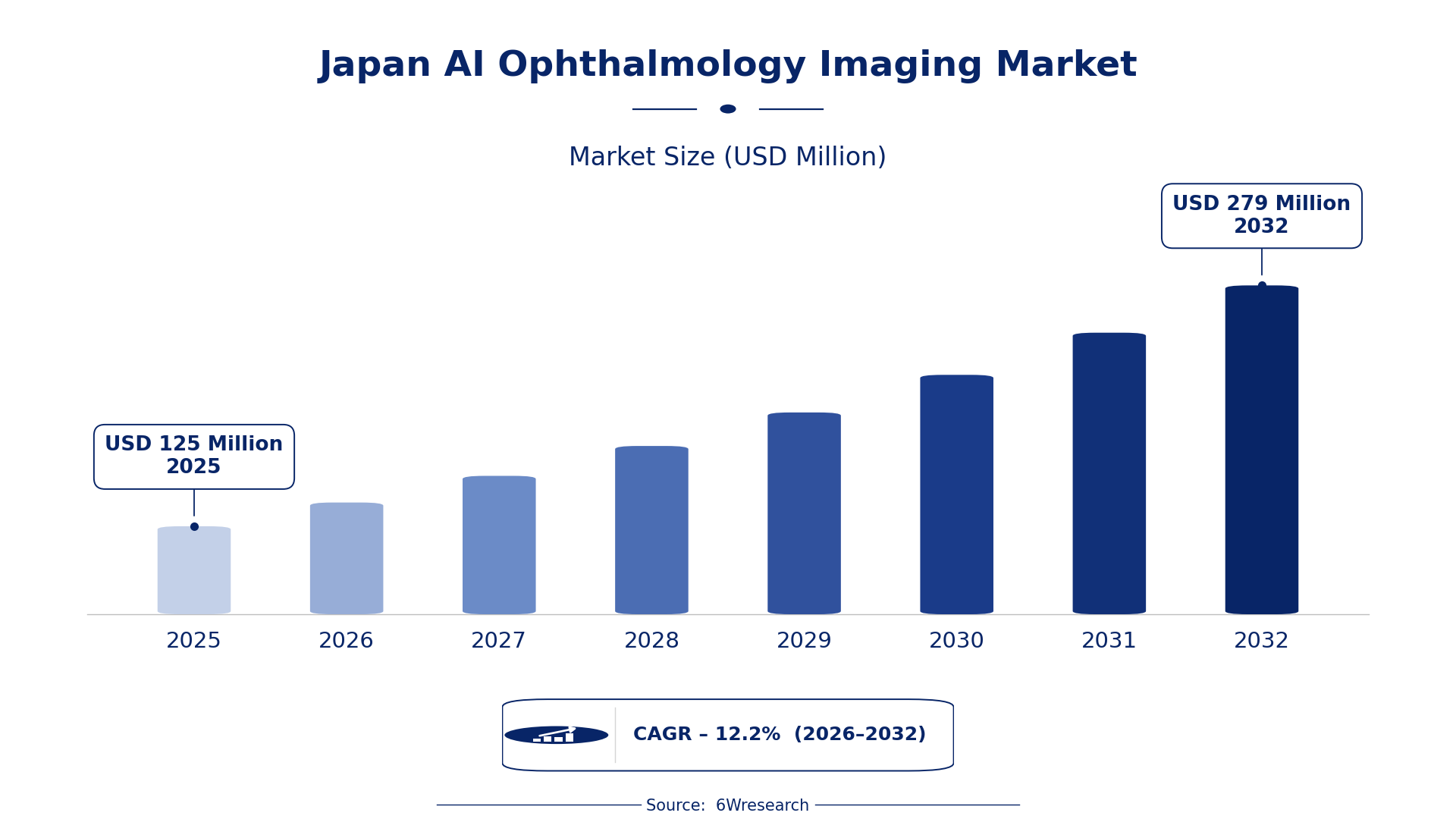
According to 6Wresearch internal database and industry insights, the Japan AI Ophthalmology Imaging Market was valued at USD 125 Million in 2025 and is projected to reach USD 279 Million by 2032, growing at a CAGR of approximately 12.2% during 2026–2032.
Japan AI Ophthalmology Imaging Market Highlights
| Report Metric | Details |
| Report Name | Japan AI Ophthalmology Imaging Market (2026-2032) |
| Market Size 2025 | USD 125 Million |
| Market Size 2032 | USD 279 Million |
| Absolute Growth 2025–2032 | USD 154 Million |
| CAGR 2026–2032 | 12.2% |
| Peak Annual Growth | 17.0% in 2026 |
| Forecast Period | 2026–2032 |
| Historical Data | 2022–2025 |
| Base Year | 2025 |
| Leading Imaging Type, 2025 | OCT Imaging (45% share) |
| Leading AI Functionality, 2025 | Disease Classification (49% share) |
| Leading Distribution Channel, 2025 | Vision AI Providers (53% share) |
| Leading End User, 2025 | Eye Hospitals (40% share) |
| Fastest-Growing AI Functionality | Predictive Analytics (15.3% CAGR) |
| Fastest-Growing Distribution Channel | Health SaaS Portals (15.4% CAGR) |
| Fastest-Growing End User | Retinal Care Clinics (15.1% CAGR) |
| Growing Sector | ophthalmology |
| Key End Users | eye hospitals, retinal care clinics, ophthalmologists |
Japan AI Ophthalmology Imaging Market Year-wise Growth Rate and Key Drivers (2022–2032)
This graph illustrates the annual growth rates of the market from 2022 to 2032, highlighting a steady upward trajectory and projected market expansion over the forecast period.
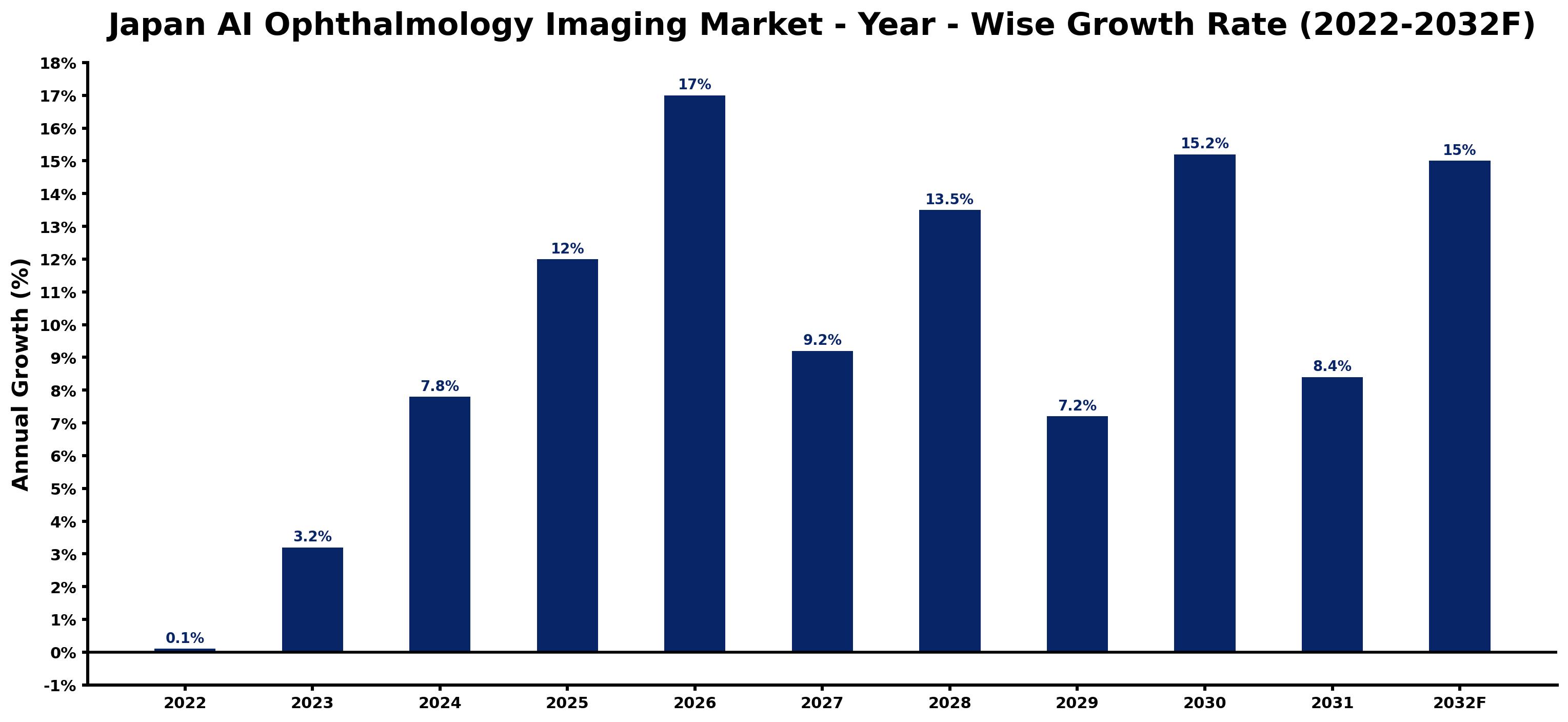
Year by year, the estimates below pair each growth rate with the development that shaped it.
| Year | Estimated Annual Growth (%) | Market Rationale |
| 2022 | 0.1 | The market showed minimal activity with a slight increase in demand for imaging technologies. |
| 2023 | 3.2 | Growth accelerated as healthcare providers began adopting advanced imaging solutions. |
| 2024 | 7.8 | The introduction of new AI guidelines spurred further investment in imaging technologies. |
| 2025 | 12.0 | The market reached its historical peak, driven by increased awareness of eye diseases. |
| 2026 | 17.0 | A surge in funding for AI healthcare projects is expected to boost market growth. |
| 2027 | 9.2 | Growth is projected to slow as the market begins to stabilise after rapid expansion in previous years. |
| 2028 | 13.5 | Demand is expected to rise again as more eye hospitals adopt advanced imaging technologies. |
| 2029 | 7.2 | The market is projected to experience a slowdown as growth rates normalise after peak years. |
| 2030 | 15.2 | Increased investment in predictive analytics will drive a resurgence in market activity. |
| 2031 | 8.4 | Growth is expected to slow as the market matures, yet demand for imaging technologies will remain strong. |
| 2032 | 15.0 | The market is projected to grow as healthcare providers continue to invest in AI solutions. |
Note: Market size estimations and growth projections presented in this report are based on 6Wresearch's proprietary forecasting methodology, utilizing the latest available industry data, government publications, and primary research inputs.
Japan AI Ophthalmology Imaging Market Synopsis
AI Ophthalmology Imaging employs advanced imaging technologies to diagnose and manage eye diseases. In Japan, over 8 million patients with diabetic retinopathy require regular imaging, creating a strong demand for these technologies. The Tokyo region serves as a hub for ophthalmology practices, supported by substantial government funding initiatives, including ¥500 million allocated for AI healthcare projects in 2023, which facilitate the integration of AI in medical imaging.
Market Dynamics Impact Analysis (2026–2032)
| Factor | Type | Impact | Primary Segment Affected |
| Increasing prevalence of diabetic retinopathy drives demand for imaging solutions. | Driver | High | Fundus Imaging |
| Growing adoption of AI technologies enhances diagnostic accuracy and efficiency. | Driver | High | OCT Imaging |
| Investment in eye hospitals is rising, creating demand for advanced imaging equipment. | Opportunity | High | Eye Hospitals |
| The Tokyo region's focus on ophthalmology research opens new markets for imaging technologies. | Opportunity | Medium | Retinal Care Clinics |
| High costs of advanced imaging devices may limit access for smaller clinics. | Restraint | High | Diagnostic Device Vendors |
| Regulatory compliance requirements can delay the introduction of new technologies. | Restraint | Medium | Vision AI Providers |
| Budget constraints in healthcare can restrict investment in new imaging technologies. | Challenge | High | Eye Hospitals |
| Limited integration of AI in existing systems poses challenges for healthcare providers. | Challenge | Medium | Hospital Tech Integrators |
Evaluation of Drivers in Japan AI Ophthalmology Imaging Market (2026–2032)
Below are the drivers that matter most for revenue growth, with supporting evidence.
| Drivers | Primary Segment Affected | Why It Matters (Evidence) |
| Rising patient numbers with diabetic retinopathy increase demand for imaging. | Fundus Imaging | Over 8 million patients in Japan require regular imaging, driving purchases by healthcare providers. |
| Integration of AI improves diagnostic capabilities, boosting adoption of OCT imaging. | OCT Imaging | In 2023, new guidelines from the Japanese Ophthalmological Society encourage AI integration. |
| Government funding for AI healthcare projects supports the development of imaging technologies. | OCT Imaging | The government allocated ¥500 million in 2023 for AI healthcare initiatives, stimulating market growth. |
| Increased awareness of eye diseases leads to higher demand for glaucoma detection imaging. | Glaucoma Detection | The average age of patients receiving imaging for glaucoma detection is 60 years, indicating a growing market. |
| Technological advancements in imaging devices improve diagnostic accuracy and efficiency. | Disease Classification | ISO 13485 standards ensure quality in medical devices, enhancing trust in AI-enhanced imaging solutions. |
Several shifts outside the market lift sales. The increasing number of patients with diabetic retinopathy, exceeding 8 million, drives demand for imaging solutions, particularly in fundus imaging. Funding for AI healthcare projects, including ¥500 million allocated in 2023, stimulates investment in advanced imaging technologies. Awareness of eye diseases is rising, with the average age of patients receiving glaucoma detection imaging at 60 years, prompting healthcare providers to adopt these technologies. Compliance with ISO 13485 standards builds trust in AI imaging, further boosting demand.
Evaluation of Restraints in Japan AI Ophthalmology Imaging Market
The main factors holding the market back are set out below.
| Market Restraint | Primary Segment Affected | Why It Matters (Evidence) |
| High operational costs for advanced imaging technologies limit accessibility. | OCT Imaging | The need for continuous investment in technology raises prices, making it difficult for some facilities to adopt these systems. |
| Limited availability of skilled technicians to operate imaging systems. | Fundus Imaging | A shortage of trained professionals delays diagnosis and treatment, impacting patient care in eye hospitals. |
| Compliance with stringent regulations increases production timelines. | Glaucoma Detection | Meeting safety and quality standards can prolong the approval process for new imaging devices. |
| High competition among imaging technology providers pressures pricing. | Retinal Scans | Intense competition can lead to reduced margins for suppliers, affecting their ability to invest in innovation. |
| Technological advancements require frequent upgrades to existing systems. | Disease Classification | The need to stay current with technological trends can strain budgets and resources for healthcare facilities. |
Japan AI Ophthalmology Imaging Market Challenges
In Japan, over 8 million patients with diabetic retinopathy require regular imaging, straining the supply of advanced imaging technologies. This high demand stems from an ageing population and rising eye disease prevalence, leading to longer wait times for patients and potential deterioration of their conditions. A shortage of skilled technicians to operate these systems delays diagnosis and treatment for hospitals, costing them valuable time and resources. Rapid advancements in technology necessitate continuous investment from producers, increasing operational costs for suppliers and limiting their ability to compete effectively in the market.
Trends in the Japan AI Ophthalmology Imaging Market
The trends below show where the Japan AI Ophthalmology Imaging Market is heading.
- New Guidelines on AI Integration: In 2023, the Japanese Ophthalmological Society published new guidelines promoting AI integration in ophthalmology. This shift encourages eye hospitals to adopt advanced imaging technologies, with over 70% of facilities now using OCT imaging.
- Rise of Predictive Analytics: The adoption of predictive analytics is increasing in ophthalmology, helping forecast disease progression. This trend is reflected in the growing number of eye hospitals implementing AI solutions, indicating a shift towards data-driven diagnostics.
- Focus on Retinal Care Clinics: Retinal care clinics are expanding their services, utilising advanced imaging technologies for comprehensive assessments. This trend is evidenced by a 15.1% CAGR in this segment, indicating a growing market for specialised eye care.
- Shift Towards Health SaaS Portals: Health SaaS portals are gaining traction as platforms for managing imaging data. With a projected CAGR of 15.4%, this trend highlights the need for efficient data management solutions in the ophthalmology sector.
Investment Opportunities in the Japan AI Ophthalmology Imaging Market
The openings below show where demand in the Japan AI Ophthalmology Imaging Market is visible and how suppliers can enter.
- Tokyo Region's Advanced Ophthalmology Practices: The Tokyo region is a hub for advanced ophthalmology practices, presenting investment opportunities. In 2023, the government allocated ¥500 million for AI healthcare projects, creating a demand for imaging technologies.
- Growing Need for Glaucoma Detection: With over 8 million patients requiring regular imaging for diabetic retinopathy, there is a gap in glaucoma detection services. Eye hospitals can invest in advanced imaging technologies to meet this demand.
- Partnerships with Health SaaS Providers: Eye hospitals can explore partnerships with health SaaS providers to improve their imaging data management. This collaboration can streamline operations and improve patient care, tapping into a growing market.
- Investment in Predictive Analytics: The increasing focus on predictive analytics presents an opportunity for investment in AI solutions. Eye hospitals can enhance their diagnostic capabilities by adopting these technologies, improving patient outcomes.
Government Initiatives in the Japan AI Ophthalmology Imaging Market
The Long-Term Care Insurance Act, in force since 2000, provides funding for nursing care and support services, influencing the demand for AI ophthalmology imaging. Additionally, the Medical Care Act sets standards for hospitals, ensuring that facilities are equipped with the latest imaging technologies to meet patient needs.
The Pharmaceuticals and Medical Devices Agency (PMDA) oversees the approval of medical devices, including imaging technologies, ensuring compliance with safety standards. This regulatory framework supports the integration of AI in healthcare, allowing eye hospitals to adopt advanced imaging solutions while maintaining high-quality standards.
Future Insight of the Japan AI Ophthalmology Imaging Market
By 2032, the funding pipeline for AI healthcare projects will expand significantly, driven by government initiatives and the rising demand for advanced diagnostic solutions. This increase in funding will facilitate the integration of AI in imaging systems, improving diagnostic accuracy for healthcare providers. New guidelines from the Japanese Ophthalmological Society will standardise AI applications, promoting consistency in treatment protocols. As the Tokyo region remains a research hub, collaboration among healthcare providers will expedite the development of novel imaging technologies.
Market Segmentation Analysis
Japan AI Ophthalmology Imaging Market report covers a detailed analysis of the following market segments:
By Imaging Type – OCT Imaging Leads and Records the Fastest Growth
According to Saurav Kr Singh, Senior Research Analyst at 6Wresearch, the largest imaging type category in 2025 was OCT Imaging, at 45% of revenue. OCT Imaging commands the largest share because it is employed in over 70% of eye hospitals across Japan, providing essential detailed images for diagnosing eye diseases. This technology is vital for managing conditions such as diabetic retinopathy, which affects millions of patients requiring regular assessments. The same category is also set to grow fastest, at a CAGR of 13.6% during 2026–2032. OCT Imaging will maintain its rapid growth as healthcare providers increasingly depend on its accuracy for early diagnosis. The recent guidelines from the Japanese Ophthalmological Society in 2023 further solidify the role of OCT Imaging in clinical practices. Suppliers should prioritise advancements in OCT Imaging technologies to satisfy the rising demand from healthcare institutions.
By AI Functionality – Disease Classification Leads, Predictive Analytics Expected to Grow Fastest
Disease Classification took 49% of ai functionality revenue in 2025, more than any other category. Disease Classification holds the largest share as it enables accurate categorisation of eye diseases, which is essential for effective treatment. In Japan, health insurance covers AI-enhanced imaging for conditions like diabetic retinopathy, driving demand for this functionality. Over 2026–2032, Predictive Analytics is expected to post the fastest growth, at a CAGR of 15.3%. Predictive Analytics is experiencing rapid growth because it helps forecast disease progression based on imaging data, crucial for proactive patient management. The recent government funding for AI healthcare projects is likely to accelerate the adoption of this functionality. This indicates that suppliers should focus on developing functionalities that improve diagnostic accuracy and patient outcomes.
By Distribution Channel – Vision AI Providers Lead, Health SaaS Portals Expected to Grow Fastest
Vision AI Providers accounted for 53% of the market by distribution channel in 2025. Vision AI Providers lead the distribution channel by supplying tailored solutions for ophthalmic imaging, effectively meeting the demands of eye hospitals. Their established relationships with healthcare providers in Japan facilitate the integration of advanced imaging technologies into clinical practice. Health SaaS Portals are projected to grow fastest, at a CAGR of 15.4% during 2026–2032. Health SaaS Portals are growing quickly as they provide essential platforms for managing and analysing healthcare data, which is increasingly important. The trend towards cloud-based solutions is driving this segment's rapid expansion. This suggests that suppliers should consider partnerships with Health SaaS Portals to enhance their market reach and service offerings.
By End User – Eye Hospitals Lead, Retinal Care Clinics Expected to Grow Fastest
With 40% of end user revenue in 2025, Eye Hospitals was the largest category. Eye Hospitals represent the largest end user segment as they primarily utilise advanced imaging technologies to serve a vast patient base. With around 1,200 eye hospitals equipped with these technologies, their demand remains strong and consistent. The quickest growth will come from Retinal Care Clinics, forecast to expand at a CAGR of 15.1% between 2026 and 2032. Retinal Care Clinics are experiencing the fastest growth as they focus on specialised treatment using imaging technologies. Their targeted approach to managing conditions such as diabetic retinopathy is a key factor driving this segment's expansion. Suppliers must adapt their products to cater to the distinct requirements of both Eye Hospitals and Retinal Care Clinics.
Key Attractiveness of the Report
- 10 Years of Market Numbers
- Historical Data Starting from 2022 to 2025
- Base Year 2025
- Forecast Data until 2032
- Key Performance Indicators Impacting the Market
- Major Upcoming Developments and Projects
Key Highlights of the Report:
- Japan AI Ophthalmology Imaging Market Outlook
- Market Size of Japan AI Ophthalmology Imaging Market, 2025
- Forecast of Japan AI Ophthalmology Imaging Market, 2032
- Historical Data and Forecast of Japan AI Ophthalmology Imaging Revenues & Volume for the Period 2022-2032F
- Japan AI Ophthalmology Imaging Market Trend Evolution
- Japan AI Ophthalmology Imaging Market Drivers and Challenges
- Japan AI Ophthalmology Imaging Price Trends
- Japan AI Ophthalmology Imaging Porter's Five Forces
- Japan AI Ophthalmology Imaging Industry Life Cycle
- Historical Data and Forecast of Japan AI Ophthalmology Imaging Market Revenues & Volume By Imaging Type for the Period 2022-2032F
- Historical Data and Forecast of Japan AI Ophthalmology Imaging Market Revenues & Volume By Fundus Imaging for the Period 2022-2032F
- Historical Data and Forecast of Japan AI Ophthalmology Imaging Market Revenues & Volume By OCT Imaging for the Period 2022-2032F
- Historical Data and Forecast of Japan AI Ophthalmology Imaging Market Revenues & Volume By Retinal Scans for the Period 2022-2032F
- Historical Data and Forecast of Japan AI Ophthalmology Imaging Market Revenues & Volume By Glaucoma Detection for the Period 2022-2032F
- Historical Data and Forecast of Japan AI Ophthalmology Imaging Market Revenues & Volume By AI Functionality for the Period 2022-2032F
- Historical Data and Forecast of Japan AI Ophthalmology Imaging Market Revenues & Volume By Disease Classification for the Period 2022-2032F
- Historical Data and Forecast of Japan AI Ophthalmology Imaging Market Revenues & Volume By Layer Segmentation for the Period 2022-2032F
- Historical Data and Forecast of Japan AI Ophthalmology Imaging Market Revenues & Volume By Pattern Recognition for the Period 2022-2032F
- Historical Data and Forecast of Japan AI Ophthalmology Imaging Market Revenues & Volume By Predictive Analytics for the Period 2022-2032F
- Historical Data and Forecast of Japan AI Ophthalmology Imaging Market Revenues & Volume By Distribution Channel for the Period 2022-2032F
- Historical Data and Forecast of Japan AI Ophthalmology Imaging Market Revenues & Volume By Vision AI Providers for the Period 2022-2032F
- Historical Data and Forecast of Japan AI Ophthalmology Imaging Market Revenues & Volume By Diagnostic Device Vendors for the Period 2022-2032F
- Historical Data and Forecast of Japan AI Ophthalmology Imaging Market Revenues & Volume By Health SaaS Portals for the Period 2022-2032F
- Historical Data and Forecast of Japan AI Ophthalmology Imaging Market Revenues & Volume By Hospital Tech Integrators for the Period 2022-2032F
- Historical Data and Forecast of Japan AI Ophthalmology Imaging Market Revenues & Volume By End User for the Period 2022-2032F
- Historical Data and Forecast of Japan AI Ophthalmology Imaging Market Revenues & Volume By Eye Hospitals for the Period 2022-2032F
- Historical Data and Forecast of Japan AI Ophthalmology Imaging Market Revenues & Volume By Retinal Care Clinics for the Period 2022-2032F
- Historical Data and Forecast of Japan AI Ophthalmology Imaging Market Revenues & Volume By Ophthalmologists for the Period 2022-2032F
- Historical Data and Forecast of Japan AI Ophthalmology Imaging Market Revenues & Volume By Vision Research Labs for the Period 2022-2032F
- Japan AI Ophthalmology Imaging Import Export Trade Statistics
- Market Opportunity Assessment By Imaging Type
- Market Opportunity Assessment By AI Functionality
- Market Opportunity Assessment By Distribution Channel
- Market Opportunity Assessment By End User
- Japan AI Ophthalmology Imaging Top Companies Market Share
- Japan AI Ophthalmology Imaging Competitive Benchmarking By Technical and Operational Parameters
- Japan AI Ophthalmology Imaging Company Profiles
- Japan AI Ophthalmology Imaging Key Strategic Recommendations
Market Covered
The study includes the following segmentation.
By Imaging Type
- Fundus Imaging
- OCT Imaging
- Retinal Scans
- Glaucoma Detection
By AI Functionality
- Disease Classification
- Layer Segmentation
- Pattern Recognition
- Predictive Analytics
By Distribution Channel
- Vision AI Providers
- Diagnostic Device Vendors
- Health SaaS Portals
- Hospital Tech Integrators
By End User
- Eye Hospitals
- Retinal Care Clinics
- Ophthalmologists
- Vision Research Labs































