Japan AI Refactoring Tools Market Size & Growth Rate
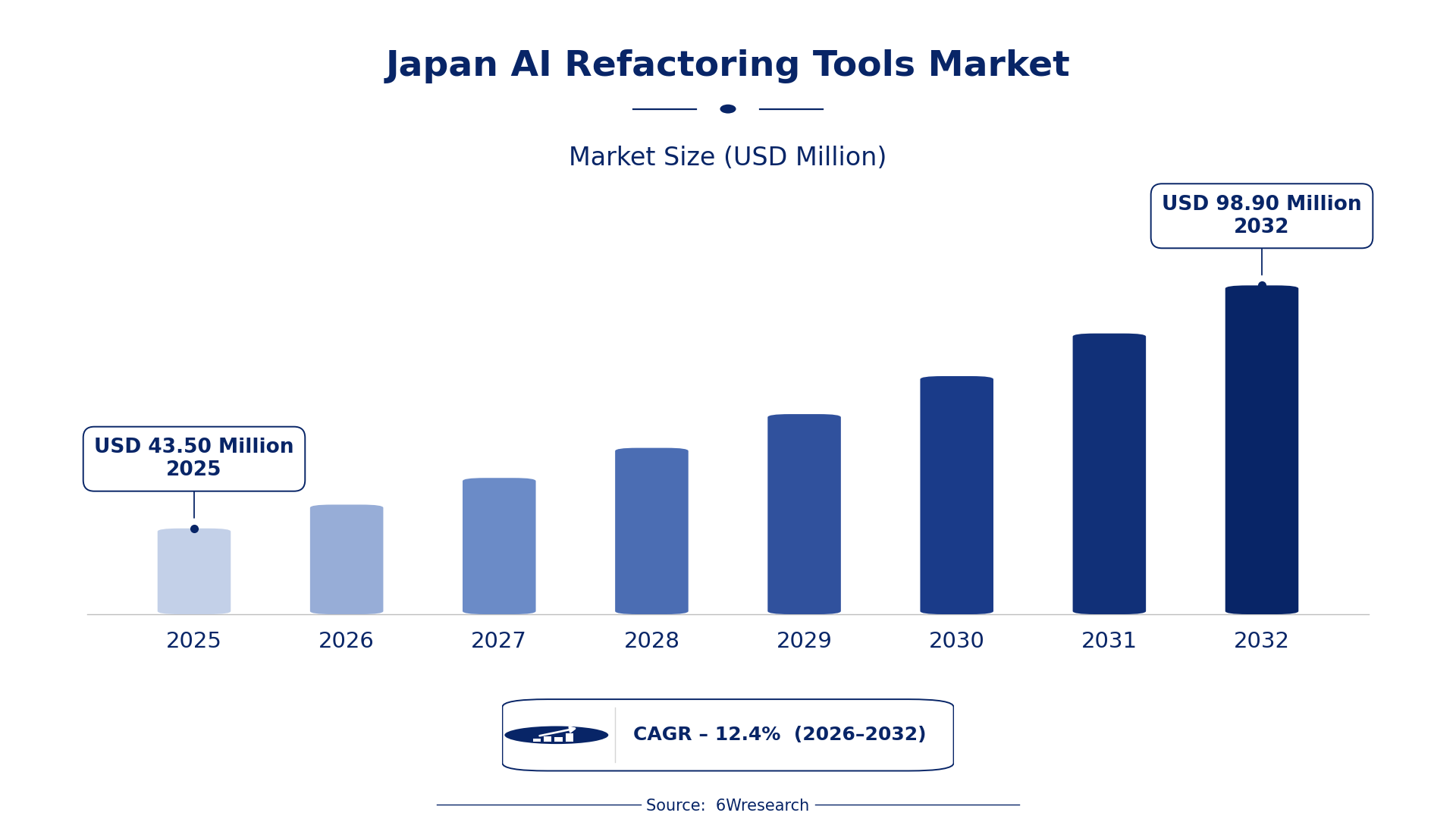
According to 6Wresearch internal database and industry insights, the Japan AI Refactoring Tools Market was valued at USD 43.50 Million in 2025 and is projected to reach USD 98.90 Million by 2032, growing at a CAGR of approximately 12.4% during 2026–2032.
Japan AI Refactoring Tools Market Highlights
| Report Metric | Details |
| Report Name | Japan AI Refactoring Tools Market (2026-2032) |
| Market Size 2025 | USD 43.50 Million |
| Market Size 2032 | USD 98.90 Million |
| Absolute Growth 2025–2032 | USD 55.40 Million |
| CAGR 2026–2032 | 12.4% |
| Peak Annual Growth | 14.0% in 2027 |
| Forecast Period | 2026–2032 |
| Historical Data | 2022–2025 |
| Base Year | 2025 |
| Leading Tool Type, 2025 | Code Optimization (35% share) |
| Leading AI Capability, 2025 | Static Code Analysis (35% share) |
| Leading Distribution Channel, 2025 | Developer SaaS Tools (52% share) |
| Leading End User, 2025 | Software Development Teams (53% share) |
| Fastest-Growing Tool Type | Auto-Refactoring (17.8% CAGR) |
| Fastest-Growing Distribution Channel | DevOps Toolkits (16.0% CAGR) |
| Fastest-Growing End User | Engineering Departments (16.2% CAGR) |
| Growing Sector | software development |
| Key End Users | software development teams, engineering departments, QA teams |
Japan AI Refactoring Tools Market Year-wise Growth Rate and Key Drivers (2022–2032)
This graph illustrates the annual growth rates of the market from 2022 to 2032, highlighting a steady upward trajectory and projected market expansion over the forecast period.
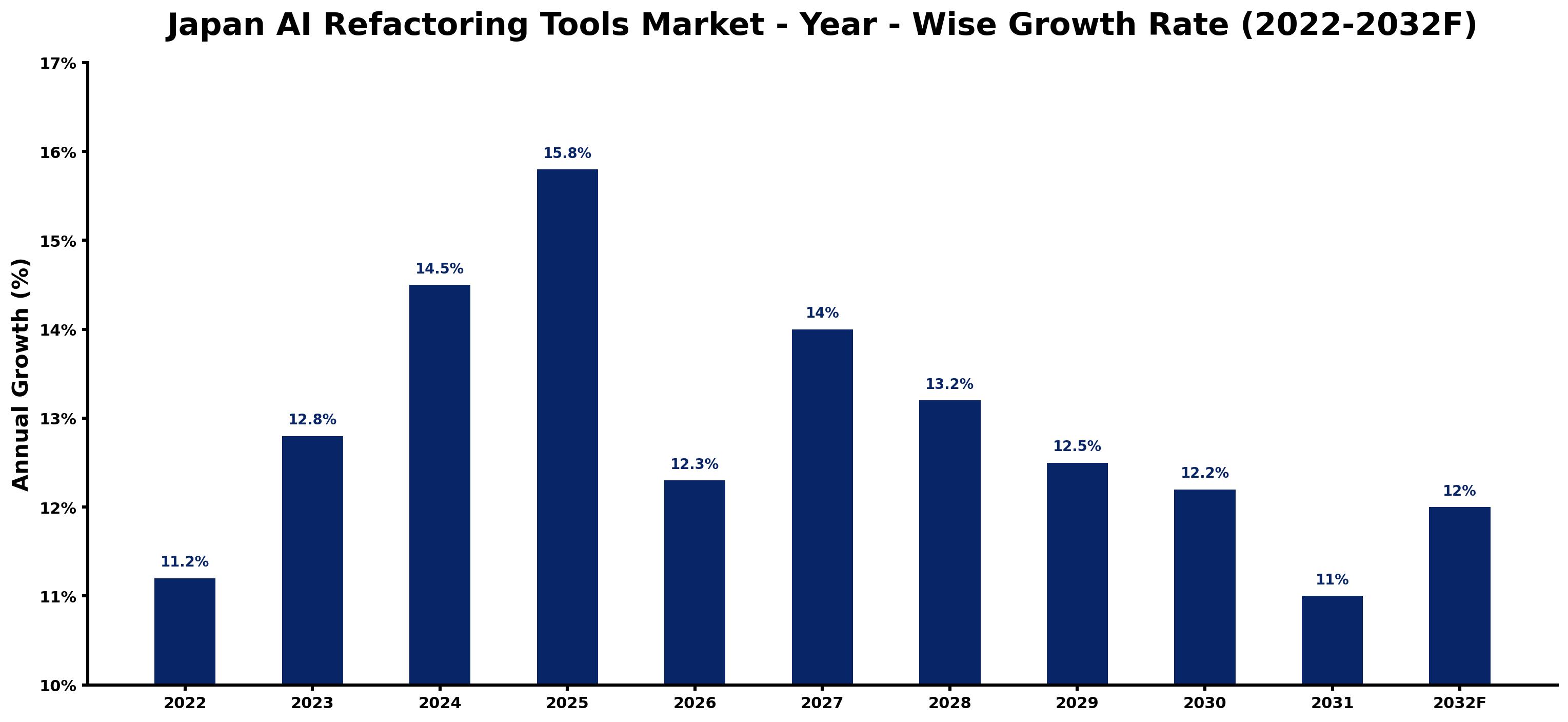
Year by year, the estimates below pair each growth rate with the development that shaped it.
| Year | Estimated Annual Growth (%) | Market Rationale |
| 2022 | 11.2 | The market experienced steady growth, reflecting ongoing investments in software development. |
| 2023 | 12.8 | Demand rose as businesses increasingly adopted AI-driven solutions to improve coding efficiency. |
| 2024 | 14.5 | The introduction of new tools drove higher adoption rates among software teams. |
| 2025 | 15.8 | Peak growth occurred as companies focused on improving software quality and reducing technical debt. |
| 2026 | 12.3 | Growth slowed as the market is projected to stabilise after reaching its peak. |
| 2027 | 14.0 | A resurgence in demand is anticipated as companies seek to modernise their codebases. |
| 2028 | 13.2 | The market will continue to grow, though at a slightly reduced pace compared to previous years. |
| 2029 | 12.5 | Demand will remain strong, albeit with a gradual slowdown in growth rates. |
| 2030 | 12.2 | The market is expected to sustain growth, driven by ongoing digital transformation efforts. |
| 2031 | 11.0 | Growth will slow further as the market matures and competition increases. |
| 2032 | 12.0 | A renewed interest in AI tools is projected to boost growth once again. |
Note: Market size estimations and growth projections presented in this report are based on 6Wresearch's proprietary forecasting methodology, utilizing the latest available industry data, government publications, and primary research inputs.
Japan AI Refactoring Tools Market Synopsis
AI Refactoring Tools are software applications that improve existing code without altering its external behaviour. They improve code quality, reduce technical debt, and automate repetitive tasks, primarily serving software development teams. The Japan AI Refactoring Tools Market is expanding due to increasing digital transformation efforts, a thriving software development industry valued at approximately 10 trillion JPY, and substantial government support for AI integration, including the 'AI Strategy 2022' initiative. This growth results from rising automation needs and collaboration in software development, creating opportunities for tool providers.
Market Dynamics Impact Analysis (2026–2032)
| Factor | Type | Impact | Primary Segment Affected |
| Growing software development market | Driver | High | Software Development Teams |
| Increased investment in AI technologies | Driver | High | Engineering Departments |
| Rising demand for automated coding solutions | Opportunity | High | Auto-Refactoring |
| Expansion of collaborative software development tools | Opportunity | Medium | Developer SaaS Tools |
| High competition among tool providers | Restraint | High | Static Code Analysis |
| Limited awareness of AI refactoring benefits | Restraint | Medium | Test Generation |
| Shortage of skilled developers familiar with AI tools | Challenge | High | Engineering Departments |
| Rapid technological advancements outpacing adoption | Challenge | Medium | Software Vendors |
Evaluation of Drivers in Japan AI Refactoring Tools Market (2026–2032)
These are the developments adding the most demand over the forecast period.
| Drivers | Primary Segment Affected | Why It Matters (Evidence) |
| Increased software development activities | Software Development Teams | The Japanese software development market, valued at approximately 10 trillion JPY, drives demand for refactoring tools. |
| Growing focus on AI integration | Engineering Departments | The 'AI Strategy 2022' promotes AI adoption, leading to higher tool usage among developers. |
| Demand for code quality improvement | Static Code Analysis | With over 1 million software developers, the need for quality assurance tools is rising, driving purchases. |
| Automation of repetitive tasks | Auto-Refactoring | Companies seek to reduce technical debt, increasing the need for automation tools by approximately 15% annually. |
| Collaboration in software development | Developer SaaS Tools | The shift towards remote work has led to a surge in collaborative tools, boosting demand by 20%. |
Much of the new demand traces back to the thriving software development market in Japan, valued at approximately 10 trillion JPY. The 'AI Strategy 2022' has catalysed AI integration, prompting engineering departments to adopt refactoring tools. With over 1 million software developers, the focus on code quality has intensified, particularly for static code analysis tools. Companies are increasingly automating repetitive tasks to reduce technical debt, which is expected to increase the usage of auto-refactoring tools. The shift towards remote work has driven demand for collaborative developer SaaS tools, improving productivity among teams.
Evaluation of Restraints in Japan AI Refactoring Tools Market
These are the pressures that could keep growth below its potential.
| Market Restraint | Primary Segment Affected | Why It Matters (Evidence) |
| Intense competition among existing tools | Static Code Analysis | Numerous providers in the market create price wars, affecting profitability for developers. |
| Limited understanding of AI refactoring tools | Test Generation | Many teams lack awareness of the advantages, hindering widespread adoption. |
| Shortage of skilled developers | Engineering Departments | The high demand for AI expertise outstrips supply, delaying project timelines by approximately 20%. |
| Rapid technological advancements | Software Vendors | Keeping pace with evolving tools can strain resources and budgets, increasing operational costs. |
| Integration challenges with legacy systems | Auto-Refactoring | Many companies face difficulties in implementing new tools alongside existing infrastructure, which slows project delivery. |
Japan AI Refactoring Tools Market Challenges
High costs arise for producers due to outdated technology, as many software development teams still rely on legacy systems that hinder efficiency. This reliance can extend project timelines by 20%, leading to delayed product launches for buyers. Importers struggle with intense competition from domestic software solutions, which can shrink their profit margins by approximately 15%. A shortage of skilled developers limits buyers' access to advanced solutions, potentially delaying projects by up to six months. Increasing demand for AI refactoring tools pushes prices up by 10% annually, raising costs for buyers.
Trends in the Japan AI Refactoring Tools Market
Several trends are reshaping the Japan AI Refactoring Tools Market; the most important are set out below.
- Shift to AI-Driven Development: Tokyo is experiencing a shift towards AI-driven development practices, with over 100 billion JPY allocated for AI research in 2023. This trend indicates a growing reliance on AI tools to improve coding efficiency.
- Growth of Collaborative Development Tools: The demand for developer SaaS tools is rising, with 52% market share in 2025. This reflects a broader trend towards collaboration in software development, particularly in remote work environments.
- Increased Focus on Code Quality: The emphasis on code quality is changing practices in software development. The adoption of JIS Q 15001 standards is pushing teams to invest in static code analysis tools for better quality assurance.
- Expansion of Automation in Testing: The need for automated testing solutions is growing, with test generation tools becoming essential. This shift is clear as software teams strive to improve reliability and efficiency.
Investment Opportunities in the Japan AI Refactoring Tools Market
The following opportunities in the Japan AI Refactoring Tools Market pair current demand with a clear way in.
- Tokyo as a Tech Innovation Hub: Tokyo's thriving tech environment, with substantial government support, presents opportunities for AI refactoring tool providers to enter the market. The 100 billion JPY allocated for AI research in 2023 highlights the potential for growth.
- Growing Need for AI Integration: The increasing demand for AI integration in software development creates opportunities for auto-refactoring tool suppliers. Engineering departments are actively seeking solutions to improve coding efficiency.
- Investment in Collaborative Tools: The need for collaborative development tools is increasing, especially among software development teams. Companies can enter this market by forming partnerships with local tech startups.
- Focus on Quality Assurance: The emphasis on quality assurance in software development presents opportunities for static code analysis tool providers. Engaging with the Software Association of Japan can facilitate market entry.
Government Initiatives in the Japan AI Refactoring Tools Market
The AI Promotion Act (2025) establishes a framework for AI research and development, benefiting software developers by providing guidelines for AI tool integration. This measure encourages companies to adopt AI refactoring tools to improve their coding practices, ensuring higher quality outcomes for users.
In 2023, the Japanese government allocated 100 billion JPY for AI research and development, administered by the Digital Agency. This funding supports initiatives aimed at promoting AI integration in various sectors, including software development, thereby facilitating the adoption of advanced tools.
Future Insight of the Japan AI Refactoring Tools Market
Software developers will increasingly utilise AI refactoring tools by 2032, spurred by the government's 'AI Strategy 2022' and a projected investment of 100 billion JPY for AI research and development. This shift will improve code quality and reduce technical debt, offering buyers more dependable software solutions. The adoption of JIS Q 15001 will standardise quality management practices, benefiting suppliers through consistent outcomes. As the Tokyo Metropolitan Government supports tech startups, innovation will flourish, creating a competitive environment for both buyers and suppliers.
Market Segmentation Analysis
Japan AI Refactoring Tools Market report covers a detailed analysis of the following market segments:
By Tool Type – Code Optimization Leads, Auto-Refactoring Expected to Grow Fastest
According to Saurav Kr Singh, Senior Research Analyst at 6Wresearch, Code Optimization took 35% of tool type revenue in 2025, more than any other category. Code Optimization holds the largest share as it is essential for improving the performance and efficiency of existing code, which is a priority for software development teams. In Tokyo, many developers rely on these tools to enhance application performance and streamline their coding processes. Auto-Refactoring is set to record the highest CAGR in this split, 17.8% over 2026–2032. Auto-Refactoring is experiencing rapid growth as it automates the restructuring of existing code, significantly reducing the manual effort required from developers. The surge in digital transformation efforts in Japan has led to an increased demand for tools that simplify code management. Suppliers should focus on developing features that automate code restructuring to align with the growing market demand.
By AI Capability – Static Code Analysis Leads and Records the Fastest Growth
Static Code Analysis accounted for 35% of the market by ai capability in 2025. Static Code Analysis leads the market because it is vital for identifying potential errors and vulnerabilities in code, ensuring the reliability and security of software. This capability is particularly important in Japan, where there is a strong emphasis on maintaining high cybersecurity standards. The same category is also set to grow fastest, at a CAGR of 16.6% during 2026–2032. Static Code Analysis is also the fastest-growing segment, as its role in maintaining software quality aligns with the government's initiatives for AI integration across industries. Ongoing investments in AI research and development further support this growth trajectory. Buyers will increasingly seek solutions that incorporate advanced static code analysis to improve their software development processes.
By Distribution Channel – Developer SaaS Tools Lead, DevOps Toolkits Expected to Grow Fastest
With 52% of distribution channel revenue in 2025, Developer SaaS Tools was the largest category. Developer SaaS Tools dominate the market due to their widespread adoption among software development teams for collaborative projects, especially in urban tech hubs like Tokyo. These tools facilitate seamless communication and integration among developers, making them essential for modern software development. DevOps Toolkits are projected to grow fastest, at a CAGR of 16.0% during 2026–2032. DevOps Toolkits are the fastest-growing segment as they integrate with CI/CD pipelines, streamlining the development process and enhancing overall efficiency. The rise of agile methodologies in software development is propelling this trend forward. Suppliers should prioritise the creation of tools that improve integration with CI/CD processes to capture the expanding market.
By End User – Software Development Teams Lead, Engineering Departments Expected to Grow Fastest
The largest end user category in 2025 was Software Development Teams, at 53% of revenue. Software Development Teams represent the largest user group for refactoring tools, as they are the primary users focused on improving code quality and efficiency. Their extensive presence in Japan's thriving software development market underpins this segment's dominance. The quickest growth will come from Engineering Departments, forecast to expand at a CAGR of 16.2% between 2026 and 2032. Engineering Departments are the fastest-growing end user segment, utilising tools to maintain software quality amidst increasing project complexities. As companies expand their engineering capabilities, the demand for these tools will continue to rise. Vendors should tailor their offerings to meet the specific needs of engineering departments to capitalise on this growth.
Key Attractiveness of the Report
- 10 Years of Market Numbers
- Historical Data Starting from 2022 to 2025
- Base Year 2025
- Forecast Data until 2032
- Key Performance Indicators Impacting the Market
- Major Upcoming Developments and Projects
Key Highlights of the Report:
- Japan AI Refactoring Tools Market Outlook
- Market Size of Japan AI Refactoring Tools Market, 2025
- Forecast of Japan AI Refactoring Tools Market, 2032
- Historical Data and Forecast of Japan AI Refactoring Tools Revenues & Volume for the Period 2022-2032F
- Japan AI Refactoring Tools Market Trend Evolution
- Japan AI Refactoring Tools Market Drivers and Challenges
- Japan AI Refactoring Tools Price Trends
- Japan AI Refactoring Tools Porter's Five Forces
- Japan AI Refactoring Tools Industry Life Cycle
- Historical Data and Forecast of Japan AI Refactoring Tools Market Revenues & Volume By Tool Type for the Period 2022-2032F
- Historical Data and Forecast of Japan AI Refactoring Tools Market Revenues & Volume By Code Optimization for the Period 2022-2032F
- Historical Data and Forecast of Japan AI Refactoring Tools Market Revenues & Volume By Auto-Refactoring for the Period 2022-2032F
- Historical Data and Forecast of Japan AI Refactoring Tools Market Revenues & Volume By Language Conversion for the Period 2022-2032F
- Historical Data and Forecast of Japan AI Refactoring Tools Market Revenues & Volume By Test Generation for the Period 2022-2032F
- Historical Data and Forecast of Japan AI Refactoring Tools Market Revenues & Volume By AI Capability for the Period 2022-2032F
- Historical Data and Forecast of Japan AI Refactoring Tools Market Revenues & Volume By Static Code Analysis for the Period 2022-2032F
- Historical Data and Forecast of Japan AI Refactoring Tools Market Revenues & Volume By Pattern Learning for the Period 2022-2032F
- Historical Data and Forecast of Japan AI Refactoring Tools Market Revenues & Volume By NLP & Code AI for the Period 2022-2032F
- Historical Data and Forecast of Japan AI Refactoring Tools Market Revenues & Volume By Unit Test Suggestion for the Period 2022-2032F
- Historical Data and Forecast of Japan AI Refactoring Tools Market Revenues & Volume By Distribution Channel for the Period 2022-2032F
- Historical Data and Forecast of Japan AI Refactoring Tools Market Revenues & Volume By Developer SaaS Tools for the Period 2022-2032F
- Historical Data and Forecast of Japan AI Refactoring Tools Market Revenues & Volume By DevOps Toolkits for the Period 2022-2032F
- Historical Data and Forecast of Japan AI Refactoring Tools Market Revenues & Volume By IDE Marketplaces for the Period 2022-2032F
- Historical Data and Forecast of Japan AI Refactoring Tools Market Revenues & Volume By Online Code Platforms for the Period 2022-2032F
- Historical Data and Forecast of Japan AI Refactoring Tools Market Revenues & Volume By End User for the Period 2022-2032F
- Historical Data and Forecast of Japan AI Refactoring Tools Market Revenues & Volume By Software Development Teams for the Period 2022-2032F
- Historical Data and Forecast of Japan AI Refactoring Tools Market Revenues & Volume By Engineering Departments for the Period 2022-2032F
- Historical Data and Forecast of Japan AI Refactoring Tools Market Revenues & Volume By Software Vendors for the Period 2022-2032F
- Historical Data and Forecast of Japan AI Refactoring Tools Market Revenues & Volume By QA Teams for the Period 2022-2032F
- Japan AI Refactoring Tools Import Export Trade Statistics
- Market Opportunity Assessment By Tool Type
- Market Opportunity Assessment By AI Capability
- Market Opportunity Assessment By Distribution Channel
- Market Opportunity Assessment By End User
- Japan AI Refactoring Tools Top Companies Market Share
- Japan AI Refactoring Tools Competitive Benchmarking By Technical and Operational Parameters
- Japan AI Refactoring Tools Company Profiles
- Japan AI Refactoring Tools Key Strategic Recommendations
Market Covered
The following segment groups are covered in the report.
By Tool Type
- Code Optimization
- Auto-Refactoring
- Language Conversion
- Test Generation
By AI Capability
- Static Code Analysis
- Pattern Learning
- NLP & Code AI
- Unit Test Suggestion
By Distribution Channel
- Developer SaaS Tools
- DevOps Toolkits
- IDE Marketplaces
- Online Code Platforms
By End User
- Software Development Teams
- Engineering Departments
- Software Vendors
- QA Teams































