Japan AI Shopping Assistant Market Size & Growth Rate
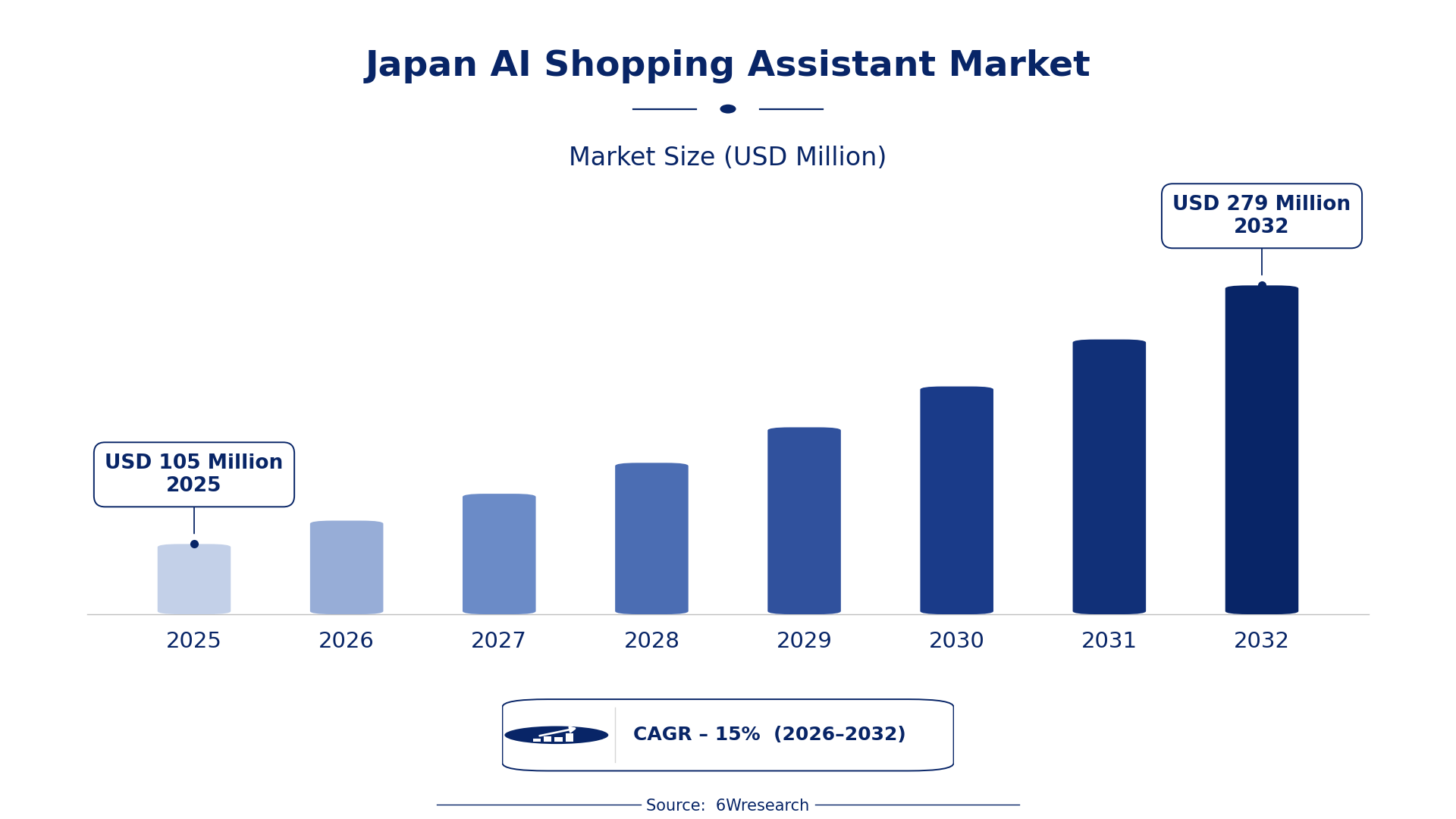
According to 6Wresearch internal database and industry insights, the Japan AI Shopping Assistant Market was valued at USD 105 Million in 2025 and is projected to reach USD 279 Million by 2032, growing at a CAGR of approximately 15% during 2026–2032.
Japan AI Shopping Assistant Market Highlights
| Report Metric | Details |
| Report Name | Japan AI Shopping Assistant Market (2026-2032) |
| Market Size 2025 | USD 105 Million |
| Market Size 2032 | USD 279 Million |
| Absolute Growth 2025–2032 | USD 174 Million |
| CAGR 2026–2032 | 15% |
| Peak Annual Growth | 16.2% in 2032 |
| Forecast Period | 2026–2032 |
| Historical Data | 2022–2025 |
| Base Year | 2025 |
| Leading AI Type, 2025 | Virtual Assistant (44% share) |
| Leading Functionality, 2025 | Product Recommendations (44% share) |
| Leading Application Area, 2025 | E-commerce (41% share) |
| Leading Distribution Channel, 2025 | Mobile Apps (43% share) |
| Leading End User, 2025 | Online Shoppers (38% share) |
| Fastest-Growing AI Type | Chatbots (17.0% CAGR) |
| Fastest-Growing Functionality | Customer Support (19.4% CAGR) |
| Fastest-Growing Application Area | Retail Websites (18.9% CAGR) |
| Fastest-Growing Distribution Channel | Cloud (19.8% CAGR) |
| Fastest-Growing End User | Retail Companies (20.3% CAGR) |
| Growing Sector | E-commerce |
| Key End Users | Online Shoppers, Retail Companies, Consumers |
Japan AI Shopping Assistant Market Year-wise Growth Rate and Key Drivers (2022–2032)
This graph illustrates the annual growth rates of the market from 2022 to 2032, highlighting a steady upward trajectory and projected market expansion over the forecast period.
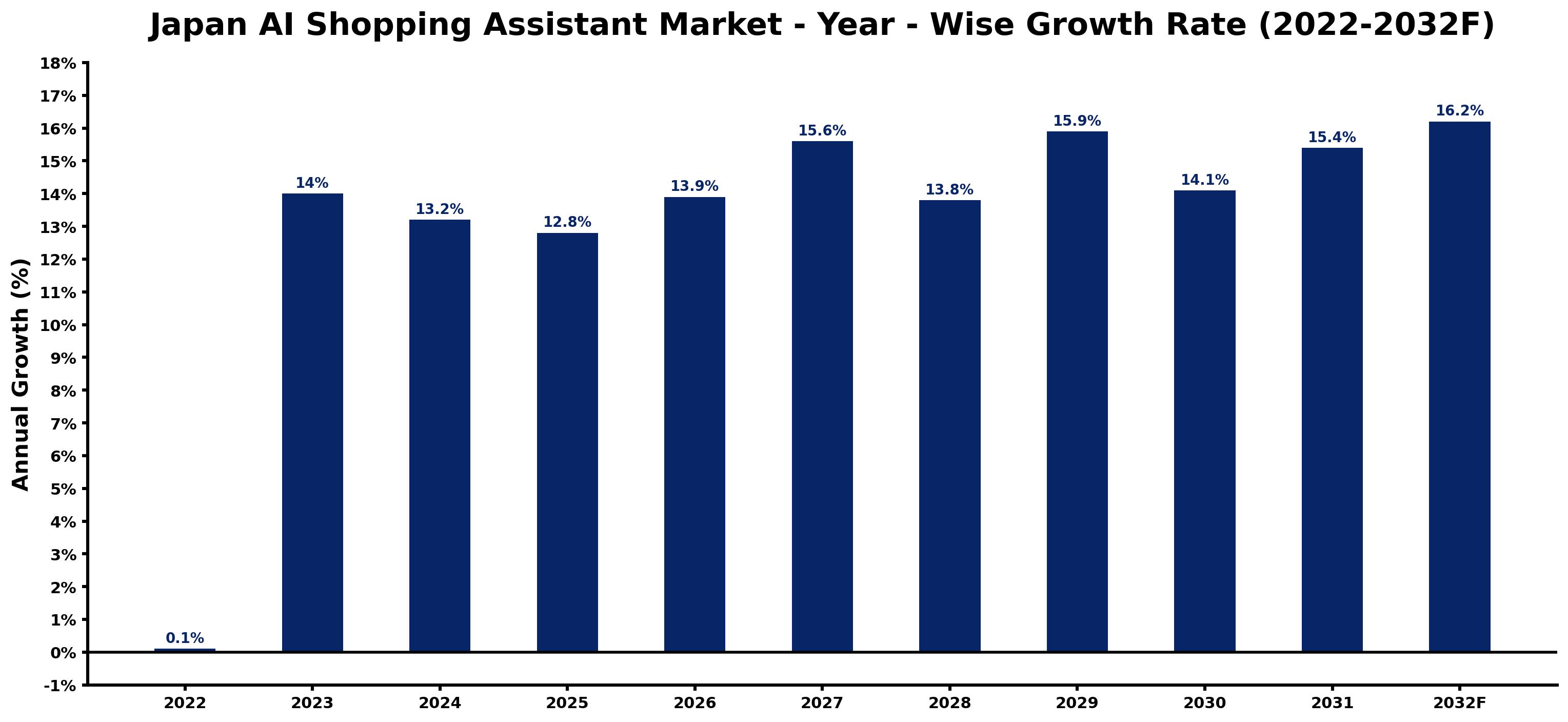
Annual growth estimates for each year appear below with the principal reason behind them, explaining the shifts that set the pace of the market.
| Year | Estimated Annual Growth (%) | Market Rationale |
| 2022 | 0.1 | The market exhibited minimal growth, reflecting initial adoption phases among users. |
| 2023 | 14.0 | Growth accelerated as online shopping surged during the recovery phase. |
| 2024 | 13.2 | Growth slowed slightly as the market began to stabilise after rapid expansion. |
| 2025 | 12.8 | The market continued to grow, albeit at a slower rate due to market saturation. |
| 2026 | 13.9 | Growth is expected to pick up again as new technologies attract more users. |
| 2027 | 15.6 | Demand is projected to surge as retailers increasingly adopt AI solutions for customer engagement. |
| 2028 | 13.8 | Growth is expected to decelerate slightly as the market matures and competition intensifies. |
| 2029 | 15.9 | Demand is projected to rebound as new applications of AI shopping assistants emerge. |
| 2030 | 14.1 | The market is expected to see a slowdown as user growth begins to plateau. |
| 2031 | 15.4 | Growth is projected to accelerate again as retailers focus on enhancing customer experiences. |
| 2032 | 16.2 | The market is expected to peak as advanced AI features drive user engagement. |
Note: Market size estimations and growth projections presented in this report are based on 6Wresearch's proprietary forecasting methodology, utilizing the latest available industry data, government publications, and primary research inputs.
Japan AI Shopping Assistant Market Synopsis
AI Shopping Assistants are sophisticated software solutions that improve online shopping experiences through advanced algorithms. They provide personalised recommendations, customer support, and voice-activated shopping options. The Japan AI Shopping Assistant Market is expanding due to the thriving e-commerce sector, with over 80% of online shoppers utilising AI for product suggestions. Retailers' investments in AI integration further fuel this growth, leading to increased consumer engagement and sales.
Market Dynamics Impact Analysis (2026–2032)
| Factor | Type | Impact | Primary Segment Affected |
| Growing e-commerce sector driving demand for AI solutions | Driver | High | E-commerce |
| Increased adoption of AI technologies by retail companies | Driver | High | Retail Websites |
| Expansion of voice commerce as a shopping method | Opportunity | High | Voice Commerce |
| Rising consumer expectations for personalized shopping experiences | Opportunity | High | Product Recommendations |
| Challenges in data privacy compliance for AI applications | Restraint | High | Personalization AI |
| Limited AI literacy among some retail staff | Restraint | Medium | Customer Support |
| High initial investment costs for AI integration | Challenge | High | Chatbots |
| Capacity constraints in scaling AI solutions for larger retailers | Challenge | Medium | Virtual Assistant |
Evaluation of Drivers in Japan AI Shopping Assistant Market (2026–2032)
Below are the drivers that matter most for revenue growth, with supporting evidence.
| Drivers | Primary Segment Affected | Why It Matters (Evidence) |
| Increased online shopping penetration | E-commerce | Over 70% of consumers engage in online shopping, driving demand for AI solutions. |
| High consumer spending on online purchases | Online Shoppers | The average online shopper spends ¥30,000 annually, boosting AI shopping assistant usage. |
| Government support for AI initiatives | Retail Companies | The government allocated ¥5 billion for AI development in retail, encouraging adoption. |
| Rising use of AI chatbots for customer engagement | Chatbots | 70% of major retail websites utilise chatbots, improving customer interaction. |
| Growth in voice commerce applications | Voice Commerce | Voice commerce is projected to grow by 25% in the next five years, increasing AI demand. |
Volumes grow on the back of the increasing online shopping penetration in Japan, with over 70% of consumers engaging in e-commerce activities. The average online shopper spends approximately ¥30,000 annually, driving the demand for AI shopping assistants. Seventy percent of major retail websites have implemented AI chatbots to improve customer engagement. The projected 25% growth in voice commerce over the next five years further boosts demand for these advanced solutions.
Evaluation of Restraints in Japan AI Shopping Assistant Market
Below are the constraints most often cited by buyers and suppliers, with the segment each affects.
| Market Restraint | Primary Segment Affected | Why It Matters (Evidence) |
| Data privacy compliance challenges for AI applications | Personalization AI | JIS Q 15001:2017 outlines strict data usage standards that complicate compliance. |
| Limited AI literacy among retail staff | Customer Support | Many retail employees lack training in AI technologies, hindering effective implementation. |
| High initial investment costs for AI integration | Chatbots | Retailers face upfront costs that can delay adoption of AI solutions. |
| Capacity constraints in scaling AI solutions | Virtual Assistant | Larger retailers struggle to implement scalable AI systems due to resource limitations. |
| Consumer resistance to AI-driven interactions | Voice-enabled AI | Some consumers prefer human interaction over AI, limiting adoption rates. |
Japan AI Shopping Assistant Market Challenges
Japan's e-commerce market reached ¥19 trillion in 2022, yet producers face intense competition that compresses profit margins for retailers. Only 30% of retail staff are trained in AI technologies, creating skills shortages that hinder effective implementation for distributors. Technology adoption lags, with 40% of retailers not using advanced AI features, resulting in missed sales opportunities for buyers. Supply chain inefficiencies stem from outdated systems, causing delays in product recommendations and diminishing customer satisfaction for consumers.
Trends in the Japan AI Shopping Assistant Market
Four trends stand out in the Japan AI Shopping Assistant Market.
- Shift Towards Voice Commerce Integration: Since 2023, there has been a notable shift towards integrating voice commerce in retail, with projections indicating a 25% growth in the next five years that reshapes consumer interactions.
- Rise of Personalized Shopping Experiences: The growing demand for personalised shopping experiences has led to increased adoption of Personalization AI. Retailers are utilising tailored recommendations to boost customer retention, resulting in a 15% sales increase.
- Expansion of AI Chatbots in Retail: The widespread adoption of AI chatbots has transformed customer support in retail. Currently, 70% of major retail websites employ chatbots, improving customer engagement and satisfaction.
- Government Support for AI Integration: In 2023, the government allocated ¥5 billion for AI development in retail, encouraging companies to adopt advanced AI solutions and improve their operational capabilities.
Investment Opportunities in the Japan AI Shopping Assistant Market
Where to invest in the Japan AI Shopping Assistant Market: the main openings are set out below.
- Investing in Voice Commerce Solutions: Now is the perfect time to invest in voice commerce solutions, projected to grow by 25% in the next five years. Retail companies seeking to improve customer experience can benefit from this technology.
- Partnering with Retail Companies for AI Integration: Retail companies are increasingly looking for partnerships to integrate AI solutions. Collaborating with local firms can facilitate entry into the market, especially in Tokyo, the leading region for AI adoption.
- Supplying AI Chatbot Technologies: Given that 70% of major retail websites use AI chatbots, supplying advanced chatbot technologies presents a significant opportunity. Companies can target retailers in urban areas to maximise impact.
- Developing Personalization AI Tools: With a 15% increase in sales attributed to Personalization AI, developing tailored solutions for retailers can meet growing demand. Engaging with the Japan E-commerce Association can provide valuable insights for market entry.
Government Initiatives in the Japan AI Shopping Assistant Market
The Digital Agency's initiatives impact AI Shopping Assistants by promoting digital transformation and ensuring standards for AI integration in retail, which improves the operational capabilities of retailers. The agency's efforts are supported by a ¥5 billion allocation for AI development in 2023, aimed at enhancing the integration of AI technologies.
Retail companies benefit from government funding schemes that support the integration of AI technologies. This funding enables retailers to improve customer engagement and streamline operations, creating a more competitive retail environment.
Future Insight of the Japan AI Shopping Assistant Market
The government's AI literacy programme will enhance retailer capabilities by 2032, enabling better integration of AI shopping assistants. A new standard for data protection will strengthen consumer trust in AI applications, encouraging more buyers to embrace these technologies. Voice-activated shopping will experience substantial growth, allowing suppliers to tap into new sales channels. Enhanced AI solutions are set to contribute to a 15% increase in sales for online retailers, positively impacting both buyers and suppliers.
Market Segmentation Analysis
Japan AI Shopping Assistant Market report covers a detailed analysis of the following market segments:
By AI Type – Virtual Assistant Leads, Chatbots Expected to Grow Fastest
According to Prakhar Dixit, Senior Research Analyst at 6Wresearch, with 44% of ai type revenue in 2025, Virtual Assistant was the largest category. Virtual Assistants dominate the market as they provide crucial real-time assistance, significantly improving the shopping experience for users. Their widespread use among over 80% of online shoppers in Japan underscores their importance in product recommendations. Chatbots are set to record the highest CAGR in this split, 17.0% over 2026–2032. Chatbots are experiencing rapid growth due to their effectiveness in engaging customers for support and inquiries. The fact that 70% of major retail websites have adopted these tools highlights a strong trend towards their utilisation. Suppliers should prioritise developing chatbot functionalities to align with the increasing demand from retailers.
By Functionality – Product Recommendations Lead, Customer Support Expected to Grow Fastest
In 2025, Product Recommendations led the functionality split with a 44% share. Product Recommendations lead the market as they suggest items tailored to user preferences, significantly boosting sales for online retailers. This functionality is critical, as it contributes to a 15% increase in sales, demonstrating its value in e-commerce. The quickest growth will come from Customer Support, forecast to expand at a CAGR of 19.4% between 2026 and 2032. Customer Support is the fastest-growing functionality, driven by the need for effective assistance and issue resolution during shopping. Retailers are increasingly integrating these tools to maintain competitiveness in the market. Buyers will benefit from improved shopping experiences through enhanced customer support features.
By Application Area – E-commerce Leads, Retail Websites Expected to Grow Fastest
The largest application area category in 2025 was E-commerce, at 41% of revenue. E-commerce is the primary application area, as it utilises AI shopping assistants to enhance user engagement. The robust e-commerce market in Japan, valued at ¥19 trillion, reinforces this leading position. Over 2026–2032, Retail Websites are expected to post the fastest growth, at a CAGR of 18.9%. Retail Websites are rapidly adopting AI tools to improve user experience, reflecting a growing trend in the sector. This is evident in the increasing number of retail websites implementing these solutions for customer interaction. Suppliers must tailor their offerings to meet the specific requirements of retail websites to capitalise on this growth.
By Distribution Channel – Mobile Apps Lead, Cloud Expected to Grow Fastest
Mobile Apps held 43% of the Japan AI Shopping Assistant Market by distribution channel in 2025. Mobile Apps lead the distribution channel, as they commonly integrate AI assistants, making them easily accessible to users. With mobile apps accounting for 50% of online shopping transactions, their importance is clear. Cloud is projected to grow fastest, at a CAGR of 19.8% during 2026–2032. Cloud solutions are the fastest-growing channel, as they support AI functionalities for various applications. The preference for cloud-based AI solutions by 60% of retail companies indicates a shift towards more scalable options. Suppliers should invest in cloud capabilities to align with the preferences of retail companies.
By End User – Online Shoppers Lead, Retail Companies Expected to Grow Fastest
Online Shoppers accounted for 38% of the market by end user in 2025. Online Shoppers represent the largest end-user group, benefiting directly from AI shopping assistants that enhance their shopping experience. The average online shopper in Japan interacts with these assistants three times a week, highlighting their significance. Retail Companies are set to record the highest CAGR in this split, 20.3% over 2026–2032. Retail Companies are the fastest-growing end-user segment, utilising AI tools to boost customer engagement and retention. Government initiatives supporting AI integration in retail further accelerate this trend, indicating a strong future for this segment. Suppliers should concentrate on creating solutions that address the specific needs of retail companies.
Key Attractiveness of the Report
- 10 Years of Market Numbers
- Historical Data Starting from 2022 to 2025
- Base Year 2025
- Forecast Data until 2032
- Key Performance Indicators Impacting the Market
- Major Upcoming Developments and Projects
Key Highlights of the Report:
- Japan AI Shopping Assistant Market Outlook
- Market Size of Japan AI Shopping Assistant Market, 2025
- Forecast of Japan AI Shopping Assistant Market, 2032
- Historical Data and Forecast of Japan AI Shopping Assistant Market Revenues & Volume for the Period 2022-2032F
- Japan AI Shopping Assistant Market Trend Evolution
- Japan AI Shopping Assistant Market Drivers and Challenges
- Japan AI Shopping Assistant Market Price Trends
- Japan AI Shopping Assistant Market Porter's Five Forces
- Japan AI Shopping Assistant Market Industry Life Cycle
- Historical Data and Forecast of Japan AI Shopping Assistant Market Revenues & Volume By AI Type for the Period 2022-2032F
- Historical Data and Forecast of Japan AI Shopping Assistant Market Revenues & Volume By Virtual Assistant for the Period 2022-2032F
- Historical Data and Forecast of Japan AI Shopping Assistant Market Revenues & Volume By Chatbots for the Period 2022-2032F
- Historical Data and Forecast of Japan AI Shopping Assistant Market Revenues & Volume By Personalization AI for the Period 2022-2032F
- Historical Data and Forecast of Japan AI Shopping Assistant Market Revenues & Volume By Voice-enabled AI for the Period 2022-2032F
- Historical Data and Forecast of Japan AI Shopping Assistant Market Revenues & Volume By Functionality for the Period 2022-2032F
- Historical Data and Forecast of Japan AI Shopping Assistant Market Revenues & Volume By Product Recommendations for the Period 2022-2032F
- Historical Data and Forecast of Japan AI Shopping Assistant Market Revenues & Volume By Customer Support for the Period 2022-2032F
- Historical Data and Forecast of Japan AI Shopping Assistant Market Revenues & Volume By Customized Offers for the Period 2022-2032F
- Historical Data and Forecast of Japan AI Shopping Assistant Market Revenues & Volume By Voice Commerce for the Period 2022-2032F
- Historical Data and Forecast of Japan AI Shopping Assistant Market Revenues & Volume By Application Area for the Period 2022-2032F
- Historical Data and Forecast of Japan AI Shopping Assistant Market Revenues & Volume By E-commerce for the Period 2022-2032F
- Historical Data and Forecast of Japan AI Shopping Assistant Market Revenues & Volume By Retail Websites for the Period 2022-2032F
- Historical Data and Forecast of Japan AI Shopping Assistant Market Revenues & Volume By Online Shopping for the Period 2022-2032F
- Historical Data and Forecast of Japan AI Shopping Assistant Market Revenues & Volume By Smart Devices for the Period 2022-2032F
- Historical Data and Forecast of Japan AI Shopping Assistant Market Revenues & Volume By Distribution Channel for the Period 2022-2032F
- Historical Data and Forecast of Japan AI Shopping Assistant Market Revenues & Volume By Mobile Apps for the Period 2022-2032F
- Historical Data and Forecast of Japan AI Shopping Assistant Market Revenues & Volume By Cloud for the Period 2022-2032F
- Historical Data and Forecast of Japan AI Shopping Assistant Market Revenues & Volume By SaaS for the Period 2022-2032F
- Historical Data and Forecast of Japan AI Shopping Assistant Market Revenues & Volume By Online Platforms for the Period 2022-2032F
- Historical Data and Forecast of Japan AI Shopping Assistant Market Revenues & Volume By End User for the Period 2022-2032F
- Historical Data and Forecast of Japan AI Shopping Assistant Market Revenues & Volume By Online Shoppers for the Period 2022-2032F
- Historical Data and Forecast of Japan AI Shopping Assistant Market Revenues & Volume By Retail Companies for the Period 2022-2032F
- Historical Data and Forecast of Japan AI Shopping Assistant Market Revenues & Volume By Consumers for the Period 2022-2032F
- Historical Data and Forecast of Japan AI Shopping Assistant Market Revenues & Volume By E-commerce Users for the Period 2022-2032F
- Japan AI Shopping Assistant Market Import Export Trade Statistics
- Market Opportunity Assessment By AI Type
- Market Opportunity Assessment By Functionality
- Market Opportunity Assessment By Application Area
- Market Opportunity Assessment By Distribution Channel
- Market Opportunity Assessment By End User
- Japan AI Shopping Assistant Market Top Companies Market Share
- Japan AI Shopping Assistant Market Competitive Benchmarking By Technical and Operational Parameters
- Japan AI Shopping Assistant Market Company Profiles
- Japan AI Shopping Assistant Market Key Strategic Recommendations
Market Covered
Coverage by segment is as follows.
By AI Type
- Virtual Assistant
- Chatbots
- Personalization AI
- Voice-enabled AI
By Functionality
- Product Recommendations
- Customer Support
- Customized Offers
- Voice Commerce
By Application Area
- E-commerce
- Retail Websites
- Online Shopping
- Smart Devices
By Distribution Channel
- Mobile Apps
- Cloud
- SaaS
- Online Platforms
By End User
- Online Shoppers
- Retail Companies
- Consumers
- E-commerce Users































