Japan AI SoC (System on Chip) Market Size & Growth Rate
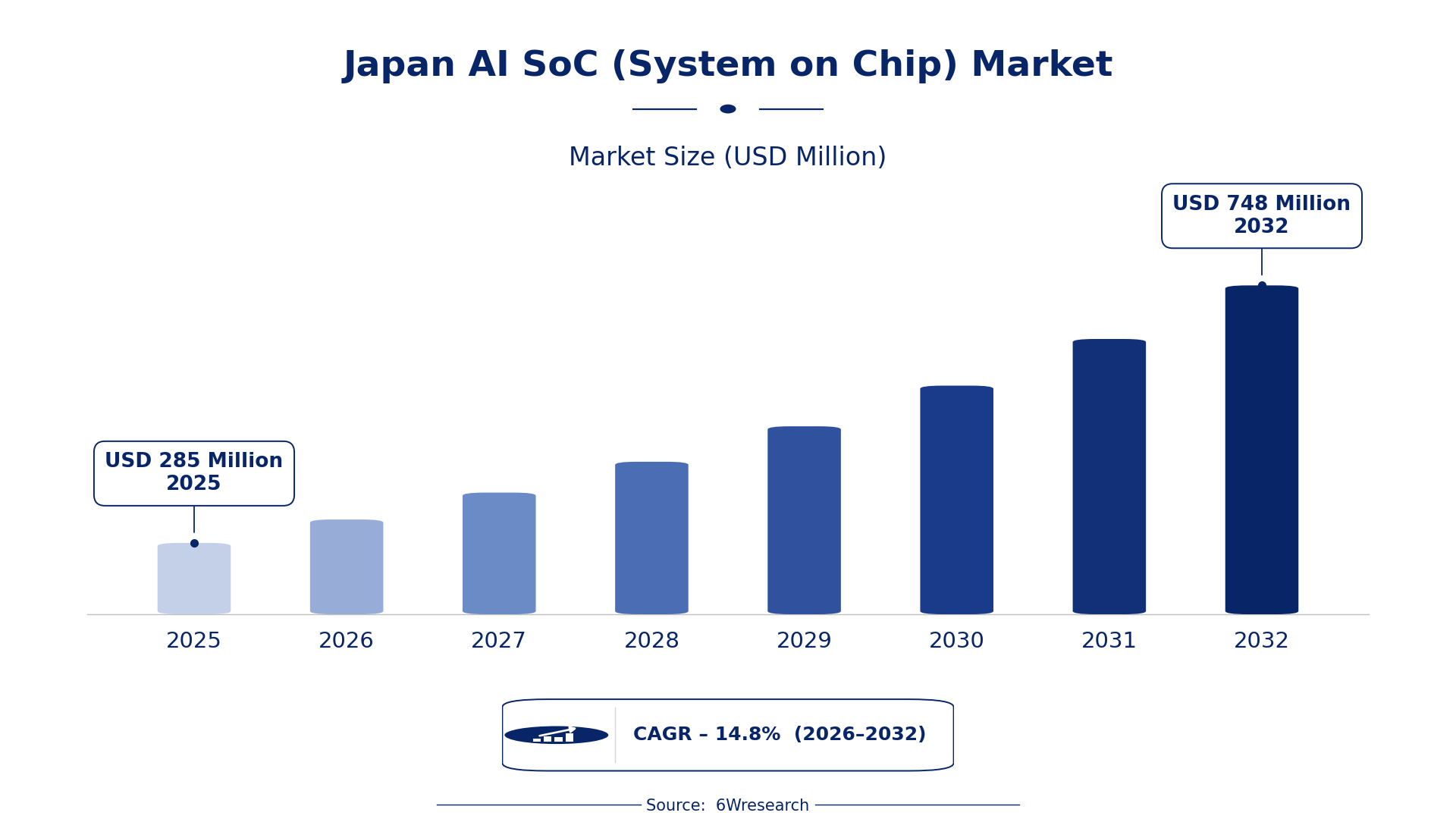
According to 6Wresearch internal database and industry insights, the Japan AI SoC (System on Chip) Market was valued at USD 285 Million in 2025 and is projected to reach USD 748 Million by 2032, growing at a CAGR of approximately 14.8% during 2026–2032.
Japan AI SoC (System on Chip) Market Highlights
| Report Metric | Details |
| Report Name | Japan AI SoC (System on Chip) Market (2026-2032) |
| Market Size 2025 | USD 285 Million |
| Market Size 2032 | USD 748 Million |
| Absolute Growth 2025–2032 | USD 463 Million |
| CAGR 2026–2032 | 14.8% |
| Peak Annual Growth | 21.2% in 2026 |
| Forecast Period | 2026–2032 |
| Historical Data | 2022–2025 |
| Base Year | 2025 |
| Leading SoC Type, 2025 | AI for Edge Devices (43% share) |
| Leading Target Application, 2025 | Smart Inference (35% share) |
| Leading Distribution Channel, 2025 | OEM Partnerships (52% share) |
| Leading End User, 2025 | IoT Device Manufacturers (46% share) |
| Fastest-Growing SoC Type | Embedded AI SoCs (17.6% CAGR) |
| Fastest-Growing Target Application | Real-Time Processing (20.6% CAGR) |
| Fastest-Growing Distribution Channel | Chipset Suppliers (17.7% CAGR) |
| Fastest-Growing End User | Wearables Firms (19.2% CAGR) |
| Growing Sector | automotive sector |
| Key End Users | IoT device manufacturers, automotive manufacturers, consumer electronics producers, smart city developers |
Japan AI SoC (System on Chip) Market Year-wise Growth Rate and Key Drivers (2022–2032)
This graph illustrates the annual growth rates of the market from 2022 to 2032, highlighting a steady upward trajectory and projected market expansion over the forecast period.
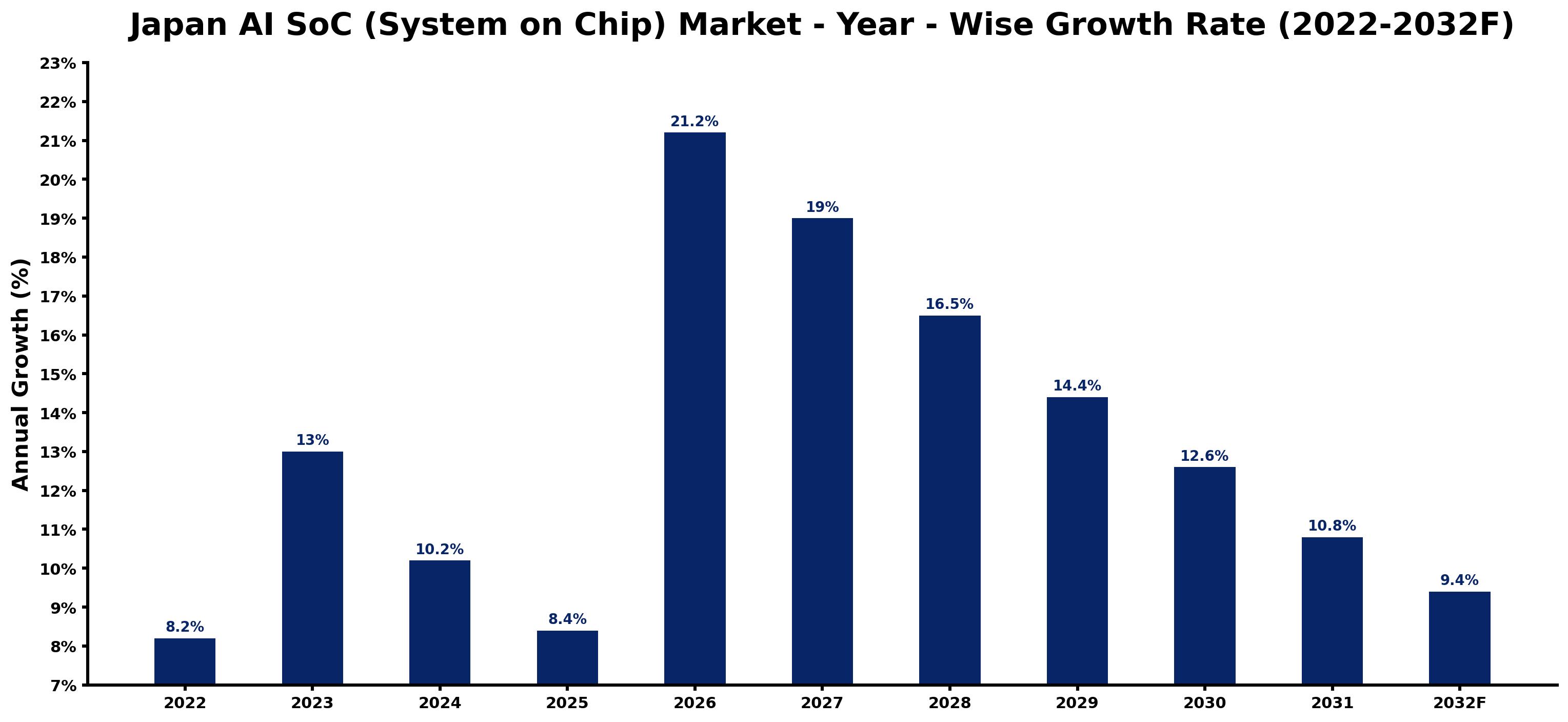
The following figures match every annual growth estimate with the main market development of that year, giving the reasoning behind each rise or slowdown.
| Year | Estimated Annual Growth (%) | Market Rationale |
| 2022 | 8.2 | The market experienced steady growth, driven by increasing adoption of AI technologies. |
| 2023 | 13.0 | Demand surged as automotive manufacturers accelerated AI SoC integration into new models. |
| 2024 | 10.2 | Growth slowed slightly as supply chain challenges impacted production rates. |
| 2025 | 8.4 | A further slowdown in growth occurred due to market saturation in certain segments. |
| 2026 | 21.2 | The market is expected to rebound sharply with a surge in demand for advanced AI applications. |
| 2027 | 19.0 | Growth will decelerate as the market begins to stabilise after the peak. |
| 2028 | 16.5 | A continued slowdown is projected as competition intensifies among manufacturers. |
| 2029 | 14.4 | The market will maintain a positive growth trend, driven by ongoing technological advancements. |
| 2030 | 12.6 | Growth will continue to slow as the market matures and demand stabilises. |
| 2031 | 10.8 | A further slowdown in growth rate is anticipated as the market reaches saturation. |
| 2032 | 9.4 | The market is expected to grow steadily as new applications for AI SoCs emerge. |
Note: Market size estimations and growth projections presented in this report are based on 6Wresearch's proprietary forecasting methodology, utilizing the latest available industry data, government publications, and primary research inputs.
Japan AI SoC (System on Chip) Market Synopsis
AI SoCs (System on Chip) are integrated circuits designed for artificial intelligence tasks, manufactured through advanced semiconductor processes. They enable smart devices, automotive functionalities, and data processing across various applications. The Japan AI SoC (System on Chip) Market is projected to reach 1.2 billion units by 2025, driven by the automotive sector's 30% annual adoption rate and the Tokyo region's semiconductor manufacturing hub. The integration of AI in smart cities and IoT devices further fuels demand, creating substantial opportunities for growth.
Market Dynamics Impact Analysis (2026–2032)
| Factor | Type | Impact | Primary Segment Affected |
| Increasing adoption of AI technologies in automotive applications | Driver | High | Automotive AI SoCs |
| Growing demand for smart devices and IoT applications | Driver | High | AI for Edge Devices |
| Expansion of smart city initiatives in Japan | Opportunity | High | Real-Time Processing |
| Rising investments in semiconductor manufacturing facilities | Opportunity | Medium | Embedded AI SoCs |
| Supply chain disruptions affecting component availability | Restraint | High | Mobile AI SoCs |
| Market saturation in consumer electronics limiting growth | Restraint | Medium | Embedded AI SoCs |
| High development costs for advanced AI SoCs | Challenge | High | Automotive AI SoCs |
| Regulatory compliance requirements for semiconductor manufacturing | Challenge | Medium | AI for Edge Devices |
Evaluation of Drivers in Japan AI SoC (System on Chip) Market (2026–2032)
The main growth drivers and the segments they affect most are set out below.
| Drivers | Primary Segment Affected | Why It Matters (Evidence) |
| Surge in automotive AI SoC adoption | Automotive AI SoCs | The automotive sector is integrating AI SoCs at a rate of 30% annually, driving demand for advanced safety features. |
| Growth in IoT device production | AI for Edge Devices | Japan's IoT device population reached 100 million units in 2023, increasing the need for intelligent processing capabilities. |
| Investment in smart city projects | Real-Time Processing | Investment in smart city projects is expected to reach USD 200 million by 2025, promoting real-time applications. |
| Rising consumer electronics sales | Embedded AI SoCs | Over 50% of new consumer electronics incorporate embedded AI SoCs, boosting demand for these integrated solutions. |
| Development of 5G technology | Mobile AI SoCs | AI for edge devices is critical for Japan's 5G rollout strategy, enabling faster data processing and connectivity. |
Orders keep climbing as the automotive sector integrates AI SoCs at a rate of 30% annually, leading to increased demand for advanced safety features. In 2023, Japan's IoT device population reached 100 million units, boosting the need for intelligent capabilities. Investment in smart city projects is expected to reach USD 200 million by 2025, promoting real-time applications. Over 50% of new consumer electronics incorporate embedded AI SoCs, reflecting rising sales. The rollout of 5G technology is critical for edge devices, enabling faster data processing and connectivity.
Evaluation of Restraints in Japan AI SoC (System on Chip) Market
Several factors work against faster growth; the main ones are summarised below.
| Market Restraint | Primary Segment Affected | Why It Matters (Evidence) |
| Supply chain disruptions affecting component availability | Mobile AI SoCs | Supply chain challenges have delayed the delivery of essential components, impacting production timelines. |
| Market saturation in consumer electronics limiting growth | Embedded AI SoCs | The saturation of consumer electronics markets has led to reduced demand for new AI SoC integrations. |
| High development costs for advanced AI SoCs | Automotive AI SoCs | Development costs can reach up to 20% of project budgets, deterring new entrants. |
| Regulatory compliance requirements for semiconductor manufacturing | AI for Edge Devices | Compliance with regulations can increase operational costs by 15%, affecting pricing strategies. |
| Intense competition among manufacturers | Embedded AI SoCs | The growing number of players has led to price wars, impacting profit margins. |
Japan AI SoC (System on Chip) Market Challenges
Producers face high compliance costs from stringent semiconductor regulations, increasing production expenses by 15% for local manufacturers. The expensive nature of advanced fabrication processes delays product launches by an average of six months for buyers, impacting their time-to-market. Supply chain disruptions arise from reliance on specific raw materials, leading to delivery delays of up to 20% for suppliers. Buyers encounter rising costs due to market volatility, with prices increasing by 10% in recent quarters, complicating their budgeting and planning efforts.
Trends in the Japan AI SoC (System on Chip) Market
The trends below show where the Japan AI SoC (System on Chip) Market is heading.
- Shift Towards Real-Time Processing: In 2023, smart city projects in Japan accelerated the demand for real-time processing applications, with investments in urban infrastructure expected to reach USD 200 million by 2025. This trend is set to improve service delivery and operational efficiency.
- Transition from Traditional to Embedded AI SoCs: The Tokyo region is experiencing a transition from traditional chips to embedded AI SoCs in consumer electronics, with over 50% of new products featuring these technologies, reflecting a growing market focus on intelligent devices.
- Emergence of AI for Edge Devices: The AI for edge devices segment is gaining traction, critical for Japan's 5G rollout strategy. By 2025, 70% of new electric vehicles are projected to integrate AI SoCs, improving connectivity and processing capabilities.
- Prioritisation of Automotive AI SoCs: Automotive AI SoCs are becoming a priority as the sector adopts AI technologies at a rate of 30% annually. This shift is vital for improving vehicle safety and autonomous driving capabilities.
Investment Opportunities in the Japan AI SoC (System on Chip) Market
Below are the investment opportunities with the strongest case in the Japan AI SoC (System on Chip) Market.
- Tokyo as a Semiconductor Manufacturing Hub: Tokyo's semiconductor manufacturing facilities are expanding, with investments projected to reach USD 100 million by 2025. This presents opportunities for partnerships with local manufacturers to improve production capabilities.
- Entry into Smart City Projects: With the Smart City Initiative promoting AI integration, there is a gap for suppliers of real-time processing solutions. Collaborating with local governments can facilitate entry into this growing market.
- Investment in IoT Device Development: The rising population of IoT devices, reaching 100 million units in 2023, creates opportunities for AI SoC suppliers. Targeting IoT device manufacturers can drive significant sales growth.
- Supply of Embedded AI SoCs: The demand for embedded AI SoCs in consumer electronics is growing, with over 50% adoption in new products. Focusing on this segment can yield profitable returns for manufacturers.
Government Initiatives in the Japan AI SoC (System on Chip) Market
The Industrial Standardization Act (1949; amended and renamed the Act on Japanese Industrial Standards in 2019) governs JIS product and test standards, ensuring compliance for manufacturers. The Semiconductor and Digital Industry Strategy, launched by the Ministry of Economy, Trade and Industry in June 2021, aims to secure domestic semiconductor manufacturing. This strategy includes measures to improve production capabilities and support research and development in AI technologies, ensuring a competitive edge for local manufacturers. The Economic Security Promotion Act of 2022 further supports supply-chain resilience for critical products and materials, benefiting AI SoC producers.
The Japan Ministry of Internal Affairs and Communications funds AI research initiatives and approves projects that improve semiconductor manufacturing capabilities. The Japan Electronics and Information Technology Industries Association actively supports AI SoC development through various programs, ensuring that manufacturers meet industry standards and consumer demands.
Future Insight of the Japan AI SoC (System on Chip) Market
The investment pipeline for AI technology will expand, driving demand for 1.2 billion AI SoCs by 2025. By 2032, the integration of AI in smart city initiatives will enhance urban planning and public services. Advancements in standards like ISO/IEC 30170:2018 will streamline development processes. The automotive sector will evolve, with 70% of new electric vehicles incorporating AI SoCs, reflecting a significant shift towards smarter transportation solutions.
Market Segmentation Analysis
Japan AI SoC (System on Chip) Market report covers a detailed analysis of the following market segments:
By SoC Type – AI for Edge Devices Lead, Embedded AI SoCs Expected to Grow Fastest
According to Saurav Kr Singh, Senior Research Analyst at 6Wresearch, AI for Edge Devices accounted for 43% of the market by soc type in 2025. AI for Edge Devices holds the largest share as it is crucial for IoT applications that require real-time data processing. The integration of these devices supports Japan's extensive installed base of 100 million IoT devices, ensuring consistent demand. Embedded AI SoCs are set to record the highest CAGR in this split, 17.6% over 2026–2032. Embedded AI SoCs are growing rapidly due to their integration into over 50% of new consumer electronics, enhancing functionality and user experience. This trend will likely continue as consumer electronics evolve to incorporate more advanced features. Suppliers should focus on developing advanced embedded solutions to meet the increasing demand in consumer electronics.
By Target Application – Smart Inference Leads, Real-Time Processing Expected to Grow Fastest
The largest target application category in 2025 was Smart Inference, at 35% of revenue. Smart Inference leads the market because it is essential for making real-time decisions in smart devices, which are increasingly prevalent across various sectors. The integration of such capabilities is becoming standard, driving demand for this application. The quickest growth will come from Real-Time Processing, forecast to expand at a CAGR of 20.6% between 2026 and 2032. Real-Time Processing is the fastest-growing application, propelled by the rising need for immediate data analysis in smart cities and other environments. This growth is supported by initiatives like the Smart City Initiative, which promotes the integration of advanced technologies. Buyers should prioritise solutions that enhance real-time processing capabilities to maintain competitiveness in the market.
By Distribution Channel – OEM Partnerships Lead, Chipset Suppliers Expected to Grow Fastest
OEM Partnerships held 52% of the Japan AI SoC (System on Chip) Market by distribution channel in 2025. OEM Partnerships dominate the distribution landscape as they facilitate collaborations with manufacturers for integrated solutions, ensuring widespread adoption of AI SoCs. This channel allows for tailored solutions that meet specific manufacturer requirements, enhancing market penetration. Over 2026–2032, Chipset Suppliers are expected to post the fastest growth, at a CAGR of 17.7%. Chipset Suppliers are experiencing rapid growth as they provide essential components that support the increasing demand for AI SoCs across various applications. Their role is becoming increasingly critical as the market expands and diversifies. Suppliers must strengthen relationships with chipset suppliers to ensure a steady supply of components for their offerings.
By End User – IoT Device Manufacturers Lead, Wearables Firms Expected to Grow Fastest
With 46% of end user revenue in 2025, IoT Device Manufacturers was the largest category. IoT Device Manufacturers represent the largest user group for AI SoCs, leveraging these chips to enhance device intelligence and functionality. Their focus on smart devices aligns with the growing trend of connectivity and automation across various sectors. Wearables Firms are projected to grow fastest, at a CAGR of 19.2% during 2026–2032. Wearables Firms are the fastest-growing user group, utilising AI SoCs for health monitoring devices that are gaining popularity among consumers. The increasing emphasis on health and fitness technology is driving this rapid growth. Suppliers should tailor their products to meet the specific needs of wearables firms to capitalise on this fast-growing segment.
Key Attractiveness of the Report
- 10 Years of Market Numbers
- Historical Data Starting from 2022 to 2025
- Base Year 2025
- Forecast Data until 2032
- Key Performance Indicators Impacting the Market
- Major Upcoming Developments and Projects
Key Highlights of the Report:
- Japan AI SoC (System on Chip) Market Outlook
- Market Size of Japan AI SoC (System on Chip) Market, 2025
- Forecast of Japan AI SoC (System on Chip) Market, 2032
- Historical Data and Forecast of Japan AI SoC (System on Chip) Revenues & Volume for the Period 2022-2032F
- Japan AI SoC (System on Chip) Market Trend Evolution
- Japan AI SoC (System on Chip) Market Drivers and Challenges
- Japan AI SoC (System on Chip) Price Trends
- Japan AI SoC (System on Chip) Porter's Five Forces
- Japan AI SoC (System on Chip) Industry Life Cycle
- Historical Data and Forecast of Japan AI SoC (System on Chip) Market Revenues & Volume By SoC Type for the Period 2022-2032F
- Historical Data and Forecast of Japan AI SoC (System on Chip) Market Revenues & Volume By AI for Edge Devices for the Period 2022-2032F
- Historical Data and Forecast of Japan AI SoC (System on Chip) Market Revenues & Volume By Embedded AI SoCs for the Period 2022-2032F
- Historical Data and Forecast of Japan AI SoC (System on Chip) Market Revenues & Volume By Automotive AI SoCs for the Period 2022-2032F
- Historical Data and Forecast of Japan AI SoC (System on Chip) Market Revenues & Volume By Mobile AI SoCs for the Period 2022-2032F
- Historical Data and Forecast of Japan AI SoC (System on Chip) Market Revenues & Volume By Target Application for the Period 2022-2032F
- Historical Data and Forecast of Japan AI SoC (System on Chip) Market Revenues & Volume By Smart Inference for the Period 2022-2032F
- Historical Data and Forecast of Japan AI SoC (System on Chip) Market Revenues & Volume By Real-Time Processing for the Period 2022-2032F
- Historical Data and Forecast of Japan AI SoC (System on Chip) Market Revenues & Volume By Sensor Fusion & Driving for the Period 2022-2032F
- Historical Data and Forecast of Japan AI SoC (System on Chip) Market Revenues & Volume By NLP, Vision AI for the Period 2022-2032F
- Historical Data and Forecast of Japan AI SoC (System on Chip) Market Revenues & Volume By Distribution Channel for the Period 2022-2032F
- Historical Data and Forecast of Japan AI SoC (System on Chip) Market Revenues & Volume By OEM Partnerships for the Period 2022-2032F
- Historical Data and Forecast of Japan AI SoC (System on Chip) Market Revenues & Volume By Chipset Suppliers for the Period 2022-2032F
- Historical Data and Forecast of Japan AI SoC (System on Chip) Market Revenues & Volume By Vehicle OEMs for the Period 2022-2032F
- Historical Data and Forecast of Japan AI SoC (System on Chip) Market Revenues & Volume By Consumer Electronics Stores for the Period 2022-2032F
- Historical Data and Forecast of Japan AI SoC (System on Chip) Market Revenues & Volume By End User for the Period 2022-2032F
- Historical Data and Forecast of Japan AI SoC (System on Chip) Market Revenues & Volume By IoT Device Manufacturers for the Period 2022-2032F
- Historical Data and Forecast of Japan AI SoC (System on Chip) Market Revenues & Volume By Wearables Firms for the Period 2022-2032F
- Historical Data and Forecast of Japan AI SoC (System on Chip) Market Revenues & Volume By EV Companies for the Period 2022-2032F
- Historical Data and Forecast of Japan AI SoC (System on Chip) Market Revenues & Volume By Smartphone Companies for the Period 2022-2032F
- Japan AI SoC (System on Chip) Import Export Trade Statistics
- Market Opportunity Assessment By SoC Type
- Market Opportunity Assessment By Target Application
- Market Opportunity Assessment By Distribution Channel
- Market Opportunity Assessment By End User
- Japan AI SoC (System on Chip) Top Companies Market Share
- Japan AI SoC (System on Chip) Competitive Benchmarking By Technical and Operational Parameters
- Japan AI SoC (System on Chip) Company Profiles
- Japan AI SoC (System on Chip) Key Strategic Recommendations
Market Covered
The report covers the following segments.
By SoC Type
- AI for Edge Devices
- Embedded AI SoCs
- Automotive AI SoCs
- Mobile AI SoCs
By Target Application
- Smart Inference
- Real-Time Processing
- Sensor Fusion & Driving
- NLP
- Vision AI
By Distribution Channel
- OEM Partnerships
- Chipset Suppliers
- Vehicle OEMs
- Consumer Electronics Stores
By End User
- IoT Device Manufacturers
- Wearables Firms
- EV Companies
- Smartphone Companies































